instrument panel FIAT 500 ABARTH 2014 2.G Owners Manual
[x] Cancel search | Manufacturer: FIAT, Model Year: 2014, Model line: 500 ABARTH, Model: FIAT 500 ABARTH 2014 2.GPages: 392, PDF Size: 8.74 MB
Page 241 of 392
facing uphill is in forward gear; vehicle backing uphill
is in REVERSE gear).
WARNING!
There may be situations on minor hills with a loaded
vehicle, or while pulling a trailer, when the system
will not activate and slight rolling may occur. This
could cause a collision with another vehicle or object.
Always remember the driver is responsible for brak-
ing the vehicle.
Disabling/Enabling HSA
If you wish to turn the HSA system on or off, it can be
done using the Customer Programmable Features in the
Electronic Vehicle Information Center (EVIC). Refer to
“Electronic Vehicle Information Center (EVIC)” in “Un-
derstanding Your Instrument Panel” for further informa-
tion.
Electronic Stability Control (ESC)
This system enhances directional control and stability of
the vehicle under various driving conditions. ESC cor-
rects for oversteering or understeering of the vehicle by
applying the brake of the appropriate wheel to assist in
counteracting the oversteering or understeering condi-
tion. Engine power may also be reduced to help the
vehicle maintain the desired path. ESC uses sensors in
the vehicle to determine the vehicle path intended by the
driver and compares it to the actual path of the vehicle.
When the actual path does not match the intended path,
ESC applies the brake of the appropriate wheel to assist
in counteracting the oversteer or understeer condition.
•Oversteer - when the vehicle is turning more than
appropriate for the steering wheel position.
•Understeer - when the vehicle is turning less than
appropriate for the steering wheel position.
5
STARTING AND OPERATING 239
Page 271 of 392
Monitoring Telltale Light will flash on and off for 75
seconds and then remain on solid and the#Ti re
Pressure Monitoring Unavailable#message will be
displayed.
4. For each subsequent ignition key cycle, a chime will
sound and the Tire Pressure Monitoring Telltale Light
will flash on and off for 75 seconds and then remain on
solid and the “Tire Pressure Monitoring Unavailable”
message will be displayed.
5. Once you repair or replace the original road tire and
reinstall it on the vehicle in place of the compact spare
tire, the TPMS will update automatically and the Tire
Pressure Monitoring Telltale Light will turn OFF, as
long as no tire pressure is below the low-pressure
warning limit in any of the four active road tires. The
vehicle may need to be driven for up to 20 minutes
above 15 mph (24 km/h) in order for the TPMS to
receive this information.
Enhanced TPM System
When the vehicle is equipped with an enhanced TPM
system, the driver can view text messages showing the
actual tire pressure value by position by selecting the tire
pressure menu command in the instrument cluster. Refer
to ”Instrument Panel Features” in “Understanding Your
Instrument Panel” for further information.
General Information
This device complies with Part 15 of the FCC rules and
RSS 210 of Industry Canada. Operation is subject to the
following conditions:
•This device may not cause harmful interference.
•This device must accept any interference received,
including interference that may cause undesired op-
eration.
5
STARTING AND OPERATING 269
Page 282 of 392
HAZARD WARNING FLASHERS
The Hazard Warning flasher switch is located on the
instrument panel below the radio.
Press the switch to turn on the Hazard Warning
flashers. When the switch is activated, all direc-
tional turn signals will flash on and off to warn oncoming
traffic of an emergency. Press the switch a second time to
turn off the Hazard Warning flashers.
Do not use this emergency warning system when the
vehicle is in motion. Use it when your vehicle is disabled
and it is creating a safety hazard for other motorists.
If it is necessary to leave the vehicle to go for service, the
Hazard Warning flashers will continue to operate with
the ignition key removed and the vehicle locked.
NOTE:With extended use, the Hazard Warning flashers
may wear down your battery.
IF YOUR ENGINE OVERHEATS
In any of the following situations, you can reduce the
potential for overheating by taking the appropriate ac-
tion.
•On the highways — slow down.
•In city traffic — while stopped, place the transmission
in NEUTRAL, but do not increase engine idle speed.
NOTE:There are steps that you can take to slow down
an impending overheat condition:
•If your air conditioner (A/C) is on, turn it off. The A/C
system adds heat to the engine cooling system and
turning the A/C off can help remove this heat.
•You can also turn the temperature control to maximum
heat, the mode control to floor and the blower control
to high. This allows the heater core to act as a
supplement to the radiator and aids in removing heat
from the engine cooling system.
280 WHAT TO DO IN EMERGENCIES
Page 345 of 392
CAUTION!
Do not use Alcohol and Alcohol-based and/or Keton
based cleaning products to clean leather seats, as
damage to the seat may result.
Cleaning Headlights
Your vehicle has plastic headlights that are lighter and
less susceptible to stone breakage than glass headlights.
Plastic is not as scratch resistant as glass and therefore
different lens cleaning procedures must be followed.
To minimize the possibility of scratching the lenses and
reducing light output, avoid wiping with a dry cloth. To
remove road dirt, wash with a mild soap solution fol-
lowed by rinsing.
Do not use abrasive cleaning components, solvents, steel
wool or other aggressive material to clean the lenses.
Glass Surfaces
All glass surfaces should be cleaned on a regular basis
with MOPAR® Glass Cleaner, or any commercial
household-type glass cleaner. Never use an abrasive type
cleaner. Use caution when cleaning the inside rear win-
dow equipped with electric defrosters or the right rear
quarter window equipped with the radio antenna. Do
not use scrapers or other sharp instrument that may
scratch the elements.
When cleaning the rear view mirror, spray cleaner on the
towel or rag that you are using. Do not spray cleaner
directly on the mirror.
Instrument Panel Cover
The instrument panel cover has a low glare surface which
minimizes reflections on the windshield. Do not use
protectants or other products which may cause undesir-
able reflections. Use soap and warm water to restore the
low glare surface.
7
MAINTAINING YOUR VEHICLE 343
Page 346 of 392
Instrument Panel Bezels
CAUTION!
When installing hanging air fresheners in your ve-
hicle, read the installation instructions carefully.
Some air fresheners will damage the finish of
painted or decorated parts if allowed to directly
contact any surface.
Cleaning Plastic Instrument Cluster Lenses
The lenses in front of the instruments in this vehicle are
molded in clear plastic. When cleaning the lenses, care
must be taken to avoid scratching the plastic.
1. Clean with a wet soft rag. A mild soap solution may be
used, but do not use high alcohol content or abrasive
cleaners. If soap is used, wipe clean with a clean damp
rag.
2. Dry with a soft cloth.
Seat Belt Maintenance
Do not bleach, dye or clean the belts with chemical
solvents or abrasive cleaners. This will weaken the fabric.
Sun damage can also weaken the fabric.
If the belts need cleaning, use a mild soap solution or
lukewarm water. Do not remove the belts from the car to
wash them. Dry with a soft cloth.
Replace the belts if they appear frayed or worn or if the
buckles do not work properly.
344 MAINTAINING YOUR VEHICLE
Page 347 of 392
FUSES
WARNING!
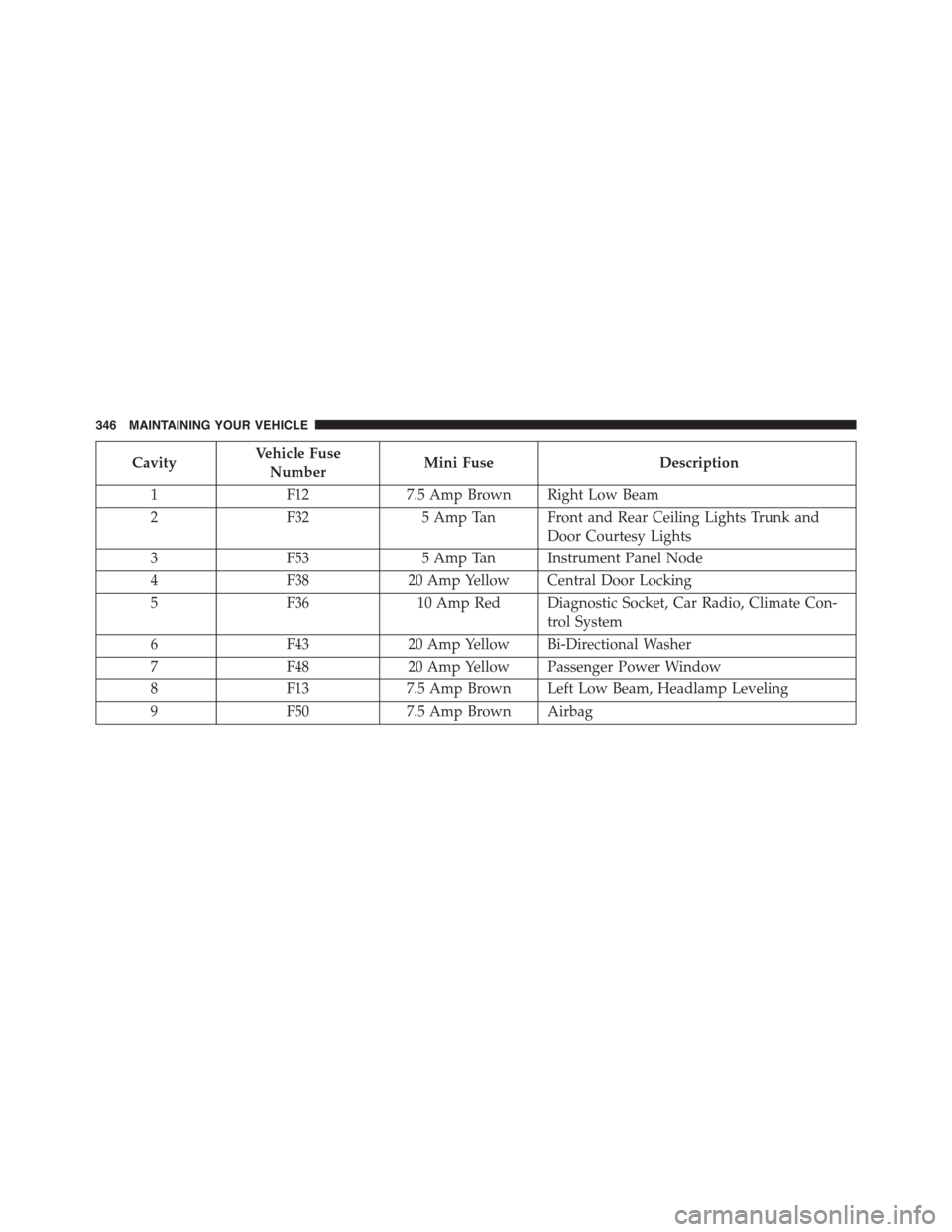
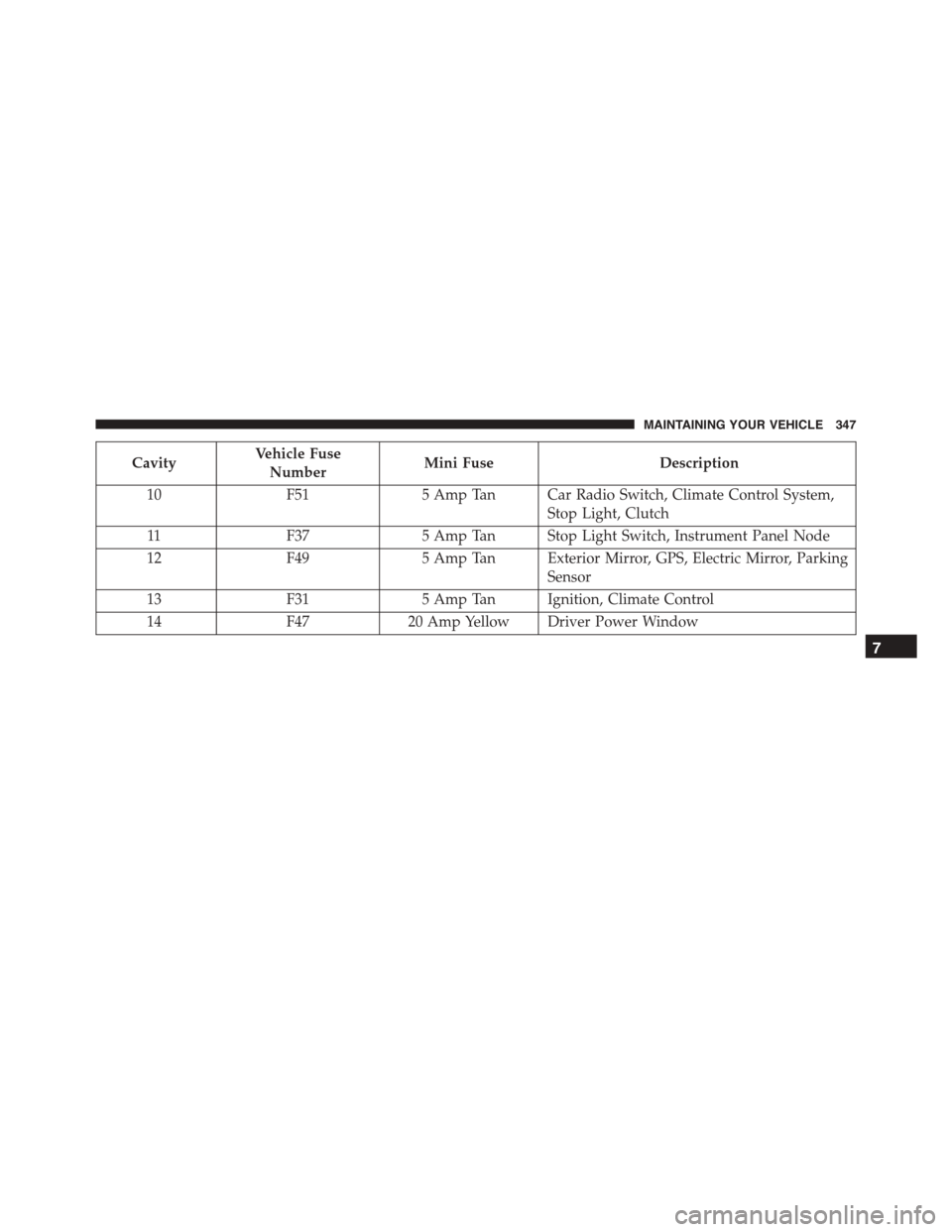
•When replacing a blown fuse, always use an appro-
priate replacement fuse with the same amp rating as
the original fuse. Never replace a fuse with another
fuse of higher amp rating. Never replace a blown
fuse with metal wires or any other material. Failure
to use proper fuses may result in serious personal
injury, fire and/or property damage.
•Before replacing a fuse, make sure that the ignition
is off and that all the other services are switched off
and/or disengaged.
•If the replaced fuse blows again, contact an autho-
rized dealer.
•If a general protection fuse for safety systems (air
bag system, braking system), power unit systems
(engine system, gearbox system) or steering system
blows, contact an authorized dealer.
Interior Fuses
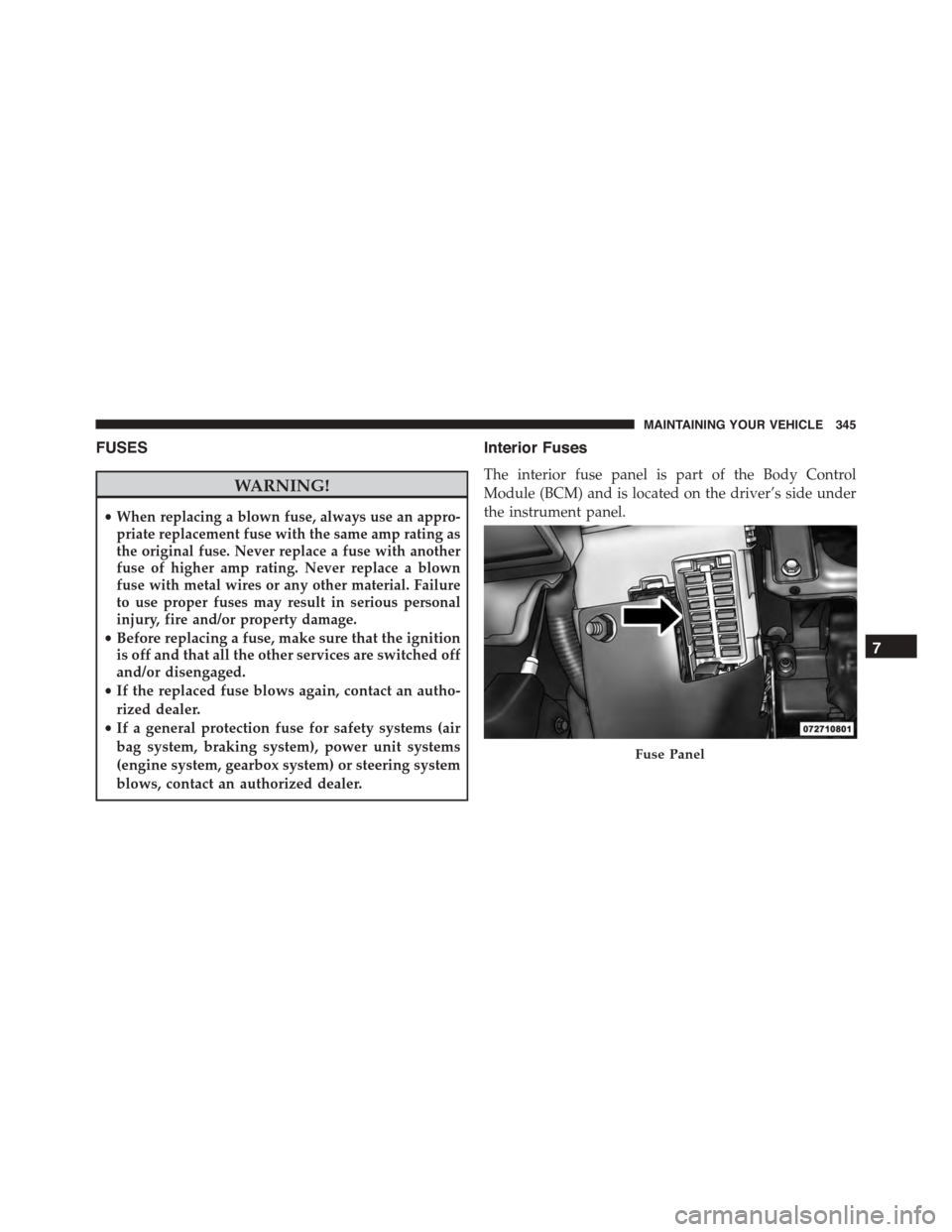
The interior fuse panel is part of the Body Control
Module (BCM) and is located on the driver’s side under
the instrument panel.
Fuse Panel
7
MAINTAINING YOUR VEHICLE 345
Page 348 of 392
CavityVehicle Fuse
NumberMini FuseDescription
1F127.5 Amp Brown Right Low Beam
2F325 Amp Tan Front and Rear Ceiling Lights Trunk and
Door Courtesy Lights
3F535 Amp Tan Instrument Panel Node
4F3820 Amp Yellow Central Door Locking
5F3610 Amp Red Diagnostic Socket, Car Radio, Climate Con-
trol System
6F4320 Amp Yellow Bi-Directional Washer
7F4820 Amp Yellow Passenger Power Window
8F137.5 Amp Brown Left Low Beam, Headlamp Leveling
9F507.5 Amp Brown Airbag
346 MAINTAINING YOUR VEHICLE
Page 349 of 392
CavityVehicle Fuse
NumberMini FuseDescription
10F515 Amp Tan Car Radio Switch, Climate Control System,
Stop Light, Clutch
11F375 Amp Tan Stop Light Switch, Instrument Panel Node
12F495 Amp Tan Exterior Mirror, GPS, Electric Mirror, Parking
Sensor
13F315 Amp Tan Ignition, Climate Control
14F4720 Amp Yellow Driver Power Window
7
MAINTAINING YOUR VEHICLE 347
Page 383 of 392
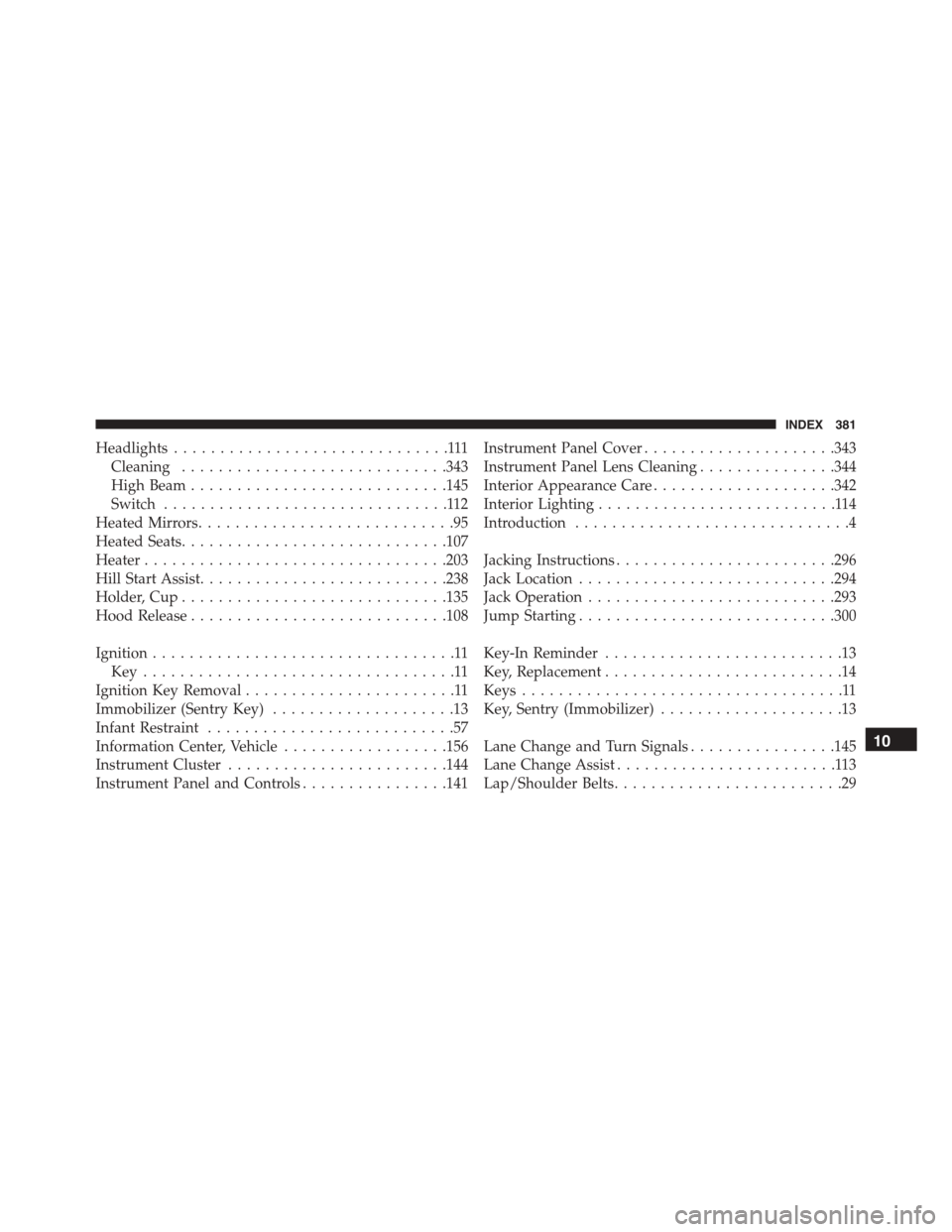
Headlights..............................111
Cleaning.............................343
High Beam............................145
Switch...............................112
Heated Mirrors............................95
Heated Seats.............................107
Heater.................................203
Hill Start Assist...........................238
Holder, Cup.............................135
Hood Release............................108
Ignition.................................11
Key . . . . . . . . . . . . . . . . . . . . . . . . . . . . . . . . . .11
Ignition Key Removal.......................11
Immobilizer (Sentry Key)....................13
Infant Restraint...........................57
Information Center, Vehicle..................156
Instrument Cluster........................144
Instrument Panel and Controls................141
Instrument Panel Cover.....................343
Instrument Panel Lens Cleaning...............344
Interior Appearance Care....................342
Interior Lighting..........................114
Introduction..............................4
Jacking Instructions........................296
Jack Location............................294
Jack Operation...........................293
Jump Starting............................300
Key-In Reminder..........................13
Key, Replacement..........................14
Keys...................................11
Key, Sentry (Immobilizer)....................13
Lane Change and Turn Signals................145
Lane Change Assist........................113
Lap/Shoulder Belts.........................29
10
INDEX 381