ECU FIAT 500C 2013 2.G Owner's Manual
[x] Cancel search | Manufacturer: FIAT, Model Year: 2013, Model line: 500C, Model: FIAT 500C 2013 2.GPages: 423, PDF Size: 9.86 MB
Page 239 of 423
In the event of a momentary problem, the transmission
can be reset to regain all forward gears by performing the
following steps:
1. Stop the vehicle.
2. Shift the transmission into PARK.
3. Turn the ignition switch to the LOCK/OFF position.
4. Wait approximately 10 seconds.
5. Restart the engine.
6. Shift into the desired gear range. If the problem is no
longer detected, the transmission will return to normal
operation.
NOTE:Even if the transmission can be reset, we recom-
mend that you visit your authorized studio at your
earliest possible convenience. Your authorized studio has
diagnostic equipment to determine if the problem could
recur.
If the transmission cannot be reset, authorized studio
service is required.
AUTOSTICK® — IF EQUIPPED
AutoStick® is a driver-interactive transmission feature
providing manual shift control, giving you more control
of the vehicle. AutoStick® allows you to maximize en-
gine braking, eliminate undesirable upshifts and down-
shifts, and improve overall vehicle performance. This
system can also provide you with more control during
passing, city driving, cold slippery conditions, mountain
driving, and many other situations.
Operation
When the shift lever is in the AutoStick® position (beside the
Drive position), it can be moved forward and rearward. This
allows the driver to manually select the transmission gear
being used. Moving the shift lever forward (-) triggers a
downshift, and rearward (+) an upshift. The current gear
will be displayed in the instrument cluster.
5
STARTING AND OPERATING 237
Page 280 of 423
NOTE:Do not use tire chains on a compact spare tire.
CAUTION!
To avoid damage to your vehicle or tires, observe the
following precautions:
•Use Security Chain Company (SCC) SCC Z6 low
profile or equivalent chains on 185/55R15 tires only.
•Because of restricted chain clearance between tires
and other suspension components, it is important
that only chains in good condition are used. Broken
chains can cause serious damage. Stop the vehicle
immediately if noise occurs that could indicate
chain breakage. Remove the damaged parts of the
chain before further use.
•Do not exceed 45 mph (70 km/h).
•Drive cautiously and avoid severe turns and large
bumps, especially with a loaded vehicle.
(Continued)
CAUTION!(Continued)
•Install chains on the front wheels as tightly as
possible and then retighten after driving about
0.5 mile (0.8 km).
•Do not drive for prolonged periods of time on dry
pavement.
•Observe the tire chain manufacturer’s instructions
on the method of installation, operating speed, and
conditions for use. Always use the lower suggested
operating speed of the chain manufacturer, if dif-
ferent from the speed recommended by the vehicle
manufacturer.
Always use the lower suggested operating speed if the
chain manufacturer and vehicle manufacturer suggest
different maximum speeds. This notice applies to all
chain traction devices, including link and cable (radial)
chains.
278 STARTING AND OPERATING
Page 316 of 423
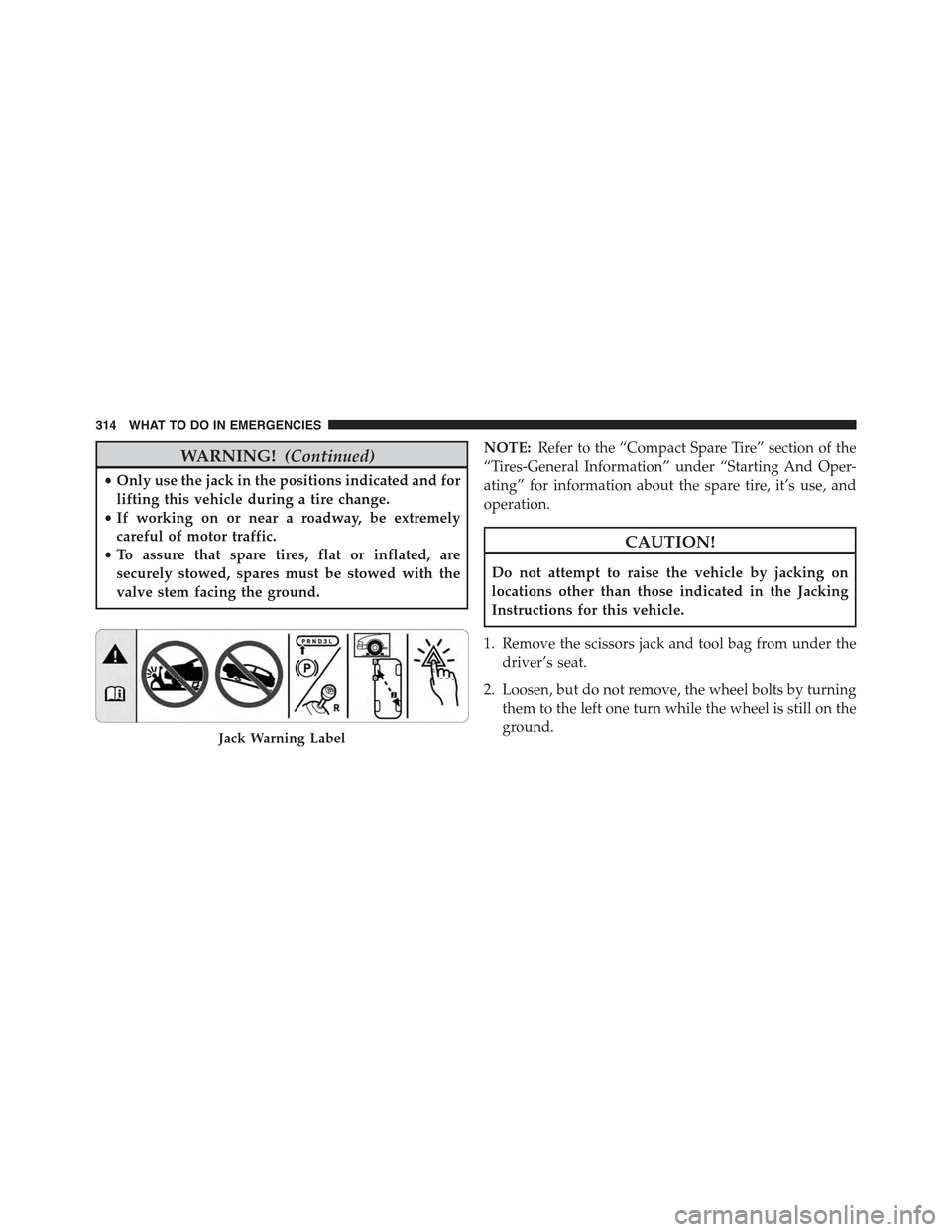
WARNING!(Continued)
•Only use the jack in the positions indicated and for
lifting this vehicle during a tire change.
•If working on or near a roadway, be extremely
careful of motor traffic.
•To assure that spare tires, flat or inflated, are
securely stowed, spares must be stowed with the
valve stem facing the ground.
NOTE:Refer to the “Compact Spare Tire” section of the
“Tires-General Information” under “Starting And Oper-
ating” for information about the spare tire, it’s use, and
operation.
CAUTION!
Do not attempt to raise the vehicle by jacking on
locations other than those indicated in the Jacking
Instructions for this vehicle.
1. Remove the scissors jack and tool bag from under the
driver’s seat.
2. Loosen, but do not remove, the wheel bolts by turning
them to the left one turn while the wheel is still on the
ground.Jack Warning Label
314 WHAT TO DO IN EMERGENCIES
Page 317 of 423
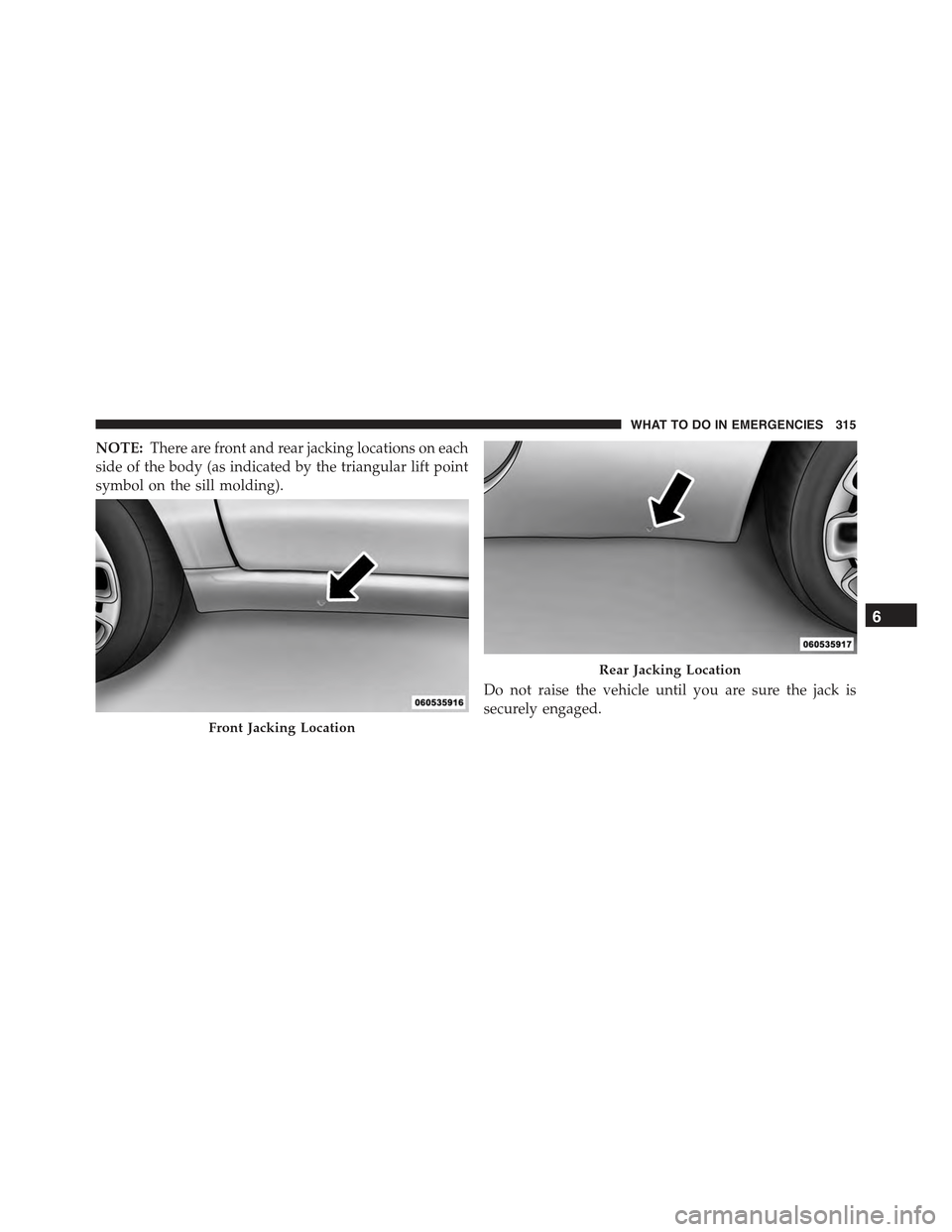
NOTE:There are front and rear jacking locations on each
side of the body (as indicated by the triangular lift point
symbol on the sill molding).
Do not raise the vehicle until you are sure the jack is
securely engaged.
Front Jacking Location
Rear Jacking Location
6
WHAT TO DO IN EMERGENCIES 315
Page 320 of 423
WARNING!
To avoid possible personal injury, handle the wheel
covers with care to avoid contact with any sharp
edges.
NOTE:The wheel cover is held on the wheel by the
wheel bolts. When reinstalling the original wheel, prop-
erly align the wheel cover to the valve stem, place the
wheel cover onto the wheel, then install the wheel bolts.
6. Install the spare wheel and wheel bolts with the cone
shaped end of the bolts toward the wheel. Lightly
tighten the bolts. To avoid the risk of forcing the
vehicle off the jack, do not tighten the bolts fully until
the vehicle has been lowered.
7. Lower the vehicle by turning the jack screw to the left.
8. Finish tightening the bolts. Push down on the wrench
while tightening the wheel bolts. Alternate bolts until
each bolt has been tightened twice. The correct wheel
bolt torque is 63 ft lbs (85 N·m) for steel wheels and
75 ft lbs (100 N·m) for aluminum wheels. If you doubt
that you have tightened the bolts correctly, have them
checked with a torque wrench by your authorized
studio or service station.
9. Disassemble the jack and tools and place them in the
bag. Stow it under the driver’s seat and secure the bag
to the floor with the straps attached to the floor of the
vehicle.
318 WHAT TO DO IN EMERGENCIES
Page 330 of 423
Proper towing or lifting equipment is required to prevent
damage to your vehicle. Use only tow bars and other
equipment designed for this purpose, following equip-
ment manufacturer ’s instructions. Use of safety chains is
mandatory. Attach a tow bar or other towing device to
main structural members of the vehicle, not to bumpers
or associated brackets. State and local laws regarding
vehicles under tow must be observed.
If you must use the accessories (wipers, defrosters, etc.)
while being towed, the ignition must be in the ON/RUN
position.
If the ignition key is unavailable, or the battery is
discharged, see “Shift Lever Override” in “What To Do In
Emergencies” for instructions on shifting the automatic
transmission out of PARK for towing.
CAUTION!
DO NOT use sling-type equipment when towing.
When securing the vehicle to a flatbed truck, do not
attach to front or rear suspension components. Dam-
age to your vehicle may result from improper towing.
Automatic Transmission
•Vehicle can be towed with the front wheels elevated.
•Vehicle can be towed on a flatbed truck (all wheels off
the ground).
CAUTION!
•DO NOT flat tow any vehicle equipped with an
automatic transmission. Damage to the drivetrain
will result.
(Continued)
328 WHAT TO DO IN EMERGENCIES
Page 350 of 423
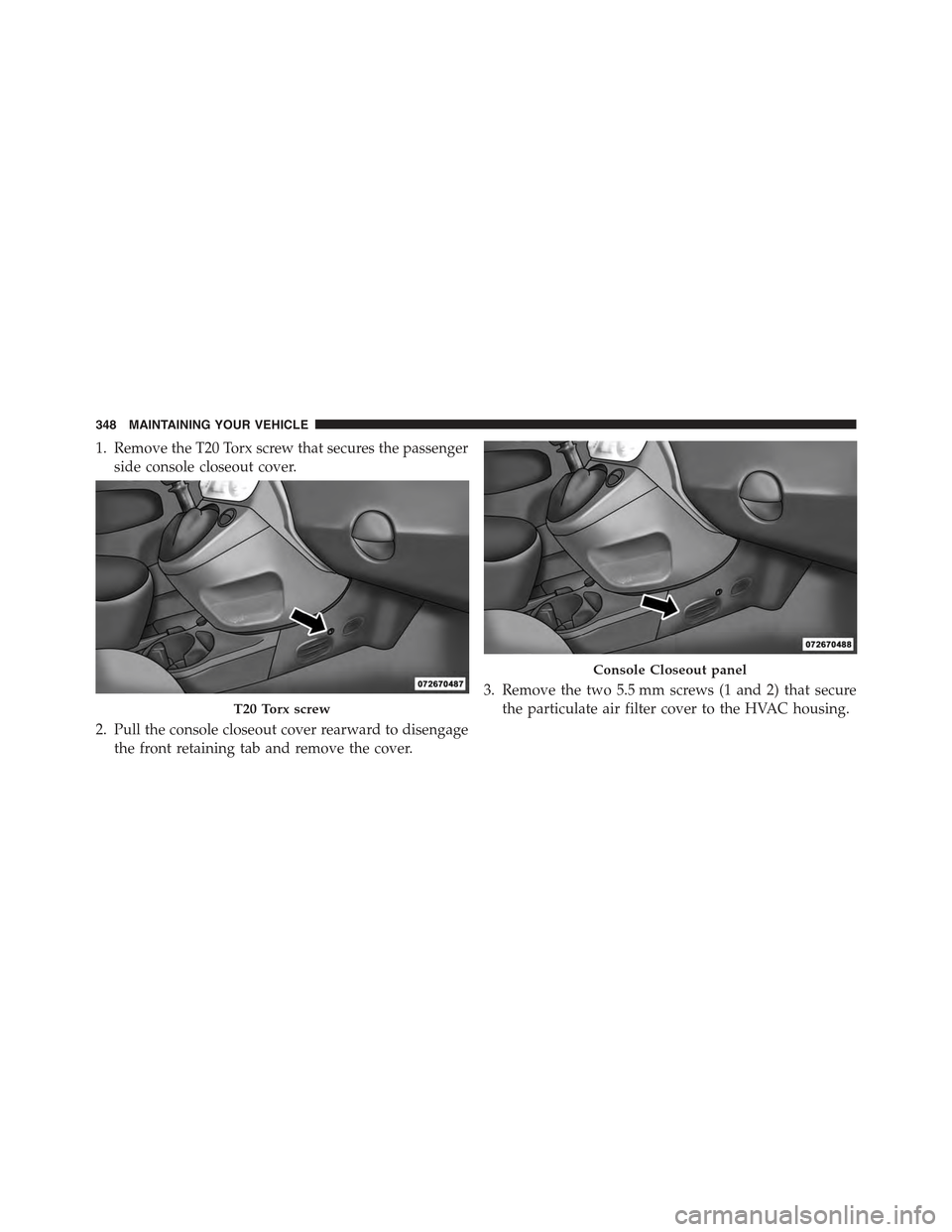
1. Remove the T20 Torx screw that secures the passenger
side console closeout cover.
2. Pull the console closeout cover rearward to disengage
the front retaining tab and remove the cover.
3. Remove the two 5.5 mm screws (1 and 2) that secure
the particulate air filter cover to the HVAC housing.T20 Torx screw
Console Closeout panel
348 MAINTAINING YOUR VEHICLE
Page 366 of 423
WARNING!(Continued)
•To avoid contamination from foreign matter or
moisture, use only new brake fluid or fluid that has
been in a tightly closed container. Keep the master
cylinder reservoir cap secured at all times. Brake
fluid in a open container absorbs moisture from the
air resulting in a lower boiling point. This may
cause it to boil unexpectedly during hard or pro-
longed braking, resulting in sudden brake failure.
This could result in a collision.
•Overfilling the brake fluid reservoir can result in
spilling brake fluid on hot engine parts, causing
the brake fluid to catch fire. Brake fluid can also
damage painted and vinyl surfaces, care should be
taken to avoid its contact with these surfaces.
(Continued)
WARNING!(Continued)
•Do not allow petroleum-based fluid to contaminate
the brake fluid. Brake seal components could be
damaged, causing partial or complete brake failure.
This could result in a collision.
CAUTION!
Use of improper brake fluids will affect overall
clutch system performance. Improper brake fluids
may damage the clutch system resulting in loss of
clutch function and the ability to shift the transmis-
sion.
364 MAINTAINING YOUR VEHICLE