check engine FIAT 500C 2018 Owner's Manual
[x] Cancel search | Manufacturer: FIAT, Model Year: 2018, Model line: 500C, Model: FIAT 500C 2018Pages: 338, PDF Size: 4 MB
Page 253 of 338
Cooling System Pressure Cap
The cap must be fully tightened to prevent loss of engine
coolant (antifreeze), and to ensure that engine coolant
(antifreeze) will return to the radiator from the coolant
expansion bottle/recovery tank if so equipped.
The cap should be inspected and cleaned if there is any
accumulation of foreign material on the sealing surfaces.
WARNING!• Do not open hot engine cooling system. Never add
engine coolant (antifreeze) when the engine is over-
heated. Do not loosen or remove the cap to cool an
overheated engine. Heat causes pressure to build up
in the cooling system. To prevent scalding or injury,
do not remove the pressure cap while the system is
hot or under pressure.
• Do not use a pressure cap other than the one speci-
fied for your vehicle. Personal injury or engine
damage may result. Disposal Of Used Coolant
Used ethylene glycol-based coolant (antifreeze) is a regu-
lated substance requiring proper disposal. Check with your
local authorities to determine the disposal rules for your
community. To prevent ingestion by animals or children,
do not store ethylene glycol-based coolant in open contain-
ers or allow it to remain in puddles on the ground. If
ingested by a child or pet, seek emergency assistance
immediately. Clean up any ground spills immediately.
Coolant Level
The coolant expansion bottle provides a quick visual
method for determining that the coolant level is adequate.
With the engine off and cold, the level of the coolant
(antifreeze) in the bottle should be between the “MAX” and
“MIN” lines marked on the bottle.
As long as the engine operating temperature is satisfactory,
the coolant bottle need only be checked once a month.
When additional coolant (antifreeze) is needed to maintain
the proper level, it should be added to the coolant bottle.
Do not overfill.
See an authorized dealer for service. 8SERVICING AND MAINTENANCE 251
Page 254 of 338
Points To Remember
NOTE: When the vehicle is stopped after a few miles/
kilometers of operation, you may observe vapor coming
from the front of the engine compartment. This is normally
a result of moisture from rain, snow, or high humidity
accumulating on the radiator and being vaporized when
the thermostat opens, allowing hot engine coolant (anti-
freeze) to enter the radiator.
If an examination of your engine compartment shows no
evidence of radiator or hose leaks, the vehicle may be
safely driven. The vapor will soon dissipate.
• Do not overfill the coolant expansion bottle.
• Check the coolant freeze point in the radiator and in the
coolant expansion bottle. If engine coolant (antifreeze)
needs to be added, the contents of the coolant expansion
bottle must also be protected against freezing.
• If frequent engine coolant (antifreeze) additions are
required, the cooling system should be pressure tested
for leaks.
• Maintain engine coolant (antifreeze) concentration at a
minimum of 50% OAT coolant (conforming to MS.90032)
and distilled water for proper corrosion protection of your
engine which contains aluminum components. • Keep the front of the radiator clean. If your vehicle is
equipped with air conditioning, keep the front of the
condenser clean.
• Do not change the thermostat for Summer or Winter
operation. If replacement is ever necessary, install ONLY
the correct type thermostat. Other designs may result in
unsatisfactory engine coolant (antifreeze) performance,
poor gas mileage, and increased emissions.
Brake System
In order to assure brake system performance, all brake
system components should be inspected periodically. Refer
to the “Maintenance Plan” in this section for the proper
maintenance intervals.
WARNING!Riding the brakes can lead to brake failure and possi-
bly a collision. Driving with your foot resting or riding
on the brake pedal can result in abnormally high brake
temperatures, excessive lining wear, and possible
brake damage. You would not have your full braking
capacity in an emergency.252 SERVICING AND MAINTENANCE
Page 255 of 338
Brake Master Cylinder
The fluid in the master cylinder should be checked when
performing under hood services or immediately if the
“Brake Warning Light” is illuminated.
Be sure to clean the top of the master cylinder area before
removing the cap. If necessary, add fluid to bring the fluid
level up to the requirements described on the brake fluid
reservoir. With disc brakes, fluid level can be expected to
fall as the brake pads wear. Brake fluid level should be
checked when pads are replaced. However, low fluid level
may be caused by a leak and a checkup may be needed.
Use only manufacturer’s recommended brake fluid. Refer
to “Fluids And Lubricants” in “Technical Specifications”
for further information.
WARNING!• Use only manufacturer’s recommended brake fluid.
Refer to “Fluids And Lubricants” in “Technical
Specifications” for further information. Using the
wrong type of brake fluid can severely damage your
brake system and/or impair its performance. The (Continued) WARNING! (Continued)proper type of brake fluid for your vehicle is also
identified on the original factory installed hydraulic
master cylinder reservoir.
• To avoid contamination from foreign matter or mois-
ture, use only new brake fluid or fluid that has been
in a tightly closed container. Keep the master cylin-
der reservoir cap secured at all times. Brake fluid in
a open container absorbs moisture from the air
resulting in a lower boiling point. This may cause it
to boil unexpectedly during hard or prolonged brak-
ing, resulting in sudden brake failure. This could
result in a collision.
• Overfilling the brake fluid reservoir can result in
spilling brake fluid on hot engine parts, causing the
brake fluid to catch fire. Brake fluid can also damage
painted and vinyl surfaces, care should be taken to
avoid its contact with these surfaces.
• Do not allow petroleum based fluid to contaminate
the brake fluid. Brake seal components could be
damaged, causing partial or complete brake failure.
This could result in a collision. 8SERVICING AND MAINTENANCE 253
Page 257 of 338
Automatic Transmission Fluid (ATF) is an engineered
product and its performance may be impaired by supple-
mental additives. Therefore, do not add any fluid additives
to the transmission. The only exception to this policy is the
use of special dyes for diagnosing fluid leaks. Avoid using
transmission sealers as they may adversely affect seals.
CAUTION!Do not use chemical flushes in your transmission as
the chemicals can damage your transmission compo-
nents. Such damage is not covered by the New Vehicle
Limited Warranty.
Fluid Level Check
The fluid level is preset at the factory and does not require
adjustment under normal operating conditions. Routine
fluid level checks are not required; therefore the transmis-
sion has no dipstick. An authorized dealer can check your
transmission fluid level using special service tools. If you
notice fluid leakage or transmission malfunction, visit an
authorized dealer immediately to have the transmission
fluid level checked. Operating the vehicle with an im-
proper fluid level can cause severe transmission damage. CAUTION!If a transmission fluid leak occurs, visit an authorized
dealer immediately. Severe transmission damage may
occur. An authorized dealer has the proper tools to
adjust the fluid level accurately.
Fluid And Filter Changes
Under normal operating conditions, the fluid installed at
the factory will provide satisfactory lubrication for the life
of the vehicle.
Routine fluid and filter changes are not required. However,
change the fluid and filter if the fluid becomes contami-
nated (with water, etc.), or if the transmission is disas-
sembled for any reason.
RAISING THE VEHICLE
In the case where it is necessary to raise the vehicle, go to
an authorized dealer or service station. 8SERVICING AND MAINTENANCE 255
Page 324 of 338
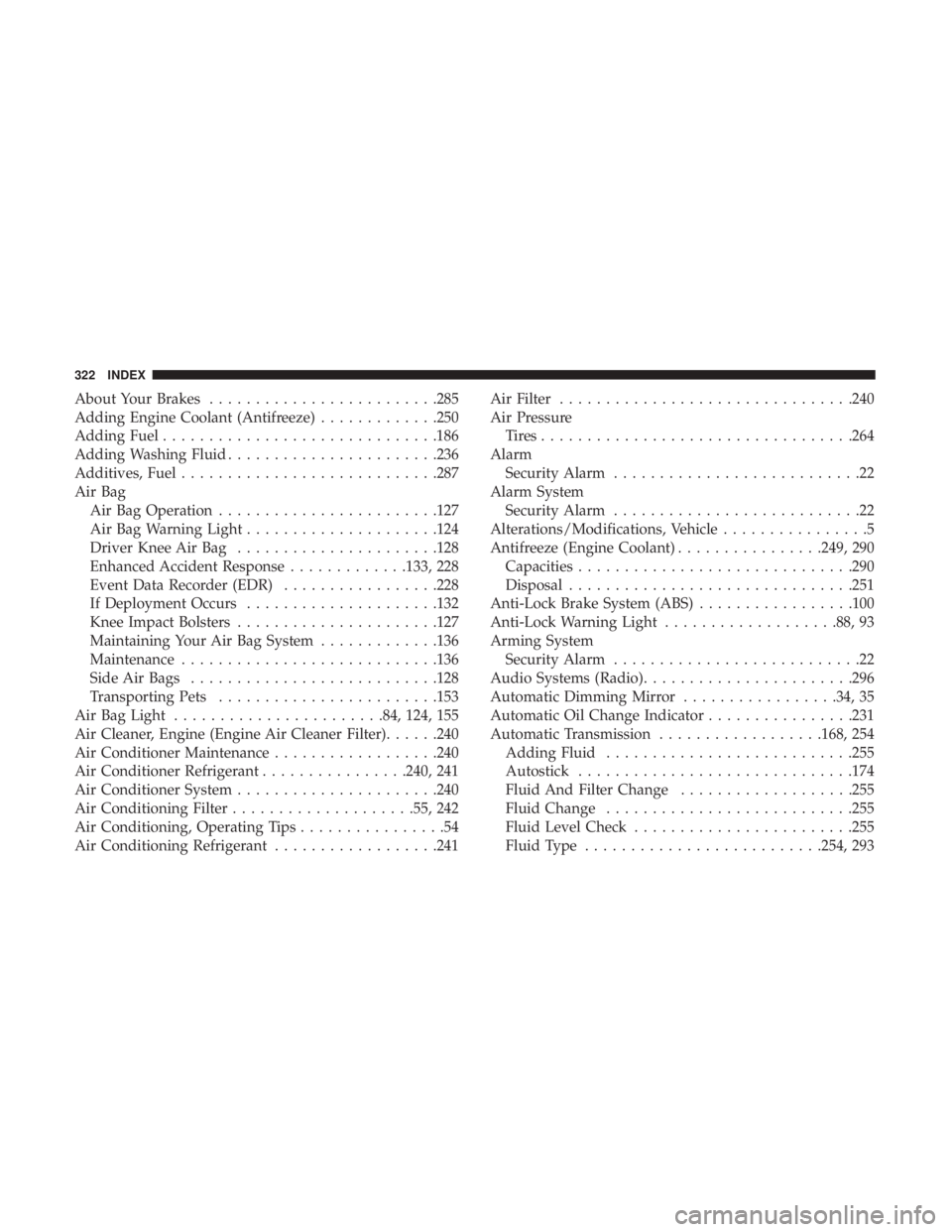
About Your Brakes ........................ .285
Adding Engine Coolant (Antifreeze) ............ .250
Adding Fuel ............................. .186
Adding Washing Fluid ...................... .236
Additives, Fuel ........................... .287
Air Bag
Air Bag Operation ....................... .127
Air Bag Warning Light .................... .124
Driver Knee Air Bag ..................... .128
Enhanced Accident Response ............ .133, 228
Event Data Recorder (EDR) ................ .228
If Deployment Occurs .................... .132
Knee Impact Bolsters ..................... .127
Maintaining Your Air Bag System ............ .136
Maintenance ........................... .136
Side Air Bags .......................... .128
Transporting Pets ....................... .153
Air Bag Light ...................... .84, 124, 155
Air Cleaner, Engine (Engine Air Cleaner Filter) ..... .240
Air Conditioner Maintenance ................. .240
Air Conditioner Refrigerant ............... .240, 241
Air Conditioner System ..................... .240
Air Conditioning Filter ................... .55, 242
Air Conditioning, Operating Tips ................54
Air Conditioning Refrigerant ................. .241 Air Filter ............................... .240
Air Pressure
Tires................................. .264
Alarm
Security Alarm ...........................22
Alarm System
Security Alarm ...........................22
Alterations/Modifications, Vehicle ................5
Antifreeze (Engine Coolant) ............... .249, 290
Capacities ............................. .290
Disposal .............................. .251
Anti-Lock Brake System (ABS) ................ .100
Anti-Lock Warning Light .................. .88, 93
Arming System
Security Alarm ........................... 2 2
Audio Systems (Radio) ...................... .296
Automatic Dimming Mirror ................ .34, 35
Automatic Oil Change Indicator ............... .231
Automatic Transmission ................. .168, 254
Adding Fluid .......................... .255
Autostick ............................. .174
Fluid And Filter Change .................. .255
Fluid Change .......................... .255
Fluid Level Check ....................... .255
Fluid Type ......................... .254, 293322 INDEX
Page 325 of 338
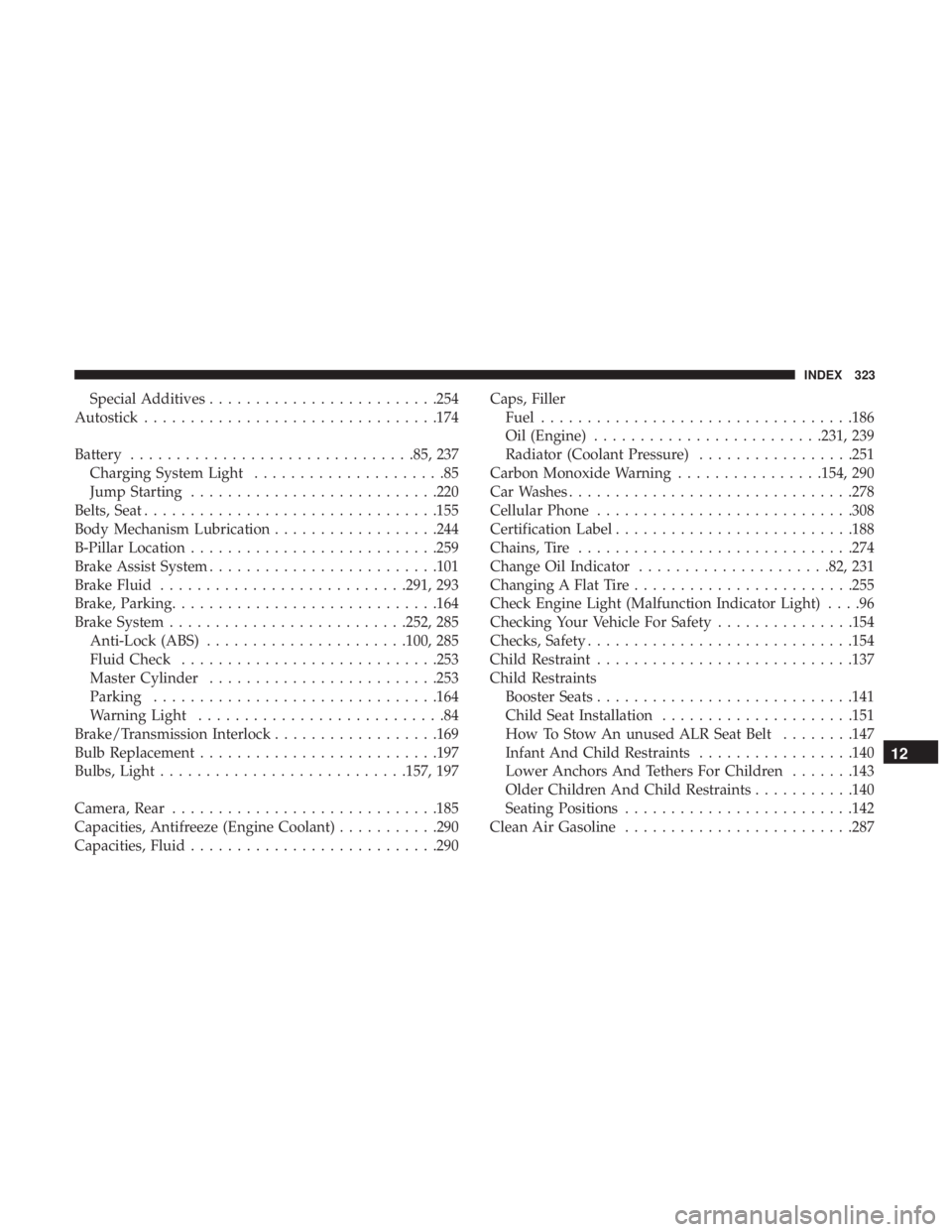
Special Additives ........................ .254
Autostick ............................... .174
Battery .............................. .85, 237
Charging System Light .....................85
Jump Starting .......................... .220
Belts, Seat ............................... .155
Body Mechanism Lubrication ................. .244
B-Pillar Location .......................... .259
Brake Assist System ........................ .101
Brake Fluid .......................... .291, 293
Brake, Parking ............................ .164
Brake System ......................... .252, 285
Anti-Lock (ABS) ..................... .100, 285
Fluid Check ........................... .253
Master Cylinder ........................ .253
Parking .............................. .164
Warning Light ...........................84
Brake/Transmission Interlock ................. .169
Bulb Replacement ......................... .197
Bulbs, Light .......................... .157, 197
Camera, Rear ............................ .185
Capacities, Antifreeze (Engine Coolant) .......... .290
Capacities, Fluid .......................... .290 Caps, Filler
Fuel ................................. .186
Oil (Engine) ........................ .231, 239
Radiator (Coolant Pressure) ................ .251
Carbon Monoxide Warning ............... .154, 290
Car Washes .............................. .278
Cellular Phone ........................... .308
Certification Label ......................... .188
Chains, Tire ............................. .274
Change Oil Indicator .................... .82, 231
Changing A Flat Tire ....................... .255
Check Engine Light (Malfunction Indicator Light) ....96
Checking Your Vehicle For Safety .............. .154
Checks, Safety ............................ .154
Child Restraint ........................... .137
Child Restraints
Booster Seats ........................... .141
Child Seat Installation .................... .151
How To Stow An unused ALR Seat Belt ....... .147
Infant And Child Restraints ................ .140
Lower Anchors And Tethers For Children ...... .143
Older Children And Child Restraints .......... .140
Seating Positions ........................ .142
Clean Air Gasoline ........................ .28712 INDEX 323
Page 327 of 338
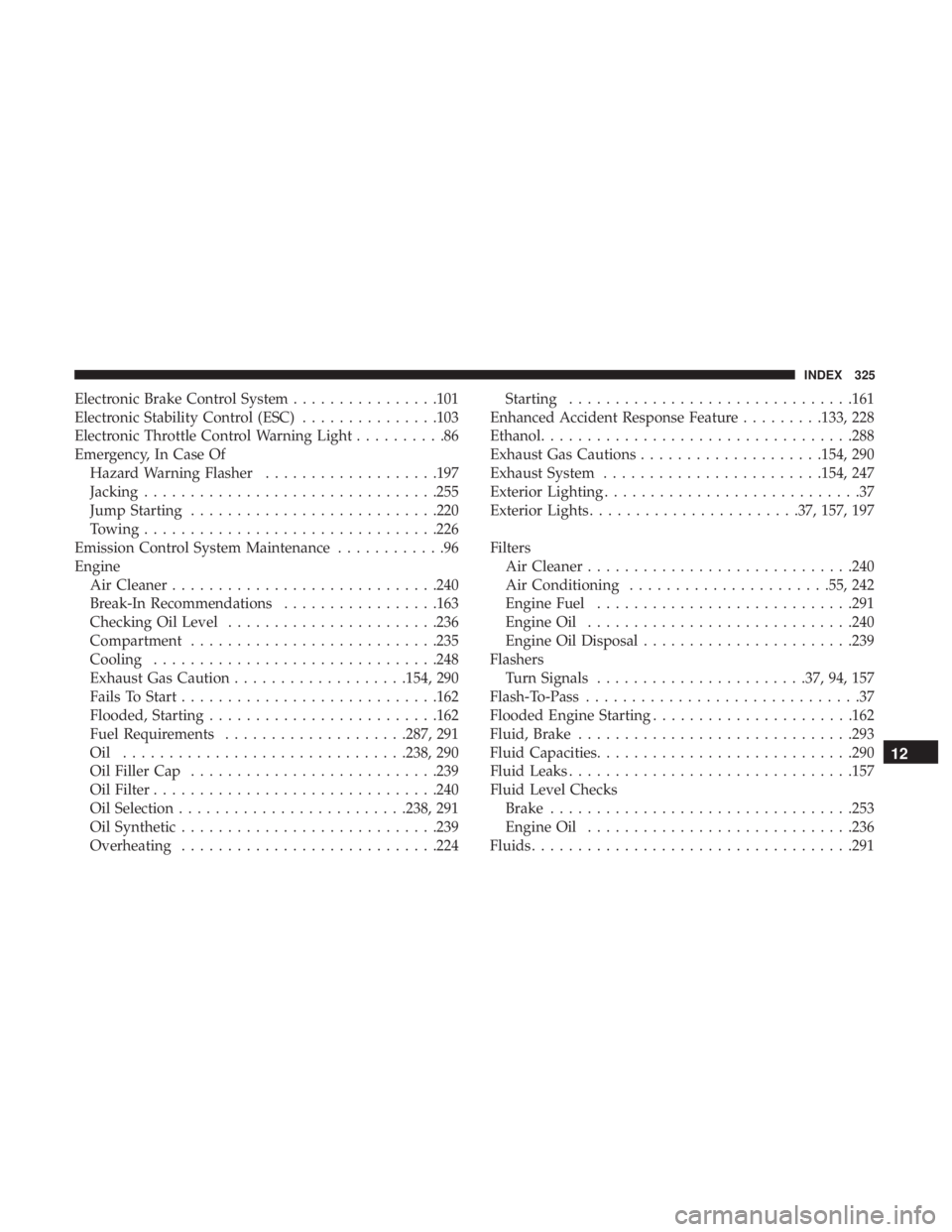
Electronic Brake Control System ............... .101
Electronic Stability Control (ESC) .............. .103
Electronic Throttle Control Warning Light ..........86
Emergency, In Case Of
Hazard Warning Flasher .................. .197
Jacking ............................... .255
Jump Starting .......................... .220
Towing ............................... .226
Emission Control System Maintenance ............96
Engine
Air Cleaner ............................ .240
Break-In Recommendations ................ .163
Checking Oil Level ...................... .236
Compartment .......................... .235
Cooling .............................. .248
Exhaust Gas Caution .................. .154, 290
Fails To Start ........................... .162
Flooded, Starting ........................ .162
Fuel Requirements ................... .287, 291
Oil .............................. .238, 290
Oil Filler Cap .......................... .239
Oil Filter .............................. .240
Oil Selection ........................ .238, 291
Oil Synthetic ........................... .239
Overheating ........................... .224 Starting .............................. .161
Enhanced Accident Response Feature ........ .133, 228
Ethanol ................................. .288
Exhaust Gas Cautions ................... .154, 290
Exhaust System ....................... .154, 247
Exterior Lighting ............................37
Exterior Lights ...................... .37, 157, 197
Filters
Air Cleaner ............................ .240
Air Conditioning ..................... .55, 242
Engine Fuel ........................... .291
Engine Oil ............................ .240
Engine Oil Disposal ...................... .239
Flashers
Turn Signals ...................... .37, 94, 157
Flash-To-Pass ..............................37
Flooded Engine Starting ..................... .162
Fluid, Brake ............................. .293
Fluid Capacities ........................... .290
Fluid Leaks .............................. .157
Fluid Level Checks
Brake ................................ .253
Engine Oil ............................ .236
Fluids .................................. .29112 INDEX 325
Page 330 of 338
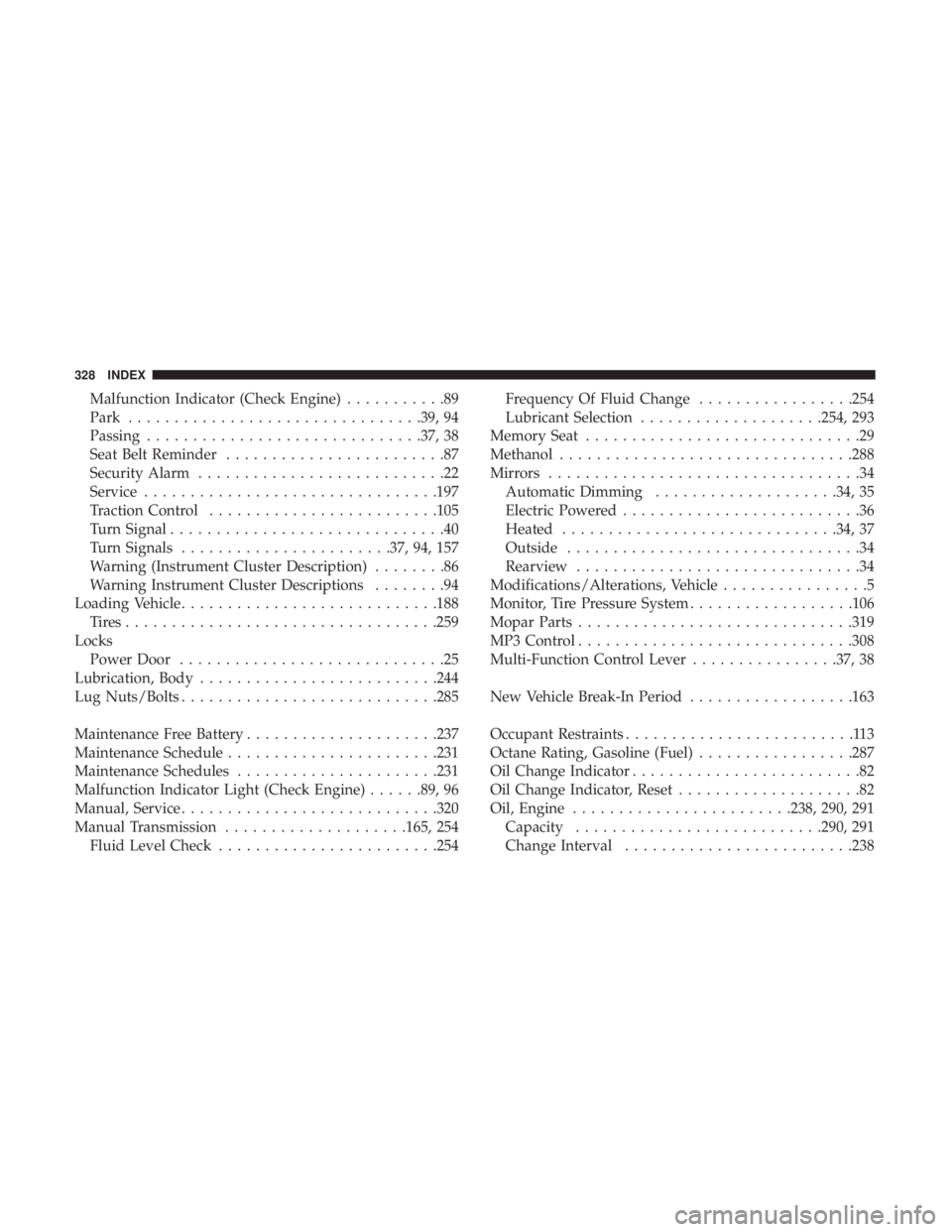
Malfunction Indicator (Check Engine) ...........89
Park ............................... .39, 94
Passing ............................. .37, 38
Seat Belt Reminder ........................87
Security Alarm ...........................22
Service ............................... .197
Traction Control ........................ .105
Turn Signal ..............................40
Turn Signals ...................... .37, 94, 157
Warning (Instrument Cluster Description) ........86
Warning Instrument Cluster Descriptions ........94
Loading Vehicle ........................... .188
Tires................................. .259
Locks
Power Door .............................25
Lubrication, Body ......................... .244
Lug Nuts/Bolts ........................... .285
Maintenance Free Battery .................... .237
Maintenance Schedule ...................... .231
Maintenance Schedules ..................... .231
Malfunction Indicator Light (Check Engine) ..... .89, 96
Manual, Service ........................... .320
Manual Transmission ................... .165, 254
Fluid Level Check ....................... .254 Frequency Of Fluid Change ................ .254
Lubricant Selection ................... .254, 293
Memory Seat ..............................29
Methanol ............................... .288
Mirrors ..................................34
Automatic Dimming ................... .34, 35
Electric Powered ..........................36
Heated ............................. .34, 37
Outside ................................34
Rearview ...............................34
Modifications/Alterations, Vehicle ................5
Monitor, Tire Pressure System ................. .106
Mopar Parts ............................. .319
MP3 Control ............................. .308
Multi-Function Control Lever ............... .37, 38
New Vehicle Break-In Period ................. .163
Occupant Restraints ......................... 1 13
Octane Rating, Gasoline (Fuel) ................ .287
Oil Change Indicator .........................82
Oil Change Indicator, Reset ....................82
Oil, Engine ....................... .238, 290, 291
Capacity .......................... .290, 291
Change Interval ........................ .238328 INDEX
Page 331 of 338
Checking ............................. .236
Dipstick .............................. .236
Disposal .............................. .239
Filter ................................ .240
Filter Disposal .......................... .239
Identification Logo ...................... .238
Materials Added To ...................... .239
Pressure Warning Light .....................87
Recommendation .................... .238, 290
Synthetic ............................. .239
Viscosity .............................. .239
Oil Filter, Change ......................... .240
Oil Filter, Selection ......................... .240
Oil Pressure Light ...........................87
Onboard Diagnostic System ....................95
Operating Precautions ........................95
Operator Manual (Owner’s Manual) ...............5
Outlet
Power .................................68
Outside Rearview Mirrors .....................34
Overheating, Engine ....................... .224
Owner’s Manual (Operator Manual) ...........5,320
Paint Care ............................... .277
Parking Brake ............................ .164 Passing Light ..............................38
Pets ................................... .153
Placard, Tire And Loading Information .......... .259
Power
Brakes ............................... .285
Door Locks ..............................25
Mirrors ................................36
Outlet (Auxiliary Electrical Outlet) .............68
Steering .............................. .177
Sunroof ................................57
Pregnant Women And Seat Belts ............... .120
Pretensioners
Seat Belts ............................. .121
Radial Ply Tires ........................... .265
Radiator Cap (Coolant Pressure Cap) ............ .251
Radio Frequency
General Information .................... .19, 22
Radio Operation .......................... .308
Rear Camera ............................. .185
Rear Liftgate (Sedan) .........................65
Recreational Towing ........................ .190
Reformulated Gasoline ...................... .287
Refrigerant .............................. .241
Release, Hood ..............................63 12 INDEX 329
Page 337 of 338
INSTALLATION OF RADIO TRANSMITTING
EQUIPMENT
Special design considerations are incorporated into this
vehicle’s electronic system to provide immunity to radio
frequency signals. Mobile two-way radios and telephone
equipment must be installed properly by trained person-
nel. The following must be observed during installation.
The positive power connection should be made directly
to the battery and fused as close to the battery as possible.
The negative power connection should be made to body
sheet metal adjacent to the negative battery connection.
This connection should not be fused.
Antennas for two-way radios should be mounted on the
roof or the rear area of the vehicle. Care should be used
in mounting antennas with magnet bases. Magnets may
affect the accuracy or operation of the compass on
vehicles so equipped.
The antenna cable should be as short as practical and
routed away from the vehicle wiring when possible. Use
only fully shielded coaxial cable.
Carefully match the antenna and cable to the radio to
ensure a low Standing Wave Ratio (SWR). Mobile radio equipment with output power greater than
normal may require special precautions.
All installations should be checked for possible interfer-
ence between the communications equipment and the
vehicle’s electronic systems.
WARNING:
Operating, servicing and maintaining a
passenger vehicle or off-road highway
motor vehicle can expose you to chemicals
including engine exhaust, carbon monoxide,
phthalates, and lead, which are known to
the State of California to cause cancer and
birth defects or other reproductive harm.
To minimize exposure, avoid breathing
exhaust, do not idle the engine except as
necessary, service your vehicle in a
well-ventilated area and wear gloves or
wash your hands frequently when servicing
your vehicle. For more information go to
www.P65Warnings.ca.gov/passenger-vehicle.