lock FIAT 500E 2015 2.G Workshop Manual
[x] Cancel search | Manufacturer: FIAT, Model Year: 2015, Model line: 500E, Model: FIAT 500E 2015 2.GPages: 367, PDF Size: 9.42 MB
Page 232 of 367
Brake Assist System (BAS)
The BAS is designed to optimize the vehicle’s braking
capability during emergency braking maneuvers. The
system detects an emergency braking situation by sens-
ing the rate and amount of brake application and then
applies optimum pressure to the brakes. This can help
reduce braking distances. The BAS complements the
Anti-Lock Brake System (ABS). Applying the brakes very
quickly results in the best BAS assistance. To receive the
benefit of the system, you must applycontinuousbrak-
ing pressure during the stopping sequence (do not
“pump” the brakes). Do not reduce brake pedal pressure
unless braking is no longer desired. Once the brake pedal
is released, the BAS is deactivated.
WARNING!
•The Brake Assist System (BAS) cannot prevent the
natural laws of physics from acting on the vehicle,
nor can it increase the traction afforded by prevail-
ing road conditions.
•The BAS cannot prevent collisions, including those
resulting from excessive speed in turns, driving on
very slippery surfaces, or hydroplaning.
•The capabilities of a BAS-equipped vehicle must
never be exploited in a reckless or dangerous
manner which could jeopardize the user ’s safety or
the safety of others.
230 STARTING AND OPERATING
Page 269 of 367
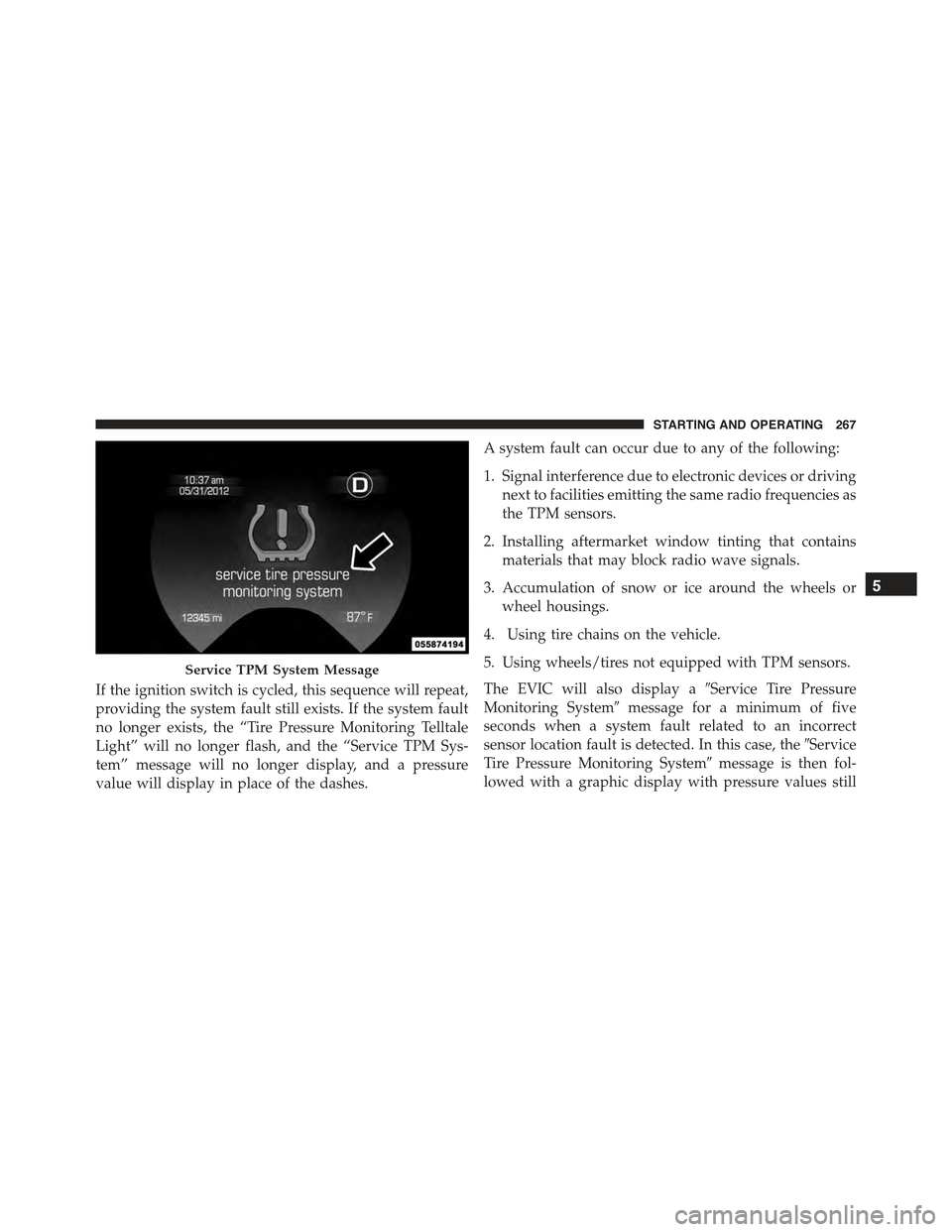
If the ignition switch is cycled, this sequence will repeat,
providing the system fault still exists. If the system fault
no longer exists, the “Tire Pressure Monitoring Telltale
Light” will no longer flash, and the “Service TPM Sys-
tem” message will no longer display, and a pressure
value will display in place of the dashes.
A system fault can occur due to any of the following:
1. Signal interference due to electronic devices or driving
next to facilities emitting the same radio frequencies as
the TPM sensors.
2. Installing aftermarket window tinting that contains
materials that may block radio wave signals.
3. Accumulation of snow or ice around the wheels or
wheel housings.
4. Using tire chains on the vehicle.
5. Using wheels/tires not equipped with TPM sensors.
The EVIC will also display a#Service Tire Pressure
Monitoring System#message for a minimum of five
seconds when a system fault related to an incorrect
sensor location fault is detected. In this case, the#Service
Tire Pressure Monitoring System#message is then fol-
lowed with a graphic display with pressure values still
Service TPM System Message
5
STARTING AND OPERATING 267
Page 276 of 367
HAZARD WARNING FLASHERS
The Hazard Warning flasher switch is located on the
instrument panel below the radio.
Push the switch to turn on the Hazard Warning
flashers. When the switch is activated, all direc-
tional turn signals will flash on and off to warn oncoming
traffic of an emergency. Push the switch a second time to
turn off the Hazard Warning flashers.
Do not use this emergency warning system when the
vehicle is in motion. Use it when your vehicle is disabled
and it is creating a safety hazard for other motorists.
If it is necessary to leave the vehicle to go for service, the
Hazard Warning flashers will continue to operate with
the ignition key removed and the vehicle locked.
NOTE:With extended use, the Hazard Warning flashers
may wear down your battery.
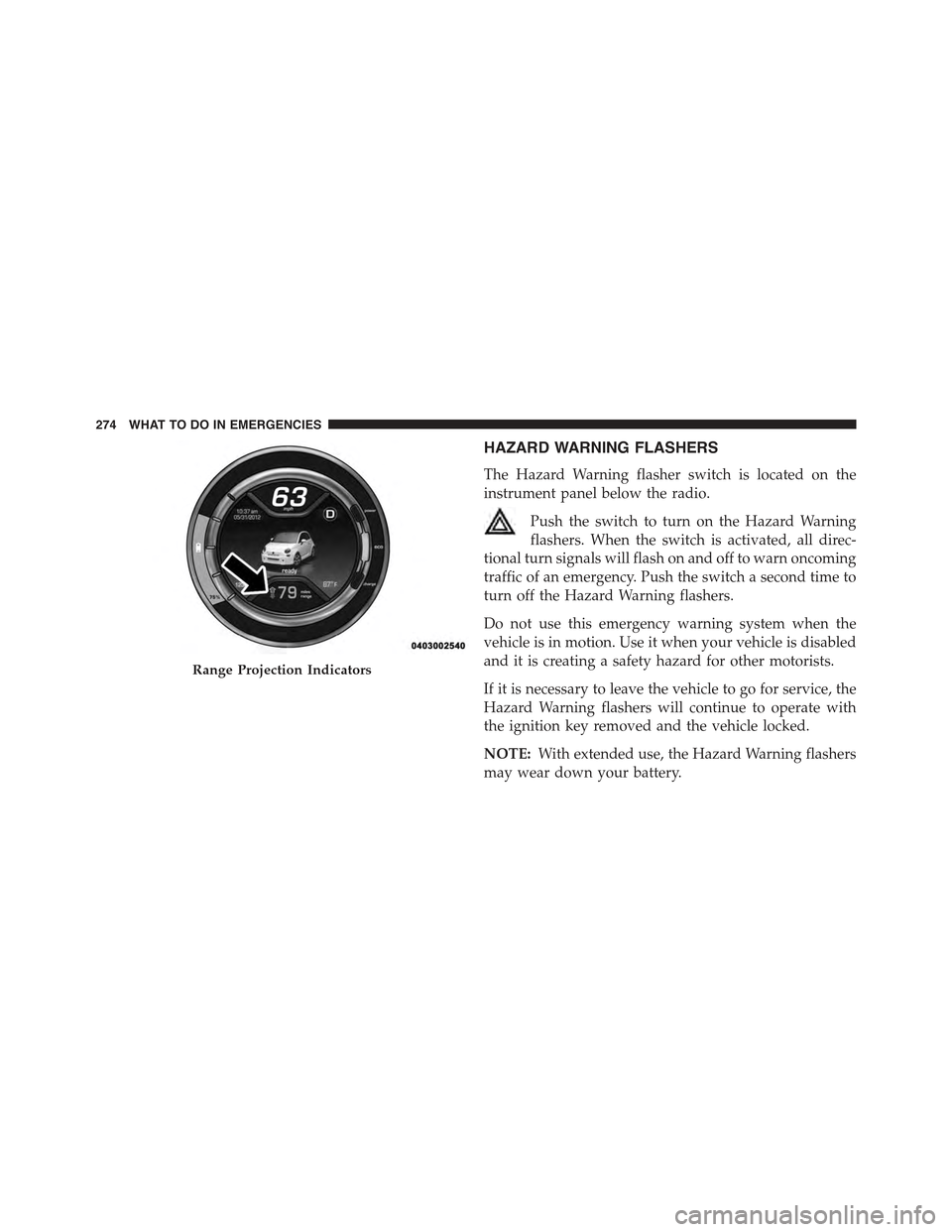
Range Projection Indicators
274 WHAT TO DO IN EMERGENCIES
Page 288 of 367
5. Remove the Speed Limit sticker from the instrument
panel after the tire has been repaired.
6. Replace the Sealant Bottle (1) and Sealant Hose (6)
assembly at your authorized dealer as soon as pos-
sible. Refer to (F) “Sealant Bottle and Hose Replace-
ment”.
NOTE:When having the tire serviced, advise the autho-
rized dealer or service center that the tire has been sealed
using the Tire Service Kit.
(F) Sealant Bottle And Hose Replacement:
1. Uncoil the Sealant Hose (6) (clear in color).
2. Locate the round Sealant Bottle release button in the
recessed area under the sealant bottle.
3. Push the Sealant Bottle release button. The Sealant
Bottle (1) will pop up. Remove the bottle and dispose
of it accordingly.
4. Clean any remaining sealant from the Tire Service Kit
housing.
5. Position the new Sealant Bottle (1) in the housing so
that the Sealant Hose (6) aligns with the hose slot in
the front of the housing. Push the bottle into the
housing. An audible click will be heard indicating the
bottle is locked into place.
6. Verify that the cap is installed on the fitting at the end
of the Sealant Hose (6) and return the hose to its
storage area (located on the bottom of the air pump).
7. Return the Tire Service Kit to its storage location in the
vehicle.
286 WHAT TO DO IN EMERGENCIES
Page 290 of 367
WARNING!
•Take care to avoid the radiator cooling fan when-
ever the hood is raised. It can start anytime the
ignition switch is ON. You can be injured by
moving fan blades.
•Remove any metal jewelry such as rings, watch
bands and bracelets that could make an inadvertent
electrical contact. You could be seriously injured.
•Batteries contain sulfuric acid that can burn your
skin or eyes and generate hydrogen gas which is
flammable and explosive. Keep open flames or
sparks away from the battery.
1. Set the parking brake, place the transmission into
PARK and turn the ignition to LOCK.
2. Turn off the heater, radio, and all unnecessary electri-
cal accessories.
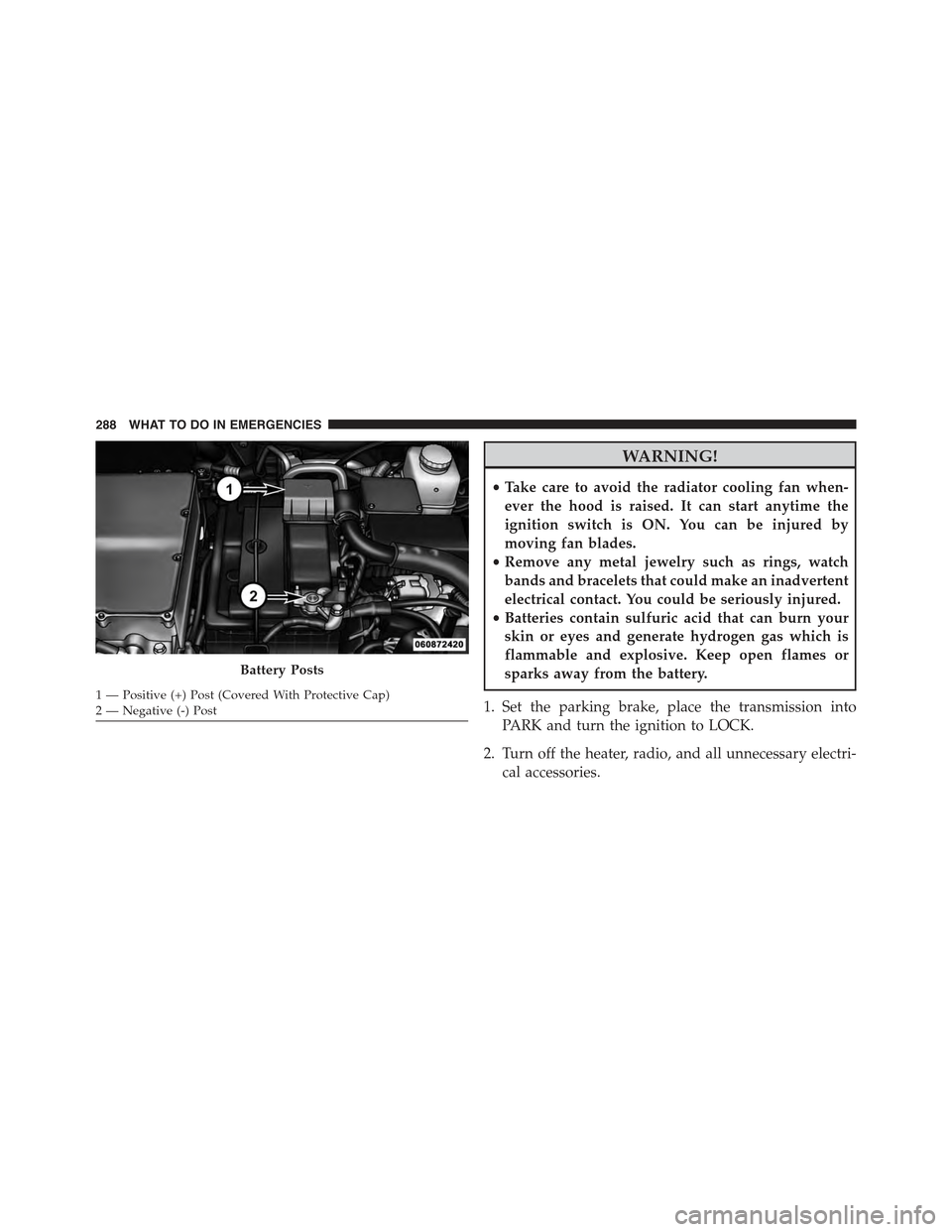
Battery Posts
1—Positive(+)Post(CoveredWithProtectiveCap)2 — Negative (-) Post
288 WHAT TO DO IN EMERGENCIES
Page 295 of 367
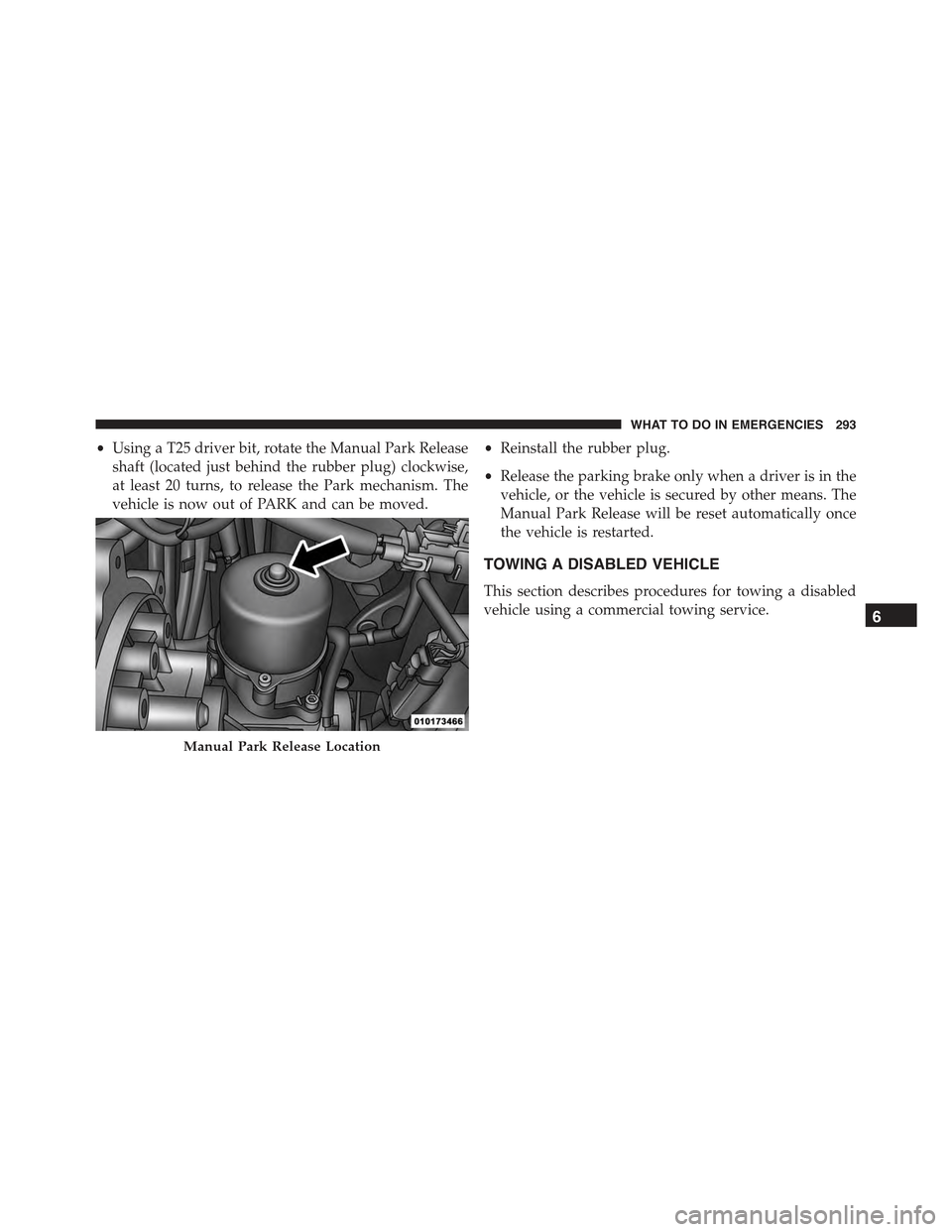
•Using a T25 driver bit, rotate the Manual Park Release
shaft (located just behind the rubber plug) clockwise,
at least 20 turns, to release the Park mechanism. The
vehicle is now out of PARK and can be moved.
•Reinstall the rubber plug.
•Release the parking brake only when a driver is in the
vehicle, or the vehicle is secured by other means. The
Manual Park Release will be reset automatically once
the vehicle is restarted.
TOWING A DISABLED VEHICLE
This section describes procedures for towing a disabled
vehicle using a commercial towing service.
Manual Park Release Location
6
WHAT TO DO IN EMERGENCIES 293
Page 311 of 367
WARNING!(Continued)
•The air conditioning system contains refrigerant
under high pressure. To avoid risk of personal
injury or damage to the system, adding refrigerant
or any repair requiring lines to be disconnected
should be done by an experienced technician.
Body Lubrication
Locks and all body pivot points, including such items as
seat tracks, door hinge pivot points and rollers, liftgate,
tailgate, decklid, sliding doors and hood hinges, should
be lubricated periodically with a lithium based grease,
such as MOPAR® Spray White Lube to assure quiet, easy
operation and to protect against rust and wear. Prior to
the application of any lubricant, the parts concerned
should be wiped clean to remove dust and grit; after
lubricating excess oil and grease should be removed.
Particular attention should also be given to hood latching
components to ensure proper function. When performing
other underhood services, the hood latch, release mecha-
nism and safety catch should be cleaned and lubricated.
The external lock cylinders should be lubricated twice a
year, preferably in the Fall and Spring. Apply a small
amount of a high quality lubricant, such as MOPAR®
Lock Cylinder Lubricant directly into the lock cylinder.
Wiper Blades
Clean the rubber edges of the wiper blades and the
windshield and rear window periodically with a sponge
or soft cloth and a mild nonabrasive cleaner. This will
remove accumulations of salt, waxes, or road film, and
help reduce streaking and smearing.
Operation of the wipers on dry glass for long periods
may cause deterioration of the wiper blades. Always use
washer fluid when using the wipers to remove salt or dirt
from a dry windshield or rear window.
7
MAINTAINING YOUR VEHICLE 309
Page 324 of 367
Interior Fuses
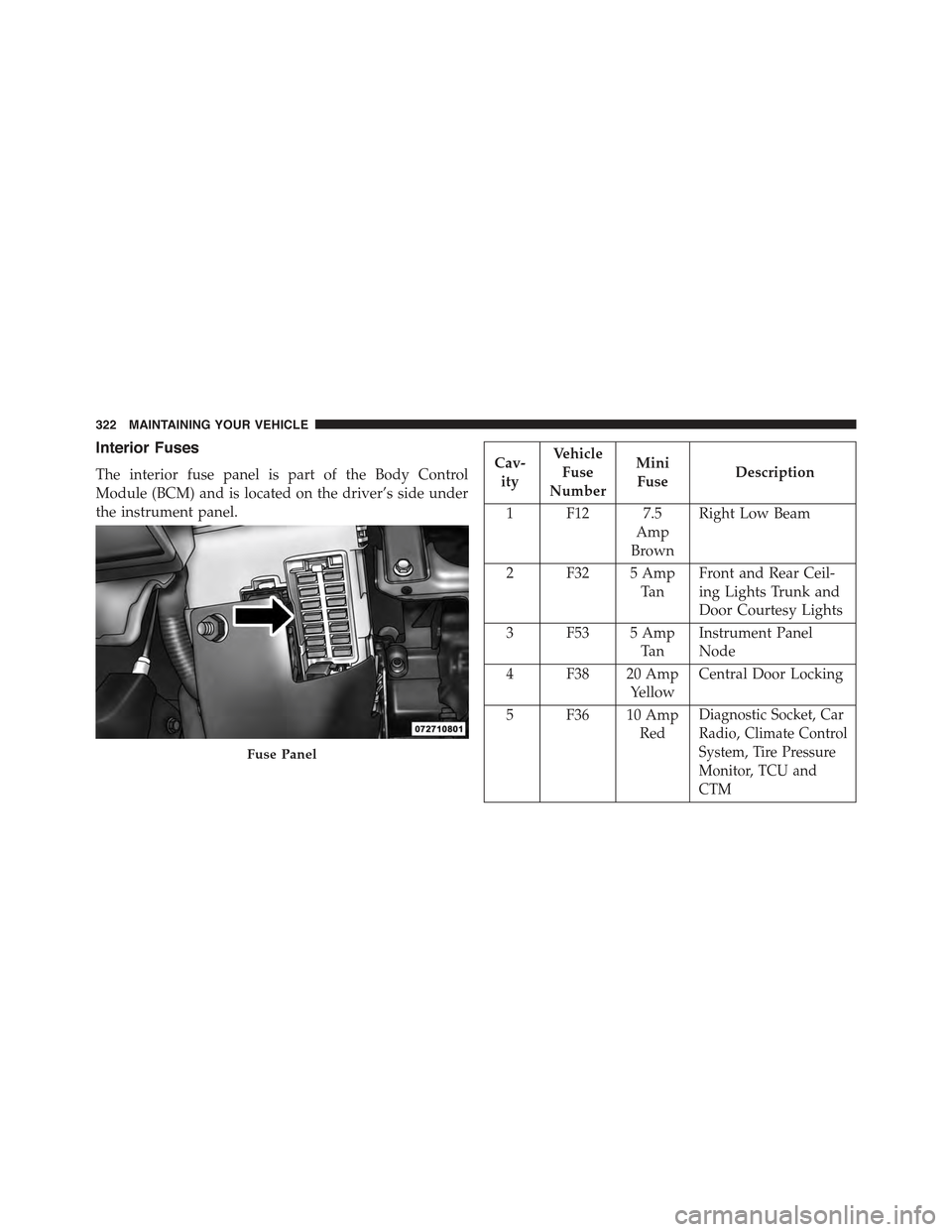
The interior fuse panel is part of the Body Control
Module (BCM) and is located on the driver’s side under
the instrument panel.
Cav-
ity
Vehicle
Fuse
Number
Mini
FuseDescription
1 F12 7.5
Amp
Brown
Right Low Beam
2 F32 5 Amp
Ta n
Front and Rear Ceil-
ing Lights Trunk and
Door Courtesy Lights
3 F53 5 Amp
Ta n
Instrument Panel
Node
4 F38 20 Amp
Yellow
Central Door Locking
5 F36 10 Amp
Red
Diagnostic Socket, Car
Radio, Climate Control
System, Tire Pressure
Monitor, TCU and
CTM
Fuse Panel
322 MAINTAINING YOUR VEHICLE
Page 327 of 367
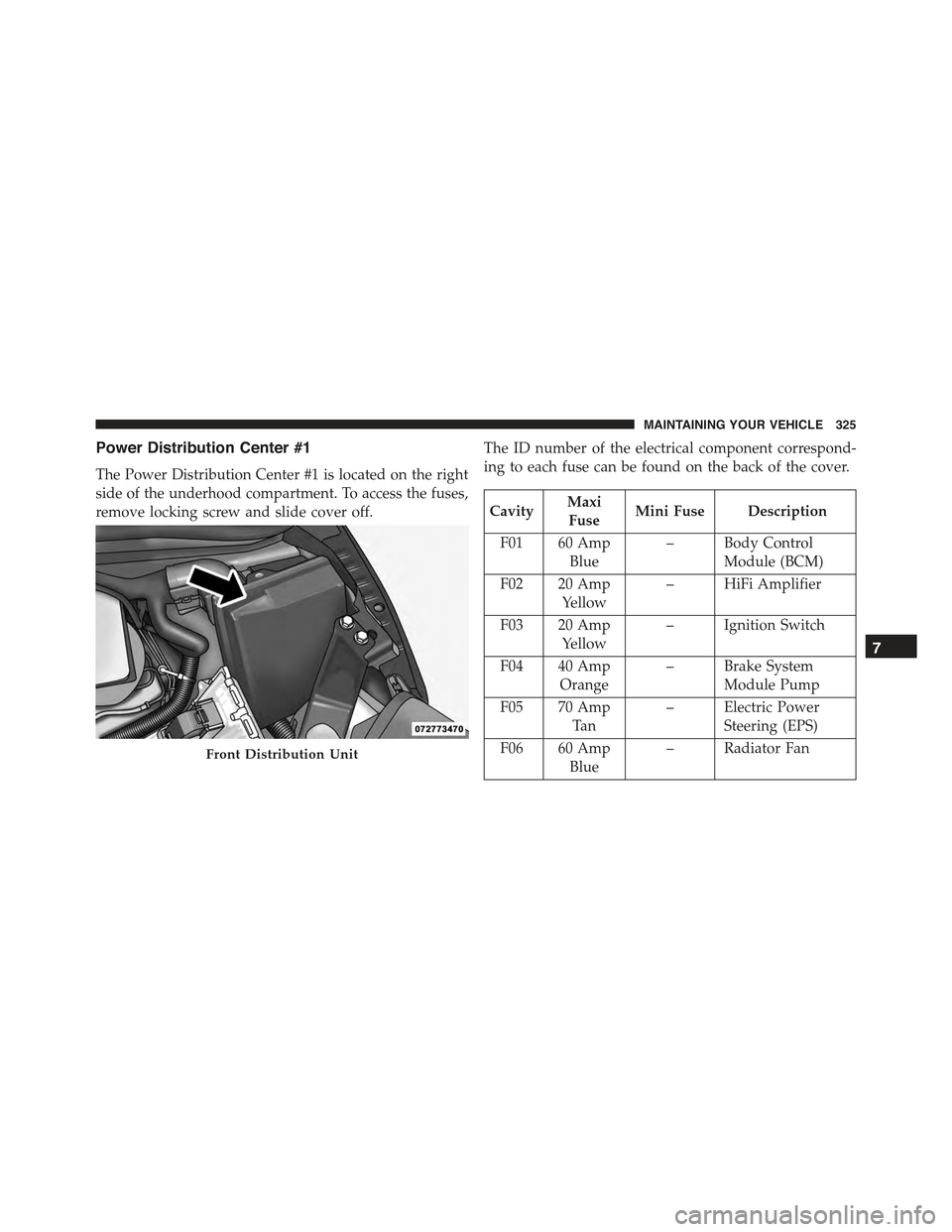
Power Distribution Center #1
The Power Distribution Center #1 is located on the right
side of the underhood compartment. To access the fuses,
remove locking screw and slide cover off.
The ID number of the electrical component correspond-
ing to each fuse can be found on the back of the cover.
CavityMaxi
FuseMini Fuse Description
F01 60 Amp
Blue
– Body Control
Module (BCM)
F02 20 Amp
Yellow
– HiFi Amplifier
F03 20 Amp
Yellow
– Ignition Switch
F04 40 Amp
Orange
– Brake System
Module Pump
F05 70 Amp
Ta n
– Electric Power
Steering (EPS)
F06 60 Amp
Blue
– Radiator FanFront Distribution Unit
7
MAINTAINING YOUR VEHICLE 325
Page 328 of 367
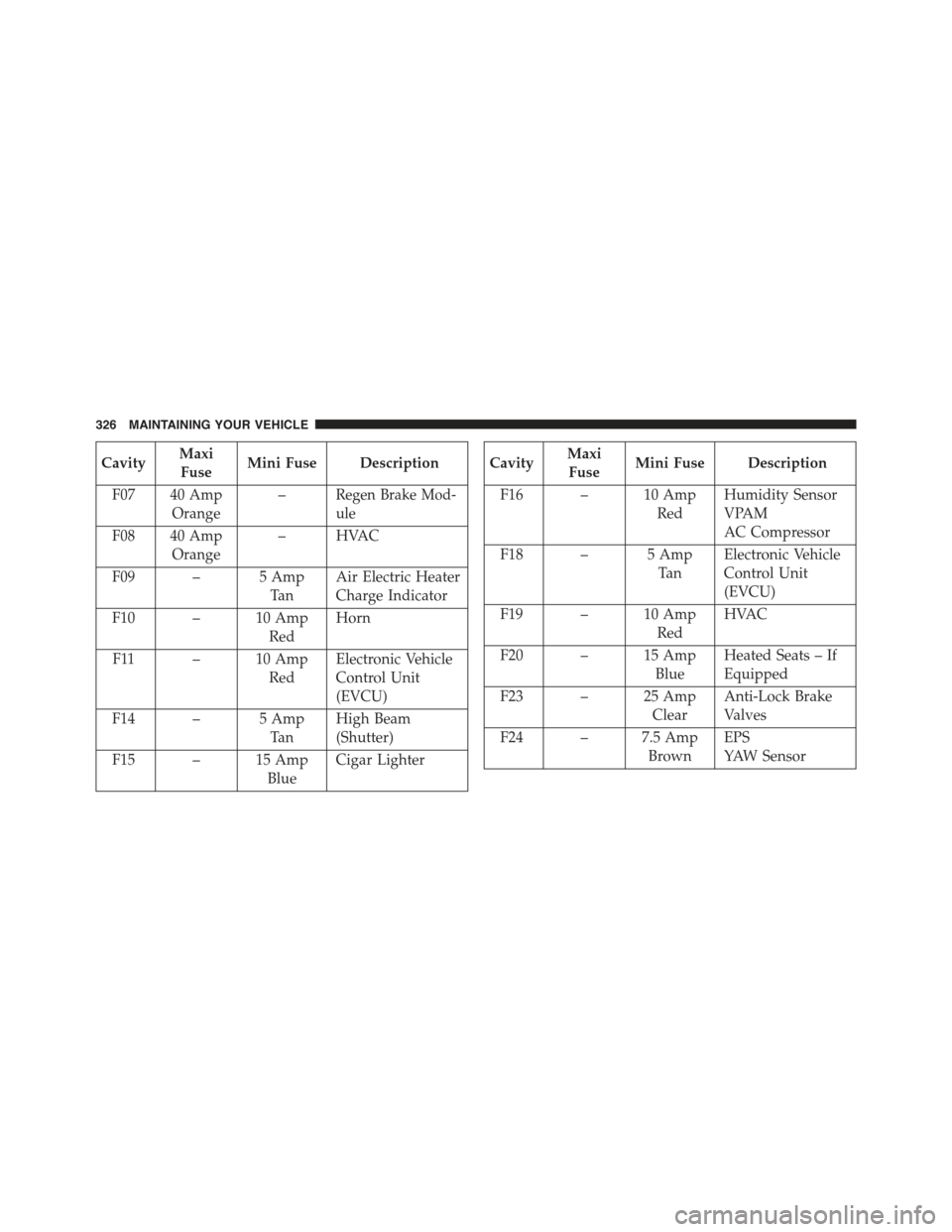
CavityMaxi
FuseMini Fuse Description
F07 40 Amp
Orange
–Regen Brake Mod-
ule
F08 40 Amp
Orange
–HVAC
F09 – 5 Amp
Ta n
Air Electric Heater
Charge Indicator
F10 – 10 Amp
Red
Horn
F11 – 10 Amp
Red
Electronic Vehicle
Control Unit
(EVCU)
F14 – 5 Amp
Ta n
High Beam
(Shutter)
F15 – 15 Amp
Blue
Cigar Lighter
CavityMaxi
FuseMini Fuse Description
F16 – 10 Amp
Red
Humidity Sensor
VPAM
AC Compressor
F18 – 5 Amp
Ta n
Electronic Vehicle
Control Unit
(EVCU)
F19 – 10 Amp
Red
HVAC
F20 – 15 Amp
Blue
Heated Seats – If
Equipped
F23 – 25 Amp
Clear
Anti-Lock Brake
Valves
F24 – 7.5 Amp
Brown
EPS
YAW Sensor
326 MAINTAINING YOUR VEHICLE