transmission FIAT 500E 2017 2.G User Guide
[x] Cancel search | Manufacturer: FIAT, Model Year: 2017, Model line: 500E, Model: FIAT 500E 2017 2.GPages: 300, PDF Size: 2.58 MB
Page 175 of 300
STARTING PROCEDURES
Before starting your vehicle, adjust your seat, adjust
both inside and outside mirrors, and fasten your seat
belts.
WARNING!
•Never leave children alone in a vehicle, or with
access to an unlocked vehicle.
• Allowing children to be in a vehicle unattended is
dangerous for a number of reasons. A child or
others could be seriously or fatally injured. Chil-
dren should be warned not to touch the parking
brake, brake pedal or the gear selector.
• Do not leave the key fob in or near the vehicle (or
in a location accessible to children). A child could
operate power windows, other controls, or move
the vehicle.
Single-Speed Transmission
The transmission must be in the PARK or NEUTRAL
position before you can start the vehicle. Apply the
brakes when selecting a transmission gear from Park.
NOTE: You must press the brake pedal before selecting
a transmission gear.
Normal Starting
Turn the key to the START position while your vehicle
is in PARK. When the ignition key is turned to the
START and then released to the RUN position, a chime
will sound and the “READY” indicator in the instru-
ment cluster display will illuminate to indicate the
500e’s Electric Drive System has started. When the
“READY” indicator is illuminated your 500e is ready to
be driven.
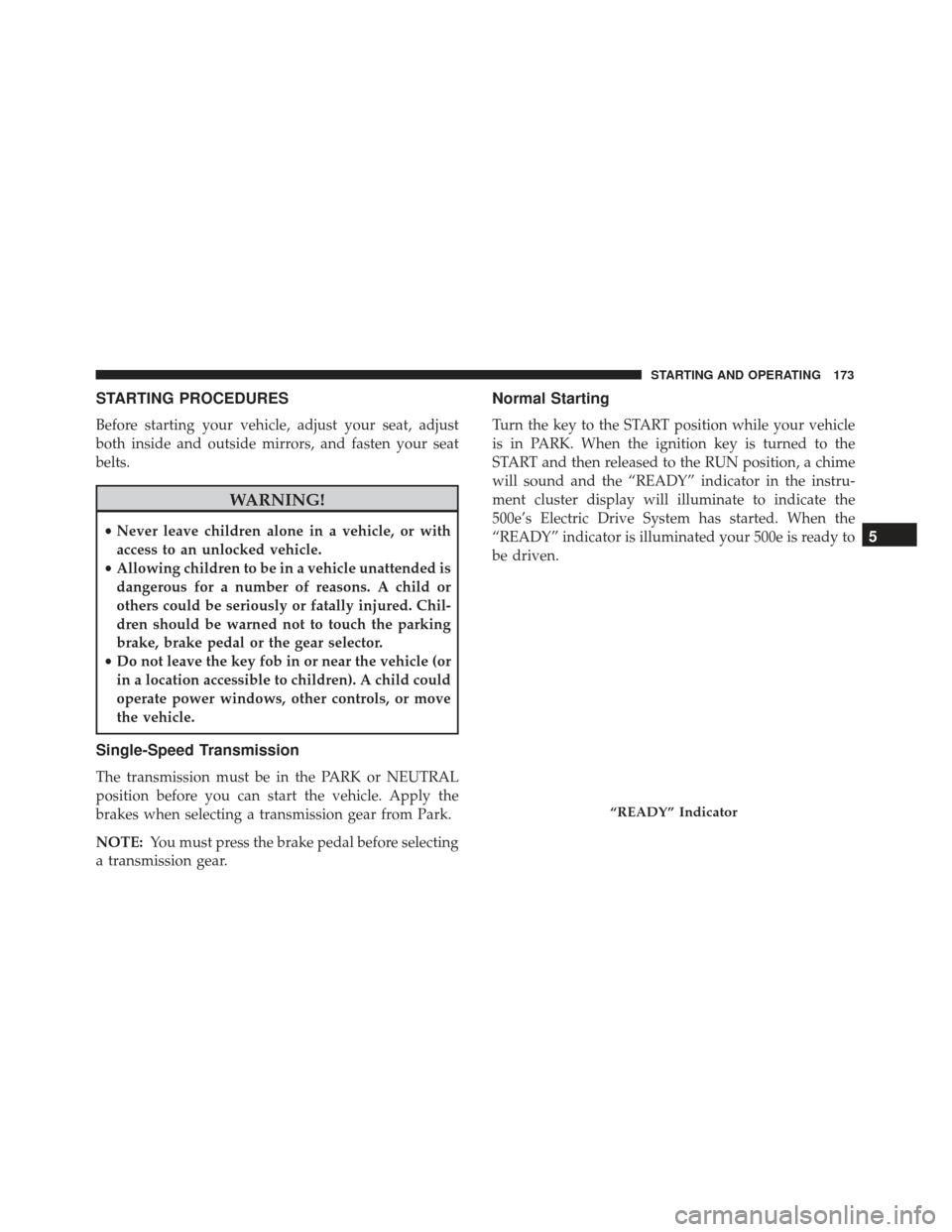
“READY” Indicator
5
STARTING AND OPERATING 173
Page 176 of 300
NOTE:
•If the key is held in the START position for more than
10 seconds “READY” mode will not be achieved.
Return the key to OFF position, and then back to the
START position and hold for less than 10 seconds to
achieve “READY”.
• If the “READY” indicator fails to illuminate after you
have followed the normal starting procedure contact
your authorized dealer.
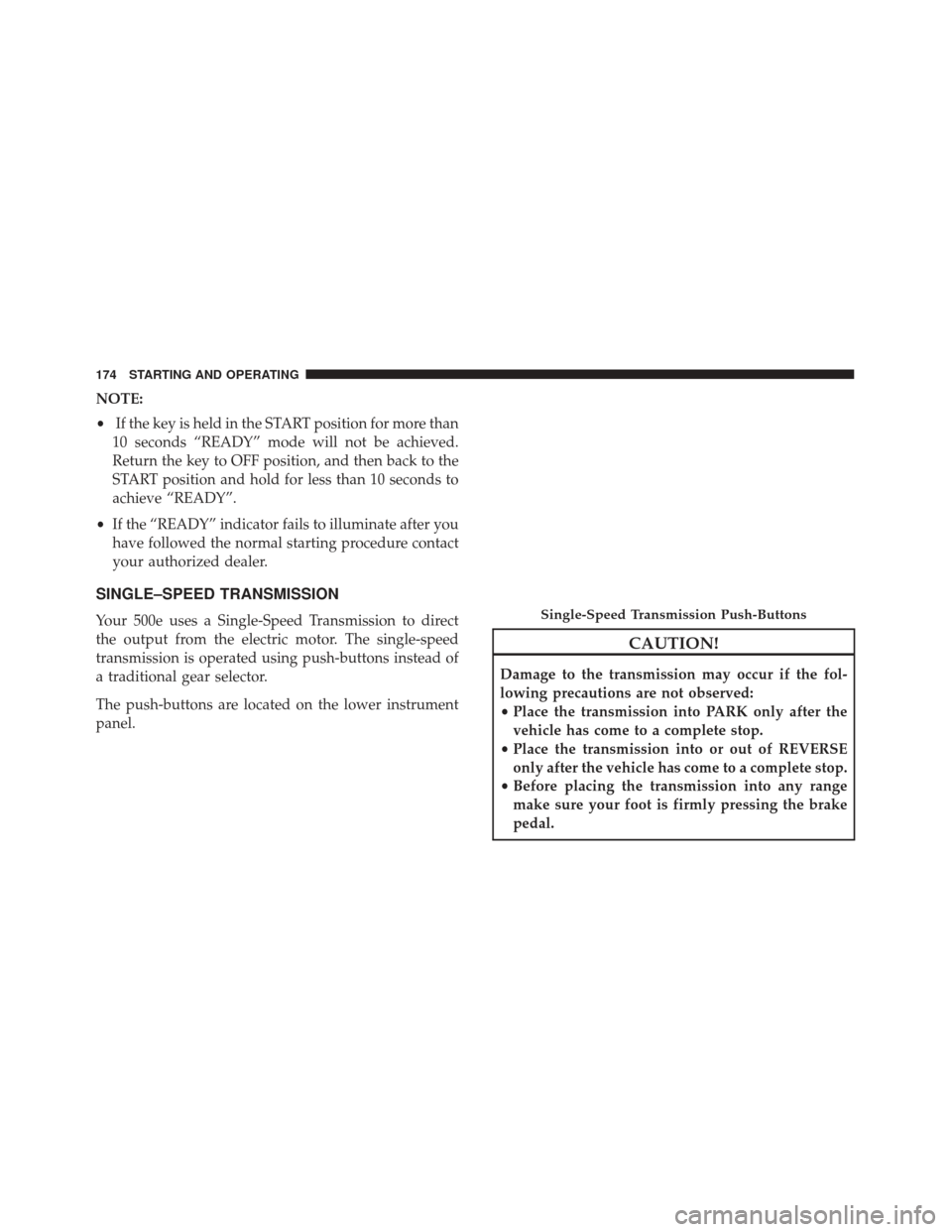
SINGLE–SPEED TRANSMISSION
Your 500e uses a Single-Speed Transmission to direct
the output from the electric motor. The single-speed
transmission is operated using push-buttons instead of
a traditional gear selector.
The push-buttons are located on the lower instrument
panel.
CAUTION!
Damage to the transmission may occur if the fol-
lowing precautions are not observed:
• Place the transmission into PARK only after the
vehicle has come to a complete stop.
• Place the transmission into or out of REVERSE
only after the vehicle has come to a complete stop.
• Before placing the transmission into any range
make sure your foot is firmly pressing the brake
pedal.
Single-Speed Transmission Push-Buttons
174 STARTING AND OPERATING
Page 177 of 300
NOTE:
•You must press and hold the brake pedal while
shifting in or out of PARK.
• If all push-button LEDs are on when the key is ON,
see your authorized dealer.
WARNING!
• Only place the transmission into gear when your
foot is firmly pressing the brake pedal.
• Unintended movement of a vehicle could injure
those in or near the vehicle. As with all vehicles,
you should never exit a vehicle while the vehicle
is in “READY” mode. Before exiting a vehicle,
always apply the parking brake, shift the trans-
mission into PARK, and remove the ignition key.
Once the key is removed, the transmission is
locked in PARK, securing the vehicle against
unwanted movement.
• When leaving the vehicle, always remove the
ignition key and lock your vehicle.
• Never leave children alone in a vehicle, or with
access to an unlocked vehicle. Allowing children
(Continued)
WARNING! (Continued)
to be in a vehicle unattended is dangerous for a
number of reasons. A child or others could be
seriously or fatally injured. Children should be
warned not to touch the parking brake, brake
pedal or the transmission range buttons.
• Do not leave the ignition key in or near the
vehicle (or in a location accessible to children). A
child could operate power windows, other con-
trols, or move the vehicle.
Key Ignition Park Interlock
This vehicle is equipped with a Key Ignition Park
Interlock which requires the transmission to be in PARK
before the ignition can be turned to the OFF position.
The key can only be removed from the ignition when
the ignition is in the OFF position, and once removed,
the transmission is locked in PARK.
5
STARTING AND OPERATING 175
Page 178 of 300
Gear Ranges
Push the desired push button to shift into gear.
NOTE:
•The brake pedal must be depressed to select a
transmission gear.
• After selecting any gear, wait a moment to allow the
selected gear to engage before accelerating.
PARK (P)
The PARK selection supplements the parking brake by
locking the transmission. The vehicle can be started in
this range. Never attempt to use PARK while the vehicle
is in motion. Apply the parking brake when leaving the
vehicle in PARK.
When parking on a level surface, you may place the
transmission into PARK first, and then apply the park-
ing brake.
When parking on a hill, apply the parking brake before
placing the transmission into PARK. As an added
precaution, turn the front wheels toward the curb on a
downhill grade and away from the curb on an uphill
grade. NOTE:
Refer to the transmission range position dis-
played in the instrument cluster and verify that it
indicates the PARK position.
WARNING!
• Never use the PARK position as a substitute for
the parking brake. Always apply the parking
brake fully when parked to guard against vehicle
movement and possible injury or damage.
• Your vehicle could move and injure you and
others if it is not in PARK. Make sure the trans-
mission is in PARK before leaving the vehicle.
• It is dangerous to shift out of PARK or NEUTRAL
if your foot is not firmly pressing the brake pedal.
The vehicle could accelerate quickly forward or in
reverse. You could lose control of the vehicle and
hit someone or something. Only shift the trans-
mission into gear when your foot is firmly press-
ing the brake pedal.
• Unintended movement of a vehicle could injure
those in or near the vehicle. As with all vehicles,
you should never exit a vehicle while the vehicle
is in “ready mode”. Before exiting a vehicle,
(Continued)
176 STARTING AND OPERATING
Page 179 of 300
WARNING!(Continued)
always apply the parking brake, shift the trans-
mission into PARK, and remove the ignition key.
Once the key is removed, the transmission is
locked in PARK, securing the vehicle against
unwanted movement.
• When leaving the vehicle, always remove the
ignition key and lock your vehicle.
• Never leave children alone in a vehicle, or with
access to an unlocked vehicle. Allowing children
to be in a vehicle unattended is dangerous for a
number of reasons. A child or others could be
seriously or fatally injured. Children should be
warned not to touch the parking brake, brake
pedal or the transmission range buttons.
• Do not leave the ignition key in or near the
vehicle (or in a location accessible to children). A
child could operate power windows, other con-
trols, or move the vehicle.
REVERSE (R)
This gear is for moving the vehicle backward. Shift into
REVERSE only after the vehicle has come to a complete
stop.
NEUTRAL (N)
The vehicle may be started in this gear. Apply the
parking brake and place the transmission into PARK if
you must leave the vehicle.
WARNING!
Do not coast in NEUTRAL and never turn off the
ignition to coast down a hill. These are unsafe
practices that limit your response to changing traf-
fic or road conditions. You might lose control of the
vehicle and have a collision.
CAUTION!
Towing the vehicle, coasting, or driving for any
other reason with the transmission in NEUTRAL
can cause severe transmission damage. Refer to
“Recreational Towing” in “Starting And Operating”
and “Towing A Disabled Vehicle” in “What To Do
In Emergencies” for further information.
DRIVE (D)
Use this gear for all city and highway driving.
5
STARTING AND OPERATING 177
Page 180 of 300
Auto Park
The Auto Park feature automatically places the trans-
mission into PARK if there is any indication that the
driver may leave the vehicle while the transmission is in
D (DRIVE), N (NEUTRAL) or R (REVERSE).
Auto Park is enabled under the following conditions:
•Key On (12 Volt ON and High Voltage OFF) or
READY mode (12 Volt ON and High Voltage ON).
• Vehicle speed is below 2 mph (3 km/h).
NOTE:
• Auto Park is enabled (only once) at the beginning of
each key cycle and is re-enabled each time the vehicle
speed exceeds 8 mph (13 km/h).
• Auto Park is disabled above 2 mph (3 km/h) and
transmission range will be maintained.
The instrument cluster will display an Auto Shift To
Park message and chime once when Auto Park is
activated. Mode Of Operation With Key ON:
Auto Park will be engaged when the transmission is in
DRIVE, NEUTRAL or REVERSE and the following
conditions are detected:
•
Seat Belt is unlatched
• Brake pedal is released
• Driver’s door is ajar
• Vehicle speed is less than 2 mph (3 km/h)
Mode Of Operation With Key OFF:
Auto Park will be engaged when the transmission is in
DRIVE, NEUTRAL or REVERSE and the vehicle speed
is less than 2 mph (3 km/h).
DRIVING ON SLIPPERY SURFACES
Acceleration
Rapid acceleration on snow covered, wet, or other
slippery surfaces may cause the driving wheels to pull
erratically to the right or left. This phenomenon occurs
when there is a difference in the surface traction under
the front (driving) wheels.
178 STARTING AND OPERATING
Page 184 of 300
When the parking brake is applied with the ignition
switch in the MAR (ACC/ON/RUN) position, the
Brake Warning Light in the instrument cluster will
illuminate.
When parking on a hill, it is important to turn the front
wheels toward the curb on a downhill grade and away
from the curb on an uphill grade. The parking brake
should always be applied whenever the driver is not in
the vehicle.
WARNING!
•Never leave children alone in a vehicle, or with
access to an unlocked vehicle.
• Allowing children to be in a vehicle unattended is
dangerous for a number of reasons. A child or
others could be seriously or fatally injured. Chil-
dren should be warned not to touch the parking
brake, brake pedal or the transmission push but-
tons.
• Do not leave the key fob in or near the vehicle (or
in a location accessible to children). A child could
operate power windows, other controls, or move
the vehicle.
• Be sure the parking brake is fully disengaged
before driving; failure to do so can lead to brake
failure and a collision.
• Always fully apply the parking brake when leav-
ing your vehicle, or it may roll and cause damage
or injury.
Parking Brake
182 STARTING AND OPERATING
Page 218 of 300
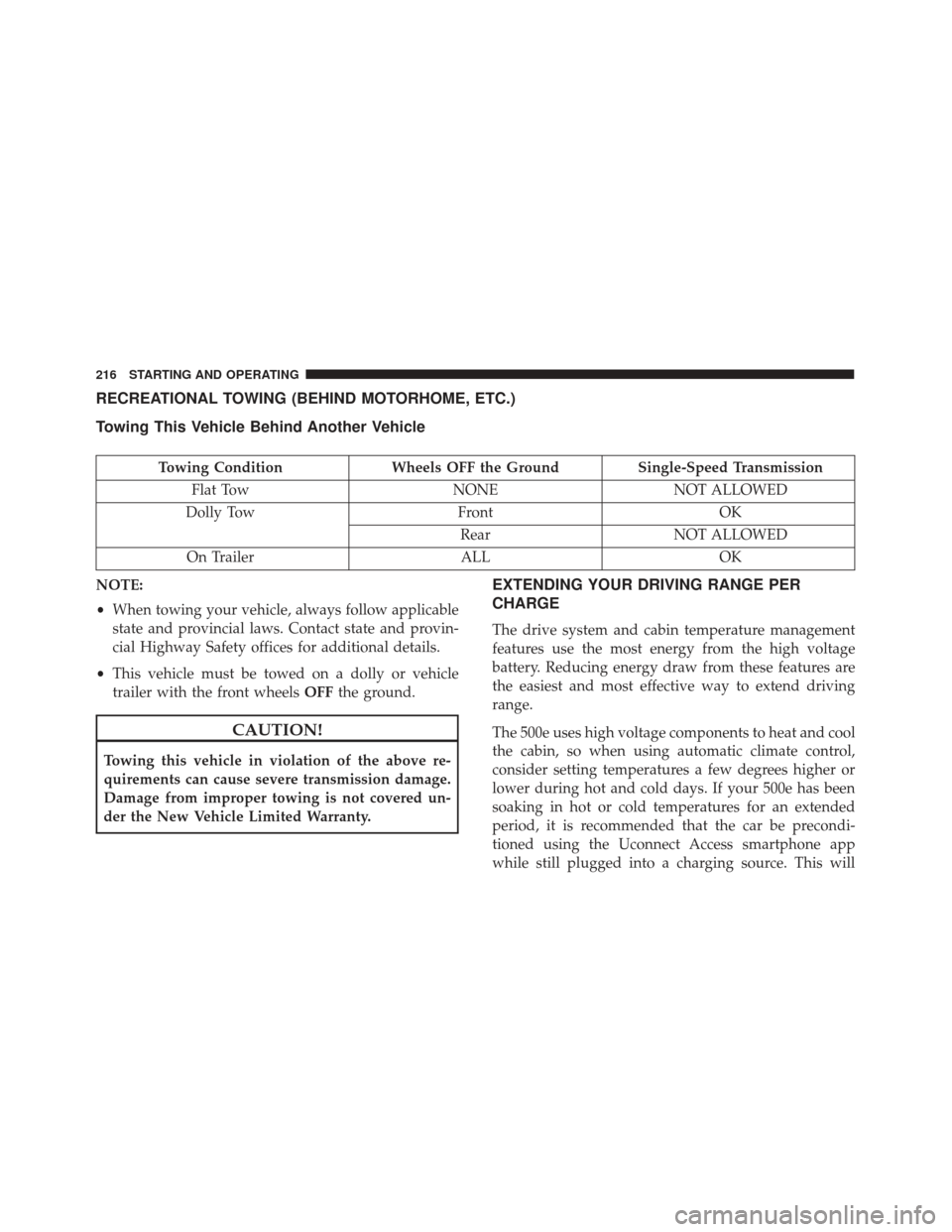
RECREATIONAL TOWING (BEHIND MOTORHOME, ETC.)
Towing This Vehicle Behind Another Vehicle
Towing ConditionWheels OFF the Ground Single-Speed Transmission
Flat Tow NONENOT ALLOWED
Dolly Tow FrontOK
Rear NOT ALLOWED
On Trailer ALLOK
NOTE:
• When towing your vehicle, always follow applicable
state and provincial laws. Contact state and provin-
cial Highway Safety offices for additional details.
• This vehicle must be towed on a dolly or vehicle
trailer with the front wheels OFFthe ground.
CAUTION!
Towing this vehicle in violation of the above re-
quirements can cause severe transmission damage.
Damage from improper towing is not covered un-
der the New Vehicle Limited Warranty.
EXTENDING YOUR DRIVING RANGE PER
CHARGE
The drive system and cabin temperature management
features use the most energy from the high voltage
battery. Reducing energy draw from these features are
the easiest and most effective way to extend driving
range.
The 500e uses high voltage components to heat and cool
the cabin, so when using automatic climate control,
consider setting temperatures a few degrees higher or
lower during hot and cold days. If your 500e has been
soaking in hot or cold temperatures for an extended
period, it is recommended that the car be precondi-
tioned using the Uconnect Access smartphone app
while still plugged into a charging source. This will
216 STARTING AND OPERATING
Page 227 of 300
WARNING!(Continued)
warnings can result in injuries that are serious or
fatal to you, your passengers, and others around
you.
• Take care not to allow the contents of Tire Service
Kit to come in contact with hair, eyes, or clothing.
Tire Service Kit sealant is harmful if inhaled,
swallowed, or absorbed through the skin. It
causes skin, eye, and respiratory irritation. Flush
immediately with plenty of water if there is any
contact with eyes or skin. Change clothing as soon
as possible, if there is any contact with clothing.
• Tire Service Kit Sealant solution contains latex. In
case of an allergic reaction or rash, consult a
physician immediately. Keep Tire Service Kit out
of reach of children. If swallowed, rinse mouth
immediately with plenty of water and drink
plenty of water. Do not induce vomiting! Consult
a physician immediately.
Sealing A Tire With Tire Service Kit
(A) Whenever You Stop To Use Tire Service Kit:
1. Pull over to a safe location and turn on the vehicle’s Hazard Warning flashers. 2. Verify that the valve stem (on the wheel with the
deflated tire) is in a position that is near to the
ground. This will allow the Tire Service Kit Hoses (6)
and (7) to reach the valve stem and keep the Tire
Service Kit flat on the ground. This will provide the
best positioning of the kit when injecting the sealant
into the deflated tire and running the air pump.
Move the vehicle as necessary to place the valve stem
in this position before proceeding.
3. Place the transmission in PARK (auto transmission) or in Gear (manual transmission) and place the
ignition in the OFF position.
4. Set the parking brake.
(B) Setting Up To Use Tire Service Kit:
1. Push in the Mode Select Knob (5) and turn to the Sealant Mode position.
2. Uncoil the Sealant Hose (6) and then remove the cap from the fitting at the end of the hose.
3. Place the Tire Service Kit flat on the ground next to the deflated tire.
6
WHAT TO DO IN EMERGENCIES 225
Page 228 of 300
4. Remove the cap from the valve stem and then screwthe fitting at the end of the Sealant Hose (6) onto the
valve stem.
5. Uncoil the Power Plug (8) and insert the plug into the vehicle’s 12 Volt power outlet.
NOTE: Do not remove foreign objects (e.g., screws or
nails) from the tire.
(C) Injecting Tire Service Kit Sealant Into The
Deflated Tire:
• Always start the engine before turning on the Tire
Service Kit.
NOTE: Manual transmission vehicles must have the
parking brake engaged and the gear selector in NEU-
TRAL.
• After pushing the Power Button (4), the sealant
(white fluid) will flow from the Sealant Bottle (1)
through the Sealant Hose (6) and into the tire.
NOTE: Sealant may leak out through the puncture in
the tire. If the sealant (white fluid) does not flow within0–10
seconds through the Sealant Hose (6):
1. Push the Power Button (4) to turn off the Tire Service
Kit. Disconnect the Sealant Hose (6) from the valve
stem. Make sure the valve stem is free of debris.
Reconnect the Sealant Hose (6) to the valve stem.
Check that the Mode Select Knob (5) is in the Sealant
Mode position and not Air Mode. Push the Power
Button (4) to turn on the Tire Service Kit.
2. Connect the Power Plug (8) to a different 12 Volt power outlet in your vehicle or another vehicle, if
available. Make sure the engine is running before
turning on the Tire Service Kit.
3. The Sealant Bottle (1) may be empty due to previous use. Call for assistance.
NOTE: If the Mode Select Knob (5) is on Air Mode and
the pump is operating, air will dispense from the Air
Pump Hose (7) only, not the Sealant Hose (6).
226 WHAT TO DO IN EMERGENCIES