coolant FIAT 500E 2019 User Guide
[x] Cancel search | Manufacturer: FIAT, Model Year: 2019, Model line: 500E, Model: FIAT 500E 2019Pages: 300, PDF Size: 3.03 MB
Page 220 of 300
Check the Power Electronics and Battery Thermal Manage-
ment Systems coolant (antifreeze) protection every 12
months (before the onset of freezing weather, where appli-
cable).
Maintain coolant (antifreeze) concentration at a minimum
of 50% Mopar Antifreeze/Coolant 10 Year/150,000 Mile
Formula OAT (Organic Additive Technology) and
distilled/deionized water for proper corrosion protection.
Check the coolant bottles tubing for brittle rubber, crack-
ing, tears, cuts and tightness of the connection at the bottles
and radiator. Inspect the entire system for leaks.
Check the front of the A/C condenser for any accumula-
tion of bugs, leaves, etc. If dirty, clean by gently spraying
water from a garden hose vertically down the face of the
condenser.
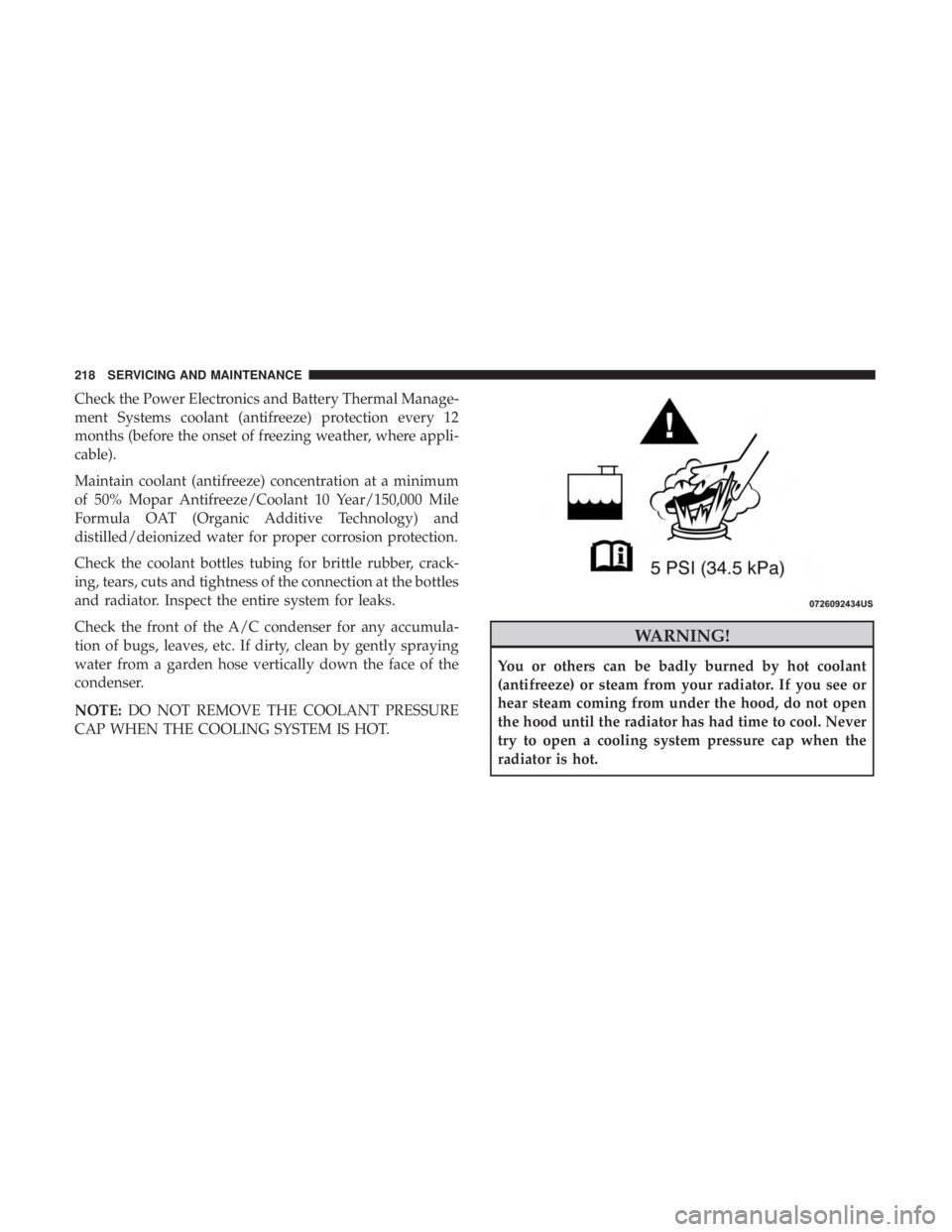
NOTE:DO NOT REMOVE THE COOLANT PRESSURE
CAP WHEN THE COOLING SYSTEM IS HOT.
WARNING!
You or others can be badly burned by hot coolant
(antifreeze) or steam from your radiator. If you see or
hear steam coming from under the hood, do not open
the hood until the radiator has had time to cool. Never
try to open a cooling system pressure cap when the
radiator is hot.
218 SERVICING AND MAINTENANCE
Page 221 of 300
Power Electronics And Battery Thermal
Management Systems — Cooling Pressure Caps
The caps must be fully tightened to prevent loss of coolant
(antifreeze).
The caps should be inspected and cleaned if there is any
accumulation of foreign material on the sealing surfaces.
NOTE:
•The pressure caps on the reservoirs are unique and rated
at 5 PSI (34.5 kPa).
• Use only Mopar replacement parts.
WARNING!
•The warning words “DO NOT OPEN HOT” on the
cooling system pressure cap are a safety precaution.
Never add coolant (antifreeze) when the cooling
system is overheated. Do not loosen or remove the
cap to cool an overheated cooling system. Heat
causes pressure to build up in the cooling system. To
prevent scalding or injury, do not remove the pres-
sure cap while the system is hot or under pressure.
• Do not use a pressure cap other than the one speci-
fied for your vehicle. Personal injury or vehicle
damage may result.
Selection Of Coolant
Refer to “Fluids And Lubricants” in “Technical Specifica-
tions” for further information.
CAUTION!
• Mixing of coolant (antifreeze) other than specified
Organic Additive Technology (OAT) coolant (anti-
freeze), may result in cooling system damage and
may decrease corrosion protection. Organic Additive
Technology (OAT) coolant is different and should
not be mixed with Hybrid Organic Additive Tech-
nology (HOAT) coolant (antifreeze). If a non-OAT
coolant (antifreeze) is introduced into the cooling
system in an emergency, it should be replaced with
the specified coolant (antifreeze) as soon as possible.
• Do not use water alone or alcohol-based coolant
(antifreeze) products. Do not use additional rust
inhibitors or antirust products, as they may not be
compatible with the radiator coolant and may plug
the radiator.
• This vehicle has not been designed for use with
propylene glycol-based coolant (antifreeze). Use of
propylene glycol-based coolant (antifreeze) is not
recommended.
8
SERVICING AND MAINTENANCE 219
Page 222 of 300
Adding Coolant
Your vehicle has been built with cooling systems that allow
extended maintenance intervals. This coolant (antifreeze)
can be used up to ten years or 150,000 miles (240,000 km)
before replacement. To prevent reducing this extended
maintenance period, it is important that you use the same
coolant (antifreeze) throughout the life of your vehicle.
Please review these recommendations for using Organic
Additive Technology (OAT) coolant (antifreeze).
When adding coolant (antifreeze):
•The manufacturer recommends using Mopar
Antifreeze/Coolant 10 Year/150,000 Mile (240,000 km)
Formula OAT (Organic Additive Technology).
• Mix a minimum solution of 50% OAT coolant (anti-
freeze) and distilled water. Use higher concentrations
(not to exceed 70%) if temperatures below -34ºF (-37ºC)
are anticipated.
• Use only high purity water such as distilled or deionized
water when mixing the water and coolant (antifreeze)
solution. The use of lower quality water will reduce the
amount of corrosion protection in the cooling systems. Please note that it is the owner ’s responsibility to maintain
the proper level of protection against freezing according to
the temperatures occurring in the area where the vehicle is
operated.
NOTE:
Mixing coolant (antifreeze) types will decrease the
life of the Power Electronics and Battery Thermal Manage-
ment Systems coolant (antifreeze) and will require more
frequent coolant (antifreeze) changes.
Power Electronics And Battery Thermal
Management Systems — Drain, Flush And Refill
Refer to “Scheduled Servicing” for the proper maintenance
intervals.
If the coolant (antifreeze) is dirty or contains a considerable
amount of sediment, clean and flush with a reliable cooling
system cleaner. Follow with a thorough rinsing to remove
all deposits and chemicals. Properly dispose of old coolant
(antifreeze) solution.
220 SERVICING AND MAINTENANCE
Page 223 of 300
CAUTION!
It is recommended to have the cooling systems ser-
viced at your authorized dealer. Failure to do so could
result in poor cooling system performance and/or ve-
hicle damage.
Disposal Of Used Power Electronics And Battery
Thermal Management Systems Coolant
Used antifreeze is a regulated substance requiring proper
disposal. Check with your local authorities to determine
the disposal rules for your community. To prevent inges-
tion by animals or children, do not store antifreeze in open
containers or allow it to remain in puddles on the ground.
If ingested by a child, contact a physician immediately.
Clean up any ground spills immediately.
Points To Remember
WARNING!
•Turn vehicle OFF and disconnect the fan motor lead
before working near the radiator cooling fan.
• You or others can be badly burned by hot coolant
(antifreeze) or steam from your radiator. If you see or
hear steam coming from under the hood, do not open
the hood until the radiator has had time to cool.
Never open a cooling system pressure cap when the
radiator or coolant bottle is hot.
• Do not put your hands, tools, clothing, and jewelry
near the radiator cooling fan. The fan may start at any
time, whether the ignition is on or off.
If an examination of your underhood compartment shows
no evidence of cooler or hose leaks, the vehicle may be
safely driven.
• Do not overfill the coolant recovery bottles.
• Check coolant (antifreeze) freeze point in the coolant
recovery bottles. If coolant (antifreeze) needs to be
added, contents of coolant recovery bottles must also be
protected against freezing.
8
SERVICING AND MAINTENANCE 221
Page 224 of 300
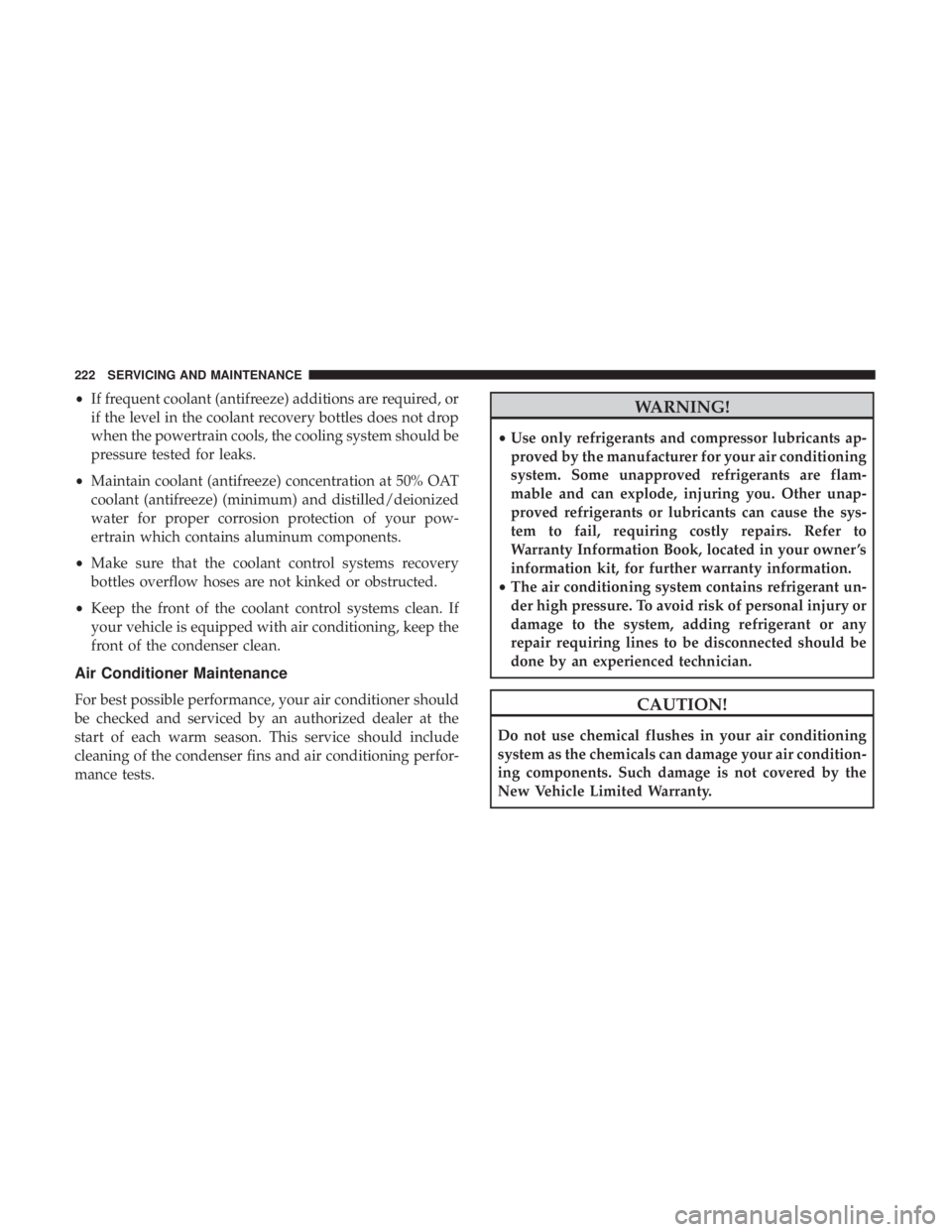
•If frequent coolant (antifreeze) additions are required, or
if the level in the coolant recovery bottles does not drop
when the powertrain cools, the cooling system should be
pressure tested for leaks.
• Maintain coolant (antifreeze) concentration at 50% OAT
coolant (antifreeze) (minimum) and distilled/deionized
water for proper corrosion protection of your pow-
ertrain which contains aluminum components.
• Make sure that the coolant control systems recovery
bottles overflow hoses are not kinked or obstructed.
• Keep the front of the coolant control systems clean. If
your vehicle is equipped with air conditioning, keep the
front of the condenser clean.
Air Conditioner Maintenance
For best possible performance, your air conditioner should
be checked and serviced by an authorized dealer at the
start of each warm season. This service should include
cleaning of the condenser fins and air conditioning perfor-
mance tests.
WARNING!
• Use only refrigerants and compressor lubricants ap-
proved by the manufacturer for your air conditioning
system. Some unapproved refrigerants are flam-
mable and can explode, injuring you. Other unap-
proved refrigerants or lubricants can cause the sys-
tem to fail, requiring costly repairs. Refer to
Warranty Information Book, located in your owner ’s
information kit, for further warranty information.
• The air conditioning system contains refrigerant un-
der high pressure. To avoid risk of personal injury or
damage to the system, adding refrigerant or any
repair requiring lines to be disconnected should be
done by an experienced technician.
CAUTION!
Do not use chemical flushes in your air conditioning
system as the chemicals can damage your air condition-
ing components. Such damage is not covered by the
New Vehicle Limited Warranty.
222 SERVICING AND MAINTENANCE
Page 259 of 300
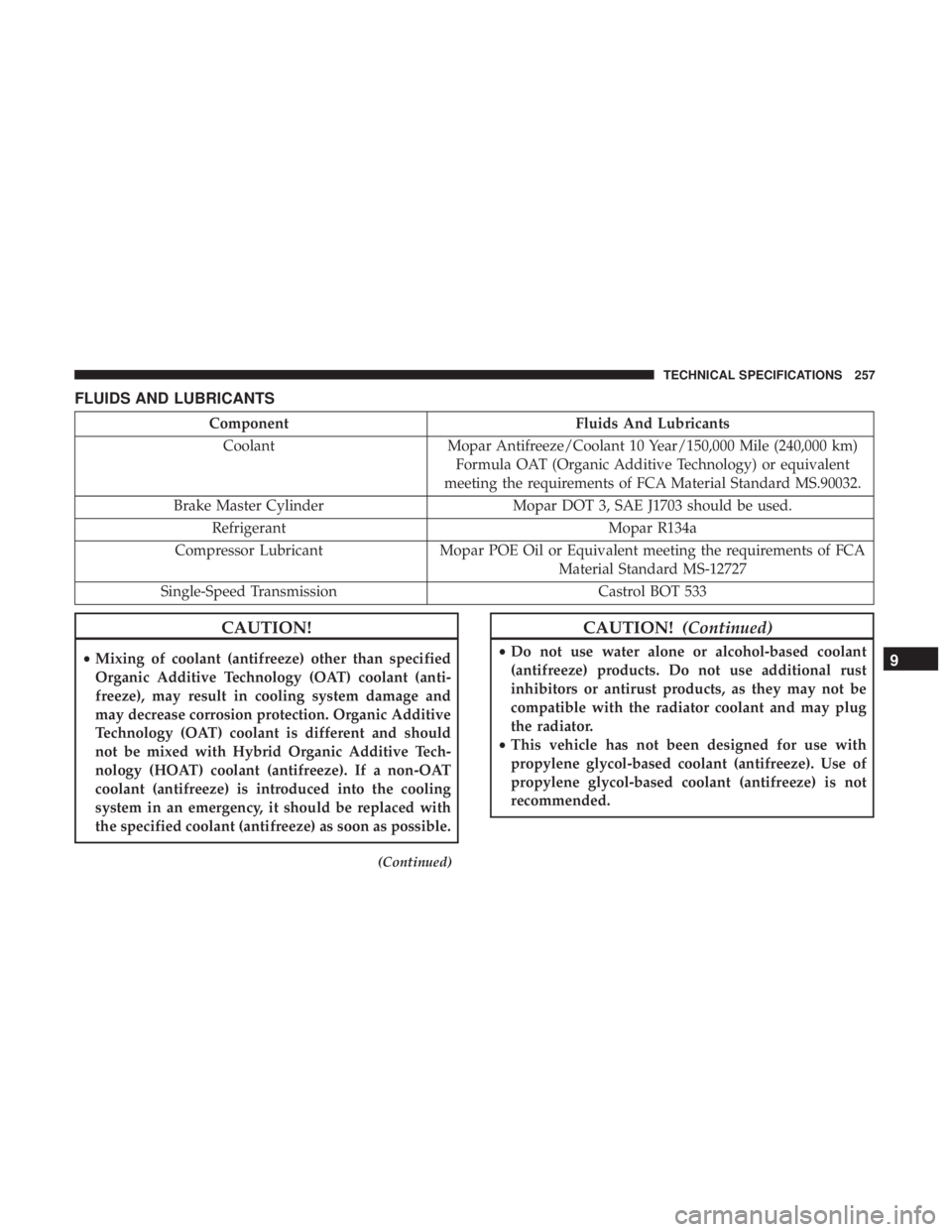
FLUIDS AND LUBRICANTS
ComponentFluids And Lubricants
Coolant Mopar Antifreeze/Coolant 10 Year/150,000 Mile (240,000 km)
Formula OAT (Organic Additive Technology) or equivalent
meeting the requirements of FCA Material Standard MS.90032.
Brake Master Cylinder Mopar DOT 3, SAE J1703 should be used. Refrigerant Mopar R134a
Compressor Lubricant Mopar POE Oil or Equivalent meeting the requirements of FCA
Material Standard MS-12727
Single-Speed Transmission Castrol BOT 533
CAUTION!
•Mixing of coolant (antifreeze) other than specified
Organic Additive Technology (OAT) coolant (anti-
freeze), may result in cooling system damage and
may decrease corrosion protection. Organic Additive
Technology (OAT) coolant is different and should
not be mixed with Hybrid Organic Additive Tech-
nology (HOAT) coolant (antifreeze). If a non-OAT
coolant (antifreeze) is introduced into the cooling
system in an emergency, it should be replaced with
the specified coolant (antifreeze) as soon as possible.
(Continued)
CAUTION! (Continued)
•Do not use water alone or alcohol-based coolant
(antifreeze) products. Do not use additional rust
inhibitors or antirust products, as they may not be
compatible with the radiator coolant and may plug
the radiator.
• This vehicle has not been designed for use with
propylene glycol-based coolant (antifreeze). Use of
propylene glycol-based coolant (antifreeze) is not
recommended.9
TECHNICAL SPECIFICATIONS 257
Page 291 of 300
Fluid Check........................... .225
Master Cylinder ........................ .225
Parking .............................. .158
Warning Light ...........................92
Bulb Replacement ......................... .182
Bulbs, Light .......................... .154, 182
Camera, Rear ............................ .172
Capacities, Fluid .......................... .256
Car Washes .............................. .249
Cellular Phone ........................... .273
Certification Label ......................... .173
Chains, Tire ............................. .245
Changing A Flat Tire ....................... .226
Charging .................................22
AC Level 1 ..............................22
AC Level 2 ..............................35
Cordset ................................24
Indicator ...............................32
Times ..................................36
Troubleshooting ..........................28
Checking Your Vehicle For Safety ...............152
Checks, Safety ............................ .152
Child Restraint ........................... .135Child Restraints
Booster Seats ........................... .139
Child Seat Installation .....................148
How To Stow An unused ALR Seat Belt ........145
Infant And Child Restraints .................138
Lower Anchors And Tethers For Children .......141
Older Children And Child Restraints ...........138
Seating Positions ........................ .140
Cleaning Wheels ............................... .244
Climate Control ............................65
Automatic ........................... .66, 71
Compact Disc (CD) Maintenance ................279
Compact Spare Tire ........................ .242
Contract, Service .......................... .284
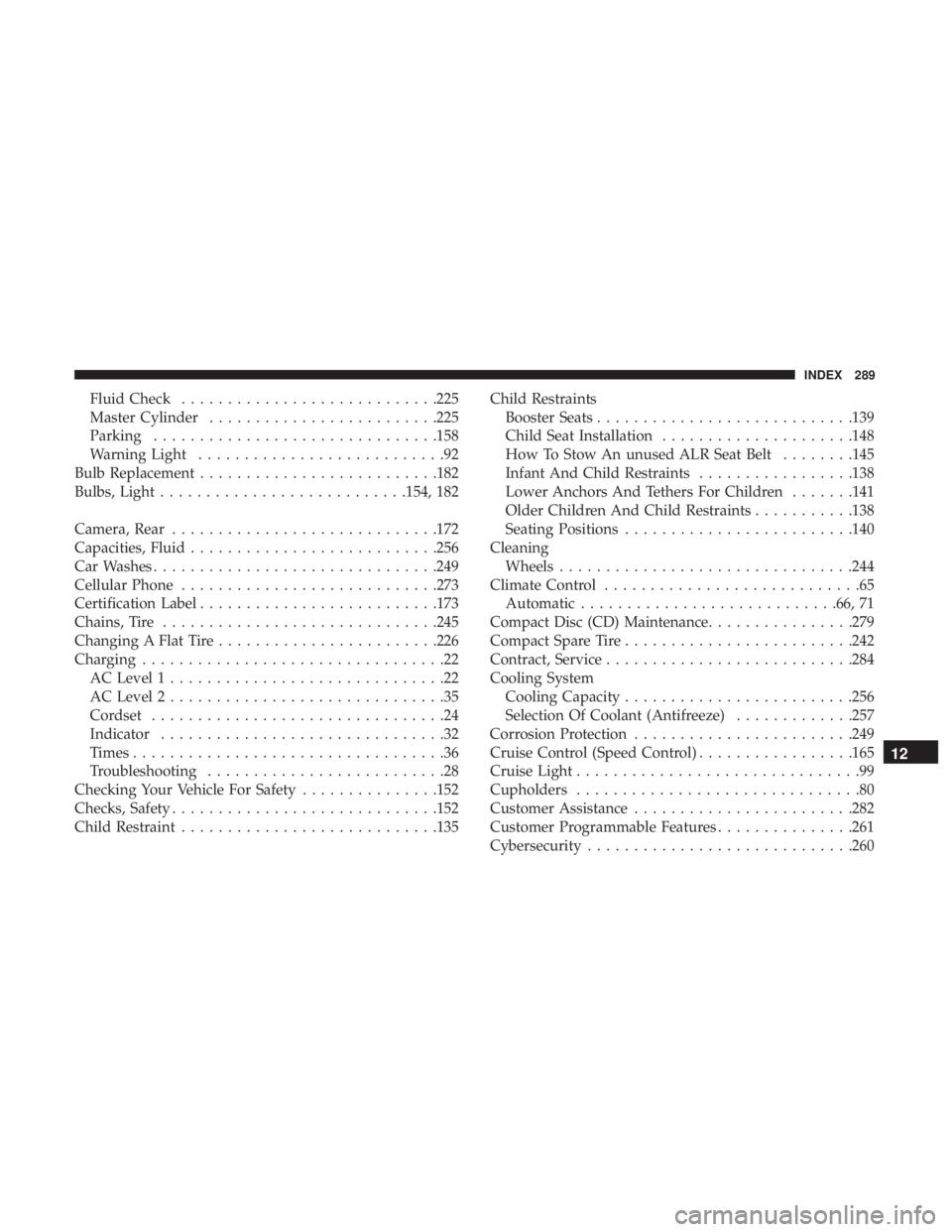
Cooling System Cooling
Capacity........................ .256
Selection Of Coolant (Antifreeze) .............257
Corrosion Protection ....................... .249
Cruise Control (Speed Control) .................165
Cruise Light ...............................99
Cupholders ...............................80
Customer Assistance ....................... .282
Customer Programmable Features ...............261
Cybersecurity ............................ .260
12
INDEX 289
Page 296 of 300
Schedule, Maintenance.......................211
Seat Belt Reminder ..........................94
Seat Belts .............................114,152
Child Restraints ........................ .135
Energy Management Feature ................120
Extender ...............................119
Front Seat .......................114,115,117
Inspection ............................. .152
Lap/Shoulder Belt Operation ................117
Lap/Shoulder Belts .......................115
Lap/Shoulder Belt Untwisting ...............119
Operating Instructions .....................117
Pregnant Women ........................ .120
Pretensioners .......................... .120
Rear Seat ..............................115
Reminder ..............................114
Seat Belt Extender ........................119
Seat Belt Pretensioner .....................120
Untwisting Procedure .....................119
Seat Belts Maintenance ...................... .251
Seats ....................................47
Adjustment .............................47
Heated .................................50
Rear Folding .............................47
Tilting .................................47 Security Alarm
.............................42
Selection Of Coolant (Antifreeze) ...............257
Sentry Key Key Programming .........................42
Sentry Key (Immobilizer) ......................41
Service Assistance ......................... .282
Service Contract .......................... .284
Service Manuals .......................... .286
Settings Personal .............................. .261
Shoulder Belts .............................115
Side View Mirror Adjustment ...................56
Signals, Turn ..................... .58, 60, 99, 154
Snow Chains (Tire Chains) ....................245
Snow Tires .............................. .241
Spare Tires ........................ .241, 242, 243
Speed Control Cancel ............................... .168
Resume .............................. .168
Speed
Control (Cruise Control) .................165
Starting ................................ .157
Button .................................39
Steering Power ............................... .164
Tilt Column .............................55
294 INDEX