battery FIAT 500E 2019 Service Manual
[x] Cancel search | Manufacturer: FIAT, Model Year: 2019, Model line: 500E, Model: FIAT 500E 2019Pages: 300, PDF Size: 3.03 MB
Page 216 of 300
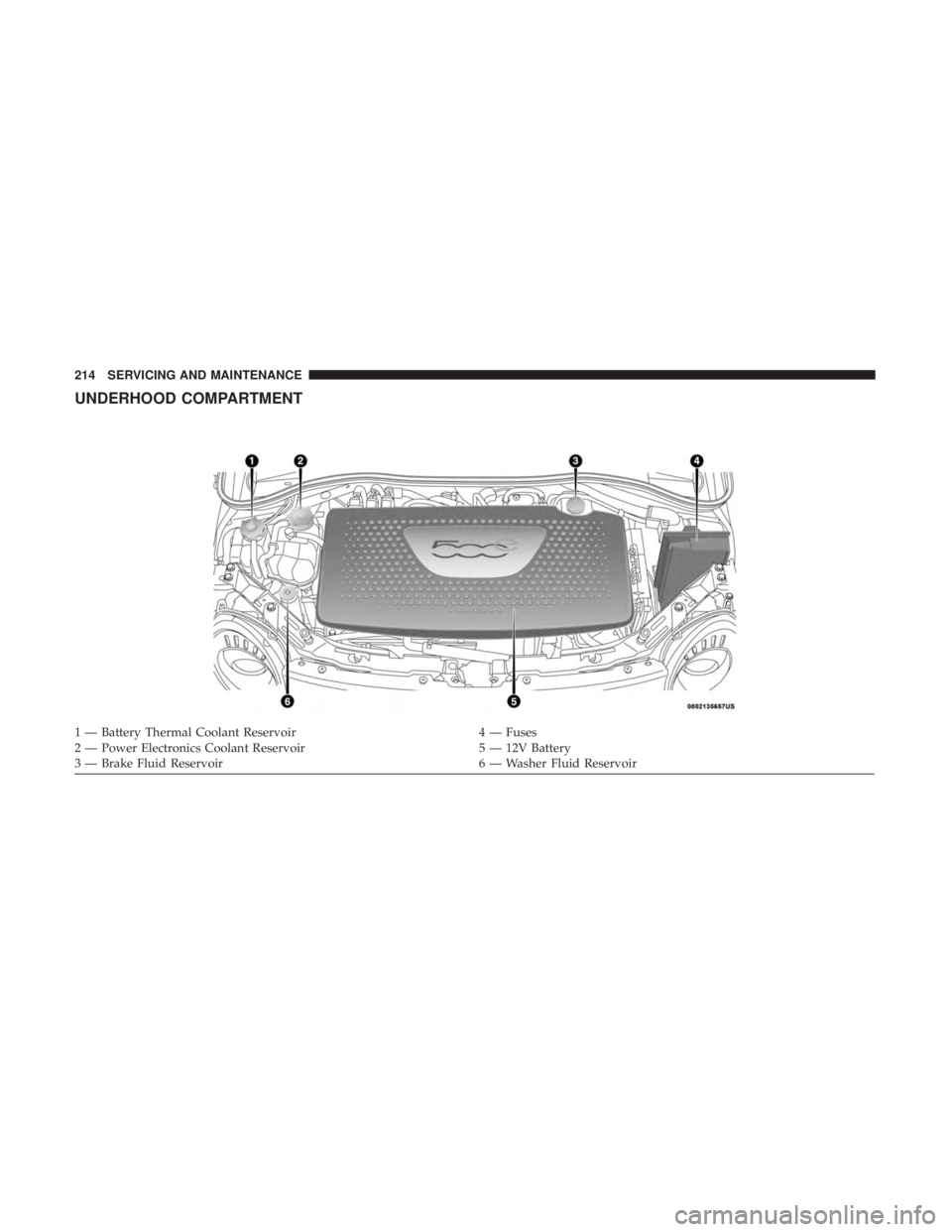
UNDERHOOD COMPARTMENT
1 — Battery Thermal Coolant Reservoir4 — Fuses
2 — Power Electronics Coolant Reservoir 5 — 12V Battery
3 — Brake Fluid Reservoir 6 — Washer Fluid Reservoir
214 SERVICING AND MAINTENANCE
Page 217 of 300
Adding Washer Fluid
The windshield washer fluid reservoir is located in the
underhood compartment, and the fluid level should be
checked at regular intervals. Fill the reservoir with wind-
shield washer solvent (not coolant/ antifreeze). Refer to
“Underhood Compartment” in this section for further
information.
WARNING!
Commercially available windshield washer solvents
are flammable. They could ignite and burn you. Care
must be exercised when filling or working around the
washer solution.
Maintenance-Free Battery 12 Volt
Your vehicle is equipped with a maintenance-free 12 Volt
battery. You will never have to add water, nor is periodic
maintenance required.
WARNING!
•Battery fluid is a corrosive acid solution and can
burn or even blind you. Do not allow battery fluid to
(Continued)
WARNING! (Continued)
contact your eyes, skin, or clothing. Do not lean over
a battery when attaching clamps. If acid splashes in
eyes or on skin, flush the area immediately with
large amounts of water. Refer to “Jump Starting
Procedure” in “In Case Of Emergency” for further
information.
• Battery gas is flammable and explosive. Keep flame
or sparks away from the battery. Do not use a booster
battery or any other booster source with an output
greater than 12 Volts. Do not allow cable clamps to
touch each other.
• Battery posts, terminals, and related accessories con-
tain lead and lead compounds. Wash hands after
handling.
• The battery in this vehicle has a vent hose that
should not be disconnected and should only be
replaced with a battery of the same type (vented).
CAUTION!
• It is essential when replacing the cables on the
battery that the positive cable is attached to the
(Continued)
8
SERVICING AND MAINTENANCE 215
Page 218 of 300
CAUTION!(Continued)
positive post and the negative cable is attached to the
negative post. Battery posts are marked positive (+)
and negative (-) and are identified on the battery
case. Cable clamps should be tight on the terminal
posts and free of corrosion.
• If a 12 Volt Low Voltage Battery System “fast char-
ger” is used while the battery is in the vehicle,
disconnect both vehicle battery cables before con-
necting the charger to the battery. Do not use a “fast
charger” to provide starting voltage.
DEALER SERVICE
WARNING!
Your vehicle has both a high voltage DC and AC
system as well as a 12 Volt system. DC and AC high
voltage are both extremely dangerous and can cause
severe burns, electric shock, serious injury or even
death. In order to avoid personal injuries:
•
DO NOT TOUCH THE HIGH VOLTAGE CABLES
(ORANGE COLORED) AND/OR THE CONNECTORS.
(Continued)
WARNING! (Continued)
•Follow all Caution and Warning labels attached to
the High Voltage components.
• Do not remove or replace any of the 500e System
components. All replacement or repairs of 500e Sys-
tem components should be performed by a factory-
trained technician at an authorized dealer.
The pages that follow contain the requiredmaintenance
services determined by the engineers who designed your
vehicle.
Besides those maintenance items specified in the fixed
maintenance schedule, there are other components which
may require servicing or replacement in the future.
CAUTION!
• Failure to properly maintain your vehicle or perform
repairs and service when necessary could result in
more costly repairs, damage to other components or
negatively impact vehicle performance. Immediately
have potential malfunctions examined by an autho-
rized dealer or qualified repair center.
(Continued)
216 SERVICING AND MAINTENANCE
Page 219 of 300
CAUTION!(Continued)
•Your vehicle has been built with improved fluids
that protect the performance and durability of your
vehicle and also allow extended maintenance inter-
vals. Do not use chemical flushes in these compo-
nents as the chemicals can damage them. Such dam-
age is not covered by the New Vehicle Limited
Warranty. If a flush is needed because of component
malfunction, use only the specified fluid for the
flushing procedure.
Power Electronics And Battery Thermal
Management Systems
The Power Electronics and Battery Thermal Management
Systems are completely separate and designed to regulate
temperature for the high voltage battery and the electric
components.
Power Electronics And Battery Thermal
Management Systems — Coolant Level Check
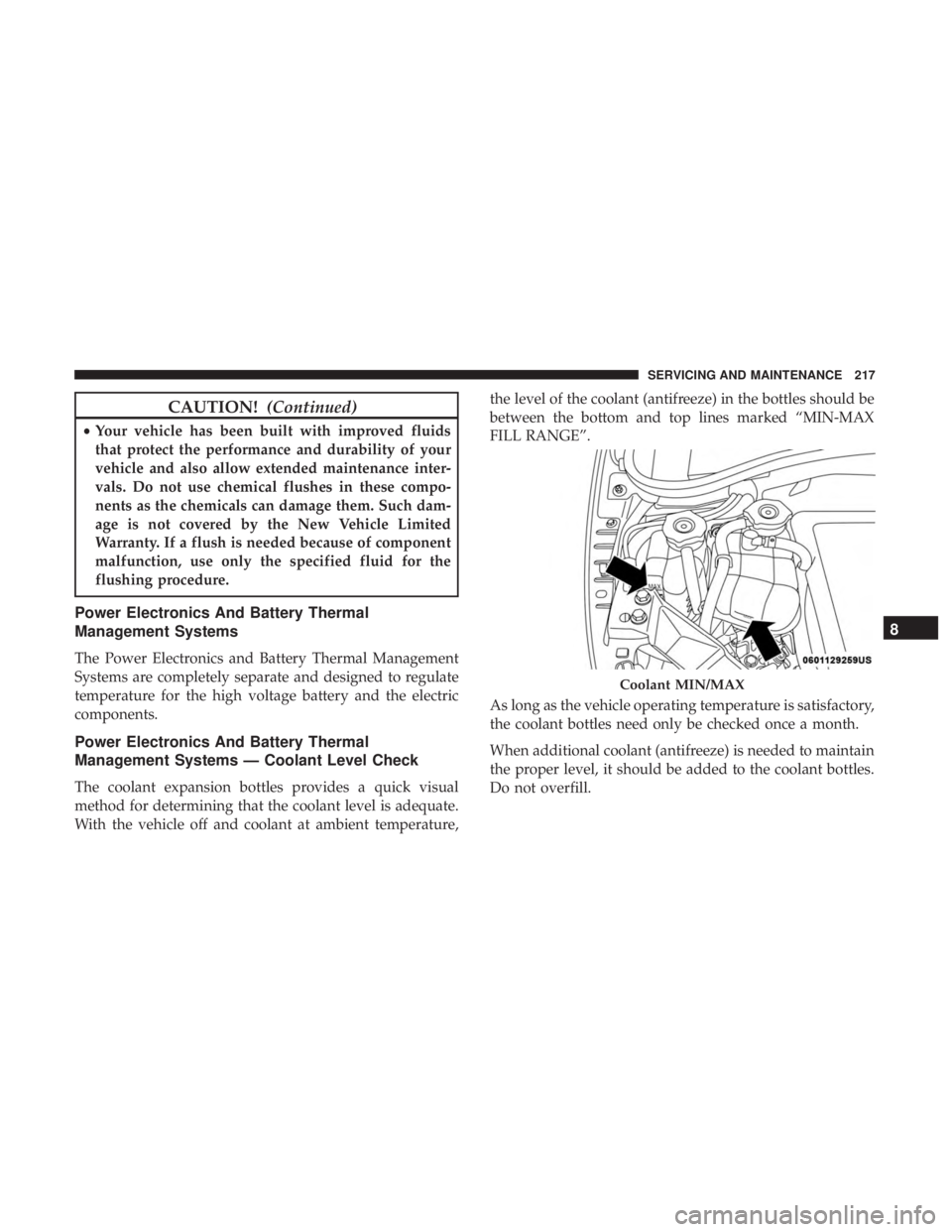
The coolant expansion bottles provides a quick visual
method for determining that the coolant level is adequate.
With the vehicle off and coolant at ambient temperature, the level of the coolant (antifreeze) in the bottles should be
between the bottom and top lines marked “MIN-MAX
FILL RANGE”.
As long as the vehicle operating temperature is satisfactory,
the coolant bottles need only be checked once a month.
When additional coolant (antifreeze) is needed to maintain
the proper level, it should be added to the coolant bottles.
Do not overfill.
Coolant MIN/MAX
8
SERVICING AND MAINTENANCE 217
Page 220 of 300
Check the Power Electronics and Battery Thermal Manage-
ment Systems coolant (antifreeze) protection every 12
months (before the onset of freezing weather, where appli-
cable).
Maintain coolant (antifreeze) concentration at a minimum
of 50% Mopar Antifreeze/Coolant 10 Year/150,000 Mile
Formula OAT (Organic Additive Technology) and
distilled/deionized water for proper corrosion protection.
Check the coolant bottles tubing for brittle rubber, crack-
ing, tears, cuts and tightness of the connection at the bottles
and radiator. Inspect the entire system for leaks.
Check the front of the A/C condenser for any accumula-
tion of bugs, leaves, etc. If dirty, clean by gently spraying
water from a garden hose vertically down the face of the
condenser.
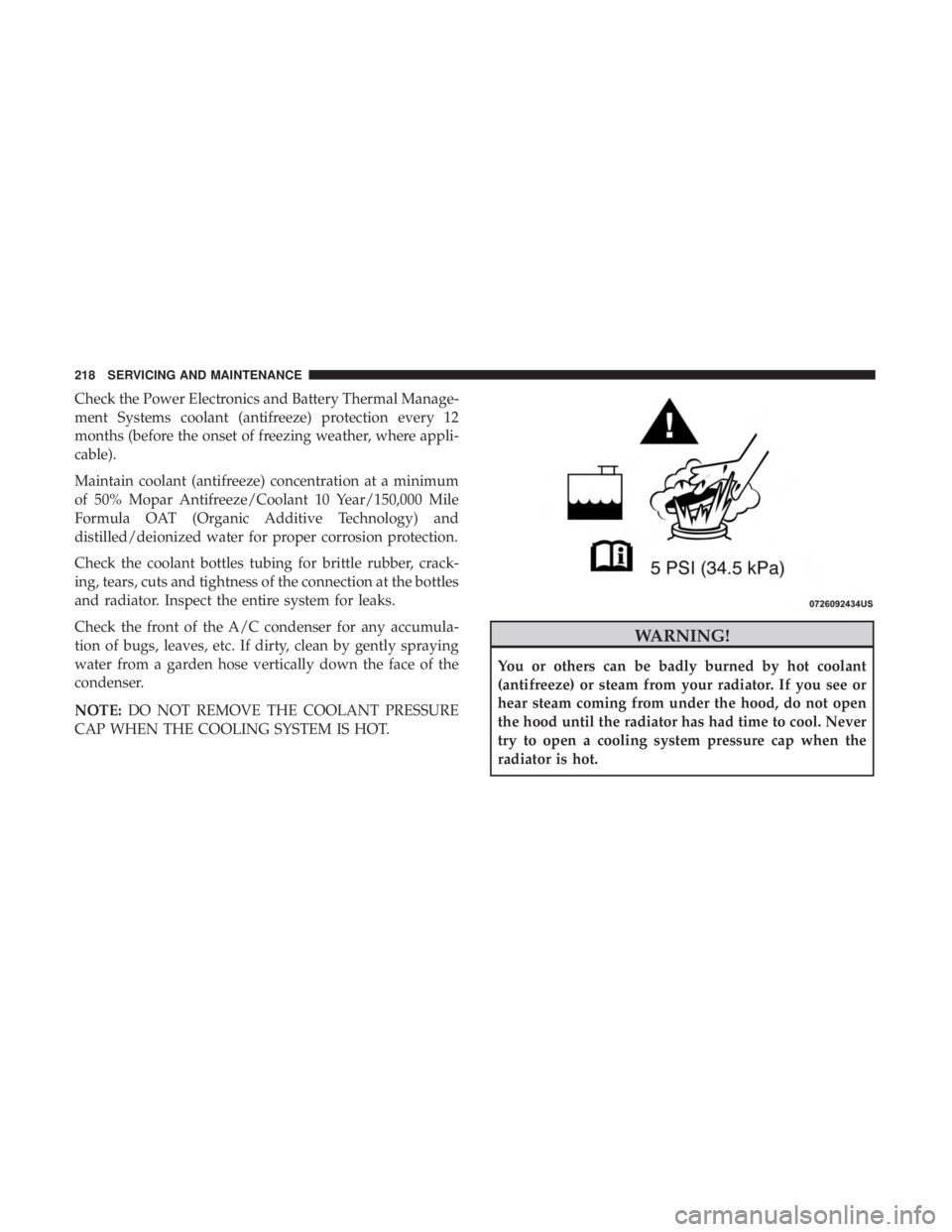
NOTE:DO NOT REMOVE THE COOLANT PRESSURE
CAP WHEN THE COOLING SYSTEM IS HOT.
WARNING!
You or others can be badly burned by hot coolant
(antifreeze) or steam from your radiator. If you see or
hear steam coming from under the hood, do not open
the hood until the radiator has had time to cool. Never
try to open a cooling system pressure cap when the
radiator is hot.
218 SERVICING AND MAINTENANCE
Page 221 of 300
Power Electronics And Battery Thermal
Management Systems — Cooling Pressure Caps
The caps must be fully tightened to prevent loss of coolant
(antifreeze).
The caps should be inspected and cleaned if there is any
accumulation of foreign material on the sealing surfaces.
NOTE:
•The pressure caps on the reservoirs are unique and rated
at 5 PSI (34.5 kPa).
• Use only Mopar replacement parts.
WARNING!
•The warning words “DO NOT OPEN HOT” on the
cooling system pressure cap are a safety precaution.
Never add coolant (antifreeze) when the cooling
system is overheated. Do not loosen or remove the
cap to cool an overheated cooling system. Heat
causes pressure to build up in the cooling system. To
prevent scalding or injury, do not remove the pres-
sure cap while the system is hot or under pressure.
• Do not use a pressure cap other than the one speci-
fied for your vehicle. Personal injury or vehicle
damage may result.
Selection Of Coolant
Refer to “Fluids And Lubricants” in “Technical Specifica-
tions” for further information.
CAUTION!
• Mixing of coolant (antifreeze) other than specified
Organic Additive Technology (OAT) coolant (anti-
freeze), may result in cooling system damage and
may decrease corrosion protection. Organic Additive
Technology (OAT) coolant is different and should
not be mixed with Hybrid Organic Additive Tech-
nology (HOAT) coolant (antifreeze). If a non-OAT
coolant (antifreeze) is introduced into the cooling
system in an emergency, it should be replaced with
the specified coolant (antifreeze) as soon as possible.
• Do not use water alone or alcohol-based coolant
(antifreeze) products. Do not use additional rust
inhibitors or antirust products, as they may not be
compatible with the radiator coolant and may plug
the radiator.
• This vehicle has not been designed for use with
propylene glycol-based coolant (antifreeze). Use of
propylene glycol-based coolant (antifreeze) is not
recommended.
8
SERVICING AND MAINTENANCE 219
Page 222 of 300
Adding Coolant
Your vehicle has been built with cooling systems that allow
extended maintenance intervals. This coolant (antifreeze)
can be used up to ten years or 150,000 miles (240,000 km)
before replacement. To prevent reducing this extended
maintenance period, it is important that you use the same
coolant (antifreeze) throughout the life of your vehicle.
Please review these recommendations for using Organic
Additive Technology (OAT) coolant (antifreeze).
When adding coolant (antifreeze):
•The manufacturer recommends using Mopar
Antifreeze/Coolant 10 Year/150,000 Mile (240,000 km)
Formula OAT (Organic Additive Technology).
• Mix a minimum solution of 50% OAT coolant (anti-
freeze) and distilled water. Use higher concentrations
(not to exceed 70%) if temperatures below -34ºF (-37ºC)
are anticipated.
• Use only high purity water such as distilled or deionized
water when mixing the water and coolant (antifreeze)
solution. The use of lower quality water will reduce the
amount of corrosion protection in the cooling systems. Please note that it is the owner ’s responsibility to maintain
the proper level of protection against freezing according to
the temperatures occurring in the area where the vehicle is
operated.
NOTE:
Mixing coolant (antifreeze) types will decrease the
life of the Power Electronics and Battery Thermal Manage-
ment Systems coolant (antifreeze) and will require more
frequent coolant (antifreeze) changes.
Power Electronics And Battery Thermal
Management Systems — Drain, Flush And Refill
Refer to “Scheduled Servicing” for the proper maintenance
intervals.
If the coolant (antifreeze) is dirty or contains a considerable
amount of sediment, clean and flush with a reliable cooling
system cleaner. Follow with a thorough rinsing to remove
all deposits and chemicals. Properly dispose of old coolant
(antifreeze) solution.
220 SERVICING AND MAINTENANCE
Page 223 of 300
CAUTION!
It is recommended to have the cooling systems ser-
viced at your authorized dealer. Failure to do so could
result in poor cooling system performance and/or ve-
hicle damage.
Disposal Of Used Power Electronics And Battery
Thermal Management Systems Coolant
Used antifreeze is a regulated substance requiring proper
disposal. Check with your local authorities to determine
the disposal rules for your community. To prevent inges-
tion by animals or children, do not store antifreeze in open
containers or allow it to remain in puddles on the ground.
If ingested by a child, contact a physician immediately.
Clean up any ground spills immediately.
Points To Remember
WARNING!
•Turn vehicle OFF and disconnect the fan motor lead
before working near the radiator cooling fan.
• You or others can be badly burned by hot coolant
(antifreeze) or steam from your radiator. If you see or
hear steam coming from under the hood, do not open
the hood until the radiator has had time to cool.
Never open a cooling system pressure cap when the
radiator or coolant bottle is hot.
• Do not put your hands, tools, clothing, and jewelry
near the radiator cooling fan. The fan may start at any
time, whether the ignition is on or off.
If an examination of your underhood compartment shows
no evidence of cooler or hose leaks, the vehicle may be
safely driven.
• Do not overfill the coolant recovery bottles.
• Check coolant (antifreeze) freeze point in the coolant
recovery bottles. If coolant (antifreeze) needs to be
added, contents of coolant recovery bottles must also be
protected against freezing.
8
SERVICING AND MAINTENANCE 221
Page 236 of 300
Tires — General Information
Tire Pressure
Proper tire inflation pressure is essential to the safe and
satisfactory operation of your vehicle. Four primary areas
are affected by improper tire pressure:
•Safety and Vehicle Stability
• Energy Consumption
• Tread Wear
• Ride Comfort
Safety
WARNING!
• Improperly inflated tires are dangerous and can
cause collisions.
• Underinflation increases tire flexing and can result
in overheating and tire failure.
• Overinflation reduces a tire’s ability to cushion
shock. Objects on the road and chuckholes can cause
damage that result in tire failure.
(Continued)
WARNING! (Continued)
•Overinflated or underinflated tires can affect vehicle
handling and can fail suddenly, resulting in loss of
vehicle control.
• Unequal tire pressures can cause steering problems.
You could lose control of your vehicle.
• Unequal tire pressures from one side of the vehicle
to the other can cause the vehicle to drift to the right
or left.
• Always drive with each tire inflated to the recom-
mended cold tire inflation pressure.
Both under-inflation and over-inflation affect the stability
of the vehicle and can produce a feeling of sluggish
response or over responsiveness in the steering.
NOTE:
• Unequal tire pressures from side to side may cause
erratic and unpredictable steering response.
• Unequal tire pressure from side to side may cause the
vehicle to drift left or right.
Battery Consumption
Underinflated tires will increase tire rolling resistance
resulting in higher battery charge consumption.
234 SERVICING AND MAINTENANCE
Page 250 of 300
WARNING!
The traction grade assigned to this tire is based on
straight-ahead braking traction tests, and does not
include acceleration, cornering, hydroplaning, or
peak traction characteristics.
Temperature Grades
The Temperature grades are A (the highest), B, and C,
representing the tire’s resistance to the generation of
heat and its ability to dissipate heat, when tested under
controlled conditions on a specified indoor laboratory
test wheel.
Sustained high temperature can cause the material of
the tire to degenerate and reduce tire life, and excessive
temperature can lead to sudden tire failure. The grade C
corresponds to a level of performance, which all pas-
senger vehicle tires must meet under the Federal Motor
Vehicle Safety Standard No. 109. Grades B and A
represent higher levels of performance on the laboratory
test wheel, than the minimum required by law.
WARNING!
The temperature grade for this tire is established for
a tire that is properly inflated and not overloaded.
Excessive speed, under-inflation, or excessive load-
ing, either separately or in combination, can cause
heat buildup and possible tire failure.
STORING THE VEHICLE
The preferred way of storing your vehicle for a long period
of time is to leave it attached to a Level 1 or Level 2 charger.
The vehicle has a wake-up feature that will wake the
system every 3 weeks and do a maintenance charge on the
12 Volt battery and also top off the high voltage battery if
necessary.
Anytime you store your vehicle, or keep it out of service
(e.g., vacation) for two weeks or more, run the air condi-
tioning system at idle for about five minutes in the fresh air
and high blower setting. This will ensure adequate system
lubrication to minimize the possibility of compressor dam-
age when the air conditioning system is started again.
248 SERVICING AND MAINTENANCE