check engine light FIAT 500L LIVING 2014 2.G User Guide
[x] Cancel search | Manufacturer: FIAT, Model Year: 2014, Model line: 500L LIVING, Model: FIAT 500L LIVING 2014 2.GPages: 420, PDF Size: 9.77 MB
Page 191 of 420
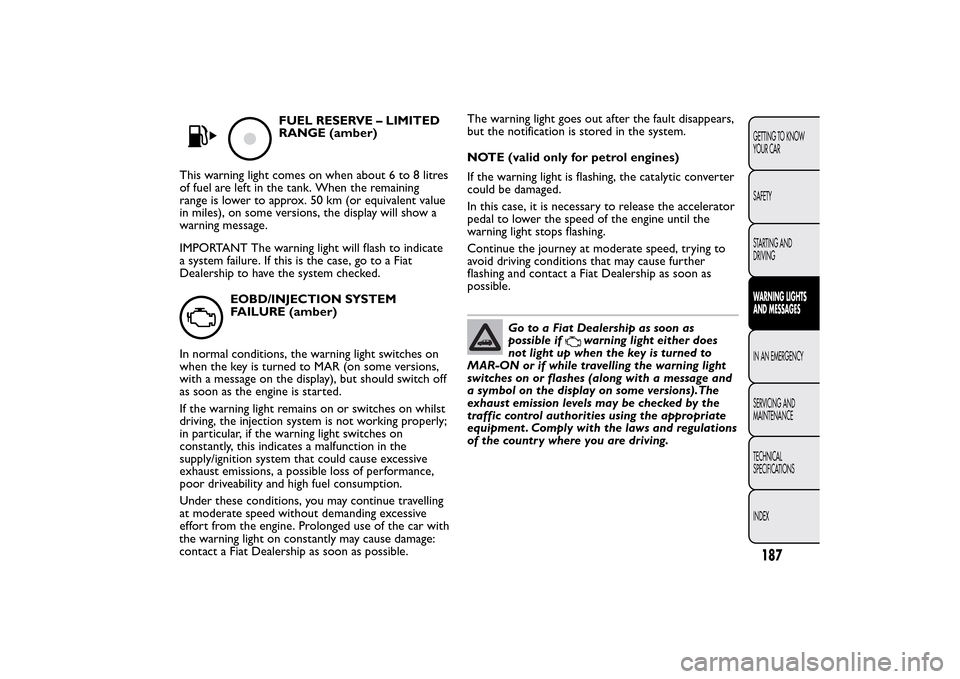
FUEL RESERVE – LIMITED
RANGE (amber)
This warning light comes on when about 6 to 8 litres
of fuel are left in the tank. When the remaining
range is lower to approx. 50 km (or equivalent value
in miles), on some versions, the display will show a
warning message.
IMPORTANT The warning light will flash to indicate
a system failure. If this is the case, go to a Fiat
Dealership to have the system checked.
EOBD/INJECTION SYSTEM
FAILURE (amber)
In normal conditions, the warning light switches on
when the key is turned to MAR (on some versions,
with a message on the display), but should switch off
as soon as the engine is started.
If the warning light remains on or switches on whilst
driving, the injection system is not working properly;
in particular, if the warning light switches on
constantly, this indicates a malfunction in the
supply/ignition system that could cause excessive
exhaust emissions, a possible loss of performance,
poor driveability and high fuel consumption.
Under these conditions, you may continue travelling
at moderate speed without demanding excessive
effort from the engine. Prolonged use of the car with
the warning light on constantly may cause damage:
contact a Fiat Dealership as soon as possible.The warning light goes out after the fault disappears,
but the notification is stored in the system.
NOTE (valid only for petrol engines)
If the warning light is flashing, the catalytic converter
could be damaged.
In this case, it is necessary to release the accelerator
pedal to lower the speed of the engine until the
warning light stops flashing.
Continue the journey at moderate speed, trying to
avoid driving conditions that may cause further
flashing and contact a Fiat Dealership as soon as
possible.
Go to a Fiat Dealership as soon as
possible if
warning light either does
not light up when the key is turned to
MAR-ON or if while travelling the warning light
switches on or flashes (along with a message and
a symbol on the display on some versions).The
exhaust emission levels may be checked by the
traffic control authorities using the appropriate
equipment . Comply with the laws and regulations
of the country where you are driving.
187GETTING TO KNOW
YOUR CAR
SAFETY
STARTING AND
DRIVINGWARNING LIGHTS
AND MESSAGESIN AN EMERGENCY
SERVICING AND
MAINTENANCE
TECHNICAL
SPECIFICATIONS
INDEX
Page 209 of 420
WARNING
The cylinder contains ethyl glycol.
Contains latex: may cause an allergic
reaction. Harmful if swallowed. Eye irritant .
May cause irritation if inhaled or on contact .
Avoid contact with eyes, skin and clothes. In the
event of contact , wash immediately with plenty
of water. If ingested, do not induce vomiting.
Rinse out your mouth, drink large quantities of
water and seek immediate medical attention.
Keep away from children.The product must not
be used by asthmatics. Do not inhale the
vapours during insertion and suction. Call a
doctor immediately if allergic reactions are
noted. Store the canister in its proper
compartment , away from sources of heat .The
sealant fluid has an expiry date. Replace the
bottle containing out-of-date sealant fluid.Dispose of the bottle and the sealant
liquid properly. Have the sealing fluid and
the cylinder disposed of in compliance
with national and local regulations.
INFLATING PROCEDURE
WARNING
Put on the protective gloves provided
together with quick tyre repair kit .Proceed as follows:
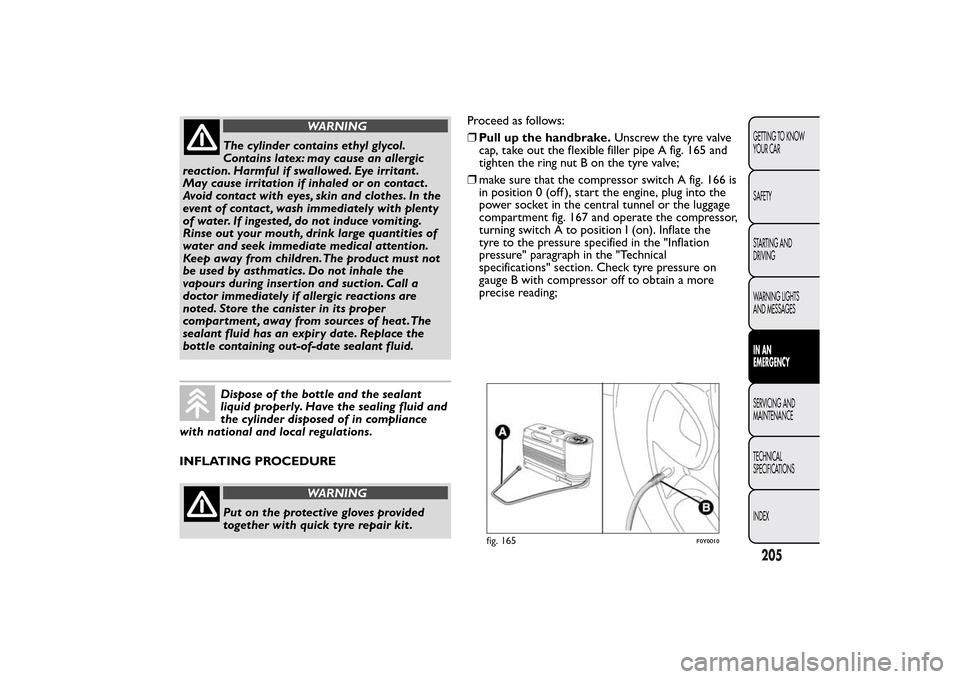
❒Pull up the handbrake.Unscrew the tyre valve
cap, take out the flexible filler pipe A fig. 165 and
tighten the ring nut B on the tyre valve;
❒make sure that the compressor switch A fig. 166 is
in position 0 (off ), start the engine, plug into the
power socket in the central tunnel or the luggage
compartment fig. 167 and operate the compressor,
turning switch A to position I (on). Inflate the
tyre to the pressure specified in the "Inflation
pressure" paragraph in the "Technical
specifications" section. Check tyre pressure on
gauge B with compressor off to obtain a more
precise reading;
fig. 165
F0Y0010
205GETTING TO KNOW
YOUR CAR
SAFETY
STARTING AND
DRIVING
WARNING LIGHTS
AND MESSAGESIN AN
EMERGENCYSERVICING AND
MAINTENANCE
TECHNICAL
SPECIFICATIONS
INDEX
Page 229 of 420
REPLACING FUSESGENERAL INFORMATION
Fuses protect the electrical system: they intervene
(blow) in the event of a failure or improper
intervention on the system.
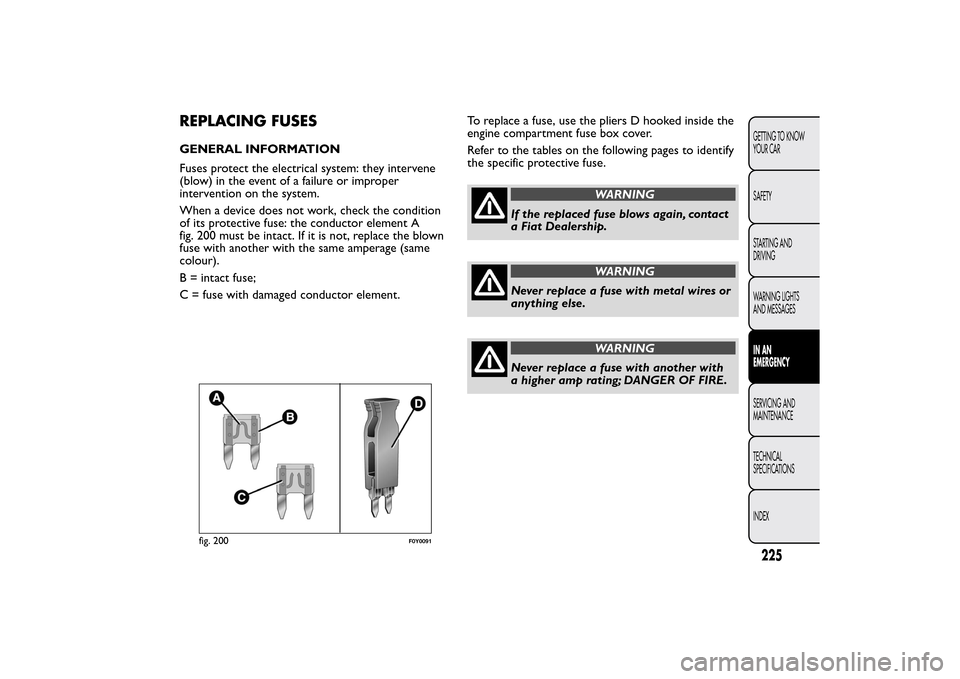
When a device does not work, check the condition
of its protective fuse: the conductor element A
fig. 200 must be intact. If it is not, replace the blown
fuse with another with the same amperage (same
colour).
B = intact fuse;
C = fuse with damaged conductor element.To replace a fuse, use the pliers D hooked inside the
engine compartment fuse box cover.
Refer to the tables on the following pages to identify
the specific protective fuse.
WARNING
If the replaced fuse blows again, contact
a Fiat Dealership.
WARNING
Never replace a fuse with metal wires or
anything else.
WARNING
Never replace a fuse with another with
a higher amp rating; DANGER OF FIRE.
fig. 200
F0Y0091
225GETTING TO KNOW
YOUR CAR
SAFETY
STARTING AND
DRIVING
WARNING LIGHTS
AND MESSAGESIN AN
EMERGENCYSERVICING AND
MAINTENANCE
TECHNICAL
SPECIFICATIONS
INDEX
Page 243 of 420
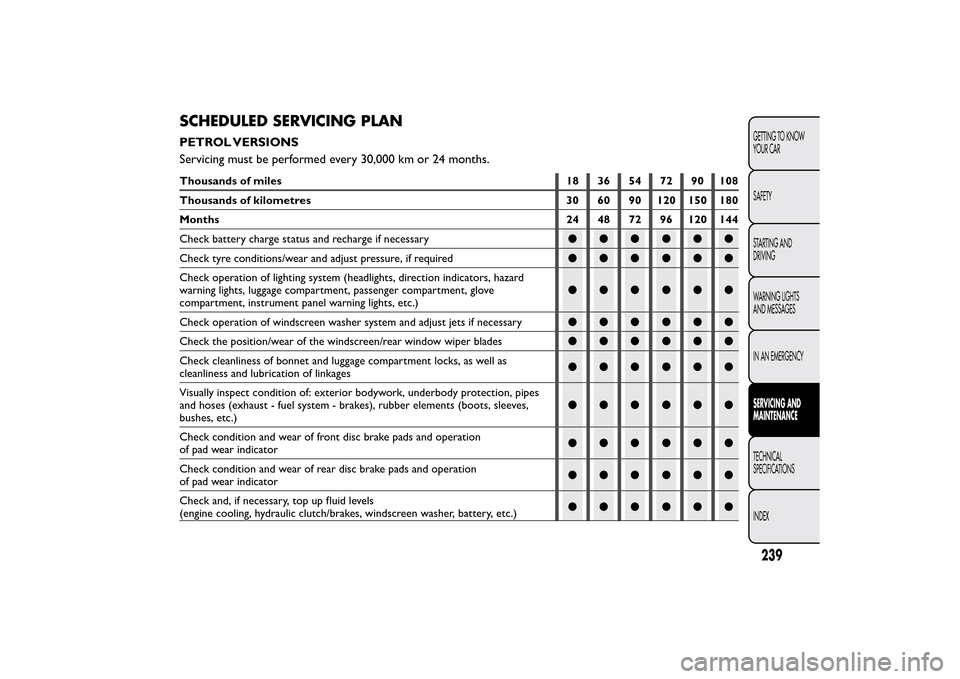
SCHEDULED SERVICING PLANPETROL VERSIONS
Servicing must be performed every 30,000 km or 24 months.Thousands of miles 18 36 54 72 90 108
Thousands of kilometres 30 60 90 120 150 180
Months 24 48 72 96 120 144
Check battery charge status and recharge if necessary●●●●●●
Check tyre conditions/wear and adjust pressure, if required●●●●●●
Check operation of lighting system (headlights, direction indicators, hazard
warning lights, luggage compartment, passenger compartment, glove
compartment, instrument panel warning lights, etc.)●●●●●●
Check operation of windscreen washer system and adjust jets if necessary●●●●●●
Check the position/wear of the windscreen/rear window wiper blades●●●●●●
Check cleanliness of bonnet and luggage compartment locks, as well as
cleanliness and lubrication of linkages●●●●●●
Visually inspect condition of: exterior bodywork, underbody protection, pipes
and hoses (exhaust - fuel system - brakes), rubber elements (boots, sleeves,
bushes, etc.)●●●●●●
Check condition and wear of front disc brake pads and operation
of pad wear indicator●●●●●●
Check condition and wear of rear disc brake pads and operation
of pad wear indicator●●●●●●
Check and, if necessary, top up fluid levels
(engine cooling, hydraulic clutch/brakes, windscreen washer, battery, etc.)●●●●●●
239GETTING TO KNOW
YOUR CAR
SAFETY
STARTING AND
DRIVING
WARNING LIGHTS
AND MESSAGES
IN AN EMERGENCYSERVICING AND
MAINTENANCETECHNICAL
SPECIFICATIONS
INDEX
Page 244 of 420
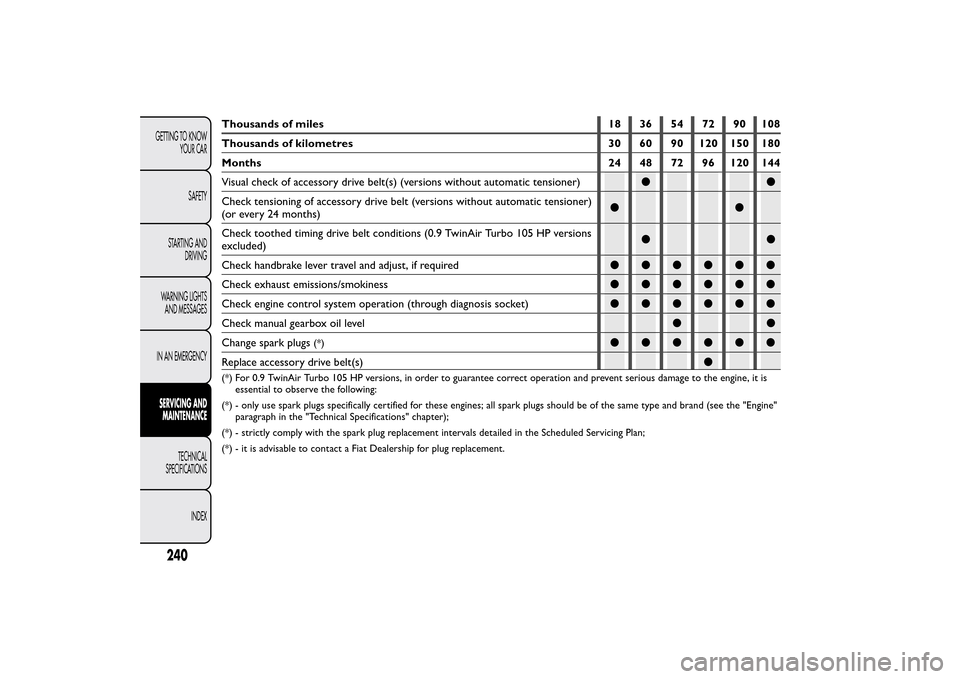
Thousands of miles 18 36 54 72 90 108
Thousands of kilometres 30 60 90 120 150 180
Months 24 48 72 96 120 144
Visual check of accessory drive belt(s) (versions without automatic tensioner)●●
Check tensioning of accessory drive belt (versions without automatic tensioner)
(or every 24 months)●●
Check toothed timing drive belt conditions (0.9 TwinAir Turbo 105 HP versions
excluded)●●
Check handbrake lever travel and adjust, if required●●●●●●
Check exhaust emissions/smokiness●●●●●●
Check engine control system operation (through diagnosis socket)●●●●●●
Check manual gearbox oil level●●
Change spark plugs
(*)
●●●●●●
Replace accessory drive belt(s)●
(*) For 0.9 TwinAir Turbo 105 HP versions, in order to guarantee correct operation and prevent serious damage to the engine, it is
essential to observe the following:
(*) - only use spark plugs specifically certified for these engines; all spark plugs should be of the same type and brand (see the "Engine"
paragraph in the "Technical Specifications" chapter);
(*) - strictly comply with the spark plug replacement intervals detailed in the Scheduled Servicing Plan;
(*) - it is advisable to contact a Fiat Dealership for plug replacement.
240GETTING TO KNOW
YOUR CAR
SAFETY
STARTING AND
DRIVING
WARNING LIGHTS
AND MESSAGES
IN AN EMERGENCYSERVICING AND
MAINTENANCE
TECHNICAL
SPECIFICATIONS
INDEX
Page 246 of 420
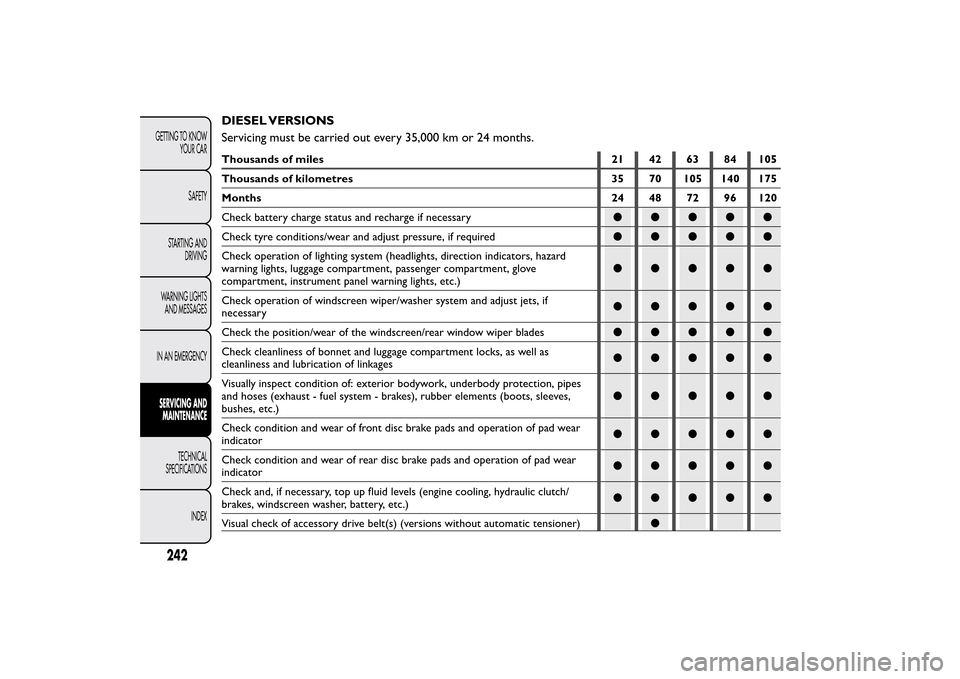
DIESEL VERSIONS
Servicing must be carried out every 35,000 km or 24 months.Thousands of miles 21 42 63 84 105
Thousands of kilometres 35 70 105 140 175
Months 24 48 72 96 120
Check battery charge status and recharge if necessary●●●●●
Check tyre conditions/wear and adjust pressure, if required●●●●●
Check operation of lighting system (headlights, direction indicators, hazard
warning lights, luggage compartment, passenger compartment, glove
compartment, instrument panel warning lights, etc.)●●●●●
Check operation of windscreen wiper/washer system and adjust jets, if
necessary●●●●●
Check the position/wear of the windscreen/rear window wiper blades●●●●●
Check cleanliness of bonnet and luggage compartment locks, as well as
cleanliness and lubrication of linkages●●●●●
Visually inspect condition of: exterior bodywork, underbody protection, pipes
and hoses (exhaust - fuel system - brakes), rubber elements (boots, sleeves,
bushes, etc.)●●●●●
Check condition and wear of front disc brake pads and operation of pad wear
indicator●●●●●
Check condition and wear of rear disc brake pads and operation of pad wear
indicator●●●●●
Check and, if necessary, top up fluid levels (engine cooling, hydraulic clutch/
brakes, windscreen washer, battery, etc.)●●●●●
Visual check of accessory drive belt(s) (versions without automatic tensioner)●
242GETTING TO KNOW
YOUR CAR
SAFETY
STARTING AND
DRIVING
WARNING LIGHTS
AND MESSAGES
IN AN EMERGENCYSERVICING AND
MAINTENANCE
TECHNICAL
SPECIFICATIONS
INDEX
Page 247 of 420
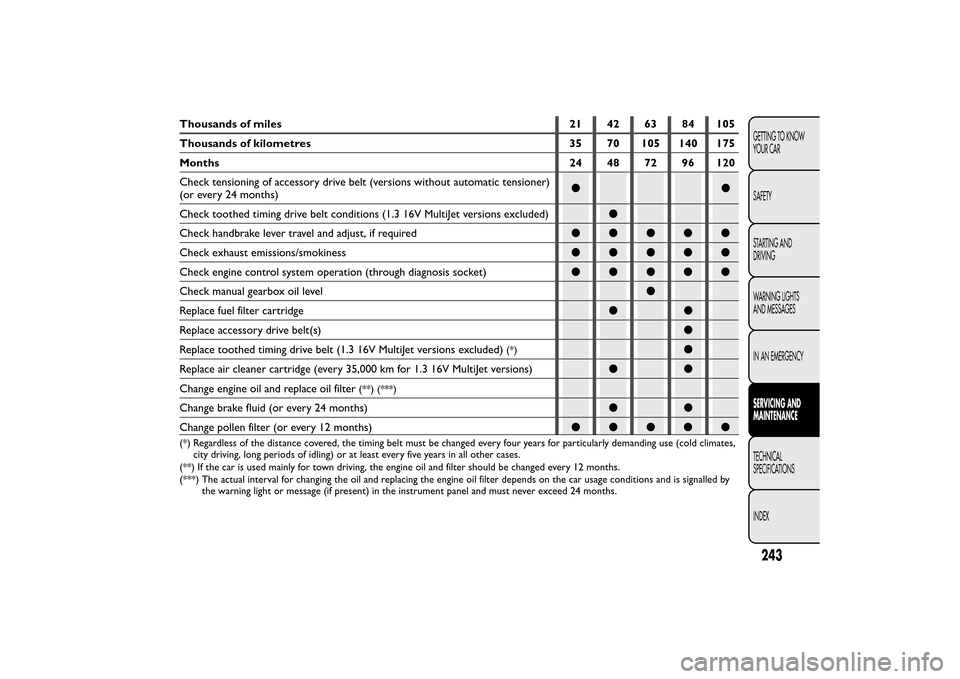
Thousands of miles 21 42 63 84 105
Thousands of kilometres 35 70 105 140 175
Months 24 48 72 96 120
Check tensioning of accessory drive belt (versions without automatic tensioner)
(or every 24 months)●●
Check toothed timing drive belt conditions (1.3 16V MultiJet versions excluded)●
Check handbrake lever travel and adjust, if required●●●●●
Check exhaust emissions/smokiness●●●●●
Check engine control system operation (through diagnosis socket)●●●●●
Check manual gearbox oil level●
Replace fuel filter cartridge●●
Replace accessory drive belt(s)●
Replace toothed timing drive belt (1.3 16V MultiJet versions excluded)
(*)
●
Replace air cleaner cartridge (every 35,000 km for 1.3 16V MultiJet versions)●●
Change engine oil and replace oil filter
(**) (***)
Change brake fluid (or every 24 months)●●
Change pollen filter (or every 12 months)●●●●●(*) Regardless of the distance covered, the timing belt must be changed every four years for particularly demanding use (cold climates,
city driving, long periods of idling) or at least every five years in all other cases.
(**) If the car is used mainly for town driving, the engine oil and filter should be changed every 12 months.
(***) The actual interval for changing the oil and replacing the engine oil filter depends on the car usage conditions and is signalled by
the warning light or message (if present) in the instrument panel and must never exceed 24 months.
243GETTING TO KNOW
YOUR CAR
SAFETY
STARTING AND
DRIVING
WARNING LIGHTS
AND MESSAGES
IN AN EMERGENCYSERVICING AND
MAINTENANCETECHNICAL
SPECIFICATIONS
INDEX
Page 248 of 420
PERIODIC CHECKSEvery 1,000 km or before long journeys, check and, if
necessary, restore the following:
❒engine coolant, brake fluid and windscreen washer
fluid level;
❒tyre inflation pressure and condition;
❒operation of lighting system (headlights, direction
indicators, hazard warning lights, etc.);
❒operation of screen washer/wiper system and
positioning/wear of windscreen/rear window wiper
blades.
Every 3,000 km, check and top up, if required, the
engine oil level.
HEAVY-DUTY USE OF THE CARIf the car is mainly used in one of the following
conditions:
❒towing a trailer or caravan;
❒dusty roads;
❒short, repeated journeys (less than 7-8 km) at
sub-zero outside temperatures;
❒engine often idling or driving long distances at low
speeds or long periods of idleness;
the following checks must be performed more
frequently than prescribed in the Scheduled Servicing
Plan:
❒check front disc brake pad conditions and wear;
❒check cleanliness of bonnet and boot locks,
cleanliness and lubrication of linkage;
❒visually inspect conditions of: engine, gearbox,
transmission, pipes and hoses (exhaust - fuel
system - brakes) and rubber elements (boots -
sleeves - bushes - etc.);
❒check battery charge and battery fluid level
(electrolyte);
❒visually inspect condition of the accessory drive
belts;
❒check and, if necessary, change engine oil and
replace oil filter;
❒check and, if necessary, replace pollen filter;
❒check and, if necessary, replace air cleaner.
244GETTING TO KNOW
YOUR CAR
SAFETY
STARTING AND
DRIVING
WARNING LIGHTS
AND MESSAGES
IN AN EMERGENCYSERVICING AND
MAINTENANCE
TECHNICAL
SPECIFICATIONS
INDEX
Page 249 of 420
CHECKING LEVELS
WARNING
Never smoke while working in the
engine compartment : gas and
inflammable vapours may be present , with the
risk of fire.
WARNING
Be very careful when working in the
engine compartment when the engine is
hot : you may get burned. Remember that the
fan may start up if the engine is hot : this could
injure you. Scarves, ties and other loose clothing
might be pulled by moving parts.
When topping up, take care not to mix up
the various types of fluids: they are not
compatible with each other and could
seriously damage the car.
245GETTING TO KNOW
YOUR CAR
SAFETY
STARTING AND
DRIVING
WARNING LIGHTS
AND MESSAGES
IN AN EMERGENCYSERVICING AND
MAINTENANCETECHNICAL
SPECIFICATIONS
INDEX
Page 254 of 420
ENGINE OIL
Check the oil level a few minutes (about 5) after the
engine has stopped, with the vehicle parked on
level ground.
For 1.4 16V, 1.3 16V MultiJet and 1.6 16V
MultiJet versions
Remove the engine oil dipstick A, clean it with a
lint-free cloth and reinsert it. Extract the engine oil
dipstick again and check that the level is between the
MIN and MAX marks on the dipstick.
The range between the MIN and MAX marks
corresponds to about 1 litre of oil.
If the oil level is near or under the MIN line, add oil
through the filler B until it reaches the MAX line.
The oil level must never exceed the MAX
mark.
For 0.9 TwinAir 105 HP versions
The engine oil dipstick A is integral with plug B.
Undo the plug, clean the dipstick with a cloth that
does not leave traces, reinsert the dipstick and
re-tighten the plug.
Unscrew the plug again and check that the engine oil
level is between the MIN and MAX marks on the
dipstick.Engine oil consumption
The maximum engine oil consumption is
approximately 400 grams every 1,000 km.
During the initial period of usage for the vehicle, the
engine is bedding in, therefore the engine oil
consumption may settle down only after the first
5,000 - 6,000 km.
IMPORTANT After adding or changing the oil, let the
engine run for a few seconds and wait a few minutes
after switching it off before checking the level.
Do not add oil with characteristics that
are different from those of the oil
currently in the engine.Used engine oil and oil filters contain
substances which are harmful to the
environment .To change the oil and filters,
we advise you to contact a Fiat Dealership.
250GETTING TO KNOW
YOUR CAR
SAFETY
STARTING AND
DRIVING
WARNING LIGHTS
AND MESSAGES
IN AN EMERGENCYSERVICING AND
MAINTENANCE
TECHNICAL
SPECIFICATIONS
INDEX