ignition FIAT 500L LIVING 2014 2.G User Guide
[x] Cancel search | Manufacturer: FIAT, Model Year: 2014, Model line: 500L LIVING, Model: FIAT 500L LIVING 2014 2.GPages: 420, PDF Size: 9.77 MB
Page 44 of 420
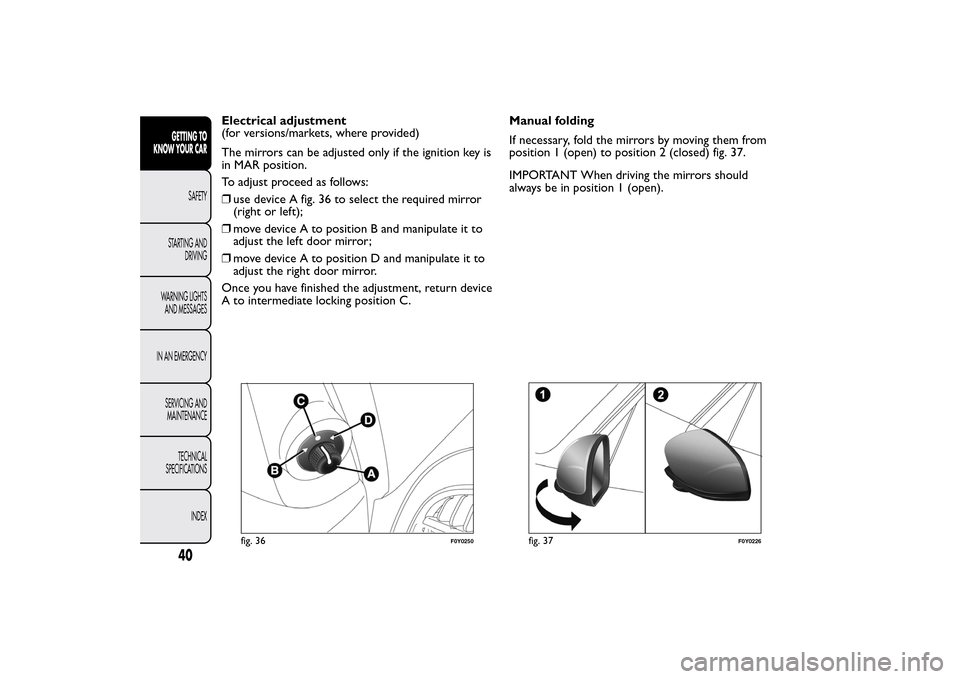
Electrical adjustment
(for versions/markets, where provided)
The mirrors can be adjusted only if the ignition key is
in MAR position.
To adjust proceed as follows:
❒use device A fig. 36 to select the required mirror
(right or left);
❒move device A to position B and manipulate it to
adjust the left door mirror;
❒move device A to position D and manipulate it to
adjust the right door mirror.
Once you have finished the adjustment, return device
A to intermediate locking position C.Manual folding
If necessary, fold the mirrors by moving them from
position 1 (open) to position 2 (closed) fig. 37.
IMPORTANT When driving the mirrors should
always be in position 1 (open).
fig. 36
F0Y0250
fig. 37
F0Y0226
40GETTING TO
KNOW YOUR CAR
SAFETY
STARTING AND
DRIVING
WARNING LIGHTS
AND MESSAGES
IN AN EMERGENCY
SERVICING AND
MAINTENANCE
TECHNICAL
SPECIFICATIONS
INDEX
Page 66 of 420
EXTERNAL LIGHTSThe left-hand stalk operates most of the external
lights.
The ignition key has to be in the MAR position for
the exterior lights to come on.
The instrument panel and the various dashboard
controls will come on with the external lights.
DAY LIGHTS (DRL)
"Daytime Running Lights"
(for versions/markets, where provided)
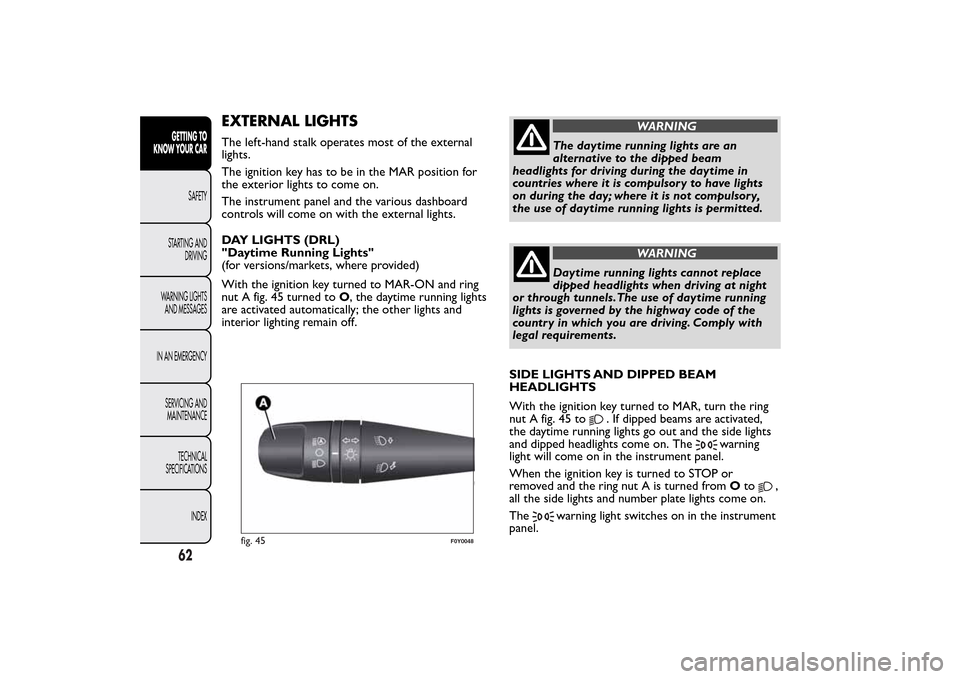
With the ignition key turned to MAR-ON and ring
nut A fig. 45 turned toO, the daytime running lights
are activated automatically; the other lights and
interior lighting remain off.
WARNING
The daytime running lights are an
alternative to the dipped beam
headlights for driving during the daytime in
countries where it is compulsory to have lights
on during the day; where it is not compulsory,
the use of daytime running lights is permitted.
WARNING
Daytime running lights cannot replace
dipped headlights when driving at night
or through tunnels.The use of daytime running
lights is governed by the highway code of the
country in which you are driving. Comply with
legal requirements.
SIDE LIGHTS AND DIPPED BEAM
HEADLIGHTS
With the ignition key turned to MAR, turn the ring
nut A fig. 45 to
. If dipped beams are activated,
the daytime running lights go out and the side lights
and dipped headlights come on. The
warning
light will come on in the instrument panel.
When the ignition key is turned to STOP or
removed and the ring nut A is turned fromOto
,
all the side lights and number plate lights come on.
The
warning light switches on in the instrument
panel.
fig. 45
F0Y0048
62GETTING TO
KNOW YOUR CAR
SAFETY
STARTING AND
DRIVING
WARNING LIGHTS
AND MESSAGES
IN AN EMERGENCY
SERVICING AND
MAINTENANCE
TECHNICAL
SPECIFICATIONS
INDEX
Page 68 of 420
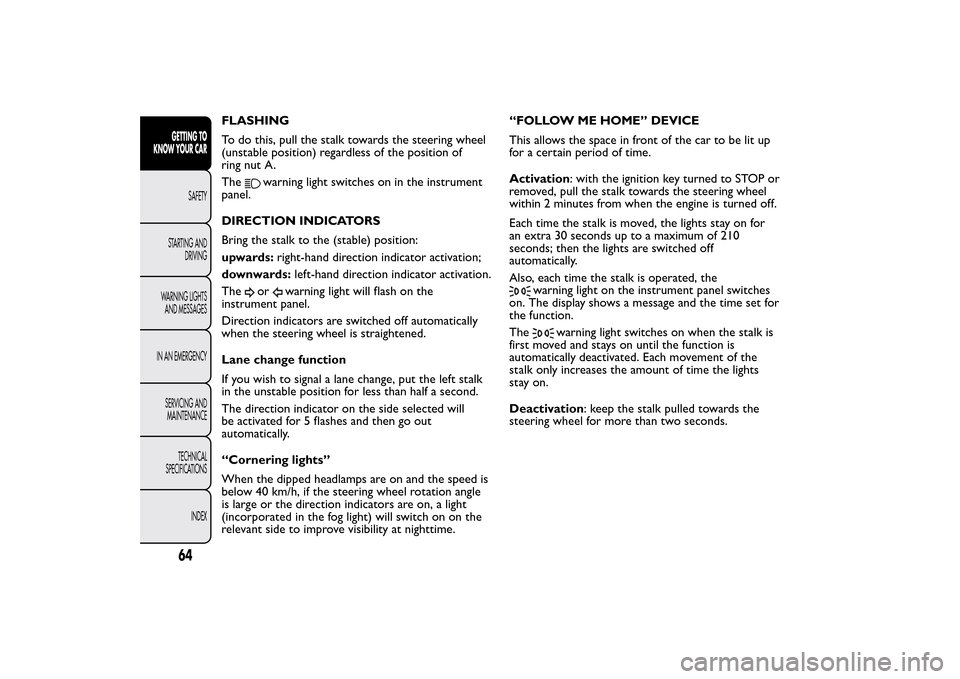
FLASHING
To do this, pull the stalk towards the steering wheel
(unstable position) regardless of the position of
ring nut A.
The
warning light switches on in the instrument
panel.
DIRECTION INDICATORS
Bring the stalk to the (stable) position:
upwards:right-hand direction indicator activation;
downwards:left-hand direction indicator activation.
Theor
warning light will flash on the
instrument panel.
Direction indicators are switched off automatically
when the steering wheel is straightened.
Lane change function
If you wish to signal a lane change, put the left stalk
in the unstable position for less than half a second.
The direction indicator on the side selected will
be activated for 5 flashes and then go out
automatically.
“Cornering lights”
When the dipped headlamps are on and the speed is
below 40 km/h, if the steering wheel rotation angle
is large or the direction indicators are on, a light
(incorporated in the fog light) will switch on on the
relevant side to improve visibility at nighttime.“FOLLOW ME HOME” DEVICE
This allows the space in front of the car to be lit up
for a certain period of time.
Activation: with the ignition key turned to STOP or
removed, pull the stalk towards the steering wheel
within 2 minutes from when the engine is turned off.
Each time the stalk is moved, the lights stay on for
an extra 30 seconds up to a maximum of 210
seconds; then the lights are switched off
automatically.
Also, each time the stalk is operated, the
warning light on the instrument panel switches
on. The display shows a message and the time set for
the function.
The
warning light switches on when the stalk is
first moved and stays on until the function is
automatically deactivated. Each movement of the
stalk only increases the amount of time the lights
stay on.
Deactivation: keep the stalk pulled towards the
steering wheel for more than two seconds.
64GETTING TO
KNOW YOUR CAR
SAFETY
STARTING AND
DRIVING
WARNING LIGHTS
AND MESSAGES
IN AN EMERGENCY
SERVICING AND
MAINTENANCE
TECHNICAL
SPECIFICATIONS
INDEX
Page 69 of 420
WINDOW CLEANINGThe right stalk controls windscreen wiper/washer
and heated rear window wiper/washer operation.
WINDSCREEN WASHER/WIPER
They can be operated only with the ignition key
turned to MAR.
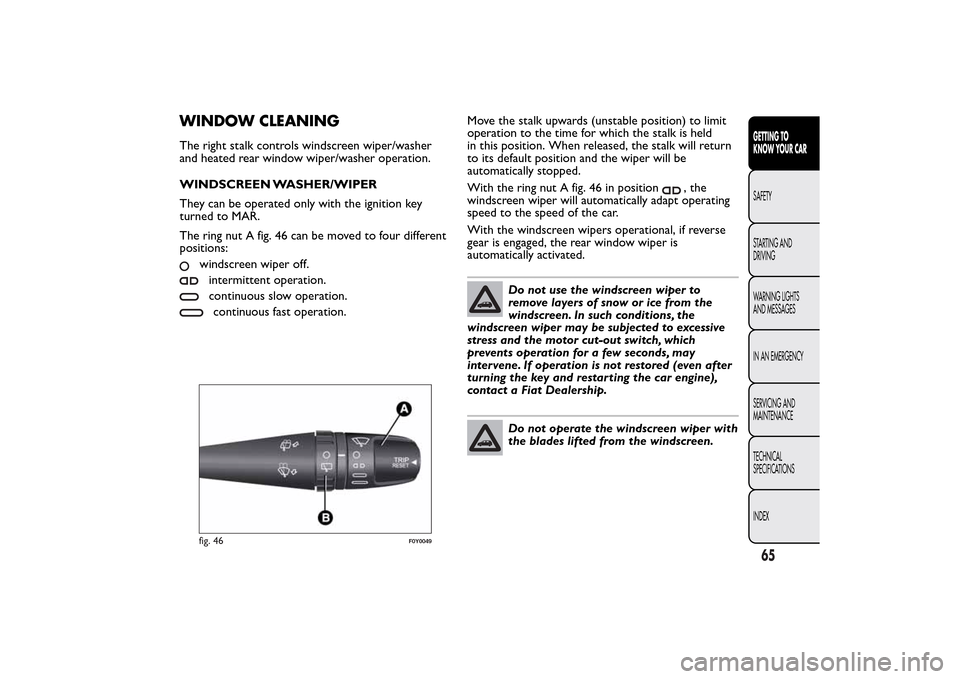
The ring nut A fig. 46 can be moved to four different
positions:
windscreen wiper off.intermittent operation.continuous slow operation.continuous fast operation.Move the stalk upwards (unstable position) to limit
operation to the time for which the stalk is held
in this position. When released, the stalk will return
to its default position and the wiper will be
automatically stopped.
With the ring nut A fig. 46 in position
, the
windscreen wiper will automatically adapt operating
speed to the speed of the car.
With the windscreen wipers operational, if reverse
gear is engaged, the rear window wiper is
automatically activated.
Do not use the windscreen wiper to
remove layers of snow or ice from the
windscreen. In such conditions, the
windscreen wiper may be subjected to excessive
stress and the motor cut-out switch, which
prevents operation for a few seconds, may
intervene. If operation is not restored (even after
turning the key and restarting the car engine),
contact a Fiat Dealership.Do not operate the windscreen wiper with
the blades lifted from the windscreen.
fig. 46
F0Y0049
65GETTING TO
KNOW YOUR CARSAFETY
STARTING AND
DRIVING
WARNING LIGHTS
AND MESSAGES
IN AN EMERGENCY
SERVICING AND
MAINTENANCE
TECHNICAL
SPECIFICATIONS
INDEX
Page 71 of 420
Deactivation
Move the stalk ring nut away from the position
or turn the ignition key to STOP.
If the ignition key is turned to the STOP position
leaving the ring nut A in position
, no wiping
cycle is performed at the next startup (ignition key
to the MAR-ON position) even in case of rain.
This prevents unwanted activation of the rain sensor
when the engine is started (i.e. when the windscreen
is being washed by hand or the wipers are stuck to
the windscreen by ice).
To restore automatic operation of the rain sensor,
turn ring nut A from
position to
position and
then turn the ring nut back to theposition.
When the rain sensor is reactivated using any of the
manoeuvres described above, reactivation is
indicated by a single stroke of the windscreen wipers,
regardless of the condition of the windscreen.
In the event of malfunction of the rain sensor whilst
it is active, the windscreen wiper operates
intermittently at a speed consistent with the
sensitivity setting of the rain sensor, regardless of
whether there is rain on the glass (on some versions
sensor failure is indicated on the display).
The sensor continues to operate and it is possible to
set the windscreen wiper to continuous mode (1
st
or 2
nd
speed). The failure indication remains for
as long as the sensor is active.The rain sensor is able to recognise, and
automatically adjust itself in the presence of the
following conditions:
❒presence of dirt on the controlled surface (salt,
dirt, etc.);
❒presence of streaks of water caused by the worn
window wiper blades;
❒difference between day and night.
Do not activate the rain sensor when
washing the car in an automatic car wash.Make sure the device is switched off if
there is ice on the windscreen.
WARNING
Make sure the device is switched off
whenever the windscreen must be
cleaned.
67GETTING TO
KNOW YOUR CARSAFETY
STARTING AND
DRIVING
WARNING LIGHTS
AND MESSAGES
IN AN EMERGENCY
SERVICING AND
MAINTENANCE
TECHNICAL
SPECIFICATIONS
INDEX
Page 72 of 420
REAR WINDOW WASHER/ WIPER
It can be operated only with the ignition key turned
to MAR.
Activation
Turn the ring nut B fig. 46 from
to
to operate
the rear window wiper as follows:
❒in intermittent mode when the windscreen wiper
is not operating;
❒in synchronous mode (at half the speed of the
windscreen wiper) when the windscreen wiper
is operating;
❒in continuous mode with reverse engaged.
With the windscreen wiper on and reverse gear
engaged, rear window wiping will be continuous in
the same way.
Pushing the stalk towards the dashboard (unstable
position) the rear window washer jet will activate.
Keep the stalk pushed for more than half a second to
activate the rear window wiper as well. Releasing
the stalk will activate the smart washing function, as
described for the windscreen wiper.
Deactivation
The function stops when the stalk is released.
Do not use the rear window wiper to
removelayersofsnoworice.In
such conditions, the wiper may be
subjected to excessive stress and the motor
protection, which prevents operation for a few
seconds, may intervene. If operation is not
restored, contact a Fiat Dealership.
68GETTING TO
KNOW YOUR CAR
SAFETY
STARTING AND
DRIVING
WARNING LIGHTS
AND MESSAGES
IN AN EMERGENCY
SERVICING AND
MAINTENANCE
TECHNICAL
SPECIFICATIONS
INDEX
Page 77 of 420
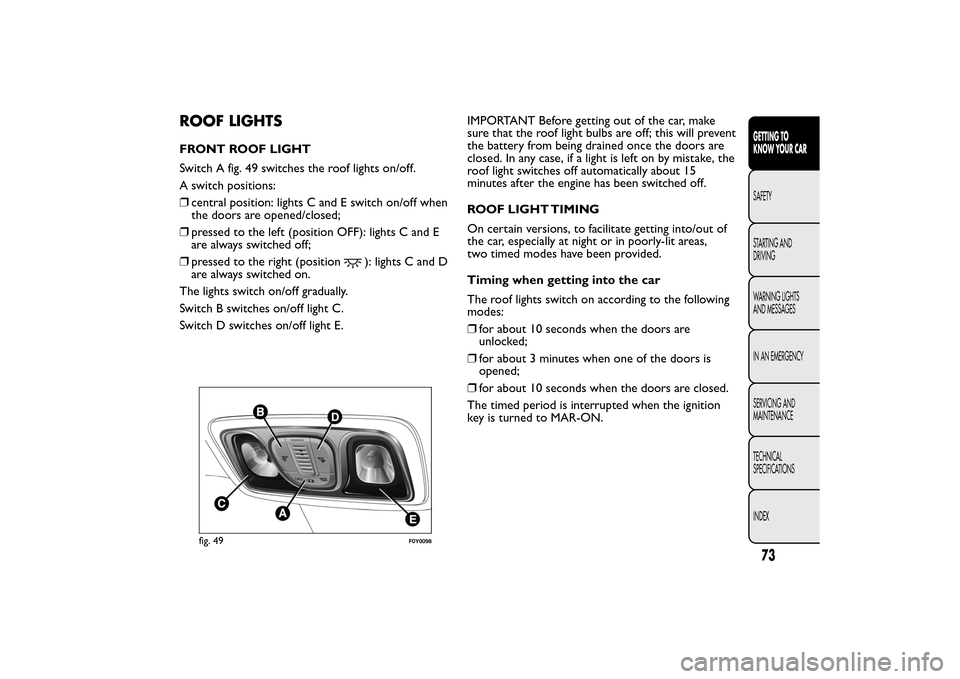
ROOF LIGHTSFRONT ROOF LIGHT
Switch A fig. 49 switches the roof lights on/off.
A switch positions:
❒central position: lights C and E switch on/off when
the doors are opened/closed;
❒pressed to the left (position OFF): lights C and E
are always switched off;
❒pressed to the right (position
): lights C and D
are always switched on.
The lights switch on/off gradually.
Switch B switches on/off light C.
Switch D switches on/off light E.IMPORTANT Before getting out of the car, make
sure that the roof light bulbs are off; this will prevent
the battery from being drained once the doors are
closed. In any case, if a light is left on by mistake, the
roof light switches off automatically about 15
minutes after the engine has been switched off.
ROOF LIGHT TIMING
On certain versions, to facilitate getting into/out of
the car, especially at night or in poorly-lit areas,
two timed modes have been provided.
Timing when getting into the car
The roof lights switch on according to the following
modes:
❒for about 10 seconds when the doors are
unlocked;
❒for about 3 minutes when one of the doors is
opened;
❒for about 10 seconds when the doors are closed.
The timed period is interrupted when the ignition
key is turned to MAR-ON.
fig. 49
F0Y0098
73GETTING TO
KNOW YOUR CARSAFETY
STARTING AND
DRIVING
WARNING LIGHTS
AND MESSAGES
IN AN EMERGENCY
SERVICING AND
MAINTENANCE
TECHNICAL
SPECIFICATIONS
INDEX
Page 78 of 420
The lights switch off in three ways:
❒when all doors are closed, the 3-minute timer will
stop and a 10-second one will start. This timer will
stop when the key is turned to MAR-ON;
❒when doors are locked (either with remote
control or with key on driver side door), the roof
light switches off;
❒the interior lights are switched off in any case after
15 minutes to preserve battery charge.
Timing when getting out of the car
After removing the key from the ignition switch, the
roof lights switch on as follows:
❒if the ignition key is removed within 3 minutes
from the engine stopping, the roof lights switch on
for 10 seconds;
❒for about 3 minutes when one of the doors is
opened;
❒for about 10 seconds when one of the doors is
closed.
The timing stops automatically when the doors are
locked.REAR ROOF LIGHT
Versions without sun roof (or glazed roof )
Press the cover A fig. 50 to switch the light on/off.
The light will stay on for a few seconds after the
doors are closed and will then switch off
automatically.
The light switches off in any case when the ignition
key is turned to MAR-ON.
The light switches off automatically after a few
minutes if a door is left open. To switch it on again, if
necessary, open another door or close and reopen
the same door or press the cover A.
fig. 50
F0Y0101
74GETTING TO
KNOW YOUR CAR
SAFETY
STARTING AND
DRIVING
WARNING LIGHTS
AND MESSAGES
IN AN EMERGENCY
SERVICING AND
MAINTENANCE
TECHNICAL
SPECIFICATIONS
INDEX
Page 79 of 420
Versions with sun roof (or with glazed roof )
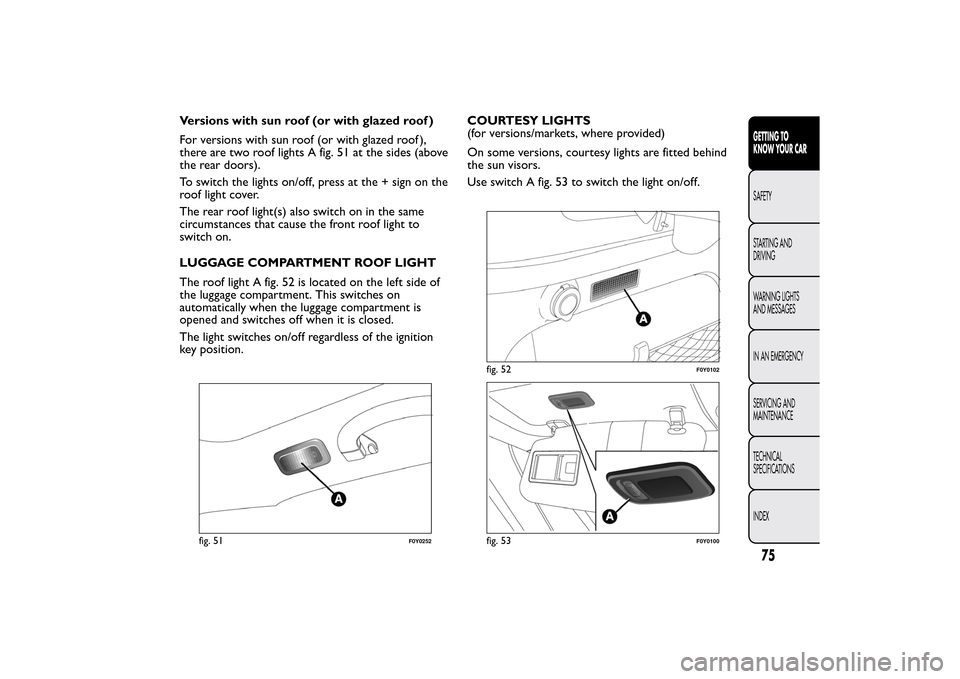
For versions with sun roof (or with glazed roof ),
there are two roof lights A fig. 51 at the sides (above
the rear doors).
To switch the lights on/off, press at the + sign on the
roof light cover.
The rear roof light(s) also switch on in the same
circumstances that cause the front roof light to
switch on.
LUGGAGE COMPARTMENT ROOF LIGHT
The roof light A fig. 52 is located on the left side of
the luggage compartment. This switches on
automatically when the luggage compartment is
opened and switches off when it is closed.
The light switches on/off regardless of the ignition
key position.COURTESY LIGHTS
(for versions/markets, where provided)
On some versions, courtesy lights are fitted behind
the sun visors.
Use switch A fig. 53 to switch the light on/off.
fig. 51
F0Y0252
fig. 52
F0Y0102
fig. 53
F0Y0100
75GETTING TO
KNOW YOUR CARSAFETY
STARTING AND
DRIVING
WARNING LIGHTS
AND MESSAGES
IN AN EMERGENCY
SERVICING AND
MAINTENANCE
TECHNICAL
SPECIFICATIONS
INDEX
Page 80 of 420
GLOVE COMPARTMENT LIGHT
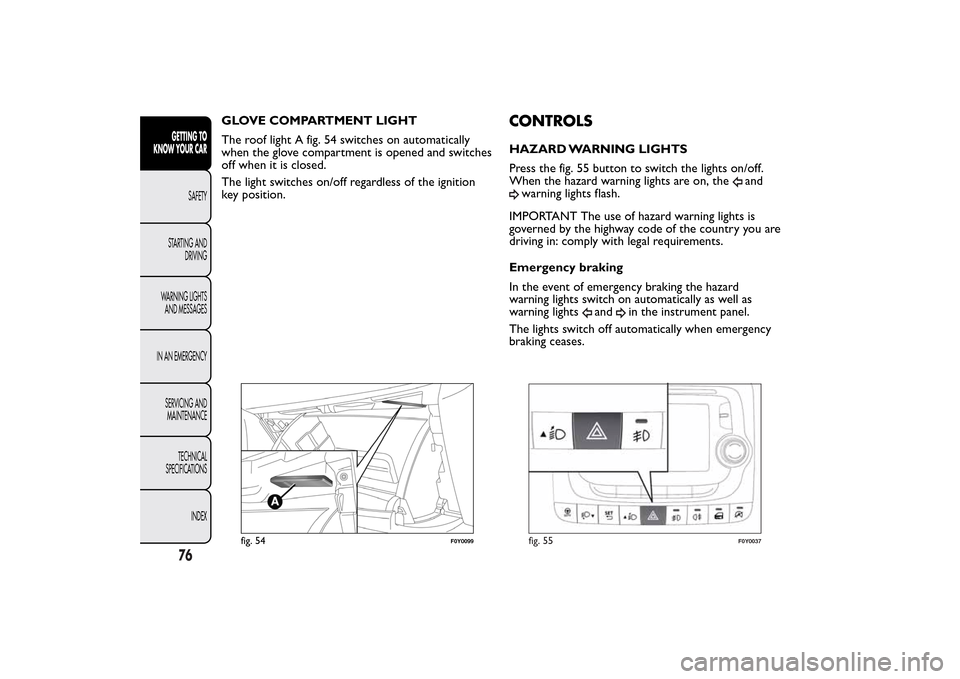
The roof light A fig. 54 switches on automatically
when the glove compartment is opened and switches
off when it is closed.
The light switches on/off regardless of the ignition
key position.
CONTROLSHAZARD WARNING LIGHTS
Press the fig. 55 button to switch the lights on/off.
When the hazard warning lights are on, the
and
warning lights flash.
IMPORTANT The use of hazard warning lights is
governed by the highway code of the country you are
driving in: comply with legal requirements.
Emergency braking
In the event of emergency braking the hazard
warning lights switch on automatically as well as
warning lights
and
in the instrument panel.
The lights switch off automatically when emergency
braking ceases.
fig. 54
F0Y0099
fig. 55
F0Y0037
76GETTING TO
KNOW YOUR CAR
SAFETY
STARTING AND
DRIVING
WARNING LIGHTS
AND MESSAGES
IN AN EMERGENCY
SERVICING AND
MAINTENANCE
TECHNICAL
SPECIFICATIONS
INDEX