sensor FIAT 500L LIVING 2014 2.G User Guide
[x] Cancel search | Manufacturer: FIAT, Model Year: 2014, Model line: 500L LIVING, Model: FIAT 500L LIVING 2014 2.GPages: 420, PDF Size: 9.77 MB
Page 131 of 420
IMPORTANT
IMPORTANT In some circumstances, such as with
ice, snow or mud on the surface of the camera,
the camera sensitivity may be reduced.
IMPORTANT If the tailgate is to be re-painted
following to repairs, make sure the paint does not
get in contact with the camera.
IMPORTANT When parking, take the utmost care
over obstacles that may be above or under the
camera range.
WARNING
The responsibility for parking and other
manoeuvres is always and in any case
charged to the driver.While carr ying out these
manoeuvres, always make sure that no people
(especially children) or animals are in the area
concerned.The camera is an aid for the driver,
but the driver must never allow his/her
attention to lapse during potentially dangerous
manoeuvres, even those executed at low speeds.
Always keep a slow speed, so as to promptly
brake in case of obstacles.
It is vital, for correct operation, that the
camera is always kept clean and free from
any mud, dirt , snow or ice. Be careful not
to scratch or damage the camera while cleaning
it . Avoid using dry, rough or hard cloths.The
camera must be washed using clean water, with
the addition of car shampoo if necessary. In
washing stations which use steam or high-
pressure jets, clean the camera quickly, keeping
the nozzle more than 10 cm away from the
sensors. Also, do not apply stickers to the camera.
127GETTING TO
KNOW YOUR CARSAFETY
STARTING AND
DRIVING
WARNING LIGHTS
AND MESSAGES
IN AN EMERGENCY
SERVICING AND
MAINTENANCE
TECHNICAL
SPECIFICATIONS
INDEX
Page 137 of 420
RADIO TRANSMITTERS AND MOBILE
PHONES
Radio transmitter equipment (vehicle mobile phones,
CB radios etc.) cannot be used inside the car unless
a separate aerial is mounted externally.
IMPORTANT The use of these devices inside the
passenger compartment (without an external aerial)
may cause the electrical systems to malfunction.
This could compromise the safety of the car in
addition to constituting a potential hazard for
passengers' health.
In addition, transmission and reception of these
devices may be negatively affected by the shielding
effect of the car body. As far as the use of
EC-approved mobile phones is concerned (GSM,
GPRS, UMTS), follow the usage instructions provided
by the mobile phone manufacturer.
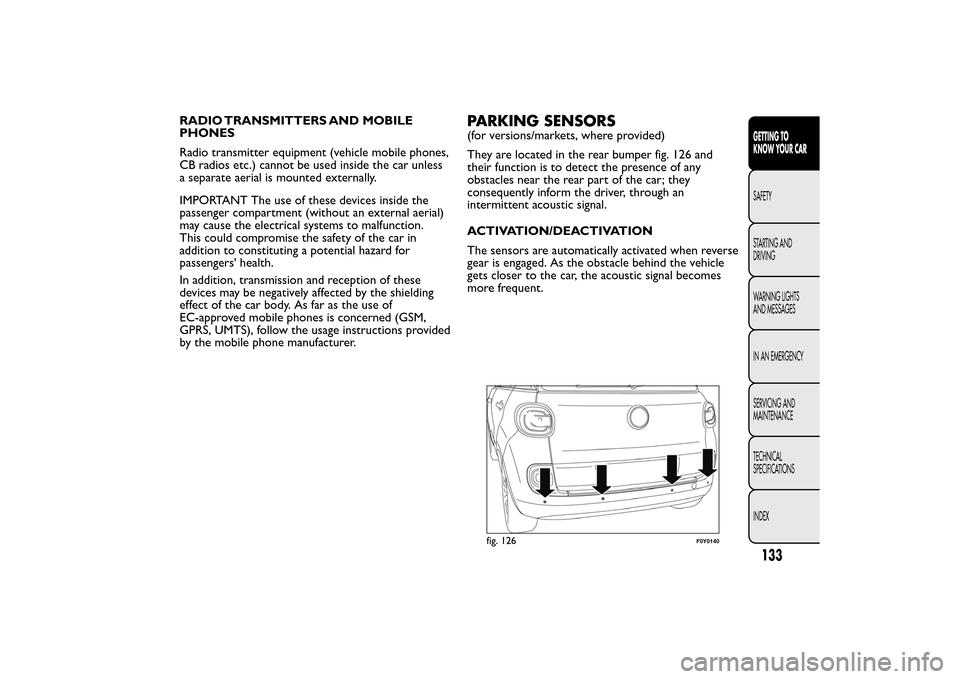
PARKING SENSORS(for versions/markets, where provided)
They are located in the rear bumper fig. 126 and
their function is to detect the presence of any
obstacles near the rear part of the car; they
consequently inform the driver, through an
intermittent acoustic signal.
ACTIVATION/DEACTIVATION
The sensors are automatically activated when reverse
gear is engaged. As the obstacle behind the vehicle
gets closer to the car, the acoustic signal becomes
more frequent.
fig. 126
F0Y0140
133GETTING TO
KNOW YOUR CARSAFETY
STARTING AND
DRIVING
WARNING LIGHTS
AND MESSAGES
IN AN EMERGENCY
SERVICING AND
MAINTENANCE
TECHNICAL
SPECIFICATIONS
INDEX
Page 138 of 420
ACOUSTIC SIGNAL
When reverse gear is engaged and there is an
obstacle behind the vehicle, an acoustic signal is
emitted which varies according to the distance of the
bumper from the obstacle.
The frequency of the acoustic signal:
❒increases as the distance between car and obstacle
decreases, culminating in a continuous acoustic
signal, when the distance is less than approximately
30 cm;
❒decreases if the distance from the obstacle
increases, until the signal ceases entirely;
❒remains constant if the distance between car and
obstacle remains unchanged; if this situation
concerns the side sensors, the signal will stop after
approximately 3 seconds to avoid, for example,
indications in the event of manoeuvres along
a wall.
If several obstacles are detected by the sensors, only
the nearest one is considered.FAULT INDICATION
Any parking sensor faults will be indicated when
reverse is engaged by the
warning light on the
instrument panel together with the message in the
multifunction display (for versions/markets, where
provided) (see “Warning lights and messages”
section).
OPERATION WITH TRAILER
Sensor operation is deactivated automatically when
the trailer's electric cable plug is fitted into the
car's tow hook socket.
The sensors are automatically reactivated when the
trailer's cable plug is removed.
For correct operation, sensors must always
be clean from mud, dirt , snow or ice. Be
careful not to scratch or damage the
sensors while cleaning them. Avoid using dry,
rough or hard cloths.The sensors should be
washed using clean water with the addition of car
shampoo if necessary.When using special
washing equipment such as high pressure jets or
steam cleaning, clean the sensors very quickly
keeping the jet more than 10 cm away. Also, do
not apply stickers to the sensors.
134GETTING TO
KNOW YOUR CAR
SAFETY
STARTING AND
DRIVING
WARNING LIGHTS
AND MESSAGES
IN AN EMERGENCY
SERVICING AND
MAINTENANCE
TECHNICAL
SPECIFICATIONS
INDEX
Page 139 of 420
GENERAL WARNINGS
When parking, take the utmost care over obstacles
that may be above or below the sensors.
Under certain circumstances, objects close to the
vehicle are not detected by the system and could
therefore cause damage to the car or be damaged
themselves.
Some conditions may influence the performance of
the parking sensors:
❒the presence of ice, snow, mud or think paint on
the sensor surface may cause reduced sensitivity
of the sensor itself and therefore reduce the
system performance.
❒mechanical interference (e.g. washing the car, rain,
strong wind, hail) may cause the sensor to detect a
non-existent obstacle ("echo interference");
❒the presence of ultrasonic systems (e.g. pneumatic
brake systems of trucks or pneumatic drills) near
the car could alter the signals sent by the sensor;
❒the variation in sensor position, caused by
variation in ride (due to suspension component
wear), changing tyres, overloaded car, or tuning
that lowers the car, for example, may affect
parking sensor system performance.
WARNING
The driver is always responsible for
parking manoeuvres however.When
making these manoeuvres, always make sure
that no people (especially children) or animals
are present in your manoeuvring area.The
parking sensors are an aid for the driver, but
must never allow their attention to lapse during
potentially dangerous manoeuvres, even those
executed at low speeds.
135GETTING TO
KNOW YOUR CARSAFETY
STARTING AND
DRIVING
WARNING LIGHTS
AND MESSAGES
IN AN EMERGENCY
SERVICING AND
MAINTENANCE
TECHNICAL
SPECIFICATIONS
INDEX
Page 144 of 420
PROTECTING THE ENVIRONMENTThe following devices are used for reducing petrol
fuel engine emissions: catalytic converter, oxygen
sensors and evaporation control system
Do not let the engine run, even for a test, with one
or more spark plugs disconnected.
The following devices are used for reducing diesel
fuel engine emissions: oxidising catalytic converter,
exhaust gas recirculation system (EGR) and
particulate filter (DPF).
DIESEL PARTICULATE FILTER
(for versions/markets, where provided)
The Diesel Particulate Filter is a mechanical filter,
integral with the exhaust system, that physically traps
particulates present in the exhaust gases of Diesel
engines.
The diesel particulate filter is needed to eliminate
almost all particulates in compliance with current/
future legislation.
During normal use of the vehicle, the engine control
unit records a set of data (e.g. travel time, type of
route, temperatures, etc.) and it will then calculate
how much particulate has been trapped by the filter.
Since this filter physically traps particulate, it should
be regenerated (cleaned) at regular intervals by
burning the carbon particles.The regeneration procedure is controlled
automatically by the engine management control unit
according to the filter conditions and car use
conditions.
During the regeneration there may be a limited
increase in the engine idle speed, fan activation, a
limited increase in fumes and high temperatures at
the exhaust.
These are not faults; they do not impair normal car
performance or damage the environment. If the
dedicated message is displayed, see contents of
"Warning lights and messages" chapter.
WARNING
The catalytic converter and particulate
filter (DPF) reach very high
temperatures during operation.Therefore, do
not park the car on flammable materials (grass,
dry leaves, pine needles etc .) to avoid the risk
of fire.
140GETTING TO
KNOW YOUR CAR
SAFETY
STARTING AND
DRIVING
WARNING LIGHTS
AND MESSAGES
IN AN EMERGENCY
SERVICING AND
MAINTENANCE
TECHNICAL
SPECIFICATIONS
INDEX
Page 196 of 420
DST (Dynamic Steering Torque or steering
corrector) system failure
The warning light switches on (together with a
message on the display) when a DST (steering
corrector) system failure is detected.
Water in diesel filter
The warning light switches on (together with a
message on the display) to indicate the presence of
water in the diesel filter.
Start&Stop failure
(for versions/markets, where provided)
The warning light switches on (together with a
message on the display) when a Start&Stop system
failure is detected.
LPG/methane level sensor failure
(for versions/markets, where provided)
The warning light switches on (together with a
message on the display) when an LPG/methane level
sensor failure is detected.
Temporary or permanent City Brake Control
- "Collision Mitigation" system failure
(for versions/markets, where provided)
The warning light switches on (together with a
message on the display) when a temporary or
permanent City Brake Control - "Collision
Mitigation" system failure is detected.Rain sensor failure
(for versions/markets, where provided)
The warning light switches on (together with a
message on the display) when a rain sensor failure is
detected.
Park Assist failure
(for versions/markets, where provided)
The warning light switches on (together with a
message on the display) when a Park Assist system
failure is detected.
Dusk sensor failure
(for versions/markets, where provided)
The warning light switches on (together with a
message on the display) when a dusk sensor failure is
detected.
Engine oil pressure sensor failure
Versions with multifunction display:engine oil pressure
sensor failure is indicated by the activation of the
warning light on the instrument panel.
Versions with reconf igurable multifunction display:the
engine oil pressure sensor failure is indicated by the
display icon switching on.
192GETTING TO KNOW
YOUR CAR
SAFETY
STARTING AND
DRIVINGWARNING LIGHTS
AND MESSAGESIN AN EMERGENCY
SERVICING AND
MAINTENANCE
TECHNICAL
SPECIFICATIONS
INDEX
Page 237 of 420
BATTERY RECHARGINGIMPORTANT The battery recharging procedure is
given as information only. You are advised to contact
a Fiat Dealership to have this operation carried
out.
Low amperage slow recharging for approximately 24
hours is advised. Charging for a longer time may
damage the battery.
VERSIONS WITHOUT Start&Stop SYSTEM
(for versions/markets, where provided)
Charge the battery as follows:
❒disconnect the negative battery terminal;
❒connect the charger cables to the battery
terminals, observing the polarity;
❒turn on the charger;
❒when finished, turn the charger off before
disconnecting the battery;
❒reconnect the negative battery terminal.
VERSIONS WITH Start&Stop SYSTEM
(for versions/markets, where provided)
Charge the battery as follows:
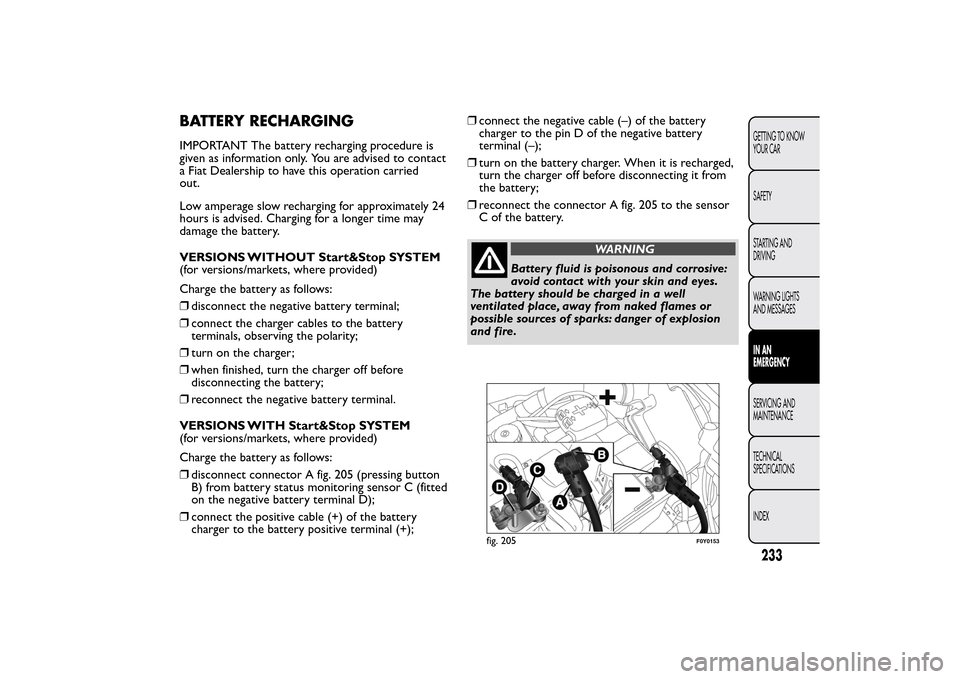
❒disconnect connector A fig. 205 (pressing button
B) from battery status monitoring sensor C (fitted
on the negative battery terminal D);
❒connect the positive cable (+) of the battery
charger to the battery positive terminal (+);❒connect the negative cable (–) of the battery
charger to the pin D of the negative battery
terminal (–);
❒turn on the battery charger. When it is recharged,
turn the charger off before disconnecting it from
the battery;
❒reconnect the connector A fig. 205 to the sensor
C of the battery.
WARNING
Battery fluid is poisonous and corrosive:
avoid contact with your skin and eyes.
The battery should be charged in a well
ventilated place, away from naked flames or
possible sources of sparks: danger of explosion
and fire.
fig. 205
F0Y0153
233GETTING TO KNOW
YOUR CAR
SAFETY
STARTING AND
DRIVING
WARNING LIGHTS
AND MESSAGESIN AN
EMERGENCYSERVICING AND
MAINTENANCE
TECHNICAL
SPECIFICATIONS
INDEX
Page 387 of 420
Clock & Date
Use this function to set the clock.
Time setting
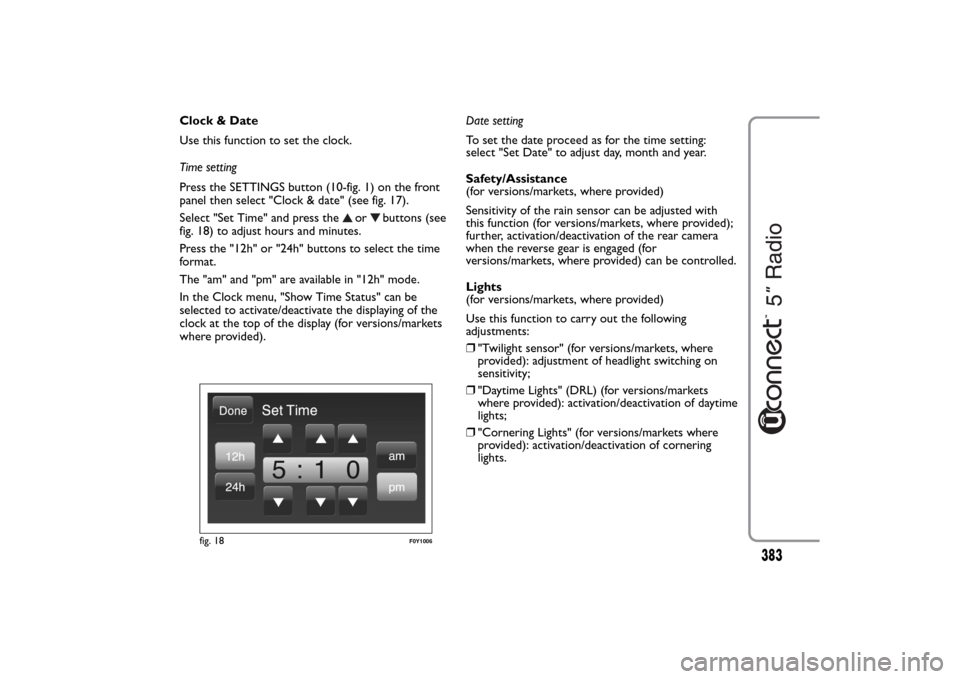
Press the SETTINGS button (10-fig. 1) on the front
panel then select "Clock & date" (see fig. 17).
Select "Set Time" and press the
or
buttons (see
fig. 18) to adjust hours and minutes.
Press the "12h" or "24h" buttons to select the time
format.
The "am" and "pm" are available in "12h" mode.
In the Clock menu, "Show Time Status" can be
selected to activate/deactivate the displaying of the
clock at the top of the display (for versions/markets
where provided).Date setting
To set the date proceed as for the time setting:
select "Set Date" to adjust day, month and year.
Safety/Assistance
(for versions/markets, where provided)
Sensitivity of the rain sensor can be adjusted with
this function (for versions/markets, where provided);
further, activation/deactivation of the rear camera
when the reverse gear is engaged (for
versions/markets, where provided) can be controlled.
Lights
(for versions/markets, where provided)
Use this function to carry out the following
adjustments:
❒"Twilight sensor" (for versions/markets, where
provided): adjustment of headlight switching on
sensitivity;
❒"Daytime Lights" (DRL) (for versions/markets
where provided): activation/deactivation of daytime
lights;
❒"Cornering Lights" (for versions/markets where
provided): activation/deactivation of cornering
lights.
fig. 18
F0Y1006
383
Page 413 of 420
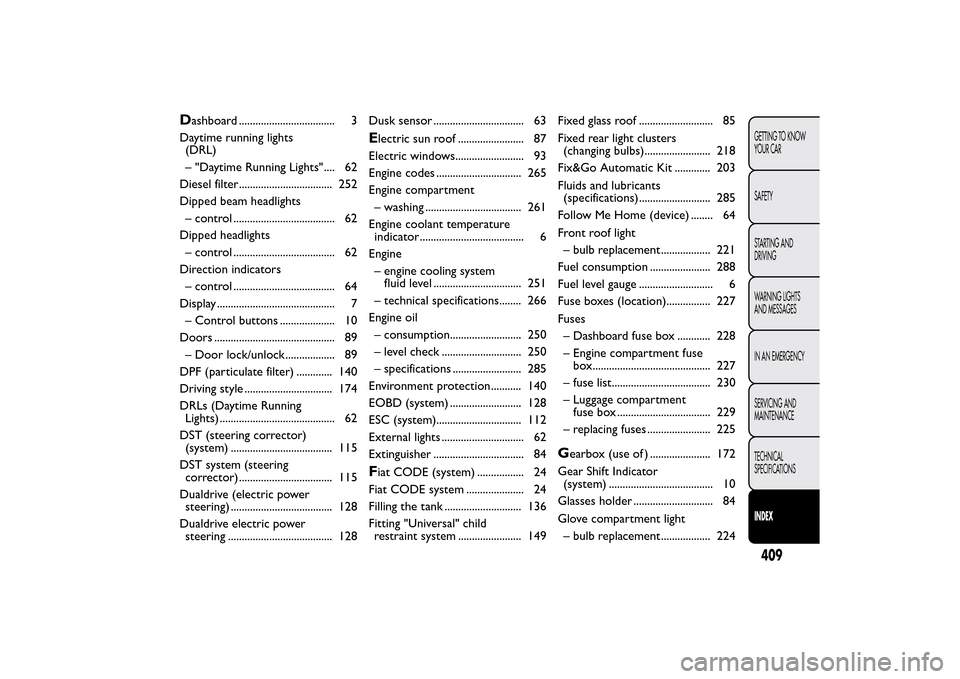
D
ashboard ................................... 3
Daytime running lights
(DRL)
– "Daytime Running Lights".... 62
Diesel filter .................................. 252
Dipped beam headlights
– control ..................................... 62
Dipped headlights
– control ..................................... 62
Direction indicators
– control ..................................... 64
Display ........................................... 7
– Control buttons .................... 10
Doors ............................................ 89
– Door lock/unlock .................. 89
DPF (particulate filter) ............. 140
Driving style ................................ 174
DRLs (Daytime Running
Lights) .......................................... 62
DST (steering corrector)
(system) ..................................... 115
DST system (steering
corrector) .................................. 115
Dualdrive (electric power
steering) ..................................... 128
Dualdrive electric power
steering ...................................... 128Dusk sensor ................................. 63
Electric sun roof ........................ 87
Electric windows......................... 93
Engine codes ............................... 265
Engine compartment
– washing ................................... 261
Engine coolant temperature
indicator...................................... 6
Engine
– engine cooling system
fluid level ................................ 251
– technical specifications........ 266
Engine oil
– consumption.......................... 250
– level check ............................. 250
– specifications ......................... 285
Environment protection........... 140
EOBD (system) .......................... 128
ESC (system)............................... 112
External lights .............................. 62
Extinguisher ................................. 84Fiat CODE (system) ................. 24
Fiat CODE system ..................... 24
Filling the tank ............................ 136
Fitting "Universal" child
restraint system ....................... 149Fixed glass roof ........................... 85
Fixed rear light clusters
(changing bulbs)........................ 218
Fix&Go Automatic Kit ............. 203
Fluids and lubricants
(specifications).......................... 285
Follow Me Home (device) ........ 64
Front roof light
– bulb replacement.................. 221
Fuel consumption ...................... 288
Fuel level gauge ........................... 6
Fuse boxes (location)................ 227
Fuses
– Dashboard fuse box ............ 228
– Engine compartment fuse
box........................................... 227
– fuse list.................................... 230
– Luggage compartment
fuse box .................................. 229
– replacing fuses ....................... 225
G
earbox (use of ) ...................... 172
Gear Shift Indicator
(system) ...................................... 10
Glasses holder ............................. 84
Glove compartment light
– bulb replacement.................. 224
409GETTING TO KNOW
YOUR CAR
SAFETY
STARTING AND
DRIVING
WARNING LIGHTS
AND MESSAGES
IN AN EMERGENCY
SERVICING AND
MAINTENANCE
TECHNICAL
SPECIFICATIONSINDEX
Page 415 of 420
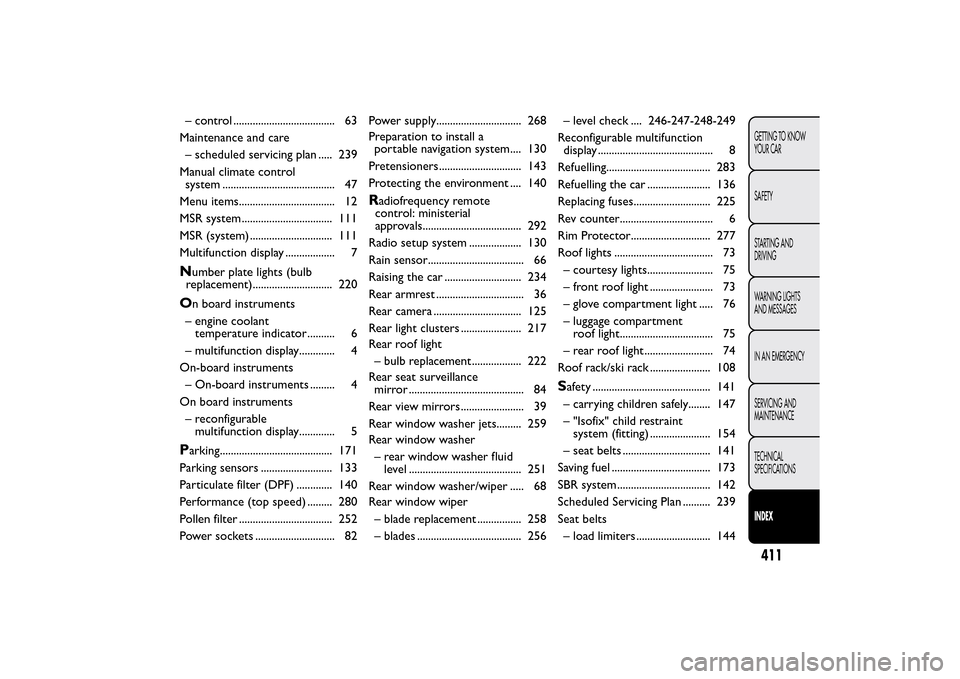
– control ..................................... 63
Maintenance and care
– scheduled servicing plan ..... 239
Manual climate control
system ......................................... 47
Menu items................................... 12
MSR system ................................. 111
MSR (system) .............................. 111
Multifunction display .................. 7N
umber plate lights (bulb
replacement)............................. 220
O
n board instruments
– engine coolant
temperature indicator.......... 6
– multifunction display............. 4
On-board instruments
– On-board instruments ......... 4
On board instruments
– reconfigurable
multifunction display............. 5
Parking......................................... 171
Parking sensors .......................... 133
Particulate filter (DPF) ............. 140
Performance (top speed) ......... 280
Pollen filter .................................. 252
Power sockets ............................. 82Power supply............................... 268
Preparation to install a
portable navigation system.... 130
Pretensioners .............................. 143
Protecting the environment .... 140
Radiofrequency remote
control: ministerial
approvals.................................... 292
Radio setup system ................... 130
Rain sensor................................... 66
Raising the car ............................ 234
Rear armrest ................................ 36
Rear camera ................................ 125
Rear light clusters ...................... 217
Rear roof light
– bulb replacement.................. 222
Rear seat surveillance
mirror .......................................... 84
Rear view mirrors ....................... 39
Rear window washer jets......... 259
Rear window washer
– rear window washer fluid
level ......................................... 251
Rear window washer/wiper ..... 68
Rear window wiper
– blade replacement ................ 258
– blades ...................................... 256– level check .... 246-247-248-249
Reconfigurable multifunction
display .......................................... 8
Refuelling...................................... 283
Refuelling the car ....................... 136
Replacing fuses............................ 225
Rev counter.................................. 6
Rim Protector............................. 277
Roof lights .................................... 73
– courtesy lights........................ 75
– front roof light ....................... 73
– glove compartment light ..... 76
– luggage compartment
roof light.................................. 75
– rear roof light ......................... 74
Roof rack/ski rack ...................... 108
Safety ........................................... 141
– carrying children safely........ 147
– "Isofix" child restraint
system (fitting) ...................... 154
– seat belts ................................ 141
Saving fuel .................................... 173
SBR system .................................. 142
Scheduled Servicing Plan .......... 239
Seat belts
– load limiters ........................... 144
411GETTING TO KNOW
YOUR CAR
SAFETY
STARTING AND
DRIVING
WARNING LIGHTS
AND MESSAGES
IN AN EMERGENCY
SERVICING AND
MAINTENANCE
TECHNICAL
SPECIFICATIONSINDEX