lock FIAT 500X 2015 2.G User Guide
[x] Cancel search | Manufacturer: FIAT, Model Year: 2015, Model line: 500X, Model: FIAT 500X 2015 2.GPages: 240, PDF Size: 10.72 MB
Page 30 of 240
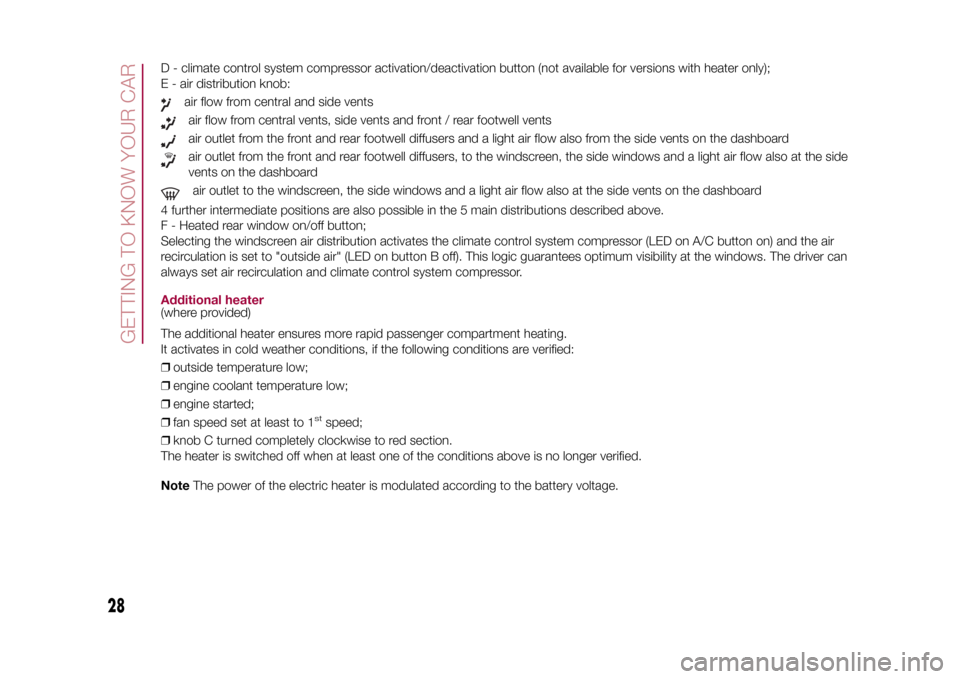
D - climate control system compressor activation/deactivation button (not available for versions with heater only);
E - air distribution knob:
air flow from central and side ventsair flow from central vents, side vents and front / rear footwell ventsair outlet from the front and rear footwell diffusers and a light air flow also from the side vents on the dashboardair outlet from the front and rear footwell diffusers, to the windscreen, the side windows and a light air flow also at the side
vents on the dashboardair outlet to the windscreen, the side windows and a light air flow also at the side vents on the dashboard
4 further intermediate positions are also possible in the 5 main distributions described above.
F - Heated rear window on/off button;
Selecting the windscreen air distribution activates the climate control system compressor (LED on A/C button on) and the air
recirculation is set to "outside air" (LED on button B off). This logic guarantees optimum visibility at the windows. The driver can
always set air recirculation and climate control system compressor.
Additional heater(where provided)
The additional heater ensures more rapid passenger compartment heating.
It activates in cold weather conditions, if the following conditions are verified:
❒outside temperature low;
❒engine coolant temperature low;
❒engine started;
❒fan speed set at least to 1
stspeed;
❒knob C turned completely clockwise to red section.
The heater is switched off when at least one of the conditions above is no longer verified.
NoteThe power of the electric heater is modulated according to the battery voltage.
28
GETTING TO KNOW YOUR CAR
15-12-2014 8:23 Pagina 28
Page 35 of 240
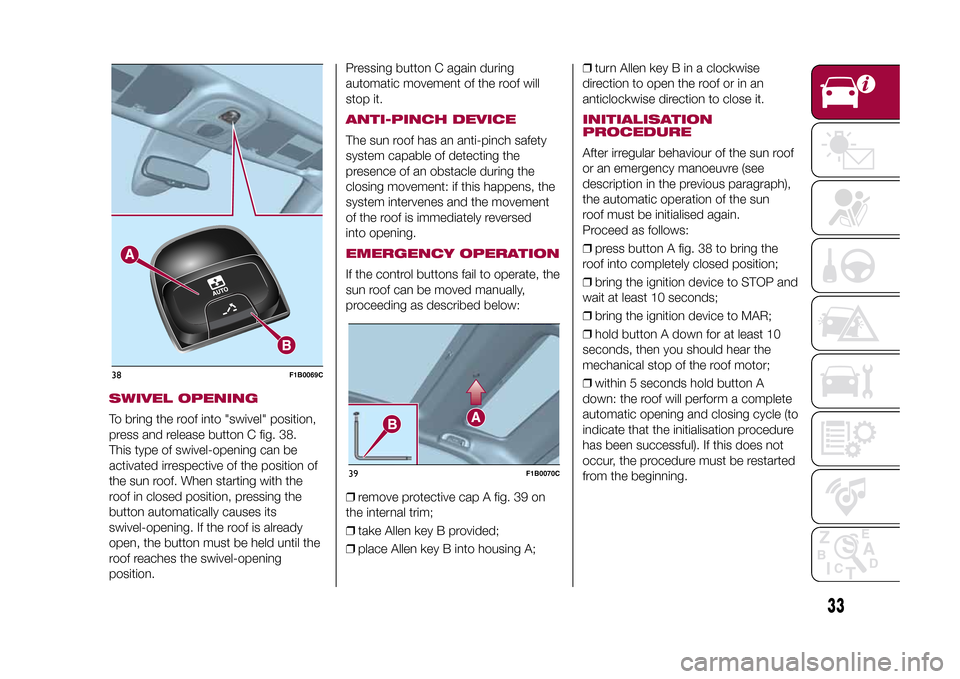
SWIVEL OPENINGTo bring the roof into "swivel" position,
press and release button C fig. 38.
This type of swivel-opening can be
activated irrespective of the position of
the sun roof. When starting with the
roof in closed position, pressing the
button automatically causes its
swivel-opening. If the roof is already
open, the button must be held until the
roof reaches the swivel-opening
position.Pressing button C again during
automatic movement of the roof will
stop it.
ANTI-PINCH DEVICEThe sun roof has an anti-pinch safety
system capable of detecting the
presence of an obstacle during the
closing movement: if this happens, the
system intervenes and the movement
of the roof is immediately reversed
into opening.EMERGENCY OPERATIONIf the control buttons fail to operate, the
sun roof can be moved manually,
proceeding as described below:
❒remove protective cap A fig. 39 on
the internal trim;
❒take Allen key B provided;
❒place Allen key B into housing A;❒turn Allen key B in a clockwise
direction to open the roof or in an
anticlockwise direction to close it.
INITIALISATION
PROCEDUREAfter irregular behaviour of the sun roof
or an emergency manoeuvre (see
description in the previous paragraph),
the automatic operation of the sun
roof must be initialised again.
Proceed as follows:
❒press button A fig. 38 to bring the
roof into completely closed position;
❒bring the ignition device to STOP and
wait at least 10 seconds;
❒bring the ignition device to MAR;
❒hold button A down for at least 10
seconds, then you should hear the
mechanical stop of the roof motor;
❒within 5 seconds hold button A
down: the roof will perform a complete
automatic opening and closing cycle (to
indicate that the initialisation procedure
has been successful). If this does not
occur, the procedure must be restarted
from the beginning.
38
F1B0069C
39
F1B0070C
33
15-12-2014 8:23 Pagina 33
Page 36 of 240
WARNING
22)When leaving the vehicle, always
remove the key (where present) from the
ignition to avoid the risk of injury due to
accidental operation of the sun roof.
Improper use of the roof can be
dangerous. Before and during operation,
always check that nobody is at risk of
being injured by the moving sun roof or by
objects getting caught or hit by it.
WARNING
11)Do not open the sun roof if a roof rack
or crossbars are fitted. Do not open the
sun roof if there is snow or ice on it: you
may damage it.
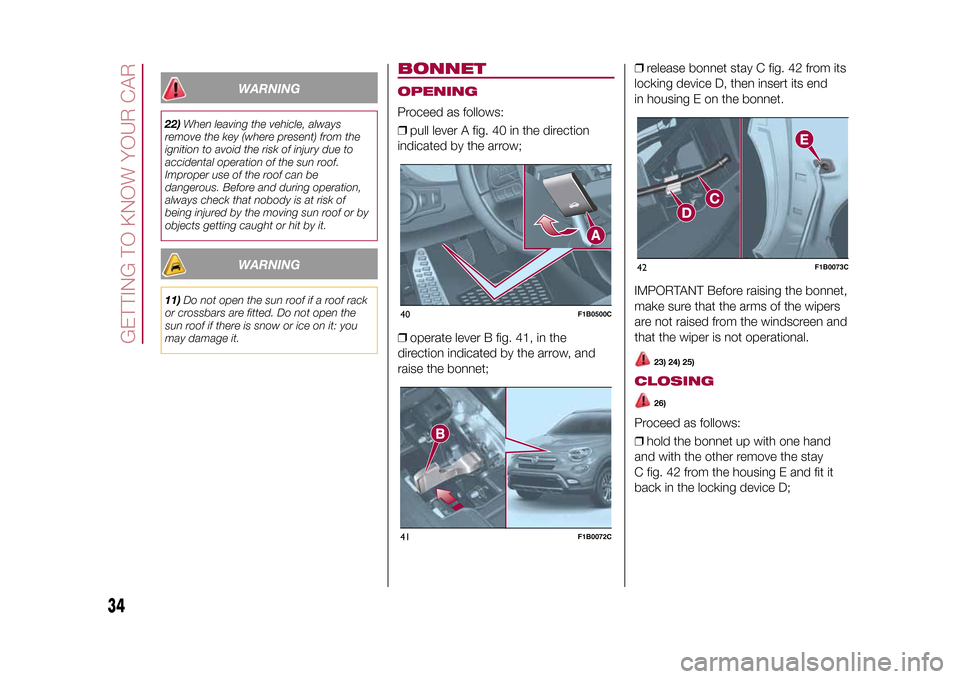
BONNETOPENINGProceed as follows:
❒pull lever A fig. 40 in the direction
indicated by the arrow;
❒operate lever B fig. 41, in the
direction indicated by the arrow, and
raise the bonnet;❒release bonnet stay C fig. 42 from its
locking device D, then insert its end
in housing E on the bonnet.
IMPORTANT Before raising the bonnet,
make sure that the arms of the wipers
are not raised from the windscreen and
that the wiper is not operational.
23) 24) 25)
CLOSING
26)
Proceed as follows:
❒hold the bonnet up with one hand
and with the other remove the stay
C fig. 42 from the housing E and fit it
back in the locking device D;
40
F1B0500C
41
F1B0072C
42
F1B0073C
34
GETTING TO KNOW YOUR CAR
15-12-2014 8:23 Pagina 34
Page 37 of 240
❒lower the bonnet to approximately 40
centimetres from the engine
compartment and let it drop. Make sure
that the bonnet is completely closed
and not only fastened by the locking
device by trying to open it. If it is not
perfectly closed, do not try to press the
bonnet lid down but open it and repeat
the procedure.
IMPORTANT Always check that the
bonnet is closed correctly to prevent it
from opening while the vehicle is
travelling.
WARNING
23)Perform these operations only when
the vehicle is stationary.
24)Wrong positioning of the bonnet stay
may cause the bonnet to fall abruptly.
25)Raise the bonnet using both hands.
Before raising the bonnet make sure that
the windscreen wipers are not lifted from
the windscreen, that the vehicle is at a
standstill and that the electric parking brake
is engaged.26)For safety reasons the bonnet must
always be correctly closed while driving.
Therefore, make sure that the bonnet
is properly closed and that the lock
is engaged. If you discover that the bonnet
is not perfectly closed during travel, stop
immediately and close the bonnet in the
correct manner.
BOOTThe boot unlocking is electrically
operated and is deactivated when the
vehicle is in motion.OPENING
27)
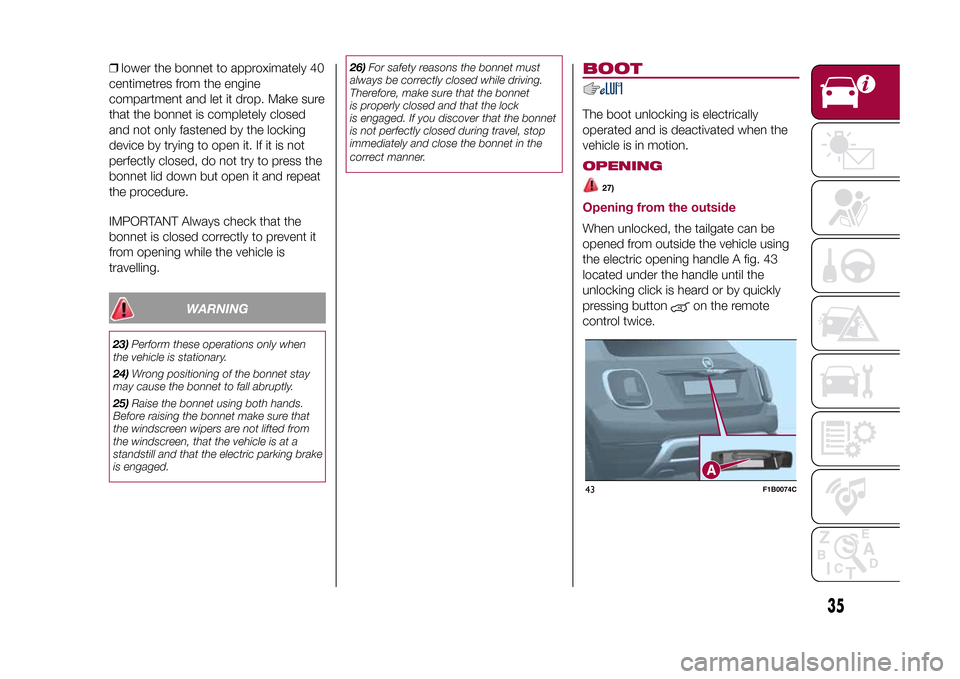
Opening from the outsideWhen unlocked, the tailgate can be
opened from outside the vehicle using
the electric opening handle A fig. 43
located under the handle until the
unlocking click is heard or by quickly
pressing button
on the remote
control twice.
43
F1B0074C
35
15-12-2014 8:23 Pagina 35
Page 38 of 240
The direction indicators will blink twice
and the internal roof light will
simultaneously come on when the boot
is opened; the roof light will
automatically switch off when the
tailgate is closed (see also "Interior
lights").
If the tailgate is left open, the roof light
will automatically switch off to preserve
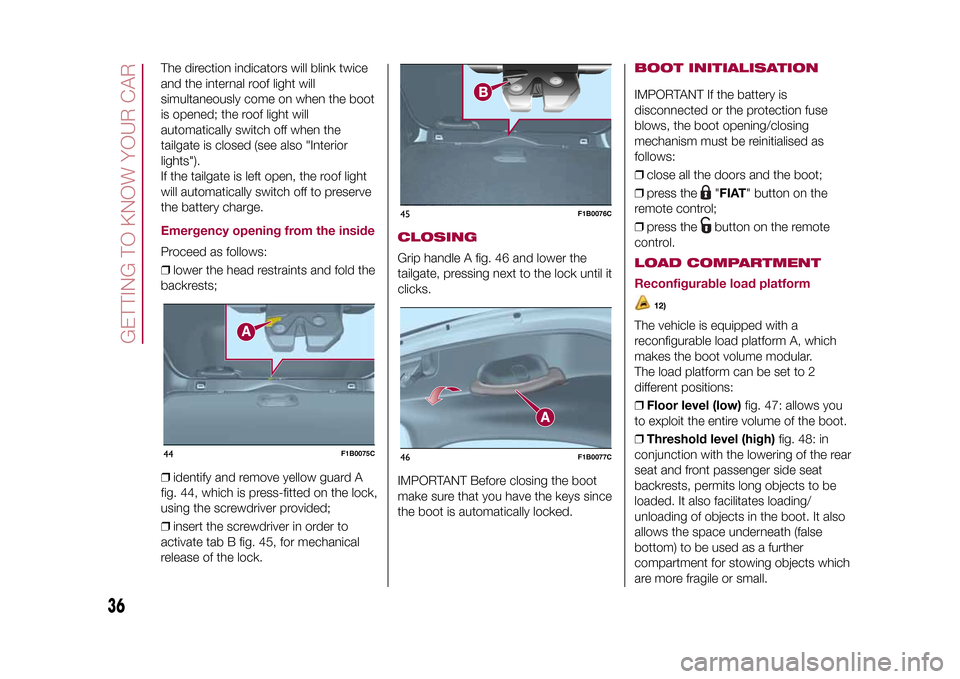
the battery charge.Emergency opening from the insideProceed as follows:
❒lower the head restraints and fold the
backrests;
❒identify and remove yellow guard A
fig. 44, which is press-fitted on the lock,
using the screwdriver provided;
❒insert the screwdriver in order to
activate tab B fig. 45, for mechanical
release of the lock.
CLOSINGGrip handle A fig. 46 and lower the
tailgate, pressing next to the lock until it
clicks.
IMPORTANT Before closing the boot
make sure that you have the keys since
the boot is automatically locked.
BOOT INITIALISATIONIMPORTANT If the battery is
disconnected or the protection fuse
blows, the boot opening/closing
mechanism must be reinitialised as
follows:
❒close all the doors and the boot;
❒press the
"FIAT" button on the
remote control;
❒press thebutton on the remote
control.
LOAD COMPARTMENT
Reconfigurable load platform
12)
The vehicle is equipped with a
reconfigurable load platform A, which
makes the boot volume modular.
The load platform can be set to 2
different positions:
❒Floor level (low)fig. 47: allows you
to exploit the entire volume of the boot.
❒Threshold level (high)fig. 48: in
conjunction with the lowering of the rear
seat and front passenger side seat
backrests, permits long objects to be
loaded. It also facilitates loading/
unloading of objects in the boot. It also
allows the space underneath (false
bottom) to be used as a further
compartment for stowing objects which
are more fragile or small.
44
F1B0075C
45
F1B0076C
46
F1B0077C
36
GETTING TO KNOW YOUR CAR
15-12-2014 8:23 Pagina 36
Page 44 of 240
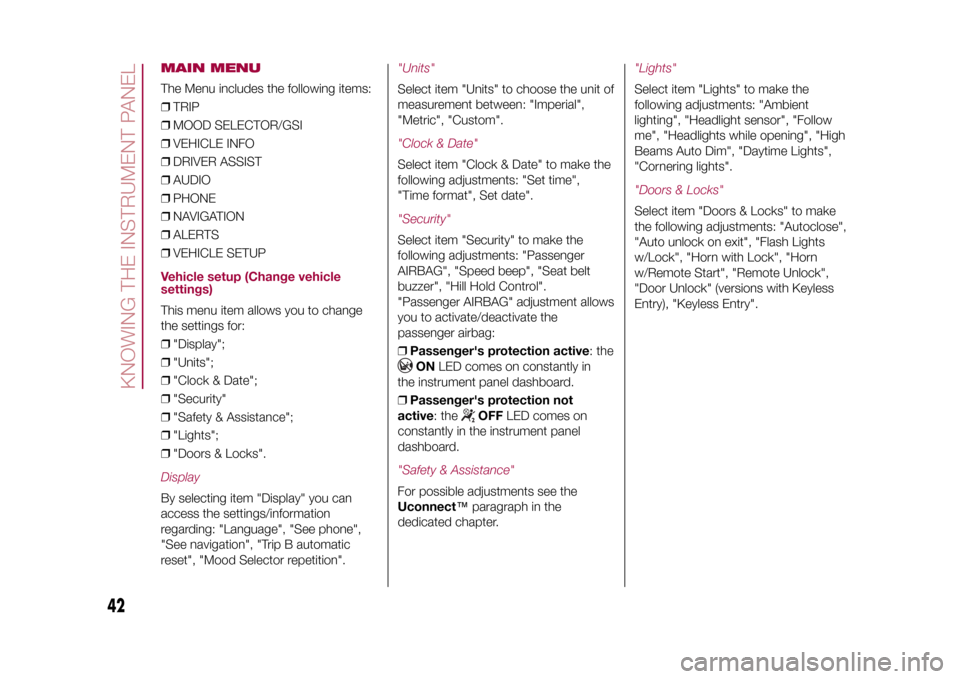
MAIN MENUThe Menu includes the following items:
❒TRIP
❒MOOD SELECTOR/GSI
❒VEHICLE INFO
❒DRIVER ASSIST
❒AUDIO
❒PHONE
❒NAVIGATION
❒ALERTS
❒VEHICLE SETUPVehicle setup (Change vehicle
settings)This menu item allows you to change
the settings for:
❒"Display";
❒"Units";
❒"Clock & Date";
❒"Security"
❒"Safety & Assistance";
❒"Lights";
❒"Doors & Locks".DisplayBy selecting item "Display" you can
access the settings/information
regarding: "Language", "See phone",
"See navigation", "Trip B automatic
reset", "Mood Selector repetition".
"Units"Select item "Units" to choose the unit of
measurement between: "Imperial",
"Metric", "Custom"."Clock & Date"Select item "Clock & Date" to make the
following adjustments: "Set time",
"Time format", Set date"."Security"Select item "Security" to make the
following adjustments: "Passenger
AIRBAG", "Speed beep", "Seat belt
buzzer", "Hill Hold Control".
"Passenger AIRBAG" adjustment allows
you to activate/deactivate the
passenger airbag:
❒Passenger's protection active: the
ONLED comes on constantly in
the instrument panel dashboard.
❒Passenger's protection not
active: the
OFFLED comes on
constantly in the instrument panel
dashboard.
"Safety & Assistance"For possible adjustments see the
Uconnect™paragraph in the
dedicated chapter.
"Lights"Select item "Lights" to make the
following adjustments: "Ambient
lighting", "Headlight sensor", "Follow
me", "Headlights while opening", "High
Beams Auto Dim", "Daytime Lights",
"Cornering lights"."Doors & Locks"Select item "Doors & Locks" to make
the following adjustments: "Autoclose",
"Auto unlock on exit", "Flash Lights
w/Lock", "Horn with Lock", "Horn
w/Remote Start", "Remote Unlock",
"Door Unlock" (versions with Keyless
Entry), "Keyless Entry".
42
KNOWING THE INSTRUMENT PANEL
15-12-2014 8:23 Pagina 42
Page 46 of 240
WARNING LIGHTS AND MESSAGESIMPORTANT The warning light switches on in the instrument panel together with a dedicated message and/or acoustic signal
when applicable. These indications are indicative and precautionary and as such must not be considered as exhaustive and/or
alternative to the information contained in the Owner Handbook, which you are advised to read carefully in all cases. Always
refer to the information in this chapter in the event of a failure indication.
IMPORTANT Failure indications displayed are divided into two categories: serious and less serious failures. Serious failures are
indicated by a repeated and prolonged warning "cycle". Less serious failures are indicated by a warning "cycle" with a shorter
duration. The display cycle of both categories can be interrupted. The instrument panel warning light will stay on until the cause
of the failure is eliminated.
Warning light What it means
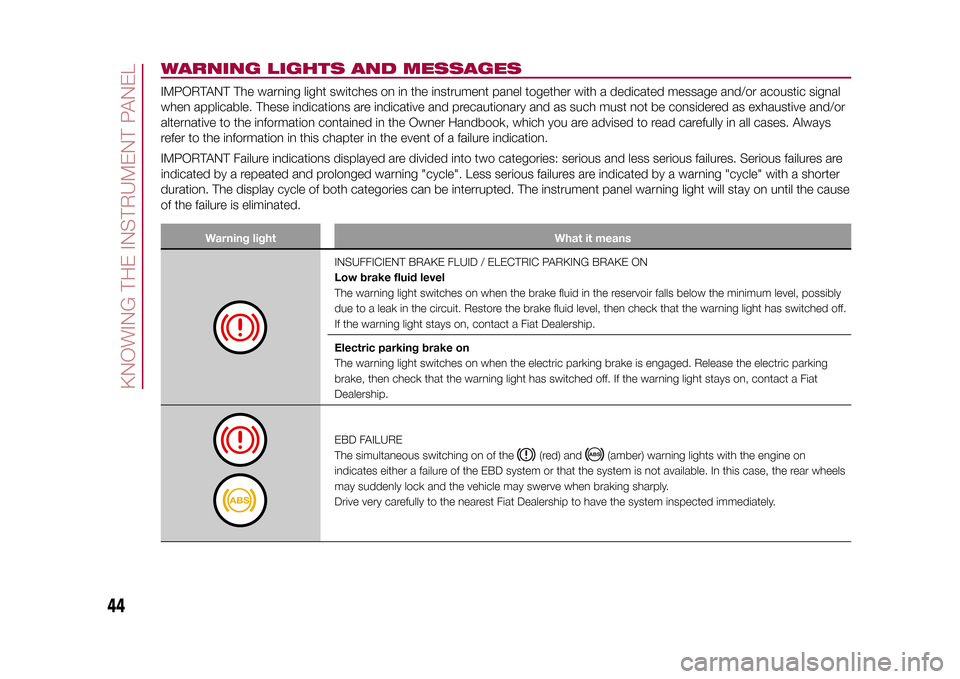
INSUFFICIENT BRAKE FLUID / ELECTRIC PARKING BRAKE ON
Low brake fluid level
The warning light switches on when the brake fluid in the reservoir falls below the minimum level, possibly
due to a leak in the circuit. Restore the brake fluid level, then check that the warning light has switched off.
If the warning light stays on, contact a Fiat Dealership.
Electric parking brake on
The warning light switches on when the electric parking brake is engaged. Release the electric parking
brake, then check that the warning light has switched off. If the warning light stays on, contact a Fiat
Dealership.EBD FAILURE
The simultaneous switching on of the
(red) and
(amber) warning lights with the engine on
indicates either a failure of the EBD system or that the system is not available. In this case, the rear wheels
may suddenly lock and the vehicle may swerve when braking sharply.
Drive very carefully to the nearest Fiat Dealership to have the system inspected immediately.
44
KNOWING THE INSTRUMENT PANEL
15-12-2014 8:23 Pagina 44
Page 50 of 240
Warning light What it means
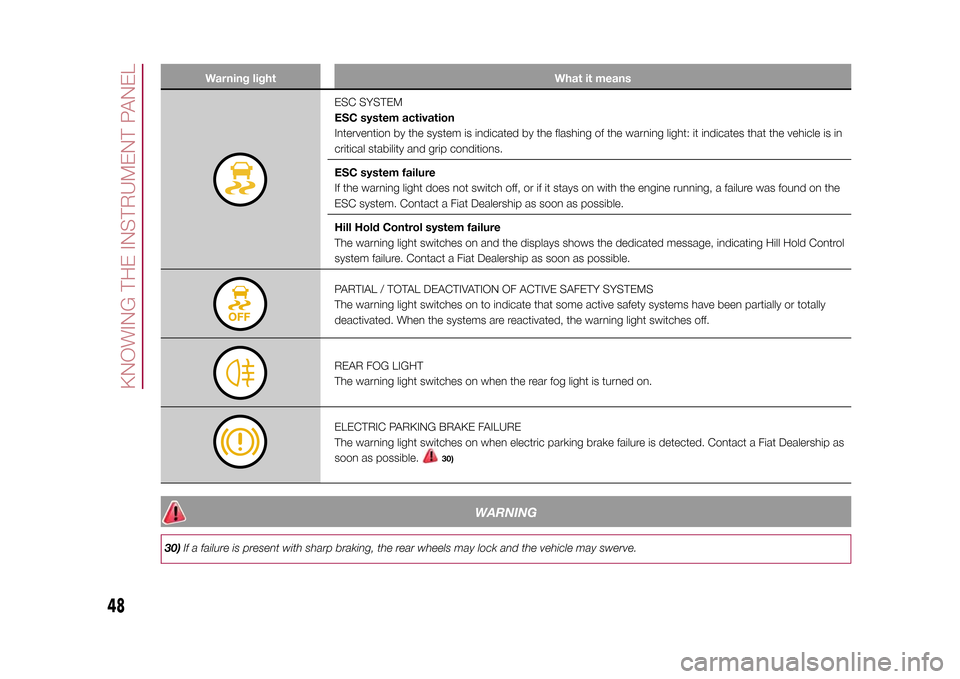
ESC SYSTEM
ESC system activation
Intervention by the system is indicated by the flashing of the warning light: it indicates that the vehicle is in
critical stability and grip conditions.
ESC system failure
If the warning light does not switch off, or if it stays on with the engine running, a failure was found on the
ESC system. Contact a Fiat Dealership as soon as possible.
Hill Hold Control system failure
The warning light switches on and the displays shows the dedicated message, indicating Hill Hold Control
system failure. Contact a Fiat Dealership as soon as possible.PARTIAL / TOTAL DEACTIVATION OF ACTIVE SAFETY SYSTEMS
The warning light switches on to indicate that some active safety systems have been partially or totally
deactivated. When the systems are reactivated, the warning light switches off.REAR FOG LIGHT
The warning light switches on when the rear fog light is turned on.ELECTRIC PARKING BRAKE FAILURE
The warning light switches on when electric parking brake failure is detected. Contact a Fiat Dealership as
soon as possible.
30)
WARNING
30)If a failure is present with sharp braking, the rear wheels may lock and the vehicle may swerve.
48
KNOWING THE INSTRUMENT PANEL
15-12-2014 8:23 Pagina 48
Page 56 of 240
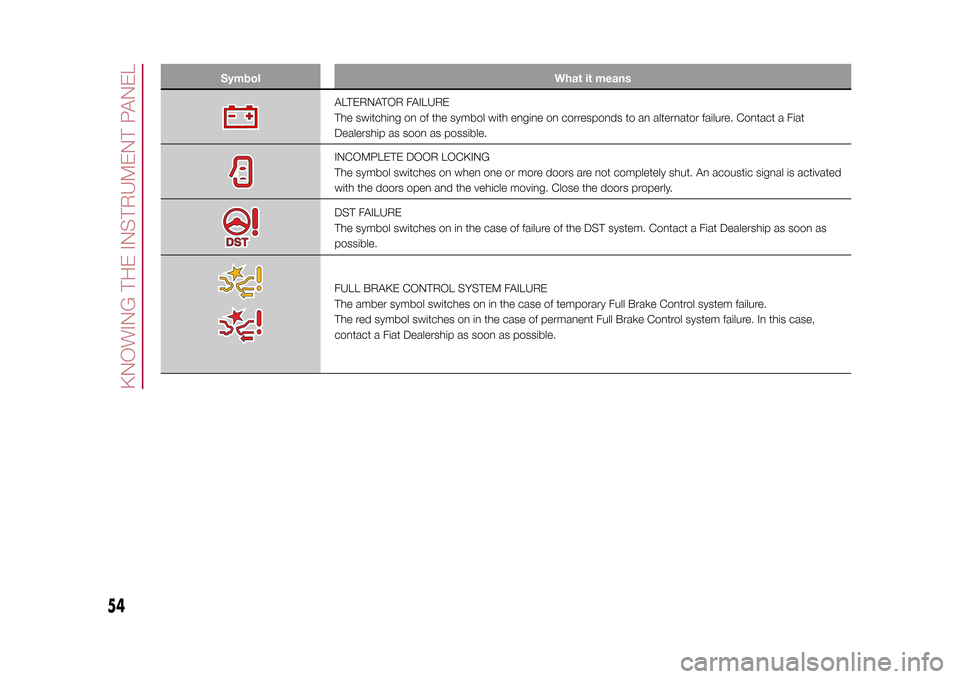
Symbol What it means
ALTERNATOR FAILURE
The switching on of the symbol with engine on corresponds to an alternator failure. Contact a Fiat
Dealership as soon as possible.INCOMPLETE DOOR LOCKING
The symbol switches on when one or more doors are not completely shut. An acoustic signal is activated
with the doors open and the vehicle moving. Close the doors properly.DST FAILURE
The symbol switches on in the case of failure of the DST system. Contact a Fiat Dealership as soon as
possible.FULL BRAKE CONTROL SYSTEM FAILURE
The amber symbol switches on in the case of temporary Full Brake Control system failure.
The red symbol switches on in the case of permanent Full Brake Control system failure. In this case,
contact a Fiat Dealership as soon as possible.
54
KNOWING THE INSTRUMENT PANEL
15-12-2014 8:23 Pagina 54
Page 64 of 240
ACTIVE SAFETY
SYSTEMSThe vehicle has the following active
safety systems:
❒ABS (Anti-lock Braking System);
❒DTC (Drag Torque Control);
❒ESC (Electronic Stability Control);
❒TC (Traction Control);
❒PBA (Panic Brake Assist);
❒HHC (Hill Hold Control);
❒DST (Dynamic Steering Torque);
❒ERM (Electronic Rollover Mitigation);
❒TSC (Trailer Sway Control).
For the operation of the systems, see
the following description.ABS (Anti-lock Braking
System)This system, which is an integral part of
the braking system, prevents one or
more wheels from locking and slipping
in all road surface conditions,
irrespective of the intensity of the
braking action, ensuring that the vehicle
can be controlled even during
emergency braking and optimising
stopping distances.
The system intervenes during braking
when the wheels are about to lock,
typically in emergency braking or
low-grip conditions, when locking may
be more frequent.The system also improves control and
stability of the vehicle when braking
on a surface where the grip of the left
and right wheels varies, or on corners.
The Electronic Braking Force
Distribution (EBD) system completes
the system allowing the brake force to
be distributed between the front and
rear wheels.
System interventionThe driver can feel that the ABS system
has come into action because the
brake pedal pulsates slightly and the
system gets noisier: this is entirely
normal with the system operating.
31) 32) 33) 34) 35) 36) 37)
DTC (Drag Torque
Control) SYSTEMThe system intervenes in the event of
sudden downshifting, or during ABS
braking, restoring torque to the engine
and thus preventing excessive drag
at the drive wheels, which may lead the
wheels to lock and a loss of vehicle
stability, above all in low-grip
conditions.
ESC (Electronic Stability
Control) SYSTEMThe ESC system improves the
directional control and stability of the
vehicle in various driving conditions.
The ESC system corrects the vehicle’s
understeer and oversteer, distributing
the brake force on the wheels
appropriately. The torque supplied by
the engine can also be reduced in order
to maintain control of the vehicle.
The ESC system uses sensors installed
on the vehicle to determine the
trajectory that the driver intends to
follow and compares it with the
vehicle’s effective trajectory. When the
real trajectory deviates from the desired
trajectory, the ESC system intervenes
to counter the vehicle’s understeer
or oversteer.
❒Oversteer: occurs when the vehicle is
turning more than it should according
to the angle of the steering wheel.
❒Understeer: occurs when the vehicle
is turning less than it should according
to the angle of the steering wheel.
62
SAFETY
15-12-2014 8:23 Pagina 62