lock FIAT 500X 2015 2.G Owner's Manual
[x] Cancel search | Manufacturer: FIAT, Model Year: 2015, Model line: 500X, Model: FIAT 500X 2015 2.GPages: 240, PDF Size: 10.72 MB
Page 65 of 240
System interventionThe intervention of the system is
indicated by the flashing of the
warning light on the instrument
panel, to inform the driver that
the vehicle is in critical stability and grip
conditions.38) 39) 40) 41) 42)
TC (Traction Control)
SYSTEMThe system automatically operates in
the event of slipping, loss of grip on wet
roads (aquaplaning) and acceleration
on slippery, snowy or icy roads, etc. on
one or more drive wheels. Depending
on the slipping conditions, two different
control systems are activated:
❒if the slipping involves both drive
wheels, the system intervenes,
reducing the power transmitted by the
engine;❒if the slipping only involves one of the
drive wheels, the BLD (Brake Limited
Differential) function is activated,
automatically braking the wheel which
is slipping (the behaviour of a
self-locking differential is simulated).
This will increase the engine torque
transferred to the wheel which isn't
slipping. This function remains active
even if the "Systems partially disabled"
and "Systems disabled" modes are
selected (see description in the
following pages).
System interventionThe intervention of the system is
indicated by the flashing of the
warning light on the instrument
panel, to inform the driver that
the vehicle is in critical stability and grip
conditions.43) 44) 45) 46) 47)
PBA (Panic Brake
Assist) SYSTEMThe PBA system is designed to
improve the vehicle’s braking capacity
during emergency braking.The system detects emergency braking
by monitoring the speed and force
with which the brake pedal is pressed,
and consequently applies the optimal
brake pressure. This can reduce the
braking distance: the PBA system
therefore completes the ABS.
Maximum assistance from the PBA
system is obtained by pressing the
brake pedal very quickly. In addition,
the brake pedal should be pressed
continuously during braking, avoiding
intermittent presses, to get the most
out of the system. Do not reduce
pressure on the brake pedal until
braking is not necessary anymore.
The PBA system is deactivated when
the brake pedal is released.
48) 49) 50)
HHC (Hill Hold Control)
SYSTEMThis is an integral part of the ESC
system and facilitates starting on
slopes, activating automatically in the
following cases:
❒uphill: vehicle stationary on a road
with a gradient higher than 5%, engine
running, brake pressed and
transmission in neutral or gear other
than reverse engaged;
63
15-12-2014 8:23 Pagina 63
Page 71 of 240
In the event of an imminent collision the
system intervenes by automatically
braking the vehicle to prevent the crash
or reduce its effects.
The system provides the driver with
acoustic and visual signals through
specific messages on the instrument
panel display.
The system may lightly brake to warn
the driver if a possible frontal accident
is detected (limited braking). Signals
and limited braking are intended to
allow the driver to react promptly,
in order to prevent or reduce the effects
of a potential accident.In situations with the risk of collision, if
the system detects no intervention
by the driver, it provides automatic
braking to help slow the vehicle and
mitigate the potential frontal collision
(automatic braking). If intervention
by the driver on the brake pedal
is detected but not deemed sufficient,
the system may intervene in order to
improve the reaction of the braking
system, therefore reducing vehicle
speed further (additional assistance in
braking stage).
Versions equipped with Start&Stop
system: at the end of the automatic
braking, the Start&Stop system will
activate as described in paragraph
"Start&Stop system" of the "Starting
and driving" chapter.
Versions with manual gearbox:at
the end of the automatic braking the
engine may stall and turn off, unless the
driver presses the clutch pedal.
Versions with automatic
transmission: at the end of the
braking, the latest stored gear
is engaged: the vehicle may therefore
restart after a few seconds from the
automatic stop.IMPORTANT Both on versions
equipped with manual gearbox and on
those with automatic transmission, after
the vehicle is stopped the brake
calipers may be locked for about 2
seconds for safety reasons. Make sure
you press the brake pedal if the vehicle
moves slightly forwards.
Activation/deactivationThe Full Brake Control system can be
deactivated (and then reactivated)
via theUconnect™system (see the
description in the dedicated
supplement).
The system can be deactivated even
with the ignition device at MAR.
IMPORTANT The system status can be
changed with vehicle at a standstill
only.
The Full Brake Control system can be
set to three activation levels through the
Uconnect™system:
❒System active: the system (if active),
in addition to the visual and acoustic
warnings, provides limited braking,
automatic braking and additional
assistance in braking stage, where the
driver does not brake sufficiently in
the event of a potential frontal impact;
58
F1B0096C
69
15-12-2014 8:23 Pagina 69
Page 72 of 240
❒System partially active: the system (if
active) does not provide limited braking,
but guarantees automatic braking or
additional assistance in braking stage,
where the driver does not brake at all or
not sufficiently in the event of a
potential frontal impact. The visual and
acoustic warnings are deactivated,
and will not be provided;
❒System deactivated: the system
does not provide visual and acoustic
warnings, limited braking, automatic
braking or additional assistance in
braking stage. The system will therefore
provide no indication of a possible
accident.Activation/deactivationIf the Full Brake Control system has
been correctly activated with the
Uconnect™system, this will be active
each time the engine is started.
Following a deactivation, the system will
not warn the driver about the possible
collision with the preceding vehicle,
regardless of the setting selected with
theUconnect™system.
The system deactivation status will not
be stored when the engine is switched
off: if the system is deactivated when
the engine is switched off, it will be
active when it is next started.This function is not active at a speed
lower than 7 km/h or higher than 200
km/h.
The system is only active if:
❒it is correctly activated via the
Uconnect™system;
❒the ignition device is at MAR;
❒the vehicle speed is between 7 and
200 km/h;
❒the front seat belts are fastened.
Changing the system sensitivityThe sensitivity of the system can be
changed through theUconnect™
system menu, choosing from one of the
following three options: "Near", "Med"
or "Far". See the description in the
Uconnect™supplement for how to
change the settings.
The pre-set option is "Med". With this
setting, the system warns the driver
of a possible collision with the vehicle in
front when that vehicle is at a standard
distance, between that of the other
two settings.With the system sensitivity set to "Far",
the system will warn the driver of a
possible collision with the vehicle in
front when that vehicle is at a greater
distance, thus providing the possibility
of acting on the brakes more lightly and
gradually. This setting provides the
drivers with the maximum possible
reaction time to prevent a potential
accident.
With the option set to "Near", the
system will warn the driver of a possible
collision with the vehicle in front when
that vehicle is close. This setting offers
the driver a lower reaction time
compared to the "Med" and "Far"
settings, in the event of a potential
collision, but permits more dynamic
driving of the vehicle.
The system sensitivity setting is kept in
the memory when the engine is
switched off.
System limited operation signalIf the dedicated message is displayed,
a condition limiting the system
operation may have occurred. The
possible reasons of this limitation are
something blocking the camera view or
a fault.
If an obstruction is signalled, clean the
area of the windscreen indicated in
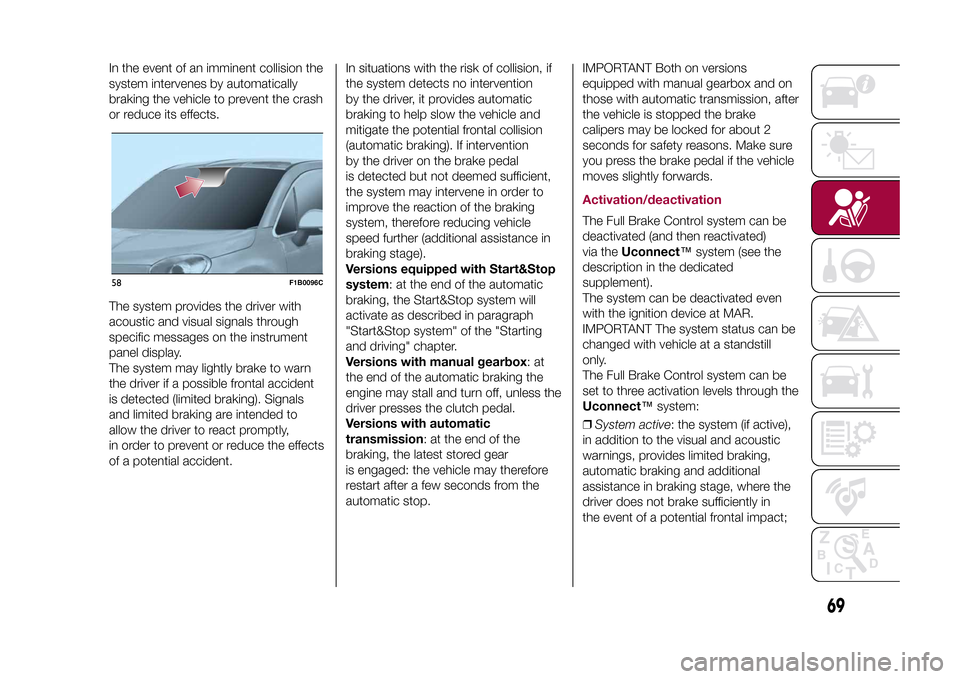
fig. 58 and check that the message has
disappeared.
70
SAFETY
15-12-2014 8:23 Pagina 70
Page 77 of 240
31)The Fix&Go automatic quick tyre repair
kit, provided with the vehicle, is compatible
with the iTPMS sensors. Using sealants
different from that in the original kit may
compromise its operation. If sealants not
equivalent with the original ones are used,
it is recommended to have the iTPMS
sensor operation checked by a qualified
repair centre.
OCCUPANT
PROTECTION
SYSTEMSThe most important safety equipment
of the vehicle comprises the following
protection systems:
❒seat belts;
❒SBR (Seat Belt Reminder) system;
❒head restraints;
❒child restraint systems;
❒front airbags and side bags.
Read the information given the
following pages with the utmost care. It
is of fundamental importance that the
protection systems are used in the
correct way to guarantee the maximum
possible safety level for the driver and
the passengers.
For the description of the head restraint
adjustment see paragraph "Head
restraints" in chapter "Knowing your
vehicle".
SEAT BELTSAll vehicle seats are equipped with seat
belts with three anchor points and a
retractor.
The retractor mechanism operates
locking the belt in the event of sharp
braking or strong deceleration due
to an impact. This allows the belt strap
to slide freely and to adapt to the body
of the occupant. In the event of an
accident, the belt will lock reducing the
risk of impact inside the passenger
compartment and of being projected
outside the vehicle.
The driver is responsible for respecting,
and ensuring that all the other
occupants of the vehicle also respect,
the local laws in force in relation to
the use of the seat belts.
Always fasten the seat belts before
setting off.USING THE SEAT BELTSThe seat belt should be worn keeping
the torso straight and rested against
the backrest.
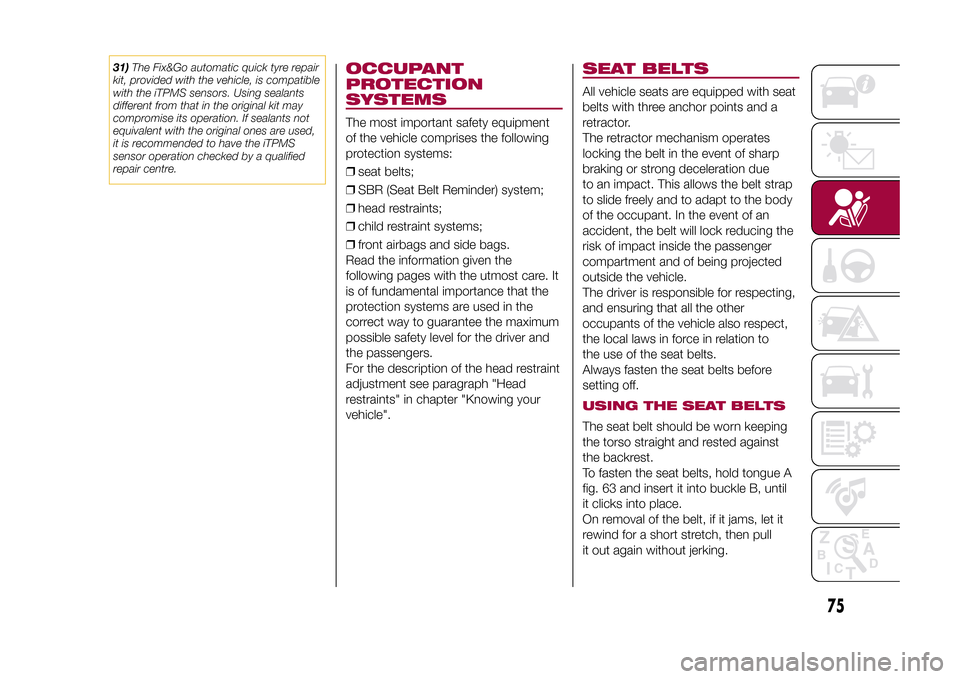
To fasten the seat belts, hold tongue A
fig. 63 and insert it into buckle B, until
it clicks into place.
On removal of the belt, if it jams, let it
rewind for a short stretch, then pull
it out again without jerking.
75
15-12-2014 8:23 Pagina 75
Page 78 of 240
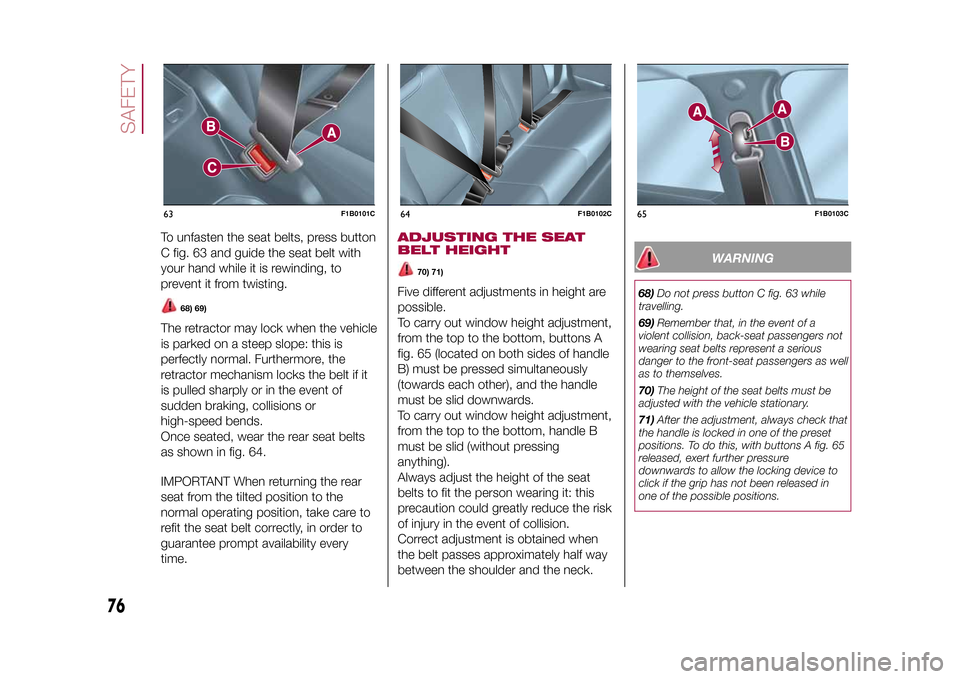
To unfasten the seat belts, press button
C fig. 63 and guide the seat belt with
your hand while it is rewinding, to
prevent it from twisting.
68) 69)
The retractor may lock when the vehicle
is parked on a steep slope: this is
perfectly normal. Furthermore, the
retractor mechanism locks the belt if it
is pulled sharply or in the event of
sudden braking, collisions or
high-speed bends.
Once seated, wear the rear seat belts
as shown in fig. 64.
IMPORTANT When returning the rear
seat from the tilted position to the
normal operating position, take care to
refit the seat belt correctly, in order to
guarantee prompt availability every
time.
ADJUSTING THE SEAT
BELT HEIGHT
70) 71)
Five different adjustments in height are
possible.
To carry out window height adjustment,
from the top to the bottom, buttons A
fig. 65 (located on both sides of handle
B) must be pressed simultaneously
(towards each other), and the handle
must be slid downwards.
To carry out window height adjustment,
from the top to the bottom, handle B
must be slid (without pressing
anything).
Always adjust the height of the seat
belts to fit the person wearing it: this
precaution could greatly reduce the risk
of injury in the event of collision.
Correct adjustment is obtained when
the belt passes approximately half way
between the shoulder and the neck.
WARNING
68)Do not press button C fig. 63 while
travelling.
69)Remember that, in the event of a
violent collision, back-seat passengers not
wearing seat belts represent a serious
danger to the front-seat passengers as well
as to themselves.
70)The height of the seat belts must be
adjusted with the vehicle stationary.
71)After the adjustment, always check that
the handle is locked in one of the preset
positions. To do this, with buttons A fig. 65
released, exert further pressure
downwards to allow the locking device to
click if the grip has not been released in
one of the possible positions.
63
F1B0101C
64
F1B0102C
65
F1B0103C
76
SAFETY
15-12-2014 8:23 Pagina 76
Page 103 of 240
106)Do not start the engine by pushing,
towing or driving downhill. These
manoeuvres may damage the catalytic
converter.
WARNING
33)In the first period of use, i.e. in the first
1,600 km, we recommend not to demand
maximum performance from the vehicle
(for instance excessive accelerations,
extended travel at maximum speed,
sudden braking, etc.).
34)With the engine off, do not leave the
ignition device at MAR to prevent the
battery from draining.
35)A quick burst on the accelerator before
turning off the engine serves absolutely
no practical purpose; it wastes fuel and is
especially damaging to turbocharged
engines.
36)Warning light
will flash after
starting or during prolonged cranking to
indicate a fault with the glow plug heating
system. If the engine starts, the vehicle can
be used as normal, but a Fiat Dealership
must be contacted as soon as possible.
ELECTRIC PARKING
BRAKE (EPB)The vehicle is equipped with electric
parking brake (EPB) to guarantee better
use and optimal performance
compared to a manually operated
parking brake.
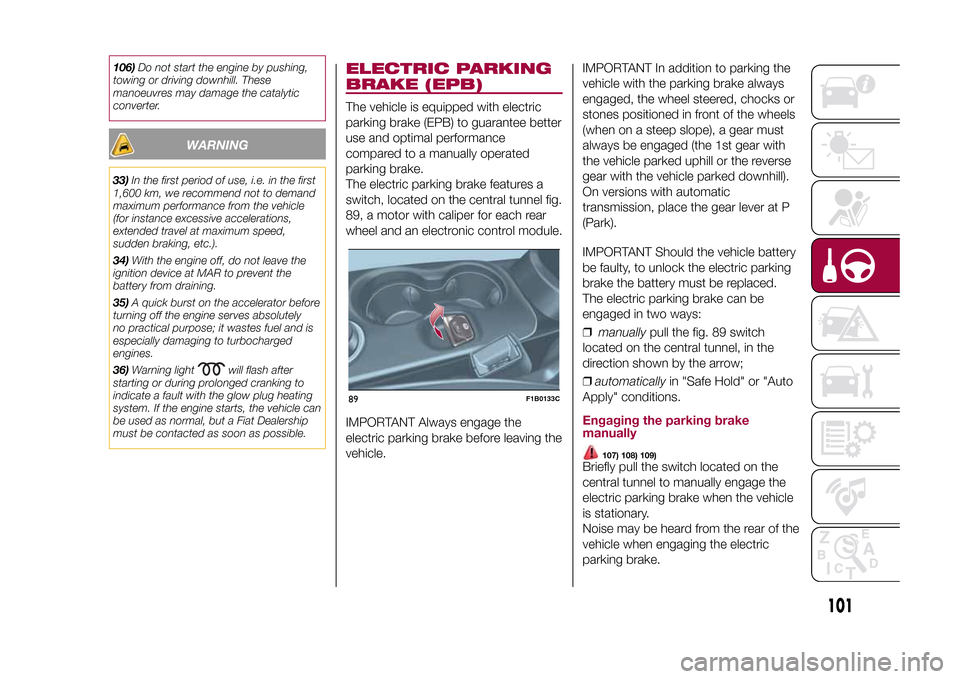
The electric parking brake features a
switch, located on the central tunnel fig.
89, a motor with caliper for each rear
wheel and an electronic control module.
IMPORTANT Always engage the
electric parking brake before leaving the
vehicle.IMPORTANT In addition to parking the
vehicle with the parking brake always
engaged, the wheel steered, chocks or
stones positioned in front of the wheels
(when on a steep slope), a gear must
always be engaged (the 1st gear with
the vehicle parked uphill or the reverse
gear with the vehicle parked downhill).
On versions with automatic
transmission, place the gear lever at P
(Park).
IMPORTANT Should the vehicle battery
be faulty, to unlock the electric parking
brake the battery must be replaced.
The electric parking brake can be
engaged in two ways:
❒manuallypull the fig. 89 switch
located on the central tunnel, in the
direction shown by the arrow;
❒automaticallyin "Safe Hold" or "Auto
Apply" conditions.
Engaging the parking brake
manually
107) 108) 109)
Briefly pull the switch located on the
central tunnel to manually engage the
electric parking brake when the vehicle
is stationary.
Noise may be heard from the rear of the
vehicle when engaging the electric
parking brake.
89
F1B0133C
101
12-1-2015 15:6 Pagina 101
Page 105 of 240
❒"Drive Away Release": the electric
parking brake will automatically
disengage with the driver side seat belt
fastened and the detection of an action
performed by the driver to move the
vehicle (forward gear or reverse gear);
❒"Safe Hold": if the vehicle speed
is lower than 3 km/h and, for the
versions with automatic transmission,
the gear lever is not in P (Park) position
and the driver intention of leaving the
vehicle is detected, the electric parking
brake will automatically engage to
hold the vehicle in safety conditions;
❒"Auto Apply": if the vehicle speed is
lower than 3 km/h, the electric parking
brake will automatically engage with the
gear lever moved to P (Park) position
(versions with automatic transmission),
or with the ignition device at STOP
(versions with manual gearbox). The
LED on the switch turns on together
with the
warning light on the
instrument panel when the parking
brake is engaged and applied to the
wheels. Each automatic parking brake
engagement can be cancelled by
pressing the switch on the central
tunnel and at the same time moving the
gear lever for the automatic
transmission to position P (Park) or the
ignition device to STOP (versions with
manual gearbox).
SAFE HOLDIt is a safety function that automatically
engages
the electric parking brake in
the event of a dangerous condition for
the vehicle.
If:
❒the vehicle speed is below 3 km/h;
❒the gear lever is not at P (Park)
(versions with automatic transmission);
❒the driver's seat belt is not fastened;
❒the driver side door is open;
❒no attempted operation of the brake
pedal or, on versions with manual
gearbox, the clutch pedal or the
accelerator pedal is detected;
the electric parking brake engages
automatically to prevent vehicle
movement.
The Safe Hold function can be
temporarily disabled by pressing the
switch located on the central tunnel
and the brake pedal at the same time,
with the vehicle stationary and the
driver side door open.
Once disabled, the function will activate
again when the vehicle speed reaches
20 km/h or the ignition device is moved
to STOP and then to MAR.
WARNING
107)In the case of parking manoeuvres on
roads on a gradient, steer the wheels,
engage the parking brake, the first gear if
uphill and the reverse if downhill; on
versions with automatic transmission, set
the lever to "P". If the vehicle is parked
on a steep slope, you need to block the
wheels with a wedge or stone.
108)Never leave children unattended in
the vehicle. Always remove the key when
leaving the vehicle and take it with you.
109)The electric parking brake must
always be engaged when leaving
the vehicle.
103
12-1-2015 15:6 Pagina 103
Page 108 of 240
IGNITION LOCK AND
PARK POSITIONVersions equipped with the Keyless
Go system: this function requires the
gear lever to be positioned at P (Park);
then bring the ignition device to STOP.
Versions equipped with key without
remote control: this function requires
the gear lever to be positioned at P
(Park) before extracting the key from
the ignition device.
If the vehicle battery is flat and the
ignition key is engaged, the latter is
locked in position.
To remove the key manually see
paragraph "Automatic transmission
lever unlock" in chapter "In an
emergency".GEAR ENGAGEMENT
DISABLING WITHOUT
BRAKE PEDAL PRESSEDThis system prevents you from moving
the gear lever from position P (Park) if
the brake pedal has not been previously
depressed.To bring the gear lever to a position
other than P (Park), the ignition device
must be in position MAR (engine on
or off) and the brake pedal must be
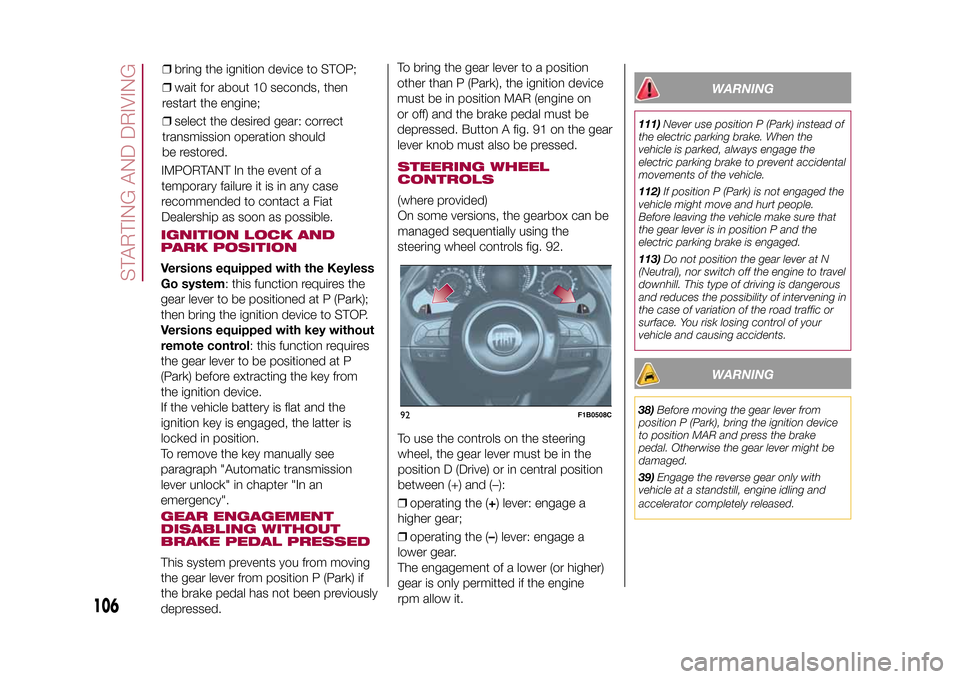
depressed. Button A fig. 91 on the gear
lever knob must also be pressed.
STEERING WHEEL
CONTROLS(where provided)
On some versions, the gearbox can be
managed sequentially using the
steering wheel controls fig. 92.
To use the controls on the steering
wheel, the gear lever must be in the
position D (Drive) or in central position
between (+) and (–):
❒operating the (+) lever: engage a
higher gear;
❒operating the (–) lever: engage a
lower gear.
The engagement of a lower (or higher)
gear is only permitted if the engine
rpm allow it.
WARNING
111)Never use position P (Park) instead of
the electric parking brake. When the
vehicle is parked, always engage the
electric parking brake to prevent accidental
movements of the vehicle.
112)If position P (Park) is not engaged the
vehicle might move and hurt people.
Before leaving the vehicle make sure that
the gear lever is in position P and the
electric parking brake is engaged.
113)Do not position the gear lever at N
(Neutral), nor switch off the engine to travel
downhill. This type of driving is dangerous
and reduces the possibility of intervening in
the case of variation of the road traffic or
surface. You risk losing control of your
vehicle and causing accidents.
WARNING
38)Before moving the gear lever from
position P (Park), bring the ignition device
to position MAR and press the brake
pedal. Otherwise the gear lever might be
damaged.
39)Engage the reverse gear only with
vehicle at a standstill, engine idling and
accelerator completely released.
92
F1B0508C
106
STARTING AND DRIVING
15-12-2014 8:23 Pagina 106
IMPORTANT In the event of a
temporary failure it is in any case
recommended to contact a Fiat
Dealership as soon as possible.❒bring the ignition device to STOP;
❒wait for about 10 seconds, then
restart the engine;
❒select the desired gear: correct
transmission operation should
be restored.
Page 113 of 240
"Auto" MODEThis mode is aimed at comfort and
safety in normal grip and driving
conditions. On 4x4 versions, this mode
also reduces fuel consumption, since
it automatically disconnects the
transmission from the rear wheels if the
road and driving conditions allow it, in
addition to changing drive torque
distribution between the front and rear
axles.ActivationStarting from the active "Traction/All
Weather" mode, turn the ring nut
anticlockwise, keeping it in this position
for at least half a second, and in any
case until the relevant LED turns on,
and the selected mode is shown on the
display. The LED for the previously set
mode will simultaneously turn off. Upon
release, the ring nut will return to the
central position.
Starting from the active "Sport" mode,
turn the ring nut clockwise, keeping it in
this position for at least half a second,
and in any case until the relevant LED
turns on, and the selected mode is
shown on the display. The LED for the
previously set mode will simultaneously
turn off. Upon release, the ring nut will
return to the central position.
"Traction"/"All Weather" MODEIt is a driving mode for safety in poor
vehicle grip conditions (wet/slippery
road surface, rain, snow). On the 4x4
versions use is also recommended
on unsurfaced roads or off-road.ActivationStarting from the active "Auto" mode,
turn the ring nut clockwise, keeping it in
this position for at least half a second,
and in any case until the relevant LED
turns on, and the selected mode is
shown on the display. The LED for the
previously set mode will simultaneously
turn off. Upon release, the ring nut will
return to the central position.
Starting from the active "Sport" mode,
turn the ring nut anticlockwise, keeping
it in this position for at least half a
second, and in any case until the
relevant LED turns on, and the selected
mode is shown on the display. The
LED for the previously set mode will
simultaneously turn off. Upon release,
the ring nut will return to the central
position.
"Sport" MODEIt is the mode that emphasises the
pleasure of sport driving; it increases
fuel consumption however. Traction
is optimised on 4x4 versions, allowing
the vehicle road-hold performance
to be improved, even on bends.ActivationStarting from the active "Auto" mode,
turn the ring nut anticlockwise, keeping
it in this position for at least half a
second, and in any case until the
relevant LED turns on, and the selected
mode is shown on the display. The
LED for the previously set mode will
simultaneously turn off. Upon release,
the ring nut will return to the central
position.
Starting from the active "Traction/All
Weather" mode, turn the ring nut
clockwise, keeping it in this position for
at least half a second, and in any case
until the relevant LED turns on, and
the selected mode is shown on the
display. The LED for the previously set
mode will simultaneously turn off. Upon
release, the ring nut will return to the
central position.
111
15-12-2014 8:23 Pagina 111
Page 121 of 240
REFUELLING THE
VEHICLE
122) 123) 124)
PETROL ENGINESOnly use unleaded petrol with a number
of octanes (R.O.N.) not lower than 95
(EN 228 specification).DIESEL ENGINES
50)
Only use Diesel for motor vehicles (EN
590 specification).
When using or parking the vehicle for a
long time in the mountains or cold
areas, it is advisable to refuel using
locally available diesel. In this case, it is
also advisable to keep the tank over
50% full.REFUELLING
PROCEDURE"Capless Fuel" is a device at the
opening for the fuel tank which opens
and recloses automatically when the
fuel supply gun is introduced/removed.
The "Capless Fuel" device is provided
with an inhibitor which prevents
refuelling with incorrect fuel.
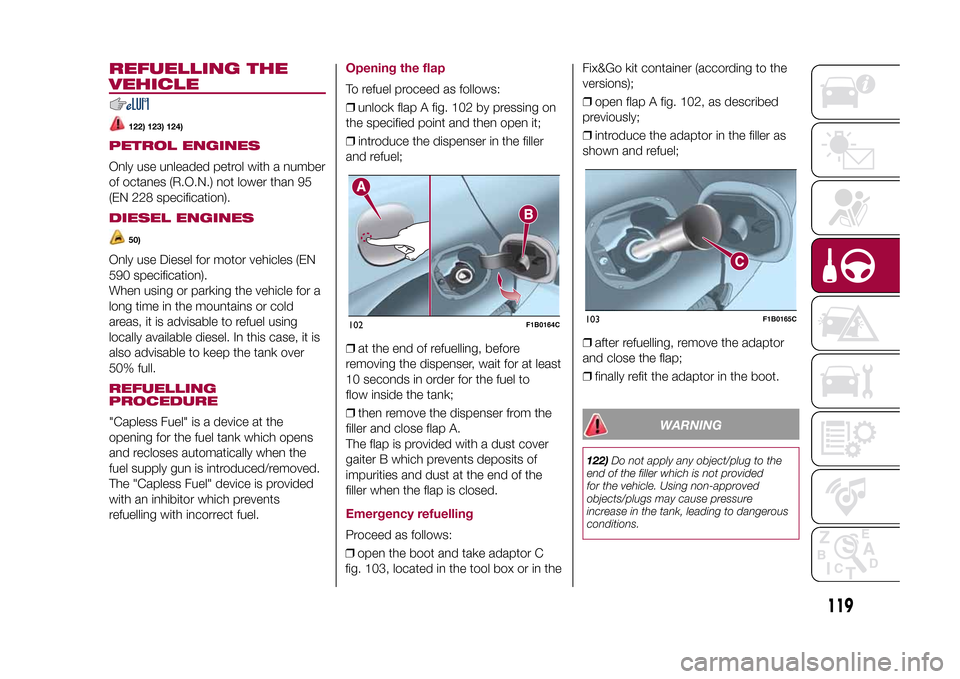
Opening the flapTo refuel proceed as follows:
❒unlock flap A fig. 102 by pressing on
the specified point and then open it;
❒introduce the dispenser in the filler
and refuel;
❒at the end of refuelling, before
removing the dispenser, wait for at least
10 seconds in order for the fuel to
flow inside the tank;
❒then remove the dispenser from the
filler and close flap A.
The flap is provided with a dust cover
gaiter B which prevents deposits of
impurities and dust at the end of the
filler when the flap is closed.Emergency refuellingProceed as follows:
❒open the boot and take adaptor C
fig. 103, located in the tool box or in theFix&Go kit container (according to the
versions);
❒open flap A fig. 102, as described
previously;
❒introduce the adaptor in the filler as
shown and refuel;
❒after refuelling, remove the adaptor
and close the flap;
❒finally refit the adaptor in the boot.
WARNING
122)Do not apply any object/plug to the
end of the filler which is not provided
for the vehicle. Using non-approved
objects/plugs may cause pressure
increase in the tank, leading to dangerous
conditions.
102
F1B0164C
103
F1B0165C
119
15-12-2014 8:23 Pagina 119