engine FIAT 500X 2015 2.G Manual PDF
[x] Cancel search | Manufacturer: FIAT, Model Year: 2015, Model line: 500X, Model: FIAT 500X 2015 2.GPages: 240, PDF Size: 10.72 MB
Page 163 of 240
BATTERY
164) 165) 166)63)6)
The battery does not require the
electrolyte to be topped up with distilled
water.
A periodic check carried out at a Fiat
Dealership is, however, necessary
to check efficiency.Replacing the batteryIf necessary, replace the battery with
another original battery with the same
specifications. Follow the battery
Manufacturer’s instructions for
maintenance.USEFUL ADVICE FOR
EXTENDING THE LIFE OF
YOUR BATTERY
Useful advice for extending the life
of your batteryTo avoid draining your battery and
make it last longer, observe the
following instructions:
❒when you park the vehicle, ensure
that the doors, tailgate and bonnet are
closed properly, to prevent any lights
from remaining on inside the passenger
compartment;❒switch off all roof lights inside the
vehicle: the vehicle is however
equipped with a system which switches
all interior lights off automatically;
❒do not keep accessories (e.g. radio,
hazard warning lights, etc.) switched on
for a long time when the engine is not
running;
❒before performing any operation on
the electrical system, disconnect the
negative battery cable.
If, after purchasing the vehicle, you wish
to install electrical accessories which
require permanent electrical supply (e.g.
alarm, etc.) or accessories which
influence the electrical supply
requirements, contact a Fiat Dealership,
whose qualified staff will evaluate the
overall electrical consumption.
64)
IMPORTANT After the battery is
disconnected, the steering must be
initialised. The
warning light on the
instrument panel (or symbol on the
display) switches on to indicate this. To
carry out this procedure, simply turn
the steering wheel all the way from one
end to the other or drive in a straight
line for about a hundred metres.IMPORTANT If the charge level remains
under 50% for a long time, the battery
is damaged by sulphation, reducing
its capacity and efficiency at start-up.
The battery is also more prone to the
risk of freezing (at temperatures of
-10°C). Refer to the "Vehicle inactivity"
paragraph in "Starting and driving"
chapter if the vehicle is left parked for a
long time.
WARNING
156)Never smoke when performing
operations in the engine compartment.
Flammable gases and fumes may be
present and risk igniting.
157)Be very careful when working in the
engine compartment when the engine
is hot: you may get burned.
158)If the engine oil is being topped up,
wait for the engine to cool down before
loosening the filler plug, particularly for
vehicles with aluminium plug (where
provided). CAUTION: risk of burns!
159)The cooling system is pressurised. If
the cap needs replacing, do so with
another original or the effectiveness of the
system may be compromised. Do not
remove the cap from the reservoir when
the engine is hot: danger of scalding.
161
15-12-2014 8:23 Pagina 161
Page 164 of 240
160)Do not travel if the windscreen washer
reservoir is empty: using the windscreen
washer is essential for improving visibility.
Repeated operation of the system without
fluid could damage or cause rapid
deterioration of some system components.
161)Certain commercial additives for
windscreen washer fluids are inflammable.
The engine compartment contains hot
components which may set it on fire.
162)Brake fluid is poisonous and highly
corrosive. In the event of accidental
contact, immediately wash the affected
parts with water and mild soap. Then rinse
thoroughly. In the case of swallowing
immediately call a doctor.
163)The symbol
, which is on the
container, indicates a synthetic brake fluid,
which is different from a mineral fluid.
Use of a mineral-based fluid will damage
the special rubber seals of the braking
system beyond repair.
164)Battery fluid is poisonous and
corrosive. Avoid contact with the skin and
eyes. Keep naked flames or possible
sources of sparks away from the battery:
risk of explosion or fire.
165)Using the battery when the fluid is too
low can damage it irreparably and generate
a risk of explosion.
166)When performing any operation on
the battery or near it, always protect your
eyes with special goggles.
WARNING
58)Be careful not to confuse the various
types of fluids while topping up: they
are not compatible with each other!
Topping up with an unsuitable fluid could
severely damage your vehicle.
59)The oil level should never exceed the
MAX mark.
60)Do not add oil with specifications other
than those of the oil already in the engine.
61)PARAFLU
UP
anti-freeze is used in
the engine cooling system. Use fluid of the
same type as that contained in the cooling
system for any top-ups. PARAFLU
UP
cannot be mixed with any other type of
fluid. If this happens, do not start the
engine under any circumstances
and contact a Fiat Dealership.
62)Avoid allowing brake fluid, which is
extremely corrosive, to come into contact
with painted areas. Should it happen, wash
immediately with water.
63)If the vehicle must remain unused for a
long time at a very low temperature,
remove the battery and take it to a warm
place, to avoid freezing.
64)Incorrect assembly of electrical and
electronic accessories may cause severe
damage to your vehicle. Go to a Fiat
Dealership if you want to install accessories
(e.g. anti-theft, radio phone, etc.): they will
suggest the most suitable devices and
advise you whether a higher capacity
battery needs to be installed.
WARNING
4)The used engine oil and the filter that
has been replaced contain substances that
are harmful to the environment. It is
advisable to contact a Fiat Dealership to
have the oil and filters changed.
5)Used transmission fluid contains
substances that are harmful to the
environment. It is advisable to contact a
Fiat Dealership to have the fluid changed.
6)Batteries contain substances which
are very dangerous for the environment.
For battery replacement, contact a Fiat
Dealership.
162
SERVICING AND MAINTENANCE
15-12-2014 8:23 Pagina 162
Page 166 of 240
❒turn on the battery charger. At the
end of the charging process, switch the
battery charger off;
❒after having disconnected the
charging device, reconnect connector
A to the sensor C as shown.
SERVICING
PROCEDURES
65) 66) 67)
The following pages contain the rules
on therequiredmaintenance
envisaged by the technical personnel
who designed the vehicle.
In addition to these specific
maintenance instructions specified for
routine scheduled servicing, there
are other components which
may require intervention or
replacements over the vehicle’s life
cycle.ENGINE OIL
68)
Engine oil level checkTo ensure correct engine lubrication,
the oil must always be kept at the
prescribed level (see "Engine
compartment" in this chapter).AIR CLEANER
167)
Replacing the air cleanerSee the "Scheduled servicing plan" for
the correct servicing intervals.
It is advisable to replace it with a
genuine spare part, designed especially
for this vehicle.
AIR CONDITIONING
SYSTEM MAINTENANCE
69) 70)
To ensure the best possible
performance, the air conditioning
system must be checked and undergo
maintenance at a Fiat Dealership at
the beginning of the summer.WINDOWSWhen cleaning the heated windscreen
and rear window be careful, if the
defrosting function is active, regarding
the temperature of the glass; also make
sure that children do not come into
contact with the heated surface. The
glass may be hot.
Never use an abrasive detergent to
clean the surface of the windows.
Do not use scrapers or sharp items that
might scratch the windows.
Spray the detergent on the cloth to be
used for cleaning the rear view mirror.
Do not spray the detergent directly
on the glass.
Cleaning the window with hot water
could cause the removal of any labels.
164
SERVICING AND MAINTENANCE
15-12-2014 8:23 Pagina 164
Page 167 of 240
WINDSCREEN/REAR
WINDOW WIPERReplacing the windscreen wiper
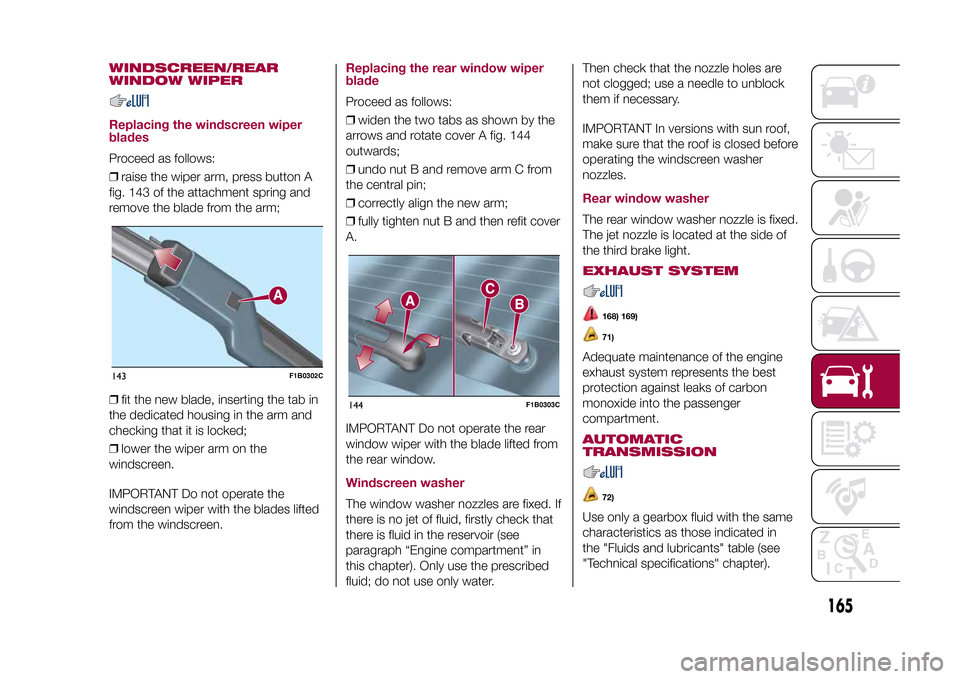
bladesProceed as follows:
❒raise the wiper arm, press button A
fig. 143 of the attachment spring and
remove the blade from the arm;
❒fit the new blade, inserting the tab in
the dedicated housing in the arm and
checking that it is locked;
❒lower the wiper arm on the
windscreen.
IMPORTANT Do not operate the
windscreen wiper with the blades lifted
from the windscreen.
Replacing the rear window wiper
bladeProceed as follows:
❒widen the two tabs as shown by the
arrows and rotate cover A fig. 144
outwards;
❒undo nut B and remove arm C from
the central pin;
❒correctly align the new arm;
❒fully tighten nut B and then refit cover
A.
IMPORTANT Do not operate the rear
window wiper with the blade lifted from
the rear window.Windscreen washerThe window washer nozzles are fixed. If
there is no jet of fluid, firstly check that
there is fluid in the reservoir (see
paragraph “Engine compartment” in
this chapter). Only use the prescribed
fluid; do not use only water.Then check that the nozzle holes are
not clogged; use a needle to unblock
them if necessary.
IMPORTANT In versions with sun roof,
make sure that the roof is closed before
operating the windscreen washer
nozzles.
Rear window washerThe rear window washer nozzle is fixed.
The jet nozzle is located at the side of
the third brake light.EXHAUST SYSTEM
168) 169)71)
Adequate maintenance of the engine
exhaust system represents the best
protection against leaks of carbon
monoxide into the passenger
compartment.AUTOMATIC
TRANSMISSION
72)
Use only a gearbox fluid with the same
characteristics as those indicated in
the "Fluids and lubricants" table (see
"Technical specifications" chapter).
143
F1B0302C
144
F1B0303C
165
15-12-2014 8:23 Pagina 165
Page 168 of 240
WARNING
167)The air intake system (air cleaner,
rubber hoses, etc.) can be a protection in
the case of blowbacks from the engine.
DO NOT REMOVE this system unless you
need to carry out repair or servicing
operations. Before starting the engine
make sure the system is not dismantled:
failure to comply with this precaution
may cause serious injuries.
168)Exhaust emissions are very
dangerous and may be fatal. They contain
carbon monoxide, a colourless and
odourless gas which, if inhaled, may cause
fainting and poisoning.
169)The exhaust system can reach high
temperatures and cause a fire if the vehicle
is parked on flammable material. Dry grass
or leaves can also catch fire if they come
into contact with the exhaust system.
Do not park or use the vehicle in a place in
which the exhaust system might come
into contact with flammable material.
WARNING
65)It is recommended to have the vehicle
serviced by a Fiat Dealership. When
carrying out normal periodic operations
and small servicing interventions personally
on the vehicle, it is recommended to use
suitable equipment, genuine spare parts
and the necessary fluids. Do not carry out
any interventions if you don't have the
necessary experience.66)Incorrect maintenance of the vehicle or
failure to carry out operations or repairs
(when necessary) may lead to more
expensive repairs, damage to other
components or have a negative impact on
the vehicle performance. Have any
operating faults immediately checked by a
Fiat Dealership.
67)The vehicle is equipped with fluids
optimised for protecting its performance
and duration, and to extend servicing
intervals. Do not use chemicals for washing
these components since they may
damage the engine, the gearbox or the
climate control system. This damage is not
covered by the vehicle’s warranty. If, due
to malfunction of a component, washing is
needed, only use the fluid specific for
that procedure.
68)An excessive or insufficient amount of
oil in the block is extremely harmful for
the engine. Make sure it is always at an
adequate level.
69)Always require the use of only
compressor coolants and lubricants
approved and suitable for the specific air
conditioning system fitted on the vehicle.
Some non-approved coolants are
flammable and may explode, with the risk
of injuries. The use of non-approved
coolants or lubricants may adversely affect
system efficiency, leading to expensive
repairs.
70)The air conditioning system contains
high-pressure coolant: to prevent damage
to people or the system, any topping up
with fuel or repairs that involves
disconnection of the pipes must be carried
out by a Fiat Dealership.71)Vehicles equipped with a catalytic
converter must be exclusively supplied with
unleaded petrol. Leaded petrol would
permanently damage the catalytic
converter and eliminate its ability to reduce
polluting emissions, seriously
compromising the engine performance,
which would be irreparably damaged. If the
engine does not work correctly, especially
if it starts irregularly or if there is a reduction
of its performance, immediately go to a
Fiat Dealership. Prolonged and faulty
operation of the engine may cause
overheating of the catalytic converter and,
as a consequence, possible damage to
it and the vehicle.
72)Using a gearbox fluid different from the
prescribed one may compromise
gearshifting quality and/or cause
anomalous vibration of the gearbox.
166
SERVICING AND MAINTENANCE
15-12-2014 8:23 Pagina 166
Page 171 of 240
❒if high pressure jets or cleaners are
used to wash the vehicle, keep a
distance of at least 40 cm from the
bodywork to avoid damage or
alteration. Build up of water could
cause damage to the vehicle in the long
term;
❒wash the bodywork using a low
pressure jet of water if possible;
❒wipe a sponge with a slightly soapy
solution over the bodywork, frequently
rinsing the sponge;
❒rinse well with water and dry with a
jet of air or a chamois leather.
Dry the less visible parts (e.g. door
frames, bonnet, headlight frames, etc.)
with special care, as water may
stagnate more easily in these areas. Do
not wash the vehicle after it has been
left in the sun or with the bonnet hot:
this may alter the shine of the
paintwork.
Exterior plastic parts must be cleaned
in the same way as the rest of the
vehicle.IMPORTANTAvoid parking under trees; the resin
dropped by trees makes the paintwork
go opaque and increases the possibility
of corrosion.Bird droppings must be washed off
immediately and thoroughly as the acid
they contain is particularly aggressive.
WindowsUse specific detergents and clean
cloths to prevent scratching or altering
the transparency.
IMPORTANT Wipe the rear window
inside gently with a cloth following the
direction of the filaments to avoid
damaging the heating device.HeadlightsUse a soft cloth soaked in water and
detergent for washing cars.
IMPORTANT Never use aromatic
substances (e.g. petrol) or ketones (e.g.
acetone) for cleaning the plastic lenses
of the headlights.
IMPORTANT When cleaning with a
pressure washer, keep the water jet at
least 20 cm away from the headlights.
Engine compartmentAt the end of every winter, wash the
engine compartment thoroughly, taking
care not to aim the jet of water directly
at the electronic control units or at
the windscreen/rear window wiper
motors. Have this operation performed
at a specialised workshop.
IMPORTANT The washing should take
place with the engine cold and the
ignition device in the STOP position.
After the washing operation, make sure
that the various protections (e.g. rubber
caps and guards) have not been
removed or damaged.
169
15-12-2014 8:23 Pagina 169
Page 174 of 240
TECHNICAL SPECIFICATIONS
Everything you may find useful for
understanding how your vehicle
is made and works is contained in this
chapter and illustrated with data, tables
and graphics. For the enthusiasts and
the technician, but also just for those
who want to know every detail of their
vehicle.IDENTIFICATION DATA....................173
ENGINE ..........................................174
WHEELS .........................................176
DIMENSIONS ..................................178
WEIGHTS........................................180
SUPPLIES .......................................182
FLUIDS AND LUBRICANTS ............184
PERFORMANCE .............................186
FUEL CONSUMPTION ....................186
CO2 EMISSIONS ............................188
PRESCRIPTIONS FOR HANDLING
THE VEHICLE AT THE END OF ITS
LIFE ................................................189
172
TECHNICAL SPECIFICATIONS
15-12-2014 8:23 Pagina 172
Page 175 of 240
IDENTIFICATION
DATAVIN PLATEIt is located on the driver's door pillar. It
can be read with the door open and
bears the following data fig. 146:A
Name of manufacturer
B
Vehicle type-approval number
C
Vehicle identification number
D
Technically allowed max. weight with
full load
ETechnically allowed max. weight for
combined vehicleFTechnically allowed max. weight on
axle 1G
Technically allowed max. weight on
axle 2
H
Engine identification
IType variant versionLPaintwork colour code
M
Smoke absorption coefficient (diesel
versions)
N
Further instructions.
CHASSIS MARKINGThe Vehicle Identification Number (VIN)
is stamped on the plate shown in fig.
147, located on the front left corner of
the dashboard cover, which can be
seen from outside the vehicle, through
the windscreen.
This number is also stamped on the
passenger compartment floor, in front
of the front right seat.
To access it, slide flap A fig. 148 in the
direction shown by the arrow.
The marking includes:
❒type of vehicle;
❒chassis serial number.
ENGINE MARKINGEngine marking is stamped on the
cylinder block and includes the model
and the chassis serial number.
146
F1B0330C
334AXC1BXXX
334AXC1BXXX
147
F1B0333C
148
F1B0058C
173
15-12-2014 8:23 Pagina 173
Page 176 of 240
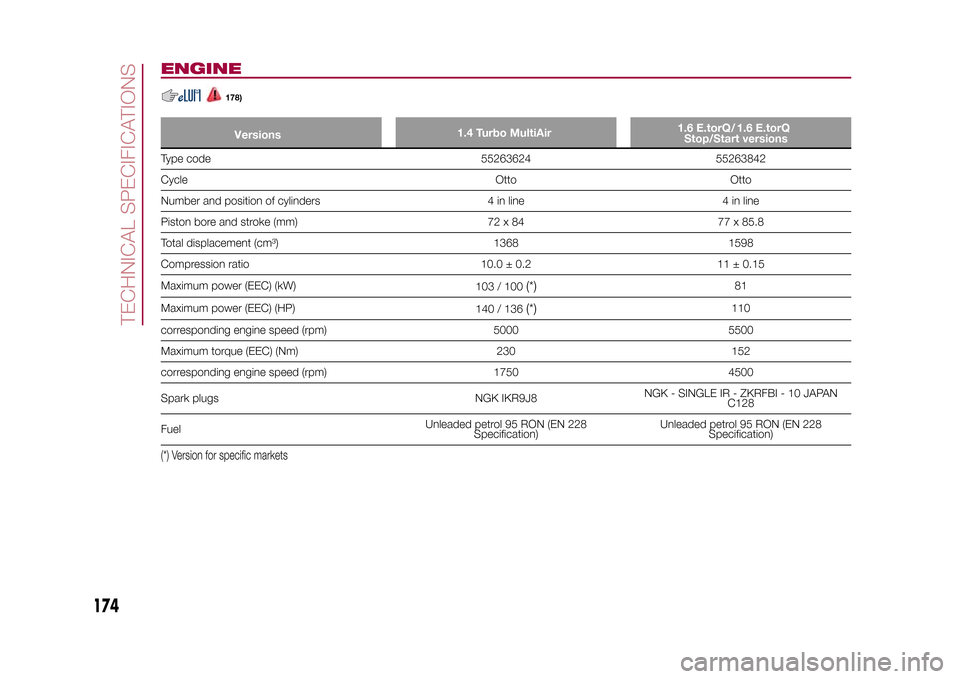
ENGINE
178)
1.4 Turbo MultiAir
Stop/Start versions
Type code 55263624 55263842
Cycle Otto Otto
Number and position of cylinders 4 in line 4 in line
Piston bore and stroke (mm) 72 x 84 77 x 85.8
Total displacement (cm³) 1368 1598
Compression ratio 10.0 ± 0.2 11 ± 0.15
Maximum power (EEC) (kW)
103 / 100
(*)
81
Maximum power (EEC) (HP)
140 / 136
(*)
110
corresponding engine speed (rpm) 5000 5500
Maximum torque (EEC) (Nm) 230 152
corresponding engine speed (rpm) 1750 4500
Spark plugs NGK IKR9J8NGK - SINGLE IR - ZKRFBI - 10 JAPAN
C128
FuelUnleaded petrol 95 RON (EN 228
Specification)Unleaded petrol 95 RON (EN 228
Specification)
(*) Version for specific markets
174
TECHNICAL SPECIFICATIONS
15-12-2014 8:23 Pagina 174
1.6 E.torQ/1.6 E.torQ
Versions
Page 177 of 240
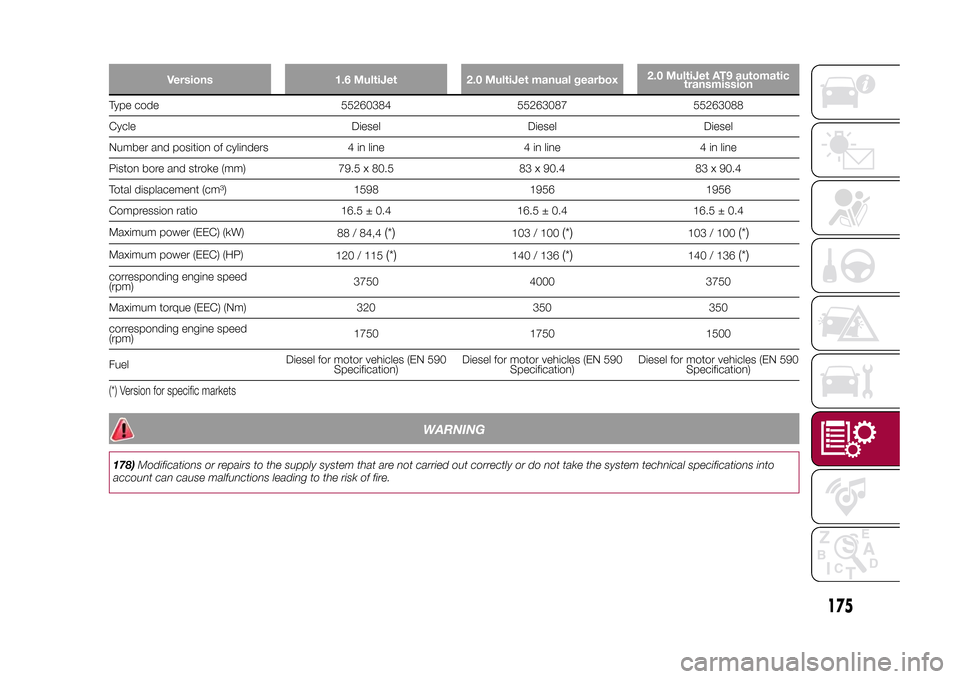
Versions 1.6 MultiJet 2.0 MultiJet manual gearbox2.0 MultiJet AT9 automatic
transmission
Type code 55260384 55263087 55263088
Cycle Diesel Diesel Diesel
Number and position of cylinders 4 in line 4 in line 4 in line
Piston bore and stroke (mm) 79.5 x 80.5 83 x 90.4 83 x 90.4
Total displacement (cm³) 1598 1956 1956
Compression ratio 16.5 ± 0.4 16.5 ± 0.4 16.5 ± 0.4
Maximum power (EEC) (kW)
88 / 84,4
(*)
103 / 100
(*)
103 / 100
(*)
Maximum power (EEC) (HP)
120 / 115
(*)
140 / 136
(*)
140 / 136
(*)
corresponding engine speed
(rpm)3750 4000 3750
Maximum torque (EEC) (Nm) 320 350 350
corresponding engine speed
(rpm)1750 1750 1500
FuelDiesel for motor vehicles (EN 590
Specification)Diesel for motor vehicles (EN 590
Specification)Diesel for motor vehicles (EN 590
Specification)(*) Version for specific markets
WARNING
178)Modifications or repairs to the supply system that are not carried out correctly or do not take the system technical specifications into
account can cause malfunctions leading to the risk of fire.
175
15-12-2014 8:23 Pagina 175