light FIAT 500X 2022 Owners Manual
[x] Cancel search | Manufacturer: FIAT, Model Year: 2022, Model line: 500X, Model: FIAT 500X 2022Pages: 312, PDF Size: 13.26 MB
Page 228 of 312
226IN CASE OF EMERGENCY
10. If the pressure is less than 26 psi (1.8 bar), DO
NOT drive the vehicle, and see an authorized
dealer.
11. If a pressure value of at least 26 psi (1.8 bar) is detected, restore the correct pressure (with
engine running and electric park brake
applied), and drive immediately with great care
to an authorized dealer.
12. Apply the adhesive label from the sealant bottle where it can be easily seen by the driver
as a reminder that the tire has been treated
with a Semi-Auto Kit, as well as not to exceed
the speed restriction for the treated tire.
SEALANT CARTRIDGE REPLACEMENT
NOTE:Only use original cartridges, which can be
purchased at an authorized dealer.
Proceed as follows:
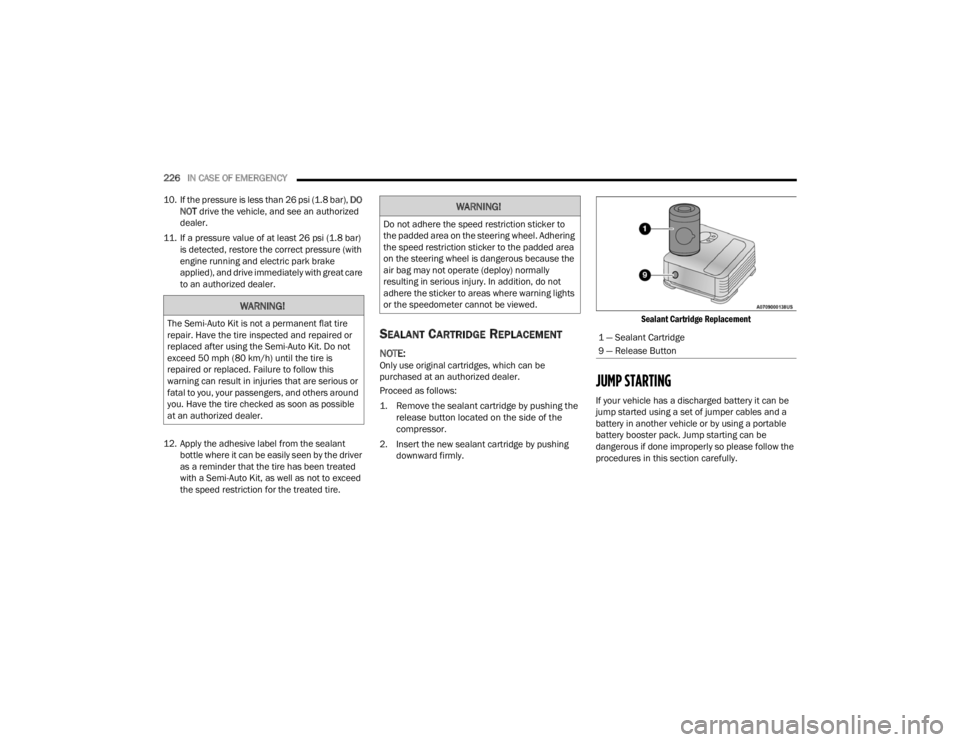
1. Remove the sealant cartridge by pushing the release button located on the side of the
compressor.
2. Insert the new sealant cartridge by pushing downward firmly.
Sealant Cartridge Replacement
JUMP STARTING
If your vehicle has a discharged battery it can be
jump started using a set of jumper cables and a
battery in another vehicle or by using a portable
battery booster pack. Jump starting can be
dangerous if done improperly so please follow the
procedures in this section carefully.
WARNING!
The Semi-Auto Kit is not a permanent flat tire
repair. Have the tire inspected and repaired or
replaced after using the Semi-Auto Kit. Do not
exceed 50 mph (80 km/h) until the tire is
repaired or replaced. Failure to follow this
warning can result in injuries that are serious or
fatal to you, your passengers, and others around
you. Have the tire checked as soon as possible
at an authorized dealer.
WARNING!
Do not adhere the speed restriction sticker to
the padded area on the steering wheel. Adhering
the speed restriction sticker to the padded area
on the steering wheel is dangerous because the
air bag may not operate (deploy) normally
resulting in serious injury. In addition, do not
adhere the sticker to areas where warning lights
or the speedometer cannot be viewed.
1 — Sealant Cartridge
9 — Release Button
22_FD_OM_EN_USC_t.book Page 226
Page 229 of 312
IN CASE OF EMERGENCY227
NOTE:When using a portable battery booster pack follow
the manufacturer’s operating instructions and
precautions.
PREPARATIONS FOR JUMP START
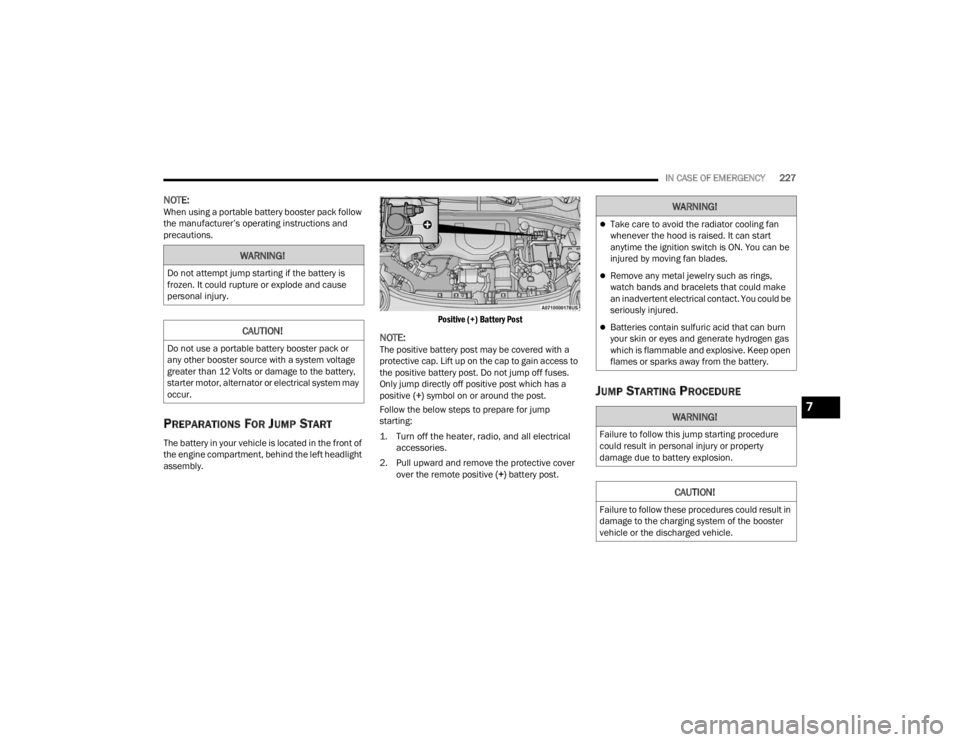
The battery in your vehicle is located in the front of
the engine compartment, behind the left headlight
assembly.
Positive (+) Battery Post
NOTE:The positive battery post may be covered with a
protective cap. Lift up on the cap to gain access to
the positive battery post. Do not jump off fuses.
Only jump directly off positive post which has a
positive
(+) symbol on or around the post.
Follow the below steps to prepare for jump
starting:
1. Turn off the heater, radio, and all electrical accessories.
2. Pull upward and remove the protective cover over the remote positive (+) battery post.
JUMP STARTING PROCEDURE
WARNING!
Do not attempt jump starting if the battery is
frozen. It could rupture or explode and cause
personal injury.
CAUTION!
Do not use a portable battery booster pack or
any other booster source with a system voltage
greater than 12 Volts or damage to the battery,
starter motor, alternator or electrical system may
occur.
WARNING!
Take care to avoid the radiator cooling fan
whenever the hood is raised. It can start
anytime the ignition switch is ON. You can be
injured by moving fan blades.
Remove any metal jewelry such as rings,
watch bands and bracelets that could make
an inadvertent electrical contact. You could be
seriously injured.
Batteries contain sulfuric acid that can burn
your skin or eyes and generate hydrogen gas
which is flammable and explosive. Keep open
flames or sparks away from the battery.
WARNING!
Failure to follow this jump starting procedure
could result in personal injury or property
damage due to battery explosion.
CAUTION!
Failure to follow these procedures could result in
damage to the charging system of the booster
vehicle or the discharged vehicle.
7
22_FD_OM_EN_USC_t.book Page 227
Page 231 of 312
IN CASE OF EMERGENCY229
REFUELING IN EMERGENCY
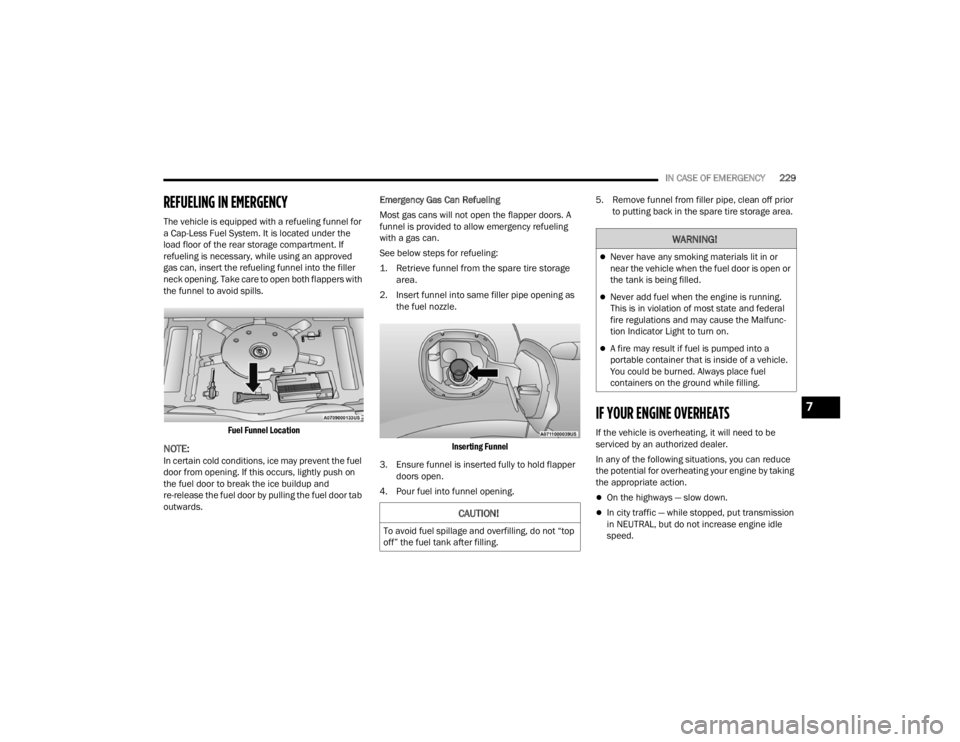
The vehicle is equipped with a refueling funnel for
a Cap-Less Fuel System. It is located under the
load floor of the rear storage compartment. If
refueling is necessary, while using an approved
gas can, insert the refueling funnel into the filler
neck opening. Take care to open both flappers with
the funnel to avoid spills.
Fuel Funnel Location
NOTE:In certain cold conditions, ice may prevent the fuel
door from opening. If this occurs, lightly push on
the fuel door to break the ice buildup and
re-release the fuel door by pulling the fuel door tab
outwards. Emergency Gas Can Refueling
Most gas cans will not open the flapper doors. A
funnel is provided to allow emergency refueling
with a gas can.
See below steps for refueling:
1. Retrieve funnel from the spare tire storage
area.
2. Insert funnel into same filler pipe opening as the fuel nozzle.
Inserting Funnel
3. Ensure funnel is inserted fully to hold flapper doors open.
4. Pour fuel into funnel opening. 5. Remove funnel from filler pipe, clean off prior
to putting back in the spare tire storage area.
IF YOUR ENGINE OVERHEATS
If the vehicle is overheating, it will need to be
serviced by an authorized dealer.
In any of the following situations, you can reduce
the potential for overheating your engine by taking
the appropriate action.
On the highways — slow down.
In city traffic — while stopped, put transmission
in NEUTRAL, but do not increase engine idle
speed.CAUTION!
To avoid fuel spillage and overfilling, do not “top
off” the fuel tank after filling.
WARNING!
Never have any smoking materials lit in or
near the vehicle when the fuel door is open or
the tank is being filled.
Never add fuel when the engine is running.
This is in violation of most state and federal
fire regulations and may cause the Malfunc -
tion Indicator Light to turn on.
A fire may result if fuel is pumped into a
portable container that is inside of a vehicle.
You could be burned. Always place fuel
containers on the ground while filling.
7
22_FD_OM_EN_USC_t.book Page 229
Page 237 of 312
235
SERVICING AND MAINTENANCE
SCHEDULED MAINTENANCE
Your vehicle is equipped with an automatic oil
change indicator system. The oil change indicator
system will remind you that it is time to take your
vehicle in for scheduled maintenance.
Based on engine operation conditions, the oil
change indicator message will illuminate in the
instrument cluster. This means that service is
required for your vehicle. Operating conditions
such as frequent short-trips, trailer tow and
extremely hot or cold ambient temperatures will
influence when the “Change Oil” or “Oil Change
Required” message is displayed. Have your vehicle
serviced as soon as possible, within the next
500 miles (805 km).An authorized dealer will reset the oil change
indicator message after completing the scheduled
oil change.
NOTE:Under no circumstances should oil change
intervals exceed 10,000 miles (16,000 km),
12 months or 350 hours of engine run time,
whichever comes first. The 350 hours of engine
run or idle time is generally only a concern for fleet
customers.
NOTE:The Oil Change Indicator will not illuminate under
these conditions.
Once A Month Or Before A Long Trip:
Check engine oil level.
Check windshield washer fluid level.
Check the tire inflation pressures and look for
unusual wear or damage.
Check the fluid levels of the coolant reservoir,
and brake master cylinder reservoir, and fill as
needed.
Check function of all interior and exterior lights.
8
22_FD_OM_EN_USC_t.book Page 235
Page 239 of 312
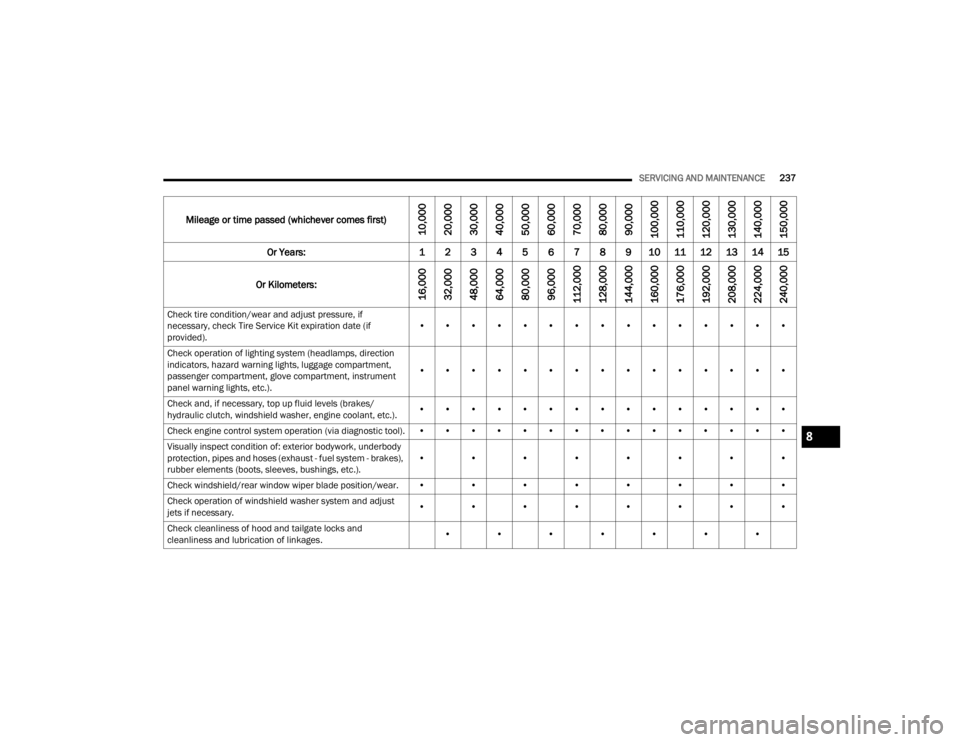
SERVICING AND MAINTENANCE237
Mileage or time passed (whichever comes first)
10,000
20,000
30,000
40,000
50,000
60,000
70,000
80,000
90,000
100,000
110,000
120,000
130,000
140,000
150,000
Or Years: 1 2 3 4 5 6 7 8 9 10 11 12 13 14 15
Or Kilometers:
16,000
32,000
48,000
64,000
80,000
96,000
112,000
128,000
144,000
160,000
176,000
192,000
208,000
224,000
240,000
Check tire condition/wear and adjust pressure, if
necessary, check Tire Service Kit expiration date (if
provided). • • • • • • • • • • • • • • •
Check operation of lighting system (headlamps, direction
indicators, hazard warning lights, luggage compartment,
passenger compartment, glove compartment, instrument
panel warning lights, etc.). • • • • • • • • • • • • • • •
Check and, if necessary, top up fluid levels (brakes/
hydraulic clutch, windshield washer, engine coolant, etc.). • • • • • • • • • • • • • • •
Check engine control system operation (via diagnostic tool). • • • • • • • • • • • • • • •
Visually inspect condition of: exterior bodywork, underbody
protection, pipes and hoses (exhaust - fuel system - brakes),
rubber elements (boots, sleeves, bushings, etc.). • • • • • • • •
Check windshield/rear window wiper blade position/wear. • • • • • • • •
Check operation of windshield washer system and adjust
jets if necessary. • • • • • • • •
Check cleanliness of hood and tailgate locks and
cleanliness and lubrication of linkages. • • • • • • •
8
22_FD_OM_EN_USC_t.book Page 237
Page 241 of 312
SERVICING AND MAINTENANCE239
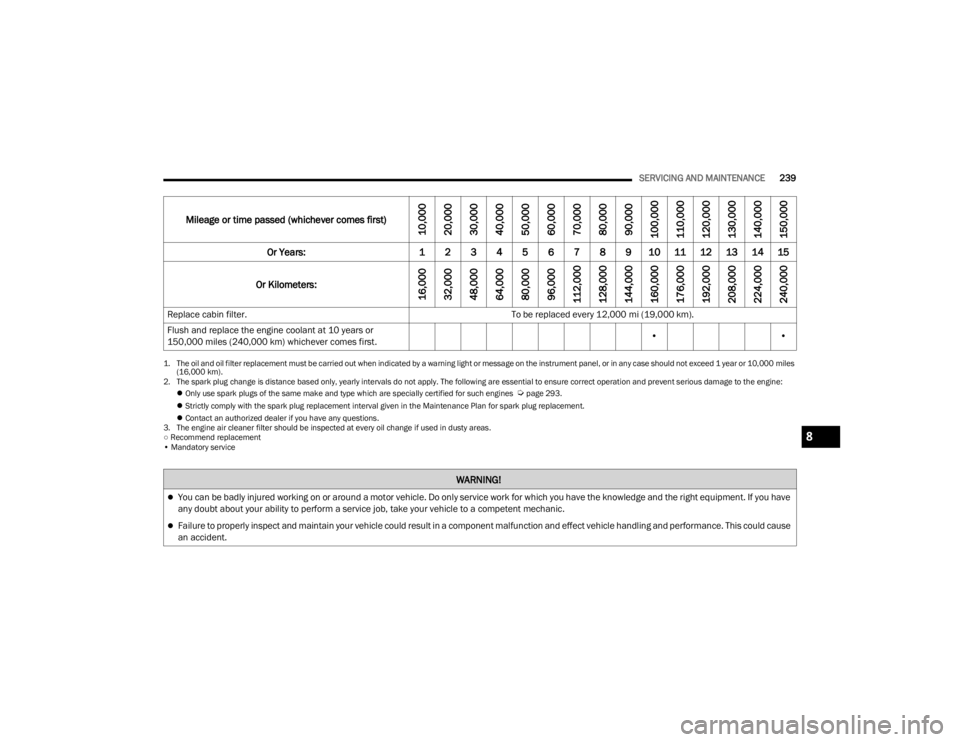
Replace cabin filter. To be replaced every 12,000 mi (19,000 km).
Flush and replace the engine coolant at 10 years or
150,000 miles (240,000 km) whichever comes first. •
•
1. The oil and oil filter replacement must be carried out when indicated by a warning light or message on the instrument panel, or in any case should not exceed 1 year or 10,000 miles
(16,000 km).
2. The spark plug change is distance based only, yearly intervals do not apply. The following are essential to ensure correct operation and prevent serious damage to the engine:
Only use spark plugs of the same make and type which are specially certified for such engines
Úpage 293.
Strictly comply with the spark plug replacement interval given in the Maintenance Plan for spark plug replacement.
Contact an authorized dealer if you have any questions.
3. The engine air cleaner filter should be inspected at every oil change if used in dusty areas.
○ Recommend replacement
• Mandatory service
Mileage or time passed (whichever comes first)
10,000
20,000
30,000
40,000
50,000
60,000
70,000
80,000
90,000
100,000
110,000
120,000
130,000
140,000
150,000
Or Years: 1 2 3 4 5 6 7 8 9 10 11 12 13 14 15
Or Kilometers:
16,000
32,000
48,000
64,000
80,000
96,000
112,000
128,000
144,000
160,000
176,000
192,000
208,000
224,000
240,000
WARNING!
You can be badly injured working on or around a motor vehicle. Do only service work for which you have the knowledge and the right equipment. If you have
any doubt about your ability to perform a service job, take your vehicle to a competent mechanic.
Failure to properly inspect and maintain your vehicle could result in a component malfunction and effect vehicle handling and performance. This could cause
an accident.
8
22_FD_OM_EN_USC_t.book Page 239
Page 252 of 312
250SERVICING AND MAINTENANCE
(Continued)
If frequent engine coolant additions are
required, the cooling system should be pressure
tested for leaks.
Maintain engine coolant concentration at a
minimum of 50% OAT coolant (conforming to
MS.90032) and distilled water for proper corro-
sion protection of your engine which contains
aluminum components.
Make sure that the coolant expansion bottle
overflow hoses are not kinked or obstructed.
Keep the front of the radiator clean. If your
vehicle is equipped with air conditioning, keep
the front of the condenser clean.
Do not change the thermostat for Summer or
Winter operation. If replacement is ever neces -
sary, install ONLY the correct type thermostat.
Other designs may result in unsatisfactory
engine cooling performance, poor gas mileage,
and increased emissions.
BRAKE SYSTEM
In order to ensure brake system performance, all
brake system components should be inspected
periodically Ú page 236.
Brake Master Cylinder
The fluid level in the master cylinder should be
checked when performing under hood services, or
immediately if the “Brake Warning Light” is on.
Be sure to clean the top of the master cylinder area
before removing the cap. If necessary, add fluid to
bring the fluid level up to the requirements
described on the brake fluid reservoir. Fluid level
can be expected to fall as the brake pads wear. The
brake fluid level should be checked when the pads
are replaced. However, low fluid level may be
caused by a leak and a checkup may be needed.
Use only manufacturer's recommended brake fluid
Úpage 293.
WARNING!
Riding the brakes can lead to brake failure and
possibly a collision. Driving with your foot resting
or riding on the brake pedal can result in
abnormally high brake temperatures, excessive
lining wear, and possible brake damage. You
would not have your full braking capacity in an
emergency.
WARNING!
Use only manufacturer’s recommended brake
fluid Ú page 293. Using the wrong type of
brake fluid can severely damage your brake
system and/or impair its performance. The
proper type of brake fluid for your vehicle is
also identified on the original factory installed
hydraulic master cylinder reservoir.
To avoid contamination from foreign matter or
moisture, use only new brake fluid or fluid that
has been in a tightly closed container. Keep
the master cylinder reservoir cap secured at
all times. Brake fluid in a open container
absorbs moisture from the air resulting in a
lower boiling point. This may cause it to boil
unexpectedly during hard or prolonged
braking, resulting in sudden brake failure. This
could result in a collision.
Overfilling the brake fluid reservoir can result
in spilling brake fluid on hot engine parts,
causing the brake fluid to catch fire. Brake
fluid can also damage painted and vinyl
surfaces, care should be taken to avoid its
contact with these surfaces.
22_FD_OM_EN_USC_t.book Page 250
Page 260 of 312
258SERVICING AND MAINTENANCE
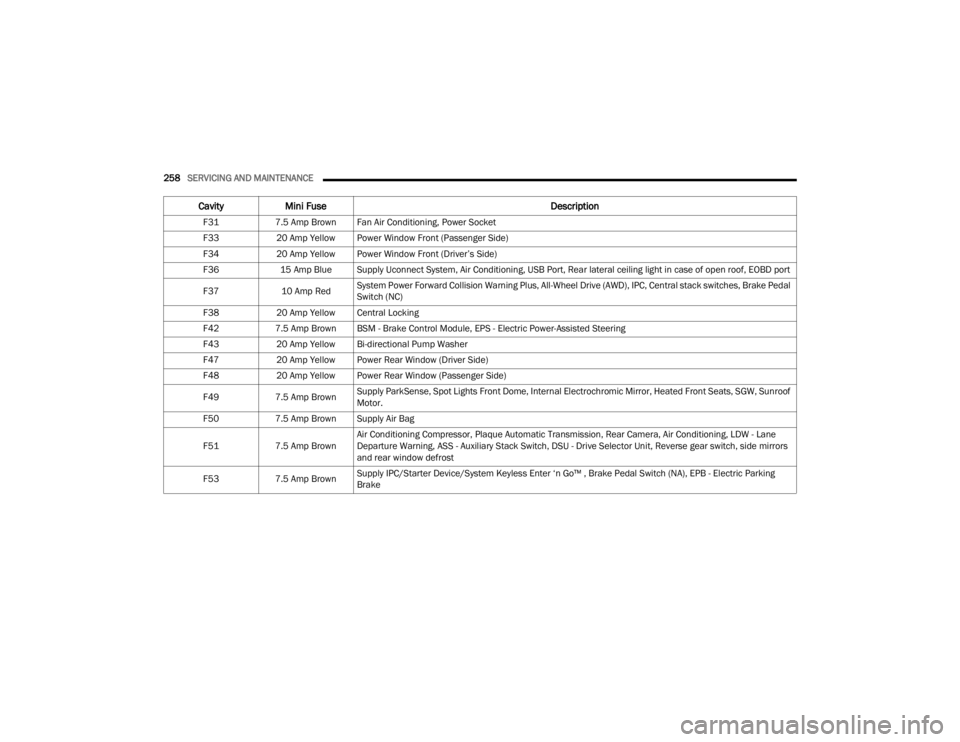
CavityMini Fuse Description
F317.5 Amp Brown Fan Air Conditioning, Power Socket
F33 20 Amp Yellow Power Window Front (Passenger Side)
F34 20 Amp Yellow Power Window Front (Driver’s Side)
F36 15 Amp Blue Supply Uconnect System, Air Conditioning, USB Port, Rear lateral ceiling light in case of open roof, EOBD port
F37 10 Amp RedSystem Power Forward Collision Warning Plus, All-Wheel Drive (AWD), IPC, Central stack switches, Brake Pedal
Switch (NC)
F38 20 Amp Yellow Central Locking
F42 7.5 Amp Brown BSM - Brake Control Module, EPS - Electric Power-Assisted Steering
F43 20 Amp Yellow Bi-directional Pump Washer
F47 20 Amp Yellow Power Rear Window (Driver Side)
F48 20 Amp Yellow Power Rear Window (Passenger Side)
F49 7.5 Amp Brown Supply ParkSense, Spot Lights Front Dome, Internal Electrochromic Mirror, Heated Front Seats, SGW, Sunroof
Motor.
F50 7.5 Amp Brown Supply Air Bag
F51 7.5 Amp Brown Air Conditioning Compressor, Plaque Automatic Transmission, Rear Camera, Air Conditioning, LDW - Lane
Departure Warning, ASS - Auxiliary Stack Switch, DSU - Drive Selector Unit, Reverse gear switch, side mirrors
and rear window defrost
F53 7.5 Amp Brown Supply IPC/Starter Device/System Keyless Enter ‘n Go™ , Brake Pedal Switch (NA), EPB - Electric Parking
Brake
22_FD_OM_EN_USC_t.book Page 258
Page 261 of 312
SERVICING AND MAINTENANCE259
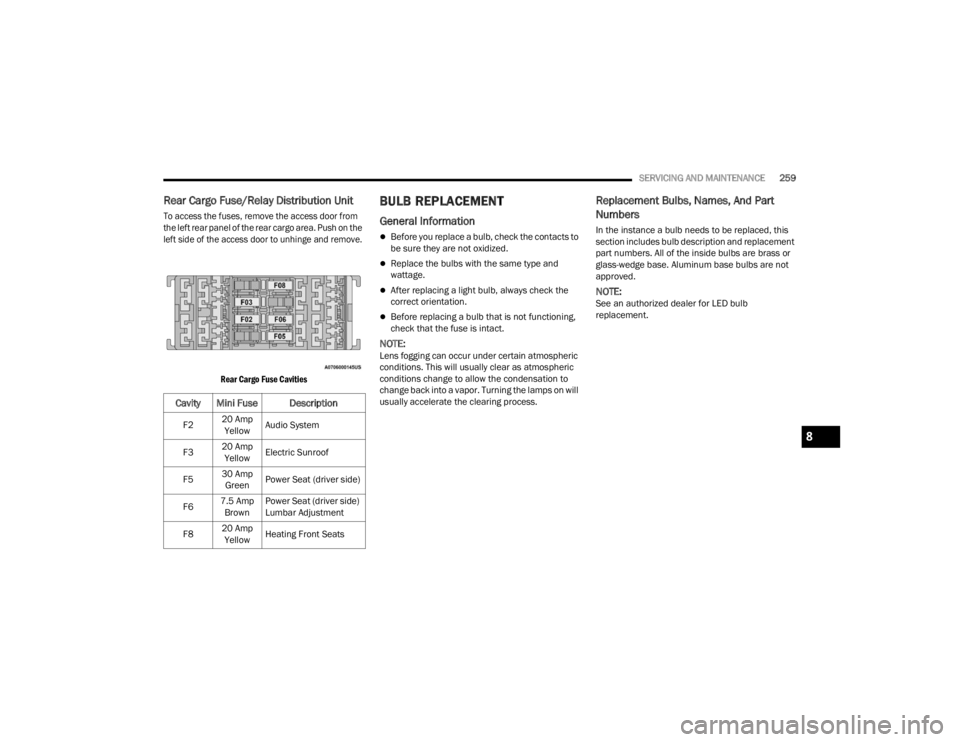
Rear Cargo Fuse/Relay Distribution Unit
To access the fuses, remove the access door from
the left rear panel of the rear cargo area. Push on the
left side of the access door to unhinge and remove.
Rear Cargo Fuse Cavities
BU LB REPLACEMENT
General Information
Before you replace a bulb, check the contacts to
be sure they are not oxidized.
Replace the bulbs with the same type and
wattage.
After replacing a light bulb, always check the
correct orientation.
Before replacing a bulb that is not functioning,
check that the fuse is intact.
NOTE:Lens fogging can occur under certain atmospheric
conditions. This will usually clear as atmospheric
conditions change to allow the condensation to
change back into a vapor. Turning the lamps on will
usually accelerate the clearing process.
Replacement Bulbs, Names, And Part
Numbers
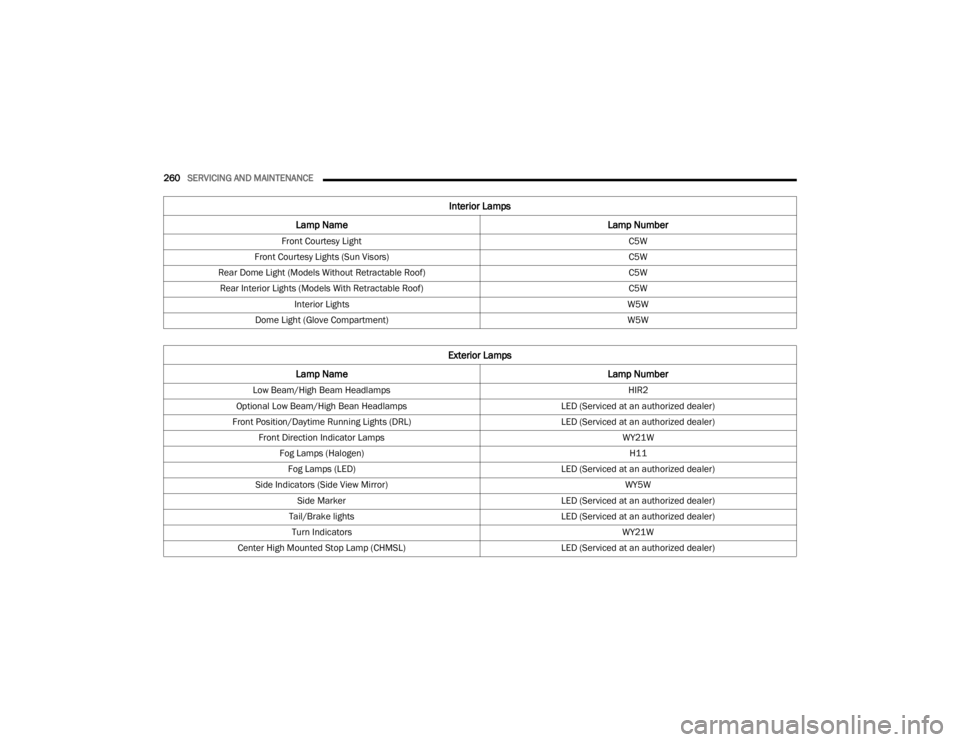
In the instance a bulb needs to be replaced, this
section includes bulb description and replacement
part numbers. All of the inside bulbs are brass or
glass-wedge base. Aluminum base bulbs are not
approved.
NOTE:See an authorized dealer for LED bulb
replacement.
Cavity Mini Fuse Description
F220 Amp
Yellow Audio System
F3 20 Amp
Yellow Electric Sunroof
F5 30 Amp
Green Power Seat (driver side)
F6 7.5 Amp
Brown Power Seat (driver side)
Lumbar Adjustment
F8 20 Amp
Yellow Heating Front Seats
8
22_FD_OM_EN_USC_t.book Page 259
Page 262 of 312
260SERVICING AND MAINTENANCE
Interior Lamps
Lamp Name Lamp Number
Front Courtesy Light C5W
Front Courtesy Lights (Sun Visors) C5W
Rear Dome Light (Models Without Retractable Roof) C5W
Rear Interior Lights (Models With Retractable Roof) C5W
Interior Lights W5W
Dome Light (Glove Compartment) W5W
Exterior Lamps
Lamp Name Lamp Number
Low Beam/High Beam Headlamps HIR2
Optional Low Beam/High Bean Headlamps LED (Serviced at an authorized dealer)
Front Position/Daytime Running Lights (DRL) LED (Serviced at an authorized dealer)
Front Direction Indicator Lamps WY21W
Fog Lamps (Halogen) H11
Fog Lamps (LED) LED (Serviced at an authorized dealer)
Side Indicators (Side View Mirror) WY5W
Side Marker LED (Serviced at an authorized dealer)
Tail/Brake lights LED (Serviced at an authorized dealer)
Turn Indicators WY21W
Center High Mounted Stop Lamp (CHMSL) LED (Serviced at an authorized dealer)
22_FD_OM_EN_USC_t.book Page 260