change time FIAT 500X 2022 Service Manual
[x] Cancel search | Manufacturer: FIAT, Model Year: 2022, Model line: 500X, Model: FIAT 500X 2022Pages: 312, PDF Size: 13.26 MB
Page 247 of 312

SERVICING AND MAINTENANCE245
a lithium based grease, such as Mopar® Spray
White Lube to ensure quiet, easy operation and to
protect against rust and wear. Prior to the
application of any lubricant, the parts concerned
should be wiped clean to remove dust and grit;
after lubricating excess oil and grease should be
removed. Particular attention should also be given
to hood latching components to ensure proper
function. When performing other underhood
services, the hood latch, release mechanism and
safety catch should be cleaned and lubricated.
The external lock cylinders should be lubricated
twice a year, preferably in the Autumn and Spring.
Apply a small amount of a high quality lubricant,
such as Mopar® Lock Cylinder Lubricant directly
into the lock cylinder.
WINDSHIELD WIPER BLADES
Clean the rubber edges of the wiper blades and the
windshield periodically with a sponge or soft cloth
and a mild nonabrasive cleaner. This will remove
accumulations of salt or road film.
Operation of the wipers on dry glass for long
periods may cause deterioration of the wiper
blades. Always use washer fluid when using the
wipers to remove salt or dirt from a dry windshield.
Avoid using the wiper blades to remove frost or ice
from the windshield. Keep the blade rubber out of
contact with petroleum products such as engine
oil, gasoline, etc.
NOTE:Life expectancy of wiper blades varies depending
on geographical area and frequency of use. Poor
performance of blades may be present with chat -
tering, marks, water lines or wet spots. If any of
these conditions are present, clean the wiper
blades or replace as necessary.
The wiper blades and wiper arms should be
inspected periodically, not just when wiper
performance problems are experienced. This
inspection should include the following points:
Wear or uneven edges
Foreign material
Hardening or cracking
Deformation or fatigue
If a wiper blade or wiper arm is damaged, replace
the affected wiper arm or blade with a new unit. Do
not attempt to repair a wiper arm or blade that is
damaged.
Service Position Strategy
The service position allows the wiper blades to be
placed in a position that allows the wiper blades to
be easily changed.
To enable the Service Position Strategy, the wipers
must be in the Park position before placing the
ignition in the OFF position. Service Mode must be activated within two
minutes after the ignition is placed in the OFF
position.
To have a correct activation of strategy, the Service
Position command (anti-panic) must be active for
at least half a second.
At every valid activation of Service Position
command, the wiper blades are activated for
250 ms.
The Service Position command can be repeated
several times to bring the blades into the desired
position, up to a maximum of three times.
After three subsequent activations the strategy is
disabled.
Function Deactivation:
The functionality is reset if:
The ignition is turned to the RUN position.
Number of subsequent activations is three.
Two minute timer has expired after placing the
ignition OFF.
NOTE:When turning the ignition ON, the blades will go
into the parking position.
8
22_FD_OM_EN_USC_t.book Page 245
Page 248 of 312
246SERVICING AND MAINTENANCE
(Continued)
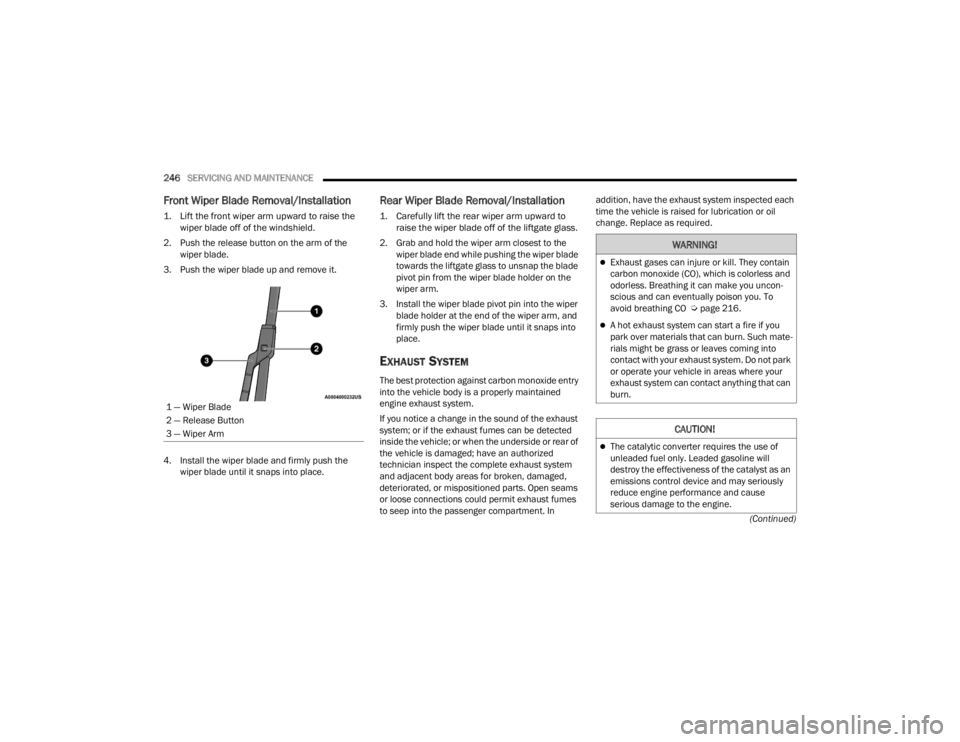
Front Wiper Blade Removal/Installation
1. Lift the front wiper arm upward to raise the wiper blade off of the windshield.
2. Push the release button on the arm of the wiper blade.
3. Push the wiper blade up and remove it.
4. Install the wiper blade and firmly push the wiper blade until it snaps into place.
Rear Wiper Blade Removal/Installation
1. Carefully lift the rear wiper arm upward to raise the wiper blade off of the liftgate glass.
2. Grab and hold the wiper arm closest to the wiper blade end while pushing the wiper blade
towards the liftgate glass to unsnap the blade
pivot pin from the wiper blade holder on the
wiper arm.
3. Install the wiper blade pivot pin into the wiper blade holder at the end of the wiper arm, and
firmly push the wiper blade until it snaps into
place.
EXHAUST SYSTEM
The best protection against carbon monoxide entry
into the vehicle body is a properly maintained
engine exhaust system.
If you notice a change in the sound of the exhaust
system; or if the exhaust fumes can be detected
inside the vehicle; or when the underside or rear of
the vehicle is damaged; have an authorized
technician inspect the complete exhaust system
and adjacent body areas for broken, damaged,
deteriorated, or mispositioned parts. Open seams
or loose connections could permit exhaust fumes
to seep into the passenger compartment. In addition, have the exhaust system inspected each
time the vehicle is raised for lubrication or oil
change. Replace as required.
1 — Wiper Blade
2 — Release Button
3 — Wiper Arm
WARNING!
Exhaust gases can injure or kill. They contain
carbon monoxide (CO), which is colorless and
odorless. Breathing it can make you uncon -
scious and can eventually poison you. To
avoid breathing CO Ú page 216.
A hot exhaust system can start a fire if you
park over materials that can burn. Such mate -
rials might be grass or leaves coming into
contact with your exhaust system. Do not park
or operate your vehicle in areas where your
exhaust system can contact anything that can
burn.
CAUTION!
The catalytic converter requires the use of
unleaded fuel only. Leaded gasoline will
destroy the effectiveness of the catalyst as an
emissions control device and may seriously
reduce engine performance and cause
serious damage to the engine.
22_FD_OM_EN_USC_t.book Page 246
Page 252 of 312

250SERVICING AND MAINTENANCE
(Continued)
If frequent engine coolant additions are
required, the cooling system should be pressure
tested for leaks.
Maintain engine coolant concentration at a
minimum of 50% OAT coolant (conforming to
MS.90032) and distilled water for proper corro-
sion protection of your engine which contains
aluminum components.
Make sure that the coolant expansion bottle
overflow hoses are not kinked or obstructed.
Keep the front of the radiator clean. If your
vehicle is equipped with air conditioning, keep
the front of the condenser clean.
Do not change the thermostat for Summer or
Winter operation. If replacement is ever neces -
sary, install ONLY the correct type thermostat.
Other designs may result in unsatisfactory
engine cooling performance, poor gas mileage,
and increased emissions.
BRAKE SYSTEM
In order to ensure brake system performance, all
brake system components should be inspected
periodically Ú page 236.
Brake Master Cylinder
The fluid level in the master cylinder should be
checked when performing under hood services, or
immediately if the “Brake Warning Light” is on.
Be sure to clean the top of the master cylinder area
before removing the cap. If necessary, add fluid to
bring the fluid level up to the requirements
described on the brake fluid reservoir. Fluid level
can be expected to fall as the brake pads wear. The
brake fluid level should be checked when the pads
are replaced. However, low fluid level may be
caused by a leak and a checkup may be needed.
Use only manufacturer's recommended brake fluid
Úpage 293.
WARNING!
Riding the brakes can lead to brake failure and
possibly a collision. Driving with your foot resting
or riding on the brake pedal can result in
abnormally high brake temperatures, excessive
lining wear, and possible brake damage. You
would not have your full braking capacity in an
emergency.
WARNING!
Use only manufacturer’s recommended brake
fluid Ú page 293. Using the wrong type of
brake fluid can severely damage your brake
system and/or impair its performance. The
proper type of brake fluid for your vehicle is
also identified on the original factory installed
hydraulic master cylinder reservoir.
To avoid contamination from foreign matter or
moisture, use only new brake fluid or fluid that
has been in a tightly closed container. Keep
the master cylinder reservoir cap secured at
all times. Brake fluid in a open container
absorbs moisture from the air resulting in a
lower boiling point. This may cause it to boil
unexpectedly during hard or prolonged
braking, resulting in sudden brake failure. This
could result in a collision.
Overfilling the brake fluid reservoir can result
in spilling brake fluid on hot engine parts,
causing the brake fluid to catch fire. Brake
fluid can also damage painted and vinyl
surfaces, care should be taken to avoid its
contact with these surfaces.
22_FD_OM_EN_USC_t.book Page 250
Page 304 of 312

302 Gauge
.......................................................... 73Materials Added........................................ 290Methanol................................................... 291Octane Rating................................. 290, 293Specifications............................................ 293Tank Capacity............................................ 292Full Brake Control System............................. 182Fuses............................................................. 252
G
Gasoline, (Fuel)............................................. 290Gasoline, Clean Air........................................ 290Gasoline, Reformulated................................. 290GaugesFuel............................................................. 73Gear Selector Override.................................. 230Glass Cleaning............................................... 288Gross Axle Weight Rating............................... 113GVWR............................................................ 112
H
HazardDriving Through Flowing, Rising, Or Shallow Standing Water
........................ 120Hazard Warning Flashers.............................. 218Head Restraints............................................... 30HeadlightsAutomatic.................................................... 37Cleaning.................................................... 286Delay........................................................... 37
High Beam/Low Beam Select Switch.......... 36Lights On Reminder..................................... 37Passing........................................................ 37Switch.......................................................... 36Time Delay................................................... 37Heated Mirrors................................................. 35Heated Seats................................................... 29High Beam/Low Beam Select (Dimmer)
Switch.............................................................. 36Hill Start Assist.............................................. 177HitchesTrailer Towing........................................... 115Holder, Coin..................................................... 51Hood Prop........................................................ 58Hood Release.................................................. 58
I
Ignition............................................................. 17Switch.......................................................... 17Inside Rearview Mirror..................................... 33Instrument Cluster........................................... 63Display......................................................... 64Instrument Panel Lens Cleaning................... 288Interior Appearance Care.............................. 287Interior Lights................................................... 38Intermittent Wipers (Delay Wipers).................. 40iPod/USB/MP3 Control.................................... 51
J
Jack Location................................................ 219Jack Operation.............................................. 220Jacking Instructions...................................... 220Jump Starting................................................ 226
K
Key FobArm The Alarm
.............................................21Disarm The Alarm........................................21Keyless Entry...............................................23Remote Keyless Entry..................................14Key Fob Battery Service (Remote Keyless
Entry)...............................................................15Keyless Enter 'n Go™Enter The Trunk...........................................23Lock The Vehicle’s Doors................... 23, 132Passive Entry...............................................23Passive Entry Programming.........................23Remote Control............................................23Unlock From The Driver’s Side.....................23Unlock From The Passenger’s Side.............23Keyless Entry...................................................14Keys.................................................................14Replacement...............................................16
L
Lane Change And Turn Signals........................38Lane Change Assist..........................................38LaneSense.................................................... 108
22_FD_OM_EN_USC_t.book Page 302