stop start FIAT 500X 2022 Workshop Manual
[x] Cancel search | Manufacturer: FIAT, Model Year: 2022, Model line: 500X, Model: FIAT 500X 2022Pages: 312, PDF Size: 13.26 MB
Page 222 of 312
220IN CASE OF EMERGENCY
(Continued)
4. Remove the jack, wheel bolt wrench, and
wheel chocks (if equipped).
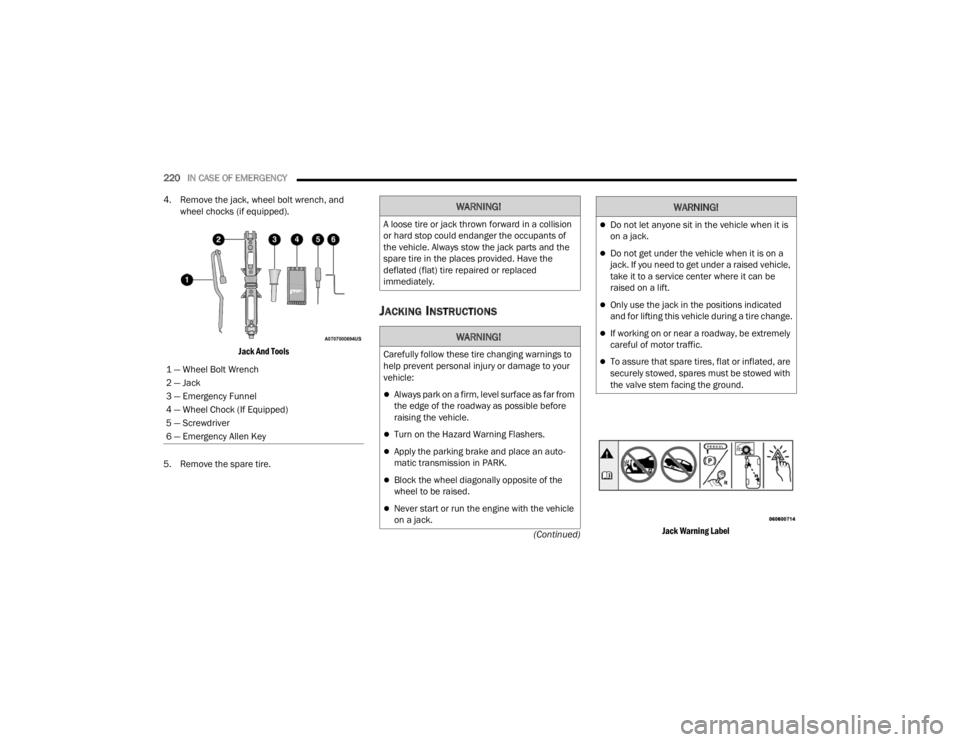
Jack And Tools
5. Remove the spare tire.
JACKING INSTRUCTIONS
Jack Warning Label
1 — Wheel Bolt Wrench
2 — Jack
3 — Emergency Funnel
4 — Wheel Chock (If Equipped)
5 — Screwdriver
6 — Emergency Allen Key
WARNING!
A loose tire or jack thrown forward in a collision
or hard stop could endanger the occupants of
the vehicle. Always stow the jack parts and the
spare tire in the places provided. Have the
deflated (flat) tire repaired or replaced
immediately.
WARNING!
Carefully follow these tire changing warnings to
help prevent personal injury or damage to your
vehicle:
Always park on a firm, level surface as far from
the edge of the roadway as possible before
raising the vehicle.
Turn on the Hazard Warning Flashers.
Apply the parking brake and place an auto
-
matic transmission in PARK.
Block the wheel diagonally opposite of the
wheel to be raised.
Never start or run the engine with the vehicle
on a jack.
Do not let anyone sit in the vehicle when it is
on a jack.
Do not get under the vehicle when it is on a
jack. If you need to get under a raised vehicle,
take it to a service center where it can be
raised on a lift.
Only use the jack in the positions indicated
and for lifting this vehicle during a tire change.
If working on or near a roadway, be extremely
careful of motor traffic.
To assure that spare tires, flat or inflated, are
securely stowed, spares must be stowed with
the valve stem facing the ground.
WARNING!
22_FD_OM_EN_USC_t.book Page 220
Page 227 of 312
IN CASE OF EMERGENCY225
To use your Semi-Auto Kit, proceed as follows:
1. Apply the Electric Park Brake.
2. Insert the sealant cartridge containing the sealing fluid in the proper compressor holder,
pushing down hard. Unscrew the tire valve
cap, take out the filler tube and tighten the
fitting on the tire valve.
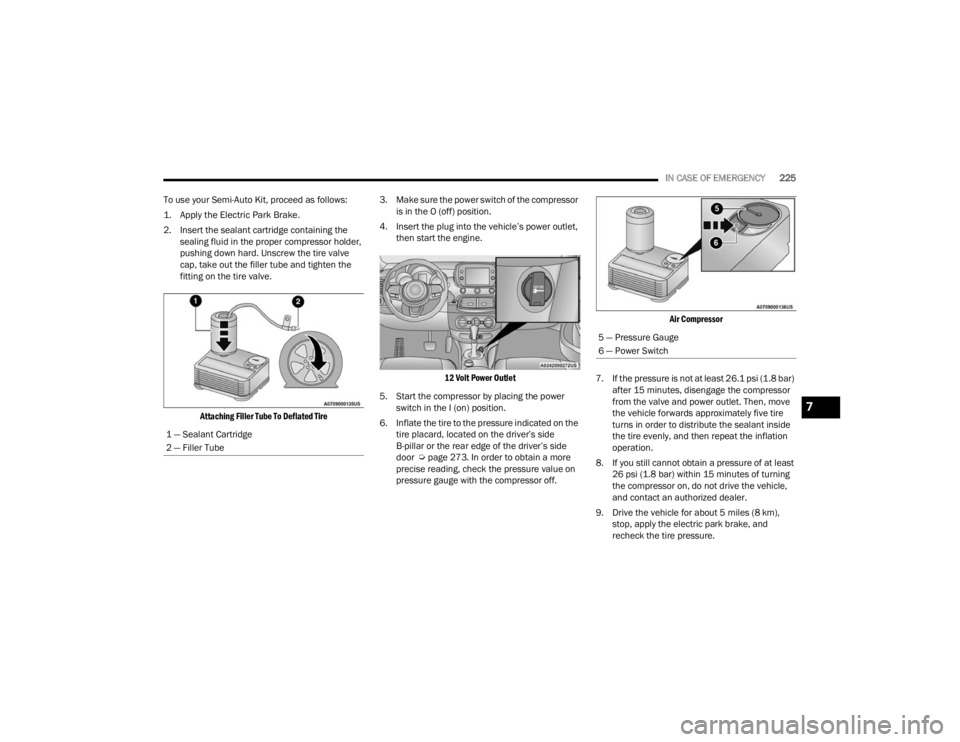
Attaching Filler Tube To Deflated Tire
3. Make sure the power switch of the compressor
is in the O (off) position.
4. Insert the plug into the vehicle’s power outlet, then start the engine.
12 Volt Power Outlet
5. Start the compressor by placing the power switch in the I (on) position.
6. Inflate the tire to the pressure indicated on the tire placard, located on the driver’s side
B-pillar or the rear edge of the driver’s side
door Ú page 273. In order to obtain a more
precise reading, check the pressure value on
pressure gauge with the compressor off.
Air Compressor
7. If the pressure is not at least 26.1 psi (1.8 bar) after 15 minutes, disengage the compressor
from the valve and power outlet. Then, move
the vehicle forwards approximately five tire
turns in order to distribute the sealant inside
the tire evenly, and then repeat the inflation
operation.
8. If you still cannot obtain a pressure of at least 26 psi (1.8 bar) within 15 minutes of turning
the compressor on, do not drive the vehicle,
and contact an authorized dealer.
9. Drive the vehicle for about 5 miles (8 km), stop, apply the electric park brake, and
recheck the tire pressure.
1 — Sealant Cartridge
2 — Filler Tube
5 — Pressure Gauge
6 — Power Switch
7
22_FD_OM_EN_USC_t.book Page 225
Page 233 of 312
IN CASE OF EMERGENCY231
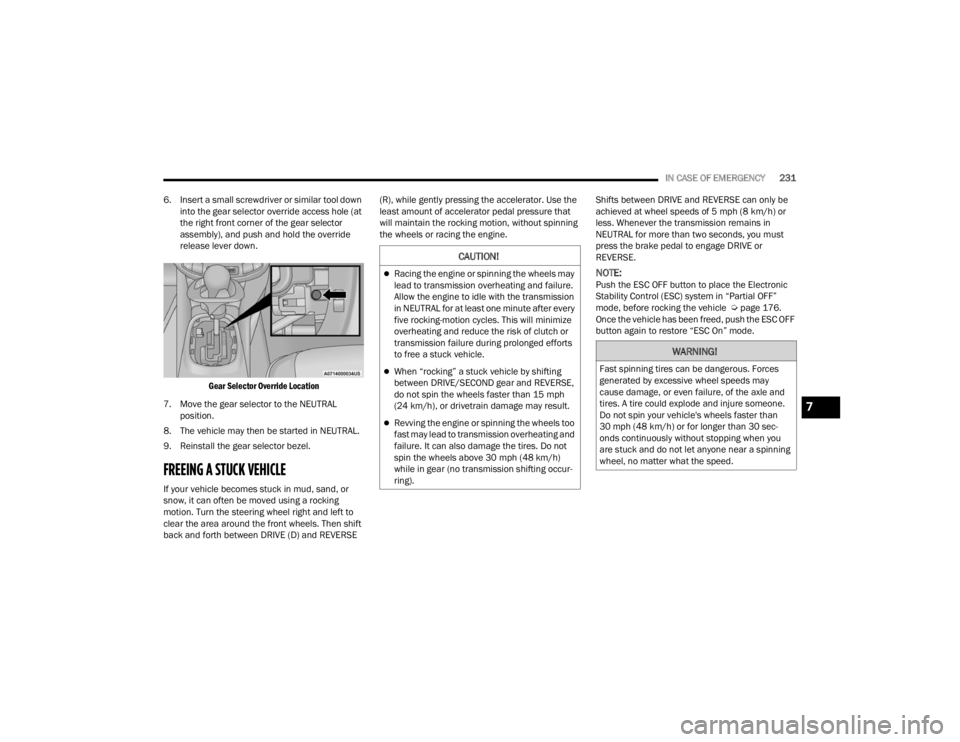
6. Insert a small screwdriver or similar tool down into the gear selector override access hole (at
the right front corner of the gear selector
assembly), and push and hold the override
release lever down.
Gear Selector Override Location
7. Move the gear selector to the NEUTRAL position.
8. The vehicle may then be started in NEUTRAL.
9. Reinstall the gear selector bezel.
FREEING A STUCK VEHICLE
If your vehicle becomes stuck in mud, sand, or
snow, it can often be moved using a rocking
motion. Turn the steering wheel right and left to
clear the area around the front wheels. Then shift
back and forth between DRIVE (D) and REVERSE (R), while gently pressing the accelerator. Use the
least amount of accelerator pedal pressure that
will maintain the rocking motion, without spinning
the wheels or racing the engine.
Shifts between DRIVE and REVERSE can only be
achieved at wheel speeds of 5 mph (8 km/h) or
less. Whenever the transmission remains in
NEUTRAL for more than two seconds, you must
press the brake pedal to engage DRIVE or
REVERSE.
NOTE:Push the ESC OFF button to place the Electronic
Stability Control (ESC) system in “Partial OFF”
mode, before rocking the vehicle Ú
page 176.
Once the vehicle has been freed, push the ESC OFF
button again to restore “ESC On” mode.
CAUTION!
Racing the engine or spinning the wheels may
lead to transmission overheating and failure.
Allow the engine to idle with the transmission
in NEUTRAL for at least one minute after every
five rocking-motion cycles. This will minimize
overheating and reduce the risk of clutch or
transmission failure during prolonged efforts
to free a stuck vehicle.
When “rocking” a stuck vehicle by shifting
between DRIVE/SECOND gear and REVERSE,
do not spin the wheels faster than 15 mph
(24 km/h), or drivetrain damage may result.
Revving the engine or spinning the wheels too
fast may lead to transmission overheating and
failure. It can also damage the tires. Do not
spin the wheels above 30 mph (48 km/h)
while in gear (no transmission shifting occur -
ring).
WARNING!
Fast spinning tires can be dangerous. Forces
generated by excessive wheel speeds may
cause damage, or even failure, of the axle and
tires. A tire could explode and injure someone.
Do not spin your vehicle's wheels faster than
30 mph (48 km/h) or for longer than 30 sec -
onds continuously without stopping when you
are stuck and do not let anyone near a spinning
wheel, no matter what the speed.
7
22_FD_OM_EN_USC_t.book Page 231
Page 249 of 312

SERVICING AND MAINTENANCE247
(Continued)
Under normal operating conditions, the catalytic
converter will not require maintenance. However, it
is important to keep the engine properly tuned to
ensure proper catalyst operation and prevent
possible catalyst damage.
NOTE:Intentional tampering with emissions control
systems can result in civil penalties being
assessed against you.
In unusual situations involving grossly
malfunctioning engine operation, a scorching odor
may suggest severe and abnormal catalyst
overheating. If this occurs, stop the vehicle, turn off
the engine and allow it to cool. Service, including a
tune-up to manufacturer's specifications, should
be obtained immediately. To minimize the possibility of catalytic converter
damage:
Do not interrupt the ignition when the transmis
-
sion is in gear and the vehicle is in motion.
Do not try to start the vehicle by pushing or
towing the vehicle.
Do not idle the engine with any ignition compo -
nents disconnected or removed, such as when
diagnostic testing, or for prolonged periods
during very rough idle or malfunctioning oper -
ating conditions.
COOLING SYSTEM
Engine Coolant Checks
Check the engine coolant (antifreeze) protection
every 12 months (before the onset of freezing
weather, where applicable). If the engine coolant is
dirty, the system should be drained, flushed, and
refilled with fresh Organic Additive Technology
(OAT) coolant (conforming to MS.90032) by an
authorized dealer. Check the front of the A/C
condenser for any accumulation of bugs, leaves,
etc. If dirty, clean by gently spraying water from a
garden hose vertically down the face of the
condenser.
Check the engine cooling system hoses for brittle
rubber, cracking, tears, cuts, and tightness of the
connection at the coolant recovery bottle and
radiator. Inspect the entire system for leaks. DO
NOT REMOVE THE COOLANT PRESSURE CAP
WHEN THE COOLING SYSTEM IS HOT.
Damage to the catalytic converter can result if
your vehicle is not kept in proper operating
condition. In the event of engine malfunction,
particularly involving engine misfire or other
apparent loss of performance, have your
vehicle serviced promptly. Continued opera -
tion of your vehicle with a severe malfunction
could cause the converter to overheat,
resulting in possible damage to the converter
and vehicle.
CAUTION!
WARNING!
You or others can be badly burned by hot
engine coolant (antifreeze) or steam from your
radiator. If you see or hear steam coming from
under the hood, do not open the hood until the
radiator has had time to cool. Never open a
cooling system pressure cap when the radi -
ator or coolant bottle is hot.
Keep hands, tools, clothing, and jewelry away
from the radiator cooling fan when the hood is
raised. The fan starts automatically and may
start at any time, whether the engine is
running or not.
When working near the radiator cooling fan,
disconnect the fan motor lead or turn the igni -
tion to the OFF position. The fan is tempera -
ture controlled and can start at any time the
ignition is in the ON position.
WARNING!
8
22_FD_OM_EN_USC_t.book Page 247
Page 305 of 312

303
Lap/Shoulder Belts
....................................... 190Latches.......................................................... 216Hood........................................................... 58Leaks, Fluid................................................... 216Life Of Tires................................................... 278Liftgate............................................................ 60Closing........................................................ 60Opening....................................................... 60Liftgate Window Wiper/Washer....................... 42Light Bulbs..................................................... 216Lighter Cigar............................................................ 52Lights............................................................. 216Adaptive Cruise Control............................... 72Air Bag....................................................... 215Audio System.............................................. 72Automatic Headlights.................................. 37Brake Warning............................................ 70Coolant Temperature.................................. 70Cruise................................................... 76, 77Daytime Running......................................... 36Dimmer Switch, Headlight........................... 36Drive Mode.................................................. 73Electric Power Steering............................... 71Electronic Park Brake.................................. 72Electronic Stability Control................... 72, 73Exterior............................................... 36, 216Exterior Bulb................................................ 76External Light.............................................. 73Fog....................................................... 38, 76
Fuel Cutoff................................................... 76Fuel Level.................................................... 76Full Brake Control........................................ 76Hazard Warning Flasher........................... 218Headlight Switch.......................................... 36Headlights................................................... 36Headlights On Reminder............................. 37High Beam............................................ 36, 77Hood Open.................................................. 71Icy Road Condition....................................... 76Immobilizer Fail........................................... 76Instrument Cluster....................................... 36Intensity Control.......................................... 39Interior......................................................... 38LaneSense.................................... 73, 76, 77Light Sensor................................................ 77Lights On Reminder..................................... 37Loose Fuel Filler Cap................................... 73Malfunction Indicator (Check Engine).......... 73Park............................................................. 76Passing........................................................ 37Seat Belt Reminder..................................... 71Security Alarm............................................. 72Service........................................................ 74Service LaneSense...................................... 73Service Stop Start........................................ 74Speed.......................................................... 77StopStart Active........................................... 77Tire Pressure Monitoring (TPMS).............. 185Transmission Fault...................................... 72
Transmission Temperature..........................75Trunk Open..................................................72Turn Signals................................ 38, 77, 216Vanity Mirror................................................33Loading Vehicle............................................. 112Tires.......................................................... 273LocksAutomatic Door............................................22Child Protection...........................................24Low Tire Pressure System............................. 185Lubrication, Body.......................................... 244Lug Nuts/Bolts.............................................. 289
M
Maintenance Free Battery............................ 241Maintenance Schedule................................. 235Malfunction Indicator Light (Check Engine).....73ManualService...................................................... 296Master CylinderBrakes...................................................... 250Media Mode.................................................. 150Methanol....................................................... 291Mirrors.............................................................33Heated.........................................................35Outside........................................................34Rearview......................................................33Vanity...........................................................33Modifications/AlterationsVehicle........................................................... 9
11
22_FD_OM_EN_USC_t.book Page 303