ABS FIAT BARCHETTA 2003 1.G User Guide
[x] Cancel search | Manufacturer: FIAT, Model Year: 2003, Model line: BARCHETTA, Model: FIAT BARCHETTA 2003 1.GPages: 170, PDF Size: 3.55 MB
Page 76 of 170
75
– Remember that fog also means the
tarmac is wet and therefore manoeu-
vres of all kinds are more difficult and
stopping distances are longer.
– Keep a good distance from the cars
in front of you.
– As far as possible, avoid spurts of
speed or sudden deceleration.
– Do not overtake other vehicles if
you can help it.
– If you are forced to stop your car
(breakdown, limited visibility etc.) try
to stop off the road. Then turn on the
hazard lights and, if possible, the
dipped headlights. Rhythmically sound
the horn if you realise another car is
coming.
DRIVING
IN THE MOUNTAINS
– When driving downhill, use the en-
gine brake by engaging a low gear so
as not to overheat the brakes.
– Under no circumstances should
you drive downhill with the engine off
or with the car in neutral, let alone
with the ignition key out.– Drive at a moderate speed without
cutting corners.
– Remember that overtaking while
going uphill is slower and therefore re-
quires more free road. If you are be-
ing overtaken while driving uphill,
make it easier for the other vehicle
to pass.
DRIVING ON SNOW OR ICE
Here are some tips for driving in
these conditions:
– Keep your speed down.
– Use chains if the roads are covered
in snow (refer to the “Snow chains”
paragraph in this section).
– Mainly use the engine brake and
under all circumstances avoid braking
sharply.
– When braking in a car not fitted
with ABS, avoid the wheels locking by
varying the pressure you exert on the
brake pedal.
– Do not accelerate suddenly and
avoid swerving.– In the winter, even apparently dry
roads may have icy patches. Be care-
ful therefore when driving over
stretches that do not get much expo-
sure to the sun or that are lined by
trees and rocks where ice might not
have melted.
– Keep a good distance from the ve-
hicles in front.
– Do not remain for long periods in
deep snow with the engine running as
the snow could force the exhaust gas-
es into the passenger compartment.
DRIVING WITH ABS
ABS is a braking system that essen-
tially offers two advantages:
1)It prevents wheel lock-up and
consequent skidding in emergency
stops, particularly when the road does
not offer much grip.
2)It makes it possible to brake and
steer at the same time so you can
avoid unexpected obstacles and direct
the car where you want while braking.
The extent to which this can be done
will depend on the physical limits of
the tyre's sideways grip.
Page 77 of 170
76
Here are some suggestions which
may help you to keep the running
costs of your vehicle down and low-
er the amount of toxic emissions re-
leased into the atmosphere.
GENERAL
CONSIDERATIONS
Car maintenance
The overall state of the car is an im-
portant factor which has a marked in-
fluence over fuel consumption and dri-
ving comfort and on the life span of
your car. For this reason care should
be taken to maintain your car by car-
rying out the necessary checks and
regulations in accordance with the
specifications given in the Scheduled
Maintenance Programme (see sec-
tions... spark plugs, idle, air filter, tim-
ing).
CONTAINING RUNNING COSTS
AND POLLUTION
Tyres
Tyres should be checked at least
every four weeks: if the pressure is
too low fuel consumption increases as
the resistance to the rolling movement
of the tyre is greater. In this state, tyre
wear is increased and car handling suf-
fers which will affect safety.
Unnecessary loads
Do not travel with too much luggage
stowed in the boot. The weight of the
vehicle (especially when driving in
town) and its trim greatly affects con-
sumption and stability. To get the most out of ABS:
– During emergency stops or when
grip conditions are poor, you will feel
a slight pulsation on the brake pedal.
This is the sign that the ABS is in ac-
tion. Do not release the brake pedal
but continue to press so as not to in-
terrupt the braking action.
– ABS prevents the wheels from
locking but it does not increase actu-
al grip conditions between tyre and
road. Therefore, even if your car is fit-
ted with ABS, respect the safety dis-
tance from the car in front of you and
keep your speed down when driving
into bends.
– ABS serves to increase the con-
trollability of the car, not to enable you
to go faster.
Page 81 of 170
80
In order to be sure you are not
exceeding the maximum towing
weight you have to take into account
the trailer’s fully laden weight,
including accessories and personal
luggage.
Do not exceed the speed limits for
towing a trailer in the country you
are driving in. In any case, do not
exceed the top speed of 100 km/h. SNOW CHAINS
Keep your speed down
when snow chains have
been fitted to the
wheels. Avoid potholes, steps
and pavements, and do not
drive for long stretches on
snow-free roads, otherwise you
risk damaging the tyres, suspen-
sion and steering.
The use of snow chains is regulated
by the legislation in force in the
country the car is driven in.
The chains may only be applied to
the drive wheel tyres (front wheels).
Check the tautness of the chains
after driving some twenty to thirty
metres.Do not use snow chains with
195/55 R15 (84V) or 195/45 R16
(80V) tyres as the chains are likely to
interfere with the plastic wheelarch-
es.
Use only low-profile chains with
185/55 R15 (81H) tyres: maximum
height off the wheel 12 mm
IMPORTANT As the spare
wheel is small, it is not possible to fit
snow chains to it. If a front tyre is
punctured, first exchange a rear
wheel with the spare tyre and then
change the flat tyre with the rear
wheel thus removed. This way there
will be two ordinary wheels at the
front and the snow chains can fitted.
The ABS system which
may be fitted to the vehi-
cle will not control the trailer
braking system. Great care should
therefore be taken when driving
on slippery road surfaces.
WARNING
Under no circumstances
modify the car's braking
system for trailer braking control.
The trailer's braking system must
be completely independent of the
car's hydraulic system.
WARNING
Page 104 of 170
103
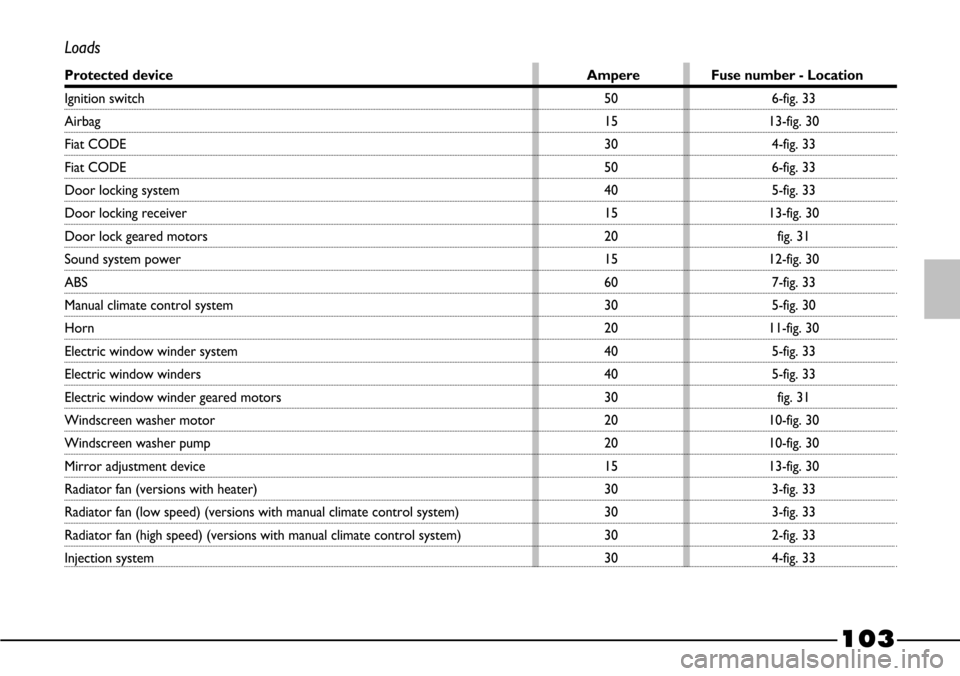
50
15
30
50
40
15
20
15
60
30
20
40
40
30
20
20
15
30
30
30
30
Loads
Protected device Ampere Fuse number - Location
Ignition switch
Airbag
Fiat CODE
Fiat CODE
Door locking system
Door locking receiver
Door lock geared motors
Sound system power
ABS
Manual climate control system
Horn
Electric window winder system
Electric window winders
Electric window winder geared motors
Windscreen washer motor
Windscreen washer pump
Mirror adjustment device
Radiator fan (versions with heater)
Radiator fan (low speed) (versions with manual climate control system)
Radiator fan (high speed) (versions with manual climate control system)
Injection system 6-fig. 33
13-fig. 30
4-fig. 33
6-fig. 33
5-fig. 33
13-fig. 30
fig. 31
12-fig. 30
7-fig. 33
5-fig. 30
11-fig. 30
5-fig. 33
5-fig. 33
fig. 31
10-fig. 30
10-fig. 30
13-fig. 30
3-fig. 33
3-fig. 33
2-fig. 33
4-fig. 33
Page 122 of 170
121
Oil consumption is ex-
tremely low: if it needs
topping up after travelling
only a short while, have the sys-
tem checked for leaks at a Fiat
Dealership.
fig. 6
P5S10044m
The level of the fluid in the reservoir
must not exceed the MAXmark.
If you need to add fluid, only use the
type classified DOT 4. You are advised
in particular to use TUTELA TOP 4
with which the braking system was
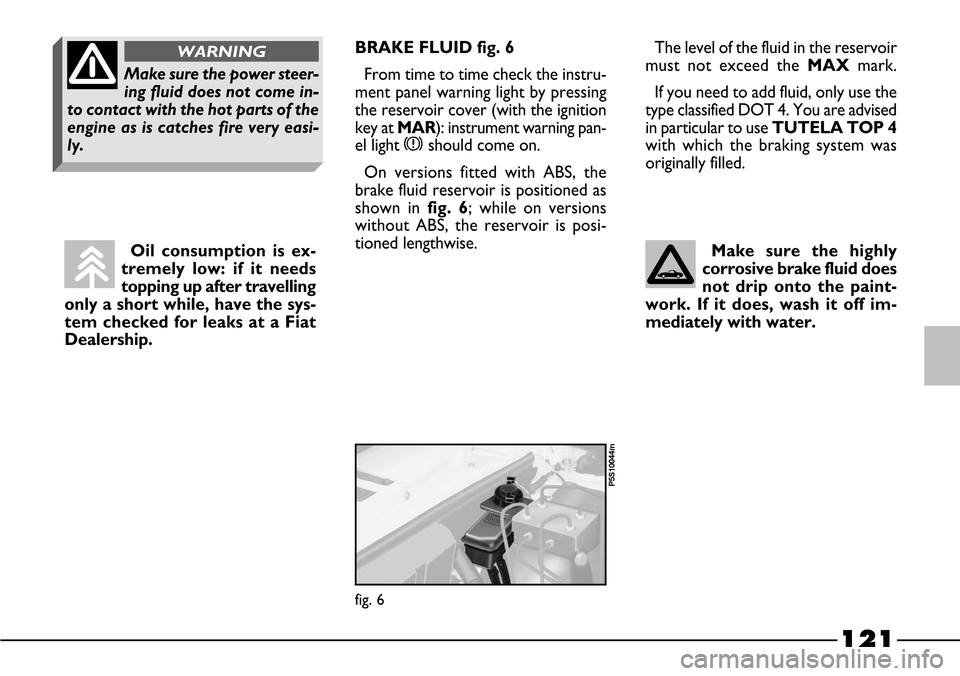
originally filled. BRAKE FLUID fig. 6
From time to time check the instru-
ment panel warning light by pressing
the reservoir cover (with the ignition
key at MAR): instrument warning pan-
el light xshould come on.
On versions fitted with ABS, the
brake fluid reservoir is positioned as
shown in fig. 6; while on versions
without ABS, the reservoir is posi-
tioned lengthwise.
Make sure the highly
corrosive brake fluid does
not drip onto the paint-
work. If it does, wash it off im-
mediately with water.
Make sure the power steer-
ing fluid does not come in-
to contact with the hot parts of the
engine as is catches fire very easi-
ly.
WARNING
Page 123 of 170
122
IMPORTANT Brake fluid is hy-
groscopic (meaning it absorbs humid-
ity). This is why the fluid should be
changed more frequently than shown
in the Service Schedule if the car is
mainly driven in areas with a high per-
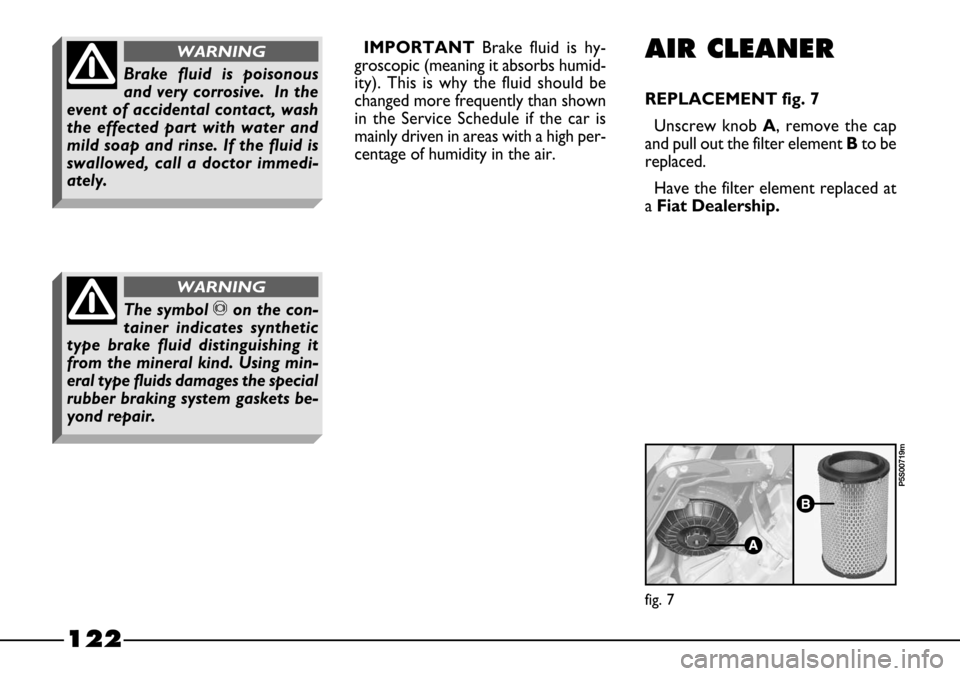
centage of humidity in the air.AIR CLEANER
REPLACEMENT fig. 7
Unscrew knob A, remove the cap
and pull out the filter element Bto be
replaced.
Have the filter element replaced at
a Fiat Dealership.
fig. 7
P5S00719m
Brake fluid is poisonous
and very corrosive. In the
event of accidental contact, wash
the effected part with water and
mild soap and rinse. If the fluid is
swallowed, call a doctor immedi-
ately.
WARNING
The symbol πon the con-
tainer indicates synthetic
type brake fluid distinguishing it
from the mineral kind. Using min-
eral type fluids damages the special
rubber braking system gaskets be-
yond repair.
WARNING
Page 129 of 170
128
RUBBER TUBING
Follow the Service Schedule careful-
ly in the case of the braking, power
steering and fuel supply systems' rub-
ber hoses. Ozone, high temperatures
and long absence of liquid in the sys-
tem can in fact cause the hardening
and cracking of the hoses with possi-
ble losses of fluid. A careful check is
therefore essential.
WINDSCREEN
WIPER
BLADES
Periodically clean the rubber part
with suitable liquid; TUTELA PRO-
FESSIONAL SC 35is recommend-
ed.
Change the blades if the rubber edge
is warped or worn out. You should in
any case change them approximately
once a year. To ensure the front and rear tyres all
wear evenly, you are advised to change
the tyres over every 10-15 thousand
kilometres (6-10 thousand miles)
keeping them on the same side of the
car so as not to reverse the direction
of rotation.
Do not change the tyres
over in criss-cross fashion
by moving a tyre from the left hand
side of the car to the right and vice
versa.
WARNING
Travelling with worn wiper
blades is dangerous be-
cause it reduces visibility in bad
weather.
WARNING
Page 135 of 170
134
If the stain does not come out, use
a special cleaning compound being par-
ticularly careful to follow the instruc-
tions for use.
IMPORTANTNever use alcohol
or alcohol-base products.
PLASTIC PARTS INSIDE
THE CAR
Use special products designed not to
alter the appearance of the compo-
nents.
IMPORTANT Do not use alcohol
or petrol for cleaning the glass of the
instrument panel. CLEANING THE SEATS AND
FABRIC UPHOLSTERY
– Remove the dust with a soft brush
or a vacuum cleaner.
– Rub the seats with a rag moistened
in a solution of water and neutral de-
tergent.
CLEANING LEATHER SEATS
– Remove the dry dirt with a buck-
skin or very slightly moist cloth with-
out exerting too much pressure.
– Remove liquid or grease stains with
a dry absorbent cloth without rubbing.
Then wipe with a buckskin or soft
cloth moistened with water and neu-
tral soap.
Do not keep aerosol cans in
the car. There is the risk
they might explode. Aerosol cans
must never be exposed to a tem-
perature above 50°C. The temper-
ature inside the car might go well
beyond that figure if the car is ex-
posed to the sun.
WARNING
Page 140 of 170
139
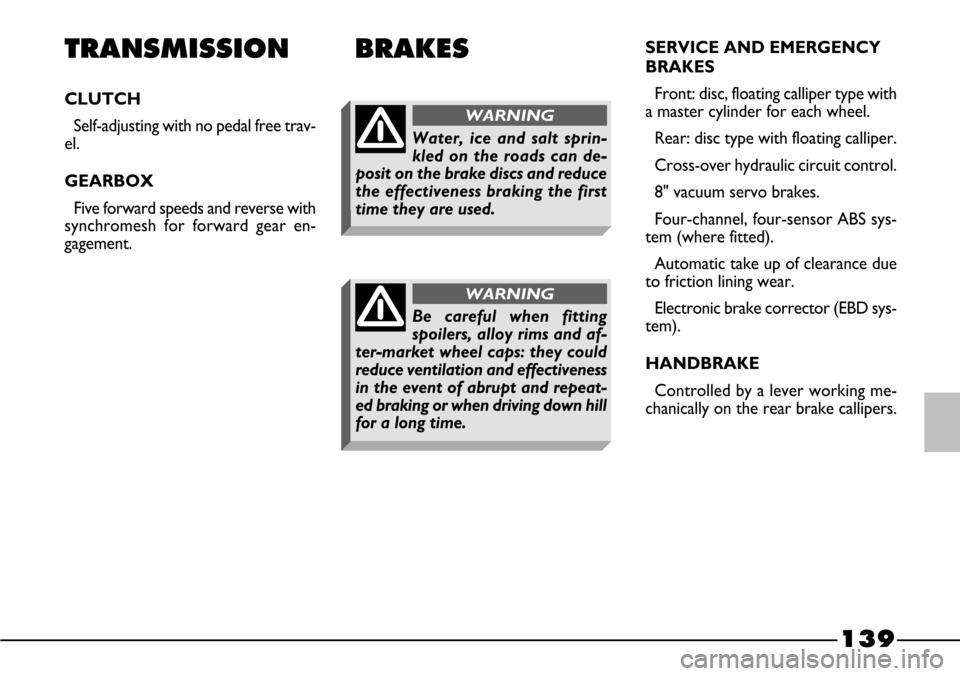
TRANSMISSION
CLUTCH
Self-adjusting with no pedal free trav-
el.
GEARBOX
Five forward speeds and reverse with
synchromesh for forward gear en-
gagement. SERVICE AND EMERGENCY
BRAKES
Front: disc, floating calliper type with
a master cylinder for each wheel.
Rear: disc type with floating calliper.
Cross-over hydraulic circuit control.
8" vacuum servo brakes.
Four-channel, four-sensor ABS sys-
tem (where fitted).
Automatic take up of clearance due
to friction lining wear.
Electronic brake corrector (EBD sys-
tem).
HANDBRAKE
Controlled by a lever working me-
chanically on the rear brake callipers.
BRAKES
Water, ice and salt sprin-
kled on the roads can de-
posit on the brake discs and reduce
the effectiveness braking the first
time they are used.
WARNING
Be careful when fitting
spoilers, alloy rims and af-
ter-market wheel caps: they could
reduce ventilation and effectiveness
in the event of abrupt and repeat-
ed braking or when driving down hill
for a long time.
WARNING
Page 141 of 170
140
SUSPENSIONS
FRONT
Independent wheel, MacPherson-
type with ferritic cast-iron wishbone
anchored to an auxiliary cross-mem-
ber.
Off-set coil springs and double-action
telescopic gas dampers.
Anti-roll bar.
REAR
Independent wheels with spheroidal
cast-iron wishbones.
Coil springs and gas dampers with
vulcanised bushings.
Anti-roll bar.
Auxiliary rigid H-shaped frame con-
sisting of a tubular cross structure and
two pressed steel long members weld-
ed to it.
STEERING
Energy-absorbing jointed steering
column with rake adjustment system.
Permanently lubricated rack and pin-
ion control.
Hydraulic power steering.
Permanently lubricated joints.
Minimum turning circle: 10.5 metres.
Number of steering wheel turns lock
to lock: approx. 2.5.
WHEEL
GEOMETRY
Wheel toe-in measured from rim to
rim: 0±1 mm.
The figures refer to the car in full
running order.
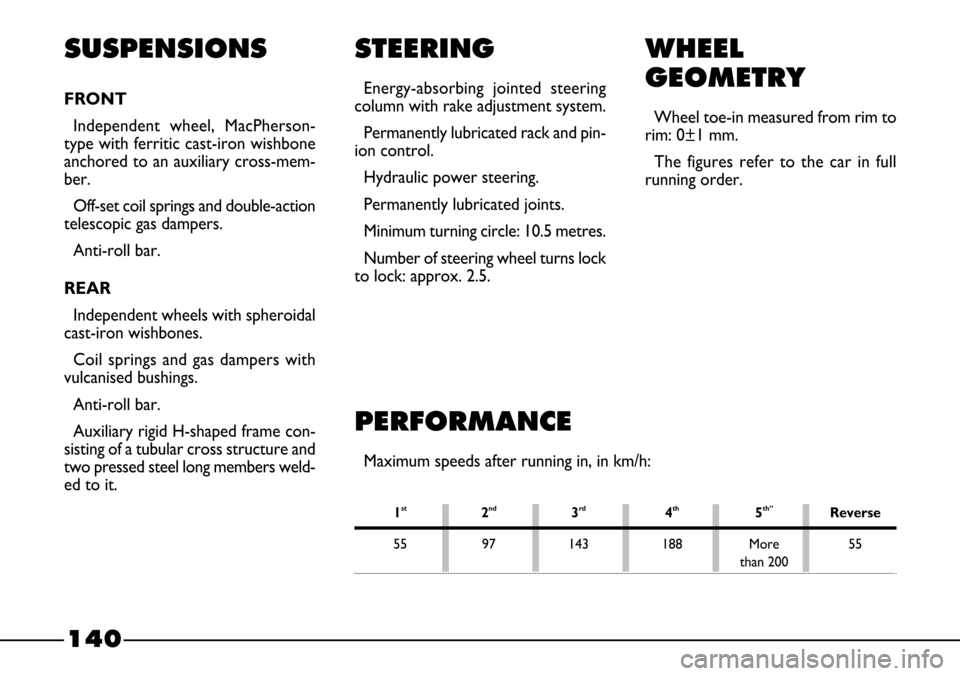
PERFORMANCE
Maximum speeds after running in, in km/h:
1st2nd3rd 4th5th”Reverse
55 97 143 188 More 55
than 200