Starting FIAT BARCHETTA 2003 1.G User Guide
[x] Cancel search | Manufacturer: FIAT, Model Year: 2003, Model line: BARCHETTA, Model: FIAT BARCHETTA 2003 1.GPages: 170, PDF Size: 3.55 MB
Page 86 of 170
85
Under no circumstances
should a battery charger
be used to start the en-
gine: it could damage the elec-
tronic systems and in particular
the control units governing igni-
tion and fuel feed.
JUMP STARTING
If the battery is flat, you can use an-
other battery to start the engine. Its
capacity must be the same or slightly
greater than the flat battery (see the
chapter “Technical specifications”).
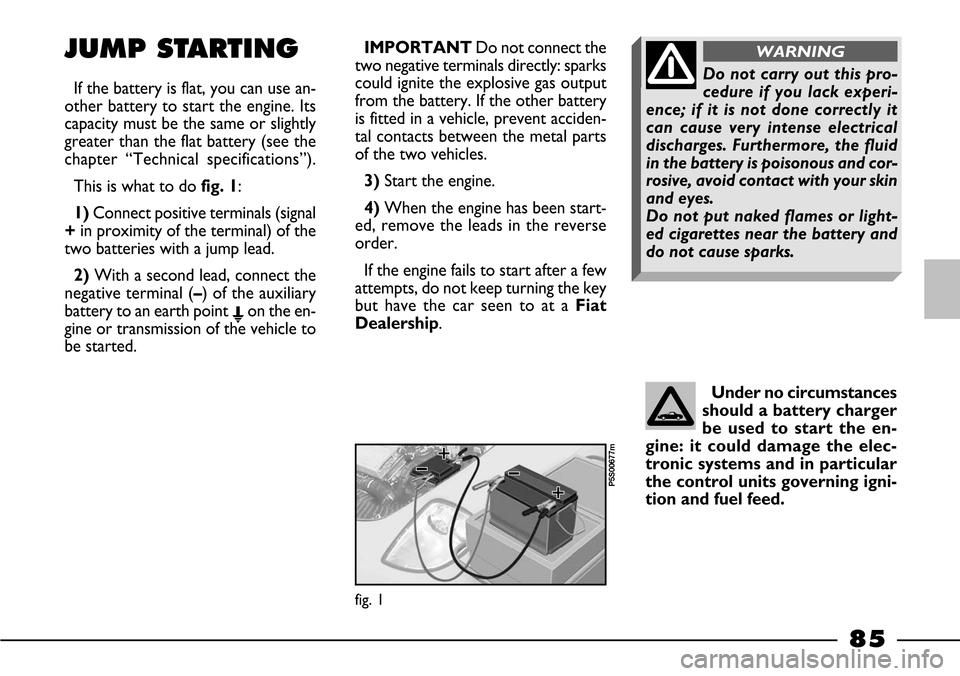
This is what to do fig. 1:
1)Connect positive terminals (signal
+in proximity of the terminal) of the
two batteries with a jump lead.
2)With a second lead, connect the
negative terminal (–) of the auxiliary
battery to an earth point Eon the en-
gine or transmission of the vehicle to
be started.IMPORTANTDo not connect the
two negative terminals directly: sparks
could ignite the explosive gas output
from the battery. If the other battery
is fitted in a vehicle, prevent acciden-
tal contacts between the metal parts
of the two vehicles.
3)Start the engine.
4)When the engine has been start-
ed, remove the leads in the reverse
order.
If the engine fails to start after a few
attempts, do not keep turning the key
but have the car seen to at a Fiat
Dealership.
fig. 1
P5S00677m
Do not carry out this pro-
cedure if you lack experi-
ence; if it is not done correctly it
can cause very intense electrical
discharges. Furthermore, the fluid
in the battery is poisonous and cor-
rosive, avoid contact with your skin
and eyes.
Do not put naked flames or light-
ed cigarettes near the battery and
do not cause sparks.
WARNING
Page 87 of 170
86
Observe the instructions on this and
the following pages to use the jack and
space-saver spare wheel correctly.
BUMP STARTING IF A TYRE
IS PUNCTURED
General instructions
Do not bump start by
pushing, towing or coast-
ing downhill. This way of
starting could cause a rush of fu-
el into the catalytic exhaust pipe
and damage it beyond repair.
Signal the presence of the
stopped vehicle according
to the laws in force (e.g. hazard
lights, reflecting triangle, etc.).
Any passengers on board should
leave the vehicle, especially if it is
heavily laden. Passengers should
stay away from oncoming traffic
while the wheel is being changed.
If the wheel is being changed on a
steep or badly surfaced road, place
wedges or other suitable material
under the wheels to stop the vehi-
cle.
WARNING
Remember that if the en-
gine is not running, the
brake booster will not work. You
therefore have to use considerably
more effort on the brake pedal.
WARNING
The space-saver spare
wheel is vehicle-specific.
Never use the wheel on other mod-
els. Never use other model spare
wheels on your vehicle.
If you change the type of wheels
(alloy rims instead of steel rims) you
will have to change the entire set of
fastening bolts with another set of
suitably sized bolts.
Only use the spare-saver wheel for
emergencies.
With the spare wheel do not exceed
80 kph.
An orange sticker is attached to the
spare wheel giving the main in-
structions for its use and limitations.
The sticker must never be re-
moved or covered.
Do not fit the hub cap to the
spare wheel.
WARNING
Page 106 of 170
105
JUMP STARTING
See “Jump starting” in this chapter. 2)Connect the battery terminals to
the charger.
3)Turn on the charger.
4)When you have finished, turn the
charger off before disconnecting the
battery.
5) Reconnect the cables to the bat-
tery posts. Make sure the polarity is
correct.IF THE BATTERY
IS FLAT
First of all, read the “Car mainte-
nance” chapter for the steps to be tak-
en to avoid the battery running down
and to ensure it has a long life.
RECHARGING THE BATTERY
You are advised to recharge the bat-
tery slowly for a period of approxi-
mately 24 hours at a very low amper-
age. Charging for too long could result
in the battery being damaged.
Proceed as follows:
1) Disconnect the electrical system
terminals from the battery posts.
IMPORTANTIf the car is fitted
with an electronic car alarm, use the
remote control to turn the alarm off
with the remote control and deacti-
vate the system by turning the emer-
gency key to “OFF” (see the “Elec-
tronic alarm” in the “Getting to know
your car” section).
The liquid in the battery is
poisonous and corrosive.
Do not let it touch the skin or eyes.
Recharging the battery should be
done in a well-ventilated area and
away from naked flames or possi-
ble sources of sparks: explosion and
fire risk.
WARNING
Do not attempt to recharge
a frozen battery. Thaw it
first otherwise it could explode. If
the battery froze, make sure the in-
ternal elements are not broken
(short-circuit risk) and that the cas-
ing is not cracked (risk of spilling
the poisonous and corrosive fluid).
WARNING
Page 109 of 170
108
The tow ring supplied as an outfit to-
gether with the car is housed into the
tool compartment under the luggage
compartment coating carpet.
Front tow
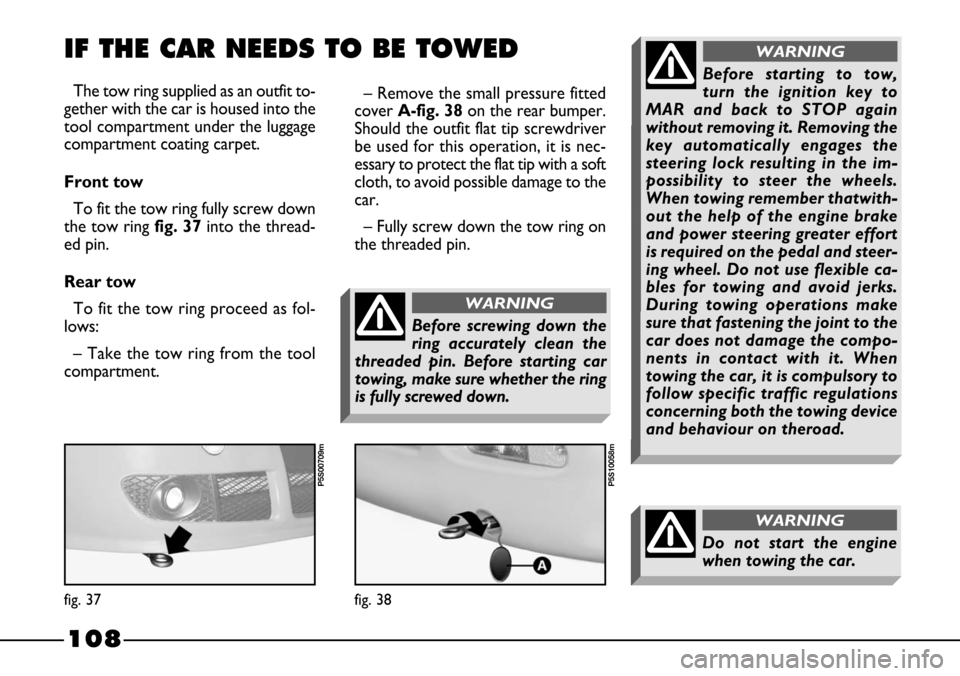
To fit the tow ring fully screw down
the tow ring fig. 37into the thread-
ed pin.
Rear tow
To fit the tow ring proceed as fol-
lows:
– Take the tow ring from the tool
compartment.
IF THE CAR NEEDS TO BE TOWED
fig. 37
P5S00709m
fig. 38
P5S10058m
– Remove the small pressure fitted
cover A-fig. 38on the rear bumper.
Should the outfit flat tip screwdriver
be used for this operation, it is nec-
essary to protect the flat tip with a soft
cloth, to avoid possible damage to the
car.
– Fully screw down the tow ring on
the threaded pin.
Before screwing down the
ring accurately clean the
threaded pin. Before starting car
towing, make sure whether the ring
is fully screwed down.
WARNING
Do not start the engine
when towing the car.
WARNING
Before starting to tow,
turn the ignition key to
MAR and back to STOP again
without removing it. Removing the
key automatically engages the
steering lock resulting in the im-
possibility to steer the wheels.
When towing remember thatwith-
out the help of the engine brake
and power steering greater effort
is required on the pedal and steer-
ing wheel. Do not use flexible ca-
bles for towing and avoid jerks.
During towing operations make
sure that fastening the joint to the
car does not damage the compo-
nents in contact with it. When
towing the car, it is compulsory to
follow specific traffic regulations
concerning both the towing device
and behaviour on theroad.
WARNING
Page 126 of 170
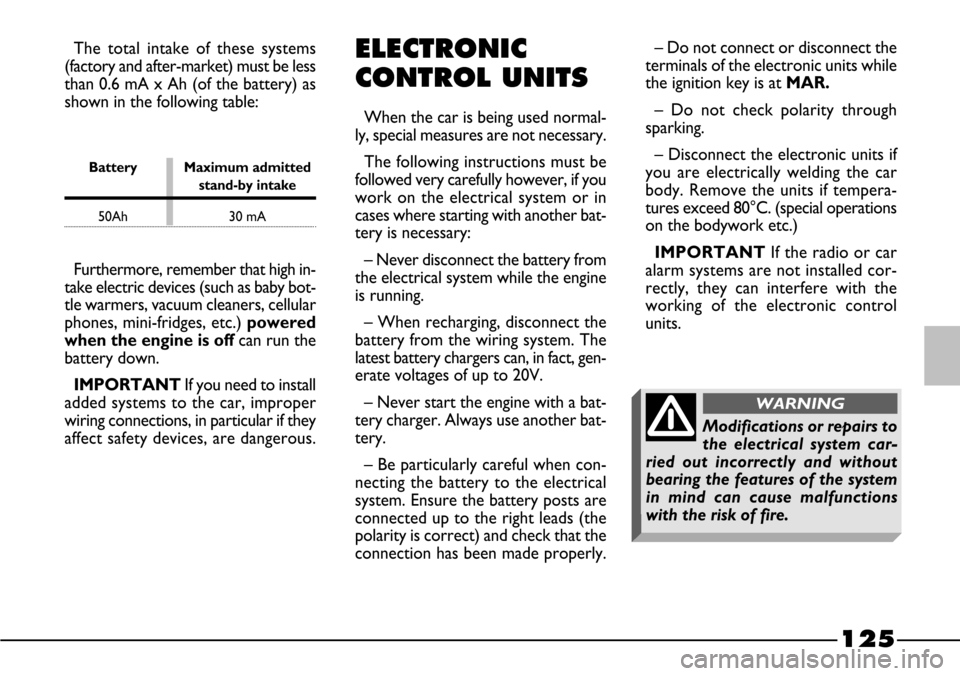
125
– Do not connect or disconnect the
terminals of the electronic units while
the ignition key is at MAR.
– Do not check polarity through
sparking.
– Disconnect the electronic units if
you are electrically welding the car
body. Remove the units if tempera-
tures exceed 80°C. (special operations
on the bodywork etc.)
IMPORTANTIf the radio or car
alarm systems are not installed cor-
rectly, they can interfere with the
working of the electronic control
units.ELECTRONIC
CONTROL UNITS
When the car is being used normal-
ly, special measures are not necessary.
The following instructions must be
followed very carefully however, if you
work on the electrical system or in
cases where starting with another bat-
tery is necessary:
– Never disconnect the battery from
the electrical system while the engine
is running.
– When recharging, disconnect the
battery from the wiring system. The
latest battery chargers can, in fact, gen-
erate voltages of up to 20V.
– Never start the engine with a bat-
tery charger. Always use another bat-
tery.
– Be particularly careful when con-
necting the battery to the electrical
system. Ensure the battery posts are
connected up to the right leads (the
polarity is correct) and check that the
connection has been made properly.
Battery Maximum admitted
stand-by intake
50Ah 30 mA
Furthermore, remember that high in-
take electric devices (such as baby bot-
tle warmers, vacuum cleaners, cellular
phones, mini-fridges, etc.) powered
when the engine is off can run the
battery down.
IMPORTANT If you need to install
added systems to the car, improper
wiring connections, in particular if they
affect safety devices, are dangerous.The total intake of these systems
(factory and after-market) must be less
than 0.6 mA x Ah (of the battery) as
shown in the following table:
Modifications or repairs to
the electrical system car-
ried out incorrectly and without
bearing the features of the system
in mind can cause malfunctions
with the risk of fire.
WARNING
Page 160 of 170
159
INDEX
ABS ........................................... 56
Accessories purchased
by the owner .............................. 82
Accessory installation......... 149
Air cleaner................................... 122
Air recirculation ......................... 36
Airbags
– general information ............ 60
– switching the passenger side
airbag off .............................. 59
Ashtray ......................................... 43
Battery
– jump starting ................ 85-105
– liquid level ............................ 123
– recharging ............................. 105
Bodywork
– maintenance ......................... 130
– paint identification plate .... 137
– versions ............................... 137
Bonnet .......................................... 53
Boot
– opening/closing.................... 55
Brake fluid level .......................... 121Brake lights .................................. 96
Brakes
– fluid level............................... 121
– service and emergency
brakes .................................... 139
Bulb replacement ....................... 91
Car maintenance................. 111
Capacities ............................. 64-144
Catalytic converter .................. 66
Ceiling light.................................. 42
– bulb replacement ............... 98
Cellular phone setup................. 63
Central door locking................. 44
Cheap running ............................ 78
Children (safety) ........................ 24
Cigar lighter ................................ 43
Climate control system ............ 36
– controls................................. 36
– maintenance ......................... 130
Clutch ........................................... 139
CO
2emissions ........................... 147
Containing running costs
and pollution ........................... 76
Dashboard ................................ 7Defrosting.................................... 35
Demisting..................................... 35
Digital clock ................................ 29
Dimensions ................................ 142
Dipped-beam headlights
– controls ............................... 38
– bulb replacement ............... 93
Direction indicators
– controls ............................... 39
– front bulb replacement ..... 94
– rear bulb replacement ...... 95
– side bulb replacement ...... 95
Doors ........................................... 44
Driving your car..................... 67
Electric windows ..................... 45
Electronic alarm.................. 13-150
Electronic control units............ 125
Engine
– cooling................................... 138
– fuel feed/ignition ................. 138
– identification code .............. 136
– lubrication ............................ 138
– specifications........................ 137
Engine compartment washing . 132
Page 162 of 170
161
– homologation codes....... 156
Rear fog lights
– controls ............................ 41
– bulb replacement ........... 97
Rear windowing (cleaning) . 133
Rearview mirrors
– electric............................... 20
– external ............................. 20
– internal .............................. 20
Rev counter............................. 28
Repeated checks ................... 82
Reversing lights ....................... 97
Rubber piping .......................... 128
Safe driving
– driving at night ................. 73
– driving in the rain ............ 74
– before getting behind
the wheel .......................... 72
– driving in fog .................... 74
– driving in the mountains 75
– driving on snow and ice 75
– driving with ABS.............. 75
– when travelling ................ 72
Seat belts
– general information ........ 22– maintenance ..................... 23
– use ...................................... 21
Seats
– adjustment ........................ 18
– cleaning.............................. 134
Servicing ................................... 111
– additional operations ..... 115
– annual inspection schedule 115
– scheduled service............ 112
– Service Schedule ............. 113
Side/taillights
– controls ............................ 38
– front bulb replacement 93
– rear bulb replacement .. 96
Snow tyres ............................... 80-141
Spark plugs............................... 126
Specifications ........................... 135
Speedometer........................... 28
Starting the engine
– jump starting .................... 85
– bump starting ................... 86
– emergency start-up ........ 84
– ignition switch.................. 17
– stopping the engine ........ 69
– warming up a recently
started engine .................. 69Steering column lock............. 18
Steering column stalks
– left-hand stalk .................. 38
– right-hand stalk................ 39
Steering wheel ........................ 19
Steering..................................... 140
Storing the car ........................ 81
Sun visors ................................. 43
Suspensions ............................. 140
Symbols .................................... 9
Technical specifications.... 135
Third brake light
(bulb replacement) ............... 96
Tools............................................. 88
Top speeds .................................. 140
Towing a trailer
– tow hitch installation ......... 152
– warnings................................ 79
Towing the car ........................... 108
Transmission (ratios) ................ 139
Transporting children
in safety .................................... 24
Tyre pressure ............................. 148
Tyres ..................................... 126-148