battery FIAT BARCHETTA 2003 1.G User Guide
[x] Cancel search | Manufacturer: FIAT, Model Year: 2003, Model line: BARCHETTA, Model: FIAT BARCHETTA 2003 1.GPages: 170, PDF Size: 3.55 MB
Page 84 of 170
83
IN AN EMERGENCY
People who find themselves in an emergency situa-
tion need immediate and concrete help.
The following pages have been written to help you if
the need arises.
As you will see, a host of little snags have been tak-
en into account and, for each of them, the measures
you yourself can take are suggested. If the problems are
more serious however, you should have the car seen
to at a Fiat Dealership.
With regard to this, we would like to remind you that,
in addition to the Owner Handbook, you have also been
provided with the WARRANTY BOOKLET where you
will find details of all the services Fiat can provide should
you find yourself in difficulty.
We nevertheless recommend you read these pages.
If in need you will be able to find the information you
require much more quickly.EMERGENCY START-UP ................................................. 84
JUMP STARTING ................................................................ 85
BUMP STARTING .............................................................. 86
IF A TYRE IS PUNCTURED ............................................ 86
IF A BULB BURNS OUT .................................................. 91
IF AN EXTERIOR LIGHT BURNS OUT ...................... 93
IF AN INTERIOR LIGHT BURNS OUT ....................... 98
IF A FUSE BLOWS ............................................................. 98
IF THE BATTERY IS FLAT ............................................... 105
IF THE CAR NEEDS TO BE RAISED ............................ 106
IF THE CAR NEEDS TO BE TOWED .......................... 108
IF AN ACCIDENT OCCOURS ...................................... 109
Page 86 of 170
85
Under no circumstances
should a battery charger
be used to start the en-
gine: it could damage the elec-
tronic systems and in particular
the control units governing igni-
tion and fuel feed.
JUMP STARTING
If the battery is flat, you can use an-
other battery to start the engine. Its
capacity must be the same or slightly
greater than the flat battery (see the
chapter “Technical specifications”).
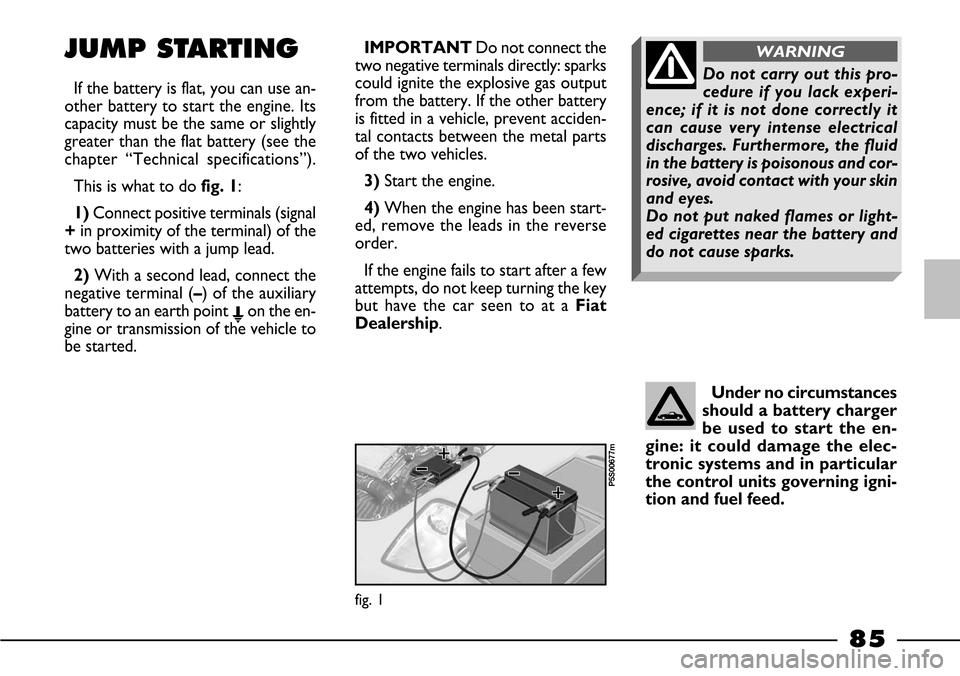
This is what to do fig. 1:
1)Connect positive terminals (signal
+in proximity of the terminal) of the
two batteries with a jump lead.
2)With a second lead, connect the
negative terminal (–) of the auxiliary
battery to an earth point Eon the en-
gine or transmission of the vehicle to
be started.IMPORTANTDo not connect the
two negative terminals directly: sparks
could ignite the explosive gas output
from the battery. If the other battery
is fitted in a vehicle, prevent acciden-
tal contacts between the metal parts
of the two vehicles.
3)Start the engine.
4)When the engine has been start-
ed, remove the leads in the reverse
order.
If the engine fails to start after a few
attempts, do not keep turning the key
but have the car seen to at a Fiat
Dealership.
fig. 1
P5S00677m
Do not carry out this pro-
cedure if you lack experi-
ence; if it is not done correctly it
can cause very intense electrical
discharges. Furthermore, the fluid
in the battery is poisonous and cor-
rosive, avoid contact with your skin
and eyes.
Do not put naked flames or light-
ed cigarettes near the battery and
do not cause sparks.
WARNING
Page 101 of 170
100
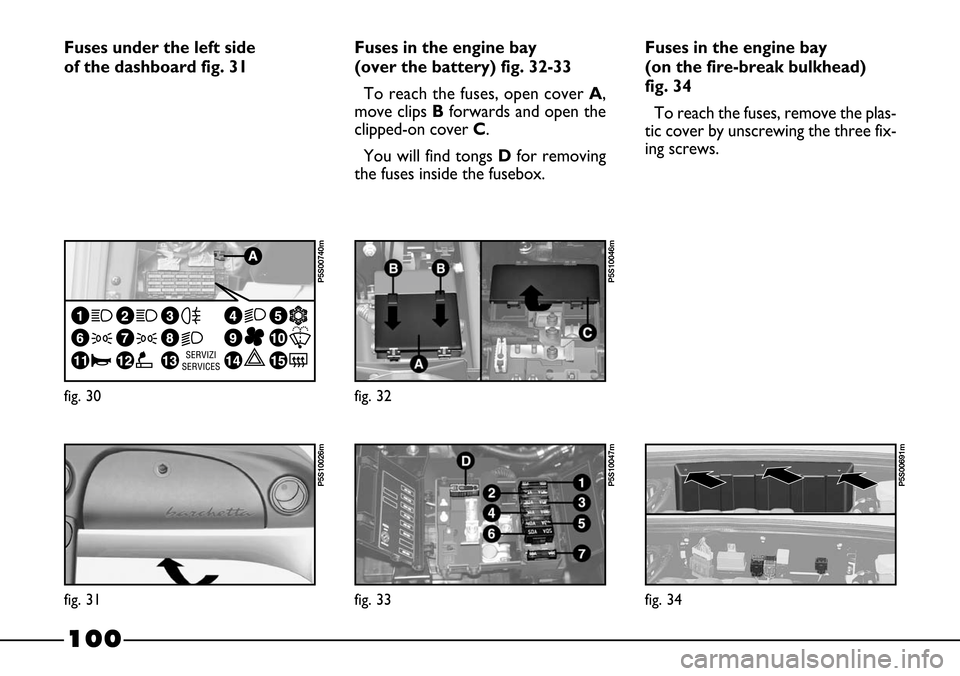
Fuses in the engine bay
(over the battery) fig. 32-33
To reach the fuses, open cover A,
move clips Bforwards and open the
clipped-on cover C.
You will find tongs Dfor removing
the fuses inside the fusebox. Fuses under the left side
of the dashboard fig. 31
fig. 30
P5S00740m
fig. 31
P5S10026m
fig. 33
P5S10047m
fig. 32
P5S10046m
fig. 34
P5S00691m
Fuses in the engine bay
(on the fire-break bulkhead)
fig. 34
To reach the fuses, remove the plas-
tic cover by unscrewing the three fix-
ing screws.
Page 106 of 170
105
JUMP STARTING
See “Jump starting” in this chapter. 2)Connect the battery terminals to
the charger.
3)Turn on the charger.
4)When you have finished, turn the
charger off before disconnecting the
battery.
5) Reconnect the cables to the bat-
tery posts. Make sure the polarity is
correct.IF THE BATTERY
IS FLAT
First of all, read the “Car mainte-
nance” chapter for the steps to be tak-
en to avoid the battery running down
and to ensure it has a long life.
RECHARGING THE BATTERY
You are advised to recharge the bat-
tery slowly for a period of approxi-
mately 24 hours at a very low amper-
age. Charging for too long could result
in the battery being damaged.
Proceed as follows:
1) Disconnect the electrical system
terminals from the battery posts.
IMPORTANTIf the car is fitted
with an electronic car alarm, use the
remote control to turn the alarm off
with the remote control and deacti-
vate the system by turning the emer-
gency key to “OFF” (see the “Elec-
tronic alarm” in the “Getting to know
your car” section).
The liquid in the battery is
poisonous and corrosive.
Do not let it touch the skin or eyes.
Recharging the battery should be
done in a well-ventilated area and
away from naked flames or possi-
ble sources of sparks: explosion and
fire risk.
WARNING
Do not attempt to recharge
a frozen battery. Thaw it
first otherwise it could explode. If
the battery froze, make sure the in-
ternal elements are not broken
(short-circuit risk) and that the cas-
ing is not cracked (risk of spilling
the poisonous and corrosive fluid).
WARNING
Page 107 of 170
106
Please note:
– the jack requires no adjustments;
– the jack cannot be repaired. If it
breaks it must be replaced with a new
jack;
– no tool, other than its handle, in-
dicated in this chapter, can be fitted
onto the jack.
IF THE CAR NEEDS
TO BE RAISED
WITH THE JACK
See “If a tyre is punctured”, in this
chapter. Under no circumstances
should a battery charger
be used to start the en-
gine: it could damage the elec-
tronic systems and in particular,
the control units governing igni-
tion and fuel feed.
The jack is used solely for
changing the wheels. It
must not be used for any other pur-
poses, for example lifting other
cars. It must not be used for carry-
ing out repairs under the car.
WARNING
The vehicle may fall if the
jack is not positioned cor-
rectly. Do not use the jack to lift
loads exceeding that indicated on
the jack itself.
WARNING
Page 112 of 170
111
CAR MAINTENANCE
The Fiat barchetta is brand new throughout, even
in its service schedule. For example: the first service
schedule coupon is to be used at 20,000 km making the
traditional check at 1,500 km unnecessary. You should
however remember that your car needs routine main-
tenance such as systematic checking of the fluid level
and tyre pressure, and any necessary topping up.
You should nonetheless bear in mind that proper car
maintenance is certainly the best way to keep your car
in tip-top condition for years to come and safeguard its
safety features, its environmentally-friendly nature and
its low running costs.
Also remember that following the servicing regula-
tions marked with the symbol ∑as specified might be
essential to ensuring the warranty remains valid.SCHEDULED SERVICING ............................................... 112
SERVICE SCHEDULE ......................................................... 113
ANNUAL INSPECTION SCHEDULE ........................... 115
ADDITIONAL OPERATIONS ........................................ 115
CHECKING FLUID LEVELS ............................................. 117
AIR CLEANER ..................................................................... 122
POLLEN FILTER .................................................................. 123
BATTERY .............................................................................. 123
ELECTRONIC CONTROL UNITS ............................... 125
SPARK PLUGS ..................................................................... 126
WHEELS AND TYRES ...................................................... 126
RUBBER TUBING .............................................................. 128
WINDSCREEN WIPER ..................................................... 128
MANUAL CLIMATE CONTROL SYSTEM ................. 130
BODYWORK ...................................................................... 130
HOOD ................................................................................... 133
INTERIORS ........................................................................... 133
Page 115 of 170
114
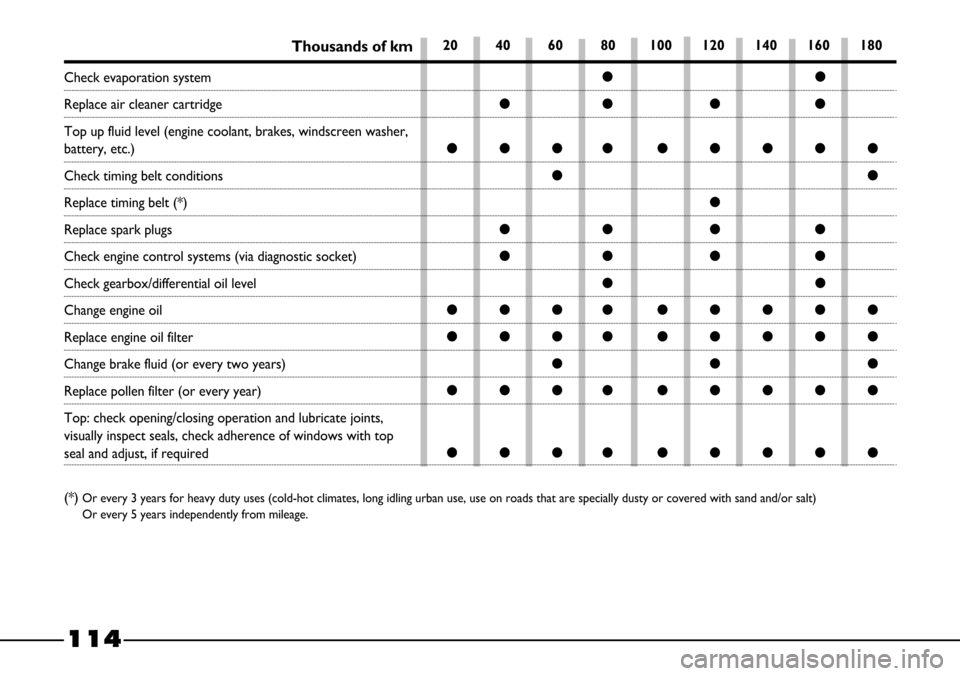
(*) Or every 3 years for heavy duty uses (cold-hot climates, long idling urban use, use on roads that are specially dusty or covered with sand and/or salt)
Or every 5 years independently from mileage.
Thousands of km
çç
çç ç ç
çççç ççççç
çç
ç
çç ç ç
çç ç ç
çç
çççç ççççç
çççç ççççç
ççç
çççç ççççç
çççç ççççç
20 40 60 80 100 120 140 160 180
Check evaporation system
Replace air cleaner cartridge
Top up fluid level (engine coolant, brakes, windscreen washer,
battery, etc.)
Check timing belt conditions
Replace timing belt (*)
Replace spark plugs
Check engine control systems (via diagnostic socket)
Check gearbox/differential oil level
Change engine oil
Replace engine oil filter
Change brake fluid (or every two years)
Replace pollen filter (or every year)
Top: check opening/closing operation and lubricate joints,
visually inspect seals, check adherence of windows with top
seal and adjust, if required
Page 116 of 170
115
ANNUAL
INSPECTION
SCHEDULE
The following annual inspection
schedule is required for cars travelling
less than 20,000 km a year (e.g. ap-
proximately 10,000 km). The schedule
includes the following operations:
– Check tyre condition and wear and
adjust pressure, if required (including
spare-saver spare wheel).
– Check operation of lights (head-
lights, direction indicators, hazard
lights, boot light, passenger compart-
ment ceiling light, glove compartment
light, instrument panel lights, etc.).
– Check windscreen wiper/washer
and adjust nozzles.
– Check position wear of windscreen
window wiper blades.
ADDITIONAL
OPERATIONS
Every 1,000 kmor before long
trips, check and top up as necessary:
– coolant level
– brake fluid level
– power steering fluid level
– electrolyte level
– windscreen washer liquid level
– tyre condition and pressure.
We advise you to use FL Selenia
products, which have been designed
and produced expressly for the Fiat
vehicles (see the table “Capacities” giv-
en in the “Technical specifications”
section).
Every 3,000 km check and top up
as necessary: engine oil level. – Check rear brake pad conditions
and wear.
– Inspect conditions of. engine, gear-
box, transmission, piping (exhaust - fu-
el feed - brakes), rubber parts (boots
- sleeves - bushings - etc.), brake and
fuel line hoses.
– Check battery charge status.
– Check conditions of various con-
trol belts.
– Check and top up fluid levels (en-
gine coolant, brakes, windscreen
washer, battery, etc.).
– Change engine oil.
– Replace engine oil filter.
– Replace pollen filter (where fitted).
Page 117 of 170
116
This check should be carried out
more frequently if the vehicle is main-
ly used for short trips, or if it is fitted
with accessories that permanently ab-
sorb electricity even with the ignition
key removed, especially in the case of
after market accessories.
You should check the battery fluid
(electrolyte) level more frequently
than shown in the Service Schedule if
the car is used in hot climates or par-
ticularly demanding conditions. IMPORTANT - Engine oil
Change the engine oil more fre-
quently than specified in the Service
Schedule if the vehicle is mainly used
under one of the following particular-
ly severe conditions:
– towing a trailer or caravan
– on dirt roads
– short, repetitive trips (less than 7
or 8 kilometres) in outside tempera-
tures below zero.
– engines that are frequently left to
idle or drive slowly over long dis-
tances.
IMPORTANT - Air cleaner
If you drive your car on dirt roads
change the air cleaner more frequently
than specified in the Service Schedule.If you are in doubt about how often
the engine oil or the air cleaner should
be changed in relation to how you use
the car, contact a Fiat Dealership.
IMPORTANT - Pollen filter
If the car is often used in dusty or ex-
tremely polluted environments, you
should change the filter element more
frequently. It should be changed espe-
cially if the amount of air introduced
into the passenger compartment is re-
duced.
IMPORTANT - Battery
You should check the status of the
battery charge preferably at the be-
ginning of the cold season to avoid the
possibility of the electrolyte freezing.Maintenance of your car
should be entrusted to a
Fiat Dealership. For in-
terventions of routine mainte-
nance and small repairs you wish
to carry out yourself, make sure
you always have the proper
equipment, genuine Fiat spare
parts and fluids available. Do not,
carry out these operations if you
have no experience.
Page 118 of 170
117
CHECKING FLUID LEVELS
P5S10059m
Be careful not to mix up
the various types of fluids
when you are topping up:
they are all mutually incompati-
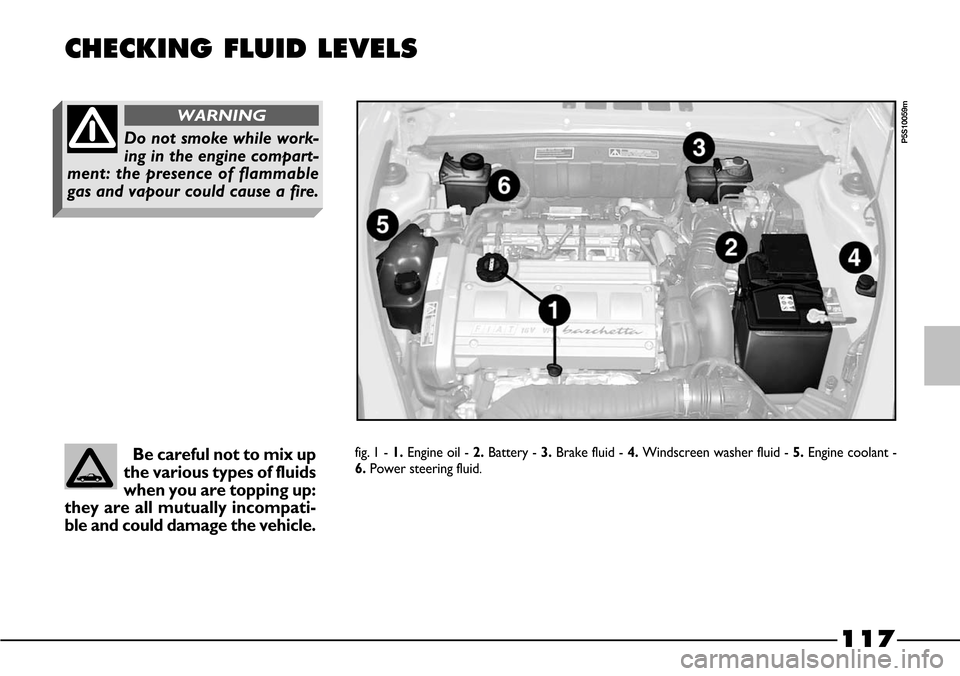
ble and could damage the vehicle.fig. 1 -1. Engine oil - 2. Battery - 3. Brake fluid - 4. Windscreen washer fluid - 5. Engine coolant -
6. Power steering fluid.
Do not smoke while work-
ing in the engine compart-
ment: the presence of flammable
gas and vapour could cause a fire.
WARNING