battery FIAT BARCHETTA 2003 1.G Owner's Manual
[x] Cancel search | Manufacturer: FIAT, Model Year: 2003, Model line: BARCHETTA, Model: FIAT BARCHETTA 2003 1.GPages: 170, PDF Size: 3.55 MB
Page 124 of 170
123
If the vehicle is to stand
for a long time in the cold,
remove the battery and
store it in a warm place to avoid
it freezing.
BATTERY
The Fiat barchetta’s battery is of the
“Limited Maintenance” type: under
normal conditions, it requires no top-
ping up with distilled water.
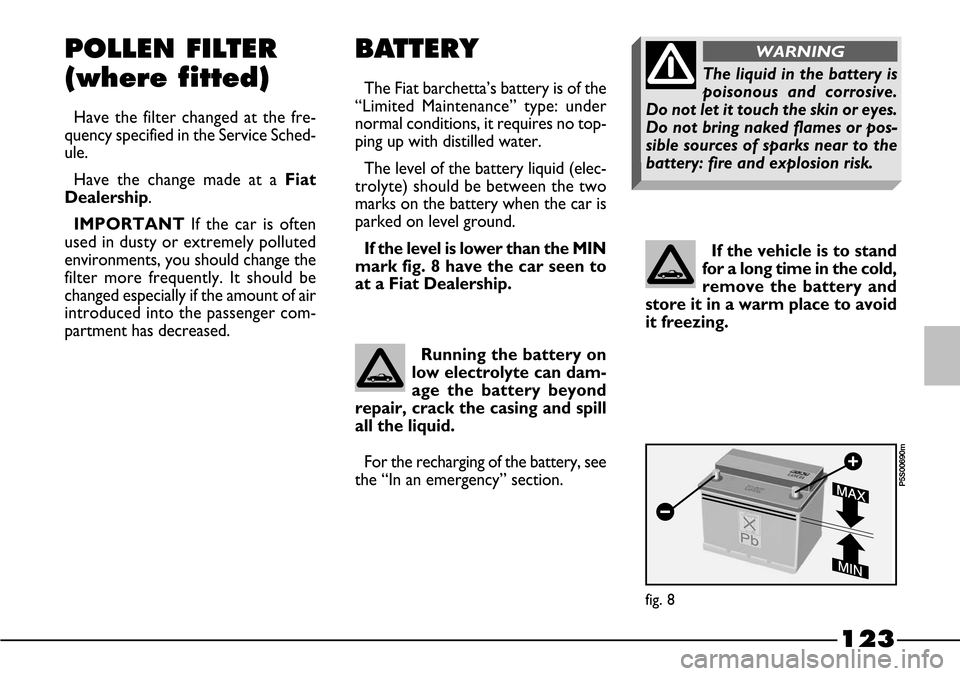
The level of the battery liquid (elec-
trolyte) should be between the two
marks on the battery when the car is
parked on level ground.
If the level is lower than the MIN
mark fig. 8 have the car seen to
at a Fiat Dealership.
Running the battery on
low electrolyte can dam-
age the battery beyond
repair, crack the casing and spill
all the liquid.
For the recharging of the battery, see
the “In an emergency” section.
fig. 8
P5S00690m
POLLEN FILTER
(where fitted)
Have the filter changed at the fre-
quency specified in the Service Sched-
ule.
Have the change made at a Fiat
Dealership.
IMPORTANTIf the car is often
used in dusty or extremely polluted
environments, you should change the
filter more frequently. It should be
changed especially if the amount of air
introduced into the passenger com-
partment has decreased.
The liquid in the battery is
poisonous and corrosive.
Do not let it touch the skin or eyes.
Do not bring naked flames or pos-
sible sources of sparks near to the
battery: fire and explosion risk.
WARNING
Page 125 of 170
124
USEFUL ADVICE
FOR LENGTHENING THE
LIFE OF YOUR BATTERY
When you park the car, ensure the
doors, boot and bonnet are closed
properly. The courtesy light must be
off.
Do not keep accessories (e.g. radio,
hazard lights etc.) switched on for a
long time when the engine is not run-
ning.
IMPORTANT A battery which is
kept at a charge of less than 50% for
any length of time will be damaged by
sulphation leading to a reduction in
cranking power and a higher risk of
the battery electrolyte freezing (this
may even occur at –10°C).
If the car is inactive for a long peri-
od of time, refer to “Storing the car”
in the “Driving your car” chapter.If, after purchasing your car you
would like to add electrical accessories
that require a permanent power sup-
ply (alarm systems, hands-free phone,
radio navigator with satellite anti-theft
system, etc.), visit a Fiat Dealership.
The staff of experts, besides suggest-
ing the most suitable accessories in the
Lineaccessori range, will also check
whether the car electrical system can
support the required load or if a larg-
er size battery needs to be installed.
These devices will, in fact, run off the
battery even when the key is not in-
serted (car parked) and can deploy the
battery.
Incorrect fitting of elec-
trical and electronic ac-
cessories can seriously
damage the car.Batteries contain sub-
stances that are very
harmful for the environ-
ment. You are advised to have the
battery changed at a Fiat Dealer-
ship. It is properly equipped for
disposing of used batteries in an
environmentally-friendly way that
complies with the law.
Do not attempt to recharge
a frozen battery. Thaw it
first otherwise it could explode. If
the battery froze, make sure the in-
ternal elements are not broken
(short-circuit risk) and that the cas-
ing is not cracked (risk of spilling
the poisonous and corrosive fluid).
WARNING
Page 126 of 170
125
– Do not connect or disconnect the
terminals of the electronic units while
the ignition key is at MAR.
– Do not check polarity through
sparking.
– Disconnect the electronic units if
you are electrically welding the car
body. Remove the units if tempera-
tures exceed 80°C. (special operations
on the bodywork etc.)
IMPORTANTIf the radio or car
alarm systems are not installed cor-
rectly, they can interfere with the
working of the electronic control
units.ELECTRONIC
CONTROL UNITS
When the car is being used normal-
ly, special measures are not necessary.
The following instructions must be
followed very carefully however, if you
work on the electrical system or in
cases where starting with another bat-
tery is necessary:
– Never disconnect the battery from
the electrical system while the engine
is running.
– When recharging, disconnect the
battery from the wiring system. The
latest battery chargers can, in fact, gen-
erate voltages of up to 20V.
– Never start the engine with a bat-
tery charger. Always use another bat-
tery.
– Be particularly careful when con-
necting the battery to the electrical
system. Ensure the battery posts are
connected up to the right leads (the
polarity is correct) and check that the
connection has been made properly.
Battery Maximum admitted
stand-by intake
50Ah 30 mA
Furthermore, remember that high in-
take electric devices (such as baby bot-
tle warmers, vacuum cleaners, cellular
phones, mini-fridges, etc.) powered
when the engine is off can run the
battery down.
IMPORTANT If you need to install
added systems to the car, improper
wiring connections, in particular if they
affect safety devices, are dangerous.The total intake of these systems
(factory and after-market) must be less
than 0.6 mA x Ah (of the battery) as
shown in the following table:
Modifications or repairs to
the electrical system car-
ried out incorrectly and without
bearing the features of the system
in mind can cause malfunctions
with the risk of fire.
WARNING
Page 153 of 170
152
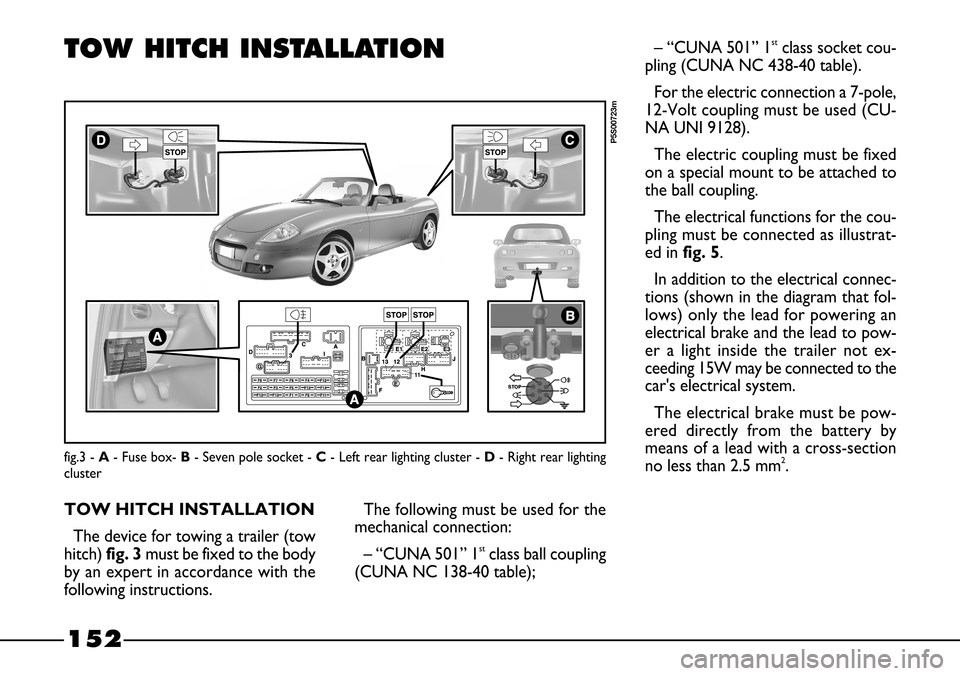
fig.3 - A- Fuse box- B- Seven pole socket - C- Left rear lighting cluster - D- Right rear lighting
cluster
P5S00723m
TOW HITCH INSTALLATION
TOW HITCH INSTALLATION
The device for towing a trailer (tow
hitch) fig. 3must be fixed to the body
by an expert in accordance with the
following instructions.The following must be used for the
mechanical connection:
– “CUNA 501” 1
stclass ball coupling
(CUNA NC 138-40 table);– “CUNA 501” 1
stclass socket cou-
pling (CUNA NC 438-40 table).
For the electric connection a 7-pole,
12-Volt coupling must be used (CU-
NA UNI 9128).
The electric coupling must be fixed
on a special mount to be attached to
the ball coupling.
The electrical functions for the cou-
pling must be connected as illustrat-
ed infig. 5.
In addition to the electrical connec-
tions (shown in the diagram that fol-
lows) only the lead for powering an
electrical brake and the lead to pow-
er a light inside the trailer not ex-
ceeding 15W may be connected to the
car's electrical system.
The electrical brake must be pow-
ered directly from the battery by
means of a lead with a cross-section
no less than 2.5 mm
2.
Page 160 of 170
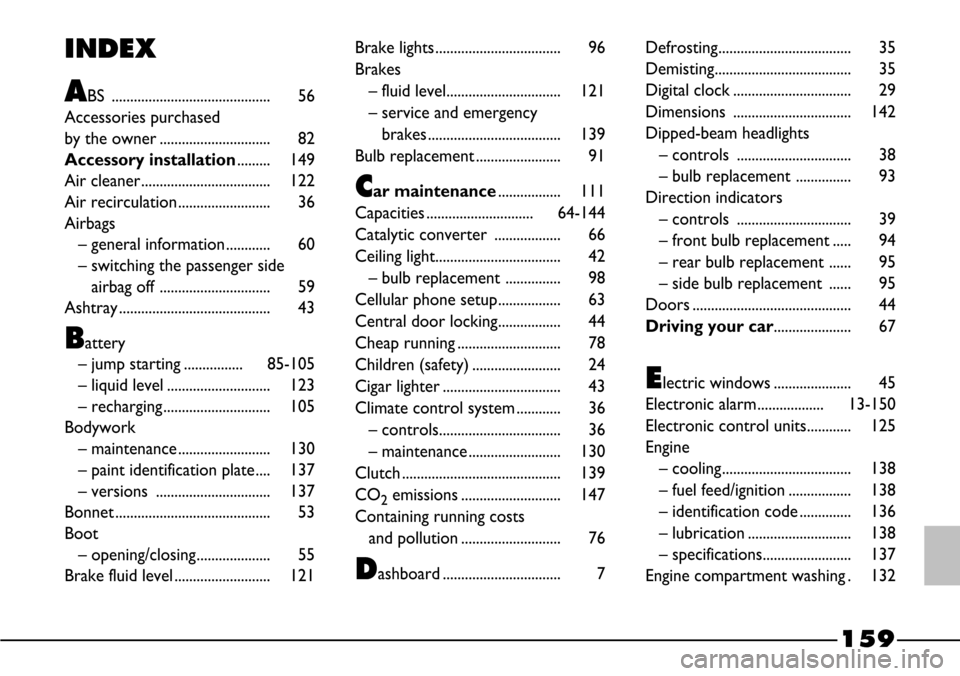
159
INDEX
ABS ........................................... 56
Accessories purchased
by the owner .............................. 82
Accessory installation......... 149
Air cleaner................................... 122
Air recirculation ......................... 36
Airbags
– general information ............ 60
– switching the passenger side
airbag off .............................. 59
Ashtray ......................................... 43
Battery
– jump starting ................ 85-105
– liquid level ............................ 123
– recharging ............................. 105
Bodywork
– maintenance ......................... 130
– paint identification plate .... 137
– versions ............................... 137
Bonnet .......................................... 53
Boot
– opening/closing.................... 55
Brake fluid level .......................... 121Brake lights .................................. 96
Brakes
– fluid level............................... 121
– service and emergency
brakes .................................... 139
Bulb replacement ....................... 91
Car maintenance................. 111
Capacities ............................. 64-144
Catalytic converter .................. 66
Ceiling light.................................. 42
– bulb replacement ............... 98
Cellular phone setup................. 63
Central door locking................. 44
Cheap running ............................ 78
Children (safety) ........................ 24
Cigar lighter ................................ 43
Climate control system ............ 36
– controls................................. 36
– maintenance ......................... 130
Clutch ........................................... 139
CO
2emissions ........................... 147
Containing running costs
and pollution ........................... 76
Dashboard ................................ 7Defrosting.................................... 35
Demisting..................................... 35
Digital clock ................................ 29
Dimensions ................................ 142
Dipped-beam headlights
– controls ............................... 38
– bulb replacement ............... 93
Direction indicators
– controls ............................... 39
– front bulb replacement ..... 94
– rear bulb replacement ...... 95
– side bulb replacement ...... 95
Doors ........................................... 44
Driving your car..................... 67
Electric windows ..................... 45
Electronic alarm.................. 13-150
Electronic control units............ 125
Engine
– cooling................................... 138
– fuel feed/ignition ................. 138
– identification code .............. 136
– lubrication ............................ 138
– specifications........................ 137
Engine compartment washing . 132