boot FIAT BARCHETTA 2003 1.G User Guide
[x] Cancel search | Manufacturer: FIAT, Model Year: 2003, Model line: BARCHETTA, Model: FIAT BARCHETTA 2003 1.GPages: 170, PDF Size: 3.55 MB
Page 77 of 170
76
Here are some suggestions which
may help you to keep the running
costs of your vehicle down and low-
er the amount of toxic emissions re-
leased into the atmosphere.
GENERAL
CONSIDERATIONS
Car maintenance
The overall state of the car is an im-
portant factor which has a marked in-
fluence over fuel consumption and dri-
ving comfort and on the life span of
your car. For this reason care should
be taken to maintain your car by car-
rying out the necessary checks and
regulations in accordance with the
specifications given in the Scheduled
Maintenance Programme (see sec-
tions... spark plugs, idle, air filter, tim-
ing).
CONTAINING RUNNING COSTS
AND POLLUTION
Tyres
Tyres should be checked at least
every four weeks: if the pressure is
too low fuel consumption increases as
the resistance to the rolling movement
of the tyre is greater. In this state, tyre
wear is increased and car handling suf-
fers which will affect safety.
Unnecessary loads
Do not travel with too much luggage
stowed in the boot. The weight of the
vehicle (especially when driving in
town) and its trim greatly affects con-
sumption and stability. To get the most out of ABS:
– During emergency stops or when
grip conditions are poor, you will feel
a slight pulsation on the brake pedal.
This is the sign that the ABS is in ac-
tion. Do not release the brake pedal
but continue to press so as not to in-
terrupt the braking action.
– ABS prevents the wheels from
locking but it does not increase actu-
al grip conditions between tyre and
road. Therefore, even if your car is fit-
ted with ABS, respect the safety dis-
tance from the car in front of you and
keep your speed down when driving
into bends.
– ABS serves to increase the con-
trollability of the car, not to enable you
to go faster.
Page 89 of 170
88
CHANGING A WHEEL
Please note:
– the jack weighs 1.85 kg;
– the jack requires no adjustments;
– the jack cannot be repaired. If it
breaks it must be replaced with a new
jack;
– no other tool, part from the han-
dle shown in this chapter can be fitted
to the jack.
Change the wheel as follows:
1)Stop the vehicle so that it is not
a hazard for other road users or your-
self when changing the wheel. The
ground should be as flat and firm as
possible.2)Stop the engine and engage the
handbrake.
3)Engage first gear or reverse.
4)Lift the boot carpet.
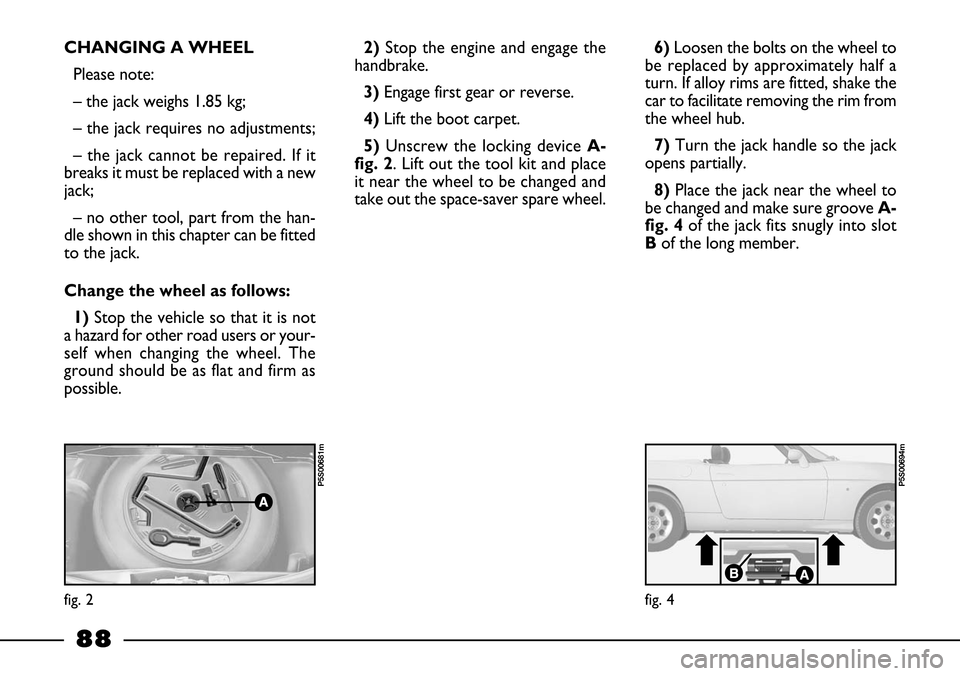
5)Unscrew the locking device A-
fig. 2. Lift out the tool kit and place
it near the wheel to be changed and
take out the space-saver spare wheel.6)Loosen the bolts on the wheel to
be replaced by approximately half a
turn. If alloy rims are fitted, shake the
car to facilitate removing the rim from
the wheel hub.
7)Turn the jack handle so the jack
opens partially.
8)Place the jack near the wheel to
be changed and make sure groove A-
fig. 4of the jack fits snugly into slot
Bof the long member.
fig. 2
P5S00681m
fig. 4
P5S00694m
Page 91 of 170
90
3)Screw up the bolts with the span-
ner provided.
4) Lower the vehicle and remove the
jack.
5)Tighten up the bolts in the same
order as shown above.When you have finished
1)Put the space-saver spare wheel
back in the boot.
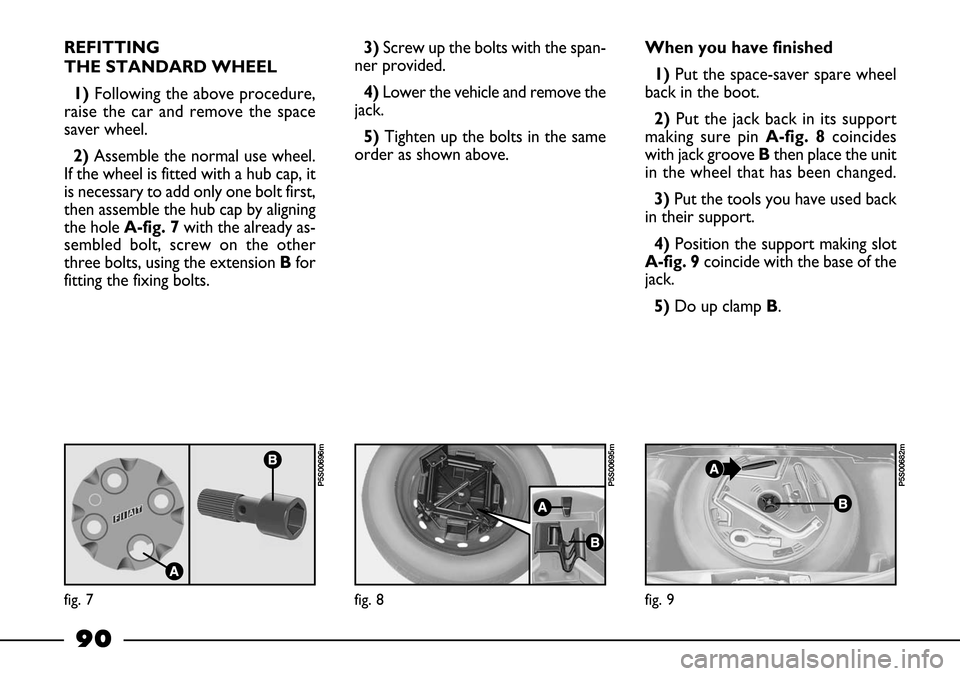
2) Put the jack back in its support
making sure pin A-fig. 8coincides
with jack groove Bthen place the unit
in the wheel that has been changed.
3) Put the tools you have used back
in their support.
4)Position the support making slot
A-fig. 9coincide with the base of the
jack.
5)Do up clamp B. REFITTING
THE STANDARD WHEEL
1) Following the above procedure,
raise the car and remove the space
saver wheel.
2)Assemble the normal use wheel.
If the wheel is fitted with a hub cap, it
is necessary to add only one bolt first,
then assemble the hub cap by aligning
the hole A-fig. 7with the already as-
sembled bolt, screw on the other
three bolts, using the extension Bfor
fitting the fixing bolts.
fig. 7
P5S00696m
fig. 8
P5S00695m
fig. 9
P5S00682m
Page 114 of 170
113
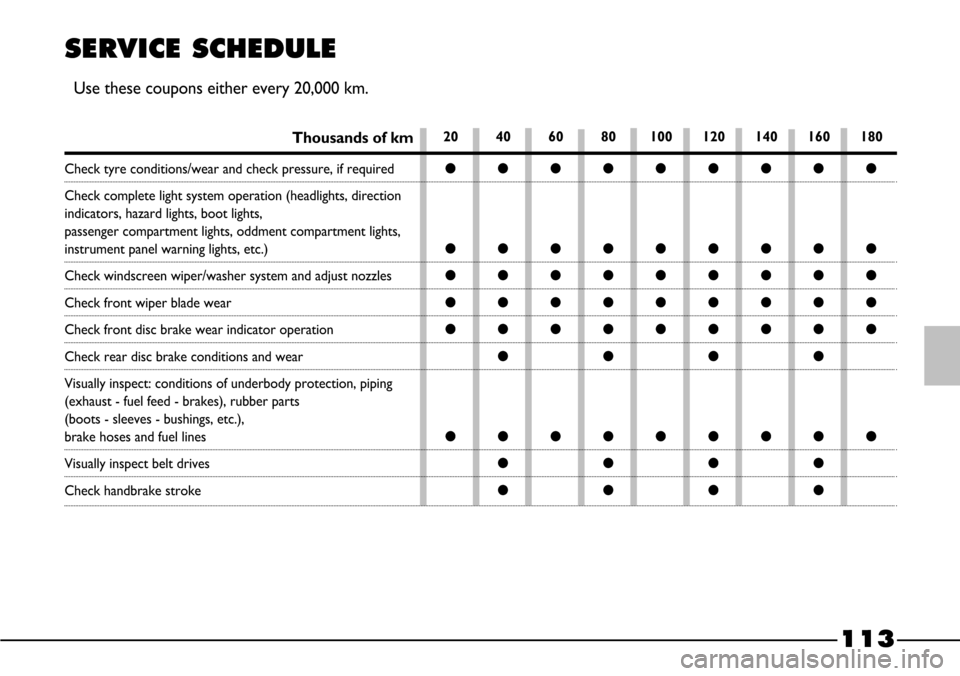
SERVICE SCHEDULE
Use these coupons either every 20,000 km.
Thousands of km20 40 60 80 100 120 140 160 180
Check tyre conditions/wear and check pressure, if required
Check complete light system operation (headlights, direction
indicators, hazard lights, boot lights,
passenger compartment lights, oddment compartment lights,
instrument panel warning lights, etc.)
Check windscreen wiper/washer system and adjust nozzles
Check front wiper blade wear
Check front disc brake wear indicator operation
Check rear disc brake conditions and wear
Visually inspect: conditions of underbody protection, piping
(exhaust - fuel feed - brakes), rubber parts
(boots - sleeves - bushings, etc.),
brake hoses and fuel lines
Visually inspect belt drives
Check handbrake stroke
ççççççççç
ççççççççç
ççççççççç
ççççççççç
ççççççççç
çççç
ççççççççç
çççç
çççç
Page 116 of 170
115
ANNUAL
INSPECTION
SCHEDULE
The following annual inspection
schedule is required for cars travelling
less than 20,000 km a year (e.g. ap-
proximately 10,000 km). The schedule
includes the following operations:
– Check tyre condition and wear and
adjust pressure, if required (including
spare-saver spare wheel).
– Check operation of lights (head-
lights, direction indicators, hazard
lights, boot light, passenger compart-
ment ceiling light, glove compartment
light, instrument panel lights, etc.).
– Check windscreen wiper/washer
and adjust nozzles.
– Check position wear of windscreen
window wiper blades.
ADDITIONAL
OPERATIONS
Every 1,000 kmor before long
trips, check and top up as necessary:
– coolant level
– brake fluid level
– power steering fluid level
– electrolyte level
– windscreen washer liquid level
– tyre condition and pressure.
We advise you to use FL Selenia
products, which have been designed
and produced expressly for the Fiat
vehicles (see the table “Capacities” giv-
en in the “Technical specifications”
section).
Every 3,000 km check and top up
as necessary: engine oil level. – Check rear brake pad conditions
and wear.
– Inspect conditions of. engine, gear-
box, transmission, piping (exhaust - fu-
el feed - brakes), rubber parts (boots
- sleeves - bushings - etc.), brake and
fuel line hoses.
– Check battery charge status.
– Check conditions of various con-
trol belts.
– Check and top up fluid levels (en-
gine coolant, brakes, windscreen
washer, battery, etc.).
– Change engine oil.
– Replace engine oil filter.
– Replace pollen filter (where fitted).
Page 125 of 170
124
USEFUL ADVICE
FOR LENGTHENING THE
LIFE OF YOUR BATTERY
When you park the car, ensure the
doors, boot and bonnet are closed
properly. The courtesy light must be
off.
Do not keep accessories (e.g. radio,
hazard lights etc.) switched on for a
long time when the engine is not run-
ning.
IMPORTANT A battery which is
kept at a charge of less than 50% for
any length of time will be damaged by
sulphation leading to a reduction in
cranking power and a higher risk of
the battery electrolyte freezing (this
may even occur at –10°C).
If the car is inactive for a long peri-
od of time, refer to “Storing the car”
in the “Driving your car” chapter.If, after purchasing your car you
would like to add electrical accessories
that require a permanent power sup-
ply (alarm systems, hands-free phone,
radio navigator with satellite anti-theft
system, etc.), visit a Fiat Dealership.
The staff of experts, besides suggest-
ing the most suitable accessories in the
Lineaccessori range, will also check
whether the car electrical system can
support the required load or if a larg-
er size battery needs to be installed.
These devices will, in fact, run off the
battery even when the key is not in-
serted (car parked) and can deploy the
battery.
Incorrect fitting of elec-
trical and electronic ac-
cessories can seriously
damage the car.Batteries contain sub-
stances that are very
harmful for the environ-
ment. You are advised to have the
battery changed at a Fiat Dealer-
ship. It is properly equipped for
disposing of used batteries in an
environmentally-friendly way that
complies with the law.
Do not attempt to recharge
a frozen battery. Thaw it
first otherwise it could explode. If
the battery froze, make sure the in-
ternal elements are not broken
(short-circuit risk) and that the cas-
ing is not cracked (risk of spilling
the poisonous and corrosive fluid).
WARNING
Page 133 of 170
132
Windows
Use specific window cleaners to
clean the windows. Use very clean
cloths to avoid scratching the glass or
damaging its transparency.
Engine compartment
At the end of each winter season,
carefully clean the engine compart-
ment. Have this done at a garage.Detergents pollute wa-
ter. The car must there-
fore be washed in an area
equipped for the collection and
purification of the liquids used
while washing.
IMPORTANTThe car should be
washed while the engine is cold and
with the ignition key at STOP. After
washing the car, make sure that the
various protections (e.g. rubber boots
and various guards) have not been re-
moved or damaged. Outside plastic parts must be cleaned
following the usual car washing pro-
cedure.
Avoid parking your car under trees;
the resinous substances that often
drop will dull the paintwork and in-
crease the possibility of corrosion.
IMPORTANT Bird droppings must
be washed off immediately and with
great care as their acid is particularly
aggressive.
Page 143 of 170
142
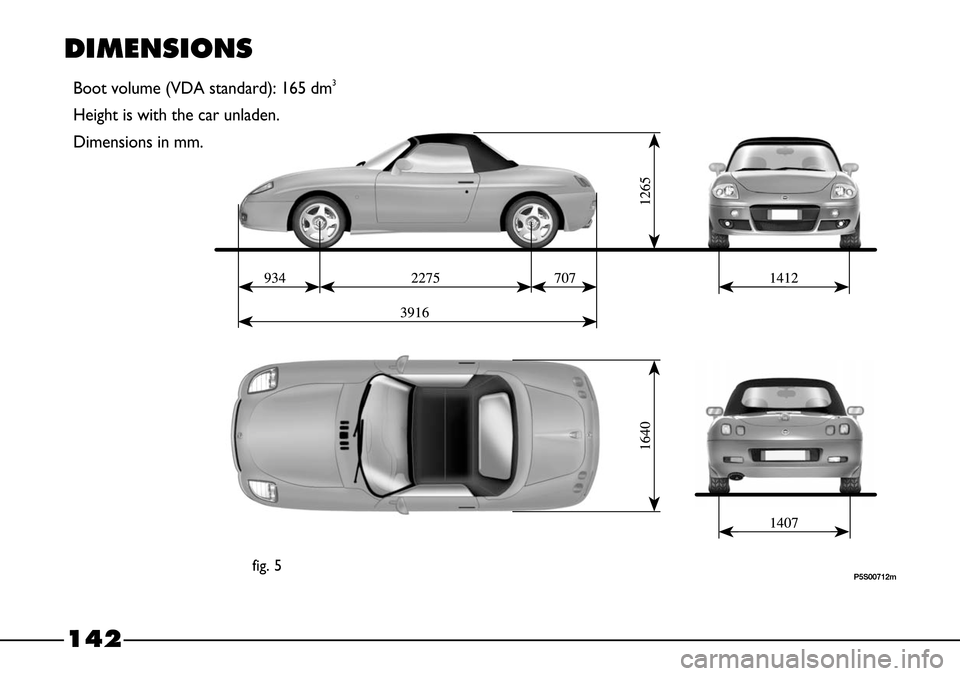
fig. 5P5S00712m
DIMENSIONS
Boot volume (VDA standard): 165 dm3
Height is with the car unladen.
Dimensions in mm.
Page 144 of 170
143
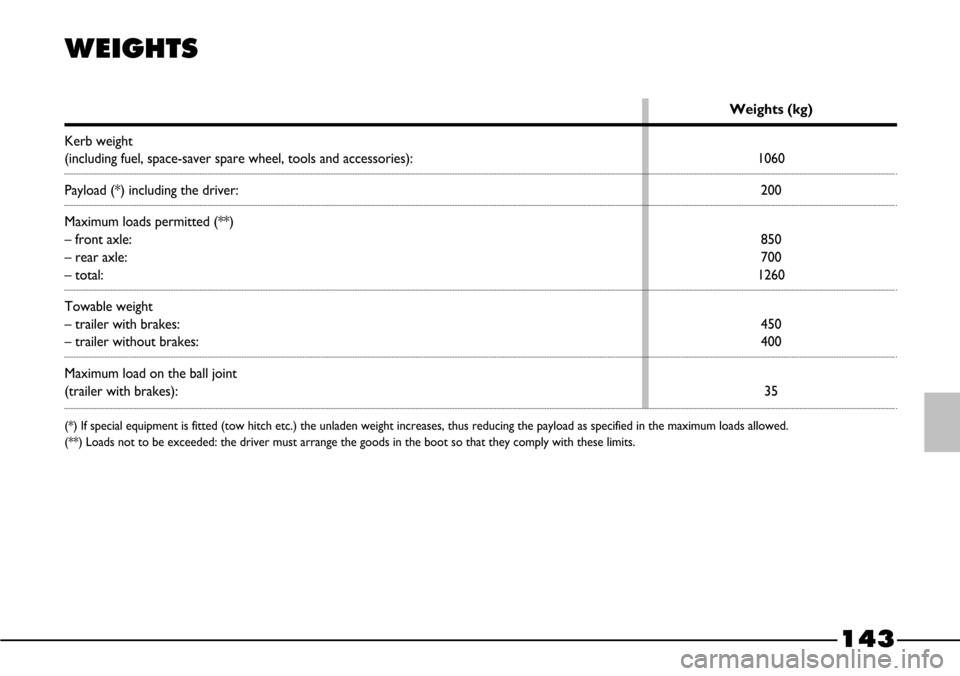
Kerb weight
(including fuel, space-saver spare wheel, tools and accessories):
Payload (*) including the driver:
Maximum loads permitted (**)
– front axle:
– rear axle:
– total:
Towable weight
– trailer with brakes:
– trailer without brakes:
Maximum load on the ball joint
(trailer with brakes):
(*) If special equipment is fitted (tow hitch etc.) the unladen weight increases, thus reducing the payload as specified in the maximum loads allowed.
(**) Loads not to be exceeded: the driver must arrange the goods in the boot so that they comply with these limits.
WEIGHTS
Weights (kg)
1060
200
850
700
1260
450
400
35
Page 151 of 170
150
ELECTRONIC ALARM
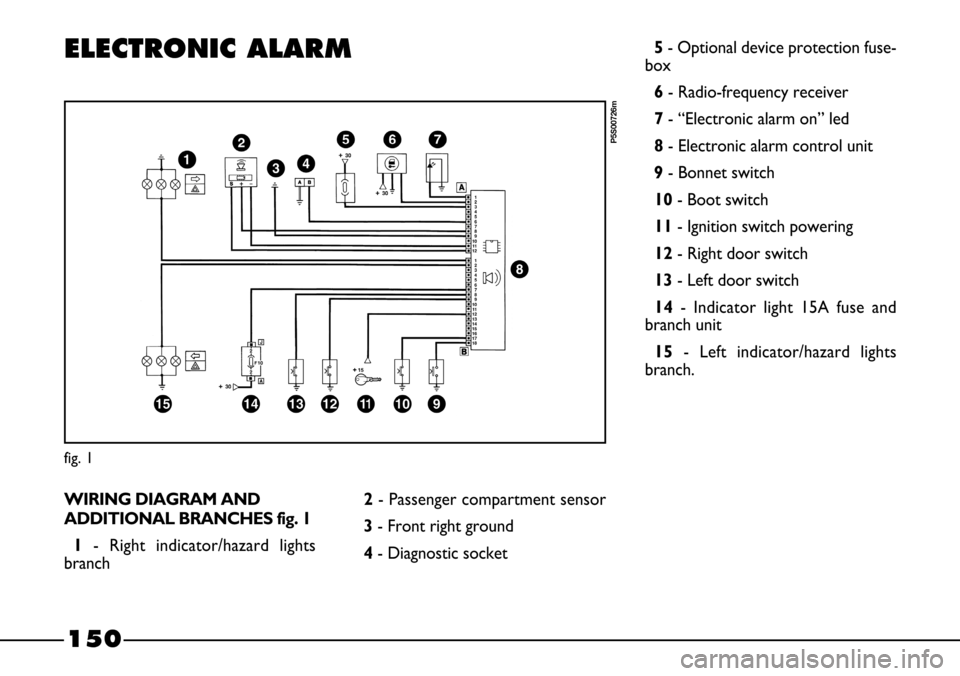
WIRING DIAGRAM AND
ADDITIONAL BRANCHES fig. 1
1- Right indicator/hazard lights
branch
fig. 1
P5S00726m
2- Passenger compartment sensor
3- Front right ground
4- Diagnostic socket5- Optional device protection fuse-
box
6- Radio-frequency receiver
7- “Electronic alarm on” led
8- Electronic alarm control unit
9- Bonnet switch
10- Boot switch
11- Ignition switch powering
12- Right door switch
13- Left door switch
14- Indicator light 15A fuse and
branch unit
15 - Left indicator/hazard lights
branch.