instrument FIAT BARCHETTA 2003 1.G User Guide
[x] Cancel search | Manufacturer: FIAT, Model Year: 2003, Model line: BARCHETTA, Model: FIAT BARCHETTA 2003 1.GPages: 170, PDF Size: 3.55 MB
Page 61 of 170
60
GENERAL WARNINGS
The front airbags can be trig-
gered if the car is subjected to
considerable crashes or involved
in an accident concerning the un-
derbody areas, such as a violent
impact against steps, kerbs or
projecting objects fastened to the
ground, falling into large holes or
dips in the road surface.
A small amount of powder and
smoke is freed when the airbags
are triggered. This is not harmful
and does not indicate the princi-
ple of a fire.
Go to a Fiat Dealership as soon
as possible if the warning light
comes on when travelling (to sig-
nal a fault) to have the problem
repaired.
The airbag system is guaranteed
for ten years. Contact a Fiat
Dealership as the expiry data ap-
proaches.
After an accident which trig-
gered the airbags, go to a Fiat
Dealership to have the entire
safety system, the electronic con-
trol unit, the seat belts and thepretensioners replaced. The
Dealership will also check the in-
tactness of the electrical system.
Any diagnostic, repair or re-
placement operations concerning
the airbag system must exclu-
sively be carried out at a Fiat
Dealership.
If you are having the car
scrapped, have the airbag system
deactivated at a Fiat Dealership
first.
If the car changes hands, the
new owner must be made aware
of the indications given above and
be given this Owner Handbook.
The pretensioners and front
airbags are activated by the elec-
tronic control unit according to
the type of impact. Consequent-
ly, missed activation of one or
more system components does
not indicate a fault in the system.
The instrument panel
warning light
¬should
come on when the ignition key is
turned to MAR and go out after ap-
proximately four seconds. Immedi-
ately, contact a Fiat Dealership if
the warning light either does not
come on or stays on or comes on
when travelling.
WARNING
When the passenger’s front
airbag is active (passenger
front airbag deactivation switch at
ON), the
Fwarning light will
come on for approximately four
seconds and flash for other four
seconds when the ignition key is
turned to MAR to remind the driver
than the passenger’s front and side
airbags (where fitted) will be fired
in the event of a crash. The warn-
ing light should go out immediate-
ly afterwards.
WARNING
Page 63 of 170
62
EOBD SYSTEM
The EOBD system (European On
Board Diagnosis) performs a non-stop
diagnosis of the components linked to
the emissions, it also warns the user
about the component current deterio-
ration conditions, by turning on the pi-
lot lamp
Uon the instrument panel.
Purpose of system is:
– keeping system efficiency under con-
trol;
– warning about emission increases
due to car malfunction;
– warning about the necessity of re-
placing deteriorated components. System also avails itself of a connector
that can be interfaced with a proper in-
strumentation, enabling to read error
codes stored in the control unit, to-
gether with a set of specific engine di-
agnosis and operation parameters. This
inspection can be also carried out by
traffic control agents. IMPORTANTAfter eliminating the
problem, yourFiat Dealershipwill
run a bench test to fully check the sys-
tem. In some cases, a long road test
may be required.
If the pilot lamp
Udoes
not turn on when the ig-
nition key is turned to the
MAR position, or if, when run-
ning, the fixed or blinking light
turns on, please contact as soon
as possible the Fiat Dealership.
Pilot light
Ufunctionality can be
inspected by the special equip-
ment available with the traffic
control agents. Comply with the
regulations current in the Coun-
try where your are driving.
Page 70 of 170
69
HOW TO WARM UP
THE ENGINE AFTER
IT HAS JUST STARTED
– Begin to move forward slowly, let-
ting the engine turn over at medium
revs. Do not floor the accelerator.
– Do not push the engine to its lim-
it for the first few kilometres. You are
recommended to wait until the water
temperature has reached 50° to 60°C.
EMERGENCY START-UP
If the Fiat CODE system fails to
recognise the code transmitted by
the ignition key (warning lamp ¢on
instrument panel lit with a fixed
light), you can start the engine by fol-
lowing the emergency procedure
using the code written on the CODE
card.
See the section “In an emergency”.Do not bump start by
pushing, towing or coast-
ing downhill. This way of
starting could cause a rush of fu-
el into the catalytic exhaust pipe
and damage it beyond repair.
A quick burst on the ac-
celerator before turning
off the engine serves ab-
solutely no practical purpose and
wastes fuel.
IMPORTANT After a taxing drive it
is better to allow the engine to “catch
its breath” before turning it off by let-
ting it idle to allow the temperature in
the engine compartment to fall.STOPPING THE ENGINE
Turn the ignition key to STOP
while the engine is idling.
Remember that as long as
the engine is not running,
the power brakes and power steer-
ing do not work. You therefore have
to use considerably more effort on
both the brake pedal and the steer-
ing wheel.
WARNING
Page 71 of 170
70
PARKING
Turn off the engine, pull up the hand-
brake, put the car in gear (1st if the car
is pointing uphill, reverse if downhill)
and turn the wheels. If the car is on a
steep incline, you should put a stone
or wedge under the wheels to block
them.
Do not leave the ignition key at
MAR because it drains the battery.
Always remove the key when you
leave the car.IMPORTANTIf this is not the
case, have the handbrake adjusted at
a Fiat Dealership.
When the hand brake is on and the
ignition key is at MAR, panel indica-
tor light xcomes on.
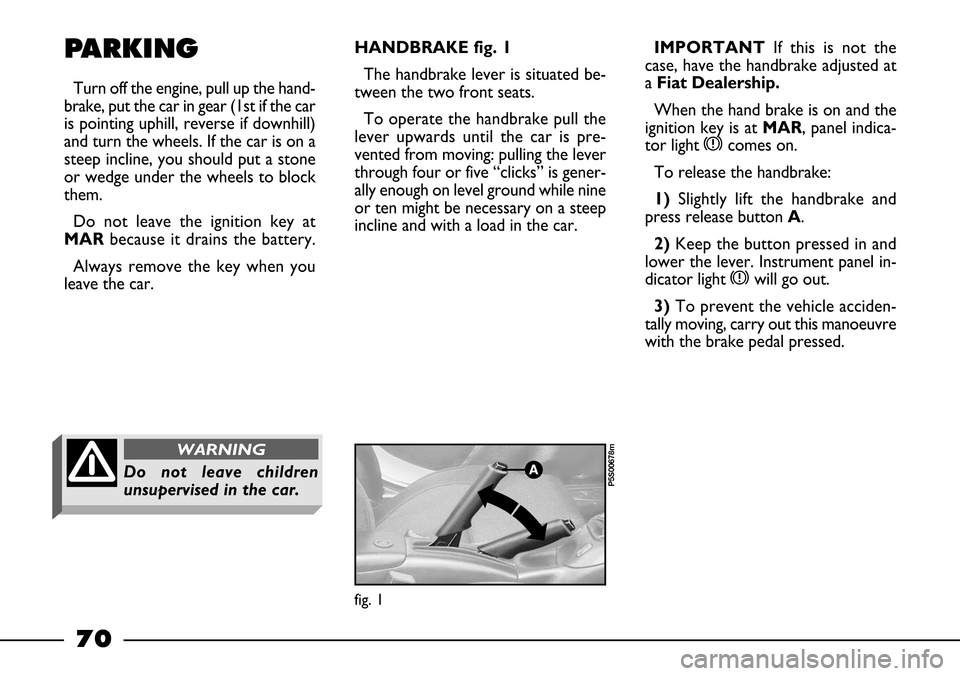
To release the handbrake:
1) Slightly lift the handbrake and
press release button A.
2) Keep the button pressed in and
lower the lever. Instrument panel in-
dicator light xwill go out.
3) To prevent the vehicle acciden-
tally moving, carry out this manoeuvre
with the brake pedal pressed. HANDBRAKE fig. 1
The handbrake lever is situated be-
tween the two front seats.
To operate the handbrake pull the
lever upwards until the car is pre-
vented from moving: pulling the lever
through four or five “clicks” is gener-
ally enough on level ground while nine
or ten might be necessary on a steep
incline and with a load in the car.
fig. 1
P5S00678mDo not leave children
unsupervised in the car.
WARNING
Page 80 of 170
79
If the engine begins to “lose its
smoothness” when travelling, contin-
ue your journey but reduce the
demands you are making on the
engine and have the car seen to at a
Fiat Dealership.
When the instrument panel fuel
reserve warning light Kcomes on, fill
up as soon as possible. A low level of
fuel can cause an uneven supply of
fuel to the engine with the inevitable
increase in the temperature of the
exhaust gas and serious damage to
the catalytic converter.
Never run the engine with one or
more spark plugs disconnected, even
for testing purposes.
Do not warm up the engine by let-
ting it idle for a while before moving
off unless the outside temperature is
very low and, even in this case, only
do so for less than thirty seconds.TOWING
A TRAILER
IMPORTANT
The car must be fitted with a
homologated tow hitch and suitable
electrical system for towing a cara-
van or trailer. Have the tow hitch fit-
ted by an expert who will issue spe-
cific documentation for use on
roads.
Fit special and/or additional
rearview mirrors in accordance with
the highway code.
Remember that towing a trailer
makes it harder for the car to climb
the maximum gradients specified,
increases braking and overtaking dis-
tance, proportionally to the overall
weight of the trailer.
The weight the trailer exerts on
the car’s tow hitch coupling reduces
the car’s loading capacity by the
same amount. Do not install other heat shields
and do not remove those already fit-
ted to the catalytic converter and
exhaust pipe.
Do not allow anything to be
sprayed onto the catalytic converter,
lambda sensor and exhaust pipe.
When functioning normal-
ly the catalytic converter
develops high temperatures. For
this reason do not park the car
over inflammable material (grass,
dry leaves, pine needles, etc.): fire
hazard.
WARNING
Failure to heed these pre-
cautions could cause a
fire.
WARNING
Page 103 of 170
102
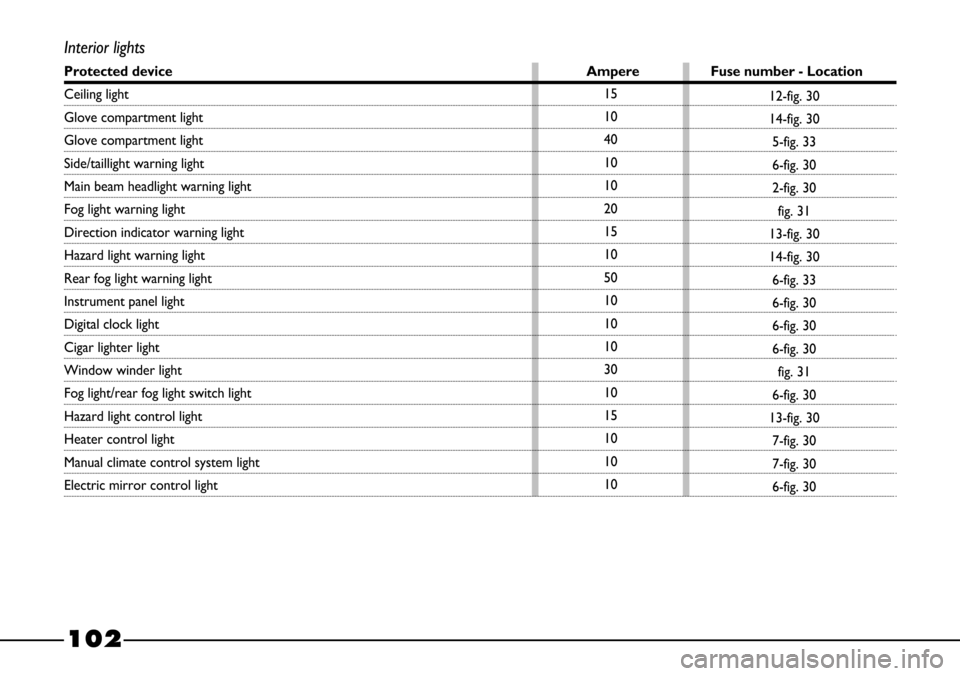
15
10
40
10
10
20
15
10
50
10
10
10
30
10
15
10
10
10
Interior lights
Protected device Ampere Fuse number - Location
Ceiling light
Glove compartment light
Glove compartment light
Side/taillight warning light
Main beam headlight warning light
Fog light warning light
Direction indicator warning light
Hazard light warning light
Rear fog light warning light
Instrument panel light
Digital clock light
Cigar lighter light
Window winder light
Fog light/rear fog light switch light
Hazard light control light
Heater control light
Manual climate control system light
Electric mirror control light 12-fig. 30
14-fig. 30
5-fig. 33
6-fig. 30
2-fig. 30
fig. 31
13-fig. 30
14-fig. 30
6-fig. 33
6-fig. 30
6-fig. 30
6-fig. 30
fig. 31
6-fig. 30
13-fig. 30
7-fig. 30
7-fig. 30
6-fig. 30
Page 105 of 170
104
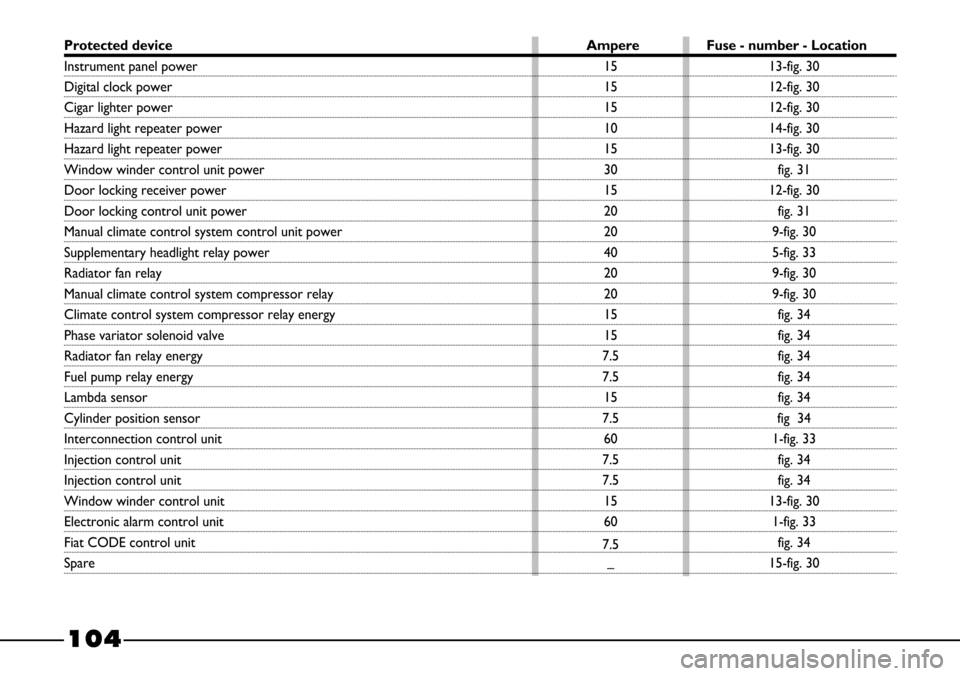
15
15
15
10
15
30
15
20
20
40
20
20
15
15
7.5
7.5
15
7.5
60
7.5
7.5
15
60
7.5
–
Protected device Ampere Fuse - number - Location
Instrument panel power
Digital clock power
Cigar lighter power
Hazard light repeater power
Hazard light repeater power
Window winder control unit power
Door locking receiver power
Door locking control unit power
Manual climate control system control unit power
Supplementary headlight relay power
Radiator fan relay
Manual climate control system compressor relay
Climate control system compressor relay energy
Phase variator solenoid valve
Radiator fan relay energy
Fuel pump relay energy
Lambda sensor
Cylinder position sensor
Interconnection control unit
Injection control unit
Injection control unit
Window winder control unit
Electronic alarm control unit
Fiat CODE control unit
Spare13-fig. 30
12-fig. 30
12-fig. 30
14-fig. 30
13-fig. 30
fig. 31
12-fig. 30
fig. 31
9-fig. 30
5-fig. 33
9-fig. 30
9-fig. 30
fig. 34
fig. 34
fig. 34
fig. 34
fig. 34
fig 34
1-fig. 33
fig. 34
fig. 34
13-fig. 30
1-fig. 33
fig. 34
15-fig. 30
Page 114 of 170
113
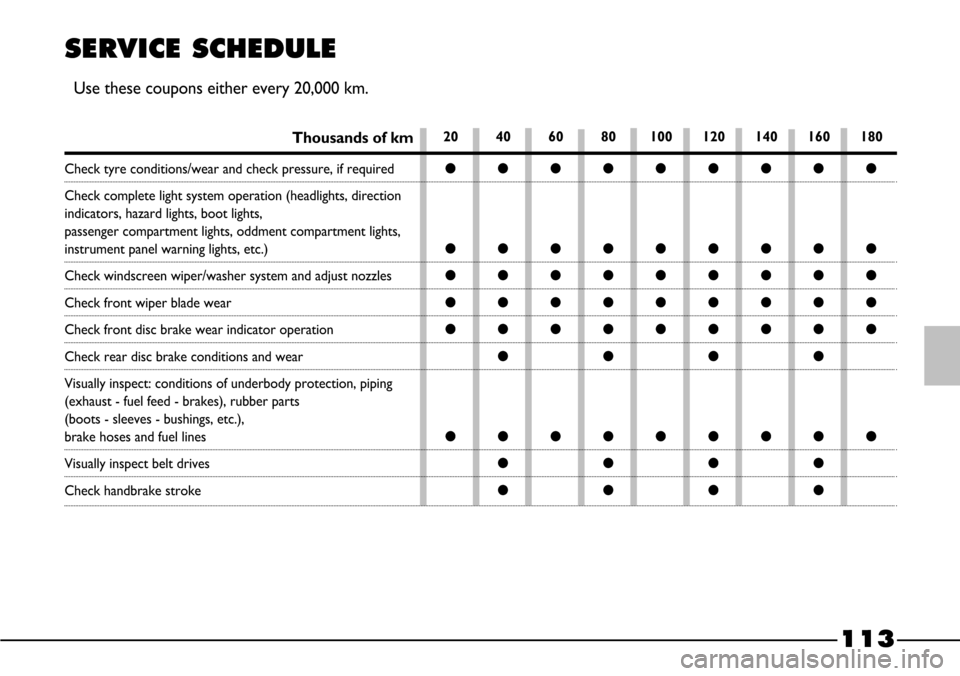
SERVICE SCHEDULE
Use these coupons either every 20,000 km.
Thousands of km20 40 60 80 100 120 140 160 180
Check tyre conditions/wear and check pressure, if required
Check complete light system operation (headlights, direction
indicators, hazard lights, boot lights,
passenger compartment lights, oddment compartment lights,
instrument panel warning lights, etc.)
Check windscreen wiper/washer system and adjust nozzles
Check front wiper blade wear
Check front disc brake wear indicator operation
Check rear disc brake conditions and wear
Visually inspect: conditions of underbody protection, piping
(exhaust - fuel feed - brakes), rubber parts
(boots - sleeves - bushings, etc.),
brake hoses and fuel lines
Visually inspect belt drives
Check handbrake stroke
ççççççççç
ççççççççç
ççççççççç
ççççççççç
ççççççççç
çççç
ççççççççç
çççç
çççç
Page 116 of 170
115
ANNUAL
INSPECTION
SCHEDULE
The following annual inspection
schedule is required for cars travelling
less than 20,000 km a year (e.g. ap-
proximately 10,000 km). The schedule
includes the following operations:
– Check tyre condition and wear and
adjust pressure, if required (including
spare-saver spare wheel).
– Check operation of lights (head-
lights, direction indicators, hazard
lights, boot light, passenger compart-
ment ceiling light, glove compartment
light, instrument panel lights, etc.).
– Check windscreen wiper/washer
and adjust nozzles.
– Check position wear of windscreen
window wiper blades.
ADDITIONAL
OPERATIONS
Every 1,000 kmor before long
trips, check and top up as necessary:
– coolant level
– brake fluid level
– power steering fluid level
– electrolyte level
– windscreen washer liquid level
– tyre condition and pressure.
We advise you to use FL Selenia
products, which have been designed
and produced expressly for the Fiat
vehicles (see the table “Capacities” giv-
en in the “Technical specifications”
section).
Every 3,000 km check and top up
as necessary: engine oil level. – Check rear brake pad conditions
and wear.
– Inspect conditions of. engine, gear-
box, transmission, piping (exhaust - fu-
el feed - brakes), rubber parts (boots
- sleeves - bushings - etc.), brake and
fuel line hoses.
– Check battery charge status.
– Check conditions of various con-
trol belts.
– Check and top up fluid levels (en-
gine coolant, brakes, windscreen
washer, battery, etc.).
– Change engine oil.
– Replace engine oil filter.
– Replace pollen filter (where fitted).
Page 122 of 170
121
Oil consumption is ex-
tremely low: if it needs
topping up after travelling
only a short while, have the sys-
tem checked for leaks at a Fiat
Dealership.
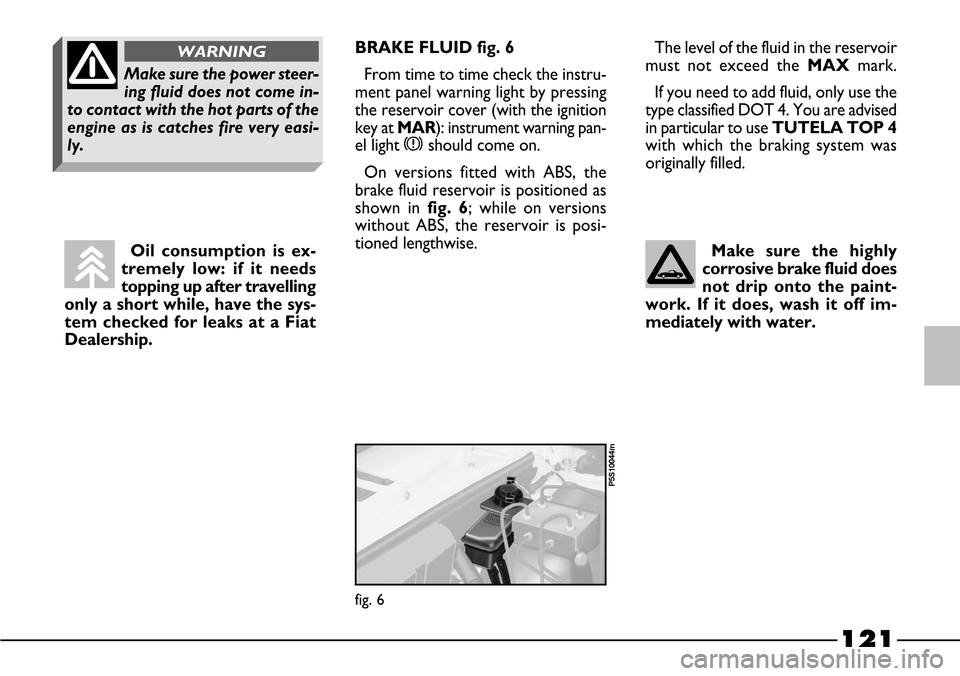
fig. 6
P5S10044m
The level of the fluid in the reservoir
must not exceed the MAXmark.
If you need to add fluid, only use the
type classified DOT 4. You are advised
in particular to use TUTELA TOP 4
with which the braking system was
originally filled. BRAKE FLUID fig. 6
From time to time check the instru-
ment panel warning light by pressing
the reservoir cover (with the ignition
key at MAR): instrument warning pan-
el light xshould come on.
On versions fitted with ABS, the
brake fluid reservoir is positioned as
shown in fig. 6; while on versions
without ABS, the reservoir is posi-
tioned lengthwise.
Make sure the highly
corrosive brake fluid does
not drip onto the paint-
work. If it does, wash it off im-
mediately with water.
Make sure the power steer-
ing fluid does not come in-
to contact with the hot parts of the
engine as is catches fire very easi-
ly.
WARNING