tow FIAT BARCHETTA 2003 1.G User Guide
[x] Cancel search | Manufacturer: FIAT, Model Year: 2003, Model line: BARCHETTA, Model: FIAT BARCHETTA 2003 1.GPages: 170, PDF Size: 3.55 MB
Page 73 of 170
72
BEFORE GETTING BEHIND
THE WHEEL
– Make sure all lights including the
headlights are working properly.
– Adjust the position of the seats,
steering wheel, driving and door mir-
rors properly for the best driving
position.
– Carefully adjust head restraints
so the back of the head and not the
nape of the neck is supported.
– Make sure that nothing (mats
etc.) gets in the way of the pedals
when they are pushed down.
– Adjust the height of the seat
belts, adapting them to your height
(see indications given in the chapter
“Getting to know your car - seat
belts”).
– Make sure that any child restraint
systems (child seats, carriers, etc.)
are properly fixed.– Stow objects in the luggage com-
partment with care to prevent them
from being thrown forwards in the
event of an accident.
– Make sure that any child restraint
systems are properly fixed. If the
child seat is installed when a passen-
ger airbag is fitted, make sure it is
facing forwards, and position the car
seat as far back as possible.
– Do not eat a heavy meal before
travelling. Light eating will help keep
your reflexes prompt. Above all, do
not have anything alcoholic to drink.
– Remember to check what is spec-
ified in the “Repeated checks and
checks before long trips” in this sec-
tion.WHEN TRAVELLING
– The first rule of safe driving is
prudence.
– Prudence also means putting
yourself into a position where you
can predict wrong or imprudent
behaviour of other drivers.
– Stick closely to the rules of the
road in the particular country where
the car is being driven and, above all,
do not exceed speed limits.
– Do not drive with your foot rest-
ing on the clutch pedal as this will
quickly wear the clutch out.
– Ensure that, besides yourself, all
the other passengers in the car have
their seat belts fastened, that chil-
dren are sitting in the appropriate
child seats and any animals are in
special compartments.
– You should be physically fit and
mentally alert before setting out on
long journeys.
Page 77 of 170
76
Here are some suggestions which
may help you to keep the running
costs of your vehicle down and low-
er the amount of toxic emissions re-
leased into the atmosphere.
GENERAL
CONSIDERATIONS
Car maintenance
The overall state of the car is an im-
portant factor which has a marked in-
fluence over fuel consumption and dri-
ving comfort and on the life span of
your car. For this reason care should
be taken to maintain your car by car-
rying out the necessary checks and
regulations in accordance with the
specifications given in the Scheduled
Maintenance Programme (see sec-
tions... spark plugs, idle, air filter, tim-
ing).
CONTAINING RUNNING COSTS
AND POLLUTION
Tyres
Tyres should be checked at least
every four weeks: if the pressure is
too low fuel consumption increases as
the resistance to the rolling movement
of the tyre is greater. In this state, tyre
wear is increased and car handling suf-
fers which will affect safety.
Unnecessary loads
Do not travel with too much luggage
stowed in the boot. The weight of the
vehicle (especially when driving in
town) and its trim greatly affects con-
sumption and stability. To get the most out of ABS:
– During emergency stops or when
grip conditions are poor, you will feel
a slight pulsation on the brake pedal.
This is the sign that the ABS is in ac-
tion. Do not release the brake pedal
but continue to press so as not to in-
terrupt the braking action.
– ABS prevents the wheels from
locking but it does not increase actu-
al grip conditions between tyre and
road. Therefore, even if your car is fit-
ted with ABS, respect the safety dis-
tance from the car in front of you and
keep your speed down when driving
into bends.
– ABS serves to increase the con-
trollability of the car, not to enable you
to go faster.
Page 78 of 170
77
Electric devices
Use the electrical devices for the
necessary time only. The heated rear
window, supplementary lights, wind-
screen wipers, heating system blow-
er require large amounts of energy
and, increasing the request for pow-
er also increase fuel consumption (up
to +25% when driving in towns).
Air conditioner
The air conditioner is an additional
load which greatly affects the engine
leading to higher consumption (on av-
erage up to +20%). When the tem-
perature outside the vehicle permits
it, use the air vents.
Spoilers
The use of aerodynamic optional
extras which are not certified for
specific use on the vehicle may
reduce the aerodynamic penetration
of the car and increase consumption.STYLE OF DRIVING
Starting
Do not warm the engine when the
vehicle is stationary or at high or low
revs: in this way the engine will warm
up gradually increasing consumption
and emissions. You should drive off
slowly straight away avoiding high revs,
so that the engine will warm up more
quickly.
Unnecessary actions
Avoid revving the engine when
stopped at traffic lights or before
switching off the engine and avoid dou-
bling the clutch as these actions have
no purpose on modern cars and only
increase consumption and pollution.
Gear selection
As soon as the traffic and road con-
ditions allow it, shift to a higher gear.
Using a lower gear to liven up accel-
eration greatly increases consumption.
In the same way, improper use of the
higher gears will increase consump-
tion, emissions and wear and tear on
the engine.Top speeds
Fuel consumption increases consid-
erably as speed increases. For exam-
ple, when accelerating from 90 to 120
kph, fuel consumption increases by
about +30%. Your speed should be
kept as even as possible and superflu-
ous braking and acceleration avoided
as this increases both consumption
and emissions. A “soft” way of driving
should be adopted by attempting to
anticipate manoeuvres to avoid immi-
nent danger and to maintain a safe dis-
tance from the vehicle in front in or-
der to avoid braking sharply.
Acceleration
Accelerating violently increasing the
revs will greatly affect consumption
and emissions: acceleration should be
gradual and should not exceed the
maximum torque.
Page 79 of 170
78
CONDITIONS OF USE
Cold starting
Frequent cold starting will not enable
the engine to reach optimal running
temperature. It follows therefore that
consumption will be higher (from
+15% to +30% in towns) as will the
production of toxic emissions.
Traffic and road conditions
Heavy traffic and higher consumption
are synonymous; for example, when
driving slowly with frequent use of the
lower gears or in large towns where
there are numerous traffic lights.
Winding roads, mountain roads and
bumpy roads also have a negative ef-
fect on consumption.
Enforced halts
During prolonged hold-ups (traffic
lights, level crossings) the engine
should be switched off.CHEAP RUNNING THAT RESPECTS
THE ENVIRONMENT
LOOKING AFTER EMISSION
CONTROL DEVICES
The correct use of pollution control
devices not only ensures respect for
the environment but also has an effect
on the car’s performance.
Keeping these devices in good con-
dition is therefore a fundamental rule
for driving that is easy on your pock-
et and on the environment too.
The first step to take is to follow the
Service Schedule to the letter.
Use only unleaded petrol in petrol
engines.
If you have trouble starting, do not
keep turning the ignition key for long
periods. Be especially careful to avoid
bump starting the car by pushing, tow-
ing or rolling down hill: these are all
manoeuvres that can damage the cat-
alytic exhaust. For emergency starts
use only an auxiliary battery. Environmental protection has been
one of the guiding principles in the
production of the Fiat barchetta. It is
no accident that its pollution control
equipment is much more effective than
that required by current legislation.
Nonetheless, the environment can-
not get by without a concerted effort
from everyone.
By following a few simple rules you
can avoid harming the environment
and often cut down fuel consumption
at the same time.
On this subject, a few useful tips have
been given below to supplement those
marked by symbol #, at various points
of the handbook.
You are asked to read both the for-
mer and latter carefully.
Page 80 of 170
79
If the engine begins to “lose its
smoothness” when travelling, contin-
ue your journey but reduce the
demands you are making on the
engine and have the car seen to at a
Fiat Dealership.
When the instrument panel fuel
reserve warning light Kcomes on, fill
up as soon as possible. A low level of
fuel can cause an uneven supply of
fuel to the engine with the inevitable
increase in the temperature of the
exhaust gas and serious damage to
the catalytic converter.
Never run the engine with one or
more spark plugs disconnected, even
for testing purposes.
Do not warm up the engine by let-
ting it idle for a while before moving
off unless the outside temperature is
very low and, even in this case, only
do so for less than thirty seconds.TOWING
A TRAILER
IMPORTANT
The car must be fitted with a
homologated tow hitch and suitable
electrical system for towing a cara-
van or trailer. Have the tow hitch fit-
ted by an expert who will issue spe-
cific documentation for use on
roads.
Fit special and/or additional
rearview mirrors in accordance with
the highway code.
Remember that towing a trailer
makes it harder for the car to climb
the maximum gradients specified,
increases braking and overtaking dis-
tance, proportionally to the overall
weight of the trailer.
The weight the trailer exerts on
the car’s tow hitch coupling reduces
the car’s loading capacity by the
same amount. Do not install other heat shields
and do not remove those already fit-
ted to the catalytic converter and
exhaust pipe.
Do not allow anything to be
sprayed onto the catalytic converter,
lambda sensor and exhaust pipe.
When functioning normal-
ly the catalytic converter
develops high temperatures. For
this reason do not park the car
over inflammable material (grass,
dry leaves, pine needles, etc.): fire
hazard.
WARNING
Failure to heed these pre-
cautions could cause a
fire.
WARNING
Page 81 of 170
80
In order to be sure you are not
exceeding the maximum towing
weight you have to take into account
the trailer’s fully laden weight,
including accessories and personal
luggage.
Do not exceed the speed limits for
towing a trailer in the country you
are driving in. In any case, do not
exceed the top speed of 100 km/h. SNOW CHAINS
Keep your speed down
when snow chains have
been fitted to the
wheels. Avoid potholes, steps
and pavements, and do not
drive for long stretches on
snow-free roads, otherwise you
risk damaging the tyres, suspen-
sion and steering.
The use of snow chains is regulated
by the legislation in force in the
country the car is driven in.
The chains may only be applied to
the drive wheel tyres (front wheels).
Check the tautness of the chains
after driving some twenty to thirty
metres.Do not use snow chains with
195/55 R15 (84V) or 195/45 R16
(80V) tyres as the chains are likely to
interfere with the plastic wheelarch-
es.
Use only low-profile chains with
185/55 R15 (81H) tyres: maximum
height off the wheel 12 mm
IMPORTANT As the spare
wheel is small, it is not possible to fit
snow chains to it. If a front tyre is
punctured, first exchange a rear
wheel with the spare tyre and then
change the flat tyre with the rear
wheel thus removed. This way there
will be two ordinary wheels at the
front and the snow chains can fitted.
The ABS system which
may be fitted to the vehi-
cle will not control the trailer
braking system. Great care should
therefore be taken when driving
on slippery road surfaces.
WARNING
Under no circumstances
modify the car's braking
system for trailer braking control.
The trailer's braking system must
be completely independent of the
car's hydraulic system.
WARNING
Page 84 of 170
83
IN AN EMERGENCY
People who find themselves in an emergency situa-
tion need immediate and concrete help.
The following pages have been written to help you if
the need arises.
As you will see, a host of little snags have been tak-
en into account and, for each of them, the measures
you yourself can take are suggested. If the problems are
more serious however, you should have the car seen
to at a Fiat Dealership.
With regard to this, we would like to remind you that,
in addition to the Owner Handbook, you have also been
provided with the WARRANTY BOOKLET where you
will find details of all the services Fiat can provide should
you find yourself in difficulty.
We nevertheless recommend you read these pages.
If in need you will be able to find the information you
require much more quickly.EMERGENCY START-UP ................................................. 84
JUMP STARTING ................................................................ 85
BUMP STARTING .............................................................. 86
IF A TYRE IS PUNCTURED ............................................ 86
IF A BULB BURNS OUT .................................................. 91
IF AN EXTERIOR LIGHT BURNS OUT ...................... 93
IF AN INTERIOR LIGHT BURNS OUT ....................... 98
IF A FUSE BLOWS ............................................................. 98
IF THE BATTERY IS FLAT ............................................... 105
IF THE CAR NEEDS TO BE RAISED ............................ 106
IF THE CAR NEEDS TO BE TOWED .......................... 108
IF AN ACCIDENT OCCOURS ...................................... 109
Page 87 of 170
86
Observe the instructions on this and
the following pages to use the jack and
space-saver spare wheel correctly.
BUMP STARTING IF A TYRE
IS PUNCTURED
General instructions
Do not bump start by
pushing, towing or coast-
ing downhill. This way of
starting could cause a rush of fu-
el into the catalytic exhaust pipe
and damage it beyond repair.
Signal the presence of the
stopped vehicle according
to the laws in force (e.g. hazard
lights, reflecting triangle, etc.).
Any passengers on board should
leave the vehicle, especially if it is
heavily laden. Passengers should
stay away from oncoming traffic
while the wheel is being changed.
If the wheel is being changed on a
steep or badly surfaced road, place
wedges or other suitable material
under the wheels to stop the vehi-
cle.
WARNING
Remember that if the en-
gine is not running, the
brake booster will not work. You
therefore have to use considerably
more effort on the brake pedal.
WARNING
The space-saver spare
wheel is vehicle-specific.
Never use the wheel on other mod-
els. Never use other model spare
wheels on your vehicle.
If you change the type of wheels
(alloy rims instead of steel rims) you
will have to change the entire set of
fastening bolts with another set of
suitably sized bolts.
Only use the spare-saver wheel for
emergencies.
With the spare wheel do not exceed
80 kph.
An orange sticker is attached to the
spare wheel giving the main in-
structions for its use and limitations.
The sticker must never be re-
moved or covered.
Do not fit the hub cap to the
spare wheel.
WARNING
Page 88 of 170
The sticker gives the follow-
ing information in four lan-
guages:
CAUTION!FOR TEMPORARY USE
ONLY
. MAX. 80 KM/H! REPLACE BY NOR-
MAL WHEEL AS SOON AS POSSIBLE. DO NOT
COVER THIS LABEL IN USE
. When driving
with a space-saver spare wheel fitted
the driving performance of your car
may change. Avoid accelerating or
braking suddenly, steering abruptly or
driving fast on bends. The life span of
a space-saver spare wheel is approx-
imately 3000 km, after which it will
need to be replaced with another
spare wheel of the same type. Nev-
er fit a standard tyre on the spare-
saver spare wheel rim. Have the
wheel replaced and refitted as soon
as possible. Never use two or more
spare wheel at the same time. Do not
lubricate the bolt threads before fit-
ting them back: they could come
loose. The jack should only be used
to change a wheel on the car for
which it was designed. It should not
be put to other uses or employed to
raise other models of car. Under no
circumstances should it be used when
carrying out repairs under the vehi-
cle.
87
WARNING
An incorrectly positioned
jack may cause the vehicle
to fall.
Do not use the jack to lift loads ex-
ceeding that indicated on the label
attached to the jack itself.
Never start the engine when the car
is jacked up.
If you are towing a trailer, release
the trailer before jacking up the car.
Do not fit snow chains on space-
saver spare wheels. If a front wheel
(drive wheel) is punctured and you
require snow chains to proceed,
take a standard wheel from the
rear axle and fit the space-saver
spare wheel in its place. Having fit-
ted two standard wheels on the dri-
ve axle, you can use snow chains,
thus solving the emergency situa-
tion.
WARNING
Torque the wheel cap cor-
rectly to prevent the wheel
from coming free in motion.
Never tamper with the inflation
valve.
Never place tools between the rim
and tyre.
Check the tyre and space-saver
spare wheel pressure regularly. Tyre
pressure is shown in the “Technical
specifications” chapter.
WARNING
Page 109 of 170
108
The tow ring supplied as an outfit to-
gether with the car is housed into the
tool compartment under the luggage
compartment coating carpet.
Front tow
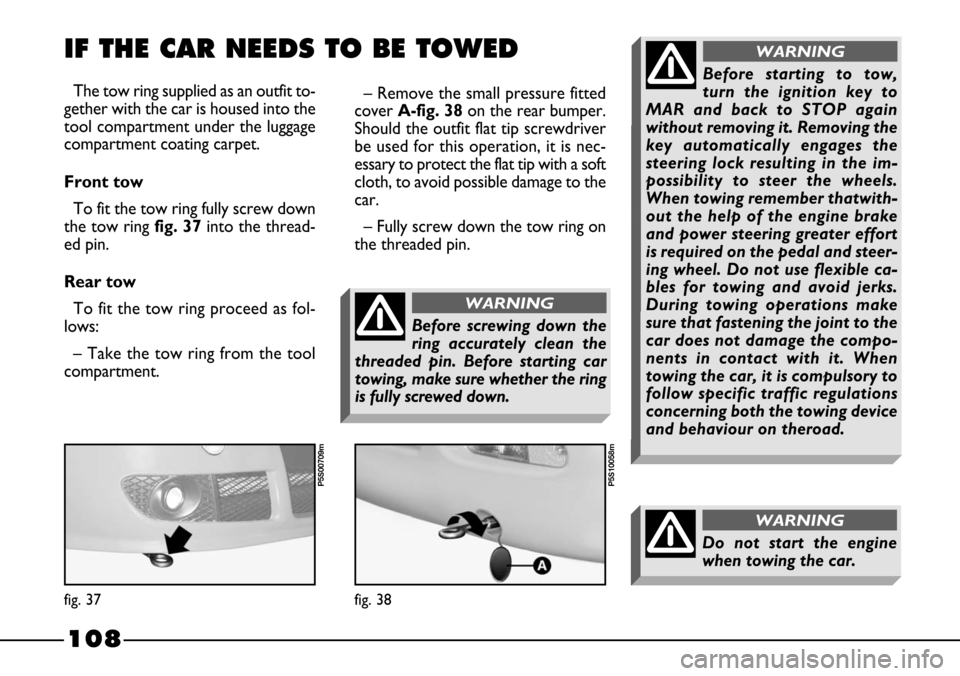
To fit the tow ring fully screw down
the tow ring fig. 37into the thread-
ed pin.
Rear tow
To fit the tow ring proceed as fol-
lows:
– Take the tow ring from the tool
compartment.
IF THE CAR NEEDS TO BE TOWED
fig. 37
P5S00709m
fig. 38
P5S10058m
– Remove the small pressure fitted
cover A-fig. 38on the rear bumper.
Should the outfit flat tip screwdriver
be used for this operation, it is nec-
essary to protect the flat tip with a soft
cloth, to avoid possible damage to the
car.
– Fully screw down the tow ring on
the threaded pin.
Before screwing down the
ring accurately clean the
threaded pin. Before starting car
towing, make sure whether the ring
is fully screwed down.
WARNING
Do not start the engine
when towing the car.
WARNING
Before starting to tow,
turn the ignition key to
MAR and back to STOP again
without removing it. Removing the
key automatically engages the
steering lock resulting in the im-
possibility to steer the wheels.
When towing remember thatwith-
out the help of the engine brake
and power steering greater effort
is required on the pedal and steer-
ing wheel. Do not use flexible ca-
bles for towing and avoid jerks.
During towing operations make
sure that fastening the joint to the
car does not damage the compo-
nents in contact with it. When
towing the car, it is compulsory to
follow specific traffic regulations
concerning both the towing device
and behaviour on theroad.
WARNING