climate control FIAT BARCHETTA 2003 1.G Owners Manual
[x] Cancel search | Manufacturer: FIAT, Model Year: 2003, Model line: BARCHETTA, Model: FIAT BARCHETTA 2003 1.GPages: 170, PDF Size: 3.55 MB
Page 7 of 170
GETTING TO KNOW YOUR CAR
You should read this chapter sitting comfortably in
your new Fiat barchetta. This way you can see the parts
described in the manual at a glance and immediately
check what you have just read for yourself.
In short, you will become more familiar with your
Fiat barchetta and its controls and other features. Lat-
er, when you start the engine and join the traffic you
will make a host of other pleasant discoveries.
DASHBOARD ...................................................................... 7
INSTRUMENT PANEL ...................................................... 8
SYMBOLIS ............................................................................. 9
THE FIAT CODE SYSTEM ............................................... 11
ELECTRONIC ALARM ..................................................... 13
IGNITION SWITCH ......................................................... 17
INDIVIDUAL SETTINGS .................................................. 18
SEAT BELTS ......................................................................... 21
TRANSPORTING CHILDREN IN SAFETY ................ 24
PRETENSIONERS ............................................................... 27
INSTRUMENTS ................................................................... 28INDICATOR AND WARNING LIGHTS .................... 30
HEATING AND VENTILATION ................................... 34
MANUAL CLIMATE CONTROL SYSTEM ................. 36
STEERING COLUMN STALKS ....................................... 38
CONTROLS ......................................................................... 40
INTERIOR EQUIPMENT .................................................. 42
DOORS ................................................................................. 44
HOOD ................................................................................... 46
HARD TOP .......................................................................... 49
WIND STOP ........................................................................ 51
BONNET .............................................................................. 53
BOOT .................................................................................... 55
HEADLIGHTS ...................................................................... 55
ABS ......................................................................................... 56
AIRBAG ................................................................................. 58
EOBD SYSTEM .................................................................... 62
CELLULAR PHONE SETUP ............................................. 63
AT THE FILLING STATION ........................................... 64
PROTECTING THE ENVIRONMENT ......................... 66
For more detailed information, see “Index”.
6
Page 8 of 170
7
DASHBOARD
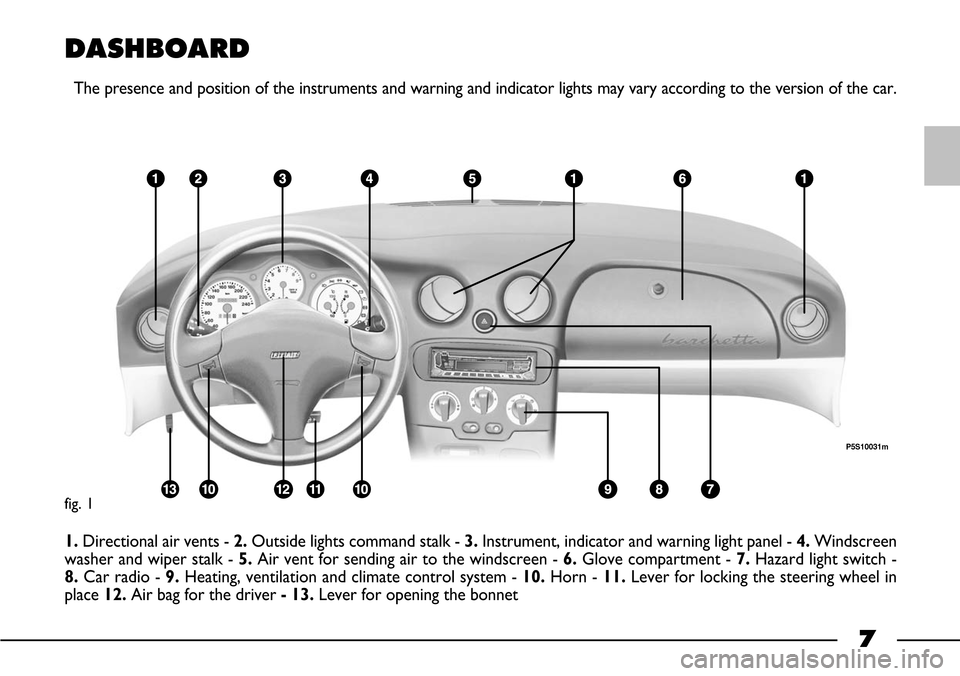
The presence and position of the instruments and warning and indicator lights may vary according to the version of the car.
1.Directional air vents -2.Outside lights command stalk - 3.Instrument, indicator and warning light panel - 4.Windscreen
washer and wiper stalk -5.Air vent for sending air to the windscreen - 6. Glove compartment -7.Hazard light switch -
8. Car radio - 9. Heating, ventilation and climate control system - 10.Horn - 11.Lever for locking the steering wheel in
place 12. Air bag for the driver - 13.Lever for opening the bonnet
fig. 1
P5S10031m
Page 10 of 170
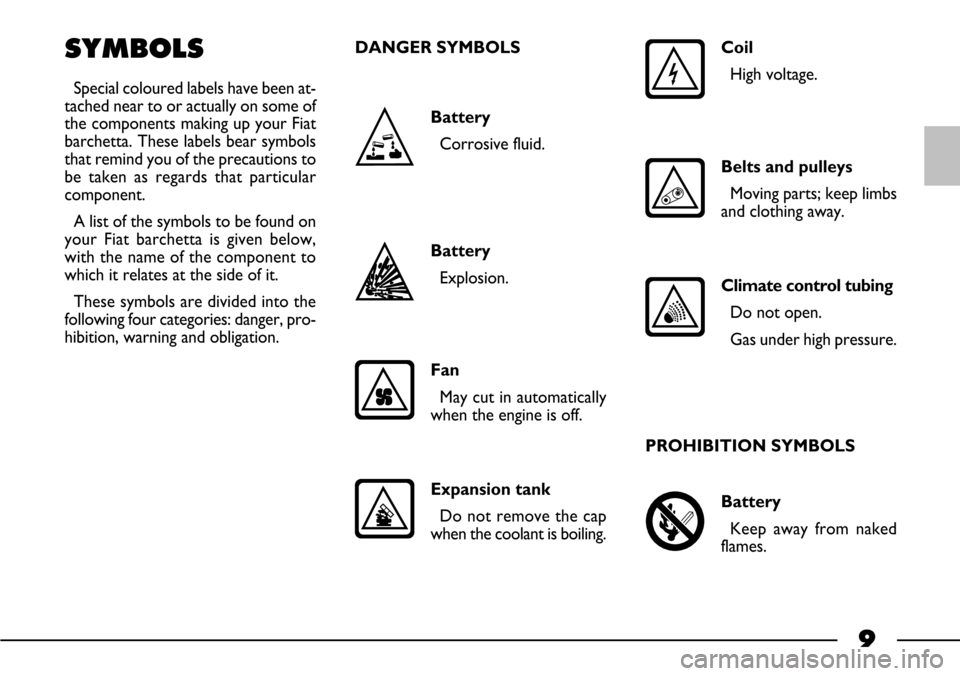
Climate control tubing
Do not open.
Gas under high pressure. Belts and pulleys
Moving parts; keep limbs
and clothing away. Coil
High voltage.
9
SYMBOLS
Special coloured labels have been at-
tached near to or actually on some of
the components making up your Fiat
barchetta. These labels bear symbols
that remind you of the precautions to
be taken as regards that particular
component.
A list of the symbols to be found on
your Fiat barchetta is given below,
with the name of the component to
which it relates at the side of it.
These symbols are divided into the
following four categories: danger, pro-
hibition, warning and obligation.DANGER SYMBOLS
Battery
Corrosive fluid.
Battery
Explosion.
Fan
May cut in automatically
when the engine is off.
Expansion tank
Do not remove the cap
when the coolant is boiling.
Battery
Keep away from naked
flames.
PROHIBITION SYMBOLS
Page 37 of 170
36
IMPORTANTIf the car has a man-
ual climate control system, you are
recommended to adjust the controls
as described above and press button
√to speed up the demisting process.
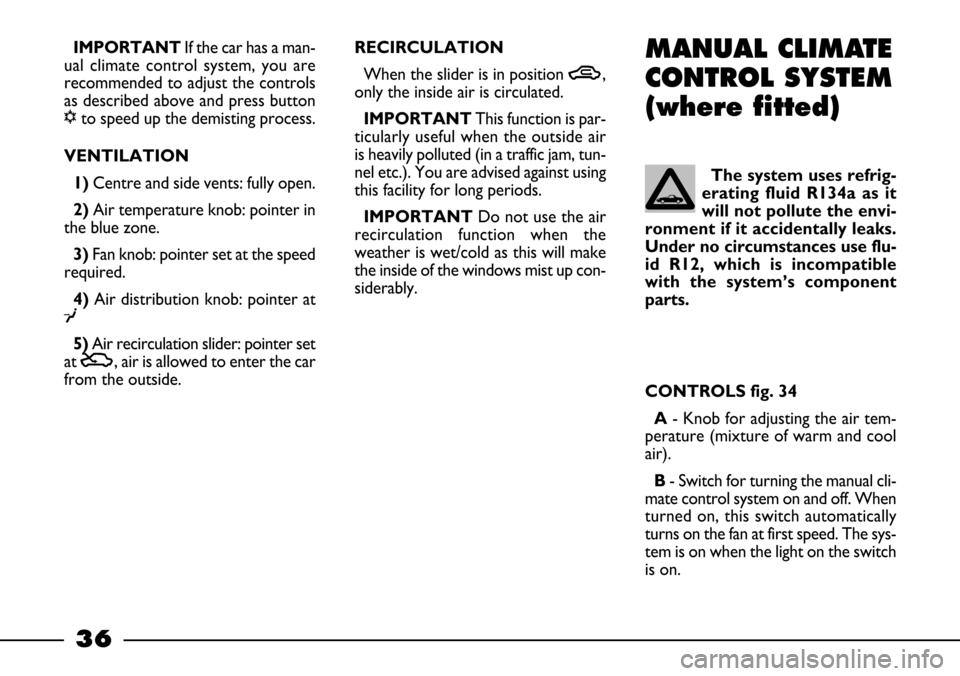
VENTILATION
1)Centre and side vents: fully open.
2) Air temperature knob: pointer in
the blue zone.
3) Fan knob: pointer set at the speed
required.
4) Air distribution knob: pointer at
¥
5)Air recirculation slider: pointer set
at U, air is allowed to enter the car
from the outside.RECIRCULATION
When the slider is in position T,
only the inside air is circulated.
IMPORTANTThis function is par-
ticularly useful when the outside air
is heavily polluted (in a traffic jam, tun-
nel etc.). You are advised against using
this facility for long periods.
IMPORTANTDo not use the air
recirculation function when the
weather is wet/cold as this will make
the inside of the windows mist up con-
siderably.MANUAL CLIMATE
CONTROL SYSTEM
(where fitted)
The system uses refrig-
erating fluid R134a as it
will not pollute the envi-
ronment if it accidentally leaks.
Under no circumstances use flu-
id R12, which is incompatible
with the system’s component
parts.
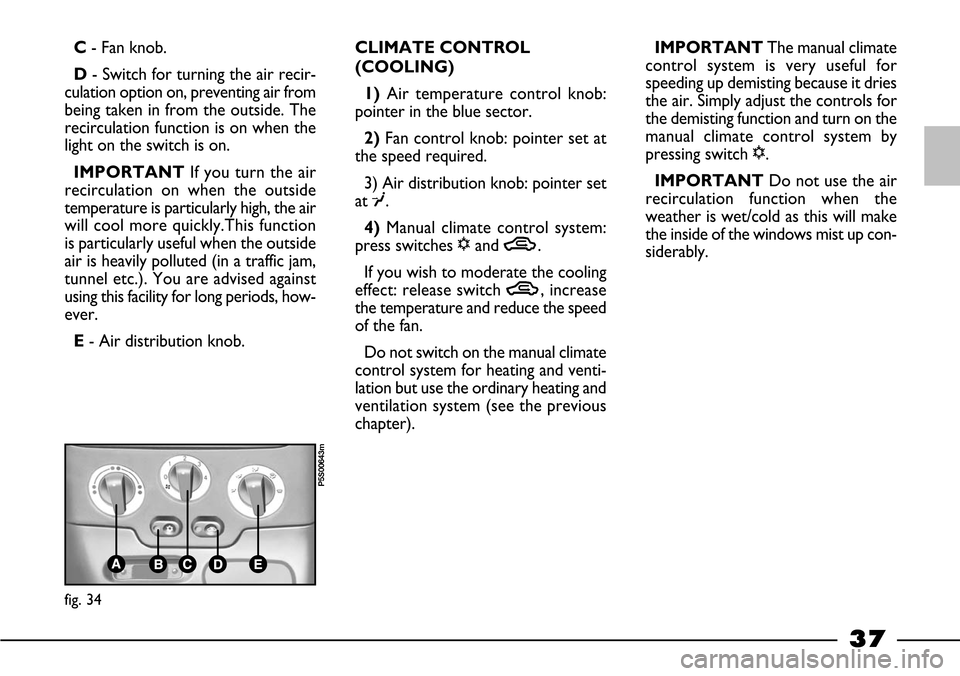
CONTROLS fig. 34
A- Knob for adjusting the air tem-
perature (mixture of warm and cool
air).
B- Switch for turning the manual cli-
mate control system on and off. When
turned on, this switch automatically
turns on the fan at first speed. The sys-
tem is on when the light on the switch
is on.
Page 38 of 170
37
C- Fan knob.
D- Switch for turning the air recir-
culation option on, preventing air from
being taken in from the outside. The
recirculation function is on when the
light on the switch is on.
IMPORTANTIf you turn the air
recirculation on when the outside
temperature is particularly high, the air
will cool more quickly.This function
is particularly useful when the outside
air is heavily polluted (in a traffic jam,
tunnel etc.). You are advised against
using this facility for long periods, how-
ever.
E- Air distribution knob.CLIMATE CONTROL
(COOLING)
1) Air temperature control knob:
pointer in the blue sector.
2)Fan control knob: pointer set at
the speed required.
3) Air distribution knob: pointer set
at ¥.
4)Manual climate control system:
press switches √and T.
If you wish to moderate the cooling
effect: release switch T, increase
the temperature and reduce the speed
of the fan.
Do not switch on the manual climate
control system for heating and venti-
lation but use the ordinary heating and
ventilation system (see the previous
chapter).IMPORTANTThe manual climate
control system is very useful for
speeding up demisting because it dries
the air. Simply adjust the controls for
the demisting function and turn on the
manual climate control system by
pressing switch √.
IMPORTANTDo not use the air
recirculation function when the
weather is wet/cold as this will make
the inside of the windows mist up con-
siderably.
fig. 34
P5S00643m
Page 67 of 170
66
PROTECTING THE
ENVIRONMENT
Protecting the environment has been
the guiding principle in the design of
the Fiat barchetta right from the start.
The result is the use of materials and
creation of devices that can reduce or
considerable curtail harmful influences
on the environment.
The Fiat barchetta is ready to travel
well ahead of the most stringent in-
ternational pollution control stan-
dards.
USE OF MATERIALS
THAT DO NOT HARM
THE ENVIRONMENT
None of the car’s components con-
tain asbestos. Padding and the climate
control system do not contain CFI’s
(Chlorofluorocarbides) the gases con-
sidered responsible for the destruc-
tion of the ozone layer. Other sub-
stances which may pollute the air and
water tables, such as cadmium used in
bolt anti-rust coverings and the chro-
mate used in some colourings, have
been replaced entirely with environ-
mentally-friendly substances. DEVICES FOR REDUCING
PETROL ENGINE EMISSIONS
Three-way catalytic converter
(catalytic exhaust pipe)
Carbon monoxide, nitrogen oxides
and unburned hydrocarbons are the
main harmful components in exhaust
gases.
The catalytic exhaust pipe and the
devices connected to it are a “minia-
ture laboratory” where a very high
percentage of these components is
converted into harmless substances.
The conversion is aided by minute
particles of precious metals on the ce-
ramic core enclosed in the stainless-
steel container.Lambda Sensor
All petrol versions are fitted with this
device. It ensures that air and fuel are
constantly mixed in the correct pro-
portions. This is a fundamental condi-
tions for the proper functioning of the
engine and the catalytic converter.
Anti-evaporation canister
As it is impossible to stop the build-
up of petrol fumes even when the en-
gine is not running, the system traps
them in a special active carbon canis-
ter. They are sucked in from here and
burnt while the engine is running.
Page 103 of 170
102
15
10
40
10
10
20
15
10
50
10
10
10
30
10
15
10
10
10
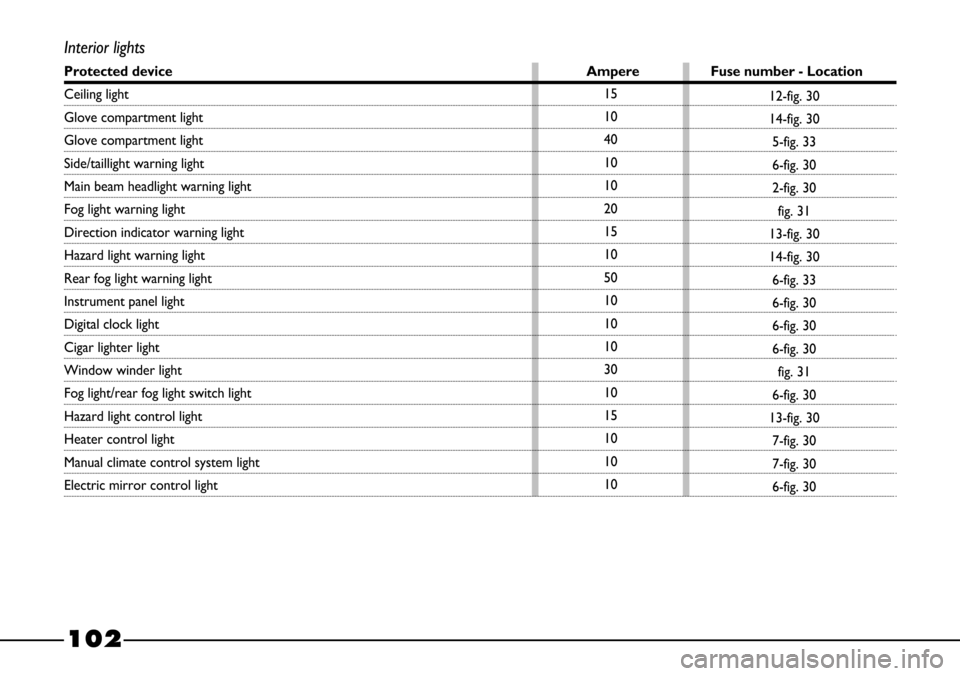
Interior lights
Protected device Ampere Fuse number - Location
Ceiling light
Glove compartment light
Glove compartment light
Side/taillight warning light
Main beam headlight warning light
Fog light warning light
Direction indicator warning light
Hazard light warning light
Rear fog light warning light
Instrument panel light
Digital clock light
Cigar lighter light
Window winder light
Fog light/rear fog light switch light
Hazard light control light
Heater control light
Manual climate control system light
Electric mirror control light 12-fig. 30
14-fig. 30
5-fig. 33
6-fig. 30
2-fig. 30
fig. 31
13-fig. 30
14-fig. 30
6-fig. 33
6-fig. 30
6-fig. 30
6-fig. 30
fig. 31
6-fig. 30
13-fig. 30
7-fig. 30
7-fig. 30
6-fig. 30
Page 104 of 170
103
50
15
30
50
40
15
20
15
60
30
20
40
40
30
20
20
15
30
30
30
30
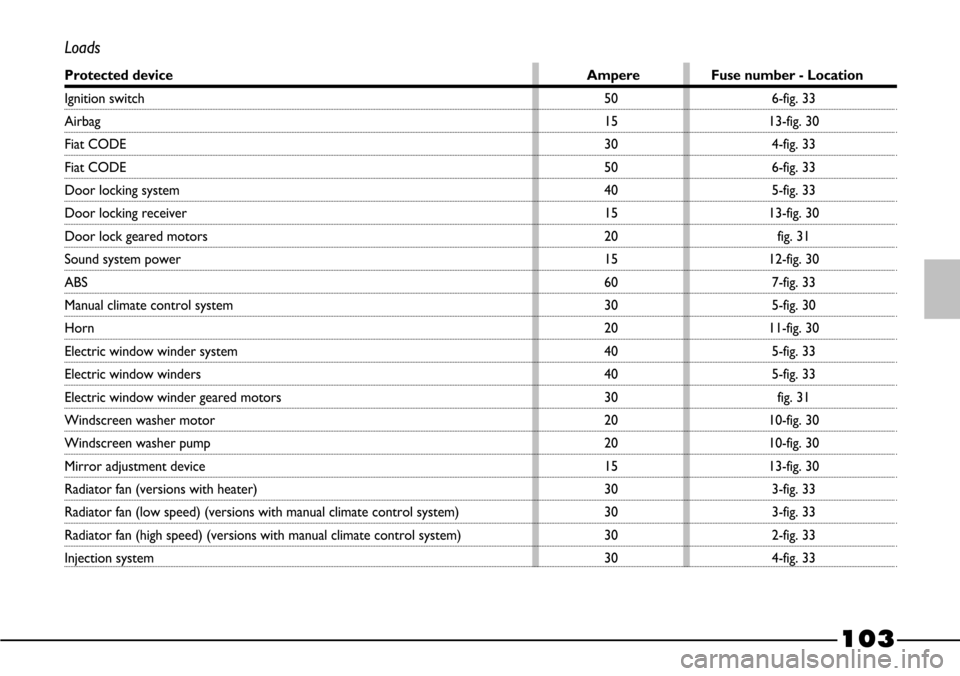
Loads
Protected device Ampere Fuse number - Location
Ignition switch
Airbag
Fiat CODE
Fiat CODE
Door locking system
Door locking receiver
Door lock geared motors
Sound system power
ABS
Manual climate control system
Horn
Electric window winder system
Electric window winders
Electric window winder geared motors
Windscreen washer motor
Windscreen washer pump
Mirror adjustment device
Radiator fan (versions with heater)
Radiator fan (low speed) (versions with manual climate control system)
Radiator fan (high speed) (versions with manual climate control system)
Injection system 6-fig. 33
13-fig. 30
4-fig. 33
6-fig. 33
5-fig. 33
13-fig. 30
fig. 31
12-fig. 30
7-fig. 33
5-fig. 30
11-fig. 30
5-fig. 33
5-fig. 33
fig. 31
10-fig. 30
10-fig. 30
13-fig. 30
3-fig. 33
3-fig. 33
2-fig. 33
4-fig. 33
Page 105 of 170
104
15
15
15
10
15
30
15
20
20
40
20
20
15
15
7.5
7.5
15
7.5
60
7.5
7.5
15
60
7.5
–
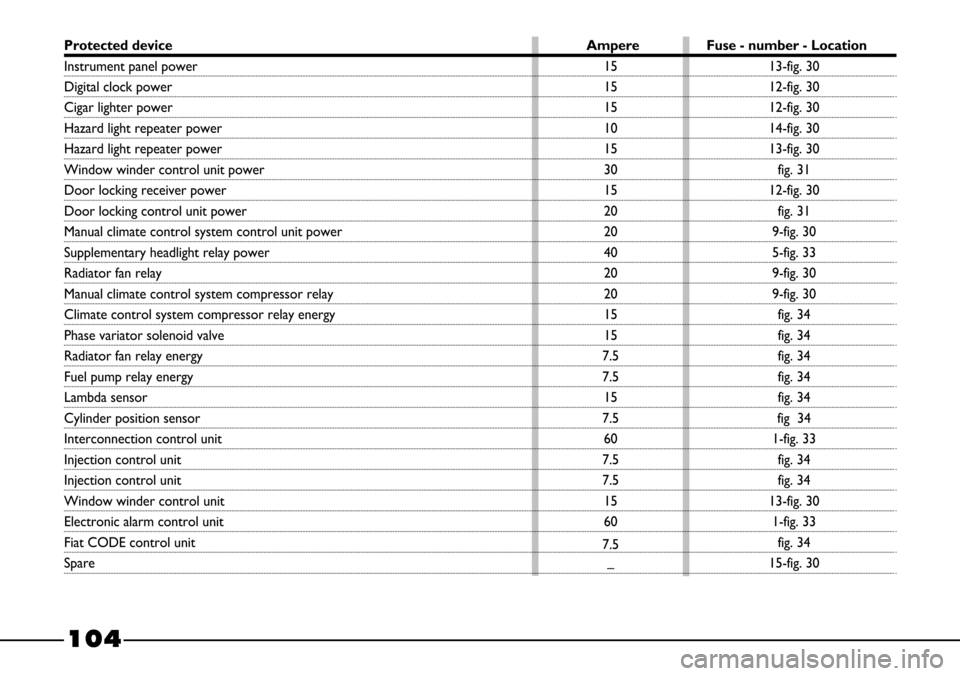
Protected device Ampere Fuse - number - Location
Instrument panel power
Digital clock power
Cigar lighter power
Hazard light repeater power
Hazard light repeater power
Window winder control unit power
Door locking receiver power
Door locking control unit power
Manual climate control system control unit power
Supplementary headlight relay power
Radiator fan relay
Manual climate control system compressor relay
Climate control system compressor relay energy
Phase variator solenoid valve
Radiator fan relay energy
Fuel pump relay energy
Lambda sensor
Cylinder position sensor
Interconnection control unit
Injection control unit
Injection control unit
Window winder control unit
Electronic alarm control unit
Fiat CODE control unit
Spare13-fig. 30
12-fig. 30
12-fig. 30
14-fig. 30
13-fig. 30
fig. 31
12-fig. 30
fig. 31
9-fig. 30
5-fig. 33
9-fig. 30
9-fig. 30
fig. 34
fig. 34
fig. 34
fig. 34
fig. 34
fig 34
1-fig. 33
fig. 34
fig. 34
13-fig. 30
1-fig. 33
fig. 34
15-fig. 30
Page 112 of 170
111
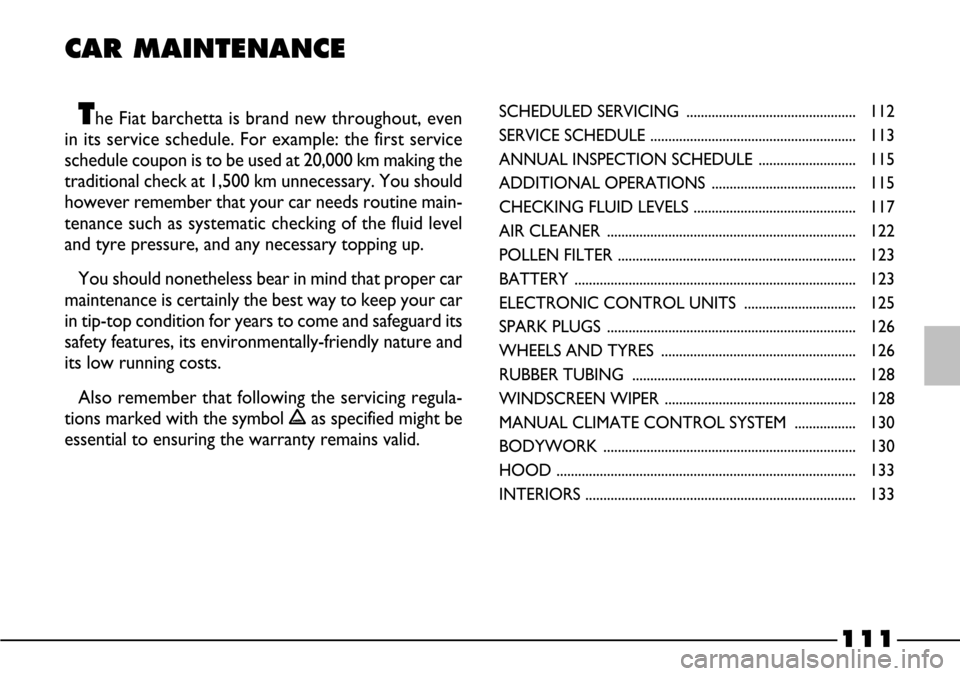
CAR MAINTENANCE
The Fiat barchetta is brand new throughout, even
in its service schedule. For example: the first service
schedule coupon is to be used at 20,000 km making the
traditional check at 1,500 km unnecessary. You should
however remember that your car needs routine main-
tenance such as systematic checking of the fluid level
and tyre pressure, and any necessary topping up.
You should nonetheless bear in mind that proper car
maintenance is certainly the best way to keep your car
in tip-top condition for years to come and safeguard its
safety features, its environmentally-friendly nature and
its low running costs.
Also remember that following the servicing regula-
tions marked with the symbol ∑as specified might be
essential to ensuring the warranty remains valid.SCHEDULED SERVICING ............................................... 112
SERVICE SCHEDULE ......................................................... 113
ANNUAL INSPECTION SCHEDULE ........................... 115
ADDITIONAL OPERATIONS ........................................ 115
CHECKING FLUID LEVELS ............................................. 117
AIR CLEANER ..................................................................... 122
POLLEN FILTER .................................................................. 123
BATTERY .............................................................................. 123
ELECTRONIC CONTROL UNITS ............................... 125
SPARK PLUGS ..................................................................... 126
WHEELS AND TYRES ...................................................... 126
RUBBER TUBING .............................................................. 128
WINDSCREEN WIPER ..................................................... 128
MANUAL CLIMATE CONTROL SYSTEM ................. 130
BODYWORK ...................................................................... 130
HOOD ................................................................................... 133
INTERIORS ........................................................................... 133