ignition FIAT BARCHETTA 2003 1.G Owner's Guide
[x] Cancel search | Manufacturer: FIAT, Model Year: 2003, Model line: BARCHETTA, Model: FIAT BARCHETTA 2003 1.GPages: 170, PDF Size: 3.55 MB
Page 104 of 170
103
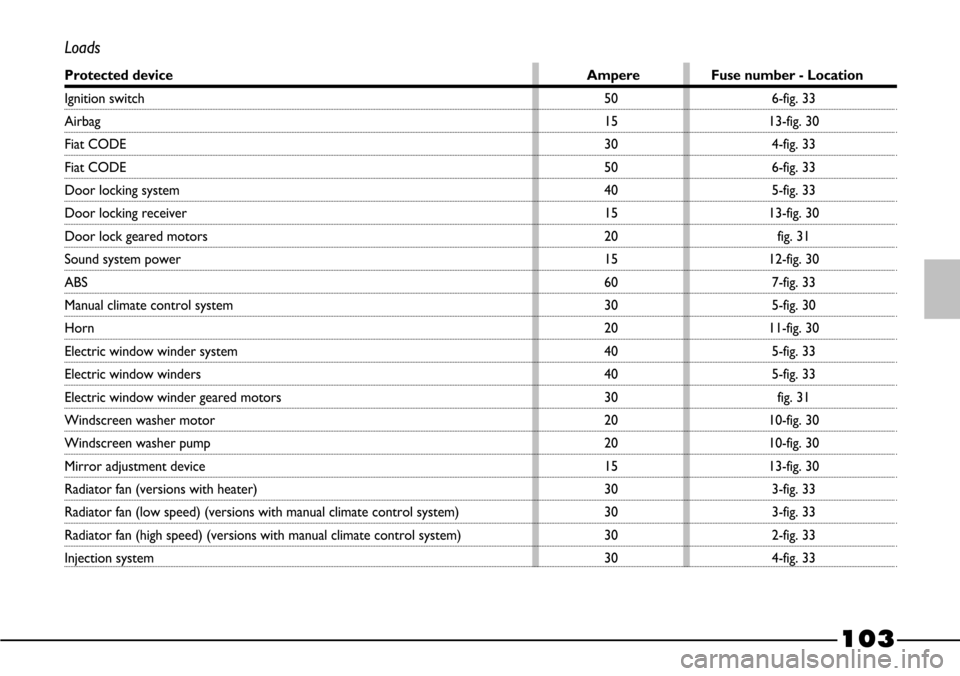
50
15
30
50
40
15
20
15
60
30
20
40
40
30
20
20
15
30
30
30
30
Loads
Protected device Ampere Fuse number - Location
Ignition switch
Airbag
Fiat CODE
Fiat CODE
Door locking system
Door locking receiver
Door lock geared motors
Sound system power
ABS
Manual climate control system
Horn
Electric window winder system
Electric window winders
Electric window winder geared motors
Windscreen washer motor
Windscreen washer pump
Mirror adjustment device
Radiator fan (versions with heater)
Radiator fan (low speed) (versions with manual climate control system)
Radiator fan (high speed) (versions with manual climate control system)
Injection system 6-fig. 33
13-fig. 30
4-fig. 33
6-fig. 33
5-fig. 33
13-fig. 30
fig. 31
12-fig. 30
7-fig. 33
5-fig. 30
11-fig. 30
5-fig. 33
5-fig. 33
fig. 31
10-fig. 30
10-fig. 30
13-fig. 30
3-fig. 33
3-fig. 33
2-fig. 33
4-fig. 33
Page 109 of 170
108
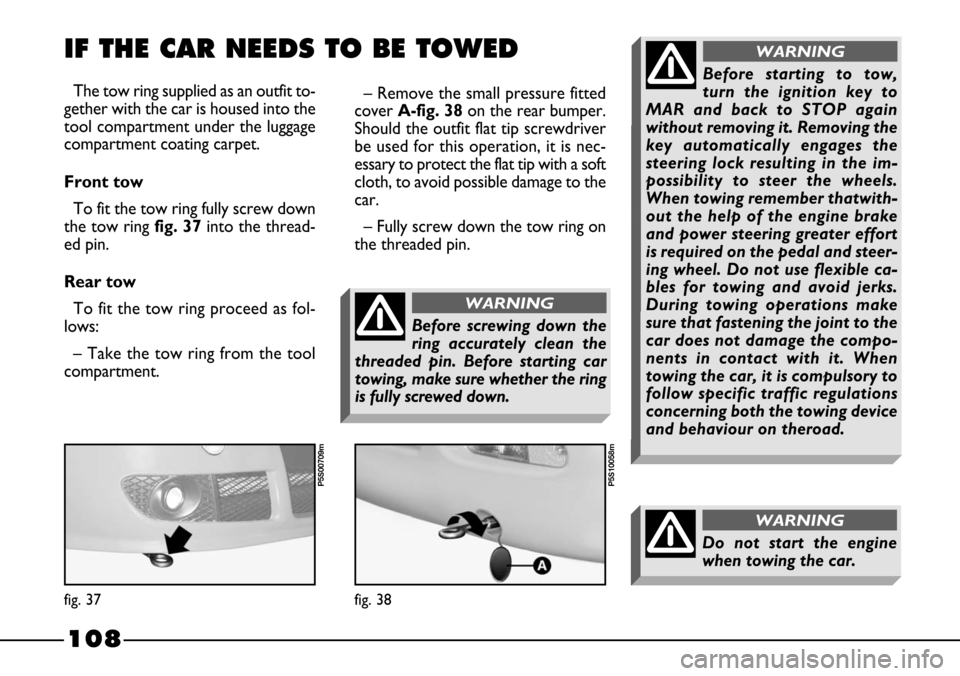
The tow ring supplied as an outfit to-
gether with the car is housed into the
tool compartment under the luggage
compartment coating carpet.
Front tow
To fit the tow ring fully screw down
the tow ring fig. 37into the thread-
ed pin.
Rear tow
To fit the tow ring proceed as fol-
lows:
– Take the tow ring from the tool
compartment.
IF THE CAR NEEDS TO BE TOWED
fig. 37
P5S00709m
fig. 38
P5S10058m
– Remove the small pressure fitted
cover A-fig. 38on the rear bumper.
Should the outfit flat tip screwdriver
be used for this operation, it is nec-
essary to protect the flat tip with a soft
cloth, to avoid possible damage to the
car.
– Fully screw down the tow ring on
the threaded pin.
Before screwing down the
ring accurately clean the
threaded pin. Before starting car
towing, make sure whether the ring
is fully screwed down.
WARNING
Do not start the engine
when towing the car.
WARNING
Before starting to tow,
turn the ignition key to
MAR and back to STOP again
without removing it. Removing the
key automatically engages the
steering lock resulting in the im-
possibility to steer the wheels.
When towing remember thatwith-
out the help of the engine brake
and power steering greater effort
is required on the pedal and steer-
ing wheel. Do not use flexible ca-
bles for towing and avoid jerks.
During towing operations make
sure that fastening the joint to the
car does not damage the compo-
nents in contact with it. When
towing the car, it is compulsory to
follow specific traffic regulations
concerning both the towing device
and behaviour on theroad.
WARNING
Page 110 of 170
109
IF AN ACCIDENT
OCCOURS
– It is important to keep calm.
– If you are not directly involved in
the accident stop at least ten metres
away from the accident.
– If you are on a motorway, do not
obstructing the emergency lane with
your car.
– Turn off the engine and turn on the
hazard lights.
– At night, illuminate the scene of the
accident with your headlights.
– Act carefully, you must not risk be-
ing run over.
– Mark the accident by putting the
red triangle at the prescribed distance
from the car where it can be clearly
seen.
– Call for rescue making the infor-
mation you give as accurate as you
can. On the motorway, use one of the
special column-mounted emergency
phones.– In pile-ups on the motorway, par-
ticularly when the visibility is bad,
there is a high risk of other vehicles
running into those already immobile.
Get out of the vehicle immediately and
take refuge behind the guard rail.
– Remove the ignition keys of the ve-
hicles involved.
– If you can smell petrol or other
chemicals, do not smoke and make
sure all cigarettes are extinguished.
– Use a fire extinguisher, blanket,
sand or earth to put out fires no mat-
ter how small they are. Never use wa-
ter.IF ANYONE IS INJURED
– Never leave the injured person
alone. The obligation to provide as-
sistance exists even for those not di-
rectly involved in the accident.
– Do not congregate around the in-
jured person.
– Reassure the injured person that
help is on its way and will arrive soon.
Stay close by to calm him/her down
should they panic.
– Unfasten or cut seat belts holding
injured parties.
– Do not give an injured person any-
thing to drink.
– Never move an injured person ex-
cept in the following cases.
– Pull the injured person from the
car only if it risks catching fire, is sink-
ing in water, is likely to fall from a
height or similar. Do not pull his/her
arms or legs, do not bend the head
and, as far as possible, keep the body
flat.
Page 117 of 170
116
This check should be carried out
more frequently if the vehicle is main-
ly used for short trips, or if it is fitted
with accessories that permanently ab-
sorb electricity even with the ignition
key removed, especially in the case of
after market accessories.
You should check the battery fluid
(electrolyte) level more frequently
than shown in the Service Schedule if
the car is used in hot climates or par-
ticularly demanding conditions. IMPORTANT - Engine oil
Change the engine oil more fre-
quently than specified in the Service
Schedule if the vehicle is mainly used
under one of the following particular-
ly severe conditions:
– towing a trailer or caravan
– on dirt roads
– short, repetitive trips (less than 7
or 8 kilometres) in outside tempera-
tures below zero.
– engines that are frequently left to
idle or drive slowly over long dis-
tances.
IMPORTANT - Air cleaner
If you drive your car on dirt roads
change the air cleaner more frequently
than specified in the Service Schedule.If you are in doubt about how often
the engine oil or the air cleaner should
be changed in relation to how you use
the car, contact a Fiat Dealership.
IMPORTANT - Pollen filter
If the car is often used in dusty or ex-
tremely polluted environments, you
should change the filter element more
frequently. It should be changed espe-
cially if the amount of air introduced
into the passenger compartment is re-
duced.
IMPORTANT - Battery
You should check the status of the
battery charge preferably at the be-
ginning of the cold season to avoid the
possibility of the electrolyte freezing.Maintenance of your car
should be entrusted to a
Fiat Dealership. For in-
terventions of routine mainte-
nance and small repairs you wish
to carry out yourself, make sure
you always have the proper
equipment, genuine Fiat spare
parts and fluids available. Do not,
carry out these operations if you
have no experience.
Page 122 of 170
121
Oil consumption is ex-
tremely low: if it needs
topping up after travelling
only a short while, have the sys-
tem checked for leaks at a Fiat
Dealership.
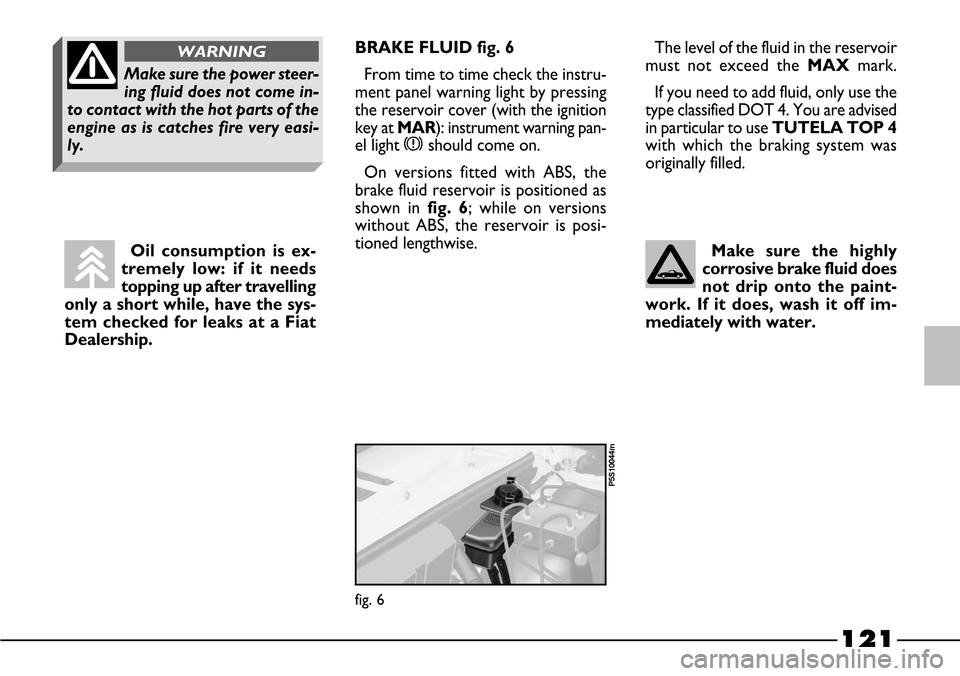
fig. 6
P5S10044m
The level of the fluid in the reservoir
must not exceed the MAXmark.
If you need to add fluid, only use the
type classified DOT 4. You are advised
in particular to use TUTELA TOP 4
with which the braking system was
originally filled. BRAKE FLUID fig. 6
From time to time check the instru-
ment panel warning light by pressing
the reservoir cover (with the ignition
key at MAR): instrument warning pan-
el light xshould come on.
On versions fitted with ABS, the
brake fluid reservoir is positioned as
shown in fig. 6; while on versions
without ABS, the reservoir is posi-
tioned lengthwise.
Make sure the highly
corrosive brake fluid does
not drip onto the paint-
work. If it does, wash it off im-
mediately with water.
Make sure the power steer-
ing fluid does not come in-
to contact with the hot parts of the
engine as is catches fire very easi-
ly.
WARNING
Page 126 of 170
125
– Do not connect or disconnect the
terminals of the electronic units while
the ignition key is at MAR.
– Do not check polarity through
sparking.
– Disconnect the electronic units if
you are electrically welding the car
body. Remove the units if tempera-
tures exceed 80°C. (special operations
on the bodywork etc.)
IMPORTANTIf the radio or car
alarm systems are not installed cor-
rectly, they can interfere with the
working of the electronic control
units.ELECTRONIC
CONTROL UNITS
When the car is being used normal-
ly, special measures are not necessary.
The following instructions must be
followed very carefully however, if you
work on the electrical system or in
cases where starting with another bat-
tery is necessary:
– Never disconnect the battery from
the electrical system while the engine
is running.
– When recharging, disconnect the
battery from the wiring system. The
latest battery chargers can, in fact, gen-
erate voltages of up to 20V.
– Never start the engine with a bat-
tery charger. Always use another bat-
tery.
– Be particularly careful when con-
necting the battery to the electrical
system. Ensure the battery posts are
connected up to the right leads (the
polarity is correct) and check that the
connection has been made properly.
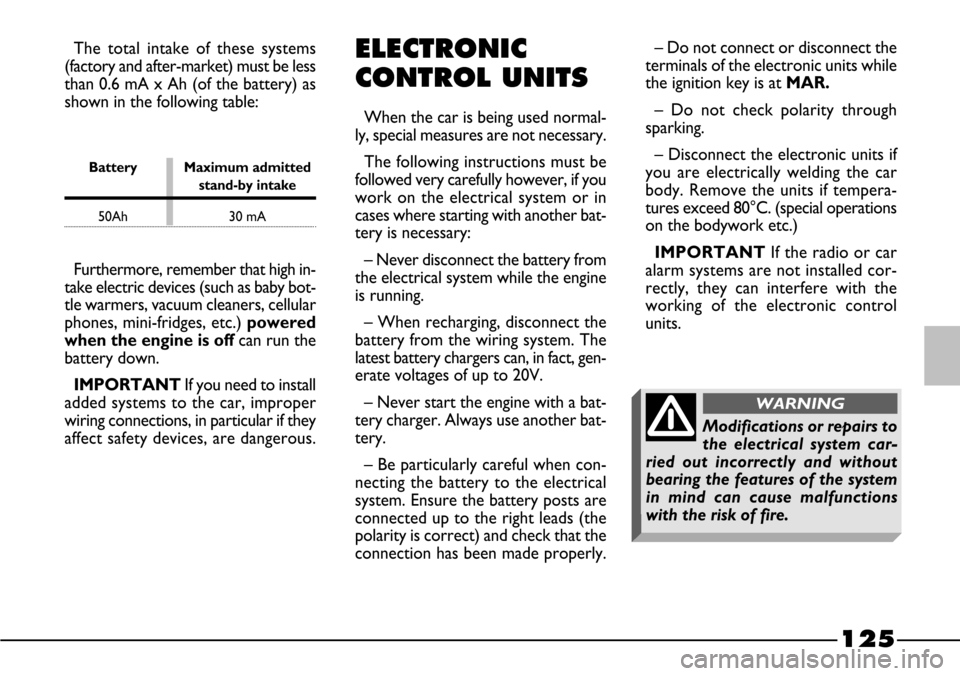
Battery Maximum admitted
stand-by intake
50Ah 30 mA
Furthermore, remember that high in-
take electric devices (such as baby bot-
tle warmers, vacuum cleaners, cellular
phones, mini-fridges, etc.) powered
when the engine is off can run the
battery down.
IMPORTANT If you need to install
added systems to the car, improper
wiring connections, in particular if they
affect safety devices, are dangerous.The total intake of these systems
(factory and after-market) must be less
than 0.6 mA x Ah (of the battery) as
shown in the following table:
Modifications or repairs to
the electrical system car-
ried out incorrectly and without
bearing the features of the system
in mind can cause malfunctions
with the risk of fire.
WARNING
Page 127 of 170
126
WHEELS
AND TYRES
TYRES PRESSURE
Every two weeks and before long
journeys, check the pressure of each
tyre including the spare.
The pressure must be checked when
the tyre is rested and cold.
It is normal for the pressure to rise
when you are driving. If you have to
check or restore the pressure when
the tyres are warm remember that the
pressure value must be 0.3 bar above
the specified value.
SPARK PLUGS
The cleanness and soundness of the
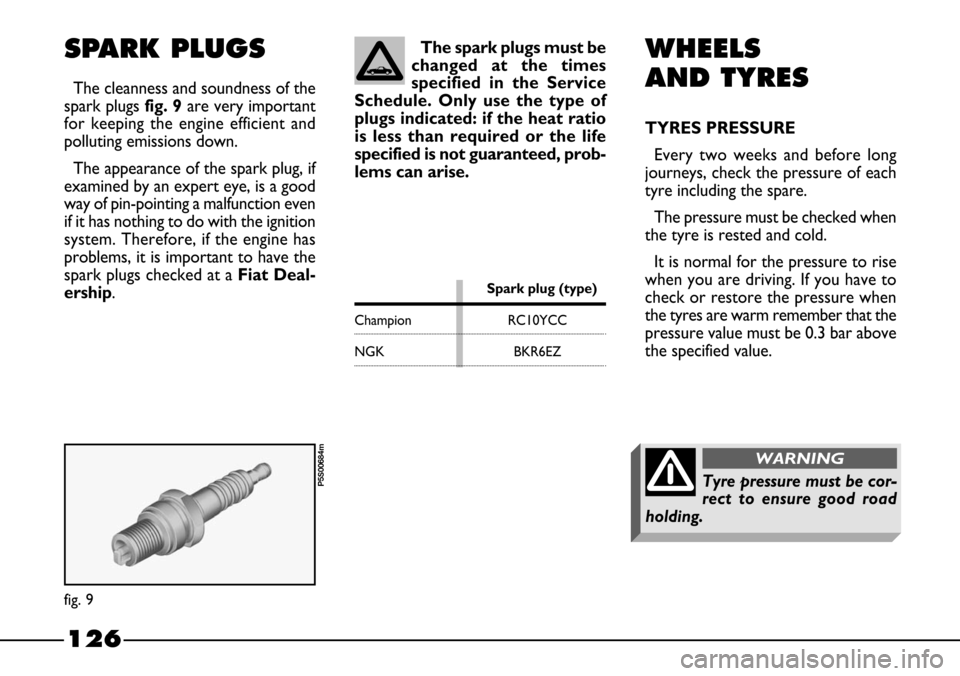
spark plugs fig. 9are very important
for keeping the engine efficient and
polluting emissions down.
The appearance of the spark plug, if
examined by an expert eye, is a good
way of pin-pointing a malfunction even
if it has nothing to do with the ignition
system. Therefore, if the engine has
problems, it is important to have the
spark plugs checked at a Fiat Deal-
ership.The spark plugs must be
changed at the times
specified in the Service
Schedule. Only use the type of
plugs indicated: if the heat ratio
is less than required or the life
specified is not guaranteed, prob-
lems can arise.
fig. 9
P5S00684m
Spark plug (type)
Champion RC10YCC
NGK BKR6EZ
Tyre pressure must be cor-
rect to ensure good road
holding.
WARNING
Page 133 of 170
132
Windows
Use specific window cleaners to
clean the windows. Use very clean
cloths to avoid scratching the glass or
damaging its transparency.
Engine compartment
At the end of each winter season,
carefully clean the engine compart-
ment. Have this done at a garage.Detergents pollute wa-
ter. The car must there-
fore be washed in an area
equipped for the collection and
purification of the liquids used
while washing.
IMPORTANTThe car should be
washed while the engine is cold and
with the ignition key at STOP. After
washing the car, make sure that the
various protections (e.g. rubber boots
and various guards) have not been re-
moved or damaged. Outside plastic parts must be cleaned
following the usual car washing pro-
cedure.
Avoid parking your car under trees;
the resinous substances that often
drop will dull the paintwork and in-
crease the possibility of corrosion.
IMPORTANT Bird droppings must
be washed off immediately and with
great care as their acid is particularly
aggressive.
Page 139 of 170
138
FUEL SUPPLY/IGNITION
Integrated electronic injection and ig-
nition system: a single electronic con-
trol unit controls both functions. It
processes both the time the injection
lasts (for fuel metering) and the igni-
tion’s advance angle.
Type: Sequential in phase Multipoint
Air cleaner: dry-type with paper fil-
ter element; thermostatically con-
trolled intake.
Petrol pump: in-tank.
Injection pressure: 3 bar
Method of measuring the amount of
aspirated air by directly measuring the
maximum rate of flow with a hot wire
air flow meter.
“Closed loop” petrol metering (in-
formation about combustion provid-
ed by the Lambda sensor).Firing order: 1-3-4-2
Spark plugs:
– Champion RC10YCC
– NGK BKR6EZLUBRICATION
Forced-fed with gear pump with
pressure relief valve incorporated.
Oil purification by means of full-flow-
cartridge filter.
COOLING
Cooling system with radiator, cen-
trifugal pump and expansion tank.
“Controlled” by-pass type thermo-
stat on the secondary circuit for the
recirculation of water from the engine
to the radiator.
Electric fan for radiator cooling with
thermostatically-controlled on/off
switch on the radiator.
Modifications or repairs to
the fuel feed system that
are not carried out properly or do
not take the system’s technical
specifications into account can
cause malfunctions with the risk of
fire.
WARNING
Page 151 of 170
150
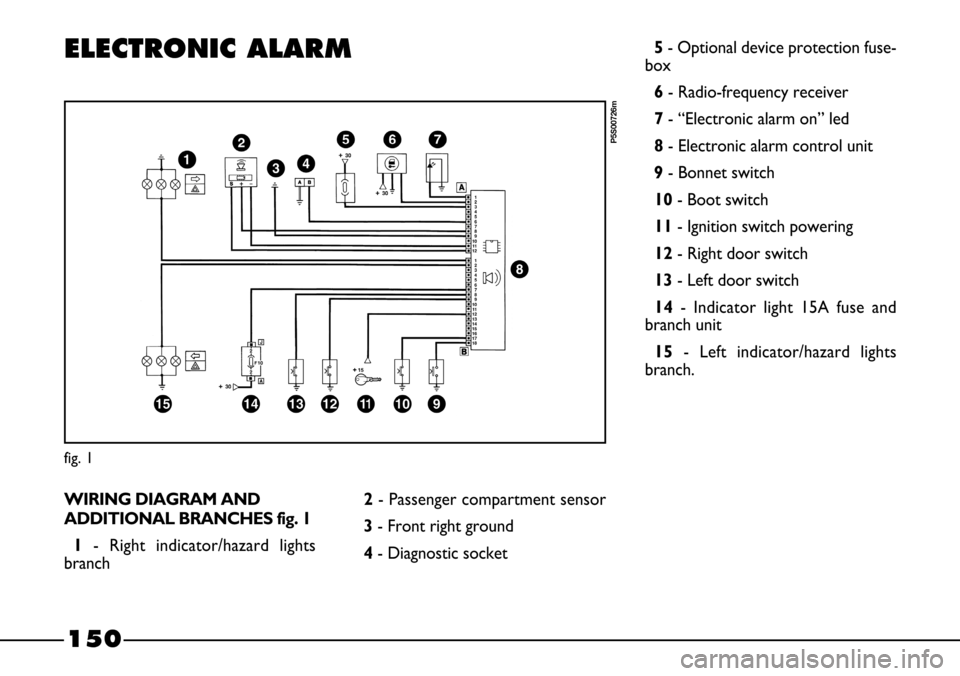
ELECTRONIC ALARM
WIRING DIAGRAM AND
ADDITIONAL BRANCHES fig. 1
1- Right indicator/hazard lights
branch
fig. 1
P5S00726m
2- Passenger compartment sensor
3- Front right ground
4- Diagnostic socket5- Optional device protection fuse-
box
6- Radio-frequency receiver
7- “Electronic alarm on” led
8- Electronic alarm control unit
9- Bonnet switch
10- Boot switch
11- Ignition switch powering
12- Right door switch
13- Left door switch
14- Indicator light 15A fuse and
branch unit
15 - Left indicator/hazard lights
branch.