ignition FIAT BARCHETTA 2003 1.G Owner's Manual
[x] Cancel search | Manufacturer: FIAT, Model Year: 2003, Model line: BARCHETTA, Model: FIAT BARCHETTA 2003 1.GPages: 170, PDF Size: 3.55 MB
Page 60 of 170
59
AIRBAG PASSENGER SIDE
(where fitted)
The passenger side airbag was de-
signed and calibrated to protect a per-
son wearing seat belts.
When fully inflated, the bag will fill
most of the space between the dash-
board and the passenger. Manual deactivation
The passenger side airbag can be de-
activated if it is absolutely necessary to
carry a child in the front passenger
seat.
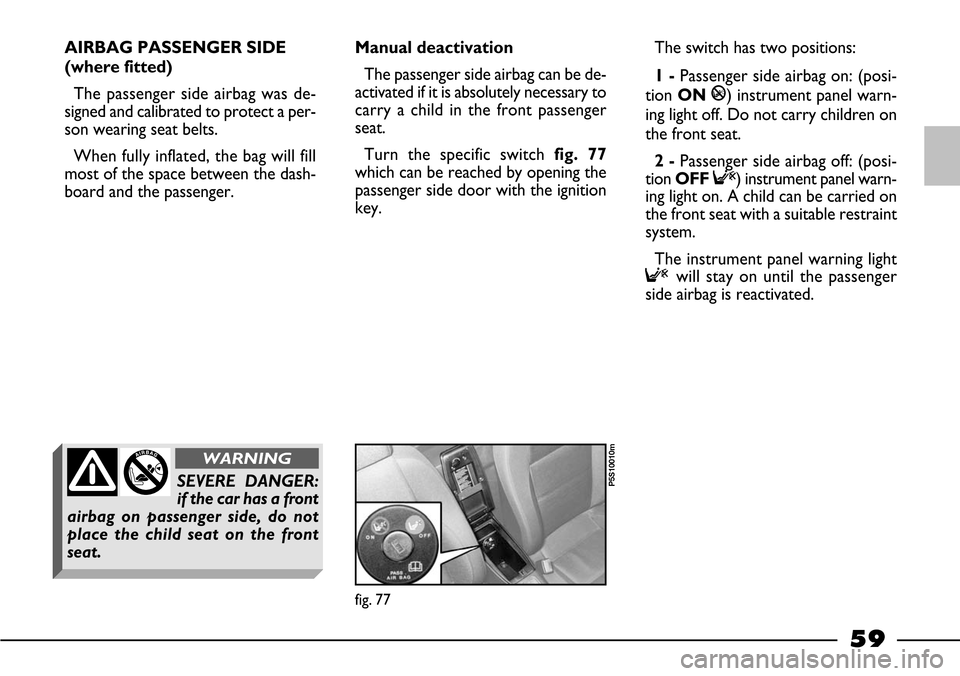
Turn the specific switch fig. 77
which can be reached by opening the
passenger side door with the ignition
key. The switch has two positions:
1 - Passenger side airbag on: (posi-
tion ON
P) instrument panel warn-
ing light off. Do not carry children on
the front seat.
2 -Passenger side airbag off: (posi-
tion OFFF) instrument panel warn-
ing light on. A child can be carried on
the front seat with a suitable restraint
system.
The instrument panel warning light
Fwill stay on until the passenger
side airbag is reactivated.
SEVERE DANGER:
if the car has a front
airbag on passenger side, do not
place the child seat on the front
seat.
WARNING
fig. 77
P5S10010m
Page 61 of 170
60
GENERAL WARNINGS
The front airbags can be trig-
gered if the car is subjected to
considerable crashes or involved
in an accident concerning the un-
derbody areas, such as a violent
impact against steps, kerbs or
projecting objects fastened to the
ground, falling into large holes or
dips in the road surface.
A small amount of powder and
smoke is freed when the airbags
are triggered. This is not harmful
and does not indicate the princi-
ple of a fire.
Go to a Fiat Dealership as soon
as possible if the warning light
comes on when travelling (to sig-
nal a fault) to have the problem
repaired.
The airbag system is guaranteed
for ten years. Contact a Fiat
Dealership as the expiry data ap-
proaches.
After an accident which trig-
gered the airbags, go to a Fiat
Dealership to have the entire
safety system, the electronic con-
trol unit, the seat belts and thepretensioners replaced. The
Dealership will also check the in-
tactness of the electrical system.
Any diagnostic, repair or re-
placement operations concerning
the airbag system must exclu-
sively be carried out at a Fiat
Dealership.
If you are having the car
scrapped, have the airbag system
deactivated at a Fiat Dealership
first.
If the car changes hands, the
new owner must be made aware
of the indications given above and
be given this Owner Handbook.
The pretensioners and front
airbags are activated by the elec-
tronic control unit according to
the type of impact. Consequent-
ly, missed activation of one or
more system components does
not indicate a fault in the system.
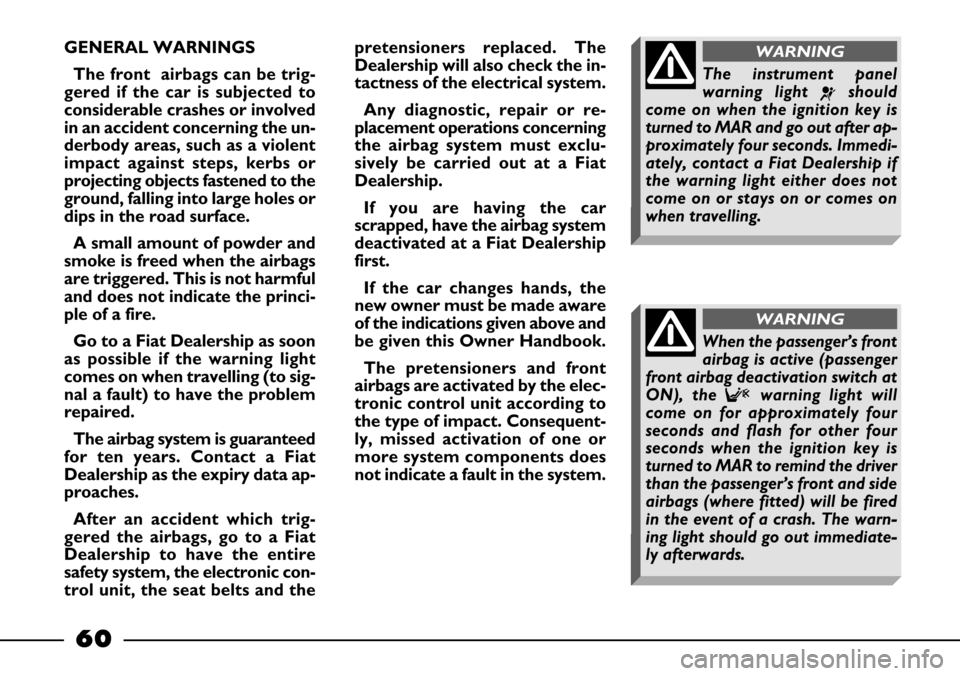
The instrument panel
warning light
¬should
come on when the ignition key is
turned to MAR and go out after ap-
proximately four seconds. Immedi-
ately, contact a Fiat Dealership if
the warning light either does not
come on or stays on or comes on
when travelling.
WARNING
When the passenger’s front
airbag is active (passenger
front airbag deactivation switch at
ON), the
Fwarning light will
come on for approximately four
seconds and flash for other four
seconds when the ignition key is
turned to MAR to remind the driver
than the passenger’s front and side
airbags (where fitted) will be fired
in the event of a crash. The warn-
ing light should go out immediate-
ly afterwards.
WARNING
Page 62 of 170
61
Do not apply stickers or
other objects to the steer-
ing wheel or to the dashboard on
the passenger’s side. Do not travel
with objects on your lap or in front
of you nor with a pipe, pencil or
similar between your lips; you could
seriously hurt yourself if the airbag
inflates in a collision.
WARNING
The correct operation of
the front airbags and pre-
tensioners is only ensured if the car
is not overloaded.
WARNING
The airbag does not replace
seat belts but rather in-
creases their effectiveness. Further-
more, the front airbag is not fired in
the event of low speed front colli-
sions, side collisions, rear-end shunts
and roll-overs. In these cases, the
passengers are only protected by
the seat belts which for this reason
must always be fastened.
WARNING
Always drive with both
hands on the rim of the
steering wheel so that the airbag is
free to inflate during a head-on col-
lision, and protect you from serious
injury. Do not drive with your body
bending towards the steering wheel,
but sit in an upright position with
your back resting against the seat.
WARNING
If an attempt has been
made to steal the car, or if
it has actually been stolen or has
been vandalised in any way or sub-
jected to flooding, have the airbag
system checked over at a Fiat Deal-
ership.
WARNING
It is important to remember
that when the ignition key
is turned to MAR even if the engine
is off, the air bag can be fired when
the car is stationary if it hit by an-
other vehicle travelling at suitable
speed. As a consequence, Fiat rec-
ommends sitting children in their
specific retainer system on the back
seat, which is the most protected
position ossible. On the contrary,
the air bags will not be fired in the
car is crashed into when the key is
not insered or turned. Consequent-
ly, in this case, the fact that the
asystem is not fired does not indi-
cate a fault.
WARNING
Page 69 of 170
68
If warning light ¢remains lit
together with the warning light
U
when the ignition key is at MAR,
turn the key toSTOPand then to
MAR; if the warning light still
remains lit, try with the other keys
provided with the car.
If you are still unable to start the
engine, follow the emergency startup
procedure (see “Emergency startup”
in the section “In an emergency”)
and go to the nearestFiat
Dealership immediately.
IMPORTANTDo not leave the
ignition key at MARwhen the
engine is off.
STARTING
THE ENGINE
The engine may seem noisier than
usual during the first seconds after
startup, especially after a long period
of inactivity. This phenomenon is
characteristic of hydraulic tappets,
and does not affect the functioning
and reliability of the engine: this par-
ticular timing system has been select-
ed for the Fiat barchetta engine to
reduce the number of maintenance
interventions necessary.IMPORTANT It is important that
the accelerator is never pressed until
the engine is started.
1) Make sure the handbrake is on.
2) Put the gear lever in neutral.
3) Press the clutch pedal right
down, without touching the acceler-
ator pedal.
4) Turn the ignition key to AVV
and let it go the moment the engine
starts.
If the engine does not start at the
first attempt, return the ignition key
to STOPbefore trying to start the
engine again.
It is dangerous to let the
engine run in a garage or
other closed area. The engine con-
sumes oxygen and gives off carbon
dioxide, carbon monoxide and oth-
er poisonous fumes.
WARNING
Never touch the high ten-
sion cables (spark plug
cables) when the engine is run-
ning.
WARNING
Page 70 of 170
69
HOW TO WARM UP
THE ENGINE AFTER
IT HAS JUST STARTED
– Begin to move forward slowly, let-
ting the engine turn over at medium
revs. Do not floor the accelerator.
– Do not push the engine to its lim-
it for the first few kilometres. You are
recommended to wait until the water
temperature has reached 50° to 60°C.
EMERGENCY START-UP
If the Fiat CODE system fails to
recognise the code transmitted by
the ignition key (warning lamp ¢on
instrument panel lit with a fixed
light), you can start the engine by fol-
lowing the emergency procedure
using the code written on the CODE
card.
See the section “In an emergency”.Do not bump start by
pushing, towing or coast-
ing downhill. This way of
starting could cause a rush of fu-
el into the catalytic exhaust pipe
and damage it beyond repair.
A quick burst on the ac-
celerator before turning
off the engine serves ab-
solutely no practical purpose and
wastes fuel.
IMPORTANT After a taxing drive it
is better to allow the engine to “catch
its breath” before turning it off by let-
ting it idle to allow the temperature in
the engine compartment to fall.STOPPING THE ENGINE
Turn the ignition key to STOP
while the engine is idling.
Remember that as long as
the engine is not running,
the power brakes and power steer-
ing do not work. You therefore have
to use considerably more effort on
both the brake pedal and the steer-
ing wheel.
WARNING
Page 71 of 170
70
PARKING
Turn off the engine, pull up the hand-
brake, put the car in gear (1st if the car
is pointing uphill, reverse if downhill)
and turn the wheels. If the car is on a
steep incline, you should put a stone
or wedge under the wheels to block
them.
Do not leave the ignition key at
MAR because it drains the battery.
Always remove the key when you
leave the car.IMPORTANTIf this is not the
case, have the handbrake adjusted at
a Fiat Dealership.
When the hand brake is on and the
ignition key is at MAR, panel indica-
tor light xcomes on.
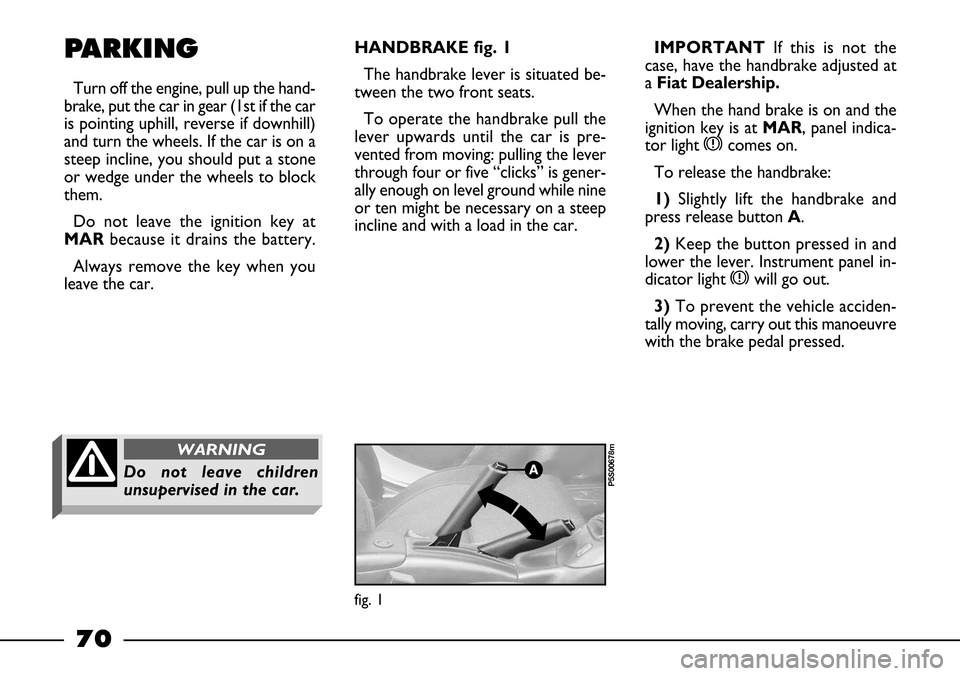
To release the handbrake:
1) Slightly lift the handbrake and
press release button A.
2) Keep the button pressed in and
lower the lever. Instrument panel in-
dicator light xwill go out.
3) To prevent the vehicle acciden-
tally moving, carry out this manoeuvre
with the brake pedal pressed. HANDBRAKE fig. 1
The handbrake lever is situated be-
tween the two front seats.
To operate the handbrake pull the
lever upwards until the car is pre-
vented from moving: pulling the lever
through four or five “clicks” is gener-
ally enough on level ground while nine
or ten might be necessary on a steep
incline and with a load in the car.
fig. 1
P5S00678mDo not leave children
unsupervised in the car.
WARNING
Page 76 of 170
75
– Remember that fog also means the
tarmac is wet and therefore manoeu-
vres of all kinds are more difficult and
stopping distances are longer.
– Keep a good distance from the cars
in front of you.
– As far as possible, avoid spurts of
speed or sudden deceleration.
– Do not overtake other vehicles if
you can help it.
– If you are forced to stop your car
(breakdown, limited visibility etc.) try
to stop off the road. Then turn on the
hazard lights and, if possible, the
dipped headlights. Rhythmically sound
the horn if you realise another car is
coming.
DRIVING
IN THE MOUNTAINS
– When driving downhill, use the en-
gine brake by engaging a low gear so
as not to overheat the brakes.
– Under no circumstances should
you drive downhill with the engine off
or with the car in neutral, let alone
with the ignition key out.– Drive at a moderate speed without
cutting corners.
– Remember that overtaking while
going uphill is slower and therefore re-
quires more free road. If you are be-
ing overtaken while driving uphill,
make it easier for the other vehicle
to pass.
DRIVING ON SNOW OR ICE
Here are some tips for driving in
these conditions:
– Keep your speed down.
– Use chains if the roads are covered
in snow (refer to the “Snow chains”
paragraph in this section).
– Mainly use the engine brake and
under all circumstances avoid braking
sharply.
– When braking in a car not fitted
with ABS, avoid the wheels locking by
varying the pressure you exert on the
brake pedal.
– Do not accelerate suddenly and
avoid swerving.– In the winter, even apparently dry
roads may have icy patches. Be care-
ful therefore when driving over
stretches that do not get much expo-
sure to the sun or that are lined by
trees and rocks where ice might not
have melted.
– Keep a good distance from the ve-
hicles in front.
– Do not remain for long periods in
deep snow with the engine running as
the snow could force the exhaust gas-
es into the passenger compartment.
DRIVING WITH ABS
ABS is a braking system that essen-
tially offers two advantages:
1)It prevents wheel lock-up and
consequent skidding in emergency
stops, particularly when the road does
not offer much grip.
2)It makes it possible to brake and
steer at the same time so you can
avoid unexpected obstacles and direct
the car where you want while braking.
The extent to which this can be done
will depend on the physical limits of
the tyre's sideways grip.
Page 79 of 170
78
CONDITIONS OF USE
Cold starting
Frequent cold starting will not enable
the engine to reach optimal running
temperature. It follows therefore that
consumption will be higher (from
+15% to +30% in towns) as will the
production of toxic emissions.
Traffic and road conditions
Heavy traffic and higher consumption
are synonymous; for example, when
driving slowly with frequent use of the
lower gears or in large towns where
there are numerous traffic lights.
Winding roads, mountain roads and
bumpy roads also have a negative ef-
fect on consumption.
Enforced halts
During prolonged hold-ups (traffic
lights, level crossings) the engine
should be switched off.CHEAP RUNNING THAT RESPECTS
THE ENVIRONMENT
LOOKING AFTER EMISSION
CONTROL DEVICES
The correct use of pollution control
devices not only ensures respect for
the environment but also has an effect
on the car’s performance.
Keeping these devices in good con-
dition is therefore a fundamental rule
for driving that is easy on your pock-
et and on the environment too.
The first step to take is to follow the
Service Schedule to the letter.
Use only unleaded petrol in petrol
engines.
If you have trouble starting, do not
keep turning the ignition key for long
periods. Be especially careful to avoid
bump starting the car by pushing, tow-
ing or rolling down hill: these are all
manoeuvres that can damage the cat-
alytic exhaust. For emergency starts
use only an auxiliary battery. Environmental protection has been
one of the guiding principles in the
production of the Fiat barchetta. It is
no accident that its pollution control
equipment is much more effective than
that required by current legislation.
Nonetheless, the environment can-
not get by without a concerted effort
from everyone.
By following a few simple rules you
can avoid harming the environment
and often cut down fuel consumption
at the same time.
On this subject, a few useful tips have
been given below to supplement those
marked by symbol #, at various points
of the handbook.
You are asked to read both the for-
mer and latter carefully.
Page 85 of 170
84
EMERGENCY
START-UP
If the Fiat CODE system cannot de-
activate the engine immobiliser, the
warning lights ¢and
Uwill remain
lit and the engine will not start. To
start your car, follow the emergency
startup procedure.
Read the whole procedure care-
fully before trying to carry it out.
If you make a mistake in the emer-
gency procedure you must turn the ig-
nition key back toSTOPand repeat
the whole operation from the begin-
ning, step 1).
1)Read the 5-figure electronic code
given on the CODE card.
2) Turn the ignition key to MAR.
3)Press the accelerator pedal to the
floor and keep it there. The injection
warning lamp
Uwill light up for about
8 seconds, and then go out. At this
point release the accelerator pedal and
get ready to count the flashes of warn-
ing lamp
U.4) Count the number of flashes that
corresponds to the first figure of the
code on the CODE card, then press
the accelerator pedal and keep it there
until the warning lamp
Ulights up for
four seconds and then goes out again.
Release the accelerator pedal.
5)The warning lamp
Uwill start
flashing again: when the lamp has
flashed the number of times that cor-
responds to the second figure on the
CODE card, press the accelerator
pedal to the floor and keep it there.
6) Do the same for the remaining fig-
ures on the CODE card.
7) Once the final figure has been en-
tered, keep the accelerator pedal
pressed. The warning lamp
Uwill
light up for 4 seconds and then go out.
Release the accelerator pedal.
8) The warning lamp
Uwill flash
rapidly for about 4 seconds to indicate
that the operation has been complet-
ed correctly.9)Turn on the engine by turning the
ignition key from the MARto the
AVVposition.
If however indicator light
Ustays
on, turn the ignition key to STOPand
repeat the procedure starting from
point 1).
IMPORTANT After emergency
starting the car you should have it seen
to at a Fiat Dealershipbecause the
emergency procedure will have to be
repeated each time you start the en-
gine otherwise.
Page 100 of 170
99
POSITION OF THE FUSES
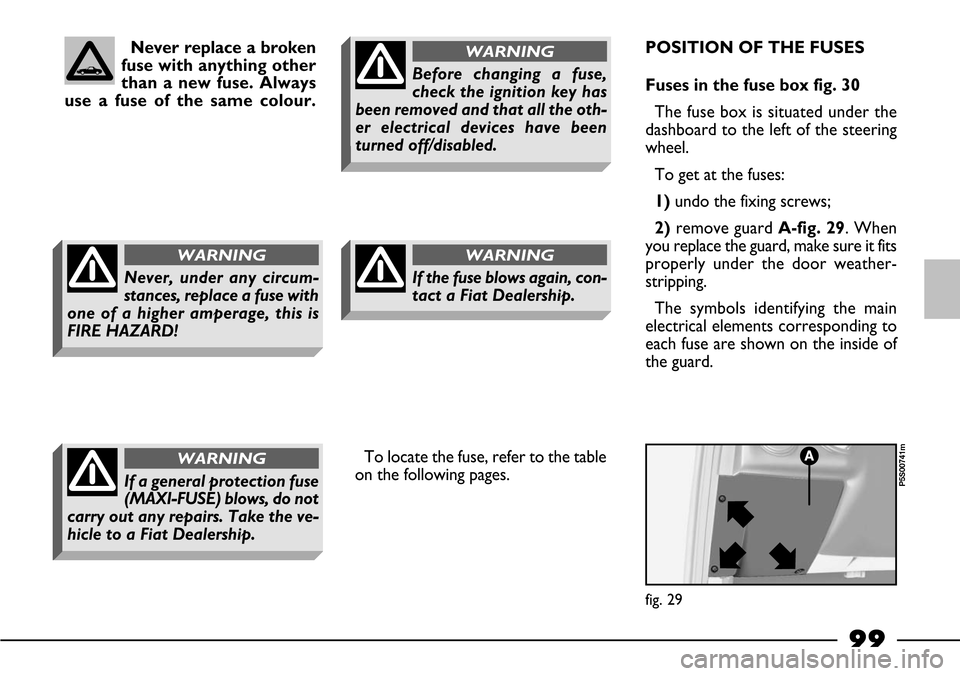
Fuses in the fuse box fig. 30
The fuse box is situated under the
dashboard to the left of the steering
wheel.
To get at the fuses:
1)undo the fixing screws;
2)remove guard A-fig. 29. When
you replace the guard, make sure it fits
properly under the door weather-
stripping.
The symbols identifying the main
electrical elements corresponding to
each fuse are shown on the inside of
the guard.
fig. 29
P5S00741m
Never replace a broken
fuse with anything other
than a new fuse. Always
use a fuse of the same colour.
To locate the fuse, refer to the table
on the following pages.
Never, under any circum-
stances, replace a fuse with
one of a higher amperage, this is
FIRE HAZARD!
WARNING
Before changing a fuse,
check the ignition key has
been removed and that all the oth-
er electrical devices have been
turned off/disabled.
WARNING
If a general protection fuse
(MAXI-FUSE) blows, do not
carry out any repairs. Take the ve-
hicle to a Fiat Dealership.
WARNING
If the fuse blows again, con-
tact a Fiat Dealership.
WARNING