Distance FIAT BRAVO 2013 2.G User Guide
[x] Cancel search | Manufacturer: FIAT, Model Year: 2013, Model line: BRAVO, Model: FIAT BRAVO 2013 2.GPages: 299, PDF Size: 5.86 MB
Page 49 of 299
Average speed
This shows the average car speed as a function of
the overall time elapsed since the start of the
new journey.
Tr i p t i me
The time elapsed since the start of a new journey.
TRIP BUTTON
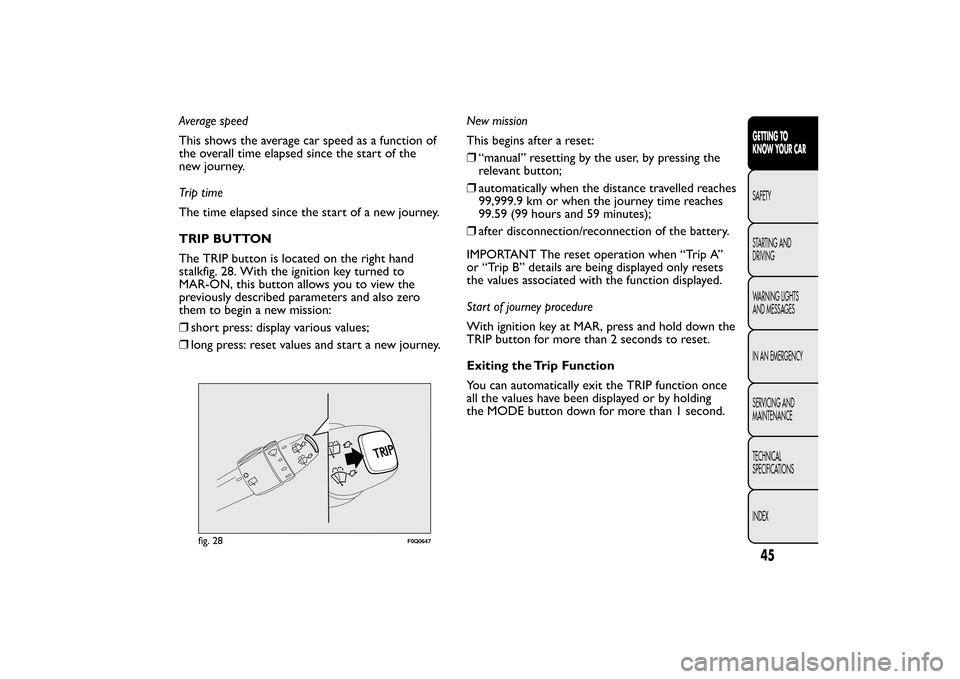
The TRIP button is located on the right hand
stalkfig. 28. With the ignition key turned to
MAR-ON, this button allows you to view the
previously described parameters and also zero
them to begin a new mission:
❒short press: display various values;
❒long press: reset values and start a new journey.New mission
This begins after a reset:
❒“manual” resetting by the user, by pressing the
relevant button;
❒automatically when the distance travelled reaches
99,999.9 km or when the journey time reaches
99.59 (99 hours and 59 minutes);
❒after disconnection/reconnection of the battery.
IMPORTANT The reset operation when “Trip A”
or “Trip B” details are being displayed only resets
the values associated with the function displayed.
Start of journey procedure
With ignition key at MAR, press and hold down the
TRIP button for more than 2 seconds to reset.
Exiting the Trip Function
You can automatically exit the TRIP function once
all the values have been displayed or by holding
the MODE button down for more than 1 second.
fig. 28
F0Q0647
45GETTING TO
KNOW YOUR CARSAFETY
STARTING AND
DRIVING
WARNING LIGHTS
AND MESSAGES
IN AN EMERGENCY
SERVICING AND
MAINTENANCE
TECHNICAL
SPECIFICATIONS
INDEX
Page 52 of 299
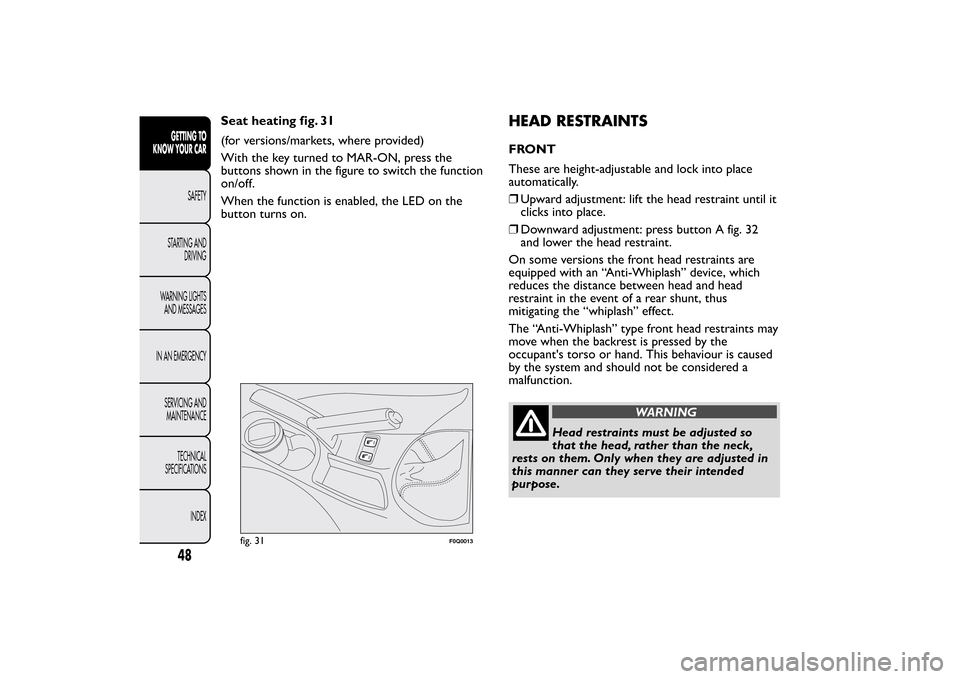
Seat heating fig. 31
(for versions/markets, where provided)
With the key turned to MAR-ON, press the
buttons shown in the figure to switch the function
on/off.
When the function is enabled, the LED on the
button turns on.
HEAD RESTRAINTSFRONT
These are height-adjustable and lock into place
automatically.
❒Upward adjustment: lift the head restraint until it
clicks into place.
❒Downward adjustment: press button A fig. 32
and lower the head restraint.
On some versions the front head restraints are
equipped with an “Anti-Whiplash” device, which
reduces the distance between head and head
restraint in the event of a rear shunt, thus
mitigating the “whiplash” effect.
The “Anti-Whiplash” type front head restraints may
move when the backrest is pressed by the
occupant's torso or hand. This behaviour is caused
by the system and should not be considered a
malfunction.
WARNING
Head restraints must be adjusted so
that the head, rather than the neck,
rests on them. Only when they are adjusted in
this manner can they serve their intended
purpose.
fig. 31
F0Q0013
48GETTING TO
KNOW YOUR CAR
SAFETY
STARTING AND
DRIVING
WARNING LIGHTS
AND MESSAGES
IN AN EMERGENCY
SERVICING AND
MAINTENANCE
TECHNICAL
SPECIFICATIONS
INDEX
Page 55 of 299
REAR VIEW MIRRORSINTERNAL MIRROR
The mirror is fitted with a safety device that causes
its release in the event of a violent impact with
the passenger.
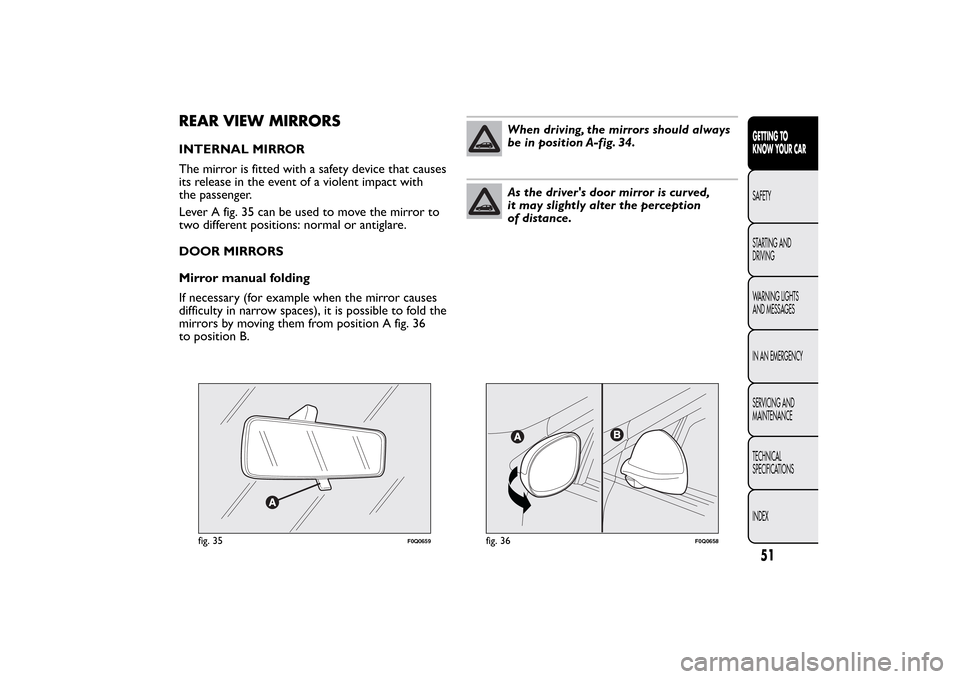
Lever A fig. 35 can be used to move the mirror to
two different positions: normal or antiglare.
DOOR MIRRORS
Mirror manual folding
If necessary (for example when the mirror causes
difficulty in narrow spaces), it is possible to fold the
mirrors by moving them from position A fig. 36
to position B.
When driving, the mirrors should always
be in position A-fig. 34.As the driver's door mirror is curved,
it may slightly alter the perception
of distance.
fig. 35
F0Q0659
fig. 36
F0Q0658
51GETTING TO
KNOW YOUR CARSAFETY
STARTING AND
DRIVING
WARNING LIGHTS
AND MESSAGES
IN AN EMERGENCY
SERVICING AND
MAINTENANCE
TECHNICAL
SPECIFICATIONS
INDEX
Page 120 of 299
EOBD SYSTEMThe EOBD system (European On Board
Diagnostic) is a diagnosis system installed on the
ECUs, which detects and reports possible
malfunctions in the electronic systems that could
worsen emissions.
The goal of the system is to:
❒monitor the system efficiency;
❒indicate an increase in emissions due to vehicle
malfunction;
❒indicate the need to replace components which
have deteriorated.It also alerts the driver, by turning on the warning
light
on the instrument panel (together with
relevant message on the display), when these
components are damaged; it can also report any
system malfunctions (see "Warning lights and
messages" chapter).
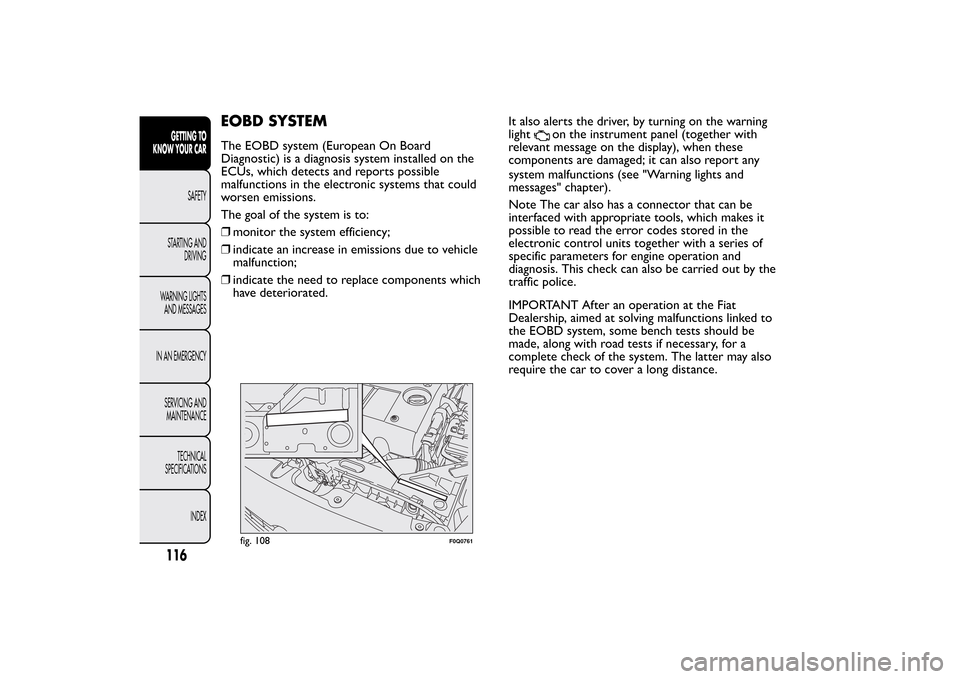
Note The car also has a connector that can be
interfaced with appropriate tools, which makes it
possible to read the error codes stored in the
electronic control units together with a series of
specific parameters for engine operation and
diagnosis. This check can also be carried out by the
traffic police.
IMPORTANT After an operation at the Fiat
Dealership, aimed at solving malfunctions linked to
the EOBD system, some bench tests should be
made, along with road tests if necessary, for a
complete check of the system. The latter may also
require the car to cover a long distance.
fig. 108
F0Q0761
116GETTING TO
KNOW YOUR CAR
SAFETY
STARTING AND
DRIVING
WARNING LIGHTS
AND MESSAGES
IN AN EMERGENCY
SERVICING AND
MAINTENANCE
TECHNICAL
SPECIFICATIONS
INDEX
Page 128 of 299
PARKING SENSORS(for versions/markets, where provided)
Parking sensors provide the driver with information
on the distance when approaching obstacles
behind the vehicle (versions with 4 rear sensors) or
in front of and behind the vehicle (versions with 4
front and 4 rear sensors).
The system therefore provides a further aid during
parking manoeuvres because it allows the
identification of obstacles outside of the driver's
field of vision.
The driver is notified of the presence and distance
of the obstacle from the vehicle by an acoustic
signal which varies depending on the distance from
the obstacle (as the distance from the obstacle
decreases the frequency of the acoustic signal
increases).
SENSORS
In order to measure the distance of obstacles, the
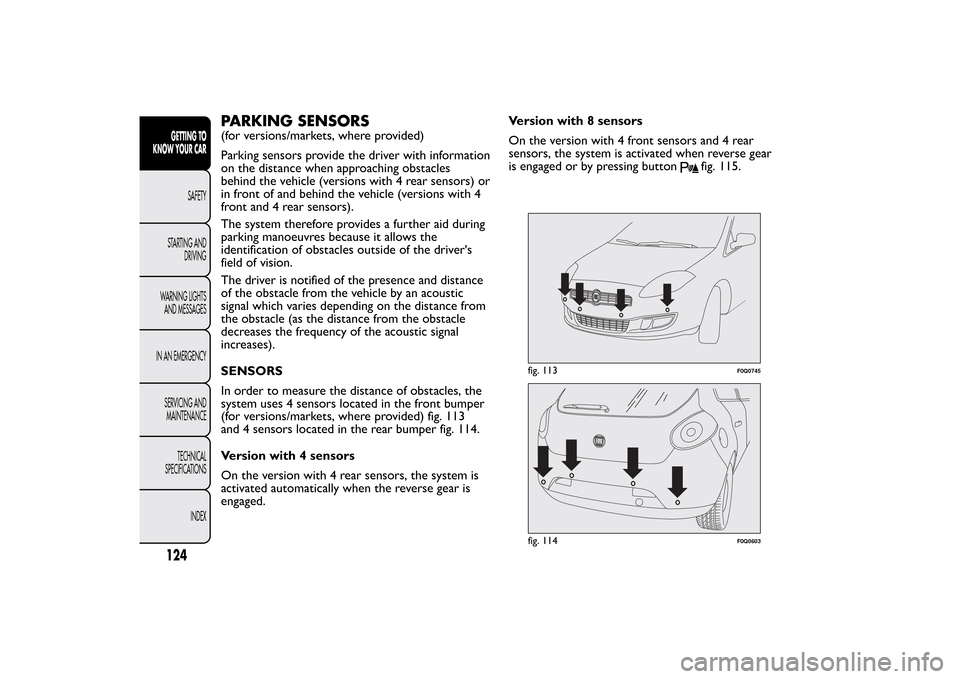
system uses 4 sensors located in the front bumper
(for versions/markets, where provided) fig. 113
and 4 sensors located in the rear bumper fig. 114.
Version with 4 sensors
On the version with 4 rear sensors, the system is
activated automatically when the reverse gear is
engaged.Version with 8 sensors
On the version with 4 front sensors and 4 rear
sensors, the system is activated when reverse gear
is engaged or by pressing button
fig. 115.
fig. 113
F0Q0745
fig. 114
F0Q0603
124GETTING TO
KNOW YOUR CAR
SAFETY
STARTING AND
DRIVING
WARNING LIGHTS
AND MESSAGES
IN AN EMERGENCY
SERVICING AND
MAINTENANCE
TECHNICAL
SPECIFICATIONS
INDEX
Page 129 of 299
When reverse gear is released, the front and rear
sensors remain activated until a speed of around 15
km/h is exceeded to allow the parking manoeuvre
to be completed.
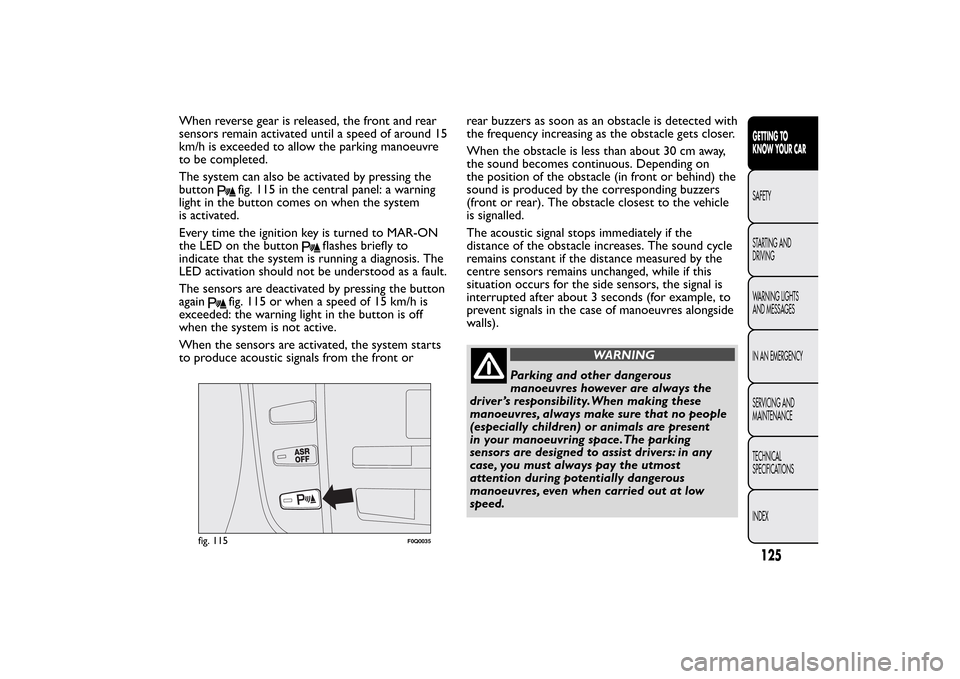
The system can also be activated by pressing the
button
fig. 115 in the central panel: a warning
light in the button comes on when the system
is activated.
Every time the ignition key is turned to MAR-ON
the LED on the button
flashes briefly to
indicate that the system is running a diagnosis. The
LED activation should not be understood as a fault.
The sensors are deactivated by pressing the button
again
fig. 115 or when a speed of 15 km/h is
exceeded: the warning light in the button is off
when the system is not active.
When the sensors are activated, the system starts
to produce acoustic signals from the front orrear buzzers as soon as an obstacle is detected with
the frequency increasing as the obstacle gets closer.
When the obstacle is less than about 30 cm away,
the sound becomes continuous. Depending on
the position of the obstacle (in front or behind) the
sound is produced by the corresponding buzzers
(front or rear). The obstacle closest to the vehicle
is signalled.
The acoustic signal stops immediately if the
distance of the obstacle increases. The sound cycle
remains constant if the distance measured by the
centre sensors remains unchanged, while if this
situation occurs for the side sensors, the signal is
interrupted after about 3 seconds (for example, to
prevent signals in the case of manoeuvres alongside
walls).
WARNING
Parking and other dangerous
manoeuvres however are always the
driver ’s responsibility.When making these
manoeuvres, always make sure that no people
(especially children) or animals are present
in your manoeuvring space.The parking
sensors are designed to assist drivers: in any
case, you must always pay the utmost
attention during potentially dangerous
manoeuvres, even when carried out at low
speed.
fig. 115
F0Q0035
125GETTING TO
KNOW YOUR CARSAFETY
STARTING AND
DRIVING
WARNING LIGHTS
AND MESSAGES
IN AN EMERGENCY
SERVICING AND
MAINTENANCE
TECHNICAL
SPECIFICATIONS
INDEX
Page 130 of 299
ACOUSTIC SIGNAL
The information concerning the presence and
distance of an obstacle from the vehicle is
transmitted by means of acoustic signals from
buzzers installed in the passenger compartment:
❒in the versions with 4 rear sensors, a buzzer
in the front dashboard area warns of the
presence of rear obstacles;
❒in the versions with 8 sensors (4 front and 4 rear
sensors), a front buzzer warns of the presence of
obstacles at the front and a buzzer located at
the rear warns of the presence of obstacles
at the rear. This notifies the driver of the
direction (front/rear) of the obstacles.
When reverse gear is engaged an intermittent
acoustic signal is automatically activated.
The acoustic signal:
❒increases as the distance between the car and the
obstacle decreases;
❒becomes continuous when the distance between
the car and the obstacle is less than 30 cm and
stops immediately if the distance increases;
❒remains constant if the distance remains
unchanged; if this situation concerns the side
sensors, the buzzer will stop after about 3
seconds to avoid, for example, warning
indications in the event of manoeuvres along
walls.
WARNING
For correct operation, sensors must
always be clean from mud, dir t , snow
or ice. Be careful not to scratch or damage the
sensors while cleaning them. Avoid using dr y,
rough or hard cloths.The sensors should be
washed using clean water with the addition of
car shampoo if necessary. In washing stations,
clean sensors quickly keeping the vapour
jet/high pressure washing nozzles at 10 cm at
least from the sensors.
WARNING
Only have the bumpers repainted or
any retouches to the paintwork in the
area of the sensors carried out by a Fiat
Dealership. Incorrect paint application could
affect the operation of the parking sensors.
SENSOR OPERATING RANGE
The sensors allow the system to check the front
part (version with 8 sensors) and rear part of the
vehicle.
Their position covers the middle and side areas of
the front and rear of the vehicle.
126GETTING TO
KNOW YOUR CAR
SAFETY
STARTING AND
DRIVING
WARNING LIGHTS
AND MESSAGES
IN AN EMERGENCY
SERVICING AND
MAINTENANCE
TECHNICAL
SPECIFICATIONS
INDEX
Page 131 of 299
If an obstacle is located in a middle area, it is
detected when the distance is less than about 0.9 m
(front) and 1.40 m (rear).
If the obstacle is located at the side, it is detected
at distances of less than 0.6 m.
OPERATION WITH TRAILER
The operation of the sensors is automatically
deactivated when the trailer's electric cable plug is
inserted in the car's tow hook socket.
The sensors are automatically enabled again when
the trailer's cable plug is removed.
IMPORTANT If you wish to leave the tow hook
fitted when there is no trailer, it is advisable to
contact a Fiat Dealership to have the system
updated because the tow hook could be detected
as an obstacle by the central sensors.
FAILURE INDICATIONS
Any failures in the parking sensor system are
signalled, when reverse gear is engaged, by the
warning light
in the instrument panel lighting up
or by the symbol
together with a message in
the display (see "Warning lights and messages"
chapter).GENERAL WARNINGS
During parking manoeuvres, pay the utmost
attention to any obstacles that could be located
above or below the sensors.
Under certain circumstances close objects located
in front of or behind the car may not be detected
and could therefore cause damage to the car or be
damaged themselves.
The following conditions may influence the
performance of the parking sensor system:
❒Reduced sensor sensitivity and a reduction in the
parking assistance system performance could be
due to the presence on the surface of the sensor
of: ice, snow, mud, thick paint.
❒The sensors may detect a non-existent obstacle
(echo interference) due to mechanical
interference, for example when washing the car,
in rain (strong wind), hail.
❒The signals sent by the sensors can also be
altered by the presence of ultrasonic systems
(e.g. pneumatic brake systems or pneumatic
drills) near the vehicle.
127GETTING TO
KNOW YOUR CARSAFETY
STARTING AND
DRIVING
WARNING LIGHTS
AND MESSAGES
IN AN EMERGENCY
SERVICING AND
MAINTENANCE
TECHNICAL
SPECIFICATIONS
INDEX
Page 165 of 299
CONDITIONS OF USE
The main usage conditions that negatively affect
fuel consumption are listed below.
Cold starting
Short journeys and frequent cold starts do not
allow the engine to reach optimum operating
temperature. This results in a significant increase in
consumption levels (from +15 to +30% on the
urban cycle) and emissions.
Traffic and road conditions
Rather high consumption levels are linked to
situations with heavy traffic, for instance when
travelling in queues with frequent use of the lower
gears or in cities with many traffic lights. Winding
mountain roads and rough road surfaces also
adversely affect consumption.
Traffic hold-ups
During prolonged hold-ups (e.g. level crossings) the
engine should be switched off.
TOWING TRAILERSIMPORTANT NOTES
For towing caravans or trailers the car must be
fitted with a certified tow hook and an adequate
electric system. Installation should be carried
out by specialised personnel who will issue the
required papers for travelling on roads.
Install any specific and/or additional rear view
mirrors as specified by the Highway Code.
Remember that when towing a trailer, steep hills
are harder to climb, braking distances increase and
overtaking takes longer depending on the overall
weight.
Engage a low gear when driving downhill, rather
than constantly using the brake.
The weight the trailer exerts on the car tow hook
reduces the car's loading capacity by the same
amount. To make sure that the maximum towable
weight is not exceeded (given in the car registration
document) account should be taken of the fully
laden trailer, including accessories and luggage.
Respect the speed limits specific to each country
for vehicles towing trailers.
In any case, the maximum speed must not exceed
80 km/h.
161GETTING TO KNOW
YOUR CAR
SAFETYSTARTING AND
DRIVINGWARNING LIGHTS
AND MESSAGES
IN AN EMERGENCY
SERVICING AND
MAINTENANCE
TECHNICAL
SPECIFICATIONS
INDEX
Page 168 of 299
SNOW CHAINSThe use of snow chains should be in compliance
with local regulations.
The snow chains may be applied only onto the front
wheel tyres (drive wheels).
Check the tension of the snow chains after the first
few metres have been driven.
Use reduced size snow chains:
– on 195/65 R15” and 205/55 R16” tyres, use
reduced size snow chains with a maximum
projection of 9 mm beyond the tyre profile;
– on 225/45 R17” tyres, use reduced size snow
chains with a maximum projection of 7 mm beyond
the tyre profile.IMPORTANT Snow chains cannot be fitted to the
space-saver spare wheel. If the front tyre has a
puncture, replace a rear wheel with the spare wheel
and move the rear wheel to the front axle. This
way with two normal drive wheels, snow chains can
be fitted to them to solve an emergency.
IMPORTANT 225/40 R18 92V tyres cannot be
fitted with chains. Snow chains may cause
interference with the surrounding elements.
Keep your speed down when snow chains
are fitted; do not exceed 50 km/h. Avoid
potholes, steps and pavements and avoid
driving for long distances on roads not covered
with snow to prevent damaging the car and
the roadbed.
164GETTING TO KNOW
YOUR CAR
SAFETYSTARTING AND
DRIVINGWARNING LIGHTS
AND MESSAGES
IN AN EMERGENCY
SERVICING AND
MAINTENANCE
TECHNICAL
SPECIFICATIONS
INDEX