bonnet FIAT BRAVO 2013 2.G User Guide
[x] Cancel search | Manufacturer: FIAT, Model Year: 2013, Model line: BRAVO, Model: FIAT BRAVO 2013 2.GPages: 299, PDF Size: 5.86 MB
Page 246 of 299
USEFUL ADVICE FOR EXTENDING THE
LIFE OF YOUR BATTERY
To avoid draining your battery and make it last
longer, observe the following instructions:
❒when you park the car, ensure that the doors,
tailgate, bonnet and flaps are closed properly,
to prevent any roof lights from remaining on
inside the passenger compartment;
❒switch off all roof lights inside the car: the car is
however equipped with a system which switches
the internal lights off automatically;
❒do not keep accessories (e.g. radio, hazard
warning lights, etc.) switched on for a long time
when the engine is not running;
❒before performing any operation on the electrical
system, disconnect the negative battery pole;
❒completely tighten the battery terminals.IMPORTANT If the charge level remains under 50%
for a long time, the battery is damaged by
sulphation, reducing its capacity and efficiency at
start-up.
The battery will also be more at risk of freezing
(this can happen as early as -10°C). Refer to the
paragraph "Car inactivity" in "Starting and driving" if
the car is left parked for a long time.
If after buying the car, you want to install electric
accessories which require permanent electrical
supply (alarm, etc.) or accessories influencing the
electrical supply requirements, contact a Fiat
Dealership whose qualified personnel, in addition to
suggesting the most suitable devices from
Lineaccessori Fiat, will evaluate the overall electrical
consumption, checking whether the car’s electric
system is capable of withstanding the load required,
or whether it should be integrated with a more
powerful battery.
Since these devices continue to consume energy
even when the engine is off, they gradually run
down the battery.
242GETTING TO KNOW
YOUR CAR
SAFETY
STARTING AND
DRIVING
WARNING LIGHTS
AND MESSAGES
IN AN EMERGENCYSERVICING AND
MAINTENANCE
TECHNICAL
SPECIFICATIONS
INDEX
Page 252 of 299
To correctly wash the vehicle, proceed as follows:
❒remove the aerial from the roof to prevent
damage to it if the car is washed in an automatic
system;
❒if high pressure jets or cleaners are used to wash
the vehicle, keep a distance of at least 40 cm
from the bodywork to avoid damage or
alteration. It should be remembered that the
build up of water can damage the car over a
period of time;
❒wash the body using a low pressure jet of water;
❒wipe a sponge with a slightly soapy solution
over the bodywork, frequently rinsing with
the sponge;
❒rinse well with water and dry with a jet of air or
a chamois leather.
Dry the less visible parts particularly carefully, such
as the door frames, bonnet and the headlight
frames, where water may stagnate more easily. The
car should not be taken to a closed area
immediately, but left outside so that residual water
can evaporate.
Do not wash the car after it has been left in the
sun or with the bonnet hot: this may alter the shine
of the paintwork.
Exterior plastic parts must be cleaned in the same
way as the rest of the car.Where possible, do not park under trees; the
resinous substance that many species release give
the paint a dull appearance and increase the
possibility of triggering rusting processes.
IMPORTANT Bird droppings must be washed off
immediately and thoroughly as the acid they contain
is particularly aggressive.
Detergents pollute the environment .
Therefore the engine compartment
should be washed in areas equipped for
collecting and purifying the liquid used in the
washing process.
248GETTING TO KNOW
YOUR CAR
SAFETY
STARTING AND
DRIVING
WARNING LIGHTS
AND MESSAGES
IN AN EMERGENCYSERVICING AND
MAINTENANCE
TECHNICAL
SPECIFICATIONS
INDEX
Page 289 of 299
285 2
RIGHT HAND DRIVE VERSIONS
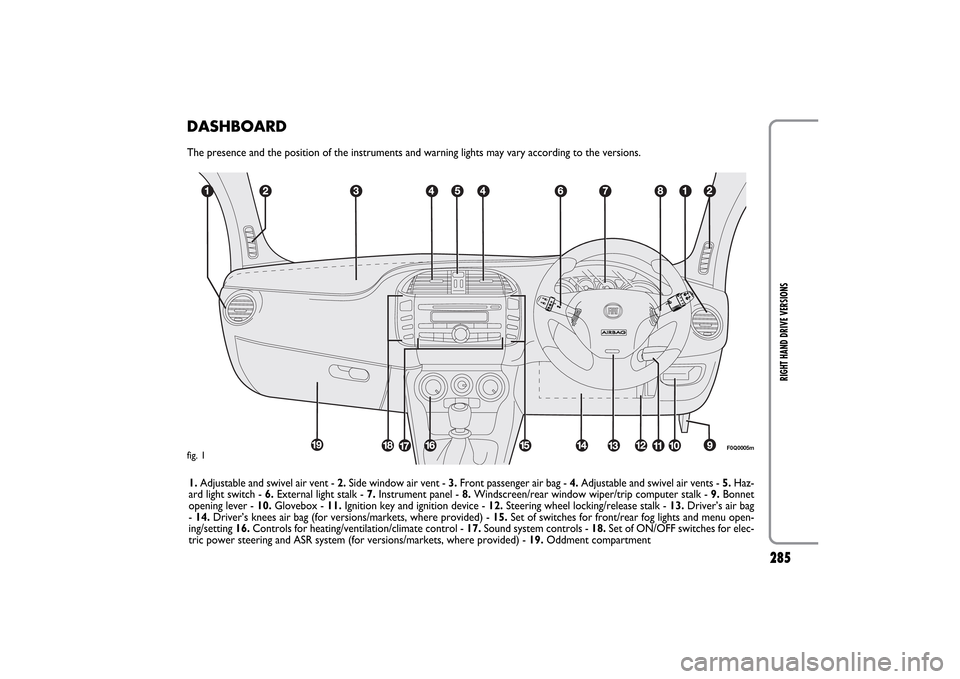
DASHBOARDThe presence and the position of the instruments and warning lights may vary according to the versions.
1.Adjustable and swivel air vent - 2.Side window air vent - 3.Front passenger air bag - 4.Adjustable and swivel air vents - 5.Haz-
ard light switch - 6.External light stalk - 7.Instrument panel - 8.Windscreen/rear window wiper/trip computer stalk - 9.Bonnet
opening lever - 10.Glovebox - 11.Ignition key and ignition device - 12.Steering wheel locking/release stalk - 13.Driver’s air bag
- 14.Driver’s knees air bag (for versions/markets, where provided) - 15.Set of switches for front/rear fog lights and menu open-
ing/setting 16.Controls for heating/ventilation/climate control - 17.Sound system controls - 18.Set of ON/OFF switches for elec-
tric power steering and ASR system (for versions/markets, where provided) - 19.Oddment compartment
F0Q0005m
fig. 1
217-248 BRAVO GB.qxd:213-236 BRAVO GB 11-04-2011 12:04 Pagina 245
Page 293 of 299
INDEX
A
BS (system) .............................. 106
Activation/Deactivation
(CITY function) ......................... 119
Activation of internal air
recirculation and
enablement of AQS
function (Air Quality
System)......................................... 68
Additional heater .............. 59-64-70
Adjustable side vents and
diffusers........................................ 54
Adjusting headlights
alignment .................................... 105
Air cleaner .................................... 240
Air distribution selection ........... 69
Alarm .............................................. 17
Anti-pinch safety device ............. 91
Ashtray ........................................... 88
ASR (system) ............................... 110
Automatic dual zone climate
control system ........................... 65
Automatic headlight sensor
(dusk sensor) .............................. 73
Automatic operation of the
climate control system
(AUTO function) ....................... 66
Battery ......................................... 241
Battery (recharging) ................... 219
Bodywork
– bodywork codes .................... 254
– maintenance ........................... 247
– protection against
atmospheric agents ............... 247
– warranty .................................. 247
Bodywork versions ..................... 254
Bonnet ........................................... 102
Brake Assist.................................. 108
Brake fluid..................................... 239
Brakes
– specifications .......................... 258
bulb replacement ................ 200-202
Bulb replacement
– exterior lights......................... 197
– interior lights .......................... 204
Bulbs
– bulbs (replacement) .............. 193
– general instructions .............. 193
– types of bulbs ......................... 195Car dimensions........................... 269
Cargo box..................................... 102
Carrying children safely ............. 138– child seats................................ 145
– "Universal Isofix" child
seat assembly setup .............. 144
Central diffusers .......................... 55
Central locking ............................. 92
Changing a wheel ........................ 182
Checking fluid levels ................... 230
Child lock device ......................... 93
Cigar lighter .................................. 87
Cleaning and maintenance
– bodywork ................................ 247
– car interior.............................. 250
– engine compartment ............ 249
– front headlights ...................... 249
– Plastic and coated parts....... 251
– seats ......................................... 250
– windows .................................. 249
Climate control/heating
system .......................................... 53
Climate control system
compressor
activation/deactivation.............. 69
Clutch ............................................ 258
CO2 emissions ............................ 279
Code card...................................... 9
289GETTING TO KNOW
YOUR CAR
SAFETY
STARTING AND
DRIVING
WARNING LIGHTS
AND MESSAGES
IN AN EMERGENCY
SERVICING AND
MAINTENANCE
TECHNICAL
SPECIFICATIONSINDEX