boot FIAT CROMA 2006 2.G User Guide
[x] Cancel search | Manufacturer: FIAT, Model Year: 2006, Model line: CROMA, Model: FIAT CROMA 2006 2.GPages: 240, PDF Size: 7.41 MB
Page 85 of 240
85
SAFETY
DEVICES
CORRECT USE
OF THE CAR
WARNING
LIGHTS AND
MESSAGES
IN AN
EMERGENCY
CAR
MAINTENANCE
TECHNICAL
SPECIFICATIONS
INDEX
DASHBOARD
AND CONTROLS
HEADLIGHTS
ADJUSTING THE HEADLIGHT
BEAM
Proper adjustment of the headlight beams
is of vital importance for your safety and
comfort and also for the other road users.
To ensure you and other drivers have the
best visibility conditions when travelling
with the headlights on, the headlights must
be set properly. Contact Fiat Dealership
to have the headlights properly adjusted.
IMPORTANT When turning on (Xenon)
gas discharge headlight lamps (where pro-
vided), it is normal that there should be a
vertical movement of reflectors, and con-
sequently the same will also happen to the
light beam, for the time required to
achieve the correct headlight trim stabili-
sation, equal to approx. 2 seconds.
Headlight aiming device
It works with ignition key at ONand
dipped beams on. When the car is loaded,
it slopes backwards. This means that the
headlight beam rises. In this case, it is nec-
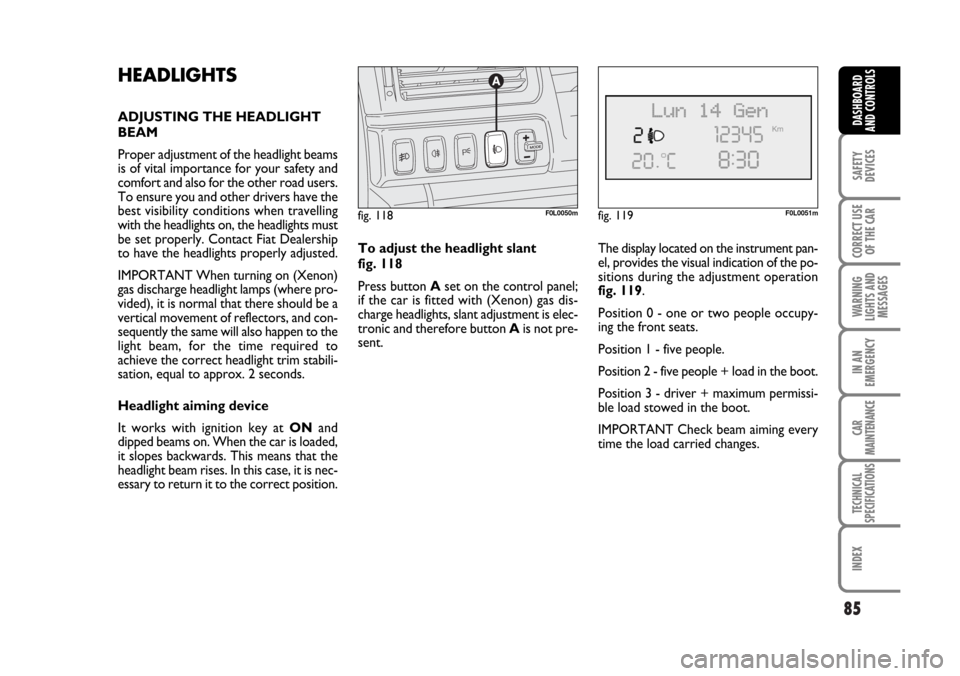
essary to return it to the correct position.To adjust the headlight slant
fig. 118
Press button Aset on the control panel;
if the car is fitted with (Xenon) gas dis-
charge headlights, slant adjustment is elec-
tronic and therefore button Ais not pre-
sent.The display located on the instrument pan-
el, provides the visual indication of the po-
sitions during the adjustment operation
fig. 119.
Position 0 - one or two people occupy-
ing the front seats.
Position 1 - five people.
Position 2 - five people + load in the boot.
Position 3 - driver + maximum permissi-
ble load stowed in the boot.
IMPORTANT Check beam aiming every
time the load carried changes.
fig. 118F0L0050mfig. 119F0L0051m
062-098 Croma TRW GB 20-11-2006 15:01 Pagina 85
Page 93 of 240
93
SAFETY
DEVICES
CORRECT USE
OF THE CAR
WARNING
LIGHTS AND
MESSAGES
IN AN
EMERGENCY
CAR
MAINTENANCE
TECHNICAL
SPECIFICATIONS
INDEX
DASHBOARD
AND CONTROLS
Hi-Fi system (where provided)
The system includes:
❒2 tweeters (power 40W max. each),
located on front doors;
❒2 mid-woofers (diameter 165 mm,
power 40W each), located on front
doors;
❒2 tweeters (power 40W each), locat-
ed on rear doors;
❒2 woofers (diameter 165 mm, power
40W max. each), located on rear
doors;
❒1 subwoofer (100W power), located
on the right side of the boot. Sub-
woofer is protected by 10A fuse.
ACCESSORIES
PURCHASED BY THE
OWNER
If after buying the vehicle, you decide to
install electrical accessories that require a
permanent electric supply (alarm, satellite
antitheft system, etc.) or accessories that
in any case burden the electric supply,
contact Fiat Dealership, whose qualified
personnel, besides suggesting the most
suitable devices belonging to Lineaccessori
Fiat, will also evaluate the overall electric
absorption, checking whether the vehicle
electric system is able to withstand the
load required, or whether it needs to be
integrated with a more powerful battery.
INSTALLATION OF
ELECTRIC/ELECTRONIC
DEVICES
Electric/electronic devices installed after
buying the vehicle and in after-market shall
bear the following marking:
Fiat Auto S.p.A. authorizes the installation
of transceivers, provided that installation
is workmanlike performed in compliance
with Manufacturer’s specifications at a spe-
cialised service centre.
IMPORTANT The installation of devices
involving modifications of vehicle charac-
teristics may determine the withdrawal ofthe driving licence by the appointed pub-
lic authorities and the forfeiture of the
warranty as concerns defects/failures due
to said modification or leading directly or
indirectly to it.
Fiat Auto S.p.A. declines all responsibility
due to damages connected with the in-
stallation of accessories/devices not sup-
plied by or recommended by Fiat Auto
S.p.A. and installed not in compliance with
the specified prescriptions.
RADIO TRANSMITTERS
AND CELLULAR TELEPHONES
Radio transceiver equipment (e.g.: e-tacs
mobile phones, HAM radio systems and
the like) shall not be used inside the ve-
hicle unless a separate aerial is mounted
on the roof.
IMPORTANT The use of similar devices
inside the passenger compartment (with-
out separated aerial) produces radio-fre-
quency electromagnetic fields which, am-
plified by the resonance effects inside the
passenger compartment, may cause elec-
trical systems equipping the vehicle to mal-
function. This could compromise safety in
addition to constituting a potential hazard
for the passengers.
In addition, transmission and reception of
these devices may be affected by the
shielding effect of the vehicle body.
As concerns EC-approved mobile phones
(GSM, GPRS, UMTS), strictly comply with
the instructions for use provided by the
mobile phone’s manufacturer.
062-098 Croma TRW GB 20-11-2006 15:01 Pagina 93
Page 116 of 240
116
CORRECT USE
OF THE CAR
WARNING
LIGHTS AND
MESSAGES
IN AN
EMERGENCY
CAR
MAINTENANCE
TECHNICAL
SPECIFICATIONS
INDEX
DASHBOARD
AND CONTROLS
SAFETY
DEVICES
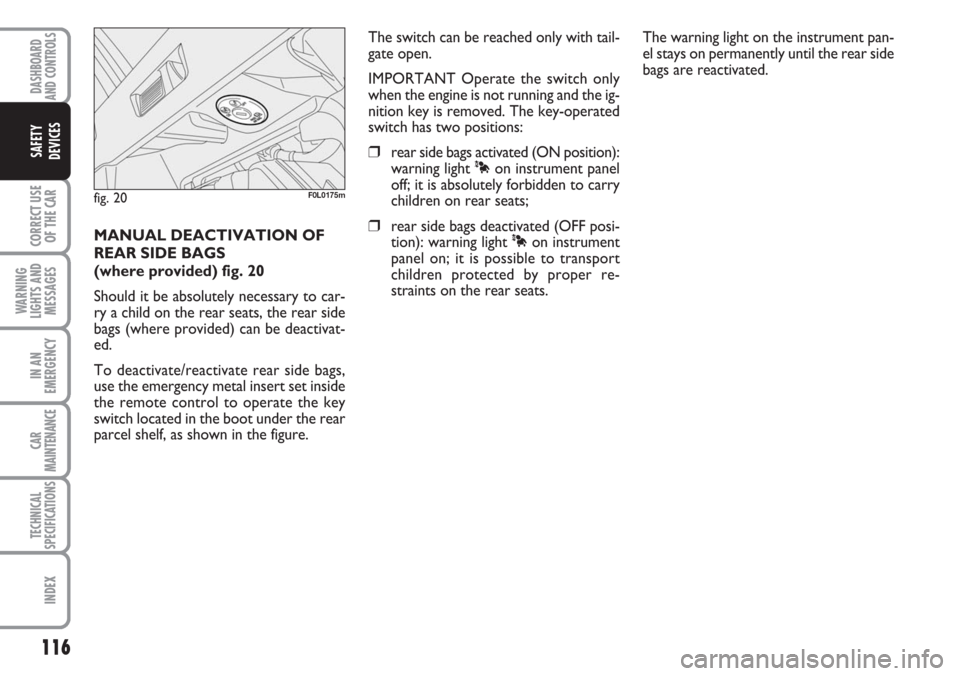
MANUAL DEACTIVATION OF
REAR SIDE BAGS
(where provided) fig. 20
Should it be absolutely necessary to car-
ry a child on the rear seats, the rear side
bags (where provided) can be deactivat-
ed.
To deactivate/reactivate rear side bags,
use the emergency metal insert set inside
the remote control to operate the key
switch located in the boot under the rear
parcel shelf, as shown in the figure.
fig. 20F0L0175m
The switch can be reached only with tail-
gate open.
IMPORTANT Operate the switch only
when the engine is not running and the ig-
nition key is removed. The key-operated
switch has two positions:
❒rear side bags activated (ON position):
warning light Àon instrument panel
off; it is absolutely forbidden to carry
children on rear seats;
❒rear side bags deactivated (OFF posi-
tion): warning light Àon instrument
panel on; it is possible to transport
children protected by proper re-
straints on the rear seats.The warning light on the instrument pan-
el stays on permanently until the rear side
bags are reactivated.
Page 130 of 240
Roof rack/ski rack
Remove the roof rack or the ski rack from
the roof as soon as they are no longer
used. These accessories lower air pene-
tration and adversely affect consumption
levels. When needing to carry particular-
ly voluminous objects, preferably use a
trailer.
Electric devices
Use electric devices only for the amount
of time needed. Rear heated window, ad-
ditional headlights, windscreen wipers and
heater fan need a considerable amount of
energy, therefore increasing the require-
ment of current increases fuel consump-
tion (up to +25% in the urban cycle).
Climate control
The air conditioner is an additional load
which greatly affects the engine leading to
higher consumption (on average up to
+20%). When the temperature outside
the car permits it, use the air vents where
possible.
Spoilers
The use of non-certified aerodynamic
items may adversely affect air drag and
consumption levels.DRIVING STYLE
Starting
Do not warm the engine with the car at
a standstill or at idle or high speed: under
these conditions the engine warms up
much more slowly, increasing electrical
consumption and emissions. It is therefore
advisable to move off immediately, slow-
ly, avoiding high speeds. This way the en-
gine will warm faster.
Unnecessary actions
Avoid accelerating when waiting at traffic
lights or before switching off the engine.
This and also double declutching is ab-
solutely pointless on modern cars and al-
so increase consumption and pollution.
Gear selection
As soon as the conditions of the traffic and
road allow, use a higher gear. Using a low
gear to obtain brilliant performance in-
creases consumption.
In the same way improper use of a high
gear increases consumption, emissions an
engine wear.CONTAINING
RUNNING COSTS
Here are some suggestions which may
help you to keep the running costs of your
car down and lower the amount of toxic
emissions released into the atmosphere.
GENERAL CONSIDERATIONS
Car maintenance
Have checks and adjustments carried out
in accordance with the “Service schedule”.
Tyres
Check the pressure of the tyres routine-
ly at an interval of no more than 4 weeks:
if the pressure is too low, consumption
levels increase as resistance to rolling is
higher.
Unnecessary loads
Do not travel with too much luggage
stowed in the boot. The weight of the car
(especially when driving in town) and its
trim greatly affects consumption and sta-
bility.
130
WARNING
LIGHTS AND
MESSAGES
IN AN
EMERGENCY
CAR
MAINTENANCE
TECHNICAL
SPECIFICATIONS
INDEX
DASHBOARD
AND CONTROLS
SAFETY
DEVICES
CORRECT USE
OF THE CAR
Page 141 of 240
If warning light vflashes,
contact Fiat Dealership im-
mediately to have oil changed
and instrument panel warning light
turned off.
141
IN AN
EMERGENCY
CAR
MAINTENANCE
TECHNICAL
SPECIFICATIONS
INDEX
DASHBOARD
AND CONTROLS
SAFETY
DEVICES
CORRECT USE
OF THE CAR
WARNING
LIGHTS AND
MESSAGES
EOBD ENGINE CONTROL
SYSTEM FAILURE
Under normal conditions, turning the ig-
nition key to ON, the warning light turns
on, but it should go off when the engine has
started. In this case, turning on indicates
proper working of the warning light. If the
warning light stays on or turns on when
travelling:
❒glowing steadily: means a fault in the
supply/ignition system which could
cause high emissions at the exhaust,
possible lack of performance, poor
handling and high consumption levels.
On certain versions the dedicated mes-
sage is displayed.
In these conditions it is possible to con-
tinue driving without however requiring
heavy effort or high speed from the en-
gine. Prolonged use of the car with the
warning light on may cause damages. Con-
tact Fiat Dealership as soon as possible.
The warning light goes off if the fault dis-
appears, but it is still stored by the system.
❒flashing: indicates the possibility of
damage to the catalyst (see “EOBD
system” in section “Dashboard and
controls”). INJECTION SYSTEM
FAILURE
(Multijet versions - red)
EOBD ENGINE
CONTROL SYSTEM FAILURE
(petrol versions - amber)
Injection system failure
Turning the ignition key to ONthe warn-
ing light turns on, but it should go off af-
ter few seconds.
If the warning light stays on or turns on
when travelling, means a fault in the sup-
ply/ignition system which could cause high
emissions at the exhaust, possible lack of
performance, poor handling and high con-
sumption levels.
On certain versions the dedicated message
is displayed.
In these conditions it is possible to con-
tinue driving without however requiring
heavy effort or high speed from the en-
gine. In any case, contact Fiat Dealership
as soon as possible.
U
INCOMPLETE DOOR
LOCKING (red)
The warning light turns on
when one or more doors, the
boot or the bonnet are not properly shut.
The dedicated message will be displayed;
When travelling with door/doors, boot or
bonnet open also a buzzer will sound.
´
POWER STEERING
FAILURE (red)
Turning the ignition key to ON
the warning light turns on, but it should go
off after few seconds. If the warning light
stays on, you will not have steering assis-
tance and the effort on the steering wheel
will be increased, steering is however pos-
sible. Contact Fiat Dealership. The dedi-
cated message will be displayed.
g
Page 153 of 240
153
WARNING
LIGHTS AND
MESSAGES
CAR
MAINTENANCE
TECHNICAL
SPECIFICATIONS
INDEX
DASHBOARD
AND CONTROLS
SAFETY
DEVICES
CORRECT USE
OF THE CAR
IN AN
EMERGENCY
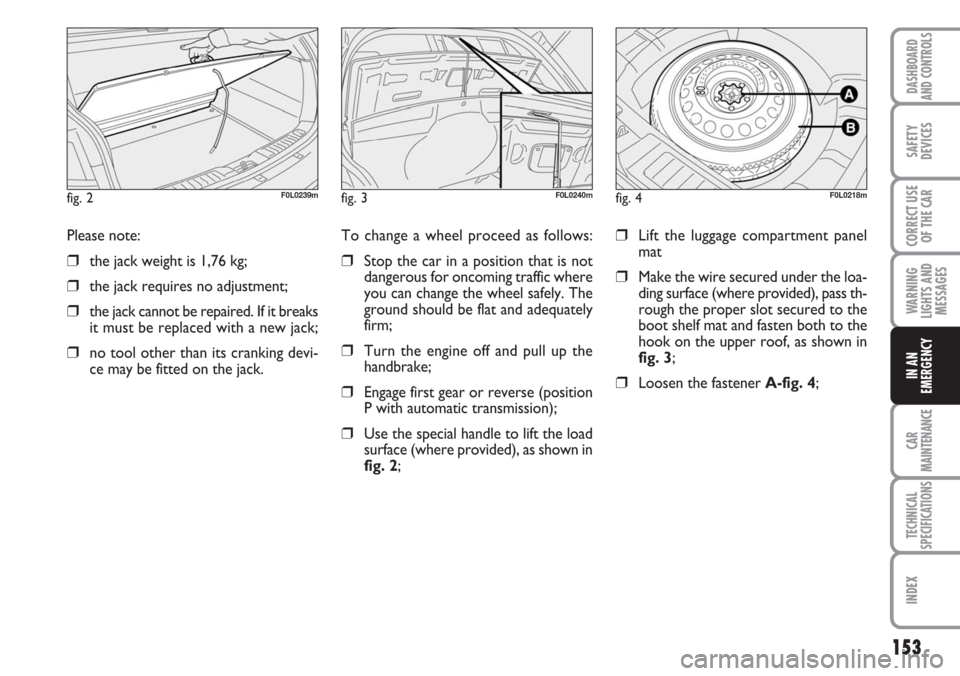
To change a wheel proceed as follows:
❒Stop the car in a position that is not
dangerous for oncoming traffic where
you can change the wheel safely. The
ground should be flat and adequately
firm;
❒Turn the engine off and pull up the
handbrake;
❒Engage first gear or reverse (position
P with automatic transmission);
❒Use the special handle to lift the load
surface (where provided), as shown in
fig. 2;
❒Lift the luggage compartment panel
mat
❒Make the wire secured under the loa-
ding surface (where provided), pass th-
rough the proper slot secured to the
boot shelf mat and fasten both to the
hook on the upper roof, as shown in
fig. 3;
❒Loosen the fastener A-fig. 4; Please note:
❒the jack weight is 1,76 kg;
❒the jack requires no adjustment;
❒the jack cannot be repaired. If it breaks
it must be replaced with a new jack;
❒no tool other than its cranking devi-
ce may be fitted on the jack.
fig. 2F0L0239mfig. 3F0L0240mfig. 4F0L0218m
Page 154 of 240
154
WARNING
LIGHTS AND
MESSAGES
CAR
MAINTENANCE
TECHNICAL
SPECIFICATIONS
INDEX
DASHBOARD
AND CONTROLS
SAFETY
DEVICES
CORRECT USE
OF THE CAR
IN AN
EMERGENCY
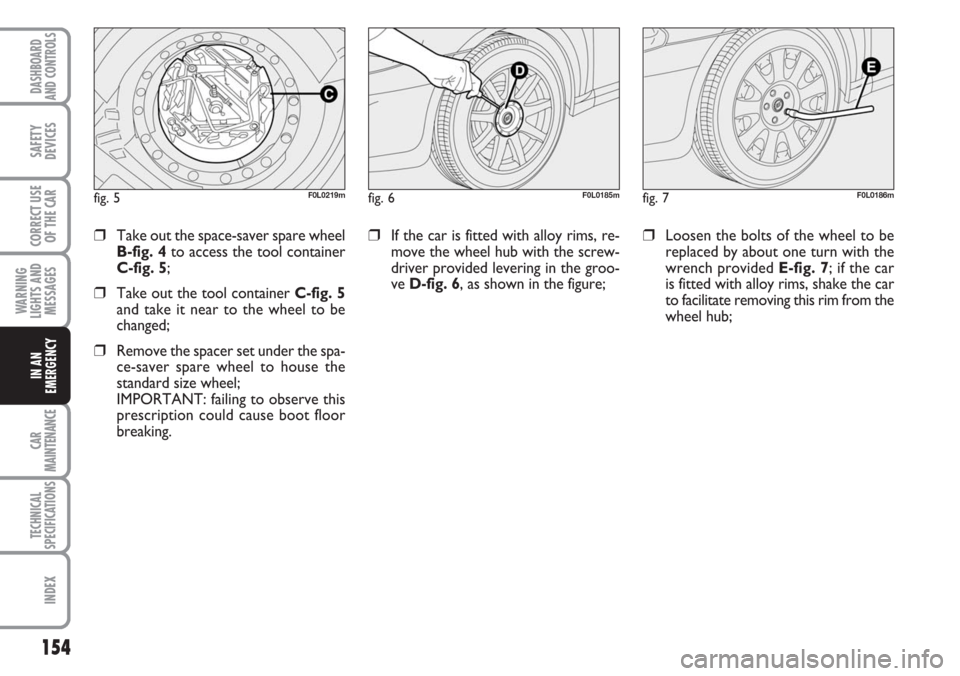
❒If the car is fitted with alloy rims, re-
move the wheel hub with the screw-
driver provided levering in the groo-
ve D-fig. 6, as shown in the figure;❒Loosen the bolts of the wheel to be
replaced by about one turn with the
wrench provided E-fig. 7; if the car
is fitted with alloy rims, shake the car
to facilitate removing this rim from the
wheel hub;❒Take out the space-saver spare wheel
B-fig. 4to access the tool container
C-fig. 5;
❒Take out the tool container C-fig. 5
and take it near to the wheel to be
changed;
❒Remove the spacer set under the spa-
ce-saver spare wheel to house the
standard size wheel;
IMPORTANT: failing to observe this
prescription could cause boot floor
breaking.
fig. 5F0L0219mfig. 6F0L0185mfig. 7F0L0186m
Page 157 of 240
157
WARNING
LIGHTS AND
MESSAGES
CAR
MAINTENANCE
TECHNICAL
SPECIFICATIONS
INDEX
DASHBOARD
AND CONTROLS
SAFETY
DEVICES
CORRECT USE
OF THE CAR
IN AN
EMERGENCY
WHEN NEEDING TO
CHANGE A BULB
GENERAL INSTRUCTIONS
❒When a light is not working, check
that the corresponding fuse is intact
before changing a bulb. For the loca-
tion of fuses, refer to the paragraph “If
a fuse blows” in this section;
❒Before changing a bulb check the con-
tacts for oxidation;
❒Burnt bulbs must be replaced by
others of the same type and power;
❒Always check the height of the head-
light beam after changing a bulb.
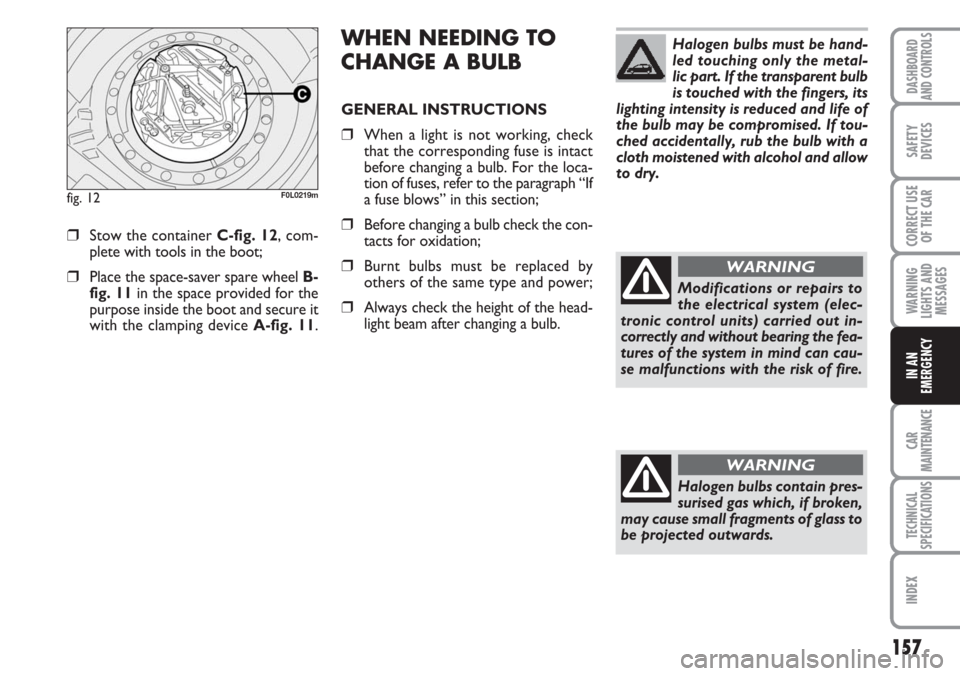
❒Stow the container C-fig. 12, com-
plete with tools in the boot;
❒Place the space-saver spare wheel B-
fig. 11in the space provided for the
purpose inside the boot and secure it
with the clamping device A-fig. 11.
fig. 12F0L0219m
Halogen bulbs must be hand-
led touching only the metal-
lic part. If the transparent bulb
is touched with the fingers, its
lighting intensity is reduced and life of
the bulb may be compromised. If tou-
ched accidentally, rub the bulb with a
cloth moistened with alcohol and allow
to dry.
Modifications or repairs to
the electrical system (elec-
tronic control units) carried out in-
correctly and without bearing the fea-
tures of the system in mind can cau-
se malfunctions with the risk of fire.
WARNING
Halogen bulbs contain pres-
surised gas which, if broken,
may cause small fragments of glass to
be projected outwards.
WARNING
Page 160 of 240
160
WARNING
LIGHTS AND
MESSAGES
CAR
MAINTENANCE
TECHNICAL
SPECIFICATIONS
INDEX
DASHBOARD
AND CONTROLS
SAFETY
DEVICES
CORRECT USE
OF THE CAR
IN AN
EMERGENCY
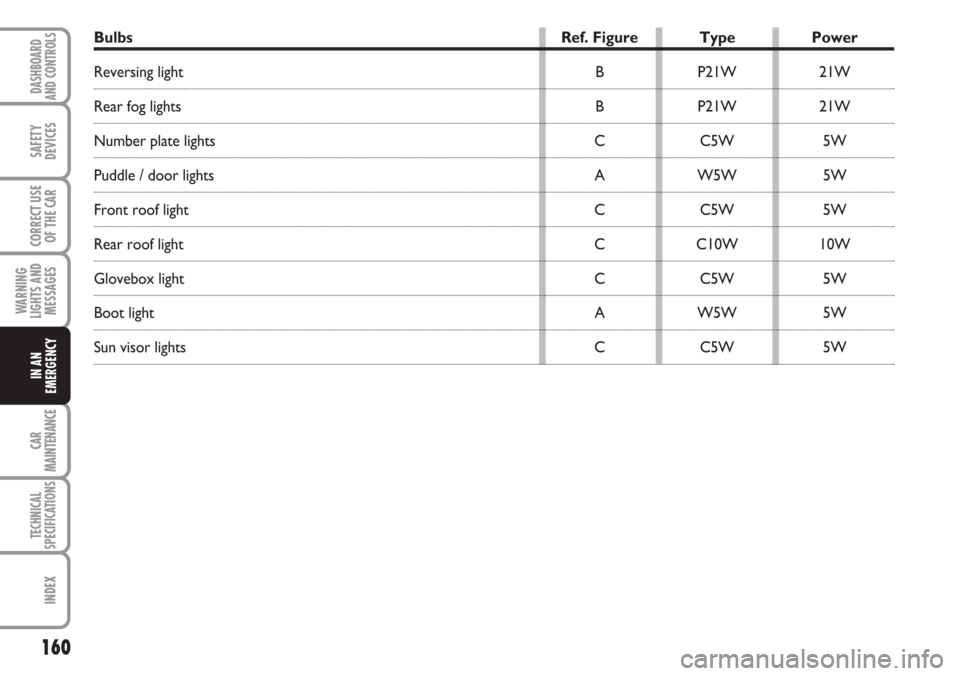
Bulbs Ref. Figure Type Power
Reversing light B P21W 21W
Rear fog lights B P21W 21W
Number plate lights C C5W 5W
Puddle / door lights A W5W 5W
Front roof light C C5W 5W
Rear roof light C C10W 10W
Glovebox light C C5W 5W
Boot light A W5W 5W
Sun visor lights C C5W 5W
Page 168 of 240
168
WARNING
LIGHTS AND
MESSAGES
CAR
MAINTENANCE
TECHNICAL
SPECIFICATIONS
INDEX
DASHBOARD
AND CONTROLS
SAFETY
DEVICES
CORRECT USE
OF THE CAR
IN AN
EMERGENCY
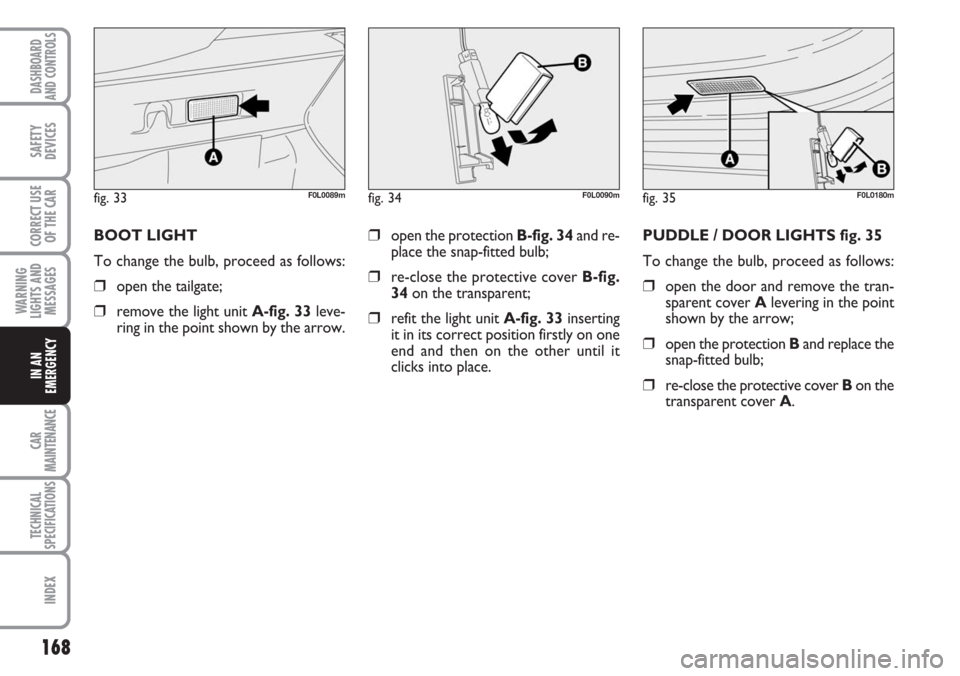
❒open the protection B-fig. 34and re-
place the snap-fitted bulb;
❒re-close the protective cover B-fig.
34on the transparent;
❒refit the light unit A-fig. 33inserting
it in its correct position firstly on one
end and then on the other until it
clicks into place.PUDDLE / DOOR LIGHTS fig. 35
To change the bulb, proceed as follows:
❒open the door and remove the tran-
sparent cover Alevering in the point
shown by the arrow;
❒open the protection Band replace the
snap-fitted bulb;
❒re-close the protective cover Bon the
transparent cover A. BOOT LIGHT
To change the bulb, proceed as follows:
❒open the tailgate;
❒remove the light unit A-fig. 33leve-
ring in the point shown by the arrow.
fig. 33F0L0089mfig. 34F0L0090mfig. 35F0L0180m