change wheel FIAT CROMA 2006 2.G User Guide
[x] Cancel search | Manufacturer: FIAT, Model Year: 2006, Model line: CROMA, Model: FIAT CROMA 2006 2.GPages: 240, PDF Size: 7.41 MB
Page 151 of 240
151
WARNING
LIGHTS AND
MESSAGES
CAR
MAINTENANCE
TECHNICAL
SPECIFICATIONS
INDEX
DASHBOARD
AND CONTROLS
SAFETY
DEVICES
CORRECT USE
OF THE CAR
IN AN
EMERGENCY
IF A TYRE IS
PUNCTURED
GENERAL INSTRUCTIONS
Wheel changing and correct use of the
jack and space-saver spare wheel call for
some precautions as listed below.
BUMP STARTING
Never bump start the engine (by pushing,
towing, or coasting downhill) as this could
cause fuel to flow into the catalytic exhau-
st system and damage it beyond repair.
Remember that the brake booster and the
power steering system are not operating
until the engine is started, a greater effort
will therefore be required to press the
brake pedal or to turn the steering wheel.
Alert other drivers that the
car is stationary in com-
pliance with local regulations: hazard
warning lights, warning triangle etc.
Any passengers on board should lea-
ve the car, especially if it is heavily la-
den. Passengers should stay away
from oncoming traffic while the
wheel is being changed on. If the
wheel is being changed on a steep or
badly surfaced road, place the wed-
ges or other suitable material under
the wheel to stop the car.
WARNING
The space-saver spare wheel
is specific to your car, do not
use it on other models, or use the spa-
re wheel of other models on your car.
The space-saver spare wheel shall
only be used in an emergency.
It shall only be used for the distance
necessary to reach a service point and
the car speed shall not exceed 80
Km/h. The spare wheel has an oran-
ge sticker that summarises the main
cautions for use and limitations. The
sticker should never be removed or
covered.
Never fit a wheel cap on a space-sa-
ver spare wheel. The sticker gives the
following information in four langua-
ges: caution! For temporary use only!
80 km/h max! Replace by normal
wheel as soon as possible. Do not co-
ver this label.
WARNING
Page 153 of 240
153
WARNING
LIGHTS AND
MESSAGES
CAR
MAINTENANCE
TECHNICAL
SPECIFICATIONS
INDEX
DASHBOARD
AND CONTROLS
SAFETY
DEVICES
CORRECT USE
OF THE CAR
IN AN
EMERGENCY
To change a wheel proceed as follows:
❒Stop the car in a position that is not
dangerous for oncoming traffic where
you can change the wheel safely. The
ground should be flat and adequately
firm;
❒Turn the engine off and pull up the
handbrake;
❒Engage first gear or reverse (position
P with automatic transmission);
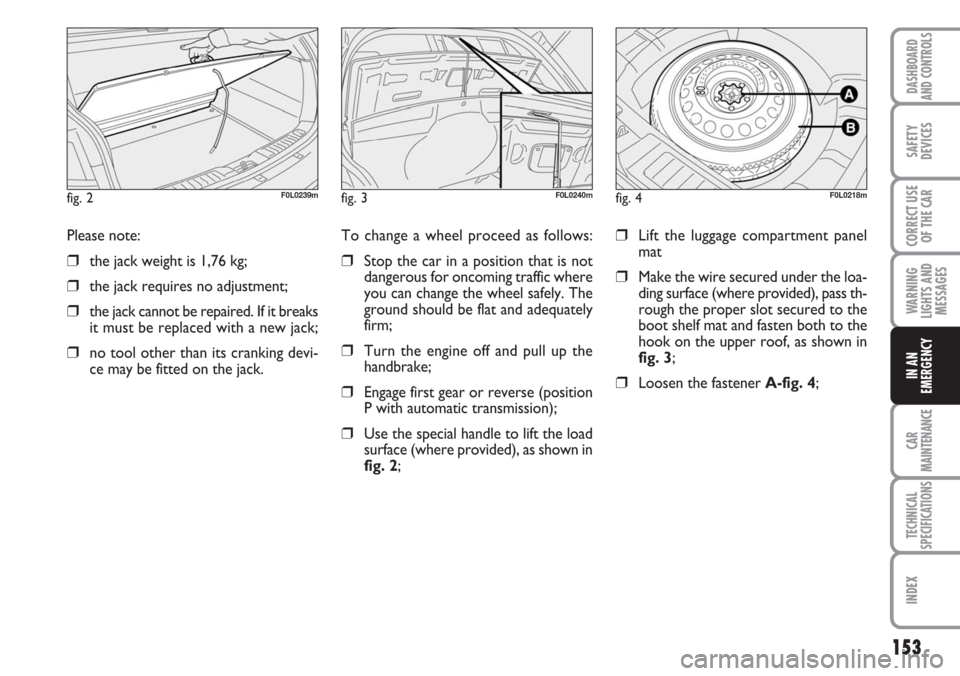
❒Use the special handle to lift the load
surface (where provided), as shown in
fig. 2;
❒Lift the luggage compartment panel
mat
❒Make the wire secured under the loa-
ding surface (where provided), pass th-
rough the proper slot secured to the
boot shelf mat and fasten both to the
hook on the upper roof, as shown in
fig. 3;
❒Loosen the fastener A-fig. 4; Please note:
❒the jack weight is 1,76 kg;
❒the jack requires no adjustment;
❒the jack cannot be repaired. If it breaks
it must be replaced with a new jack;
❒no tool other than its cranking devi-
ce may be fitted on the jack.
fig. 2F0L0239mfig. 3F0L0240mfig. 4F0L0218m
Page 154 of 240
154
WARNING
LIGHTS AND
MESSAGES
CAR
MAINTENANCE
TECHNICAL
SPECIFICATIONS
INDEX
DASHBOARD
AND CONTROLS
SAFETY
DEVICES
CORRECT USE
OF THE CAR
IN AN
EMERGENCY
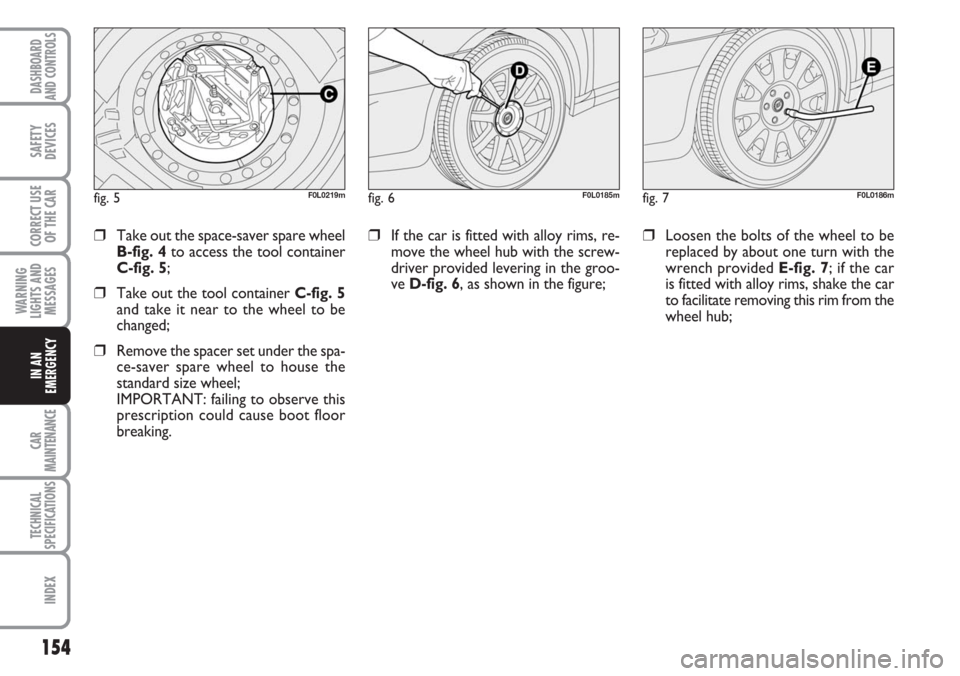
❒If the car is fitted with alloy rims, re-
move the wheel hub with the screw-
driver provided levering in the groo-
ve D-fig. 6, as shown in the figure;❒Loosen the bolts of the wheel to be
replaced by about one turn with the
wrench provided E-fig. 7; if the car
is fitted with alloy rims, shake the car
to facilitate removing this rim from the
wheel hub;❒Take out the space-saver spare wheel
B-fig. 4to access the tool container
C-fig. 5;
❒Take out the tool container C-fig. 5
and take it near to the wheel to be
changed;
❒Remove the spacer set under the spa-
ce-saver spare wheel to house the
standard size wheel;
IMPORTANT: failing to observe this
prescription could cause boot floor
breaking.
fig. 5F0L0219mfig. 6F0L0185mfig. 7F0L0186m
Page 155 of 240
155
WARNING
LIGHTS AND
MESSAGES
CAR
MAINTENANCE
TECHNICAL
SPECIFICATIONS
INDEX
DASHBOARD
AND CONTROLS
SAFETY
DEVICES
CORRECT USE
OF THE CAR
IN AN
EMERGENCY
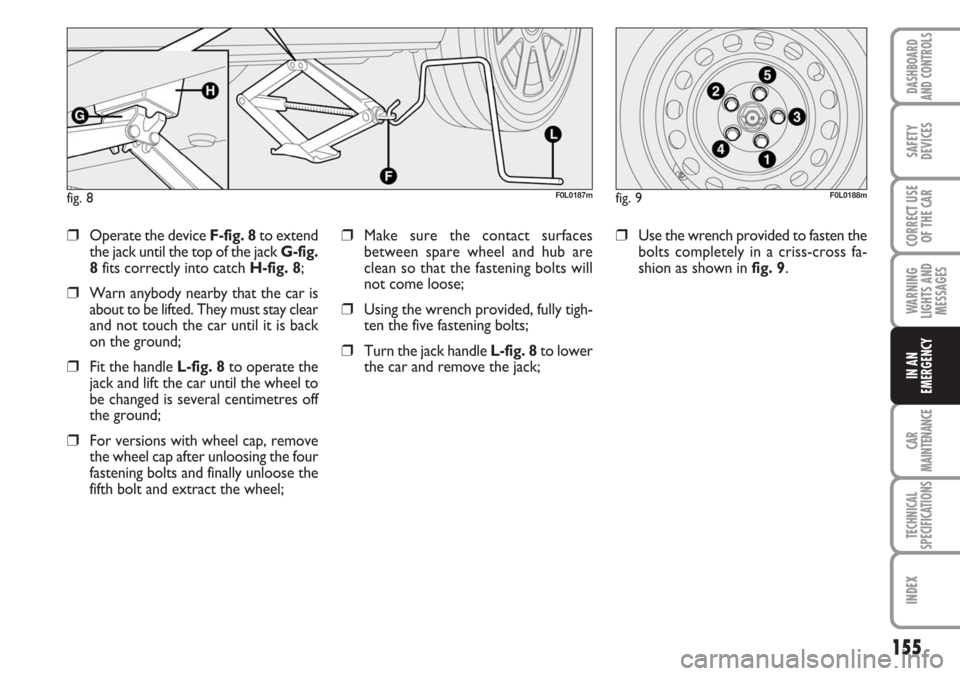
❒Make sure the contact surfaces
between spare wheel and hub are
clean so that the fastening bolts will
not come loose;
❒Using the wrench provided, fully tigh-
ten the five fastening bolts;
❒Turn the jack handle L-fig. 8to lower
the car and remove the jack;
❒Use the wrench provided to fasten the
bolts completely in a criss-cross fa-
shion as shown in fig. 9.❒Operate the device F-fig. 8to extend
the jack until the top of the jack G-fig.
8fits correctly into catch H-fig. 8;
❒Warn anybody nearby that the car is
about to be lifted. They must stay clear
and not touch the car until it is back
on the ground;
❒Fit the handle L-fig. 8to operate the
jack and lift the car until the wheel to
be changed is several centimetres off
the ground;
❒For versions with wheel cap, remove
the wheel cap after unloosing the four
fastening bolts and finally unloose the
fifth bolt and extract the wheel;
fig. 8F0L0187mfig. 9F0L0188m
Page 157 of 240
157
WARNING
LIGHTS AND
MESSAGES
CAR
MAINTENANCE
TECHNICAL
SPECIFICATIONS
INDEX
DASHBOARD
AND CONTROLS
SAFETY
DEVICES
CORRECT USE
OF THE CAR
IN AN
EMERGENCY
WHEN NEEDING TO
CHANGE A BULB
GENERAL INSTRUCTIONS
❒When a light is not working, check
that the corresponding fuse is intact
before changing a bulb. For the loca-
tion of fuses, refer to the paragraph “If
a fuse blows” in this section;
❒Before changing a bulb check the con-
tacts for oxidation;
❒Burnt bulbs must be replaced by
others of the same type and power;
❒Always check the height of the head-
light beam after changing a bulb.
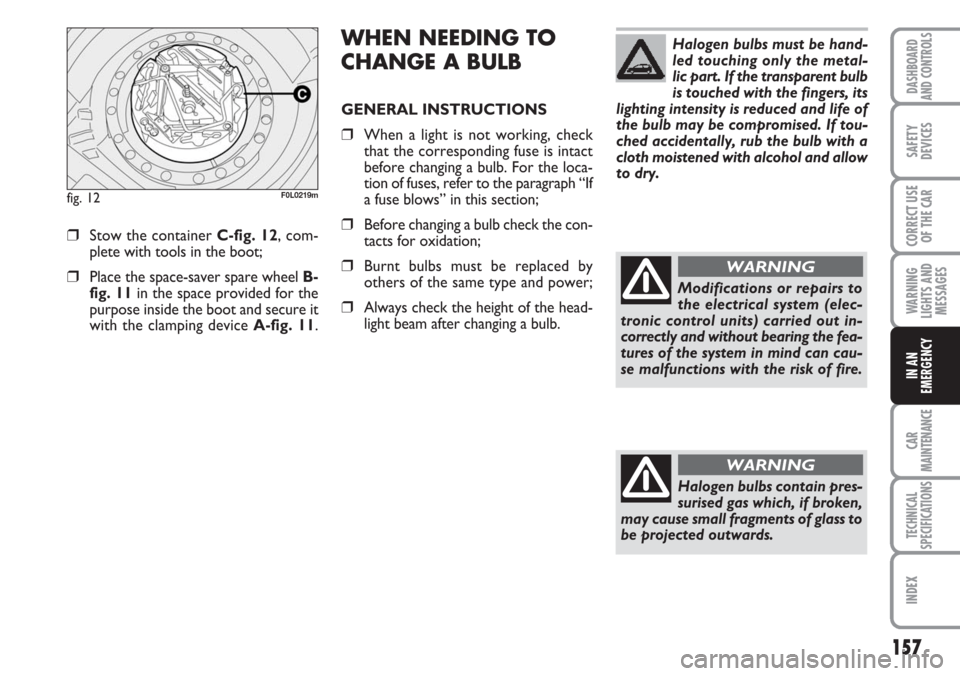
❒Stow the container C-fig. 12, com-
plete with tools in the boot;
❒Place the space-saver spare wheel B-
fig. 11in the space provided for the
purpose inside the boot and secure it
with the clamping device A-fig. 11.
fig. 12F0L0219m
Halogen bulbs must be hand-
led touching only the metal-
lic part. If the transparent bulb
is touched with the fingers, its
lighting intensity is reduced and life of
the bulb may be compromised. If tou-
ched accidentally, rub the bulb with a
cloth moistened with alcohol and allow
to dry.
Modifications or repairs to
the electrical system (elec-
tronic control units) carried out in-
correctly and without bearing the fea-
tures of the system in mind can cau-
se malfunctions with the risk of fire.
WARNING
Halogen bulbs contain pres-
surised gas which, if broken,
may cause small fragments of glass to
be projected outwards.
WARNING
Page 201 of 240
201
WARNING
LIGHTS AND
MESSAGES
TECHNICAL
SPECIFICATIONS
INDEX
DASHBOARD
AND CONTROLS
SAFETY
DEVICES
CORRECT USE
OF THE CAR
IN AN
EMERGENCY
CAR
MAINTENANCE
❒If a tyre is punctured, stop immediate-
ly and change it to avoid damage to the
tyre, the rim, suspensions and steering
system;
❒Tyres age even if they are not used
much. Cracks in the tread rubber are
a sign of ageing. In any case, if the tyres
have been on the car for over 6 years,
they should be checked by specialised
personnel, to see if they can still be
used. Also remember to check the
space-saver spare wheel;
❒In the case of replacement, always fit
new tyres, avoiding those of dubious
origin;
❒If a tyre is changed, also change the in-
flation valve;
❒To allow even wear between the front
and rear tyres, it is advisable to change
them over every 10-15 thousand kilo-
metres, keeping them on the same
side of the car so as to not reverse the
direction of rotation.
Remember that road holding
depends also on the correct
tyre inflating pressure.
WARNING
Do not cross switch the
tyres, moving them from the
right of the car to the left and vice
versa.
WARNING
If the pressure is too low the
tyre overheats and this can
cause it serious damage.
WARNING
Never submit alloy rims to
repainting treatments re-
quiring to use temperatures exceed-
ing 150°C since the mechanical prop-
erties of the wheels could be im-
paired.
WARNING
RUBBER HOSES
As far as the brake system and fuel rubber
hoses are concerned, carefully follow the
“Service schedule” in this section.
Indeed ozone, high temperatures and pro-
longed lack of fluid in the system may
cause hardening and cracking of the hoses,
with possible leaks. Careful control is
therefore necessary.
183-206 Croma TRW GB 20-11-2006 15:03 Pagina 201