steering wheel FIAT CROMA 2006 2.G User Guide
[x] Cancel search | Manufacturer: FIAT, Model Year: 2006, Model line: CROMA, Model: FIAT CROMA 2006 2.GPages: 240, PDF Size: 7.41 MB
Page 122 of 240
IMPORTANT If it is not possible to turn
the ignition key to ON, remove the emer-
gency key, fit it into slot A-fig. 1to un-
lock the ignition switch; then, turn the key
to ONand follow the starting procedure.
Contact Fiat Dealership.
IMPORTANT Never leave the ignition key
into the ignition switch when the engine
is off. In this event, when opening the dri-
ver’s door, a buzzer will sound for about
1 second.
HOW TO WARM UP THE
ENGINE AFTER IT HAS JUST
STARTED (petrol and diesel
engines)
Proceed as follows:
❒Drive off slowly, letting the engine turn
at medium revs. Do not accelerate
abruptly;
❒Do not drive at full performance for
the initial kilometres. Wait until the
coolant temperature gauge starts
moving.
122
WARNING
LIGHTS AND
MESSAGES
IN AN
EMERGENCY
CAR
MAINTENANCE
TECHNICAL
SPECIFICATIONS
INDEX
DASHBOARD
AND CONTROLS
SAFETY
DEVICES
CORRECT USE
OF THE CAR
Never bump start the engine
by pushing, towing or coasting
downhill as this could cause
fuel to flow into the catalytic
exhaust system and damage it beyond
repair.
A quick burst on the acceler-
ator before turning off the en-
gine serves absolutely no prac-
tical purpose, it wastes fuel
and is damaging especially to tur-
bocharged engines.
Remember that the servo-
brake and power steering
are not operational until the engine
has been started, therefore much ef-
fort than usual is required on the
brake pedal and steering wheel.
WARNING
STOPPING THE ENGINE
Turn the ignition key to OFFwhile the
engine is idling.
IMPORTANT After a taxing drive, you
should allow the engine to “catch its
breath” before turning it off by letting it
idle to allow the temperature in the en-
gine compartment to fall.
IMPORTANT If the engine is turned off
while the car is still moving, for safety rea-
sons it will be impossible to remove the
key from the ignition switch. To remove
the key, turn it to ONand then to OFF
with the car stopped without forcing at re-
moval.
Page 141 of 240
If warning light vflashes,
contact Fiat Dealership im-
mediately to have oil changed
and instrument panel warning light
turned off.
141
IN AN
EMERGENCY
CAR
MAINTENANCE
TECHNICAL
SPECIFICATIONS
INDEX
DASHBOARD
AND CONTROLS
SAFETY
DEVICES
CORRECT USE
OF THE CAR
WARNING
LIGHTS AND
MESSAGES
EOBD ENGINE CONTROL
SYSTEM FAILURE
Under normal conditions, turning the ig-
nition key to ON, the warning light turns
on, but it should go off when the engine has
started. In this case, turning on indicates
proper working of the warning light. If the
warning light stays on or turns on when
travelling:
❒glowing steadily: means a fault in the
supply/ignition system which could
cause high emissions at the exhaust,
possible lack of performance, poor
handling and high consumption levels.
On certain versions the dedicated mes-
sage is displayed.
In these conditions it is possible to con-
tinue driving without however requiring
heavy effort or high speed from the en-
gine. Prolonged use of the car with the
warning light on may cause damages. Con-
tact Fiat Dealership as soon as possible.
The warning light goes off if the fault dis-
appears, but it is still stored by the system.
❒flashing: indicates the possibility of
damage to the catalyst (see “EOBD
system” in section “Dashboard and
controls”). INJECTION SYSTEM
FAILURE
(Multijet versions - red)
EOBD ENGINE
CONTROL SYSTEM FAILURE
(petrol versions - amber)
Injection system failure
Turning the ignition key to ONthe warn-
ing light turns on, but it should go off af-
ter few seconds.
If the warning light stays on or turns on
when travelling, means a fault in the sup-
ply/ignition system which could cause high
emissions at the exhaust, possible lack of
performance, poor handling and high con-
sumption levels.
On certain versions the dedicated message
is displayed.
In these conditions it is possible to con-
tinue driving without however requiring
heavy effort or high speed from the en-
gine. In any case, contact Fiat Dealership
as soon as possible.
U
INCOMPLETE DOOR
LOCKING (red)
The warning light turns on
when one or more doors, the
boot or the bonnet are not properly shut.
The dedicated message will be displayed;
When travelling with door/doors, boot or
bonnet open also a buzzer will sound.
´
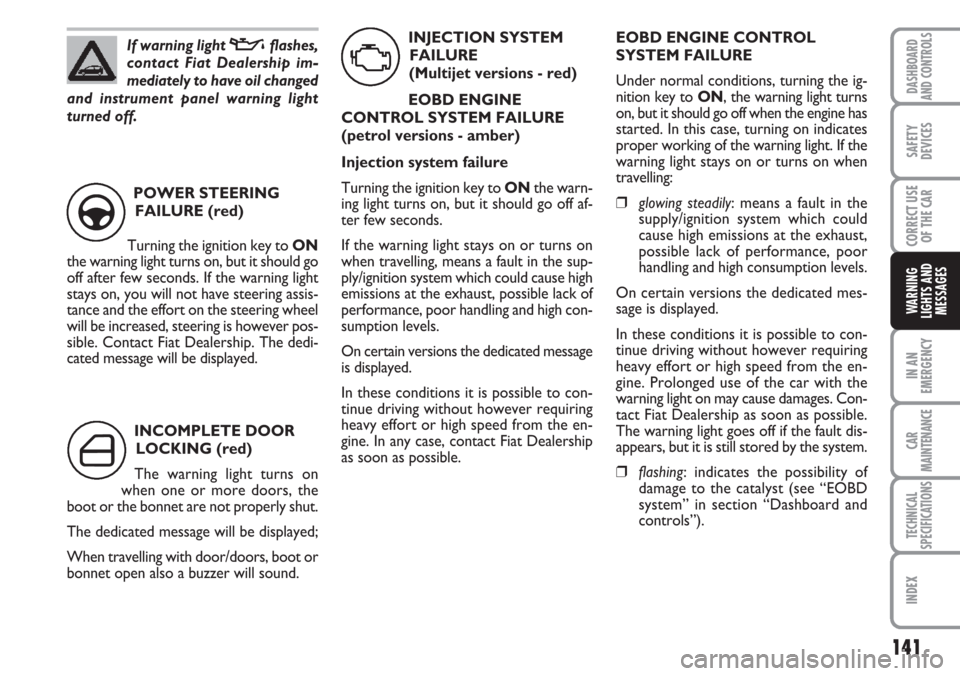
POWER STEERING
FAILURE (red)
Turning the ignition key to ON
the warning light turns on, but it should go
off after few seconds. If the warning light
stays on, you will not have steering assis-
tance and the effort on the steering wheel
will be increased, steering is however pos-
sible. Contact Fiat Dealership. The dedi-
cated message will be displayed.
g
Page 145 of 240

145
IN AN
EMERGENCY
CAR
MAINTENANCE
TECHNICAL
SPECIFICATIONS
INDEX
DASHBOARD
AND CONTROLS
SAFETY
DEVICES
CORRECT USE
OF THE CAR
WARNING
LIGHTS AND
MESSAGES
Parking sensor failure
(where provided)
The warning light on the dial turns on to-
gether with the message on the display
when failure is detected in parking sensors.
Contact Fiat Dealership.
Antipinch system failure
(where provided)
The warning light on the dial turns on to-
gether with the message on the display
when failure is detected in the antipinch
system.
Contact Fiat Dealership.
Twilight sensor failure
(where provided)
The warning light on the dial turns on (to-
gether with the message on the display)
when failure is detected in twilight sen-
sor (adjusting headlight sensitivity).Check tyre pressure
(where provided)
The warning light on the dial turns on (to-
gether with the message on the display),
when tyre pressure is low or excessive.
In this case, inflate tyres to the specified
pressure values (see paragraph “Inflating
pressures” in section “Technical Specifi-
cations”).
Flat tyres (where provided)
The warning light on the dial turns on (to-
gether with message on the display and
the buzzer), when there is a pressure drop
in one or more tyres. In this way the
T.P.M.S. system warns the driver that one
or more tyre/s is/are flat (i.e. punctured).
IMPORTANT Stop travelling with one or
more flat tyre/s since road holding could
be jeopardised. Stop the car without brak-
ing or steering sharply. Change immedi-
ately punctured wheel with space-saver
spare wheel (where provided - see sec-
tion “In an emergency”) and contact Fiat
Dealership as soon as possible.Tyre pressure monitoring system
failure (where provided)
The warning light on the dial turns on (to-
gether with the message on the display)
when a failure is detected in the T.P.M.S.
system (where provided).
Contact Fiat Dealership as soon as possi-
ble.
Should one or more wheels without sen-
sor be fitted, the instrument panel warn-
ing light will come on (together with the
message on the display) and stay on until
fitting again the four wheels with sensors.
Page 151 of 240
151
WARNING
LIGHTS AND
MESSAGES
CAR
MAINTENANCE
TECHNICAL
SPECIFICATIONS
INDEX
DASHBOARD
AND CONTROLS
SAFETY
DEVICES
CORRECT USE
OF THE CAR
IN AN
EMERGENCY
IF A TYRE IS
PUNCTURED
GENERAL INSTRUCTIONS
Wheel changing and correct use of the
jack and space-saver spare wheel call for
some precautions as listed below.
BUMP STARTING
Never bump start the engine (by pushing,
towing, or coasting downhill) as this could
cause fuel to flow into the catalytic exhau-
st system and damage it beyond repair.
Remember that the brake booster and the
power steering system are not operating
until the engine is started, a greater effort
will therefore be required to press the
brake pedal or to turn the steering wheel.
Alert other drivers that the
car is stationary in com-
pliance with local regulations: hazard
warning lights, warning triangle etc.
Any passengers on board should lea-
ve the car, especially if it is heavily la-
den. Passengers should stay away
from oncoming traffic while the
wheel is being changed on. If the
wheel is being changed on a steep or
badly surfaced road, place the wed-
ges or other suitable material under
the wheel to stop the car.
WARNING
The space-saver spare wheel
is specific to your car, do not
use it on other models, or use the spa-
re wheel of other models on your car.
The space-saver spare wheel shall
only be used in an emergency.
It shall only be used for the distance
necessary to reach a service point and
the car speed shall not exceed 80
Km/h. The spare wheel has an oran-
ge sticker that summarises the main
cautions for use and limitations. The
sticker should never be removed or
covered.
Never fit a wheel cap on a space-sa-
ver spare wheel. The sticker gives the
following information in four langua-
ges: caution! For temporary use only!
80 km/h max! Replace by normal
wheel as soon as possible. Do not co-
ver this label.
WARNING
Page 175 of 240
175
WARNING
LIGHTS AND
MESSAGES
CAR
MAINTENANCE
TECHNICAL
SPECIFICATIONS
INDEX
DASHBOARD
AND CONTROLS
SAFETY
DEVICES
CORRECT USE
OF THE CAR
IN AN
EMERGENCY
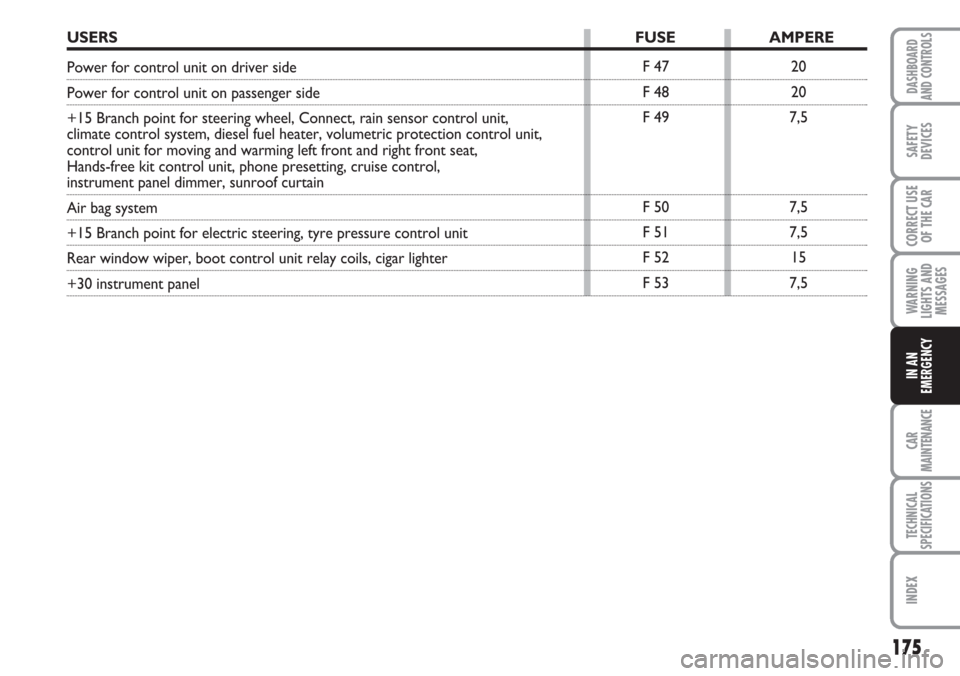
F 47
F 48
F 49
F 50
F 51
F 52
F 5320
20
7,5
7,5
7,5
15
7,5
USERSFUSE AMPERE
Power for control unit on driver side
Power for control unit on passenger side
+15 Branch point for steering wheel, Connect, rain sensor control unit,
climate control system, diesel fuel heater, volumetric protection control unit,
control unit for moving and warming left front and right front seat,
Hands-free kit control unit, phone presetting, cruise control,
instrument panel dimmer, sunroof curtain
Air bag system
+15 Branch point for electric steering, tyre pressure control unit
Rear window wiper, boot control unit relay coils, cigar lighter
+30 instrument panel
Page 182 of 240
182
WARNING
LIGHTS AND
MESSAGES
CAR
MAINTENANCE
TECHNICAL
SPECIFICATIONS
INDEX
DASHBOARD
AND CONTROLS
SAFETY
DEVICES
CORRECT USE
OF THE CAR
IN AN
EMERGENCY
When towing, remember
that without the help of the
brake booster and power steering, a
greater effort is required on the pe-
dal and steering wheel. Do not use
flexible cables for towing and avoid
jerks. During towing operations
make sure that fastening the joint to
the car does not damage the com-
ponents in contact with it. When
towing the car, you must comply
with the specific traffic regulations
regarding the tow ring and how to
tow on the road.
WARNING
Do not start the engine
when towing the car.
WARNING
Before fitting the hook,
clean accurately its threaded
seat. Before starting to tow, make su-
re to have tighten the hook.
WARNING
Before starting to tow, di-
sengage the steering lock
(see paragraph “Ignition device” in
section “Dashboard and controls”).
When towing, remember that
without the help of the brake boo-
ster and power steering, a greater
effort is required on the pedal and
steering wheel. Do not use flexible
cables for towing and avoid jerks.
During towing operations make su-
re that fastening the joint to the car
does not damage the components in
contact with it. When towing the
car, you must comply with the spe-
cific traffic regulations regarding the
tow ring and how to tow on the
road.
WARNING
Page 201 of 240
201
WARNING
LIGHTS AND
MESSAGES
TECHNICAL
SPECIFICATIONS
INDEX
DASHBOARD
AND CONTROLS
SAFETY
DEVICES
CORRECT USE
OF THE CAR
IN AN
EMERGENCY
CAR
MAINTENANCE
❒If a tyre is punctured, stop immediate-
ly and change it to avoid damage to the
tyre, the rim, suspensions and steering
system;
❒Tyres age even if they are not used
much. Cracks in the tread rubber are
a sign of ageing. In any case, if the tyres
have been on the car for over 6 years,
they should be checked by specialised
personnel, to see if they can still be
used. Also remember to check the
space-saver spare wheel;
❒In the case of replacement, always fit
new tyres, avoiding those of dubious
origin;
❒If a tyre is changed, also change the in-
flation valve;
❒To allow even wear between the front
and rear tyres, it is advisable to change
them over every 10-15 thousand kilo-
metres, keeping them on the same
side of the car so as to not reverse the
direction of rotation.
Remember that road holding
depends also on the correct
tyre inflating pressure.
WARNING
Do not cross switch the
tyres, moving them from the
right of the car to the left and vice
versa.
WARNING
If the pressure is too low the
tyre overheats and this can
cause it serious damage.
WARNING
Never submit alloy rims to
repainting treatments re-
quiring to use temperatures exceed-
ing 150°C since the mechanical prop-
erties of the wheels could be im-
paired.
WARNING
RUBBER HOSES
As far as the brake system and fuel rubber
hoses are concerned, carefully follow the
“Service schedule” in this section.
Indeed ozone, high temperatures and pro-
longed lack of fluid in the system may
cause hardening and cracking of the hoses,
with possible leaks. Careful control is
therefore necessary.
183-206 Croma TRW GB 20-11-2006 15:03 Pagina 201
Page 206 of 240
206
WARNING
LIGHTS AND
MESSAGES
TECHNICAL
SPECIFICATIONS
INDEX
DASHBOARD
AND CONTROLS
SAFETY
DEVICES
CORRECT USE
OF THE CAR
IN AN
EMERGENCY
CAR
MAINTENANCE
STEERING WHEEL/GEAR LEVER
KNOB WITH GENUINE
LEATHER COVERING
These components shall only be cleaned
with water and neutral soap. Never use
spirit or alcohol-based products.
Before using special products for clean-
ing interiors, read carefully label instruc-
tions and indications to make sure they
are free from spirit and/or alcohol-based
substances.
If when cleaning the windscreen with spe-
cial glass products, some drops fall on the
leather covering of the steering wheel/gear
lever knob remove them immediately and
then clean with water and neutral soap.
IMPORTANT Take the utmost care when
engaging the steering lock to prevent
scratching the leather covering.INTERIOR PLASTIC PARTS
Use appropriate products designed to
preserve the appearance of components.
IMPORTANT Never use spirit or petro-
leum to clean the instrument panel. If the stain persists, use specific products,
carefully following the instructions for use.
IMPORTANT Never use spirit or alcohol-
based products.
Never use flammable prod-
ucts like oil ether or rectified
petrol for cleaning car interiors. Elec-
trostatic discharges generated by rub-
bing during cleaning operations could
cause fire.
WARNING
Do not keep aerosol cans in
the car: they might explode.
Aerosol cans must never be exposed
to a temperature above 50°C. The
temperature inside the car exposed
to the sun may go well beyond that
figure.
WARNING
183-206 Croma TRW GB 20-11-2006 15:03 Pagina 206
Page 207 of 240
207
WARNING
LIGHTS AND
MESSAGES
INDEX
DASHBOARD
AND CONTROLS
SAFETY
DEVICES
CORRECT USE
OF THE CAR
IN AN
EMERGENCY
CAR
MAINTENANCE
TECHNICAL
SPECIFICATIONS
IDENTIFICATION DATA ................................................... 208
ENGINE CODES - BODYWORK VERSIONS ............... 210
ENGINE .................................................................................... 211
FUEL FEED/IGNITION ........................................................ 213
TRANSMISSION .................................................................... 213
BRAKES ..................................................................................... 214
SUSPENSIONS......................................................................... 214
STEERING ................................................................................. 214
WHEELS .................................................................................... 215
DIMENSIONS .......................................................................... 220
PERFORMANCE ..................................................................... 221
WEIGHTS ................................................................................. 222
CAPACITIES............................................................................. 224
FLUIDS AND LUBRICANTS ............................................... 226
FUEL CONSUMPTION ........................................................ 228
CO
2EMISSIONS .................................................................... 230
RADIO FREQUENCY REMOTE CONTROL:
MINISTERIAL CERTIFICATIONS ..................................... 231
T T
E E
C C
H H
N N
I I
C C
A A
L L
S S
P P
E E
C C
I I
F F
I I
C C
A A
T T
I I
O O
N N
S S
207-231 Croma TRW GB 20-11-2006 15:04 Pagina 207
Page 214 of 240
214
WARNING
LIGHTS AND
MESSAGES
INDEX
DASHBOARD
AND CONTROLS
SAFETY
DEVICES
CORRECT USE
OF THE CAR
IN AN
EMERGENCY
CAR
MAINTENANCE
TECHNICAL
SPECIFICATIONS
Disc, self-ventilating
Disc, self-ventilating
Controlled by hand lever,
it works on rear brakes
Electro-hydraulic power steering
11.3
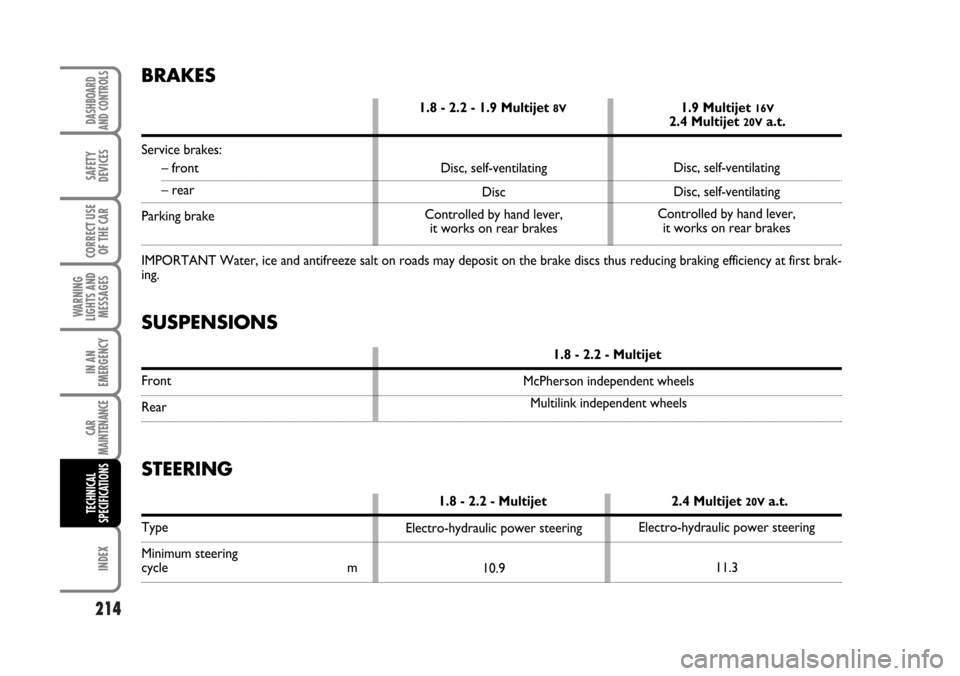
BRAKES
1.8 - 2.2 - 1.9 Multijet 8V1.9 Multijet 16V2.4 Multijet 20Va.t.
Service brakes:
– front
– rear
Parking brake
IMPORTANT Water, ice and antifreeze salt on roads may deposit on the brake discs thus reducing braking efficiency at first brak-
ing.
SUSPENSIONS
1.8 - 2.2 - Multijet
Front
RearMcPherson independent wheels
Multilink independent wheels Disc, self-ventilating
Disc
Controlled by hand lever,
it works on rear brakes
Electro-hydraulic power steering
10.9
STEERING
1.8 - 2.2 - Multijet 2.4 Multijet 20Va.t.
Type
Minimum steering
cycle m
207-231 Croma TRW GB 20-11-2006 15:04 Pagina 214