tow FIAT CROMA 2006 2.G User Guide
[x] Cancel search | Manufacturer: FIAT, Model Year: 2006, Model line: CROMA, Model: FIAT CROMA 2006 2.GPages: 240, PDF Size: 7.41 MB
Page 85 of 240
85
SAFETY
DEVICES
CORRECT USE
OF THE CAR
WARNING
LIGHTS AND
MESSAGES
IN AN
EMERGENCY
CAR
MAINTENANCE
TECHNICAL
SPECIFICATIONS
INDEX
DASHBOARD
AND CONTROLS
HEADLIGHTS
ADJUSTING THE HEADLIGHT
BEAM
Proper adjustment of the headlight beams
is of vital importance for your safety and
comfort and also for the other road users.
To ensure you and other drivers have the
best visibility conditions when travelling
with the headlights on, the headlights must
be set properly. Contact Fiat Dealership
to have the headlights properly adjusted.
IMPORTANT When turning on (Xenon)
gas discharge headlight lamps (where pro-
vided), it is normal that there should be a
vertical movement of reflectors, and con-
sequently the same will also happen to the
light beam, for the time required to
achieve the correct headlight trim stabili-
sation, equal to approx. 2 seconds.
Headlight aiming device
It works with ignition key at ONand
dipped beams on. When the car is loaded,
it slopes backwards. This means that the
headlight beam rises. In this case, it is nec-
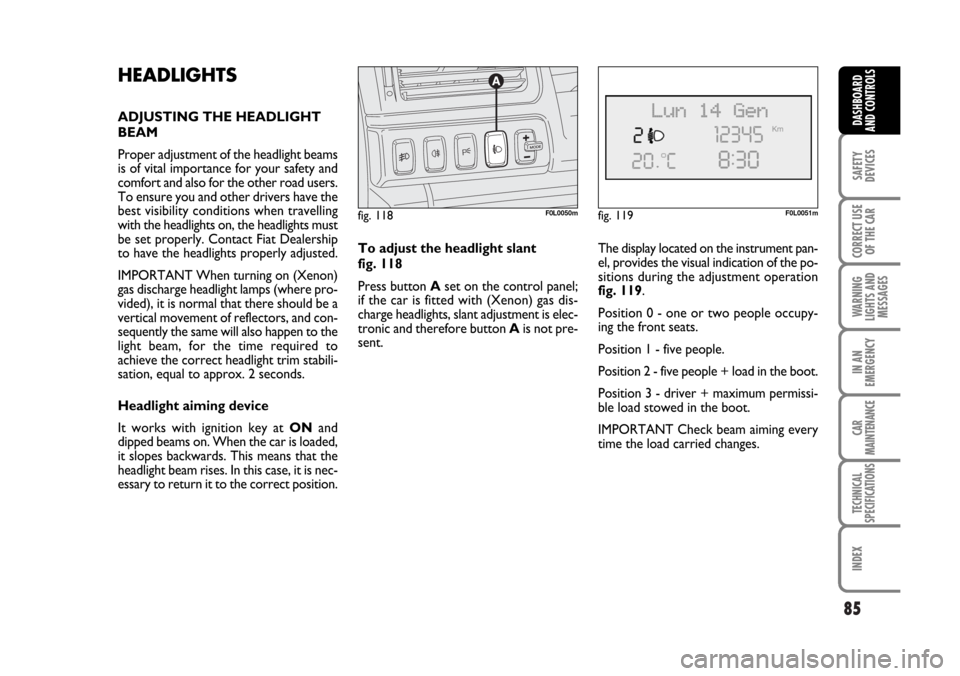
essary to return it to the correct position.To adjust the headlight slant
fig. 118
Press button Aset on the control panel;
if the car is fitted with (Xenon) gas dis-
charge headlights, slant adjustment is elec-
tronic and therefore button Ais not pre-
sent.The display located on the instrument pan-
el, provides the visual indication of the po-
sitions during the adjustment operation
fig. 119.
Position 0 - one or two people occupy-
ing the front seats.
Position 1 - five people.
Position 2 - five people + load in the boot.
Position 3 - driver + maximum permissi-
ble load stowed in the boot.
IMPORTANT Check beam aiming every
time the load carried changes.
fig. 118F0L0050mfig. 119F0L0051m
062-098 Croma TRW GB 20-11-2006 15:01 Pagina 85
Page 94 of 240
94
SAFETY
DEVICES
CORRECT USE
OF THE CAR
WARNING
LIGHTS AND
MESSAGES
IN AN
EMERGENCY
CAR
MAINTENANCE
TECHNICAL
SPECIFICATIONS
INDEX
DASHBOARD
AND CONTROLS
PARKING SENSORS
(where provided)
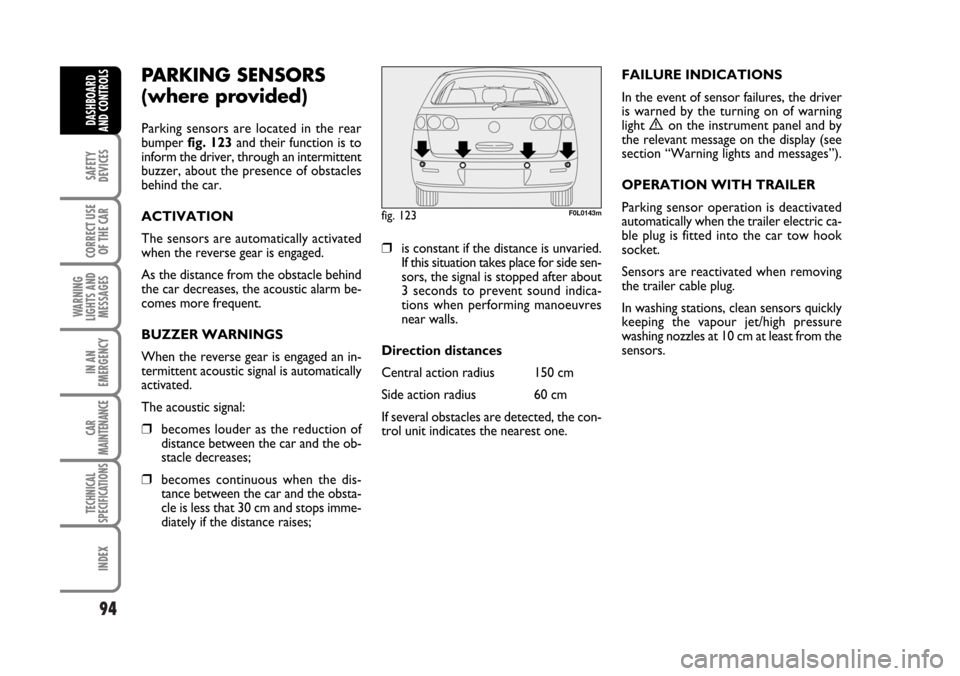
Parking sensors are located in the rear
bumper fig. 123and their function is to
inform the driver, through an intermittent
buzzer, about the presence of obstacles
behind the car.
ACTIVATION
The sensors are automatically activated
when the reverse gear is engaged.
As the distance from the obstacle behind
the car decreases, the acoustic alarm be-
comes more frequent.
BUZZER WARNINGS
When the reverse gear is engaged an in-
termittent acoustic signal is automatically
activated.
The acoustic signal:
❒becomes louder as the reduction of
distance between the car and the ob-
stacle decreases;
❒becomes continuous when the dis-
tance between the car and the obsta-
cle is less that 30 cm and stops imme-
diately if the distance raises;
❒is constant if the distance is unvaried.
If this situation takes place for side sen-
sors, the signal is stopped after about
3 seconds to prevent sound indica-
tions when performing manoeuvres
near walls.
Direction distances
Central action radius 150 cm
Side action radius 60 cm
If several obstacles are detected, the con-
trol unit indicates the nearest one.
fig. 123F0L0143m
FAILURE INDICATIONS
In the event of sensor failures, the driver
is warned by the turning on of warning
light
èon the instrument panel and by
the relevant message on the display (see
section “Warning lights and messages”).
OPERATION WITH TRAILER
Parking sensor operation is deactivated
automatically when the trailer electric ca-
ble plug is fitted into the car tow hook
socket.
Sensors are reactivated when removing
the trailer cable plug.
In washing stations, clean sensors quickly
keeping the vapour jet/high pressure
washing nozzles at 10 cm at least from the
sensors.
062-098 Croma TRW GB 20-11-2006 15:01 Pagina 94
Page 119 of 240
119
WARNING
LIGHTS AND
MESSAGES
IN AN
EMERGENCY
CAR
MAINTENANCE
TECHNICAL
SPECIFICATIONS
INDEX
DASHBOARD
AND CONTROLS
SAFETY
DEVICES
CORRECT USE
OF THE CAR
STARTING THE ENGINE ................................................... 120
PARKING .................................................................................. 123
USING THE MANUAL GEARBOX .................................. 124
ELECTRONIC AUTOMATIC TRANSMISSION ........... 125
CONTAINING RUNNING COSTS ................................. 130
TOWING TRAILERS ............................................................. 131
SNOW TYRES ......................................................................... 134
SNOW CHAINS ..................................................................... 135
CAR INACTIVITY .................................................................. 136
C C
O O
R R
R R
E E
C C
T T
U U
S S
E E
O O
F F
T T
H H
E E
C C
A A
R R
Page 122 of 240
IMPORTANT If it is not possible to turn
the ignition key to ON, remove the emer-
gency key, fit it into slot A-fig. 1to un-
lock the ignition switch; then, turn the key
to ONand follow the starting procedure.
Contact Fiat Dealership.
IMPORTANT Never leave the ignition key
into the ignition switch when the engine
is off. In this event, when opening the dri-
ver’s door, a buzzer will sound for about
1 second.
HOW TO WARM UP THE
ENGINE AFTER IT HAS JUST
STARTED (petrol and diesel
engines)
Proceed as follows:
❒Drive off slowly, letting the engine turn
at medium revs. Do not accelerate
abruptly;
❒Do not drive at full performance for
the initial kilometres. Wait until the
coolant temperature gauge starts
moving.
122
WARNING
LIGHTS AND
MESSAGES
IN AN
EMERGENCY
CAR
MAINTENANCE
TECHNICAL
SPECIFICATIONS
INDEX
DASHBOARD
AND CONTROLS
SAFETY
DEVICES
CORRECT USE
OF THE CAR
Never bump start the engine
by pushing, towing or coasting
downhill as this could cause
fuel to flow into the catalytic
exhaust system and damage it beyond
repair.
A quick burst on the acceler-
ator before turning off the en-
gine serves absolutely no prac-
tical purpose, it wastes fuel
and is damaging especially to tur-
bocharged engines.
Remember that the servo-
brake and power steering
are not operational until the engine
has been started, therefore much ef-
fort than usual is required on the
brake pedal and steering wheel.
WARNING
STOPPING THE ENGINE
Turn the ignition key to OFFwhile the
engine is idling.
IMPORTANT After a taxing drive, you
should allow the engine to “catch its
breath” before turning it off by letting it
idle to allow the temperature in the en-
gine compartment to fall.
IMPORTANT If the engine is turned off
while the car is still moving, for safety rea-
sons it will be impossible to remove the
key from the ignition switch. To remove
the key, turn it to ONand then to OFF
with the car stopped without forcing at re-
moval.
Page 129 of 240
PARKING THE CAR
Engage the handbrake and set gear lever to
P. Leave the wheels steered. Block the
wheels with a wedge or a stone if the car
is parked on a steep slope.
Do not leave the ignition key at ONto
prevent draining the battery. Always re-
move the key when you leave the car.TOWING THE CAR
IMPORTANT Comply with current local
regulations to tow the car.
If the car is to be towed, observe the fol-
lowing recommendations:
❒transport the car, if possible, on the
flatbed of a wrecker or maintenance
vehicle;
❒should this not be possible, tow the
car with the front driving wheels
raised from ground.
For towing the car, the gear lever shall be
set to N. FAILURE INDICATIONS
Failures to the electronic automatic trans-
mission is indicated by the turning of warn-
ing light
ton the instrument panel to-
gether with the dedicated message on the
multifunction display (see section “Warn-
ing lights and messages”).
Contact Fiat Dealership as soon as possi-
ble to have the fault removed.
STOPPING THE CAR
To stop the car:
❒release the accelerator pedal;
❒press the brake pedal.
IMPORTANT With the car on a sloping
road and engine running, keep the car
stopped just using the brake pedal, do not
press the accelerator pedal.
With the car parked with engine running
and gear lever at D, R or in sequential
mode, keep the brake pedal pressed to
prevent car moving off by engine idling.
For long stops set gear lever to P.
129
WARNING
LIGHTS AND
MESSAGES
IN AN
EMERGENCY
CAR
MAINTENANCE
TECHNICAL
SPECIFICATIONS
INDEX
DASHBOARD
AND CONTROLS
SAFETY
DEVICES
CORRECT USE
OF THE CAR
Never leave children unat-
tended in the car.
WARNING
BUZZER WARNINGS
The warning buzzer will sound and P po-
sition will flash for a few seconds when the
ignition key is at OFFand the gear lever
is not set at P.
Ignition key can only be removed with
gear lever at P.Do not start the engine when
towing the car.
Failure to observe the above
instructions could seriously
damage the automatic trans-
mission.
Never leave children unat-
tended in the car.
WARNING
Page 130 of 240
Roof rack/ski rack
Remove the roof rack or the ski rack from
the roof as soon as they are no longer
used. These accessories lower air pene-
tration and adversely affect consumption
levels. When needing to carry particular-
ly voluminous objects, preferably use a
trailer.
Electric devices
Use electric devices only for the amount
of time needed. Rear heated window, ad-
ditional headlights, windscreen wipers and
heater fan need a considerable amount of
energy, therefore increasing the require-
ment of current increases fuel consump-
tion (up to +25% in the urban cycle).
Climate control
The air conditioner is an additional load
which greatly affects the engine leading to
higher consumption (on average up to
+20%). When the temperature outside
the car permits it, use the air vents where
possible.
Spoilers
The use of non-certified aerodynamic
items may adversely affect air drag and
consumption levels.DRIVING STYLE
Starting
Do not warm the engine with the car at
a standstill or at idle or high speed: under
these conditions the engine warms up
much more slowly, increasing electrical
consumption and emissions. It is therefore
advisable to move off immediately, slow-
ly, avoiding high speeds. This way the en-
gine will warm faster.
Unnecessary actions
Avoid accelerating when waiting at traffic
lights or before switching off the engine.
This and also double declutching is ab-
solutely pointless on modern cars and al-
so increase consumption and pollution.
Gear selection
As soon as the conditions of the traffic and
road allow, use a higher gear. Using a low
gear to obtain brilliant performance in-
creases consumption.
In the same way improper use of a high
gear increases consumption, emissions an
engine wear.CONTAINING
RUNNING COSTS
Here are some suggestions which may
help you to keep the running costs of your
car down and lower the amount of toxic
emissions released into the atmosphere.
GENERAL CONSIDERATIONS
Car maintenance
Have checks and adjustments carried out
in accordance with the “Service schedule”.
Tyres
Check the pressure of the tyres routine-
ly at an interval of no more than 4 weeks:
if the pressure is too low, consumption
levels increase as resistance to rolling is
higher.
Unnecessary loads
Do not travel with too much luggage
stowed in the boot. The weight of the car
(especially when driving in town) and its
trim greatly affects consumption and sta-
bility.
130
WARNING
LIGHTS AND
MESSAGES
IN AN
EMERGENCY
CAR
MAINTENANCE
TECHNICAL
SPECIFICATIONS
INDEX
DASHBOARD
AND CONTROLS
SAFETY
DEVICES
CORRECT USE
OF THE CAR
Page 131 of 240
Traffic situations and road
conditions
Rather high consumption levels are tied to
situations with heavy traffic, for example
in queues with frequent use of the lower
gears or in cities with many traffic lights.
Also winding mountain roads and rough
road surfaces adversely affect consump-
tion.
Traffic hold-ups
During prolonged hold-ups (e.g.: level
crossings) the engine should be switched
off.TOWING TRAILERS
IMPORTANT NOTES
For towing caravans or trailers the car
must be fitted with a certified tow hook
and an adequate electric system. Installa-
tion should be carried out by specialised
personnel who release a special document
for circulation on the road.
Install any specific and/or additional rear-
view mirrors as specified by law.
Remember that when towing a trailer,
steep hills are harder to climb, the brak-
ing spaces increase and overtaking takes
longer depending on the overall weight.
Engage a low gear when driving downhill,
rather than constantly using the brake.
The weight the trailer exerts on the car
tow hook reduces by the same amount
the actual car loading capacity. To make
sure the maximum towable weight is not
exceeded (given in the log book) account
should be taken of the fully laden trailer,
including accessories and personal be-
longings. Top speed
Fuel consumption considerably increases
with speed. Avoid superfluous braking and
accelerating, which cost in terms of both
fuel and emissions.
Acceleration
Accelerating violently increasing the revs
will greatly affect consumption and emis-
sions: acceleration should be gradual and
should not exceed the maximum torque.
CONDITIONS OF USE
Cold starting
Short journeys and frequent cold starts do
not allow the engine to reach optimum
operating temperature. This results in a
significant increase in consumption levels
(from +15 to +30% on the urban cycle)
and emission of harmful substances.
131
WARNING
LIGHTS AND
MESSAGES
IN AN
EMERGENCY
CAR
MAINTENANCE
TECHNICAL
SPECIFICATIONS
INDEX
DASHBOARD
AND CONTROLS
SAFETY
DEVICES
CORRECT USE
OF THE CAR
Page 132 of 240

INSTALLING THE TOW HOOK
The towing device should be fastened to
the body by specialised personnel accord-
ing to any additional and/or integrative in-
formation supplied by the Manufacturer of
the device.
The towing device must meet current reg-
ulations with reference to 94/20/EC Di-
rective and subsequent amendments.
For any version the towing device used
must match the towable weight of the car
on which it is to be installed.
For the electric connection a unified con-
nector should be used which is generally
placed on a special bracket normally fas-
tened to the towing device, and a special
ECU for external trailer light control shall
be installed on the car.
For the electrical connection, 7 or 13 pin
12VDC connection is to be used (CU-
NA/UNI and ISO/DIN Standards). Follow
the instructions provided by the car man-
ufacturer and/or the tow hitch manufac-
turer.An electric brake should be supplied di-
rectly by the battery through a cable with
a cross section of no less than
2.5 mm
2.
IMPORTANT Electric brake or other de-
vice shall be used with running engine.
In addition to the electrical branches, the
car’s electric system can only be con-
nected to the supply cable for an electric
brake and to the cable for an internal light,
though not above 15W.
For connections use the preset control
unit with battery cable no less than 2.5
mm
2. Do not exceed the speed limits of the
country you are driving in. In any case do
not exceed 100 km/h.
It is recommended to use a proper tow-
ing stabiliser on the trailer drawbar.
132
WARNING
LIGHTS AND
MESSAGES
IN AN
EMERGENCY
CAR
MAINTENANCE
TECHNICAL
SPECIFICATIONS
INDEX
DASHBOARD
AND CONTROLS
SAFETY
DEVICES
CORRECT USE
OF THE CAR
The ABS system with which
the car may be fitted does
not control the trailer braking system.
Drive with extreme care on slippery
roadbeds.
WARNING
Under no circumstances
should the car brake system
be altered to control the trailer brake.
The trailer braking system must be
fully independent of the car hydraulic
system.
WARNING
Page 133 of 240
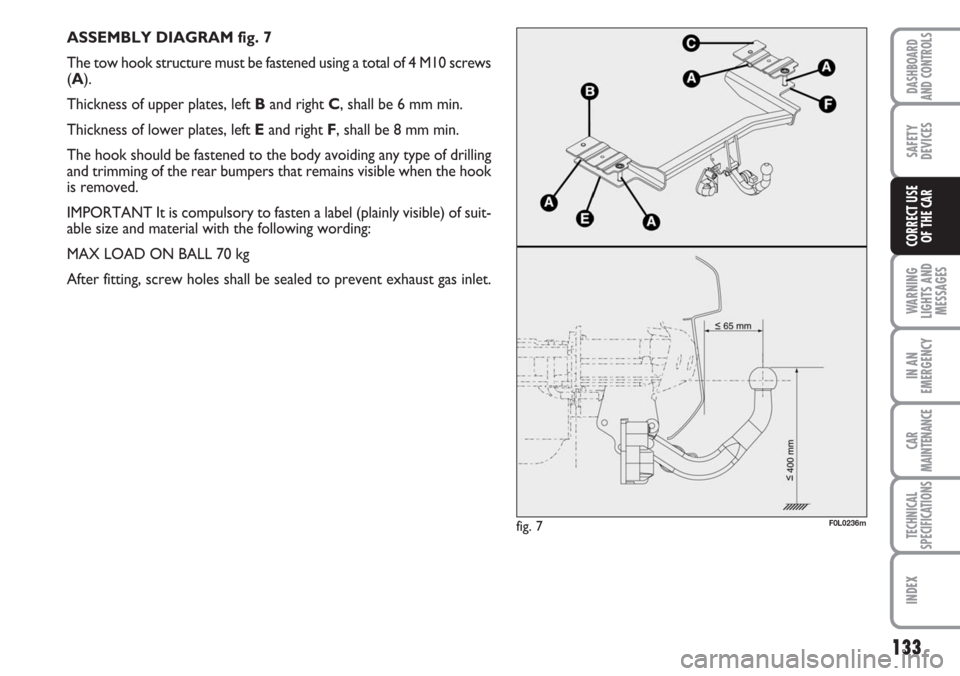
ASSEMBLY DIAGRAM fig. 7
The tow hook structure must be fastened using a total of 4 M10 screws
(A).
Thickness of upper plates, left Band right C, shall be 6 mm min.
Thickness of lower plates, left Eand right F, shall be 8 mm min.
The hook should be fastened to the body avoiding any type of drilling
and trimming of the rear bumpers that remains visible when the hook
is removed.
IMPORTANT It is compulsory to fasten a label (plainly visible) of suit-
able size and material with the following wording:
MAX LOAD ON BALL 70 kg
After fitting, screw holes shall be sealed to prevent exhaust gas inlet.
133
WARNING
LIGHTS AND
MESSAGES
IN AN
EMERGENCY
CAR
MAINTENANCE
TECHNICAL
SPECIFICATIONS
INDEX
DASHBOARD
AND CONTROLS
SAFETY
DEVICES
CORRECT USE
OF THE CAR
fig. 7F0L0236m
Page 140 of 240
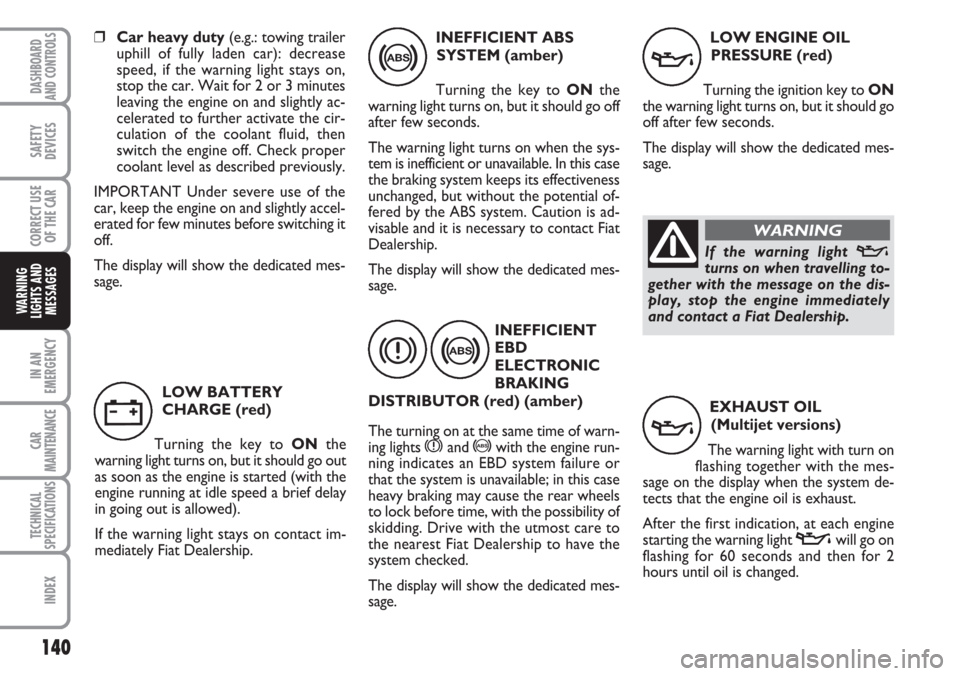
EXHAUST OIL
(Multijet versions)
The warning light with turn on
flashing together with the mes-
sage on the display when the system de-
tects that the engine oil is exhaust.
After the first indication, at each engine
starting the warning light
vwill go on
flashing for 60 seconds and then for 2
hours until oil is changed.
140
IN AN
EMERGENCY
CAR
MAINTENANCE
TECHNICAL
SPECIFICATIONS
INDEX
DASHBOARD
AND CONTROLS
SAFETY
DEVICES
CORRECT USE
OF THE CAR
WARNING
LIGHTS AND
MESSAGES
❒Car heavy duty(e.g.: towing trailer
uphill of fully laden car): decrease
speed, if the warning light stays on,
stop the car. Wait for 2 or 3 minutes
leaving the engine on and slightly ac-
celerated to further activate the cir-
culation of the coolant fluid, then
switch the engine off. Check proper
coolant level as described previously.
IMPORTANT Under severe use of the
car, keep the engine on and slightly accel-
erated for few minutes before switching it
off.
The display will show the dedicated mes-
sage.
LOW BATTERY
CHARGE (red)
Turning the key to ONthe
warning light turns on, but it should go out
as soon as the engine is started (with the
engine running at idle speed a brief delay
in going out is allowed).
If the warning light stays on contact im-
mediately Fiat Dealership.
w
INEFFICIENT ABS
SYSTEM (amber)
Turning the key to ONthe
warning light turns on, but it should go off
after few seconds.
The warning light turns on when the sys-
tem is inefficient or unavailable. In this case
the braking system keeps its effectiveness
unchanged, but without the potential of-
fered by the ABS system. Caution is ad-
visable and it is necessary to contact Fiat
Dealership.
The display will show the dedicated mes-
sage.
>
INEFFICIENT
EBD
ELECTRONIC
BRAKING
DISTRIBUTOR (red) (amber)
The turning on at the same time of warn-
ing lights
xand >with the engine run-
ning indicates an EBD system failure or
that the system is unavailable; in this case
heavy braking may cause the rear wheels
to lock before time, with the possibility of
skidding. Drive with the utmost care to
the nearest Fiat Dealership to have the
system checked.
The display will show the dedicated mes-
sage.
x>
LOW ENGINE OIL
PRESSURE (red)
Turning the ignition key to ON
the warning light turns on, but it should go
off after few seconds.
The display will show the dedicated mes-
sage.
v
v
If the warning light vturns on when travelling to-
gether with the message on the dis-
play, stop the engine immediately
and contact a Fiat Dealership.
WARNING