temperature FIAT CROMA 2006 2.G Owner's Manual
[x] Cancel search | Manufacturer: FIAT, Model Year: 2006, Model line: CROMA, Model: FIAT CROMA 2006 2.GPages: 240, PDF Size: 7.41 MB
Page 122 of 240
IMPORTANT If it is not possible to turn
the ignition key to ON, remove the emer-
gency key, fit it into slot A-fig. 1to un-
lock the ignition switch; then, turn the key
to ONand follow the starting procedure.
Contact Fiat Dealership.
IMPORTANT Never leave the ignition key
into the ignition switch when the engine
is off. In this event, when opening the dri-
ver’s door, a buzzer will sound for about
1 second.
HOW TO WARM UP THE
ENGINE AFTER IT HAS JUST
STARTED (petrol and diesel
engines)
Proceed as follows:
❒Drive off slowly, letting the engine turn
at medium revs. Do not accelerate
abruptly;
❒Do not drive at full performance for
the initial kilometres. Wait until the
coolant temperature gauge starts
moving.
122
WARNING
LIGHTS AND
MESSAGES
IN AN
EMERGENCY
CAR
MAINTENANCE
TECHNICAL
SPECIFICATIONS
INDEX
DASHBOARD
AND CONTROLS
SAFETY
DEVICES
CORRECT USE
OF THE CAR
Never bump start the engine
by pushing, towing or coasting
downhill as this could cause
fuel to flow into the catalytic
exhaust system and damage it beyond
repair.
A quick burst on the acceler-
ator before turning off the en-
gine serves absolutely no prac-
tical purpose, it wastes fuel
and is damaging especially to tur-
bocharged engines.
Remember that the servo-
brake and power steering
are not operational until the engine
has been started, therefore much ef-
fort than usual is required on the
brake pedal and steering wheel.
WARNING
STOPPING THE ENGINE
Turn the ignition key to OFFwhile the
engine is idling.
IMPORTANT After a taxing drive, you
should allow the engine to “catch its
breath” before turning it off by letting it
idle to allow the temperature in the en-
gine compartment to fall.
IMPORTANT If the engine is turned off
while the car is still moving, for safety rea-
sons it will be impossible to remove the
key from the ignition switch. To remove
the key, turn it to ONand then to OFF
with the car stopped without forcing at re-
moval.
Page 128 of 240
When stopping the car with a gear high-
er than 1st gear, transmission will set au-
tomatically at 1st gear.
When stopping the car under poor grip
conditions (snow, ice), at next starting the
transmission control unit could engage a
gear higher than 1st gear to prevent wheel
slipping. This shall not be considered as a
fault
IMPORTANT: in the event of excessive
oil temperatures (see section “Warning
lights and messages”), the electronic con-
trol intervenes excluding sequential mode
and activating automatic mode in order to
safeguard transmission life. Sequential
mode will be resumed as soon as regular
operating temperatures are restored.AUTOMATIC MODE
D can be selected from sequential mode
under whatever driving condition.
When passing from sequential mode to D,
the gear to engage is selected by trans-
mission control unit according to engine
rpm and speed (accelerator pedal posi-
tion).
Low engine power demand will result in
long gears engagement and reduced fuel
consumption. Increasing speed by press-
ing the accelerator will automatically en-
gage short gears that will result in im-
proved performance as to pickup and ac-
celeration: in this case fuel consumption
will increase.
For speedy pickup:
❒press the accelerator pedal flat-out,
the kick-down device will cut in to ob-
tain max. performance in terms of
pickup and acceleration. In this case fu-
el consumption will obviously increase.
IMPORTANT When driving under poor
grip conditions (snow, ice, etc.) avoid to
engage the kick-down device. SEQUENTIAL MODE
In sequential mode, the electronic auto-
matic transmission works like a fixed gear
sequential gearbox.
From position D move the gear lever left-
wards:
❒move gear lever to +: to upshift;
❒move gear lever to –: to downshift.
Gears are displayed by digits on the in-
strument panel. Non-stop monitoring car-
ried out by transmission control unit ex-
cludes whatever possibility of error.
Downshifting (or upshifting) is only pos-
sible if engine rpm enables it.
In sequential mode, electronic transmis-
sion control can however intervene in self-
adapting mode by shifting gears automat-
ically when engine rpm exceeds or falls be-
low the admitted rpm limit.
128
WARNING
LIGHTS AND
MESSAGES
IN AN
EMERGENCY
CAR
MAINTENANCE
TECHNICAL
SPECIFICATIONS
INDEX
DASHBOARD
AND CONTROLS
SAFETY
DEVICES
CORRECT USE
OF THE CAR
Page 130 of 240
Roof rack/ski rack
Remove the roof rack or the ski rack from
the roof as soon as they are no longer
used. These accessories lower air pene-
tration and adversely affect consumption
levels. When needing to carry particular-
ly voluminous objects, preferably use a
trailer.
Electric devices
Use electric devices only for the amount
of time needed. Rear heated window, ad-
ditional headlights, windscreen wipers and
heater fan need a considerable amount of
energy, therefore increasing the require-
ment of current increases fuel consump-
tion (up to +25% in the urban cycle).
Climate control
The air conditioner is an additional load
which greatly affects the engine leading to
higher consumption (on average up to
+20%). When the temperature outside
the car permits it, use the air vents where
possible.
Spoilers
The use of non-certified aerodynamic
items may adversely affect air drag and
consumption levels.DRIVING STYLE
Starting
Do not warm the engine with the car at
a standstill or at idle or high speed: under
these conditions the engine warms up
much more slowly, increasing electrical
consumption and emissions. It is therefore
advisable to move off immediately, slow-
ly, avoiding high speeds. This way the en-
gine will warm faster.
Unnecessary actions
Avoid accelerating when waiting at traffic
lights or before switching off the engine.
This and also double declutching is ab-
solutely pointless on modern cars and al-
so increase consumption and pollution.
Gear selection
As soon as the conditions of the traffic and
road allow, use a higher gear. Using a low
gear to obtain brilliant performance in-
creases consumption.
In the same way improper use of a high
gear increases consumption, emissions an
engine wear.CONTAINING
RUNNING COSTS
Here are some suggestions which may
help you to keep the running costs of your
car down and lower the amount of toxic
emissions released into the atmosphere.
GENERAL CONSIDERATIONS
Car maintenance
Have checks and adjustments carried out
in accordance with the “Service schedule”.
Tyres
Check the pressure of the tyres routine-
ly at an interval of no more than 4 weeks:
if the pressure is too low, consumption
levels increase as resistance to rolling is
higher.
Unnecessary loads
Do not travel with too much luggage
stowed in the boot. The weight of the car
(especially when driving in town) and its
trim greatly affects consumption and sta-
bility.
130
WARNING
LIGHTS AND
MESSAGES
IN AN
EMERGENCY
CAR
MAINTENANCE
TECHNICAL
SPECIFICATIONS
INDEX
DASHBOARD
AND CONTROLS
SAFETY
DEVICES
CORRECT USE
OF THE CAR
Page 131 of 240
Traffic situations and road
conditions
Rather high consumption levels are tied to
situations with heavy traffic, for example
in queues with frequent use of the lower
gears or in cities with many traffic lights.
Also winding mountain roads and rough
road surfaces adversely affect consump-
tion.
Traffic hold-ups
During prolonged hold-ups (e.g.: level
crossings) the engine should be switched
off.TOWING TRAILERS
IMPORTANT NOTES
For towing caravans or trailers the car
must be fitted with a certified tow hook
and an adequate electric system. Installa-
tion should be carried out by specialised
personnel who release a special document
for circulation on the road.
Install any specific and/or additional rear-
view mirrors as specified by law.
Remember that when towing a trailer,
steep hills are harder to climb, the brak-
ing spaces increase and overtaking takes
longer depending on the overall weight.
Engage a low gear when driving downhill,
rather than constantly using the brake.
The weight the trailer exerts on the car
tow hook reduces by the same amount
the actual car loading capacity. To make
sure the maximum towable weight is not
exceeded (given in the log book) account
should be taken of the fully laden trailer,
including accessories and personal be-
longings. Top speed
Fuel consumption considerably increases
with speed. Avoid superfluous braking and
accelerating, which cost in terms of both
fuel and emissions.
Acceleration
Accelerating violently increasing the revs
will greatly affect consumption and emis-
sions: acceleration should be gradual and
should not exceed the maximum torque.
CONDITIONS OF USE
Cold starting
Short journeys and frequent cold starts do
not allow the engine to reach optimum
operating temperature. This results in a
significant increase in consumption levels
(from +15 to +30% on the urban cycle)
and emission of harmful substances.
131
WARNING
LIGHTS AND
MESSAGES
IN AN
EMERGENCY
CAR
MAINTENANCE
TECHNICAL
SPECIFICATIONS
INDEX
DASHBOARD
AND CONTROLS
SAFETY
DEVICES
CORRECT USE
OF THE CAR
Page 137 of 240
137
IN AN
EMERGENCY
CAR
MAINTENANCE
TECHNICAL
SPECIFICATIONS
INDEX
DASHBOARD
AND CONTROLS
SAFETY
DEVICES
CORRECT USE
OF THE CAR
WARNING
LIGHTS AND
MESSAGES
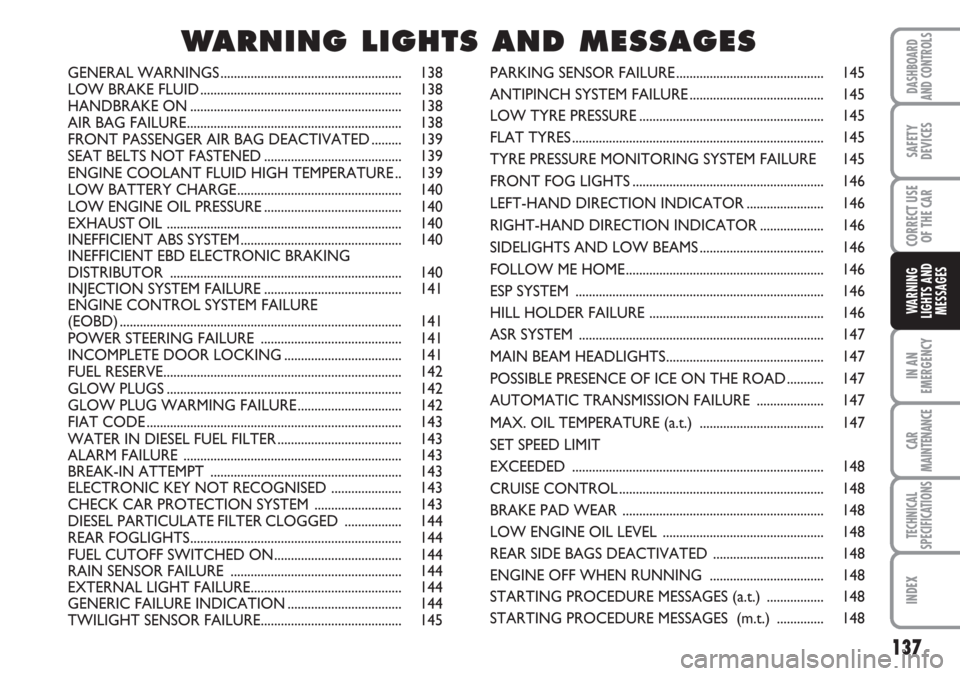
GENERAL WARNINGS ...................................................... 138
LOW BRAKE FLUID ............................................................ 138
HANDBRAKE ON ............................................................... 138
AIR BAG FAILURE................................................................ 138
FRONT PASSENGER AIR BAG DEACTIVATED ......... 139
SEAT BELTS NOT FASTENED ......................................... 139
ENGINE COOLANT FLUID HIGH TEMPERATURE .. 139
LOW BATTERY CHARGE................................................. 140
LOW ENGINE OIL PRESSURE ......................................... 140
EXHAUST OIL ...................................................................... 140
INEFFICIENT ABS SYSTEM ................................................ 140
INEFFICIENT EBD ELECTRONIC BRAKING
DISTRIBUTOR ..................................................................... 140
INJECTION SYSTEM FAILURE ......................................... 141
ENGINE CONTROL SYSTEM FAILURE
(EOBD) .................................................................................... 141
POWER STEERING FAILURE .......................................... 141
INCOMPLETE DOOR LOCKING ................................... 141
FUEL RESERVE....................................................................... 142
GLOW PLUGS ...................................................................... 142
GLOW PLUG WARMING FAILURE ............................... 142
FIAT CODE ............................................................................ 143
WATER IN DIESEL FUEL FILTER ..................................... 143
ALARM FAILURE ................................................................. 143
BREAK-IN ATTEMPT ......................................................... 143
ELECTRONIC KEY NOT RECOGNISED ..................... 143
CHECK CAR PROTECTION SYSTEM .......................... 143
DIESEL PARTICULATE FILTER CLOGGED ................. 144
REAR FOGLIGHTS............................................................... 144
FUEL CUTOFF SWITCHED ON...................................... 144
RAIN SENSOR FAILURE ................................................... 144
EXTERNAL LIGHT FAILURE............................................. 144
GENERIC FAILURE INDICATION .................................. 144
TWILIGHT SENSOR FAILURE.......................................... 145PARKING SENSOR FAILURE ............................................ 145
ANTIPINCH SYSTEM FAILURE ........................................ 145
LOW TYRE PRESSURE ....................................................... 145
FLAT TYRES ........................................................................... 145
TYRE PRESSURE MONITORING SYSTEM FAILURE 145
FRONT FOG LIGHTS ......................................................... 146
LEFT-HAND DIRECTION INDICATOR ....................... 146
RIGHT-HAND DIRECTION INDICATOR ................... 146
SIDELIGHTS AND LOW BEAMS ..................................... 146
FOLLOW ME HOME ........................................................... 146
ESP SYSTEM .......................................................................... 146
HILL HOLDER FAILURE .................................................... 146
ASR SYSTEM ......................................................................... 147
MAIN BEAM HEADLIGHTS............................................... 147
POSSIBLE PRESENCE OF ICE ON THE ROAD ........... 147
AUTOMATIC TRANSMISSION FAILURE .................... 147
MAX. OIL TEMPERATURE (a.t.) ..................................... 147
SET SPEED LIMIT
EXCEEDED ........................................................................... 148
CRUISE CONTROL ............................................................. 148
BRAKE PAD WEAR ............................................................ 148
LOW ENGINE OIL LEVEL ................................................ 148
REAR SIDE BAGS DEACTIVATED ................................. 148
ENGINE OFF WHEN RUNNING .................................. 148
STARTING PROCEDURE MESSAGES (a.t.) ................. 148
STARTING PROCEDURE MESSAGES (m.t.) .............. 148
W W
A A
R R
N N
I I
N N
G G
L L
I I
G G
H H
T T
S S
A A
N N
D D
M M
E E
S S
S S
A A
G G
E E
S S
Page 139 of 240
139
IN AN
EMERGENCY
CAR
MAINTENANCE
TECHNICAL
SPECIFICATIONS
INDEX
DASHBOARD
AND CONTROLS
SAFETY
DEVICES
CORRECT USE
OF THE CAR
WARNING
LIGHTS AND
MESSAGES
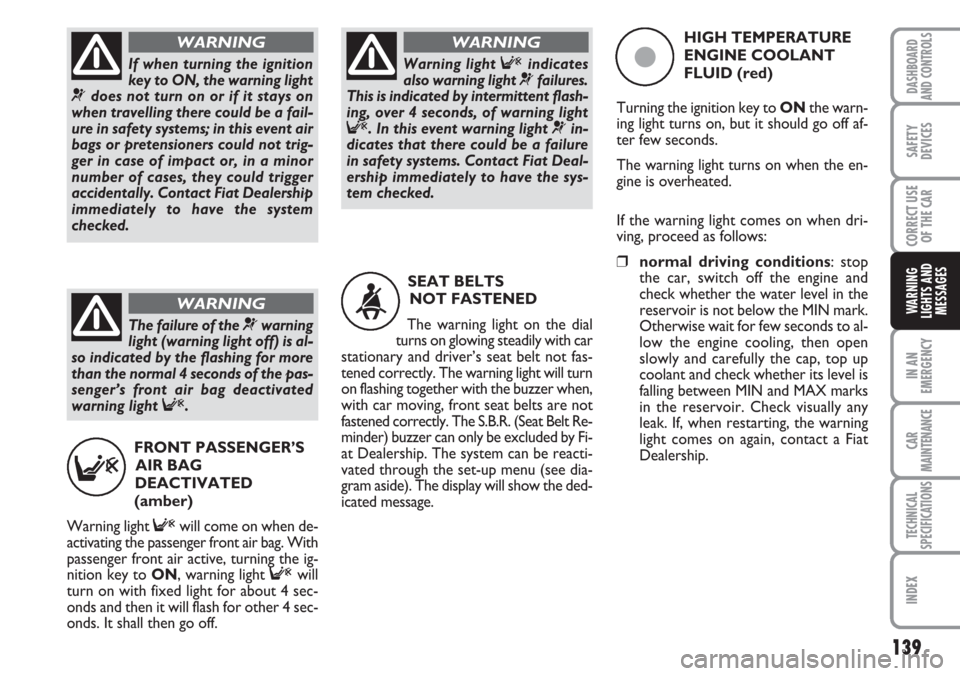
If when turning the ignition
key to ON, the warning light
¬does not turn on or if it stays on
when travelling there could be a fail-
ure in safety systems; in this event air
bags or pretensioners could not trig-
ger in case of impact or, in a minor
number of cases, they could trigger
accidentally. Contact Fiat Dealership
immediately to have the system
checked.
WARNING
The failure of the ¬warning
light (warning light off) is al-
so indicated by the flashing for more
than the normal 4 seconds of the pas-
senger’s front air bag deactivated
warning light
F.
WARNING
FRONT PASSENGER’S
AIR BAG
DEACTIVATED
(amber)
Warning light
Fwill come on when de-
activating the passenger front air bag. With
passenger front air active, turning the ig-
nition key to ON, warning light
Fwill
turn on with fixed light for about 4 sec-
onds and then it will flash for other 4 sec-
onds. It shall then go off.
F
Warning light Findicates
also warning light ¬failures.
This is indicated by intermittent flash-
ing, over 4 seconds, of warning light
F. In this event warning light ¬in-
dicates that there could be a failure
in safety systems. Contact Fiat Deal-
ership immediately to have the sys-
tem checked.
WARNINGHIGH TEMPERATURE
ENGINE COOLANT
FLUID (red)
Turning the ignition key to ONthe warn-
ing light turns on, but it should go off af-
ter few seconds.
The warning light turns on when the en-
gine is overheated.
If the warning light comes on when dri-
ving, proceed as follows:
❒normal driving conditions: stop
the car, switch off the engine and
check whether the water level in the
reservoir is not below the MIN mark.
Otherwise wait for few seconds to al-
low the engine cooling, then open
slowly and carefully the cap, top up
coolant and check whether its level is
falling between MIN and MAX marks
in the reservoir. Check visually any
leak. If, when restarting, the warning
light comes on again, contact a Fiat
Dealership.
ç
SEAT BELTS
NOT FASTENED
The warning light on the dial
turns on glowing steadily with car
stationary and driver’s seat belt not fas-
tened correctly. The warning light will turn
on flashing together with the buzzer when,
with car moving, front seat belts are not
fastened correctly. The S.B.R. (Seat Belt Re-
minder) buzzer can only be excluded by Fi-
at Dealership. The system can be reacti-
vated through the set-up menu (see dia-
gram aside). The display will show the ded-
icated message.
<
Page 142 of 240

142
IN AN
EMERGENCY
CAR
MAINTENANCE
TECHNICAL
SPECIFICATIONS
INDEX
DASHBOARD
AND CONTROLS
SAFETY
DEVICES
CORRECT USE
OF THE CAR
WARNING
LIGHTS AND
MESSAGES
If when turning ignition key at
ON, the warning light U
does not turn on or if it turns
on with fixed light or flashing
(on certain versions together with the
message on the display) when the car
is travelling, contact Fiat Dealership as
soon as possible. Warning light
Uop-
eration can by checked by traffic
agents by proper equipment therefore,
comply with laws and regulations in
force in the country where you are dri-
ving.
ç
FUEL RESERVE
(amber)
Turning the ignition key to ON
the warning light comes on but shall go off
after few seconds.
The warning light turns on when about 5
litres fuel are left in the tank.
IMPORTANT The warning light flashes to
indicate a failure, contact Fiat Dealership
as soon as possible to have the system
checked.GLOW PLUG
WARMING
(Multijet versions -
amber)
GLOW PLUG WARMING
FAILURE
(Multijet versions - amber)
Glow plug warming
Turning the ignition key to ONthe warn-
ing light turns on and it will go off when
glow plugs reach the preset temperature.
Start the engine immediately after warn-
ing light turning off.
IMPORTANT With hot ambient temper-
ature, warning light stays on for very short
time.
Glow plug warming failure
The warning light turns on when there is
a failure in the glow plug warming system.
Contact Fiat Dealership as soon as possi-
ble.
The display will show the dedicated mes-
sage.
m
If the light flashes, it is necessary to release
the accelerator pedal to lower the speed
of the engine until the warning light stops
flashing; continue the journey at moder-
ate speed, trying to avoid driving condi-
tions that may cause further flashing and
contact Fiat Dealership as soon as possi-
ble.
Page 147 of 240
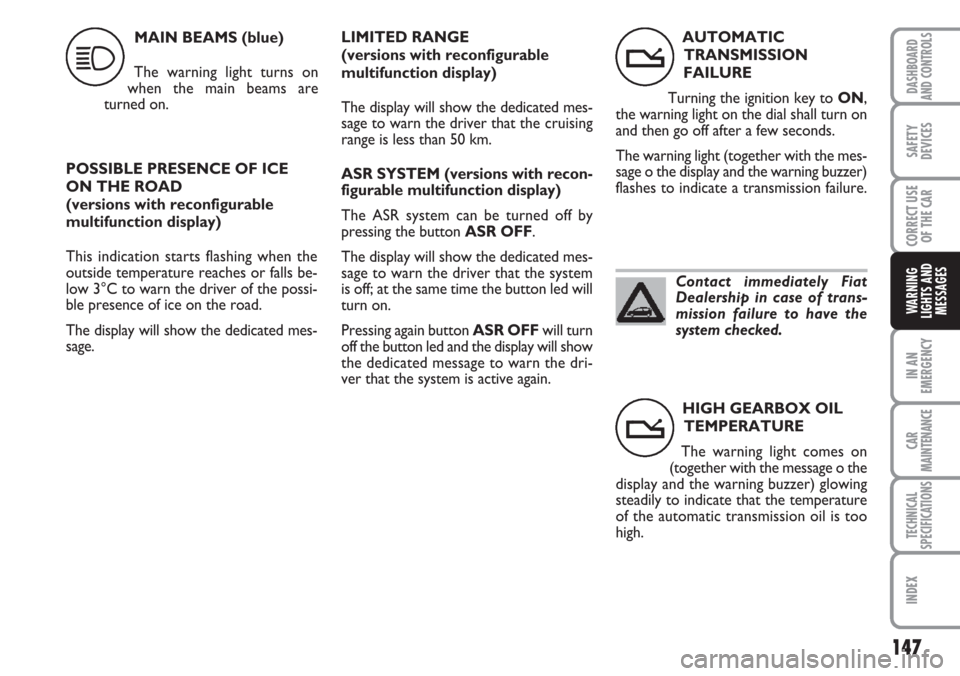
HIGH GEARBOX OIL
TEMPERATURE
The warning light comes on
(together with the message o the
display and the warning buzzer) glowing
steadily to indicate that the temperature
of the automatic transmission oil is too
high.Contact immediately Fiat
Dealership in case of trans-
mission failure to have the
system checked.AUTOMATIC
TRANSMISSION
FAILURE
Turning the ignition key to ON,
the warning light on the dial shall turn on
and then go off after a few seconds.
The warning light (together with the mes-
sage o the display and the warning buzzer)
flashes to indicate a transmission failure.
147
IN AN
EMERGENCY
CAR
MAINTENANCE
TECHNICAL
SPECIFICATIONS
INDEX
DASHBOARD
AND CONTROLS
SAFETY
DEVICES
CORRECT USE
OF THE CAR
WARNING
LIGHTS AND
MESSAGES
MAIN BEAMS (blue)
The warning light turns on
when the main beams are
turned on.
1
LIMITED RANGE
(versions with reconfigurable
multifunction display)
The display will show the dedicated mes-
sage to warn the driver that the cruising
range is less than 50 km.
ASR SYSTEM (versions with recon-
figurable multifunction display)
The ASR system can be turned off by
pressing the button ASR OFF.
The display will show the dedicated mes-
sage to warn the driver that the system
is off; at the same time the button led will
turn on.
Pressing again button ASR OFFwill turn
off the button led and the display will show
the dedicated message to warn the dri-
ver that the system is active again. POSSIBLE PRESENCE OF ICE
ON THE ROAD
(versions with reconfigurable
multifunction display)
This indication starts flashing when the
outside temperature reaches or falls be-
low 3°C to warn the driver of the possi-
ble presence of ice on the road.
The display will show the dedicated mes-
sage.
t
t
Page 195 of 240
195
WARNING
LIGHTS AND
MESSAGES
TECHNICAL
SPECIFICATIONS
INDEX
DASHBOARD
AND CONTROLS
SAFETY
DEVICES
CORRECT USE
OF THE CAR
IN AN
EMERGENCY
CAR
MAINTENANCE
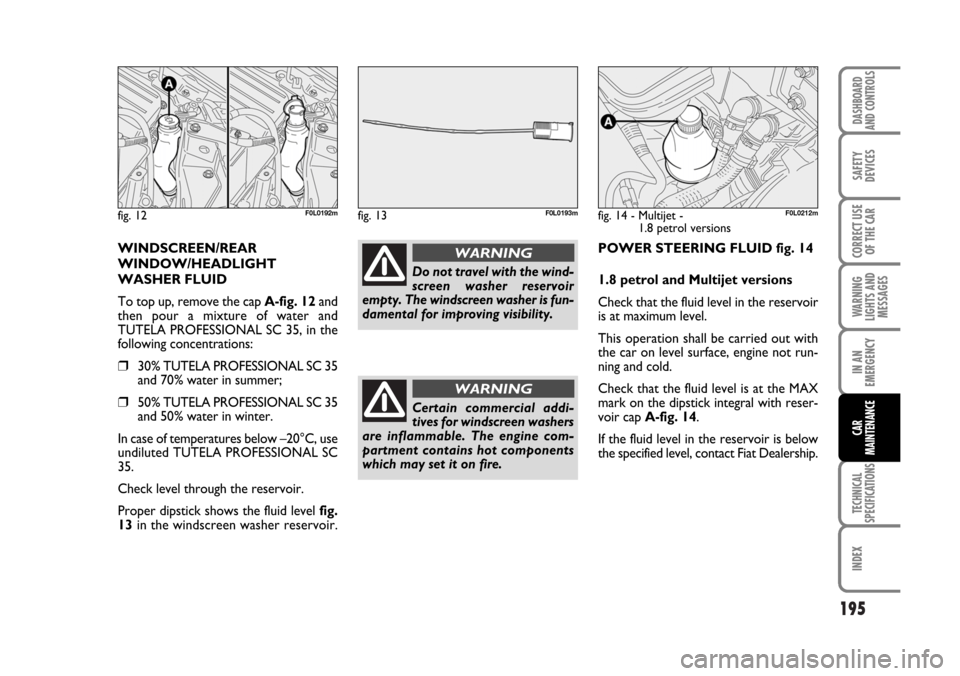
POWER STEERING FLUID fig. 14
1.8 petrol and Multijet versions
Check that the fluid level in the reservoir
is at maximum level.
This operation shall be carried out with
the car on level surface, engine not run-
ning and cold.
Check that the fluid level is at the MAX
mark on the dipstick integral with reser-
voir cap A-fig. 14.
If the fluid level in the reservoir is below
the specified level, contact Fiat Dealership. WINDSCREEN/REAR
WINDOW/HEADLIGHT
WASHER FLUID
To top up, remove the cap A-fig. 12and
then pour a mixture of water and
TUTELA PROFESSIONAL SC 35, in the
following concentrations:
❒30% TUTELA PROFESSIONAL SC 35
and 70% water in summer;
❒50% TUTELA PROFESSIONAL SC 35
and 50% water in winter.
In case of temperatures below –20°C, use
undiluted TUTELA PROFESSIONAL SC
35.
Check level through the reservoir.
Proper dipstick shows the fluid level fig.
13in the windscreen washer reservoir.
fig. 12F0L0192mfig. 13F0L0193m
Do not travel with the wind-
screen washer reservoir
empty. The windscreen washer is fun-
damental for improving visibility.
WARNING
Certain commercial addi-
tives for windscreen washers
are inflammable. The engine com-
partment contains hot components
which may set it on fire.
WARNING
fig. 14 - Multijet -
1.8 petrol versionsF0L0212m
183-206 Croma TRW GB 20-11-2006 15:03 Pagina 195
Page 201 of 240
201
WARNING
LIGHTS AND
MESSAGES
TECHNICAL
SPECIFICATIONS
INDEX
DASHBOARD
AND CONTROLS
SAFETY
DEVICES
CORRECT USE
OF THE CAR
IN AN
EMERGENCY
CAR
MAINTENANCE
❒If a tyre is punctured, stop immediate-
ly and change it to avoid damage to the
tyre, the rim, suspensions and steering
system;
❒Tyres age even if they are not used
much. Cracks in the tread rubber are
a sign of ageing. In any case, if the tyres
have been on the car for over 6 years,
they should be checked by specialised
personnel, to see if they can still be
used. Also remember to check the
space-saver spare wheel;
❒In the case of replacement, always fit
new tyres, avoiding those of dubious
origin;
❒If a tyre is changed, also change the in-
flation valve;
❒To allow even wear between the front
and rear tyres, it is advisable to change
them over every 10-15 thousand kilo-
metres, keeping them on the same
side of the car so as to not reverse the
direction of rotation.
Remember that road holding
depends also on the correct
tyre inflating pressure.
WARNING
Do not cross switch the
tyres, moving them from the
right of the car to the left and vice
versa.
WARNING
If the pressure is too low the
tyre overheats and this can
cause it serious damage.
WARNING
Never submit alloy rims to
repainting treatments re-
quiring to use temperatures exceed-
ing 150°C since the mechanical prop-
erties of the wheels could be im-
paired.
WARNING
RUBBER HOSES
As far as the brake system and fuel rubber
hoses are concerned, carefully follow the
“Service schedule” in this section.
Indeed ozone, high temperatures and pro-
longed lack of fluid in the system may
cause hardening and cracking of the hoses,
with possible leaks. Careful control is
therefore necessary.
183-206 Croma TRW GB 20-11-2006 15:03 Pagina 201