engine FIAT CROMA 2006 2.G Workshop Manual
[x] Cancel search | Manufacturer: FIAT, Model Year: 2006, Model line: CROMA, Model: FIAT CROMA 2006 2.GPages: 240, PDF Size: 7.41 MB
Page 144 of 240
Warning light vturns on
together with the dedicated
message on the display to in-
dicate that the cleaning pro-
cedure cannot be performed, contact
Fiat Dealership as soon as possible.
144
IN AN
EMERGENCY
CAR
MAINTENANCE
TECHNICAL
SPECIFICATIONS
INDEX
DASHBOARD
AND CONTROLS
SAFETY
DEVICES
CORRECT USE
OF THE CAR
WARNING
LIGHTS AND
MESSAGES
GENERIC FAILURE
INDICATION
(amber)
The warning light turns on in the follow-
ing circumstances.
Engine oil pressure
sensor failure
The warning light comes on when the en-
gine oil pressure sensor is faulty. Contact
Fiat Dealership as soon as possible.
The display will show the dedicated mes-
sage.
è
EXTERNAL LIGHT
FAILURE (amber)
The warning light turns on
when one of the following lights is failing:
– side/taillights
– brake lights (third brake light excluded)
– rear fog lights
– direction indicators
– number plate lights.
The failure referring to these lights could
be: one or more blown bulbs, a blown
protection fuse or an electric connection
cut-off.
The display will show the dedicated mes-
sage.
W
REAR FOG LIGHTS
(amber)
The warning light turns on
when the rear fog lights are turned on.
4
Diesel particulate filter clogged
(Multijet versions)
The warning light turns on together with
the message on the display and the buzzer
when the diesel particulate filter is clogged
and the driving conditions do not enable
to activate automatically the reclaiming
procedure.
To enable the cleaning procedure, keep
the car running until the warning light
turns off.
Inertial fuel cut-off switch
intervened
The warning light turns on together with
the message on the display, when the in-
ertial fuel cut-off switch is triggered.
To reset the fuel cut-off switch, see para-
graph “Power and fuel cut-off switch” in
section “Dashboard and controls”.
Rain sensor failure
The warning light on the dial turns on (on
certain versions together with the mes-
sage on the display) when the rain sensor
is faulty. Contact Fiat Dealership.
Page 148 of 240
Should the warning light turn
on glowing steadily, reduce
engine perormance and con-
tact immediately Fiat Dealer-
ship.
148
IN AN
EMERGENCY
CAR
MAINTENANCE
TECHNICAL
SPECIFICATIONS
INDEX
DASHBOARD
AND CONTROLS
SAFETY
DEVICES
CORRECT USE
OF THE CAR
WARNING
LIGHTS AND
MESSAGES
SPEED LIMIT EXCEEDED
The display will show the dedicated mes-
sage and the buzzer will sound when the car
exceeds the speed limit set previously (see
“Reconfigurable Multifunction Display” in
section “Dashboard and controls”).
CRUISE CONTROL
(where provided)
The warning light turns on to-
gether with the message on the
display when turning the knurled ring of
the Cruise Control to ON.
BRAKE PAD WEAR
The warning light on the dial
turns on (together with the
message on the display) if the
front brake pads are worn; in this case have
them changed as soon as possible.LOW ENGINE OIL
LEVEL
The warning light (if any) on the
dial comes on together with the
message on the display and the buzzer
when the engine oil level falls below the
minimum level. Restore proper oil level
(see “Checking levels” in section “Car
maintenance”).
Turning the ignition key to ONthe warn-
ing light on the dial turns on but it should
go off after few seconds.
k
REAR SIDE BAGS
DEACTIVATED
(where provided)
Dial warning light
Àcomes on
when deactivating rear side bags. With
rear side bags on, turning the ignition key
to ON, warning light
Àcomes on first
with fixed light and then it will star flash-
ing for a few seconds. It shall then go off.
À
ENGINE OFF WHEN RUNNING
Message is displayed when the engine is
turned off at a speed higher than 10 km/h;
steering lock is disabled.
To restore the function, turn the ignition
key to ONand then to OFFagain with
the car stopped.
STARTING PROCEDURE
MESSAGES
(automatic transmission)
Starting procedure messages shown on
the display when reaching position ON
with enabled key.
STARTING PROCEDURE
MESSAGES (manual transmission)
Starting procedure messages shown on
the display when reaching position ON
with enabled key.
d
Ü
Page 150 of 240
150
WARNING
LIGHTS AND
MESSAGES
CAR
MAINTENANCE
TECHNICAL
SPECIFICATIONS
INDEX
DASHBOARD
AND CONTROLS
SAFETY
DEVICES
CORRECT USE
OF THE CAR
IN AN
EMERGENCY
If after a few attempts the engine does not
start, do not insist but contact the nea-
rest Fiat Dealership.
IMPORTANT Do not directly connect the
negative terminals of the two batteries:
sparks could ignite the flammable gas from
the battery. If the other battery is fitted in
another car, prevent accidental contacts
between the metal parts of the two cars.
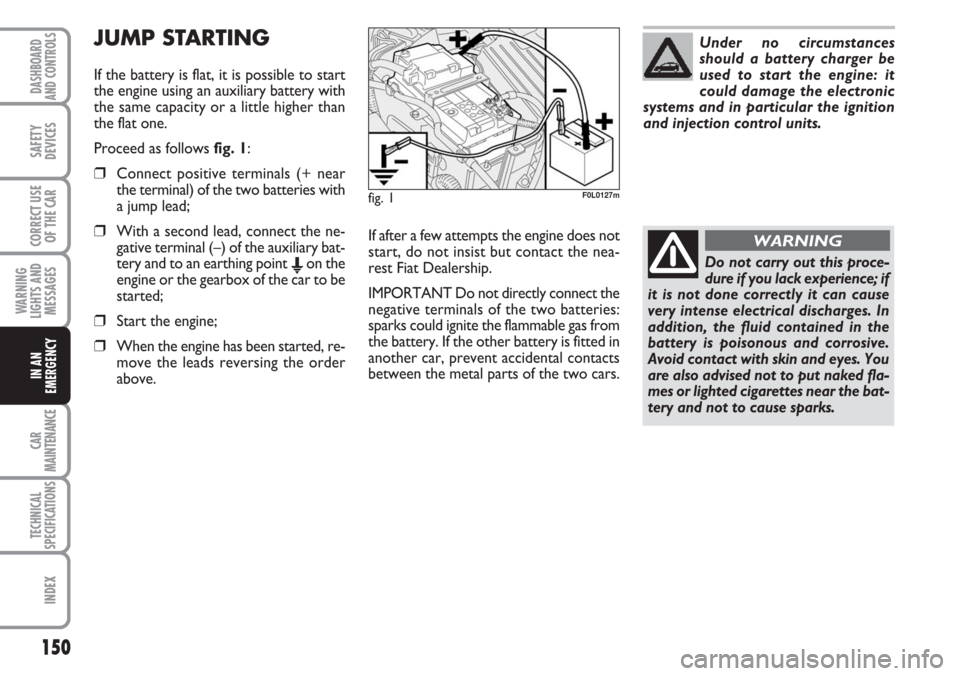
JUMP STARTING
If the battery is flat, it is possible to start
the engine using an auxiliary battery with
the same capacity or a little higher than
the flat one.
Proceed as follows fig. 1:
❒Connect positive terminals (+ near
the terminal) of the two batteries with
a jump lead;
❒With a second lead, connect the ne-
gative terminal (–) of the auxiliary bat-
tery and to an earthing point
Eon the
engine or the gearbox of the car to be
started;
❒Start the engine;
❒When the engine has been started, re-
move the leads reversing the order
above.
fig. 1F0L0127m
Under no circumstances
should a battery charger be
used to start the engine: it
could damage the electronic
systems and in particular the ignition
and injection control units.
Do not carry out this proce-
dure if you lack experience; if
it is not done correctly it can cause
very intense electrical discharges. In
addition, the fluid contained in the
battery is poisonous and corrosive.
Avoid contact with skin and eyes. You
are also advised not to put naked fla-
mes or lighted cigarettes near the bat-
tery and not to cause sparks.
WARNING
Page 151 of 240
151
WARNING
LIGHTS AND
MESSAGES
CAR
MAINTENANCE
TECHNICAL
SPECIFICATIONS
INDEX
DASHBOARD
AND CONTROLS
SAFETY
DEVICES
CORRECT USE
OF THE CAR
IN AN
EMERGENCY
IF A TYRE IS
PUNCTURED
GENERAL INSTRUCTIONS
Wheel changing and correct use of the
jack and space-saver spare wheel call for
some precautions as listed below.
BUMP STARTING
Never bump start the engine (by pushing,
towing, or coasting downhill) as this could
cause fuel to flow into the catalytic exhau-
st system and damage it beyond repair.
Remember that the brake booster and the
power steering system are not operating
until the engine is started, a greater effort
will therefore be required to press the
brake pedal or to turn the steering wheel.
Alert other drivers that the
car is stationary in com-
pliance with local regulations: hazard
warning lights, warning triangle etc.
Any passengers on board should lea-
ve the car, especially if it is heavily la-
den. Passengers should stay away
from oncoming traffic while the
wheel is being changed on. If the
wheel is being changed on a steep or
badly surfaced road, place the wed-
ges or other suitable material under
the wheel to stop the car.
WARNING
The space-saver spare wheel
is specific to your car, do not
use it on other models, or use the spa-
re wheel of other models on your car.
The space-saver spare wheel shall
only be used in an emergency.
It shall only be used for the distance
necessary to reach a service point and
the car speed shall not exceed 80
Km/h. The spare wheel has an oran-
ge sticker that summarises the main
cautions for use and limitations. The
sticker should never be removed or
covered.
Never fit a wheel cap on a space-sa-
ver spare wheel. The sticker gives the
following information in four langua-
ges: caution! For temporary use only!
80 km/h max! Replace by normal
wheel as soon as possible. Do not co-
ver this label.
WARNING
Page 153 of 240
153
WARNING
LIGHTS AND
MESSAGES
CAR
MAINTENANCE
TECHNICAL
SPECIFICATIONS
INDEX
DASHBOARD
AND CONTROLS
SAFETY
DEVICES
CORRECT USE
OF THE CAR
IN AN
EMERGENCY
To change a wheel proceed as follows:
❒Stop the car in a position that is not
dangerous for oncoming traffic where
you can change the wheel safely. The
ground should be flat and adequately
firm;
❒Turn the engine off and pull up the
handbrake;
❒Engage first gear or reverse (position
P with automatic transmission);
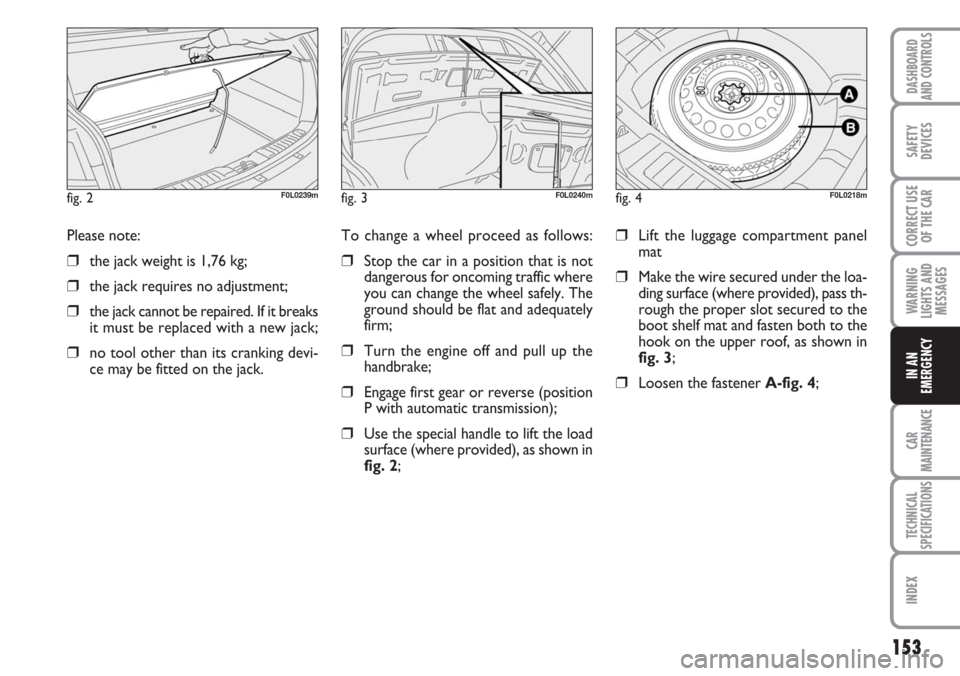
❒Use the special handle to lift the load
surface (where provided), as shown in
fig. 2;
❒Lift the luggage compartment panel
mat
❒Make the wire secured under the loa-
ding surface (where provided), pass th-
rough the proper slot secured to the
boot shelf mat and fasten both to the
hook on the upper roof, as shown in
fig. 3;
❒Loosen the fastener A-fig. 4; Please note:
❒the jack weight is 1,76 kg;
❒the jack requires no adjustment;
❒the jack cannot be repaired. If it breaks
it must be replaced with a new jack;
❒no tool other than its cranking devi-
ce may be fitted on the jack.
fig. 2F0L0239mfig. 3F0L0240mfig. 4F0L0218m
Page 171 of 240
171
WARNING
LIGHTS AND
MESSAGES
CAR
MAINTENANCE
TECHNICAL
SPECIFICATIONS
INDEX
DASHBOARD
AND CONTROLS
SAFETY
DEVICES
CORRECT USE
OF THE CAR
IN AN
EMERGENCY
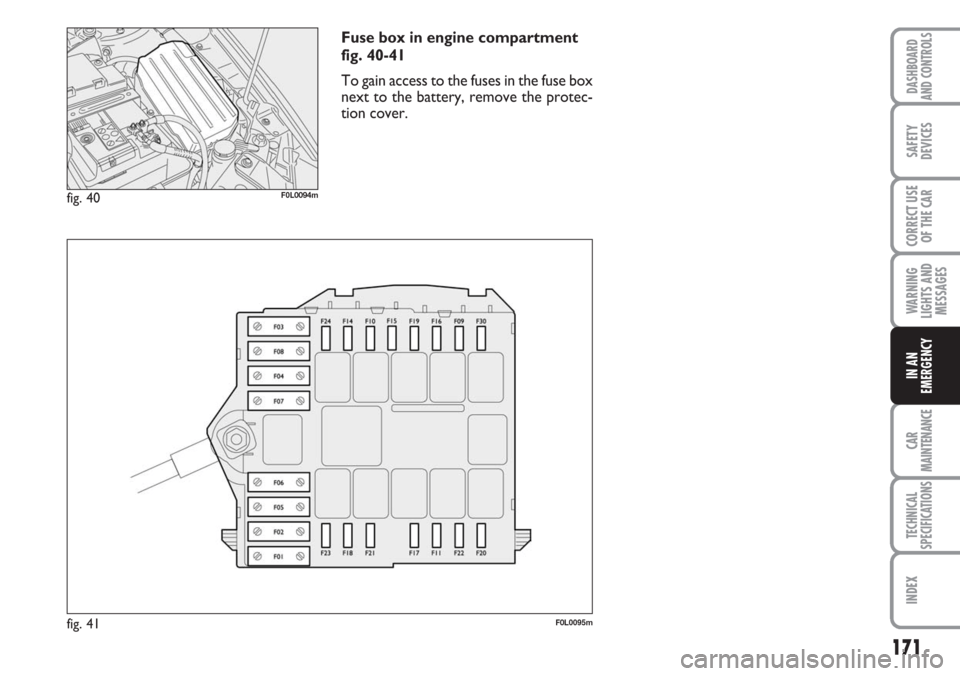
Fuse box in engine compartment
fig. 40-41
To gain access to the fuses in the fuse box
next to the battery, remove the protec-
tion cover.
fig. 40
fig. 41F0L0094m
F0L0095m
Page 174 of 240
174
WARNING
LIGHTS AND
MESSAGES
CAR
MAINTENANCE
TECHNICAL
SPECIFICATIONS
INDEX
DASHBOARD
AND CONTROLS
SAFETY
DEVICES
CORRECT USE
OF THE CAR
IN AN
EMERGENCY
F 12
F 13
F 31
F 32
F 33
F 34
F 35
F 36
F 37
F 38
F 39
F 40
F 41
F 42
F 43
F 44
F 45
F 4615
15
7.5
15
20
20
7.5
20
10
15
10
30
15
7.5
30
20
20
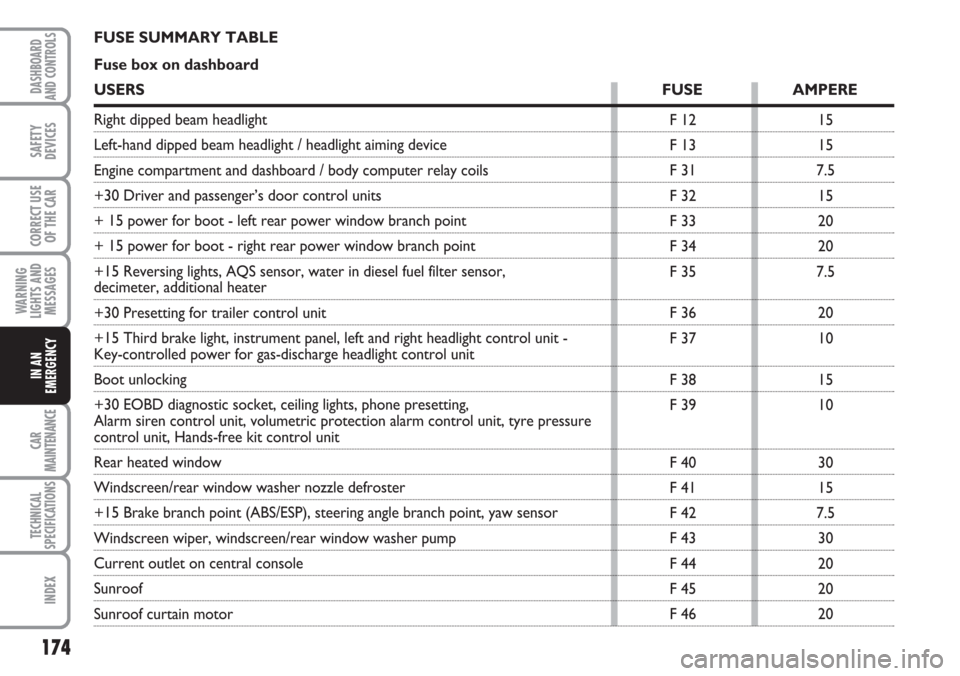
20 FUSE SUMMARY TABLE
Fuse box on dashboard
USERSFUSE AMPERE
Right dipped beam headlight
Left-hand dipped beam headlight / headlight aiming device
Engine compartment and dashboard / body computer relay coils
+30 Driver and passenger’s door control units
+ 15 power for boot - left rear power window branch point
+ 15 power for boot - right rear power window branch point
+15 Reversing lights, AQS sensor, water in diesel fuel filter sensor,
decimeter, additional heater
+30 Presetting for trailer control unit
+15 Third brake light, instrument panel, left and right headlight control unit -
Key-controlled power for gas-discharge headlight control unit
Boot unlocking
+30 EOBD diagnostic socket, ceiling lights, phone presetting,
Alarm siren control unit, volumetric protection alarm control unit, tyre pressure
control unit, Hands-free kit control unit
Rear heated window
Windscreen/rear window washer nozzle defroster
+15 Brake branch point (ABS/ESP), steering angle branch point, yaw sensor
Windscreen wiper, windscreen/rear window washer pump
Current outlet on central console
Sunroof
Sunroof curtain motor
Page 176 of 240
176
WARNING
LIGHTS AND
MESSAGES
CAR
MAINTENANCE
TECHNICAL
SPECIFICATIONS
INDEX
DASHBOARD
AND CONTROLS
SAFETY
DEVICES
CORRECT USE
OF THE CAR
IN AN
EMERGENCY
F 1
F 2
F 3
F 4
F 5
F 6
F 6
F 7
F 7
F 8
F 9
F 10
F 11
F 14
F 15
F 16
F 17
F 18
F 19
F 2060
40
20
40
40
40
50
40
50
40
20
15
15
10
10
7.5
10
7.5
7.5
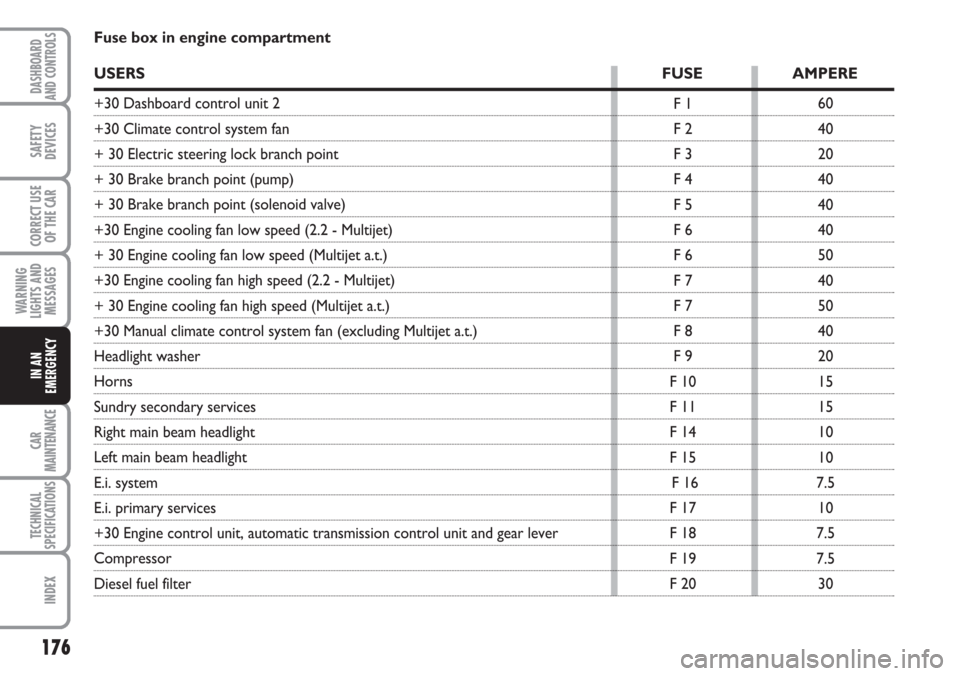
30 Fuse box in engine compartment
USERSFUSE AMPERE
+30 Dashboard control unit 2
+30 Climate control system fan
+ 30 Electric steering lock branch point
+ 30 Brake branch point (pump)
+ 30 Brake branch point (solenoid valve)
+30 Engine cooling fan low speed (2.2 - Multijet)
+ 30 Engine cooling fan low speed (Multijet a.t.)
+30 Engine cooling fan high speed (2.2 - Multijet)
+ 30 Engine cooling fan high speed (Multijet a.t.)
+30 Manual climate control system fan (excluding Multijet a.t.)
Headlight washer
Horns
Sundry secondary services
Right main beam headlight
Left main beam headlight
E.i. system
E.i. primary services
+30 Engine control unit, automatic transmission control unit and gear lever
Compressor
Diesel fuel filter
Page 179 of 240
179
WARNING
LIGHTS AND
MESSAGES
CAR
MAINTENANCE
TECHNICAL
SPECIFICATIONS
INDEX
DASHBOARD
AND CONTROLS
SAFETY
DEVICES
CORRECT USE
OF THE CAR
IN AN
EMERGENCY
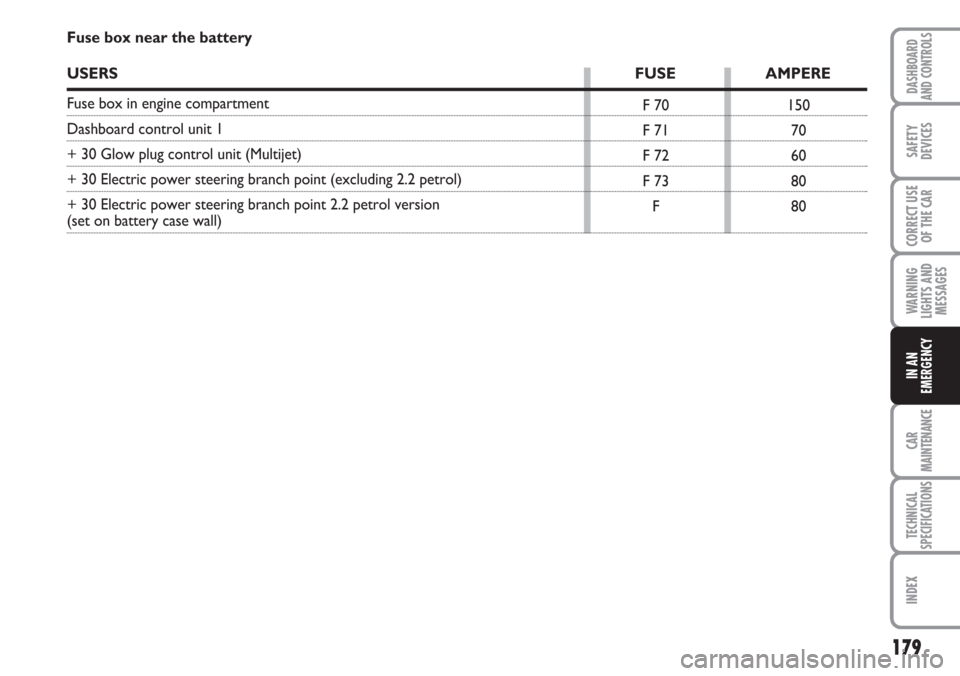
F 70
F 71
F 72
F 73
F150
70
60
80
80 Fuse box near the battery
USERSFUSE AMPERE
Fuse box in engine compartment
Dashboard control unit 1
+ 30 Glow plug control unit (Multijet)
+ 30 Electric power steering branch point (excluding 2.2 petrol)
+ 30 Electric power steering branch point 2.2 petrol version
(set on battery case wall)
Page 182 of 240
182
WARNING
LIGHTS AND
MESSAGES
CAR
MAINTENANCE
TECHNICAL
SPECIFICATIONS
INDEX
DASHBOARD
AND CONTROLS
SAFETY
DEVICES
CORRECT USE
OF THE CAR
IN AN
EMERGENCY
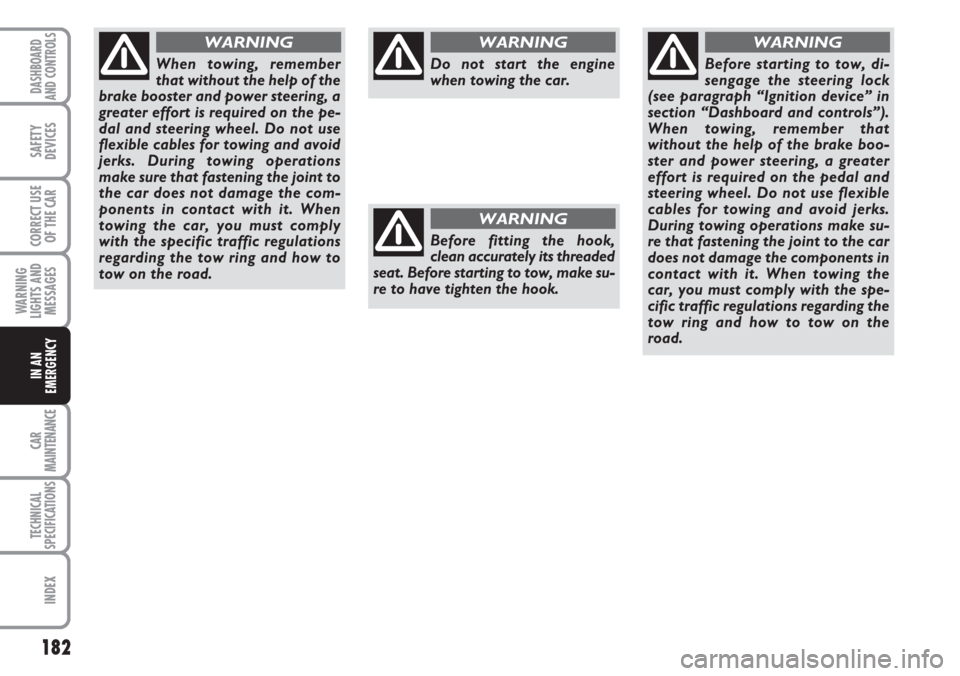
When towing, remember
that without the help of the
brake booster and power steering, a
greater effort is required on the pe-
dal and steering wheel. Do not use
flexible cables for towing and avoid
jerks. During towing operations
make sure that fastening the joint to
the car does not damage the com-
ponents in contact with it. When
towing the car, you must comply
with the specific traffic regulations
regarding the tow ring and how to
tow on the road.
WARNING
Do not start the engine
when towing the car.
WARNING
Before fitting the hook,
clean accurately its threaded
seat. Before starting to tow, make su-
re to have tighten the hook.
WARNING
Before starting to tow, di-
sengage the steering lock
(see paragraph “Ignition device” in
section “Dashboard and controls”).
When towing, remember that
without the help of the brake boo-
ster and power steering, a greater
effort is required on the pedal and
steering wheel. Do not use flexible
cables for towing and avoid jerks.
During towing operations make su-
re that fastening the joint to the car
does not damage the components in
contact with it. When towing the
car, you must comply with the spe-
cific traffic regulations regarding the
tow ring and how to tow on the
road.
WARNING