climate control FIAT CROMA 2009 2.G User Guide
[x] Cancel search | Manufacturer: FIAT, Model Year: 2009, Model line: CROMA, Model: FIAT CROMA 2009 2.GPages: 258, PDF Size: 5.69 MB
Page 56 of 258
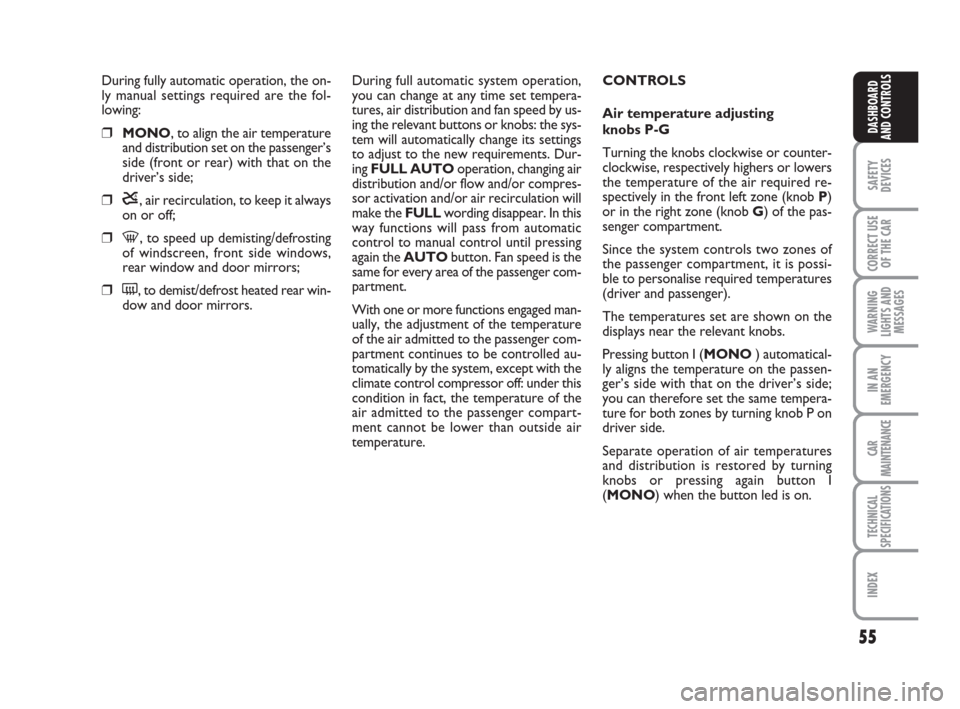
55
SAFETY
DEVICES
CORRECT USE
OF THE CAR
WARNING
LIGHTS AND
MESSAGES
IN AN
EMERGENCY
CAR
MAINTENANCE
TECHNICAL
SPECIFICATIONS
INDEX
DASHBOARD
AND CONTROLS
During fully automatic operation, the on-
ly manual settings required are the fol-
lowing:
❒MONO, to align the air temperature
and distribution set on the passenger’s
side (front or rear) with that on the
driver’s side;
❒ï, air recirculation, to keep it always
on or off;
❒-, to speed up demisting/defrosting
of windscreen, front side windows,
rear window and door mirrors;
❒(, to demist/defrost heated rear win-
dow and door mirrors.During full automatic system operation,
you can change at any time set tempera-
tures, air distribution and fan speed by us-
ing the relevant buttons or knobs: the sys-
tem will automatically change its settings
to adjust to the new requirements. Dur-
ing FULL AUTOoperation, changing air
distribution and/or flow and/or compres-
sor activation and/or air recirculation will
make the FULLwording disappear. In this
way functions will pass from automatic
control to manual control until pressing
again the AUTObutton. Fan speed is the
same for every area of the passenger com-
partment.
With one or more functions engaged man-
ually, the adjustment of the temperature
of the air admitted to the passenger com-
partment continues to be controlled au-
tomatically by the system, except with the
climate control compressor off: under this
condition in fact, the temperature of the
air admitted to the passenger compart-
ment cannot be lower than outside air
temperature.CONTROLS
Air temperature adjusting
knobs P-G
Turning the knobs clockwise or counter-
clockwise, respectively highers or lowers
the temperature of the air required re-
spectively in the front left zone (knob P)
or in the right zone (knob G) of the pas-
senger compartment.
Since the system controls two zones of
the passenger compartment, it is possi-
ble to personalise required temperatures
(driver and passenger).
The temperatures set are shown on the
displays near the relevant knobs.
Pressing button I (MONO) automatical-
ly aligns the temperature on the passen-
ger’s side with that on the driver’s side;
you can therefore set the same tempera-
ture for both zones by turning knob P on
driver side.
Separate operation of air temperatures
and distribution is restored by turning
knobs or pressing again button I
(MONO) when the button led is on.
039-069 Croma TRW GB 10-11-2008 13:15 Pagina 55
Page 57 of 258
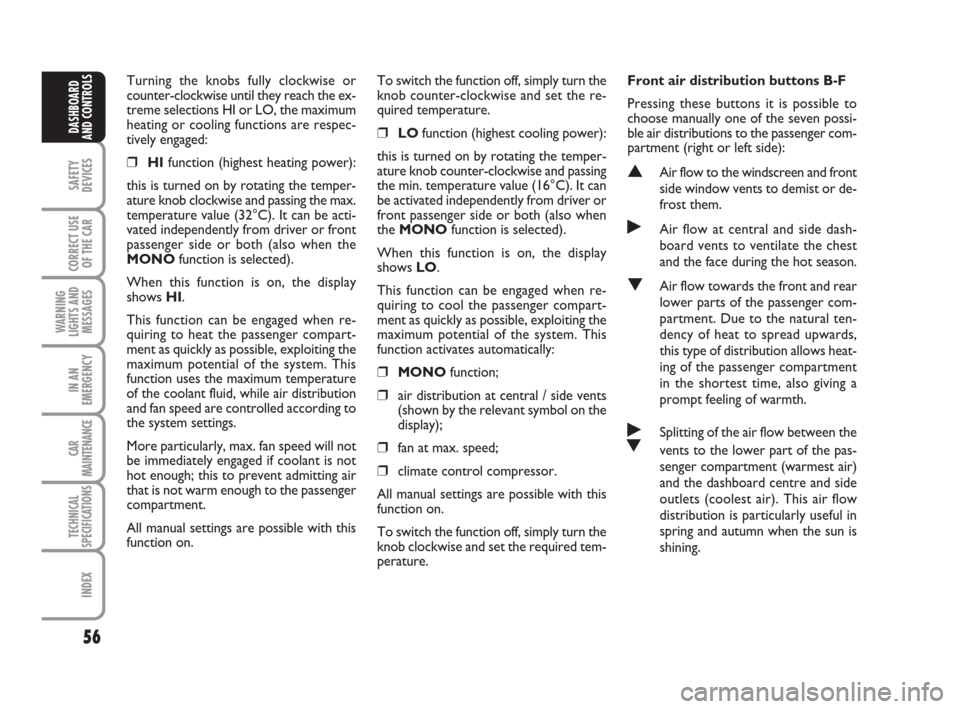
56
SAFETY
DEVICES
CORRECT USE
OF THE CAR
WARNING
LIGHTS AND
MESSAGES
IN AN
EMERGENCY
CAR
MAINTENANCE
TECHNICAL
SPECIFICATIONS
INDEX
DASHBOARD
AND CONTROLS
Turning the knobs fully clockwise or
counter-clockwise until they reach the ex-
treme selections HI or LO, the maximum
heating or cooling functions are respec-
tively engaged:
❒HI function (highest heating power):
this is turned on by rotating the temper-
ature knob clockwise and passing the max.
temperature value (32°C). It can be acti-
vated independently from driver or front
passenger side or both (also when the
MONOfunction is selected).
When this function is on, the display
shows HI.
This function can be engaged when re-
quiring to heat the passenger compart-
ment as quickly as possible, exploiting the
maximum potential of the system. This
function uses the maximum temperature
of the coolant fluid, while air distribution
and fan speed are controlled according to
the system settings.
More particularly, max. fan speed will not
be immediately engaged if coolant is not
hot enough; this to prevent admitting air
that is not warm enough to the passenger
compartment.
All manual settings are possible with this
function on.To switch the function off, simply turn the
knob counter-clockwise and set the re-
quired temperature.
❒LOfunction (highest cooling power):
this is turned on by rotating the temper-
ature knob counter-clockwise and passing
the min. temperature value (16°C). It can
be activated independently from driver or
front passenger side or both (also when
the MONOfunction is selected).
When this function is on, the display
shows LO.
This function can be engaged when re-
quiring to cool the passenger compart-
ment as quickly as possible, exploiting the
maximum potential of the system. This
function activates automatically:
❒MONOfunction;
❒air distribution at central / side vents
(shown by the relevant symbol on the
display);
❒fan at max. speed;
❒climate control compressor.
All manual settings are possible with this
function on.
To switch the function off, simply turn the
knob clockwise and set the required tem-
perature.Front air distribution buttons B-F
Pressing these buttons it is possible to
choose manually one of the seven possi-
ble air distributions to the passenger com-
partment (right or left side):
▲Air flow to the windscreen and front
side window vents to demist or de-
frost them.
˙Air flow at central and side dash-
board vents to ventilate the chest
and the face during the hot season.
▼Air flow towards the front and rear
lower parts of the passenger com-
partment. Due to the natural ten-
dency of heat to spread upwards,
this type of distribution allows heat-
ing of the passenger compartment
in the shortest time, also giving a
prompt feeling of warmth.
˙
▼Splitting of the air flow between the
vents to the lower part of the pas-
senger compartment (warmest air)
and the dashboard centre and side
outlets (coolest air). This air flow
distribution is particularly useful in
spring and autumn when the sun is
shining.
039-069 Croma TRW GB 10-11-2008 13:15 Pagina 56
Page 59 of 258
58
SAFETY
DEVICES
CORRECT USE
OF THE CAR
WARNING
LIGHTS AND
MESSAGES
IN AN
EMERGENCY
CAR
MAINTENANCE
TECHNICAL
SPECIFICATIONS
INDEX
DASHBOARD
AND CONTROLS
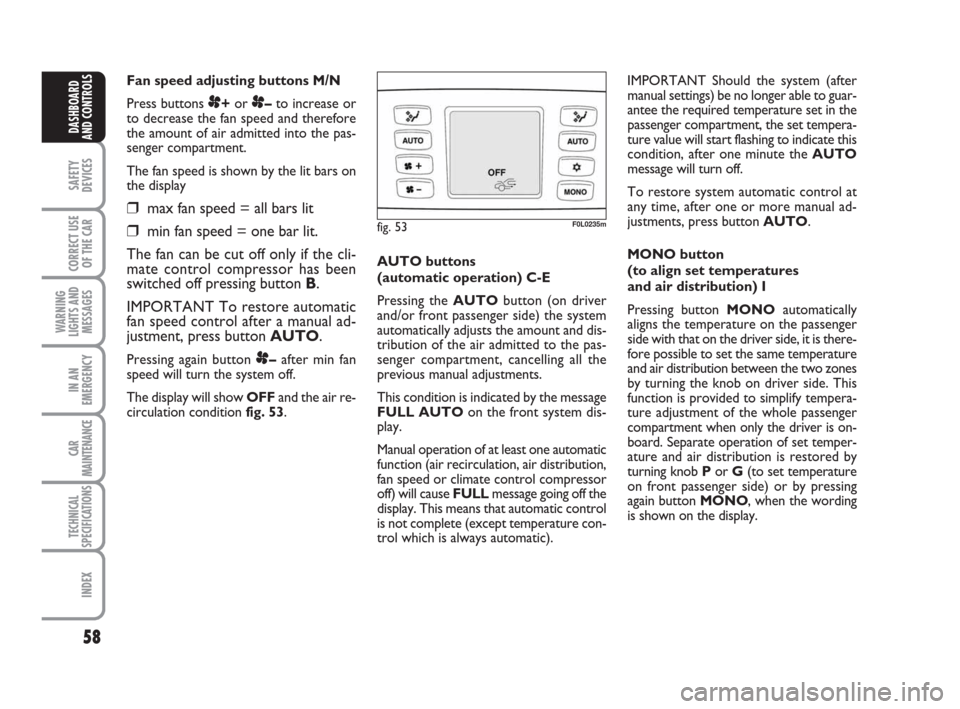
Fan speed adjusting buttons M/N
Press buttons
p+or p–to increase or
to decrease the fan speed and therefore
the amount of air admitted into the pas-
senger compartment.
The fan speed is shown by the lit bars on
the display
❒max fan speed = all bars lit
❒min fan speed = one bar lit.
The fan can be cut off only if the cli-
mate control compressor has been
switched off pressing button B.
IMPORTANT To restore automatic
fan speed control after a manual ad-
justment, press button AUTO.
Pressing again button p–after min fan
speed will turn the system off.
The display will show OFFand the air re-
circulation condition fig. 53. AUTO buttons
(automatic operation) C-E
Pressing the AUTObutton (on driver
and/or front passenger side) the system
automatically adjusts the amount and dis-
tribution of the air admitted to the pas-
senger compartment, cancelling all the
previous manual adjustments.
This condition is indicated by the message
FULL AUTOon the front system dis-
play.
Manual operation of at least one automatic
function (air recirculation, air distribution,
fan speed or climate control compressor
off) will cause FULL message going off the
display. This means that automatic control
is not complete (except temperature con-
trol which is always automatic).IMPORTANT Should the system (after
manual settings) be no longer able to guar-
antee the required temperature set in the
passenger compartment, the set tempera-
ture value will start flashing to indicate this
condition, after one minute the AUTO
message will turn off.
To restore system automatic control at
any time, after one or more manual ad-
justments, press button AUTO.
MONO button
(to align set temperatures
and air distribution) I
Pressing button MONOautomatically
aligns the temperature on the passenger
side with that on the driver side, it is there-
fore possible to set the same temperature
and air distribution between the two zones
by turning the knob on driver side. This
function is provided to simplify tempera-
ture adjustment of the whole passenger
compartment when only the driver is on-
board. Separate operation of set temper-
ature and air distribution is restored by
turning knob Por G(to set temperature
on front passenger side) or by pressing
again button MONO, when the wording
is shown on the display.
fig. 53F0L0235m
039-069 Croma TRW GB 10-11-2008 13:15 Pagina 58
Page 60 of 258
59
SAFETY
DEVICES
CORRECT USE
OF THE CAR
WARNING
LIGHTS AND
MESSAGES
IN AN
EMERGENCY
CAR
MAINTENANCE
TECHNICAL
SPECIFICATIONS
INDEX
DASHBOARD
AND CONTROLS
Air recirculation and AQS function
on/off button A
If the AQSsensor is not fitted, air recir-
culation works according to the following
operating logics:
❒forced switching on (inside air recir-
culation always on), indicated by sym-
bol íon the display;
❒forced switching off (air recirculation
always off with air inlet from the out-
side), indicated by symbol
êon the
display.
The above operating conditions are ob-
tained by pressing in sequence the air re-
circulation button A.
Due to safety reasons, after long recircu-
lation activation (over 25 minutes), the
system will deactivate automatically air re-
circulation for 60 seconds to enable out-
side air inlet.
IMPORTANT The inside air recirculation
system makes it possible to reach the re-
quired heating or cooling conditions faster. It is however inadvisable to use it on
rainy/cold days as it would considerably in-
crease the possibility of the windows mist-
ing inside, especially if the climate control
system is off.
When outside temperature is below 3°C,
recirculation is forced to off (outside air
inlet) to prevent window misting up.
It will be reactivated automatically if out-
side temperature becomes higher than 5
°C.
The AQSsensor (Air Quality System) in
addition to the above operating logics, en-
ables to control recirculation automati-
cally according to the quality of outside air:
❒automatic control indicated by symbol
≥on the display.
In this event the display will show symbol
ïor ñaccording to actual recircu-
lation operating conditions (on or off).
In automatic operation with AQS,inside
air recirculation is turned on automatical-
ly when the antipollution sensor detectsthe presence of polluted air, for example
when driving in the city, queues and tun-
nels.
With compressor on, in order to prevent
polluted air (exhaust gas) inlet at stops, the
system will stop air recirculation when the
car speed falls below 6 km/h. As the car
speed increases (over 25 km/h), the sys-
tem will restore the previous automatic
operating conditions.
In automatic operation, AQSis deacti-
vated when outside temperature is below
3°C, the system will activate air recircu-
lation (indicated by symbol ≥on the
display). The user can however set it man-
ually by operating in rolling mode the reir-
culation button: pressing the button for
the first time will display the current re-
circulation condition, indicated by symbol
ê.
It will be reactivated automatically if out-
side temperature becomes higher than 5
°C.
Press the button again to select the re-
quired recirculation condition, indicated
by the corresponding symbol on the dis-
play. Under these conditions manual ac-
tivation of the AQSfunction could cause
window misting up.
When air recirculation is set manually,
wording FULLwill turn off and A will dis-
appear from the recirculation symbol on
the display.
It is inadvisable to use the in-
side air recirculation func-
tion with low outside temperature as
windows may mist over quickly.
WARNING
039-069 Croma TRW GB 10-11-2008 13:15 Pagina 59
Page 61 of 258
60
SAFETY
DEVICES
CORRECT USE
OF THE CAR
WARNING
LIGHTS AND
MESSAGES
IN AN
EMERGENCY
CAR
MAINTENANCE
TECHNICAL
SPECIFICATIONS
INDEX
DASHBOARD
AND CONTROLS
Climate control compressor on/off
button L
Pressing button
√when the symbol is dis-
played will deactivate the climate control
system compressor. Pressing the button
when the symbol is not displayed will re-
sume automatic control of compressor ac-
tivation; this condition is indicated by the
relevant symbol on the display.
When turning the compressor off, the sys-
tem will deactivate air recirculation to pre-
vent window misting up. Although the sys-
tem is able to keep the required temper-
ature, the wording FULLwill disappear
from the display. If the system is no longer
able to keep the required temperature,
temperature value will flash and the word-
ing AUTOwill disappear from the display.
IMPORTANT With the climate control
compressor off, it is not possible to admit
air to the passenger compartment with a
temperature below the outside tempera-
ture; moreover, under certain environ-
mental conditions, windows could mist up
fastly since air is not dehumidified.The switching off of the climate control
compressor remains in storage even when
the engine has been stopped.
To restore automatic control for switch-
ing on the climate control compressor,
press again button
√or press button AU-
TO.
With climate control compressor off if
outside temperature is higher than the set
one the system will not be able to keep
the required condition, the temperature
value will then start to flash on the display
for a few seconds and wording AUTO
will then go off.
With climate control compressor off, the
fan speed can be set to zero manually.
With compressor on and engine running,
the fan speed cannot be lower that one
bar on the display.
Compressor will be disabled automatical-
ly with outside temperature below – 1°C.
Under this condition symbol
√on the dis-
play will flash for 10 seconds and then go
off.
It will be re-enabled automatically with
outside temperature higher than + 1°C. Fast window demisting/defrosting
button O
Press this button: the climate control sys-
tem will automatically switch on all the
functions required for fast windscreen and
front side window demisting/defrosting,
that is:
❒switches on climate control compres-
sor when climatic conditions are suit-
able;
❒air recirculation off;
❒maximum air temperature (HI) on
both areas;
❒activates proper fan speed according
to engine coolant temperature to lim-
it the flow into the passenger com-
partment of air not warm enough to
demist the windows;
❒directs air flow to windscreen and
front side windows vents;
❒turns heated rear window on.
IMPORTANT Fast demisting/defrosting
function stays on for about 3 minutes,
since engine coolant temperature exceeds
50°C.
039-069 Croma TRW GB 10-11-2008 13:15 Pagina 60
Page 75 of 258
74
SAFETY
DEVICES
CORRECT USE
OF THE CAR
WARNING
LIGHTS AND
MESSAGES
IN AN
EMERGENCY
CAR
MAINTENANCE
TECHNICAL
SPECIFICATIONS
INDEX
DASHBOARD
AND CONTROLS
INTERIOR FITTINGS
FRONT ARMREST WITH
ODDMENT COMPARTMENT
AND REFRIGERATED
COMPARTMENT
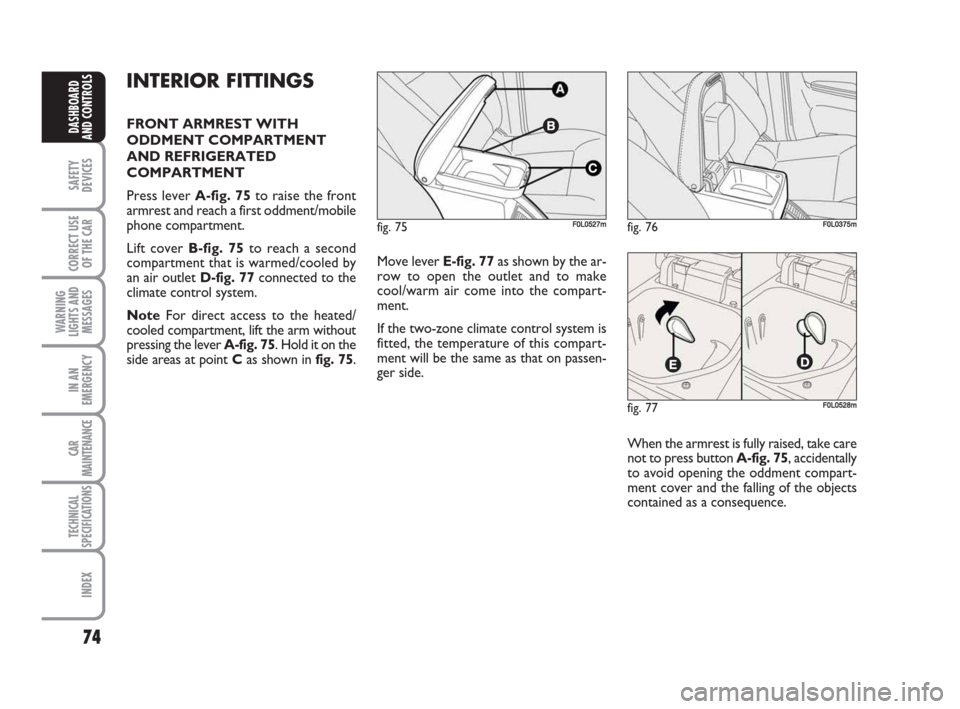
Press lever A-fig. 75to raise the front
armrest and reach a first oddment/mobile
phone compartment.
Lift cover B-fig. 75to reach a second
compartment that is warmed/cooled by
an air outlet D-fig. 77connected to the
climate control system.
NoteFor direct access to the heated/
cooled compartment, lift the arm without
pressing the lever A-fig. 75. Hold it on the
side areas at point Cas shown in fig. 75.Move lever E-fig. 77as shown by the ar-
row to open the outlet and to make
cool/warm air come into the compart-
ment.
If the two-zone climate control system is
fitted, the temperature of this compart-
ment will be the same as that on passen-
ger side.
When the armrest is fully raised, take care
not to press button A-fig. 75, accidentally
to avoid opening the oddment compart-
ment cover and the falling of the objects
contained as a consequence.
fig. 76F0L0375mfig. 75F0L0527m
fig. 77F0L0528m
070-106 Croma TRW GB 19-02-2009 15:03 Pagina 74
Page 139 of 258
Roof rack/ski rack
Remove the roof rack or the ski rack from
the roof as soon as they are no longer
used. These accessories lower air pene-
tration and adversely affect consumption
levels. When needing to carry particular-
ly voluminous objects, preferably use a
trailer.
Electric devices
Use electric devices only for the amount
of time needed. Rear heated window, ad-
ditional headlights, windscreen wipers and
heater fan need a considerable amount of
energy, therefore increasing the require-
ment of current increases fuel consump-
tion (up to +25% in the urban cycle).
Climate control
The air conditioner is an additional load
which greatly affects the engine leading to
higher consumption (on average up to
+20%). When the temperature outside
the car permits it, use the air vents where
possible.
Spoilers
The use of non-certified aerodynamic
items may adversely affect air drag and
consumption levels.DRIVING STYLE
Starting
Do not warm the engine with the car at
a standstill or at idle or high speed: under
these conditions the engine warms up
much more slowly, increasing electrical
consumption and emissions. It is therefore
advisable to move off immediately, slow-
ly, avoiding high speeds. This way the en-
gine will warm faster.
Unnecessary actions
Avoid accelerating when waiting at traffic
lights or before switching off the engine.
This and also double declutching is ab-
solutely pointless on modern cars and al-
so increase consumption and pollution.
Gear selection
As soon as the conditions of the traffic and
road allow, use a higher gear. Using a low
gear to obtain brilliant performance in-
creases consumption.
In the same way improper use of a high
gear increases consumption, emissions an
engine wear.CONTAINING
RUNNING COSTS
Here are some suggestions which may
help you to keep the running costs of your
car down and lower the amount of toxic
emissions released into the atmosphere.
GENERAL CONSIDERATIONS
Car maintenance
Have checks and adjustments carried out
in accordance with the “Service schedule”.
Tyres
Check the pressure of the tyres routine-
ly at an interval of no more than 4 weeks:
if the pressure is too low, consumption
levels increase as resistance to rolling is
higher.
Unnecessary loads
Do not travel with too much luggage
stowed in the boot. The weight of the car
(especially when driving in town) and its
trim greatly affects consumption and sta-
bility.
138
WARNING
LIGHTS AND
MESSAGES
IN AN
EMERGENCY
CAR
MAINTENANCE
TECHNICAL
SPECIFICATIONS
INDEX
DASHBOARD
AND CONTROLS
SAFETY
DEVICES
CORRECT USE
OF THE CAR
127-144 Croma TRW GB 28-05-2008 16:33 Pagina 138
Page 197 of 258
196
WARNING
LIGHTS AND
MESSAGES
TECHNICAL
SPECIFICATIONS
INDEX
DASHBOARD
AND CONTROLS
SAFETY
DEVICES
CORRECT USE
OF THE CAR
IN AN
EMERGENCY
CAR
MAINTENANCE
35 70 105 140 175
●
●●●●●
●●●●●
●●●●●
●
●
●
●
●
●●
●●
●●●●●
●●●●●
●●●●●
●●●●●
●●
●●●●●
●●●●●
Thousands of km
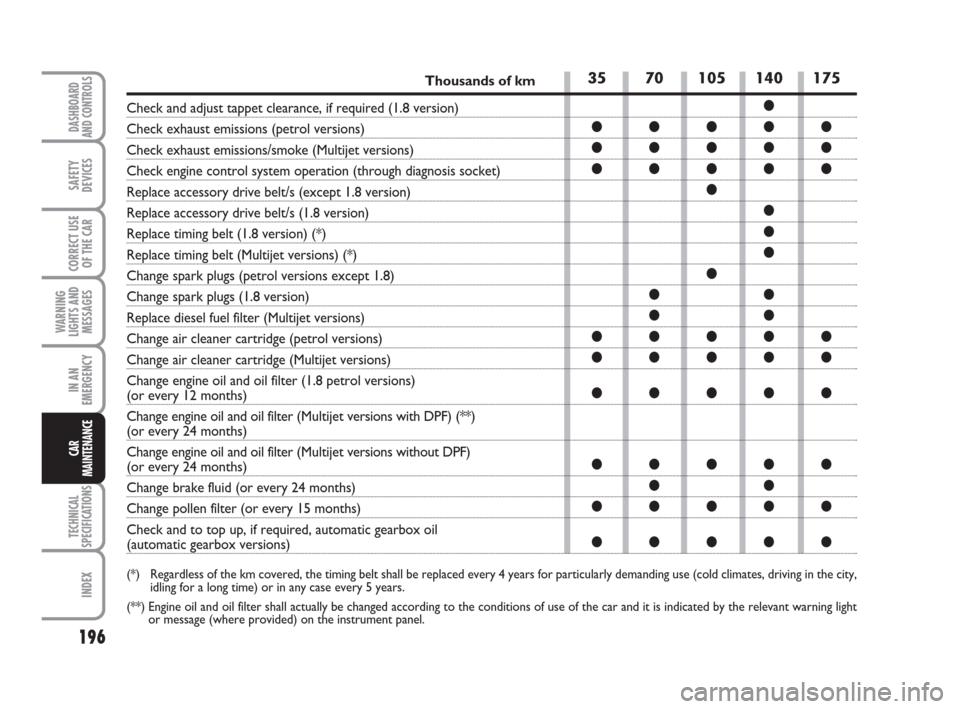
Check and adjust tappet clearance, if required (1.8 version)
Check exhaust emissions (petrol versions)
Check exhaust emissions/smoke (Multijet versions)
Check engine control system operation (through diagnosis socket)
Replace accessory drive belt/s (except 1.8 version)
Replace accessory drive belt/s (1.8 version)
Replace timing belt (1.8 version) (*)
Replace timing belt (Multijet versions) (*)
Change spark plugs (petrol versions except 1.8)
Change spark plugs (1.8 version)
Replace diesel fuel filter (Multijet versions)
Change air cleaner cartridge (petrol versions)
Change air cleaner cartridge (Multijet versions)
Change engine oil and oil filter (1.8 petrol versions)
(or every 12 months)
Change engine oil and oil filter (Multijetversions with DPF) (**)
(or every 24 months)
Change engine oil and oil filter (Multijetversions without DPF)
(or every 24 months)
Change brake fluid (or every 24 months)
Change pollen filter (or every 15 months)
Check and to top up, if required, automatic gearbox oil
(automatic gearbox versions)
(*) Regardless of the km covered, the timing belt shall be replaced every 4 years for particularly demanding use (cold climates, driving in the city,
idling for a long time) or in any case every 5 years.
(**) Engine oil and oil filter shall actually be changed according to the conditions of use of the car and it is indicated by the relevant warning light
or message (where provided) on the instrument panel.
193-216 Croma TRW GB 28-07-2009 12:15 Pagina 196
Page 205 of 258
204
WARNING
LIGHTS AND
MESSAGES
TECHNICAL
SPECIFICATIONS
INDEX
DASHBOARD
AND CONTROLS
SAFETY
DEVICES
CORRECT USE
OF THE CAR
IN AN
EMERGENCY
CAR
MAINTENANCE
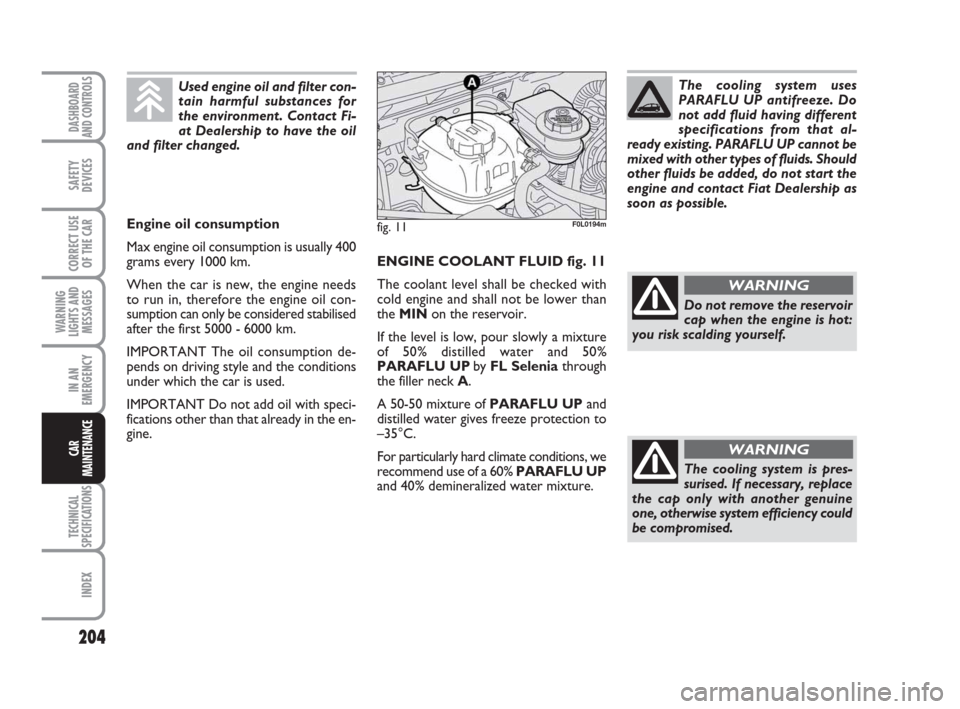
ENGINE COOLANT FLUID fig. 11
The coolant level shall be checked with
cold engine and shall not be lower than
the MINon the reservoir.
If the level is low, pour slowly a mixture
of 50% distilled water and 50%
PARAFLU UPby FL Seleniathrough
the filler neck A.
A 50-50 mixture of PARAFLU UPand
distilled water gives freeze protection to
–35°C.
For particularly hard climate conditions, we
recommend use of a 60% PARAFLU UP
and 40% demineralized water mixture. Used engine oil and filter con-
tain harmful substances for
the environment. Contact Fi-
at Dealership to have the oil
and filter changed.
Engine oil consumption
Max engine oil consumption is usually 400
grams every 1000 km.
When the car is new, the engine needs
to run in, therefore the engine oil con-
sumption can only be considered stabilised
after the first 5000 - 6000 km.
IMPORTANT The oil consumption de-
pends on driving style and the conditions
under which the car is used.
IMPORTANT Do not add oil with speci-
fications other than that already in the en-
gine.fig. 11F0L0194m
The cooling system uses
PARAFLU UP antifreeze. Do
not add fluid having different
specifications from that al-
ready existing. PARAFLU UP cannot be
mixed with other types of fluids. Should
other fluids be added, do not start the
engine and contact Fiat Dealership as
soon as possible.
Do not remove the reservoir
cap when the engine is hot:
you risk scalding yourself.
WARNING
The cooling system is pres-
surised. If necessary, replace
the cap only with another genuine
one, otherwise system efficiency could
be compromised.
WARNING
193-216 Croma TRW GB 28-07-2009 12:16 Pagina 204
Page 214 of 258
213
WARNING
LIGHTS AND
MESSAGES
TECHNICAL
SPECIFICATIONS
INDEX
DASHBOARD
AND CONTROLS
SAFETY
DEVICES
CORRECT USE
OF THE CAR
IN AN
EMERGENCY
CAR
MAINTENANCE
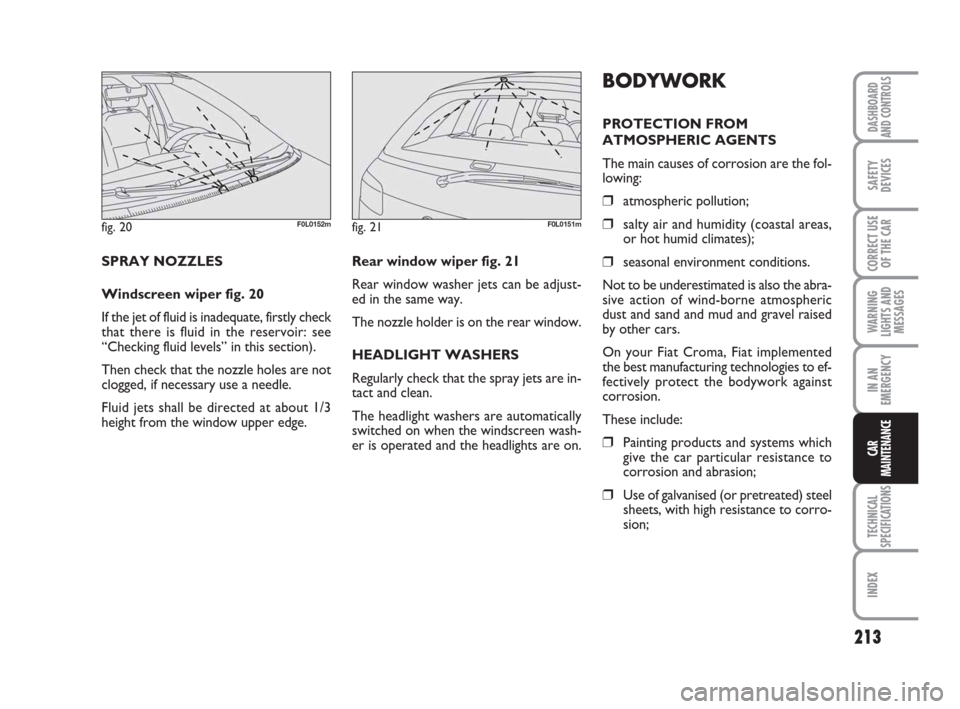
Rear window wiper fig. 21
Rear window washer jets can be adjust-
ed in the same way.
The nozzle holder is on the rear window.
HEADLIGHT WASHERS
Regularly check that the spray jets are in-
tact and clean.
The headlight washers are automatically
switched on when the windscreen wash-
er is operated and the headlights are on.
BODYWORK
PROTECTION FROM
ATMOSPHERIC AGENTS
The main causes of corrosion are the fol-
lowing:
❒atmospheric pollution;
❒salty air and humidity (coastal areas,
or hot humid climates);
❒seasonal environment conditions.
Not to be underestimated is also the abra-
sive action of wind-borne atmospheric
dust and sand and mud and gravel raised
by other cars.
On your Fiat Croma, Fiat implemented
the best manufacturing technologies to ef-
fectively protect the bodywork against
corrosion.
These include:
❒Painting products and systems which
give the car particular resistance to
corrosion and abrasion;
❒Use of galvanised (or pretreated) steel
sheets, with high resistance to corro-
sion; SPRAY NOZZLES
Windscreen wiper fig. 20
If the jet of fluid is inadequate, firstly check
that there is fluid in the reservoir: see
“Checking fluid levels” in this section).
Then check that the nozzle holes are not
clogged, if necessary use a needle.
Fluid jets shall be directed at about 1/3
height from the window upper edge.
fig. 20F0L0152mfig. 21F0L0151m
193-216 Croma TRW GB 28-07-2009 12:16 Pagina 213