steering FIAT DOBLO 2007 1.G User Guide
[x] Cancel search | Manufacturer: FIAT, Model Year: 2007, Model line: DOBLO, Model: FIAT DOBLO 2007 1.GPages: 218, PDF Size: 3.19 MB
Page 96 of 218
95GETTING TO KNOW YOUR VEHICLE
Pretensioners, front airbags and side
airbags are triggered by the electron-
ic control unit according to different
types of impacts. Missed triggering of
the system, consequently, does not in-
dicate a fault in the system.
If when turning the key
to MAR the warning light
¬does not turn on or if it
stays on when travelling there
could be a failure in safety sys-
tems; in this event air bags or
pretensioners could not trigger in
case of impact or, in a minor
number of cases, they could trig-
ger accidentally. Contact Fiat
Dealership immediately to have
the system checked.When the passenger’s
front airbag is active (pas-
senger front airbag deac-
tivation switch at ON), the
F
warning light will come on for ap-
proximately four seconds and
flash for other four seconds when
the ignition key is turned to MAR
to remind the driver than the
passenger’s front and side airbags
(where fitted) will be fired in the
event of a crash. The warning
light should go out immediately
afterwards.
If an attempt has been
made to steal the vehicle,
or if it has actually been
stolen or has been vandalised in
any way or subjected to flooding,
have the airbag system checked
over at a Fiat Dealership.The front air bag is trig-
gered for shocks greater
in magnitude that the
pretensioners. For impacts be-
tween these two thresholds, it is
therefore normal that only the
pretensioners are triggered.
Do not apply stickers or
other objects to the
steering wheel or to the
dashboard on the passenger’s
side. Do not travel with objects
on your lap or in front of you nor
with a pipe, pencil or similar be-
tween your lips; you could seri-
ously hurt yourself if the airbag
inflates in a collision.
Page 97 of 218
96GETTING TO KNOW YOUR VEHICLE
The correct operation of
front airbags, side airbags
and pretensioners is en-
sured only if the vehicle is not
overloaded.
Do not wash the seat
back in vehicles with side
airbags with pressurised
steam or water in automatic seat
washing stations.
The airbag does not re-
place seat belts but rather
increases their effective-
ness. Furthermore, the airbag is
not fired in the event of low
speed front collisions, side colli-
sions, rear-end shunts and roll-
overs. In these cases, the passen-
gers are only protected by the
seat belts which for this reason
must always be fastened.
Always drive with both
hands on the rim of the
steering wheel so that the
airbag is free to inflate during a
head-on collision, and protect
you from serious injury. Do not
drive with your body bending to-
wards the steering wheel, but sit
in an upright position with your
back resting against the seat.
Do not cover the back-
rest of front seats with
trims or covers that are
not suitable to be used with side
bags.
It is important to re-
member that the airbag
can be fired if the ignition
key is fitted and at MAR also if
the engine is not running and the
vehicle it is hit by another vehicle
travelling at suitable speed. As a
consequence, Fiat recommends
sitting children in their specific
restraint systems on the back
seat, which is the most protected
position possible. On the con-
trary, the airbags will not be fired
if the vehicle is crashed into when
the key is not inserted or turned.
Consequently, in this case, the
fact that the system is not fired
does not indicate a fault.
Page 108 of 218
107DRIVING YOUR VEHICLE
HOW TO WARM UP THE
ENGINE AFTER IS HAS JUST
STARTED (petrol and diesel
versions)
– Begin to move forward slowly let-
ting the engine turn at medium revs.
Do not accelerate abruptly.
– Do not push the engine to its lim-
it for the first few kilometres. You are
recommended to wait until the
coolant temperature gauge starts
moving.
EMERGENCY START-UP
If the Fiat CODE system fails to
recognise that code transmitted by the
ignition key (instrument panel warning
light ¢(Y) on) the emergency start-
up can be performed by using the
CODE card code.
See section “In an emergency”. The warning light m
will flash (for approxi-
mately 60 seconds) at
start-up or during prolonged
cranking to signal a fault in the
glow plug heating system. You
can use the vehicle as usual if the
engine starts but you should con-
tact a Fiat Dealership as soon as
possible to have problem seen to.
If the engine does not start at the
first attempt, return the ignition key
to STOPbefore trying to start the
engine again.
If with key at MARwarning light ¢
(Y) stays on, turn the key to STOP
and then to MARagain; if the warn-
ing light stays on, try with the other
keys provided.
If you still cannot start the engine, get
in touch with Fiat Dealership.
IMPORTANTNever leave the ig-
nition key at MARwhen the engine is
off.Catalysed vehicles must
not be bump started
(pushed, towed or coast-
ed downhill) as this could cause
fuel to flow into the catalytic ex-
haust system and damage it be-
yond repair.
Remember that until
the engine has started the
brake booster and hy-
draulic power steering systems
will not work and a greater effort
will therefore be required to de-
press the brake pedal or turn the
steering wheel.
Page 122 of 218
121IN AN EMERGENCY
BUMP STARTING IF A TYRE IS
PUNCTURED
GENERAL INSTRUCTIONS
Wheel changing and correct use of
the jack and spare wheel call for some
precautions as listed below. Catalysed vehicles must
not be bump started
(pushed, towed or coast-
ed down hill) as this could cause
fuel to flow into the catalytic ex-
haust system and damage it be-
yond repair.
Remember that until
the engine has started the
brake booster and hy-
draulic power steering systems
will not work and a greater effort
will therefore be required to de-
press the brake pedal or turn the
steering wheel.
Alert other drivers that
the vehicle is stationary in
compliance with local
regulations: hazard warning
lights, warning triangle etc.
Passengers on board should
leave the vehicle, especially if it is
heavily laden. Passengers should
stay away from oncoming traffic
while the wheel is being changed.
If the wheel is being changed on
a steep or badly surfaced road,
place wedges or other suitable
material under the wheels to
stop the vehicle.
The spare wheel is vehicle-spe-
cific. Never use the wheel on oth-
er models. Never fit other mod-
el spare wheels on your vehicle.
Do not use the jack for
loads over the value indi-
cated on the plate.
The jack should only be used to
change a wheel on the vehicle for
which it was designed. It should
not be put to other uses or em-
ployed to raise other models of
vehicle. Under no circumstances
should it be used when carrying
out repairs under the vehicle.
An incorrectly positioned jack
may cause the vehicle to fall.
Page 148 of 218
147IN AN EMERGENCY
IF AN ACCIDENT
OCCURS
– It is important to keep calm.
– If you are not directly involved in
the accident, stop at least ten metres
away from the accident.
– If you are on a motorway, do not
obstruct the emergency lane with
your vehicle.
– Turn off the engine and turn on the
hazard lights.
– At night, illuminate the scene of the
accident with your headlights.
– Act carefully, you must not risk be-
ing run over.
– Mark the accident by putting the
red triangle at the regulatory distance
from the vehicle where it can be clear-
ly seen.
– Call for rescue making the infor-
mation you give as accurate as you
can. On the motorway use the special
column-mounted emergency phones. When towing the vehi-
cle, you must comply with
the specific traffic regula-
tions regarding the tow hitch and
how to tow on the road.
Before starting to tow,
turn the ignition key to
MAR and then to STOP.
Do not remove the key. If the key
is removed, the steering lock en-
gages automatically which pre-
vents the wheels being turned.
While the vehicle is be-
ing towed with the engine
off, remember that the
brake pedal and steering will re-
quire more effort as you no
longer have the benefit of the
power brakes and power steer-
ing. Do not use flexible cables to
tow. Avoid jerking. Whilst tow-
ing, ensure that the coupling to
the vehicle does not damage the
surrounding components.
fig. 47
F0A0417b
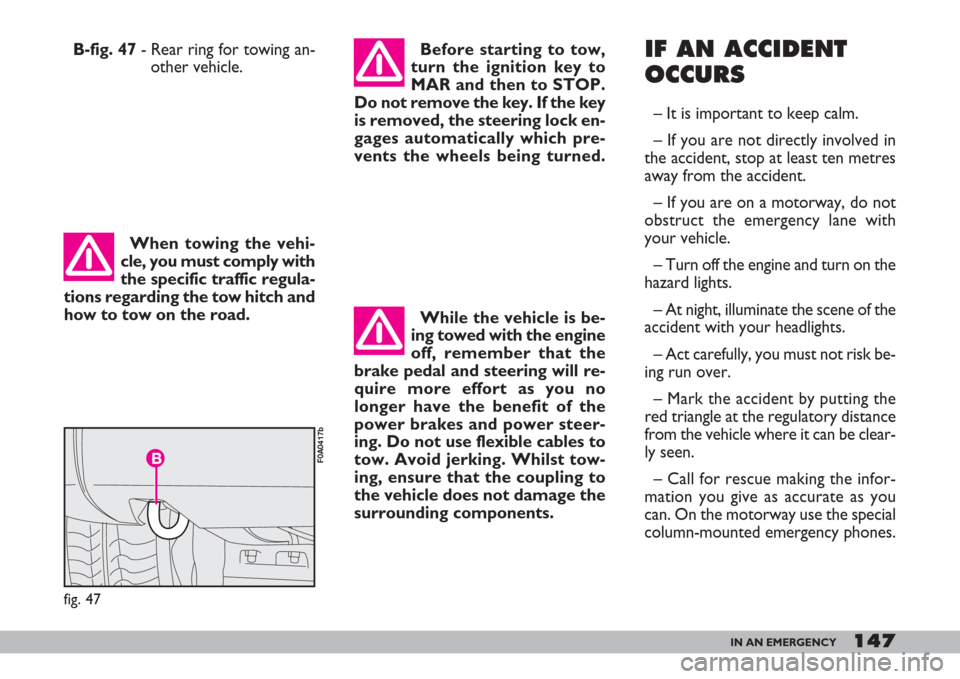
B-fig. 47- Rear ring for towing an-
other vehicle.
Page 155 of 218
154VEHICLE MAINTENANCE
CHECKING
THE LEVELS
Do not smoke while
working in the engine
compartment: the pres-
ence of flammable gas and
vapour could cause a fire.
Be careful not to mix up
the various types of fluids
when you are topping up:
they are all mutually incompati-
ble and could damage the vehicle.
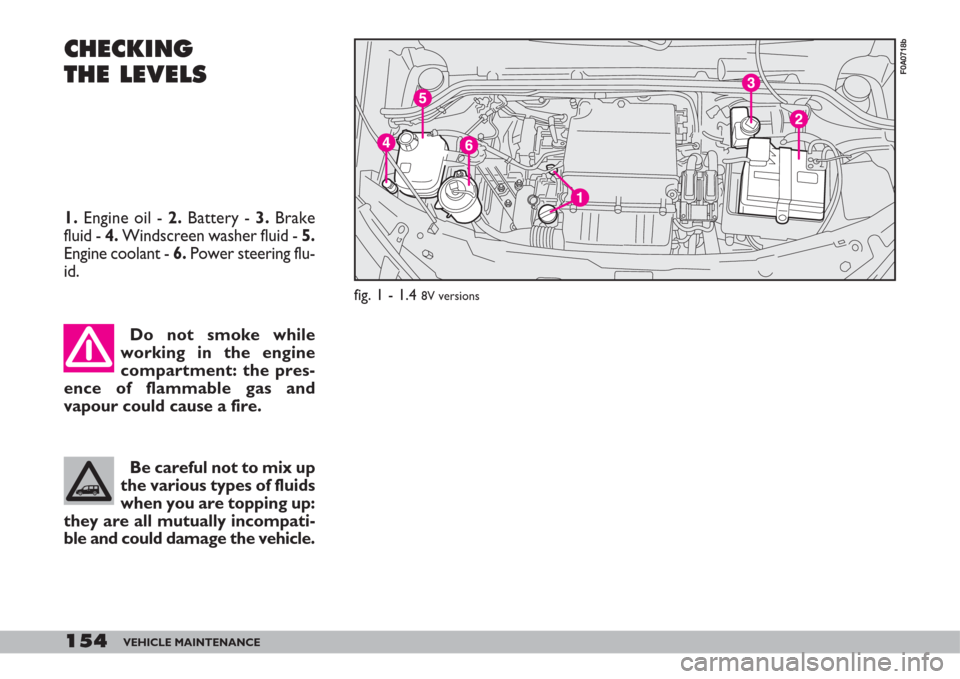
1.Engine oil - 2.Battery - 3.Brake
fluid - 4.Windscreen washer fluid - 5.
Engine coolant - 6.Power steering flu-
id.
F0A0718b
fig. 1 - 1.4 8V versions
Page 156 of 218
Be careful not to mix up
the various types of fluids
when you are topping up:
they are all mutually incompati-
ble and could damage the vehicle.Do not smoke while
working in the engine
compartment: the pres-
ence of flammable gas and
vapour could cause a fire.
155VEHICLE MAINTENANCE
F0A0719b
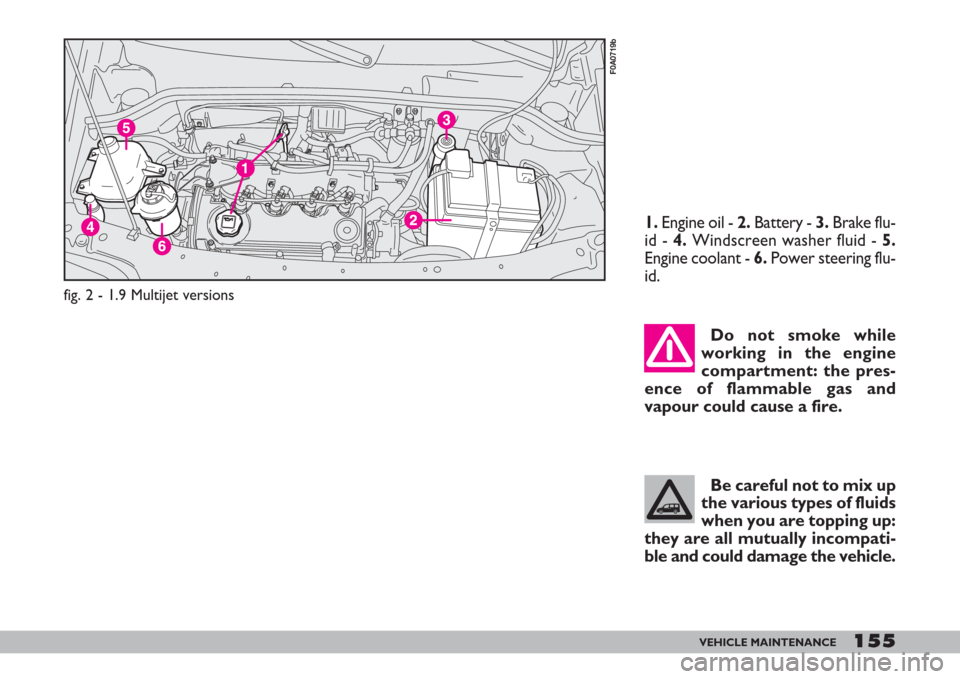
fig. 2 - 1.9 Multijet versions
1.Engine oil - 2.Battery - 3.Brake flu-
id - 4.Windscreen washer fluid - 5.
Engine coolant - 6.Power steering flu-
id.
Page 157 of 218
156VEHICLE MAINTENANCE
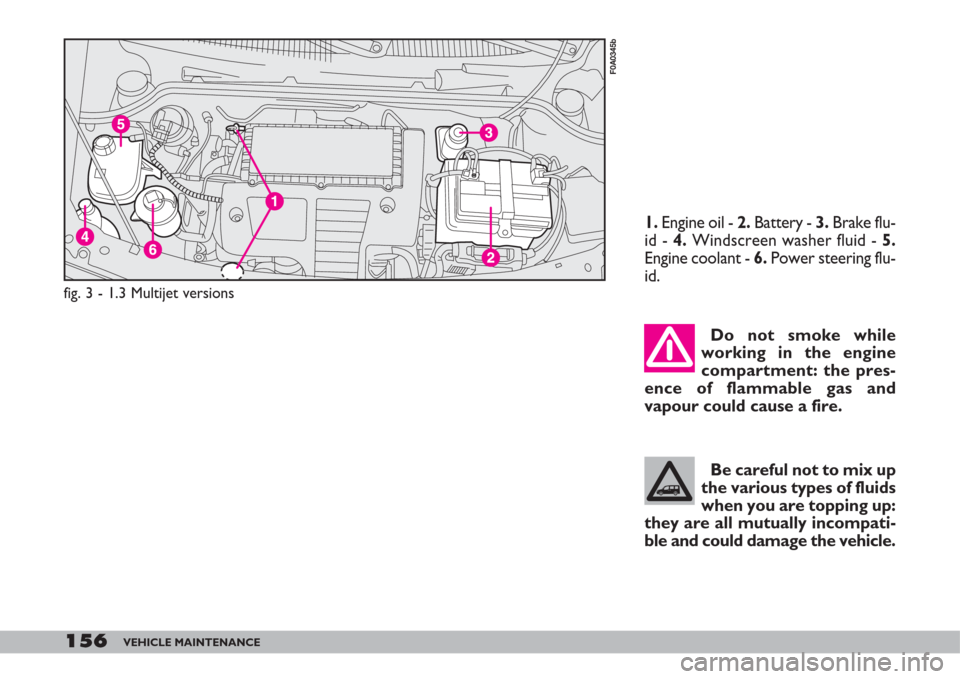
1.Engine oil - 2.Battery - 3.Brake flu-
id - 4.Windscreen washer fluid - 5.
Engine coolant - 6.Power steering flu-
id.
F0A0345b
fig. 3 - 1.3 Multijet versions
Do not smoke while
working in the engine
compartment: the pres-
ence of flammable gas and
vapour could cause a fire.
Be careful not to mix up
the various types of fluids
when you are topping up:
they are all mutually incompati-
ble and could damage the vehicle.
Page 161 of 218
160VEHICLE MAINTENANCE
Prevent brake fluid,
which is highly corrosive,
from coming into contact
with painted parts. Should it hap-
pen, immediately wash with wa-
ter.
Check that fluid contained in tank is
at maximum level. If fluid has to be
added, it is suggested to use the brake
fluid in table "Fluids and lubricants"
(see chapter "Technical characteris-
tics"). At plug opening, pay maximum
attention in order to prevent any im-
purities from entering the tank.
For topping up, always use a funnel
with integrated filter with mesh equal
to or lower than 0.12 mm.
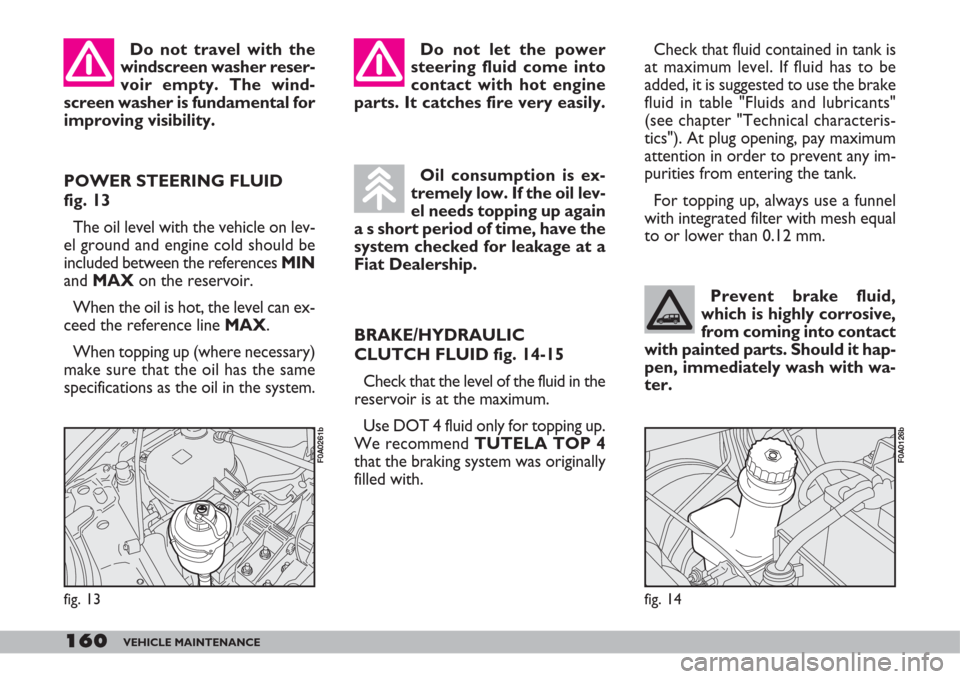
fig. 14
F0A0126b
POWER STEERING FLUID
fig. 13
The oil level with the vehicle on lev-
el ground and engine cold should be
included between the references MIN
and MAXon the reservoir.
When the oil is hot, the level can ex-
ceed the reference line MAX.
When topping up (where necessary)
make sure that the oil has the same
specifications as the oil in the system.Do not travel with the
windscreen washer reser-
voir empty. The wind-
screen washer is fundamental for
improving visibility.
fig. 13
F0A0261b
Do not let the power
steering fluid come into
contact with hot engine
parts. It catches fire very easily.
Oil consumption is ex-
tremely low. If the oil lev-
el needs topping up again
a s short period of time, have the
system checked for leakage at a
Fiat Dealership.
BRAKE/HYDRAULIC
CLUTCH FLUID fig. 14-15
Check that the level of the fluid in the
reservoir is at the maximum.
Use DOT 4 fluid only for topping up.
We recommend TUTELA TOP 4
that the braking system was originally
filled with.
Page 169 of 218
168VEHICLE MAINTENANCE
Avoid overloading your vehicle: this
can seriously damage wheels and tyres.
If you get a flat tyre, stop immediately
and change it so as not to damage the
tyre, the wheel, the suspension and
the steering.
Tyres age even if they are not used
very much. Cracking of the tread rub-
ber and the side walls are a sign of this
ageing. In any case, if the tyres have
been fitted for more than six years
they should be examined by an expert
who can judge whether they are still
fit for use. Remember to check the
spare tyre particularly carefully too.
If a replacement is necessary, always
use new tyres and avoid using ones the
origin of which you are not certain
about.
The Fiat Doblò fits tubeless tyres.
Under no circumstances use an inner
tube with these tyres.If you replace a tyre it is a good idea
to change the inflation valve, too.
To ensure the front and rear tyres all
wear evenly, you are advised to change
the tyres over every 10-15 thousand
kilometres keeping them on the same
side of the vehicle so as not to reverse
the direction of rotation.
Do not change the tyres
over in criss-cross fashion
by moving a tyre from the
left hand side of the vehicle to the
right and vice versa.RUBBER TUBING
Follow the “Service Schedule” to the
letter as concerns braking and fuel line
rubber tubing. Ozone, high tempera-
tures and long absence of fluid in the
system can in fact cause the hardening
and cracking of the pipes with possi-
ble loss of fluid. A careful check is
therefore essential.