wheel FIAT DOBLO 2007 1.G User Guide
[x] Cancel search | Manufacturer: FIAT, Model Year: 2007, Model line: DOBLO, Model: FIAT DOBLO 2007 1.GPages: 218, PDF Size: 3.19 MB
Page 92 of 218
91GETTING TO KNOW YOUR VEHICLE
The cushion immediately inflates,
placing itself as a protection between
the body of the front occupants and
the structure that could cause injuries.
Immediately after, the cushion deflates.
The front air bag (driver and pas-
senger) is not a replacement of but
complementary to the use of belts,
which should always be worn, as spec-
ified by law in Europe and most non-
European countries.
In case of crash, a person not wear-
ing the seat belt moves forward and
may come into contact with the cush-
ion while it is still inflating. Under this
circumstance the protection offered
by the airbag is reduced.
Front airbags may not activate in the
following situations:
– in collisions against highly de-
formable objects not affecting the ve-
hicle front surface (e.g. bumper colli-
sion against guard rail); If the xbrake fluid low
warning light comes on,
stop the vehicle immedi-
ately and contact the nearest Fi-
at Dealership. Fluid leaks from
the hydraulic system, in fact, can
compromise brake system oper-
ation, both traditional systems
and systems with ABS.FRONT AND SIDE
AIRBAGS
The vehicle can be fitted with front
air bags for the driver and passenger
and with side bags.
FRONT AIRBAGS
Front airbags (driver and passenger)
have been designed to protect the oc-
cupants in the event of head-on crash-
es of medium-high severity, by plac-
ing the cushion between the occupant
and the steering wheel or dashboard.
Front airbags are designed to protect
vehicle’s occupants in front crashes
and therefore non-activation in other
types of collisions (side collisions, rear
shunts, roll-overs, etc.) is not a system
malfunction.
In case of crash, an electronic con-
trol unit, when required, triggers the
inflation of the cushion according to
the severity of the collision. Warning light >alone,
with the engine running,
normally indicates a fault
in the ABS system only. In this
case, the braking system is still ef-
ficient, though without the anti-
locking device. Under these con-
ditions, performance of the EBD
system may be reduced. Also in
this case, you are advised to go
immediately to the nearest Fiat
Dealership, driving in such a way
to avoid sharp braking to have
the system checked.
Page 93 of 218
92GETTING TO KNOW YOUR VEHICLE
– in case of wedging under other ve-
hicles or protective barriers (for ex-
ample under a truck or guard rail), the
air bag is not triggered as it offers no
additional protection compared with
the seat belts, consequently it would
be pointless.
Therefore, failure to come into ac-
tion in the above circumstance does
not mean that the system is not work-
ing properly.At their maximum inflation, their vol-
ume fills most of the space between
the steering wheel and the driver and
between the dashboard and the pas-
senger.
In minor crashes (for which the re-
straining action of the seat belts is suf-
ficient), the air bags are not deployed.
Also in this case it is of vital impor-
tance to wear the seat belts since in
case of front crash they guarantee
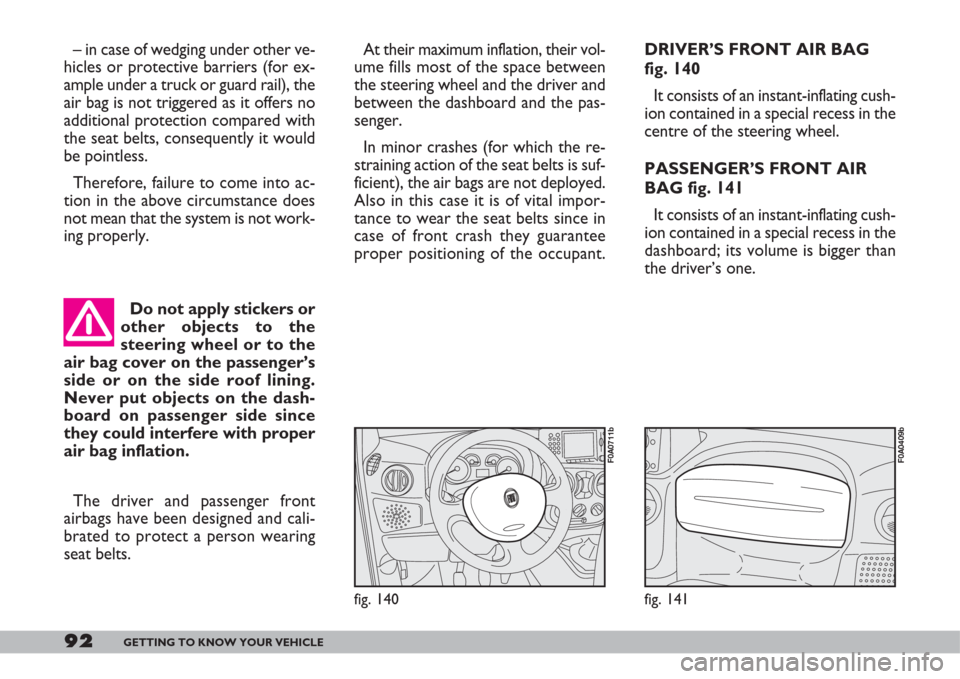
proper positioning of the occupant.DRIVER’S FRONT AIR BAG
fig. 140
It consists of an instant-inflating cush-
ion contained in a special recess in the
centre of the steering wheel.
PASSENGER’S FRONT AIR
BAG fig. 141
It consists of an instant-inflating cush-
ion contained in a special recess in the
dashboard; its volume is bigger than
the driver’s one.
Do not apply stickers or
other objects to the
steering wheel or to the
air bag cover on the passenger’s
side or on the side roof lining.
Never put objects on the dash-
board on passenger side since
they could interfere with proper
air bag inflation.
The driver and passenger front
airbags have been designed and cali-
brated to protect a person wearing
seat belts.
fig. 140
F0A0711b
fig. 141
F0A0409b
Page 96 of 218
95GETTING TO KNOW YOUR VEHICLE
Pretensioners, front airbags and side
airbags are triggered by the electron-
ic control unit according to different
types of impacts. Missed triggering of
the system, consequently, does not in-
dicate a fault in the system.
If when turning the key
to MAR the warning light
¬does not turn on or if it
stays on when travelling there
could be a failure in safety sys-
tems; in this event air bags or
pretensioners could not trigger in
case of impact or, in a minor
number of cases, they could trig-
ger accidentally. Contact Fiat
Dealership immediately to have
the system checked.When the passenger’s
front airbag is active (pas-
senger front airbag deac-
tivation switch at ON), the
F
warning light will come on for ap-
proximately four seconds and
flash for other four seconds when
the ignition key is turned to MAR
to remind the driver than the
passenger’s front and side airbags
(where fitted) will be fired in the
event of a crash. The warning
light should go out immediately
afterwards.
If an attempt has been
made to steal the vehicle,
or if it has actually been
stolen or has been vandalised in
any way or subjected to flooding,
have the airbag system checked
over at a Fiat Dealership.The front air bag is trig-
gered for shocks greater
in magnitude that the
pretensioners. For impacts be-
tween these two thresholds, it is
therefore normal that only the
pretensioners are triggered.
Do not apply stickers or
other objects to the
steering wheel or to the
dashboard on the passenger’s
side. Do not travel with objects
on your lap or in front of you nor
with a pipe, pencil or similar be-
tween your lips; you could seri-
ously hurt yourself if the airbag
inflates in a collision.
Page 97 of 218
96GETTING TO KNOW YOUR VEHICLE
The correct operation of
front airbags, side airbags
and pretensioners is en-
sured only if the vehicle is not
overloaded.
Do not wash the seat
back in vehicles with side
airbags with pressurised
steam or water in automatic seat
washing stations.
The airbag does not re-
place seat belts but rather
increases their effective-
ness. Furthermore, the airbag is
not fired in the event of low
speed front collisions, side colli-
sions, rear-end shunts and roll-
overs. In these cases, the passen-
gers are only protected by the
seat belts which for this reason
must always be fastened.
Always drive with both
hands on the rim of the
steering wheel so that the
airbag is free to inflate during a
head-on collision, and protect
you from serious injury. Do not
drive with your body bending to-
wards the steering wheel, but sit
in an upright position with your
back resting against the seat.
Do not cover the back-
rest of front seats with
trims or covers that are
not suitable to be used with side
bags.
It is important to re-
member that the airbag
can be fired if the ignition
key is fitted and at MAR also if
the engine is not running and the
vehicle it is hit by another vehicle
travelling at suitable speed. As a
consequence, Fiat recommends
sitting children in their specific
restraint systems on the back
seat, which is the most protected
position possible. On the con-
trary, the airbags will not be fired
if the vehicle is crashed into when
the key is not inserted or turned.
Consequently, in this case, the
fact that the system is not fired
does not indicate a fault.
Page 108 of 218
107DRIVING YOUR VEHICLE
HOW TO WARM UP THE
ENGINE AFTER IS HAS JUST
STARTED (petrol and diesel
versions)
– Begin to move forward slowly let-
ting the engine turn at medium revs.
Do not accelerate abruptly.
– Do not push the engine to its lim-
it for the first few kilometres. You are
recommended to wait until the
coolant temperature gauge starts
moving.
EMERGENCY START-UP
If the Fiat CODE system fails to
recognise that code transmitted by the
ignition key (instrument panel warning
light ¢(Y) on) the emergency start-
up can be performed by using the
CODE card code.
See section “In an emergency”. The warning light m
will flash (for approxi-
mately 60 seconds) at
start-up or during prolonged
cranking to signal a fault in the
glow plug heating system. You
can use the vehicle as usual if the
engine starts but you should con-
tact a Fiat Dealership as soon as
possible to have problem seen to.
If the engine does not start at the
first attempt, return the ignition key
to STOPbefore trying to start the
engine again.
If with key at MARwarning light ¢
(Y) stays on, turn the key to STOP
and then to MARagain; if the warn-
ing light stays on, try with the other
keys provided.
If you still cannot start the engine, get
in touch with Fiat Dealership.
IMPORTANTNever leave the ig-
nition key at MARwhen the engine is
off.Catalysed vehicles must
not be bump started
(pushed, towed or coast-
ed downhill) as this could cause
fuel to flow into the catalytic ex-
haust system and damage it be-
yond repair.
Remember that until
the engine has started the
brake booster and hy-
draulic power steering systems
will not work and a greater effort
will therefore be required to de-
press the brake pedal or turn the
steering wheel.
Page 109 of 218
108DRIVING YOUR VEHICLE
IMPORTANTAfter a taxing drive
you should allow the engine to “catch
its breath” before turning it off by let-
ting it idle to allow the temperature in
the engine compartment to fall.
PARKING
Switch off the engine, pull up the
handbrake and engage a gear (1st gear
or reverse, according to whether the
vehicle is facing up or downhill) and
leave the wheels turned. If the vehi-
cle is left on a steep slope, wedges or
a rock should be used to lock the
wheels.
Do not leave the ignition key at
MARto prevent draining the battery.
Always remove the key when you
leave the vehicle.HANDBRAKE
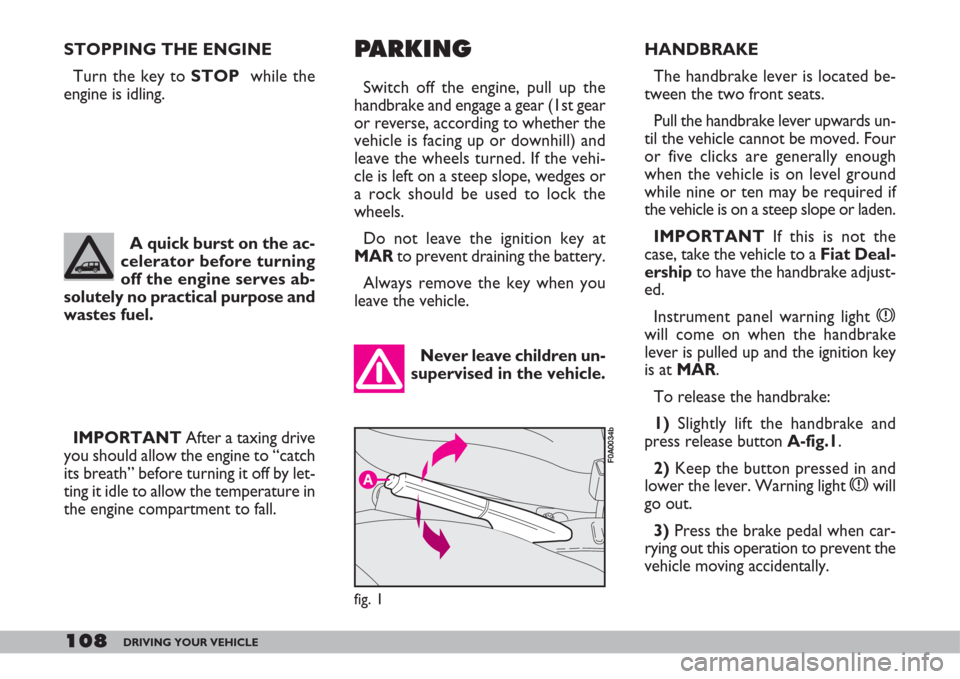
The handbrake lever is located be-
tween the two front seats.
Pull the handbrake lever upwards un-
til the vehicle cannot be moved. Four
or five clicks are generally enough
when the vehicle is on level ground
while nine or ten may be required if
the vehicle is on a steep slope or laden.
IMPORTANTIf this is not the
case, take the vehicle to a Fiat Deal-
ership to have the handbrake adjust-
ed.
Instrument panel warning light x
will come on when the handbrake
lever is pulled up and the ignition key
is at MAR.
To release the handbrake:
1)Slightly lift the handbrake and
press release button A-fig.1.
2)Keep the button pressed in and
lower the lever. Warning light xwill
go out.
3)Press the brake pedal when car-
rying out this operation to prevent the
vehicle moving accidentally. STOPPING THE ENGINE
Turn the key to STOPwhile the
engine is idling.
A quick burst on the ac-
celerator before turning
off the engine serves ab-
solutely no practical purpose and
wastes fuel.
Never leave children un-
supervised in the vehicle.
A
fig. 1
F0A0034b
Page 116 of 218
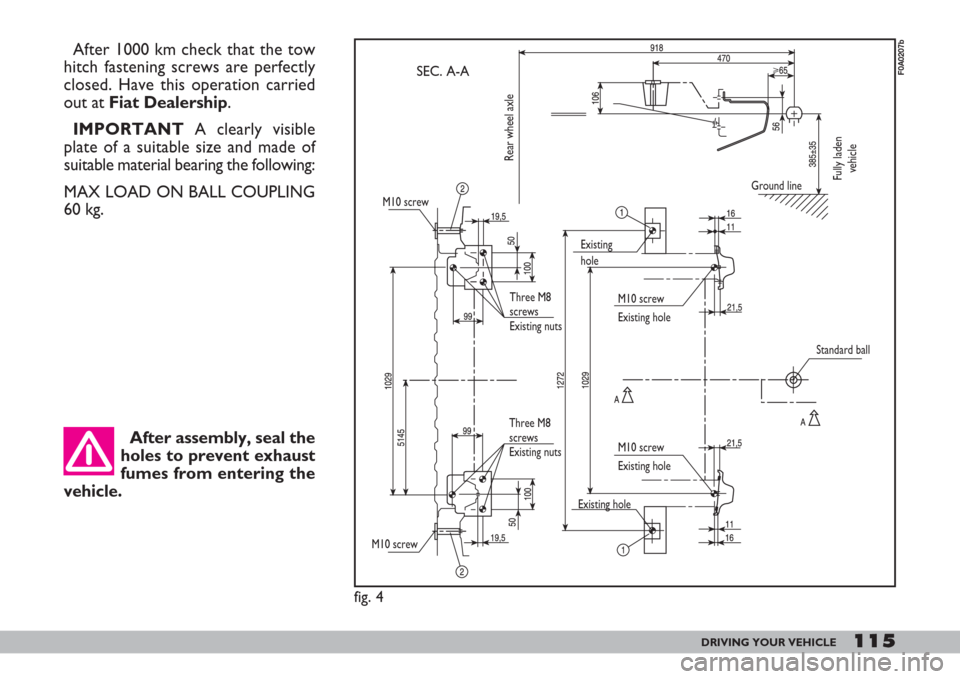
After 1000 km check that the tow
hitch fastening screws are perfectly
closed. Have this operation carried
out at Fiat Dealership.
IMPORTANT A clearly visible
plate of a suitable size and made of
suitable material bearing the following:
MAX LOAD ON BALL COUPLING
60 kg.
fig. 4
F0A0207b
After assembly, seal the
holes to prevent exhaust
fumes from entering the
vehicle.
SEC. A-A
Rear wheel axle
Fully laden
vehicle
Ground line
M10 screw
Existing
hole
M10 screw
Existing hole Three M8
screws
Existing nuts
Standard ball
Three M8
screws
Existing nuts
Existing hole
M10 screwM10 screw
Existing hole
115DRIVING YOUR VEHICLE
Page 117 of 218
116DRIVING YOUR VEHICLE
SNOW CHAINS
Use of snow chains should be in
compliance with local regulations.
Snow chains should only be applied
to the driving wheels (front wheels).We recommend using Lineaccessori
Fiat snow chains.
Check the tautness of the chains af-
ter driving some twenty to thirty me-
tres.
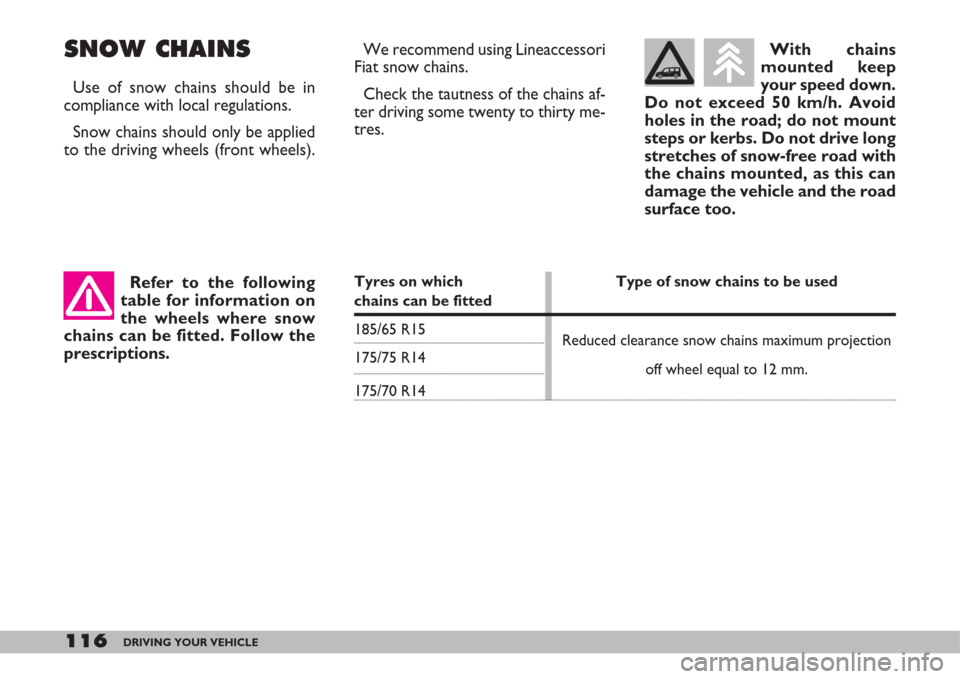
Refer to the following
table for information on
the wheels where snow
chains can be fitted. Follow the
prescriptions.
With chains
mounted keep
your speed down.
Do not exceed 50 km/h. Avoid
holes in the road; do not mount
steps or kerbs. Do not drive long
stretches of snow-free road with
the chains mounted, as this can
damage the vehicle and the road
surface too.
Type of snow chains to be used
Reduced clearance snow chains maximum projection
off wheel equal to 12 mm. Tyres on which
chains can be fitted
185/65 R15
175/75 R14
175/70 R14
Page 118 of 218
SNOW TYRES
These tyres have been specially de-
signed for driving on snow or ice, to
be fitted in place of the standard tyres.
Use snow tyres of the same size as
the standard tyres provided with the
vehicle.
Fiat Dealership will be happy to
provide advice concerning the most
suitable type of tyre for the customer’s
requirements.
For the type of tyre to be used, in-
flation pressures and the specifications
of snow tyres, follow the instructions
given at paragraph “Wheels” in section
“Technical Specifications”.The winter features of these tyres
are reduced considerably when the
tread depth is below 4 mm. In this
case, they should be replaced.
Due to the snow tyre features, un-
der normal conditions of use or on
long motorway journeys, the perfor-
mance of these tyres is lower than that
of standard tyres.
It is therefore necessary to limit their
use to the purposes for which they are
certified.IMPORTANTWhen snow tyres
are used with a max. speed index be-
low the one that can be reached by
the vehicle (increased by 5%), place a
notice in the passenger compartment,
plainly in the driver’s view which states
the max. permissible speed of the
snow tyres (as per EC Directive).
All four tyres should be the same
(brand and track) to ensure greater
safety when driving and braking and
better driveability.
Remember that it is inappropriate to
change the direction of rotation of
tyres.
The max. speed for
snow tyres with “T”
marking , is 190 km/h. The
Road Traffic Code speed limits
must however be always strictly
observed.
117DRIVING YOUR VEHICLE
Page 122 of 218
121IN AN EMERGENCY
BUMP STARTING IF A TYRE IS
PUNCTURED
GENERAL INSTRUCTIONS
Wheel changing and correct use of
the jack and spare wheel call for some
precautions as listed below. Catalysed vehicles must
not be bump started
(pushed, towed or coast-
ed down hill) as this could cause
fuel to flow into the catalytic ex-
haust system and damage it be-
yond repair.
Remember that until
the engine has started the
brake booster and hy-
draulic power steering systems
will not work and a greater effort
will therefore be required to de-
press the brake pedal or turn the
steering wheel.
Alert other drivers that
the vehicle is stationary in
compliance with local
regulations: hazard warning
lights, warning triangle etc.
Passengers on board should
leave the vehicle, especially if it is
heavily laden. Passengers should
stay away from oncoming traffic
while the wheel is being changed.
If the wheel is being changed on
a steep or badly surfaced road,
place wedges or other suitable
material under the wheels to
stop the vehicle.
The spare wheel is vehicle-spe-
cific. Never use the wheel on oth-
er models. Never fit other mod-
el spare wheels on your vehicle.
Do not use the jack for
loads over the value indi-
cated on the plate.
The jack should only be used to
change a wheel on the vehicle for
which it was designed. It should
not be put to other uses or em-
ployed to raise other models of
vehicle. Under no circumstances
should it be used when carrying
out repairs under the vehicle.
An incorrectly positioned jack
may cause the vehicle to fall.