wheel FIAT DOBLO 2007 1.G Owner's Manual
[x] Cancel search | Manufacturer: FIAT, Model Year: 2007, Model line: DOBLO, Model: FIAT DOBLO 2007 1.GPages: 218, PDF Size: 3.19 MB
Page 123 of 218
122IN AN EMERGENCY
To change a wheel proceed as
follows:
1)Stop the vehicle in a position that
is not dangerous for oncoming traffic
where you can change the wheel safe-
ly. The ground should be flat and ad-
equately firm. Do not lubricate the bolt
threads before fitting
them back: they could
come loose.
Fasten the wheel cap correctly
to prevent the wheel from com-
ing free in motion.
Never tamper with the inflation
valve.
Never place tools between the
rim and tyre.
Check the tyre and spare wheel
pressure regularly. The tyre in-
flation pressure is shown in sec-
tion “Technical specifications”.
CHANGING A WHEEL
Please note:
– The jack weighs 1.85 kg
– The jack requires no adjustments
– The jack cannot be repaired. If it
breaks it must be replaced with a new
jack
– No tool with the exception of the
handle can be fitted on the jack.2)Turn the engine off and pull up the
handbrake.
3Engage first or reverse gear.
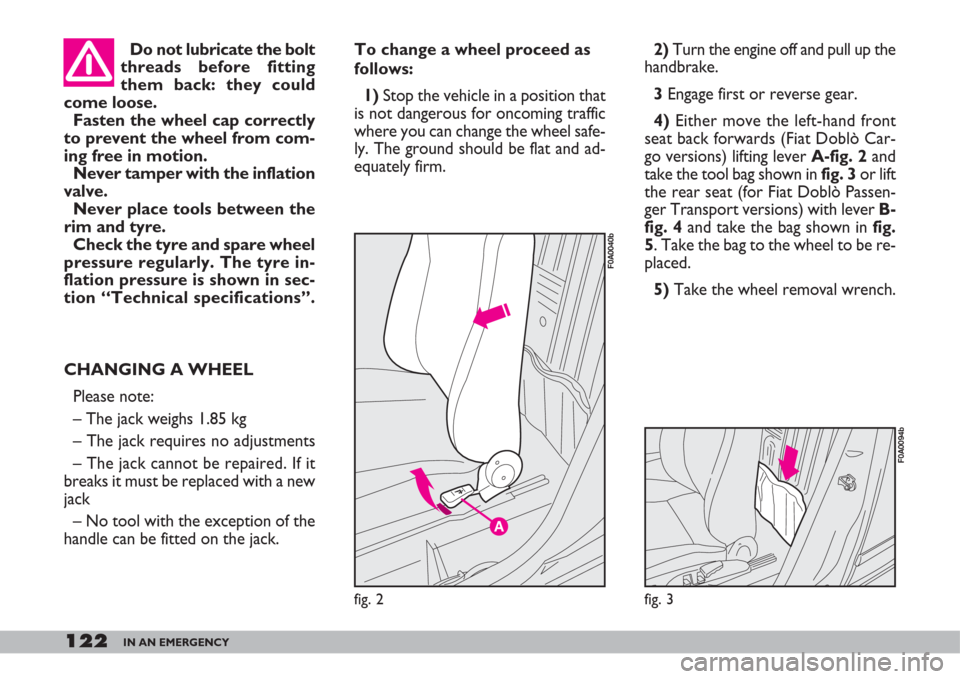
4)Either move the left-hand front
seat back forwards (Fiat Doblò Car-
go versions) lifting lever A-fig. 2and
take the tool bag shown in fig. 3or lift
the rear seat (for Fiat Doblò Passen-
ger Transport versions) with lever B-
fig. 4and take the bag shown in fig.
5. Take the bag to the wheel to be re-
placed.
5)Take the wheel removal wrench.
A
fig. 2
F0A0040b
fig. 3
F0A0094b
Page 124 of 218
123IN AN EMERGENCY
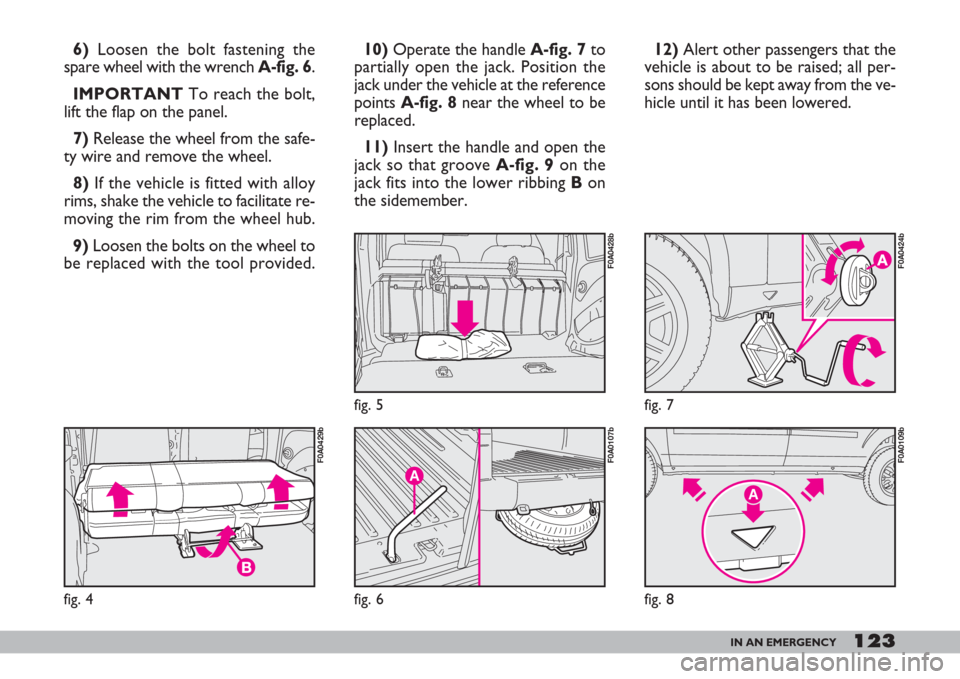
6)Loosen the bolt fastening the
spare wheel with the wrenchA-fig. 6.
IMPORTANTTo reach the bolt,
lift the flap on the panel.
7)Release the wheel from the safe-
ty wire and remove the wheel.
8)If the vehicle is fitted with alloy
rims, shake the vehicle to facilitate re-
moving the rim from the wheel hub.
9)Loosen the bolts on the wheel to
be replaced with the tool provided.10)Operate the handle A-fig. 7to
partially open the jack. Position the
jack under the vehicle at the reference
points A-fig. 8near the wheel to be
replaced.
11)Insert the handle and open the
jack so that grooveA-fig. 9on the
jack fits into the lower ribbing Bon
the sidemember.
fig. 4
F0A0429b
fig. 5
F0A0428b
A
fig. 6
F0A0107b
12) Alert other passengers that the
vehicle is about to be raised; all per-
sons should be kept away from the ve-
hicle until it has been lowered.
fig. 7
F0A0424b
A
fig. 8
F0A0109b
Page 125 of 218
124IN AN EMERGENCY
13)Operate the jack and lift the ve-
hicle until the wheel to be changed is
several centimetres off the ground.
When turning the jack handle make
sure that it can be used easily and take
care not to scrape your hand against
the ground. The moving parts of the
jack (screw and joints) may also cause
injury if touched. Clean off any grease.
14)Remove the four wheel bolts are
remove the wheel.
15) Ensure that the housings for the
wheel bolts on the spare wheel are
clean and free from dirt which could
cause the wheel bolts to come loose.
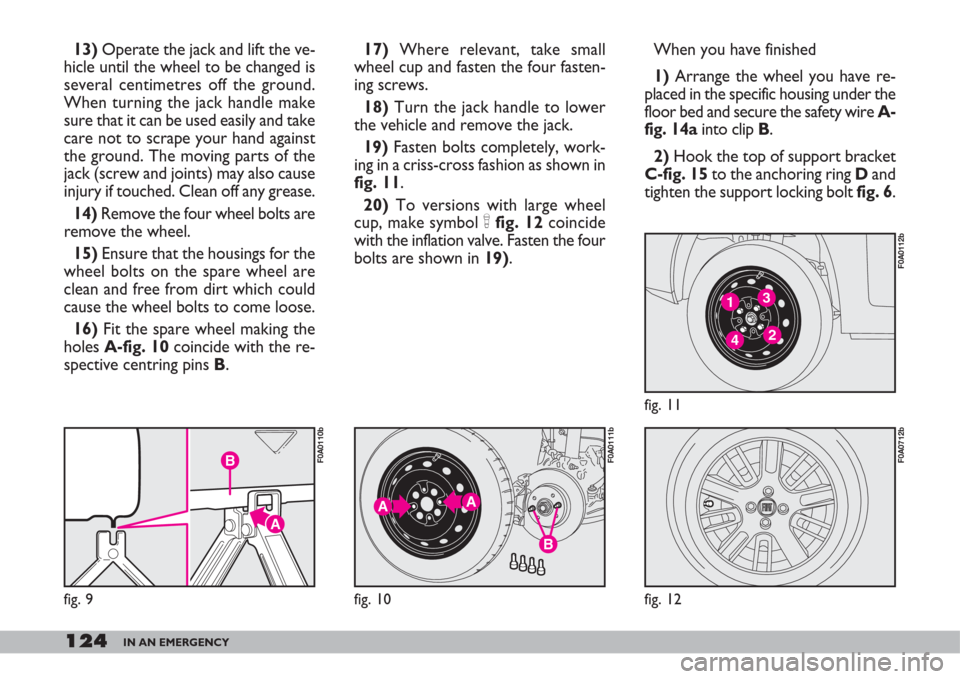
16)Fit the spare wheel making the
holes A-fig. 10coincide with the re-
spective centring pins B.17)Where relevant, take small
wheel cup and fasten the four fasten-
ing screws.
18)Turn the jack handle to lower
the vehicle and remove the jack.
19)Fasten bolts completely, work-
ing in a criss-cross fashion as shown in
fig. 11.
20)To versions with large wheel
cup, make symbol “fig. 12coincide
with the inflation valve. Fasten the four
bolts are shown in 19).
A
B
fig. 9
F0A0110b
AA
B
fig. 10
F0A0111b
When you have finished
1)Arrange the wheel you have re-
placed in the specific housing under the
floor bed and secure the safety wire A-
fig. 14ainto clip B.
2)Hook the top of support bracket
C-fig. 15to the anchoring ring Dand
tighten the support locking bolt fig. 6.
3
24
1
fig. 11
F0A0112b
fig. 12
F0A0712b
Page 126 of 218
125IN AN EMERGENCY
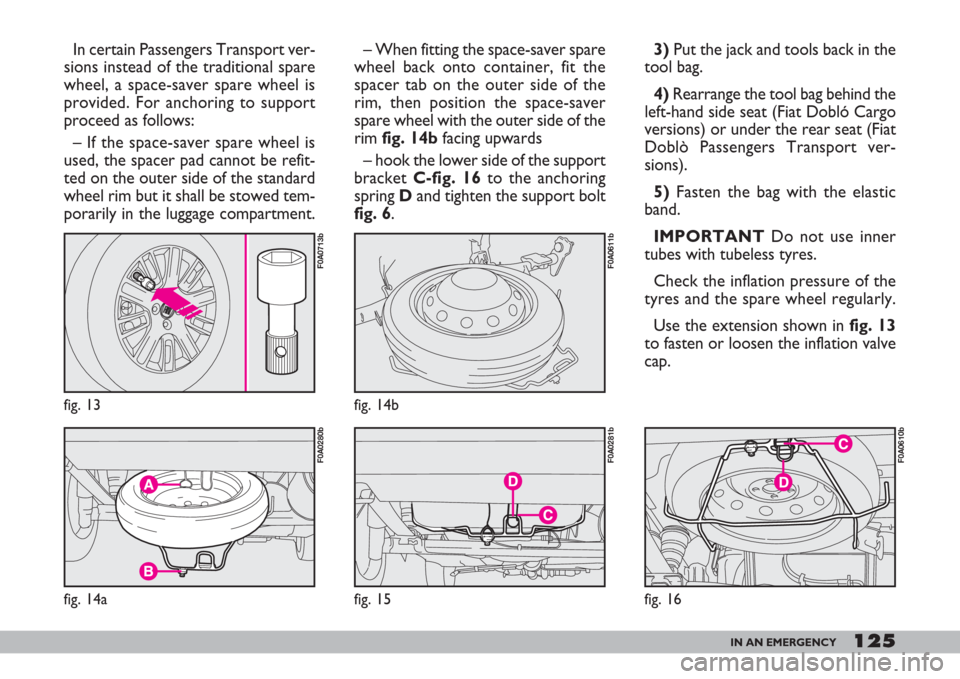
– When fitting the space-saver spare
wheel back onto container, fit the
spacer tab on the outer side of the
rim, then position the space-saver
spare wheel with the outer side of the
rim fig. 14bfacing upwards
– hook the lower side of the support
bracket C-fig. 16to the anchoring
spring Dand tighten the support bolt
fig. 6.3) Put the jack and tools back in the
tool bag.
4)Rearrange the tool bag behind the
left-hand side seat (Fiat Dobló Cargo
versions) or under the rear seat (Fiat
Doblò Passengers Transport ver-
sions).
5)Fasten the bag with the elastic
band.
IMPORTANT Do not use inner
tubes with tubeless tyres.
Check the inflation pressure of the
tyres and the spare wheel regularly.
Use the extension shown in fig. 13
to fasten or loosen the inflation valve
cap.
fig. 13
F0A0713b
fig. 14a
F0A0280b
fig. 15
F0A0281b
In certain Passengers Transport ver-
sions instead of the traditional spare
wheel, a space-saver spare wheel is
provided. For anchoring to support
proceed as follows:
– If the space-saver spare wheel is
used, the spacer pad cannot be refit-
ted on the outer side of the standard
wheel rim but it shall be stowed tem-
porarily in the luggage compartment.
fig. 14b
F0A0611b
fig. 16
F0A0610b
Page 128 of 218
Put on the protection
gloves provided together
with quick tyre repair kit.
– Pull up the handbrake. Loosen
tyre inflation valve cap, take out the
filler hose A-fig. 16cand screw the
ring nut B-fig. 16con the tyre valve; The compressor shall
not be operated for more
than 20 minutes. Risk of
overheating!. Tyres repaired with
the quick tyre repair kit shall be
used temporarily only.
127IN AN EMERGENCY
Repairs are not possible
in case of damages on the
wheel rim (bad groove
distortion causing air loss). Do
not remove foreign bodies
(screws or nails) from the tyre.
IT SHOULD BE NOTICED
THAT:
The sealing fluid of the quick tyre re-
pair kit is effective with external tem-
peratures between -20 °C and +50
°C.
The sealing fluid has limited life. The cylinder contains
ethylene glycol. The cylin-
der contains latex: it can
cause allergic reactions. It is
harmful if ingested or inhaled and
irritant for the eyes and in case of
contact. In case of contact rinse
immediately with water and take
off contaminated clothes. If swal-
lowed, do not induce vomit, rinse
out the mouth, drink a lot of wa-
ter and call the doctor immedi-
ately. Keep away from children.
This product must not be used by
asthmatics. Do not inhale
vapours. Call the doctor imme-
diately in case of allergic reac-
tions. Keep the cylinder in the
space provided for the purpose
and far from heat. The sealing flu-
id has limited life.Replace the cylinder if
sealer has run out. Do not
throw away the cylinder
and the sealing fluid. Have the
sealing fluid and the cylinder dis-
posed of in compliance with na-
tional and local regulations.
INFLATING PROCEDURE
Page 136 of 218
135IN AN EMERGENCY
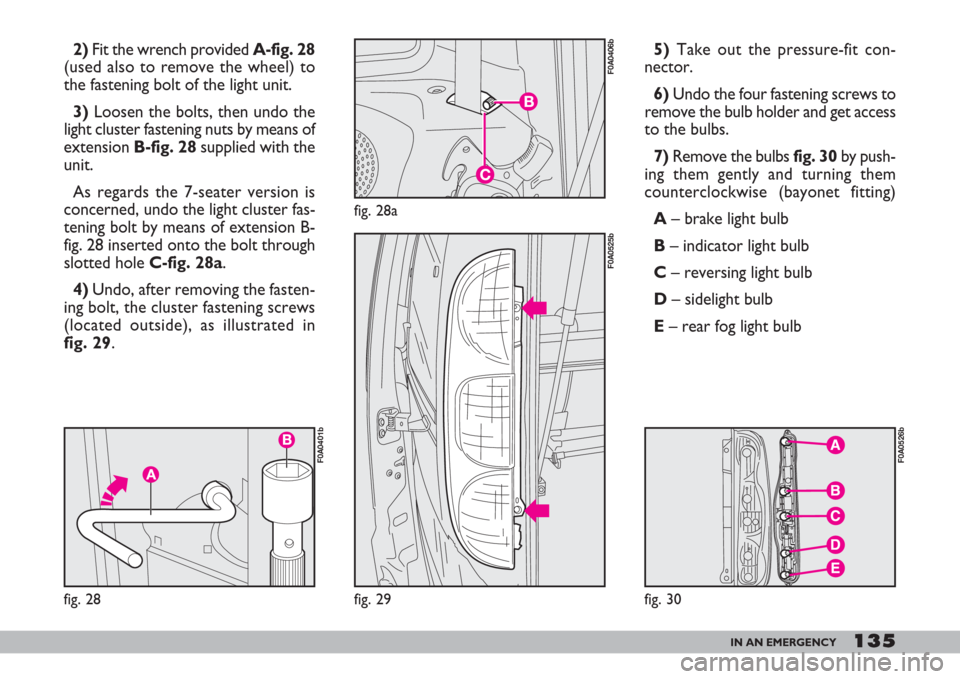
2)Fit the wrench provided A-fig. 28
(used also to remove the wheel) to
the fastening bolt of the light unit.
3)Loosen the bolts, then undo the
light cluster fastening nuts by means of
extension B-fig. 28supplied with the
unit.
As regards the 7-seater version is
concerned, undo the light cluster fas-
tening bolt by means of extension B-
fig. 28 inserted onto the bolt through
slotted hole C-fig. 28a.
4)Undo, after removing the fasten-
ing bolt, the cluster fastening screws
(located outside), as illustrated in
fig. 29.5)Take out the pressure-fit con-
nector.
6)Undo the four fastening screws to
remove the bulb holder and get access
to the bulbs.
7)Remove the bulbs fig. 30by push-
ing them gently and turning them
counterclockwise (bayonet fitting)
A– brake light bulb
B– indicator light bulb
C– reversing light bulb
D– sidelight bulb
E– rear fog light bulb
fig. 28a
F0A0406b
fig. 29
F0A0525b
fig. 30
F0A0526b
fig. 28
F0A0401b
Page 146 of 218
145IN AN EMERGENCY
JACKING
THE VEHICLE
WITH THE JACK
See “If a tyre is punctured”, in this
section.
Please note:
– The jack requires no adjustments.
– The jack cannot be repaired. If it
breaks it must be replaced with a new
jack;
– No other tool, part from the han-
dle shown in this chapter, can be fit-
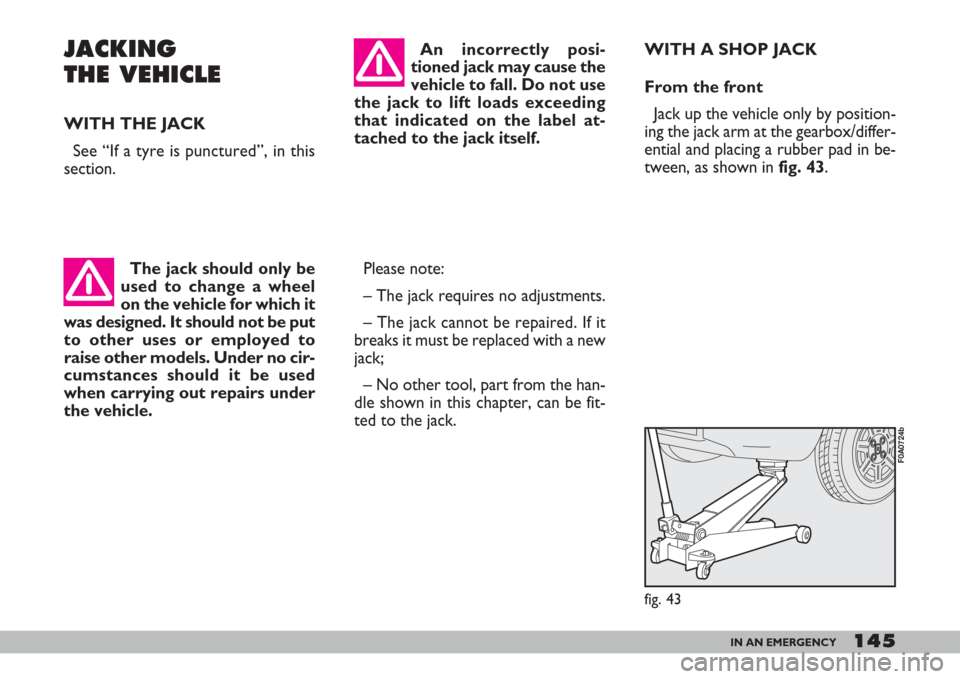
ted to the jack.WITH A SHOP JACK
From the front
Jack up the vehicle only by position-
ing the jack arm at the gearbox/differ-
ential and placing a rubber pad in be-
tween, as shown in fig. 43.
fig. 43
F0A0724b
The jack should only be
used to change a wheel
on the vehicle for which it
was designed. It should not be put
to other uses or employed to
raise other models. Under no cir-
cumstances should it be used
when carrying out repairs under
the vehicle.
An incorrectly posi-
tioned jack may cause the
vehicle to fall. Do not use
the jack to lift loads exceeding
that indicated on the label at-
tached to the jack itself.
Page 148 of 218
147IN AN EMERGENCY
IF AN ACCIDENT
OCCURS
– It is important to keep calm.
– If you are not directly involved in
the accident, stop at least ten metres
away from the accident.
– If you are on a motorway, do not
obstruct the emergency lane with
your vehicle.
– Turn off the engine and turn on the
hazard lights.
– At night, illuminate the scene of the
accident with your headlights.
– Act carefully, you must not risk be-
ing run over.
– Mark the accident by putting the
red triangle at the regulatory distance
from the vehicle where it can be clear-
ly seen.
– Call for rescue making the infor-
mation you give as accurate as you
can. On the motorway use the special
column-mounted emergency phones. When towing the vehi-
cle, you must comply with
the specific traffic regula-
tions regarding the tow hitch and
how to tow on the road.
Before starting to tow,
turn the ignition key to
MAR and then to STOP.
Do not remove the key. If the key
is removed, the steering lock en-
gages automatically which pre-
vents the wheels being turned.
While the vehicle is be-
ing towed with the engine
off, remember that the
brake pedal and steering will re-
quire more effort as you no
longer have the benefit of the
power brakes and power steer-
ing. Do not use flexible cables to
tow. Avoid jerking. Whilst tow-
ing, ensure that the coupling to
the vehicle does not damage the
surrounding components.
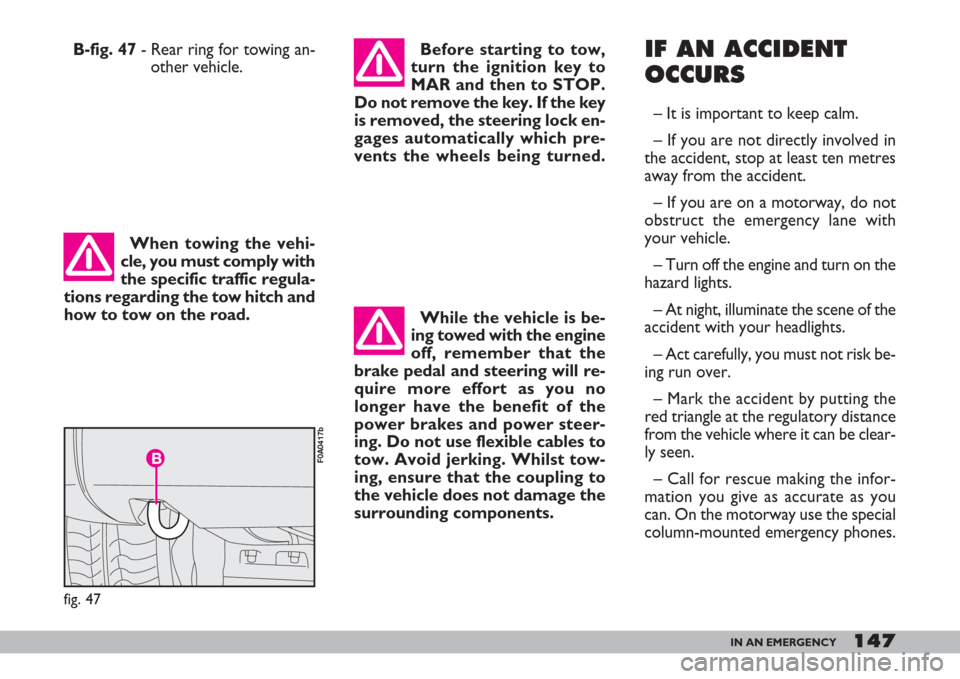
fig. 47
F0A0417b
B-fig. 47- Rear ring for towing an-
other vehicle.
Page 153 of 218
152VEHICLE MAINTENANCE
ANNUAL
INSPECTION
SCHEDULE
For vehicles with an annual
mileage of below 20.000 km (for
example about 10.000 km) the
following yearly inspection pro-
gramme is advised:
– check tyre conditions/wear and ad-
just pressure if required (including the
spare wheel).
– check light system operation (head-
lights, direction indicators, hazard
lights, boot lights, passenger compart-
ment lights, glovebox light, warning
lights, etc.).
– check windscreen wiper/washer
operation, adjust nozzles.
– check windscreen/rear window
blade position/wear
– check front disk brake pad condi-
tions and wear.– check cleanness of bonnet and
boot locks and lever cleanness and lu-
brication
– sight inspect the conditions of: en-
gine, gearbox, transmission, pipes and
hoses (exhaust - fuel - brakes), rubber
parts (boots, sleeves, bushes, etc)
brake and fuel hoses.
– check battery charge.
– visual check on various drive belt
conditions.
– check and top up, if required, fluid
levels (engine coolant, brake fluid,
windscreen washer fluid, battery fluid,
etc.).
– change engine oil.
– change engine oil filter.
– replace pollen filter (where pro-
vided).
ADDITIONAL
CHECKS
Every 1,000 kmor before long
trips, check and top up as necessary:
engine coolant level, brake fluid level,
windscreen washer liquid level, tyre
pressure and conditions.
Every 3,000 km check and top up
as necessary: engine oil level.
You are recommended to use FL
Selenia,products designed and pro-
duced specifically for Fiat vehicles (see
“Capacities” in section “Technical
specifications”).
Page 168 of 218
167VEHICLE MAINTENANCE
Tyres must be replaced when the
tread wears down to 1.6 mm. In any
case, comply with the laws in the
country where the vehicle is being dri-
ven.
IMPORTANT NOTES
As far as possible avoid sharp brak-
ing and screech starts.
Be careful not to hit the kerb, pot-
holes or other obstacles hard. Driving
for long stretches over bumpy roads
can damage the tyres.
Periodically check that the tyres have
no cuts in the sidewalls, abnormal
swelling or irregular tyre wear. If any
of these occur, have the vehicle seen
to at a Fiat Dealership. If the pressure is too low
the tyre overheats and
this can cause it serious
damage.
WHEELS
AND TYRES
TYRE PRESSURE
Check the pressure of each tyre, in-
cluding the spare, every two weeks
and before long journeys.
The pressure must be checked when
the tyre is rested and cold.
It is normal for the pressure to rise
when you are driving. If you have to
check or restore the pressure when
the tyres are warm, remember that
the pressure value must be 0.3 bar
above the specified value.
See “Wheels” in “Technical specifi-
cations” for the correct tyre inflation
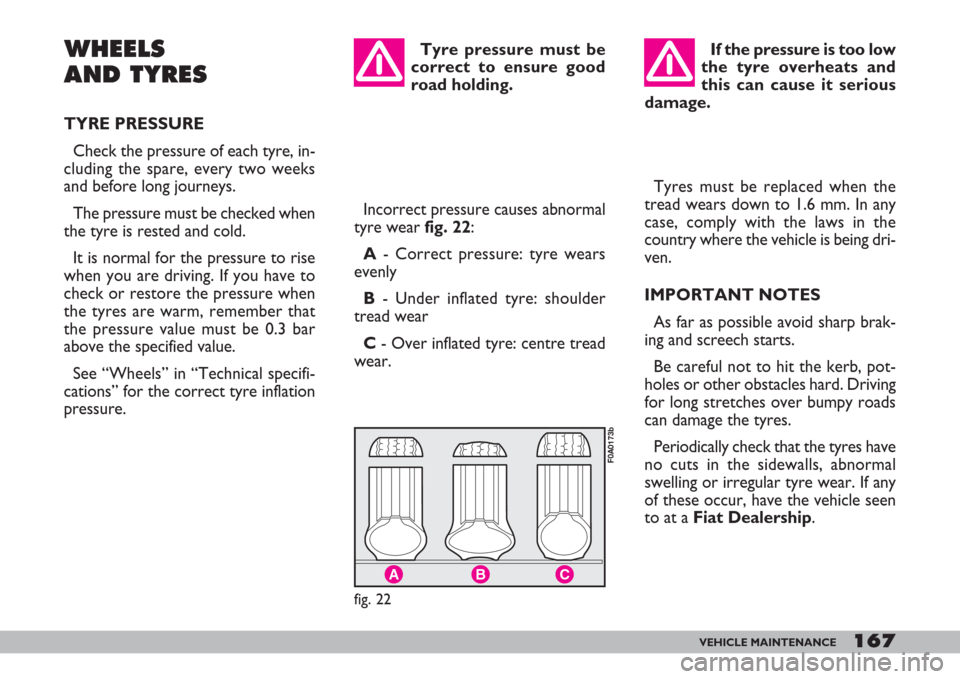
pressure.Incorrect pressure causes abnormal
tyre wearfig. 22:
A- Correct pressure: tyre wears
evenly
B- Under inflated tyre: shoulder
tread wear
C- Over inflated tyre: centre tread
wear.Tyre pressure must be
correct to ensure good
road holding.
ABC
fig. 22
F0A0173b