Seat FIAT DOBLO 2007 1.G Owner's Manual
[x] Cancel search | Manufacturer: FIAT, Model Year: 2007, Model line: DOBLO, Model: FIAT DOBLO 2007 1.GPages: 218, PDF Size: 3.19 MB
Page 58 of 218
57GETTING TO KNOW YOUR VEHICLE57
HEATING AND VENTILATION SYSTEM
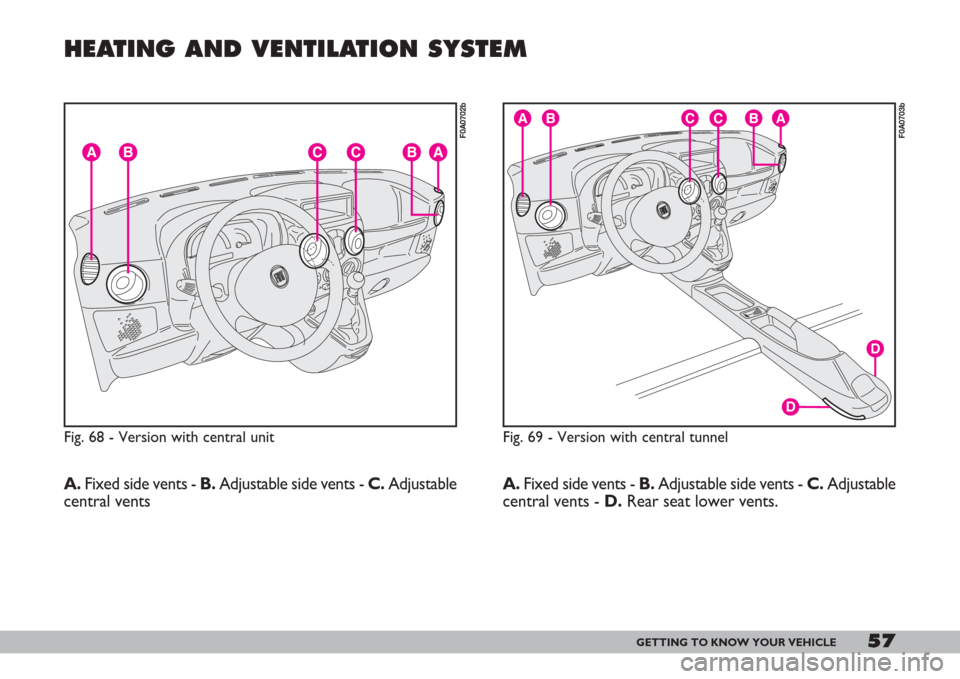
A.Fixed side vents - B.Adjustable side vents - C.Adjustable
central vents A.Fixed side vents - B.Adjustable side vents - C.Adjustable
central vents - D.Rear seat lower vents.
BABCCA
D
D
Fig. 69 - Version with central tunnel
BABCCA
Fig. 68 - Version with central unit
F0A0702b
F0A0703b
Page 81 of 218
80GETTING TO KNOW YOUR VEHICLE
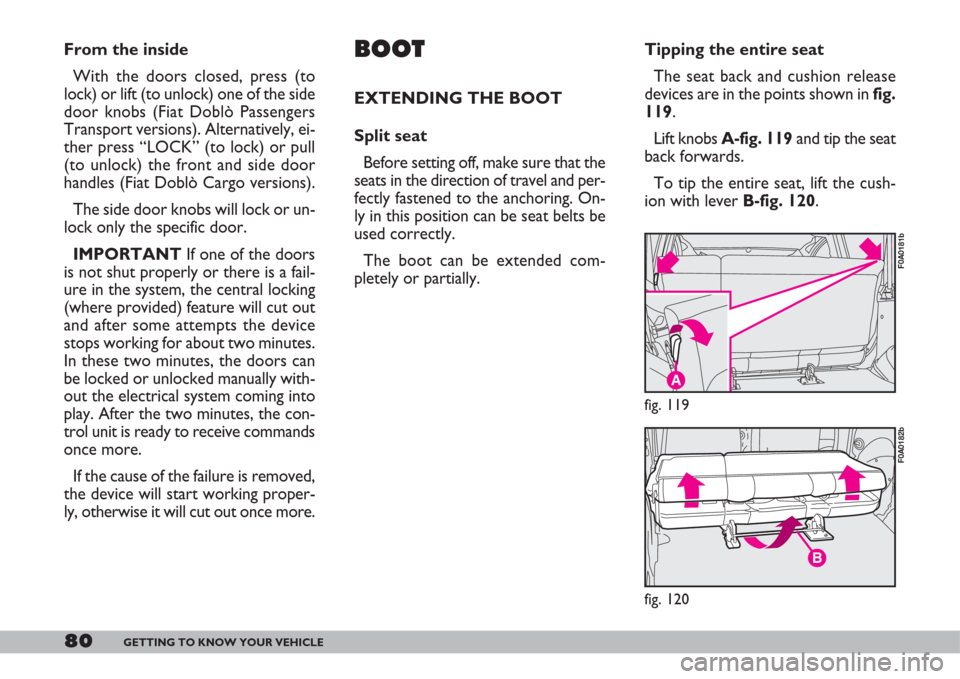
Tipping the entire seat
The seat back and cushion release
devices are in the points shown in fig.
119.
Lift knobs A-fig. 119 and tip the seat
back forwards.
To tip the entire seat, lift the cush-
ion with lever B-fig. 120.
A
fig. 119
F0A0181b
B
fig. 120
F0A0182b
From the inside
With the doors closed, press (to
lock) or lift (to unlock) one of the side
door knobs (Fiat Doblò Passengers
Transport versions). Alternatively, ei-
ther press “LOCK” (to lock) or pull
(to unlock) the front and side door
handles (Fiat Doblò Cargo versions).
The side door knobs will lock or un-
lock only the specific door.
IMPORTANTIf one of the doors
is not shut properly or there is a fail-
ure in the system, the central locking
(where provided) feature will cut out
and after some attempts the device
stops working for about two minutes.
In these two minutes, the doors can
be locked or unlocked manually with-
out the electrical system coming into
play. After the two minutes, the con-
trol unit is ready to receive commands
once more.
If the cause of the failure is removed,
the device will start working proper-
ly, otherwise it will cut out once more.BOOT
EXTENDING THE BOOT
Split seat
Before setting off, make sure that the
seats in the direction of travel and per-
fectly fastened to the anchoring. On-
ly in this position can be seat belts be
used correctly.
The boot can be extended com-
pletely or partially.
Page 82 of 218
81GETTING TO KNOW YOUR VEHICLE
fig. 121
F0A0256b
fig. 122
F0A0255b
A
fig. 123
F0A0093b
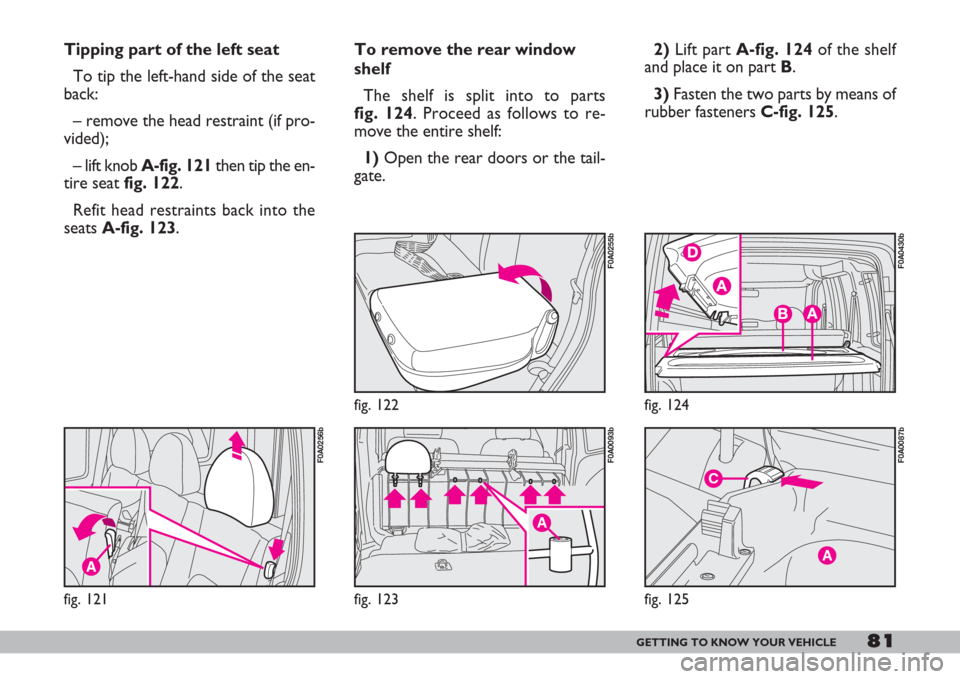
Tipping part of the left seat
To tip the left-hand side of the seat
back:
– remove the head restraint (if pro-
vided);
– lift knob A-fig. 121then tip the en-
tire seat fig. 122.
Refit head restraints back into the
seats A-fig. 123.To remove the rear window
shelf
The shelf is split into to parts
fig. 124. Proceed as follows to re-
move the entire shelf:
1)Open the rear doors or the tail-
gate.
fig. 124
F0A0430b
C
A
fig. 125
F0A0087b
2)Lift part A-fig. 124of the shelf
and place it on part B.
3)Fasten the two parts by means of
rubber fasteners C-fig. 125.
Page 83 of 218
82GETTING TO KNOW YOUR VEHICLE
fig. 127
F0A0433b
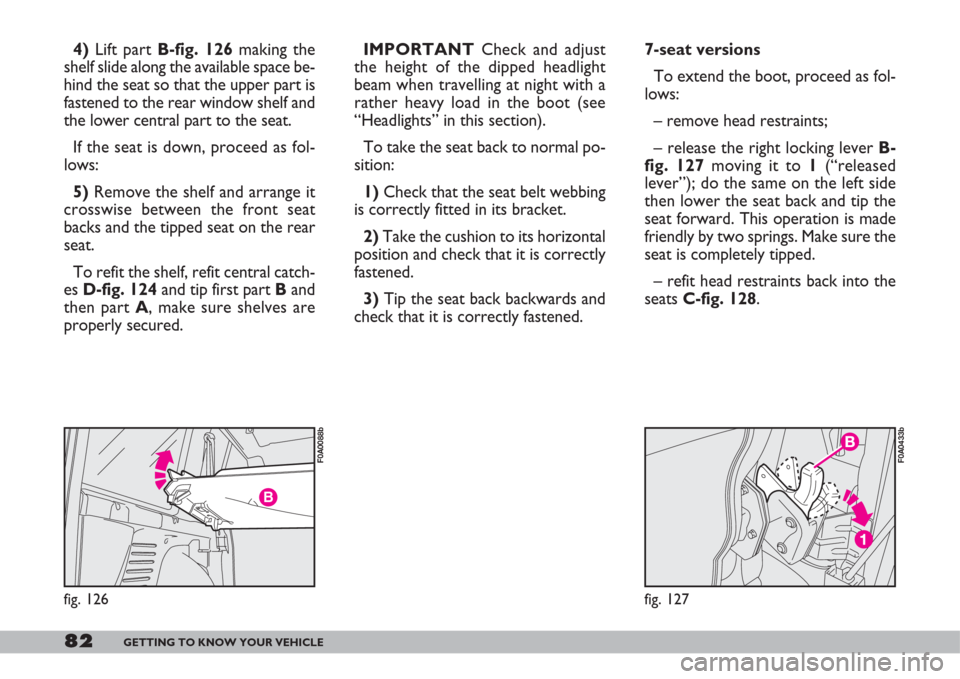
7-seat versions
To extend the boot, proceed as fol-
lows:
– remove head restraints;
– release the right locking lever B-
fig. 127moving it to 1(“released
lever”); do the same on the left side
then lower the seat back and tip the
seat forward. This operation is made
friendly by two springs. Make sure the
seat is completely tipped.
– refit head restraints back into the
seats C-fig. 128.
B
fig. 126
F0A0088b
4)Lift part B-fig. 126making the
shelf slide along the available space be-
hind the seat so that the upper part is
fastened to the rear window shelf and
the lower central part to the seat.
If the seat is down, proceed as fol-
lows:
5)Remove the shelf and arrange it
crosswise between the front seat
backs and the tipped seat on the rear
seat.
To refit the shelf, refit central catch-
es D-fig. 124and tip first part Band
then part A, make sure shelves are
properly secured.IMPORTANTCheck and adjust
the height of the dipped headlight
beam when travelling at night with a
rather heavy load in the boot (see
“Headlights” in this section).
To take the seat back to normal po-
sition:
1)Check that the seat belt webbing
is correctly fitted in its bracket.
2)Take the cushion to its horizontal
position and check that it is correctly
fastened.
3)Tip the seat back backwards and
check that it is correctly fastened.
Page 84 of 218
83GETTING TO KNOW YOUR VEHICLE
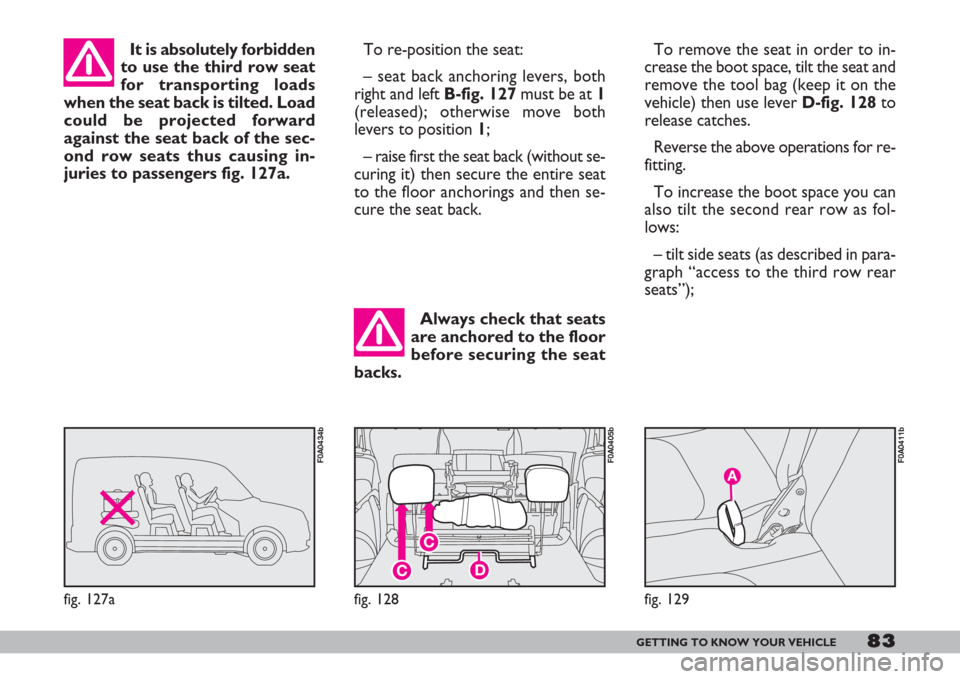
Always check that seats
are anchored to the floor
before securing the seat
backs. It is absolutely forbidden
to use the third row seat
for transporting loads
when the seat back is tilted. Load
could be projected forward
against the seat back of the sec-
ond row seats thus causing in-
juries to passengers fig. 127a.To re-position the seat:
– seat back anchoring levers, both
right and left B-fig. 127must be at 1
(released); otherwise move both
levers to position 1;
– raise first the seat back (without se-
curing it) then secure the entire seat
to the floor anchorings and then se-
cure the seat back.To remove the seat in order to in-
crease the boot space, tilt the seat and
remove the tool bag (keep it on the
vehicle) then use lever D-fig. 128to
release catches.
Reverse the above operations for re-
fitting.
To increase the boot space you can
also tilt the second rear row as fol-
lows:
– tilt side seats (as described in para-
graph “access to the third row rear
seats”);
fig. 128
F0A0405b
fig. 127a
F0A0434b
fig. 129
F0A0411b
Page 85 of 218
84GETTING TO KNOW YOUR VEHICLE
fig. 131
F0A0420b
fig. 130
F0A0412b
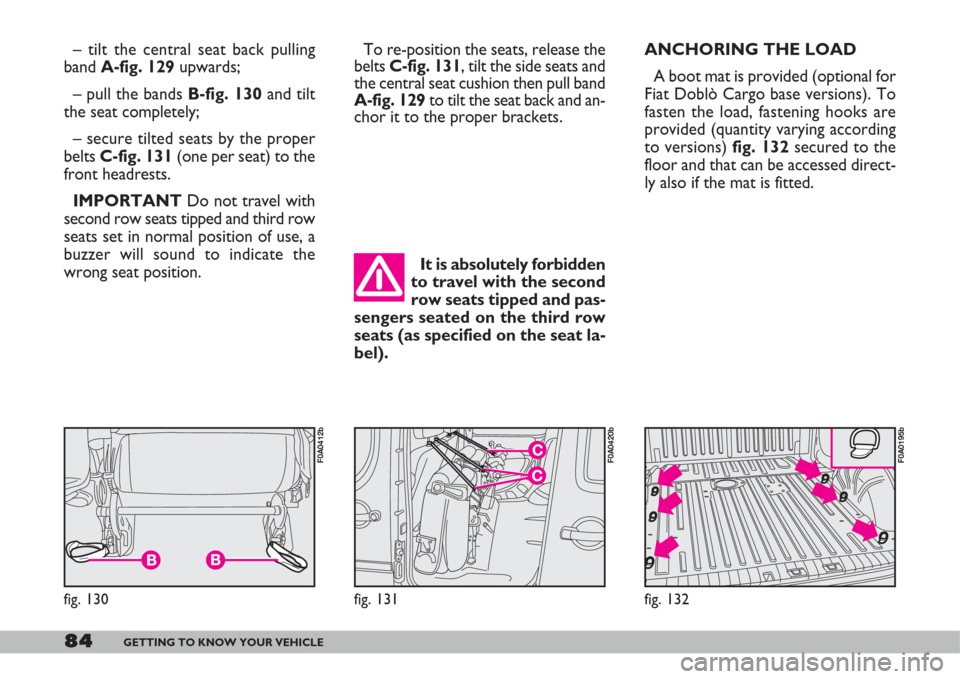
– tilt the central seat back pulling
band A-fig. 129upwards;
– pull the bands B-fig. 130and tilt
the seat completely;
– secure tilted seats by the proper
belts C-fig. 131(one per seat) to the
front headrests.
IMPORTANTDo not travel with
second row seats tipped and third row
seats set in normal position of use, a
buzzer will sound to indicate the
wrong seat position.ANCHORING THE LOAD
A boot mat is provided (optional for
Fiat Doblò Cargo base versions). To
fasten the load, fastening hooks are
provided (quantity varying according
to versions) fig. 132secured to the
floor and that can be accessed direct-
ly also if the mat is fitted.
fig. 132
F0A0195b
To re-position the seats, release the
belts C-fig. 131, tilt the side seats and
the central seat cushion then pull band
A-fig. 129to tilt the seat back and an-
chor it to the proper brackets.
It is absolutely forbidden
to travel with the second
row seats tipped and pas-
sengers seated on the third row
seats (as specified on the seat la-
bel).
Page 90 of 218
89GETTING TO KNOW YOUR VEHICLE
ABS
The vehicle can be fitted with an ABS
braking system, which prevents the
wheels from locking when braking,
makes the most of road grip and gives
the best control when emergency
braking under difficult road conditions.
The driver can tell the ABS system
has come into play because the brake
pedal pulsates slightly and the system
gets noisier.
This should not be interpreted as a
fault in the brakes; on the contrary it
is a sign that the ABS system is work-
ing: it tells the driver that the vehicle
is travelling at the limit of its road grip
and that he should alter his speed to
fit the type of road surface.
The ABS system is an addition to the
basic braking system. If there is a mal-
function, the system turns off auto-
matically and only the ordinary brakes
continue to work.If a failure occurs, and consequently
the anti-lock function is not effective,
the braking system will continue to
work as usual.
If you have never driven a vehicle
with ABS before, you should practice
using the system on slippery terrain,
obviously with the necessary safety
precautions and keeping to the High-
way Code of the country you are in.
It is also a good idea to read the fol-
lowing information carefully.
The advantage in using the ABS sys-
tem is that it continues to give you
maximum manoeuvrability even when
braking hard in conditions of poor grip
by preventing the wheels locking.
You should, however, not expect the
braking distance to always decrease:
for example surfaces with gravel or
fresh snow on a slippery road will in
fact increase the braking distance. Correct positions as a function
of the load
0- one or two occupants in the
front seats.
1- five occupants.
2- five occupants + load in boot.
3- driver + maximum permissible
load stowed in boot.
Check the headlight
beam position every time
you change the load to be
carried.
HEADLIGHT ADJUSTMENT
ABROAD
Headlights are orientated as to drive
inside the country of origin before sell-
ing the vehicle. When travelling in
countries with opposite driving direc-
tion, you need to cover the headlight
areas according to the Road Code of
the country you are travelling in.
Page 92 of 218
91GETTING TO KNOW YOUR VEHICLE
The cushion immediately inflates,
placing itself as a protection between
the body of the front occupants and
the structure that could cause injuries.
Immediately after, the cushion deflates.
The front air bag (driver and pas-
senger) is not a replacement of but
complementary to the use of belts,
which should always be worn, as spec-
ified by law in Europe and most non-
European countries.
In case of crash, a person not wear-
ing the seat belt moves forward and
may come into contact with the cush-
ion while it is still inflating. Under this
circumstance the protection offered
by the airbag is reduced.
Front airbags may not activate in the
following situations:
– in collisions against highly de-
formable objects not affecting the ve-
hicle front surface (e.g. bumper colli-
sion against guard rail); If the xbrake fluid low
warning light comes on,
stop the vehicle immedi-
ately and contact the nearest Fi-
at Dealership. Fluid leaks from
the hydraulic system, in fact, can
compromise brake system oper-
ation, both traditional systems
and systems with ABS.FRONT AND SIDE
AIRBAGS
The vehicle can be fitted with front
air bags for the driver and passenger
and with side bags.
FRONT AIRBAGS
Front airbags (driver and passenger)
have been designed to protect the oc-
cupants in the event of head-on crash-
es of medium-high severity, by plac-
ing the cushion between the occupant
and the steering wheel or dashboard.
Front airbags are designed to protect
vehicle’s occupants in front crashes
and therefore non-activation in other
types of collisions (side collisions, rear
shunts, roll-overs, etc.) is not a system
malfunction.
In case of crash, an electronic con-
trol unit, when required, triggers the
inflation of the cushion according to
the severity of the collision. Warning light >alone,
with the engine running,
normally indicates a fault
in the ABS system only. In this
case, the braking system is still ef-
ficient, though without the anti-
locking device. Under these con-
ditions, performance of the EBD
system may be reduced. Also in
this case, you are advised to go
immediately to the nearest Fiat
Dealership, driving in such a way
to avoid sharp braking to have
the system checked.
Page 93 of 218
92GETTING TO KNOW YOUR VEHICLE
– in case of wedging under other ve-
hicles or protective barriers (for ex-
ample under a truck or guard rail), the
air bag is not triggered as it offers no
additional protection compared with
the seat belts, consequently it would
be pointless.
Therefore, failure to come into ac-
tion in the above circumstance does
not mean that the system is not work-
ing properly.At their maximum inflation, their vol-
ume fills most of the space between
the steering wheel and the driver and
between the dashboard and the pas-
senger.
In minor crashes (for which the re-
straining action of the seat belts is suf-
ficient), the air bags are not deployed.
Also in this case it is of vital impor-
tance to wear the seat belts since in
case of front crash they guarantee
proper positioning of the occupant.DRIVER’S FRONT AIR BAG
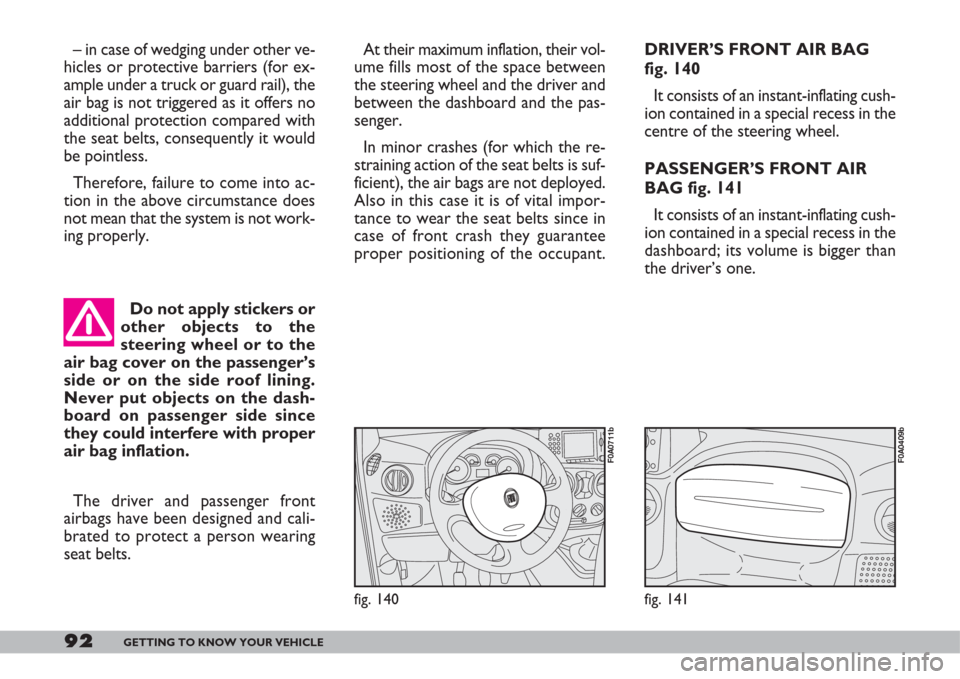
fig. 140
It consists of an instant-inflating cush-
ion contained in a special recess in the
centre of the steering wheel.
PASSENGER’S FRONT AIR
BAG fig. 141
It consists of an instant-inflating cush-
ion contained in a special recess in the
dashboard; its volume is bigger than
the driver’s one.
Do not apply stickers or
other objects to the
steering wheel or to the
air bag cover on the passenger’s
side or on the side roof lining.
Never put objects on the dash-
board on passenger side since
they could interfere with proper
air bag inflation.
The driver and passenger front
airbags have been designed and cali-
brated to protect a person wearing
seat belts.
fig. 140
F0A0711b
fig. 141
F0A0409b
Page 94 of 218
93GETTING TO KNOW YOUR VEHICLE
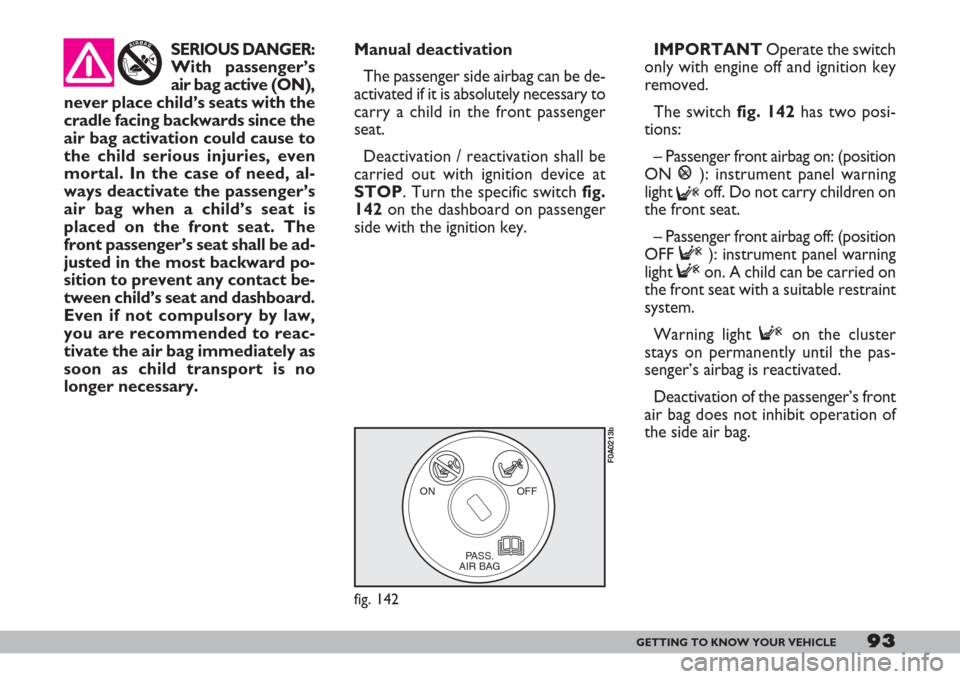
Manual deactivation
The passenger side airbag can be de-
activated if it is absolutely necessary to
carry a child in the front passenger
seat.
Deactivation / reactivation shall be
carried out with ignition device at
STOP. Turn the specific switch fig.
142on the dashboard on passenger
side with the ignition key.IMPORTANTOperate the switch
only with engine off and ignition key
removed.
The switch fig. 142has two posi-
tions:
– Passenger front airbag on: (position
ON P): instrument panel warning
light
Foff. Do not carry children on
the front seat.
– Passenger front airbag off: (position
OFF F): instrument panel warning
light Fon. A child can be carried on
the front seat with a suitable restraint
system.
Warning light Fon the cluster
stays on permanently until the pas-
senger’s airbag is reactivated.
Deactivation of the passenger’s front
air bag does not inhibit operation of
the side air bag.SERIOUS DANGER:
With passenger’s
air bag active (ON),
never place child’s seats with the
cradle facing backwards since the
air bag activation could cause to
the child serious injuries, even
mortal. In the case of need, al-
ways deactivate the passenger’s
air bag when a child’s seat is
placed on the front seat. The
front passenger’s seat shall be ad-
justed in the most backward po-
sition to prevent any contact be-
tween child’s seat and dashboard.
Even if not compulsory by law,
you are recommended to reac-
tivate the air bag immediately as
soon as child transport is no
longer necessary.
ON OFF
PASS.
AIR BAG
fig. 142
F0A0213b