tow FIAT DOBLO 2008 1.G User Guide
[x] Cancel search | Manufacturer: FIAT, Model Year: 2008, Model line: DOBLO, Model: FIAT DOBLO 2008 1.GPages: 222, PDF Size: 3.39 MB
Page 112 of 222
DRIVING STYLE
Starting
Do not warm the engine when the
vehicle is stationary or at high or low
revs: in this way the engine will warm
up gradually increasing consumption
and emissions. You should drive off
slowly straight away avoiding high revs
so that the engine will warm up more
quickly.
Unnecessary actions
Avoid revving the engine when
stopped at traffic lights or before
switching off the engine and avoid dou-
bling the clutch as these actions have
no purpose of modern vehicles and
serve only to increase consumption
and pollution.
Gear selection
As soon as the traffic and road con-
ditions allow it, shift to a higher gear.
Using a lower gear to liven up accel-
eration greatly increases consumption.
In the same way, improper use of the
higher gears will increase consump-tion, emissions and wear and tear on
the engine.
Top speed
Fuel consumption increases consid-
erably as speed increases. For exam-
ple, when accelerating from 90 to 120
km/h, fuel consumption increases up
to approximately +30%. Your speed
should be kept as even as possible and
superfluous braking and acceleration
avoided as this increases both con-
sumption and emissions. A “smooth”
driving style should be adopted by at-
tempting to anticipate manoeuvres to
avoid imminent danger and to keep a
safe distance from the vehicle in front
to avoid braking sharply.
Acceleration
Accelerating violently increasing the
revs will greatly effect consumption
and emission: acceleration should be
gradual and not exceed the maximum
torque.CONDITIONS OF USE
Cold starting
Frequent cold starting will not enable
the engine to reach optimal running
temperature. It follows, therefore, that
consumption will be higher (from +15
to +30% in towns) as will the pro-
duction of toxic emissions.
Traffic situations and road
conditions
Heavy traffic and higher consumption
are synonymous: for example, when
driving slowly with frequent use of
lower gears or in towns where there
are numerous traffic lights.
Also twisting roads, mountain roads
and rough road surfaces pay a heavy toll
on consumption.
Traffic hold-ups
During prolonged stops (traffic lights,
level crossings, etc.) the engine should
be switched off.
111DRIVING YOUR VEHICLE
106-118 Doblo GB 9-05-2008 12:09 Pagina 111
Page 113 of 222
112DRIVING YOUR VEHICLE
CHEAP RUNNING
THAT RESPECTS THE ENVIRONMENT
LOOKING
AFTER EMISSION
CONTROL DEVICES
The correct use of pollution control
devices not only ensures respect for
the environment but also has an effect
on the vehicle’s performance. Keeping
these devices in good condition is
therefore a fundamental rule for dri-
ving that is easy on your pocket and
on the environment too.
The first step to take is to follow the
SERVICE SCHEDULE to the letter.
If your vehicle has a petrol engine use
only unleaded petrol.
If you have trouble starting, do not
keep turning the ignition key for long
periods. Be especially careful to avoid
bump starting the vehicle by pushing,
towing or rolling downhill: these are
all manoeuvres that can damage the
catalytic exhaust. Use an auxiliary bat-
tery for start-ups only.If the engine begins to “loose its
smoothness”, when travelling, contin-
ue your journey but reduce the de-
mands you are making on the engine
and have the vehicle seen to at a Fi-
at Dealershipas soon as possible.
When the instrument panel fuel re-
serve warning light comes on, fill up as
soon as possible. A low level of fuel
can cause an uneven supply of fuel to
the engine with the inevitable increase
in the temperature of the exhaust gas
and serious damage to the catalytic
converter.
Never run the engine with one or
more spark plugs disconnected, even
for testing purposes.
Do not warm up the engine by let-
ting it idle for a while before moving
off unless the outside temperature is
very low and, even in this case, only
do so for less than 30 seconds.
Do not install other heat shields and
do not remove those already fitted to
the catalytic converter and exhaust
pipe. Environmental protection has been
one of the guiding principles in the
production of the Fiat Doblò. It is no
accident that its pollution control
equipment is much more effective than
that required by current legislation.
Nonetheless, the environment can-
not get by without a concerted effort
from everyone.
By following a few simple rules you
can avoid harming the environment
and often cut down fuel consumption
at the same time.
On this subject, a few useful tips have
been given below to supplement those
marked by symbol #, at various points
of the handbook.
You are asked to read both the for-
mer and the latter carefully.
106-118 Doblo GB 9-05-2008 12:09 Pagina 112
Page 114 of 222

TOWING TRAILERS
IMPORTANT NOTES
The vehicle must be fitted with a ho-
mologated tow hitch and suitable elec-
trical system for towing a caravan or
trailer. Installation must be carried out
by skilled personnel who will issue
documentation authorising circulation
on the road.
Install any specific and/or additional
rear-view mirrors in accordance with
the Highway Code.
Remember that towing a trailer
makes it harder for the vehicle to
climb the maximum gradients speci-
fied.Engage a low gear when driving
downhill rather than constantly brak-
ing.
The weight the trailer exerts on the
vehicle’s tow hitch coupling reduces
the vehicle’s payload by the same
amount.
To make sure the maximum towable
weight is not exceeded (given in the
log book) account should be taken of
the fully laden trailer, including acces-
sories and personal belongings.
Respect the speed limit for towing
trailers in the country you are travel-
ling in. In any case, do not exceed a
maximum speed of 100 km/h. Do not allow anything to
be sprayed onto the cat-
alytic converter, lambda
sensor and exhaust pipe.
When functioning nor-
mally the catalytic con-
verter reaches high tem-
peratures. For this reason do not
park the vehicle over inflamma-
ble material (grass, dry leaves,
pine needles etc.): fire hazard.
Ignoring the above rules
may lead to fire.
113DRIVING YOUR VEHICLE
106-118 Doblo GB 9-05-2008 12:09 Pagina 113
Page 115 of 222
114DRIVING YOUR VEHICLE
The tow hitch must comply with the
current regulation, with reference to
Directive 94/20/EC and amendments.
Install a tow hitch which is suitable
for the towing capacity of the vehicle.
Use a unified coupling for the elec-
trical connections. The coupling is gen-
erally fitted on a specific mount fas-
tened to the tow hitch.
For electrical connection, a 7 or 13
pole 12VDC coupling must be used
(CUNA/UNI and ISO/DIN standards).
Follow the instructions provided by
the manufacturer of the vehicle and/or
the tow hitch.
Use the specific trailer light fusebox
for electrical connections.
An electric brake should be supplied
directly by the battery through a cable
with a cross section of no less than 2.5
mm
2.In addition to the electrical connec-
tion, only the lead for powering an
electric brake and the lead to power
a light inside the trailer not exceed-
ing 15W may be connected to the ve-
hicle’s electrical system.
For connections use the preset con-
trol unit with battery cable no less
than 2,5 mm
2.
FITTING DIAGRAM
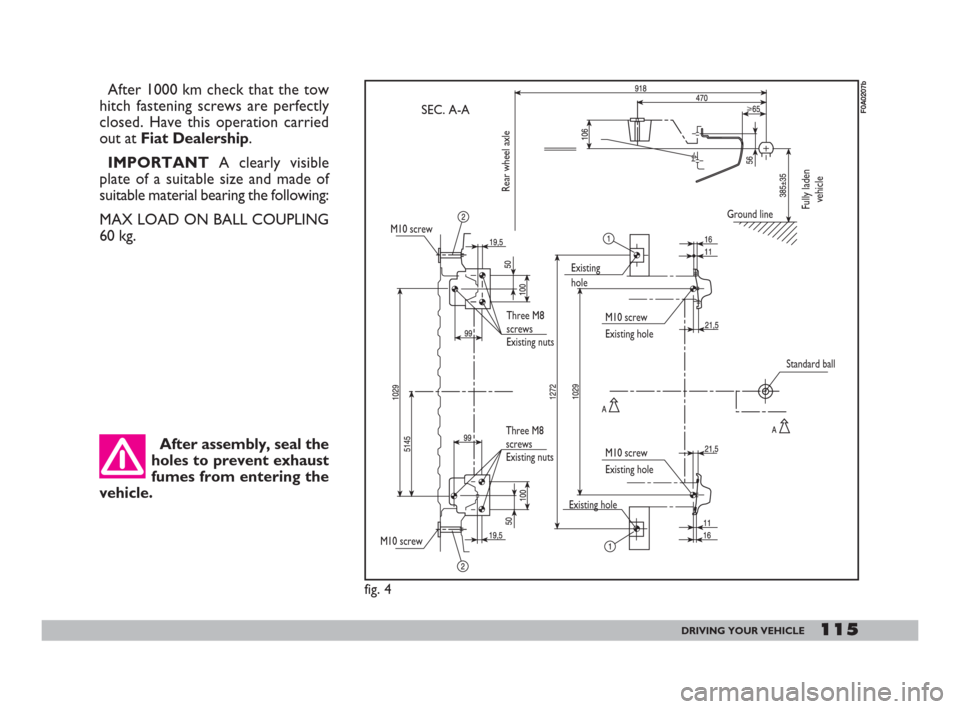
The trailer tow hitch is to be fixed in
the points indicated (see diagram fig.
4).
The plate 1must have a minimum
thickness of 6 mm. The fastening
points 2will be equipped with shims
’16 x 2 mm. The tow hitch structure
is fastened in the points shown with Ø
by means of six M8 screws and four
M10 screws.
Fasten the tow hitch to the body and
trim the bumper with the frame pro-
vided with the assembly kit.
After fitting the tow hitch, the emp-
ty vehicle weight will increase by ap-
proximately 15.5 kg. The ABS system will not
control the trailer braking
system. Great care
should therefore be taken when
driving on slippery road surfaces.
Under no circumstances
modify the vehicle’s brak-
ing system for trailer
braking control. The trailer’s
braking system must be com-
pletely independent of the vehi-
cle’s hydraulic system.
TOW HITCH INSTALLATION
The towing device should be fas-
tened to the body by specialised per-
sonnel according to any additional
and/or integrative information supplied
by the Manufacturer of the device.
106-118 Doblo GB 9-05-2008 12:09 Pagina 114
Page 116 of 222
After 1000 km check that the tow
hitch fastening screws are perfectly
closed. Have this operation carried
out at Fiat Dealership.
IMPORTANT A clearly visible
plate of a suitable size and made of
suitable material bearing the following:
MAX LOAD ON BALL COUPLING
60 kg.
fig. 4
F0A0207b
After assembly, seal the
holes to prevent exhaust
fumes from entering the
vehicle.
SEC. A-A
Rear wheel axle
Fully laden
vehicle
Ground line
M10 screw
Existing
hole
M10 screw
Existing hole Three M8
screws
Existing nuts
Standard ball
Three M8
screws
Existing nuts
Existing hole
M10 screwM10 screw
Existing hole
115DRIVING YOUR VEHICLE
106-118 Doblo GB 9-05-2008 12:09 Pagina 115
Page 122 of 222
121IN AN EMERGENCY
BUMP STARTING IF A TYRE IS
PUNCTURED
GENERAL INSTRUCTIONS
Wheel changing and correct use of
the jack and spare wheel call for some
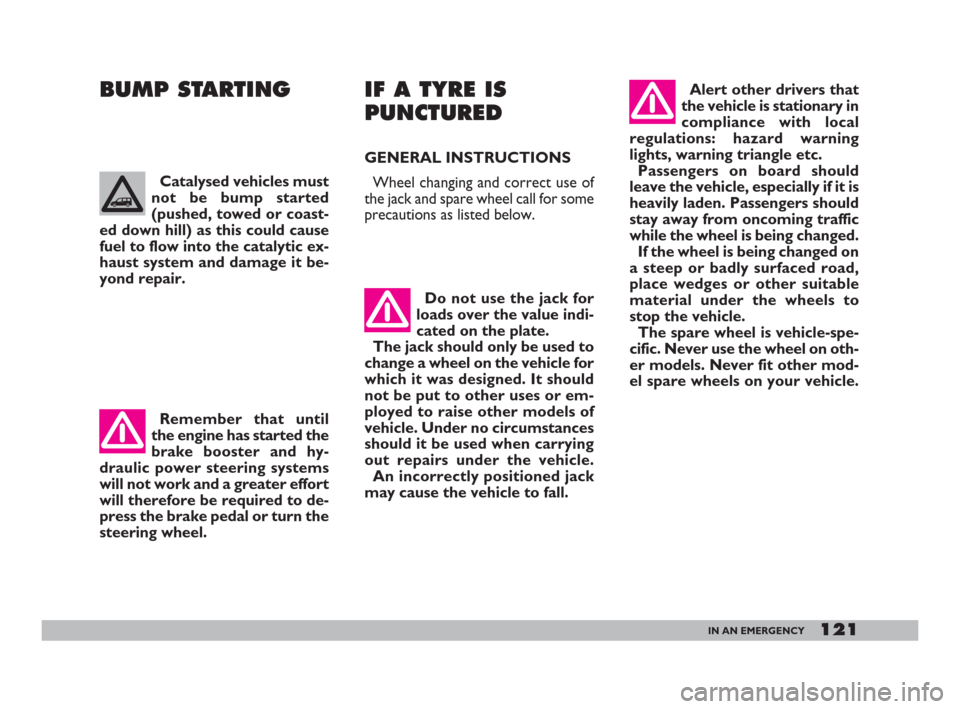
precautions as listed below. Catalysed vehicles must
not be bump started
(pushed, towed or coast-
ed down hill) as this could cause
fuel to flow into the catalytic ex-
haust system and damage it be-
yond repair.
Remember that until
the engine has started the
brake booster and hy-
draulic power steering systems
will not work and a greater effort
will therefore be required to de-
press the brake pedal or turn the
steering wheel.
Alert other drivers that
the vehicle is stationary in
compliance with local
regulations: hazard warning
lights, warning triangle etc.
Passengers on board should
leave the vehicle, especially if it is
heavily laden. Passengers should
stay away from oncoming traffic
while the wheel is being changed.
If the wheel is being changed on
a steep or badly surfaced road,
place wedges or other suitable
material under the wheels to
stop the vehicle.
The spare wheel is vehicle-spe-
cific. Never use the wheel on oth-
er models. Never fit other mod-
el spare wheels on your vehicle.
Do not use the jack for
loads over the value indi-
cated on the plate.
The jack should only be used to
change a wheel on the vehicle for
which it was designed. It should
not be put to other uses or em-
ployed to raise other models of
vehicle. Under no circumstances
should it be used when carrying
out repairs under the vehicle.
An incorrectly positioned jack
may cause the vehicle to fall.
119-148 Doblo GB 9-05-2008 12:09 Pagina 121
Page 126 of 222
125IN AN EMERGENCY
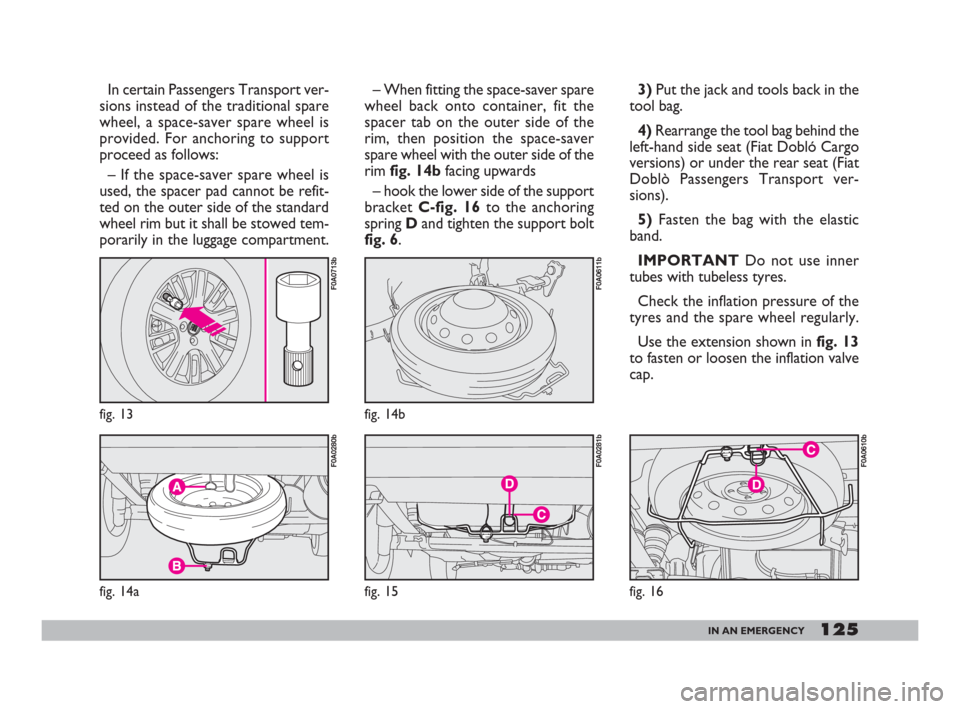
– When fitting the space-saver spare
wheel back onto container, fit the
spacer tab on the outer side of the
rim, then position the space-saver
spare wheel with the outer side of the
rim fig. 14bfacing upwards
– hook the lower side of the support
bracket C-fig. 16to the anchoring
spring Dand tighten the support bolt
fig. 6.3) Put the jack and tools back in the
tool bag.
4)Rearrange the tool bag behind the
left-hand side seat (Fiat Dobló Cargo
versions) or under the rear seat (Fiat
Doblò Passengers Transport ver-
sions).
5)Fasten the bag with the elastic
band.
IMPORTANT Do not use inner
tubes with tubeless tyres.
Check the inflation pressure of the
tyres and the spare wheel regularly.
Use the extension shown in fig. 13
to fasten or loosen the inflation valve
cap.
fig. 13
F0A0713b
fig. 14a
F0A0280b
fig. 15
F0A0281b
In certain Passengers Transport ver-
sions instead of the traditional spare
wheel, a space-saver spare wheel is
provided. For anchoring to support
proceed as follows:
– If the space-saver spare wheel is
used, the spacer pad cannot be refit-
ted on the outer side of the standard
wheel rim but it shall be stowed tem-
porarily in the luggage compartment.
fig. 14b
F0A0611b
fig. 16
F0A0610b
119-148 Doblo GB 9-05-2008 12:09 Pagina 125
Page 127 of 222
Holes and damages on
the tyre side walls cannot
be repaired. Do not use
the quick tyre repair kit if dam-
aging is due to running with flat
tyre.
126IN AN EMERGENCY
QUICK TYRE
REPAIR KIT FIX &
GO automatic
The quick tyre repair kit Fix & Go au-
tomatic is placed in the boot into a
proper container.
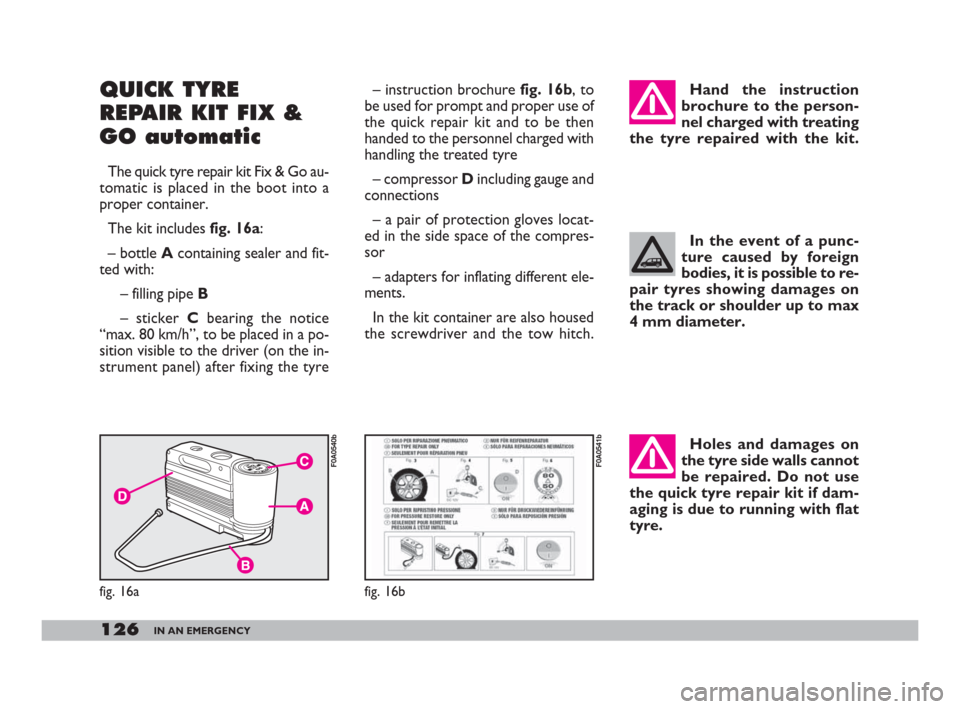
The kit includes fig. 16a:
– bottle Acontaining sealer and fit-
ted with:
– filling pipe B
– sticker Cbearing the notice
“max. 80 km/h”, to be placed in a po-
sition visible to the driver (on the in-
strument panel) after fixing the tyre– instruction brochure fig. 16b, to
be used for prompt and proper use of
the quick repair kit and to be then
handed to the personnel charged with
handling the treated tyre
– compressorDincluding gauge and
connections
– a pair of protection gloves locat-
ed in the side space of the compres-
sor
– adapters for inflating different ele-
ments.
In the kit container are also housed
the screwdriver and the tow hitch.In the event of a punc-
ture caused by foreign
bodies, it is possible to re-
pair tyres showing damages on
the track or shoulder up to max
4 mm diameter.
fig. 16a
F0A0540b
fig. 16b
F0A0541b
Hand the instruction
brochure to the person-
nel charged with treating
the tyre repaired with the kit.
119-148 Doblo GB 9-05-2008 12:09 Pagina 126
Page 147 of 222
146IN AN EMERGENCY
From the side
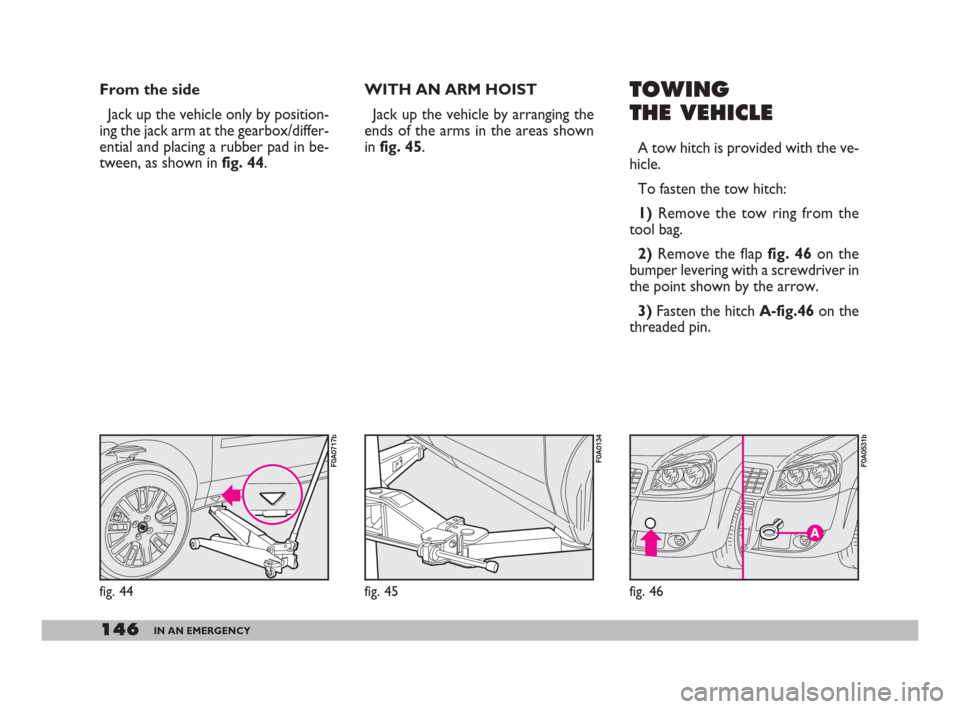
Jack up the vehicle only by position-
ing the jack arm at the gearbox/differ-
ential and placing a rubber pad in be-
tween, as shown in fig. 44.TOWING
THE VEHICLE
A tow hitch is provided with the ve-
hicle.
To fasten the tow hitch:
1)Remove the tow ring from the
tool bag.
2)Remove the flap fig. 46on the
bumper levering with a screwdriver in
the point shown by the arrow.
3)Fasten the hitch A-fig.46on the
threaded pin.
fig. 45
F0A0134
fig. 46
F0A0531b
fig. 44
F0A0717b
WITH AN ARM HOIST
Jack up the vehicle by arranging the
ends of the arms in the areas shown
in fig. 45.
119-148 Doblo GB 9-05-2008 12:09 Pagina 146
Page 148 of 222
147IN AN EMERGENCY
IF AN ACCIDENT
OCCURS
– It is important to keep calm.
– If you are not directly involved in
the accident, stop at least ten metres
away from the accident.
– If you are on a motorway, do not
obstruct the emergency lane with
your vehicle.
– Turn off the engine and turn on the
hazard lights.
– At night, illuminate the scene of the
accident with your headlights.
– Act carefully, you must not risk be-
ing run over.
– Mark the accident by putting the
red triangle at the regulatory distance
from the vehicle where it can be clear-
ly seen.
– Call for rescue making the infor-
mation you give as accurate as you
can. On the motorway use the special
column-mounted emergency phones. When towing the vehi-
cle, you must comply with
the specific traffic regula-
tions regarding the tow hitch and
how to tow on the road.
Before starting to tow,
turn the ignition key to
MAR and then to STOP.
Do not remove the key. If the key
is removed, the steering lock en-
gages automatically which pre-
vents the wheels being turned.
While the vehicle is be-
ing towed with the engine
off, remember that the
brake pedal and steering will re-
quire more effort as you no
longer have the benefit of the
power brakes and power steer-
ing. Do not use flexible cables to
tow. Avoid jerking. Whilst tow-
ing, ensure that the coupling to
the vehicle does not damage the
surrounding components.
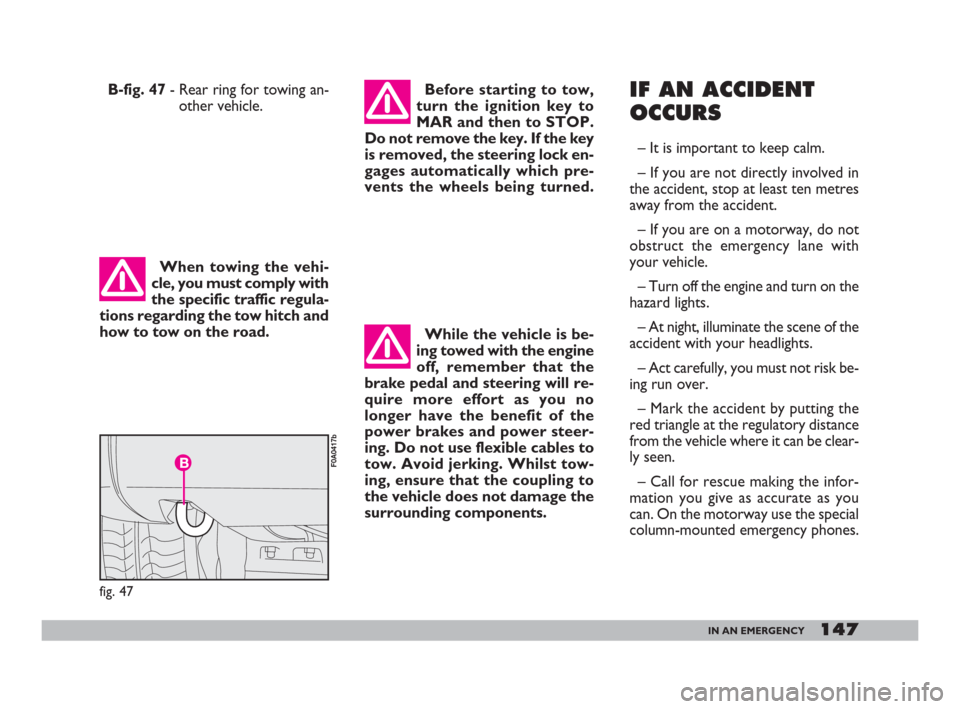
fig. 47
F0A0417b
B-fig. 47- Rear ring for towing an-
other vehicle.
119-148 Doblo GB 9-05-2008 12:09 Pagina 147