body FIAT DOBLO 2008 1.G Owners Manual
[x] Cancel search | Manufacturer: FIAT, Model Year: 2008, Model line: DOBLO, Model: FIAT DOBLO 2008 1.GPages: 222, PDF Size: 3.39 MB
Page 2 of 222
Dear Customer,
Thank you for selecting Fiat and congratulations on your choice of a Fiat Doblò.
We have written this handbook to help you get to know all your new Fiat Doblò features and use it in the best
possible way.
You should read it right through before taking the road for the first time.
You will find information, tips and important warnings regarding the driving of your vehicle to help you derive
the maximum from your Fiat Doblò’s technological features. You will find very valuable tips for your own safety,
the vehicle’s wellbeing and about how to protect the environment.
The enclosed Warranty Booklet lists the services that Fiat offers to its Customers:
• the Warranty Certificate with terms and conditions for maintaining its validity
• the range of additional services available to Fiat Customers.
Best regards and good motoring!
1
This Owner Handbook describes all Fiat Doblò versions. As a consequence, you should consider only the
information which is related to the engine and bodywork version of the vehicle you purchased.
001-105 Doblo GB 16-12-2008 14:22 Pagina 1
Page 5 of 222
WELCOME ABOARD Fiat Doblò
Fiat Doblò is a compact vehicle with an original bodyline, designed to offer great driving comfort, ensure safe-
ty and be a real friend to the environment.
Everything, from its new engines to its safety devices, from its improved comfort for driver and passengers alike
to its practical solutions, contributes to make you appreciate your Fiat Doblò’s personality.
And you will realise it later when you discover that its driving style and performance goes hand in hand with
new manufacturing processes that help cut running costs.
The Fiat Doblò, for example, needs to be taken in for its first servicing after 20,000 km.
4
001-105 Doblo GB 16-12-2008 14:22 Pagina 4
Page 11 of 222
Every rear seat (where provided) is
fitted with inertial seat belts with three
anchor points and reel.
IMPORTANTBefore fastening the
seat belts make sure the seat is prop-
erly anchored.
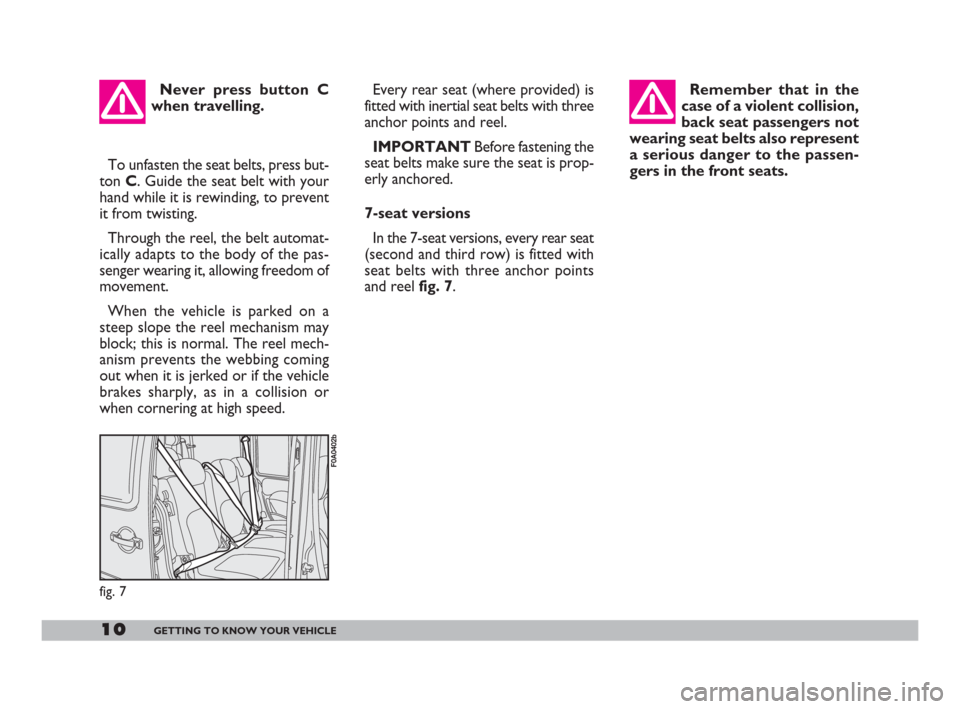
7-seat versions
In the 7-seat versions, every rear seat
(second and third row) is fitted with
seat belts with three anchor points
and reel fig. 7.Remember that in the
case of a violent collision,
back seat passengers not
wearing seat belts also represent
a serious danger to the passen-
gers in the front seats.
10GETTING TO KNOW YOUR VEHICLE
To unfasten the seat belts, press but-
ton C. Guide the seat belt with your
hand while it is rewinding, to prevent
it from twisting.
Through the reel, the belt automat-
ically adapts to the body of the pas-
senger wearing it, allowing freedom of
movement.
When the vehicle is parked on a
steep slope the reel mechanism may
block; this is normal. The reel mech-
anism prevents the webbing coming
out when it is jerked or if the vehicle
brakes sharply, as in a collision or
when cornering at high speed.
fig. 7
F0A0402b
Never press button C
when travelling.
001-105 Doblo GB 16-12-2008 14:22 Pagina 10
Page 12 of 222
11GETTING TO KNOW YOUR VEHICLE
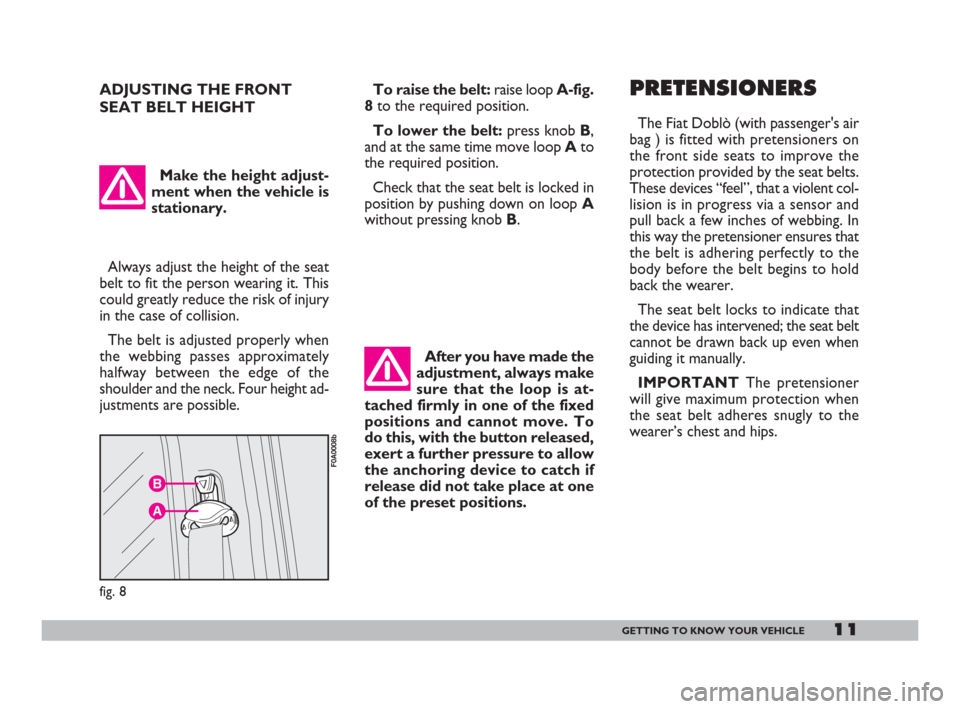
ADJUSTING THE FRONT
SEAT BELT HEIGHT
B
A
fig. 8
F0A0008b
Always adjust the height of the seat
belt to fit the person wearing it. This
could greatly reduce the risk of injury
in the case of collision.
The belt is adjusted properly when
the webbing passes approximately
halfway between the edge of the
shoulder and the neck. Four height ad-
justments are possible.After you have made the
adjustment, always make
sure that the loop is at-
tached firmly in one of the fixed
positions and cannot move. To
do this, with the button released,
exert a further pressure to allow
the anchoring device to catch if
release did not take place at one
of the preset positions.
Make the height adjust-
ment when the vehicle is
stationary.
PRETENSIONERS
The Fiat Doblò (with passenger's air
bag ) is fitted with pretensioners on
the front side seats to improve the
protection provided by the seat belts.
These devices “feel”, that a violent col-
lision is in progress via a sensor and
pull back a few inches of webbing. In
this way the pretensioner ensures that
the belt is adhering perfectly to the
body before the belt begins to hold
back the wearer.
The seat belt locks to indicate that
the device has intervened; the seat belt
cannot be drawn back up even when
guiding it manually.
IMPORTANTThe pretensioner
will give maximum protection when
the seat belt adheres snugly to the
wearer’s chest and hips. To raise the belt:raise loop A-fig.
8to the required position.
To lower the belt: press knob B,
and at the same time move loop Ato
the required position.
Check that the seat belt is locked in
position by pushing down on loop A
without pressing knob B.
001-105 Doblo GB 16-12-2008 14:22 Pagina 11
Page 14 of 222
13GETTING TO KNOW YOUR VEHICLE
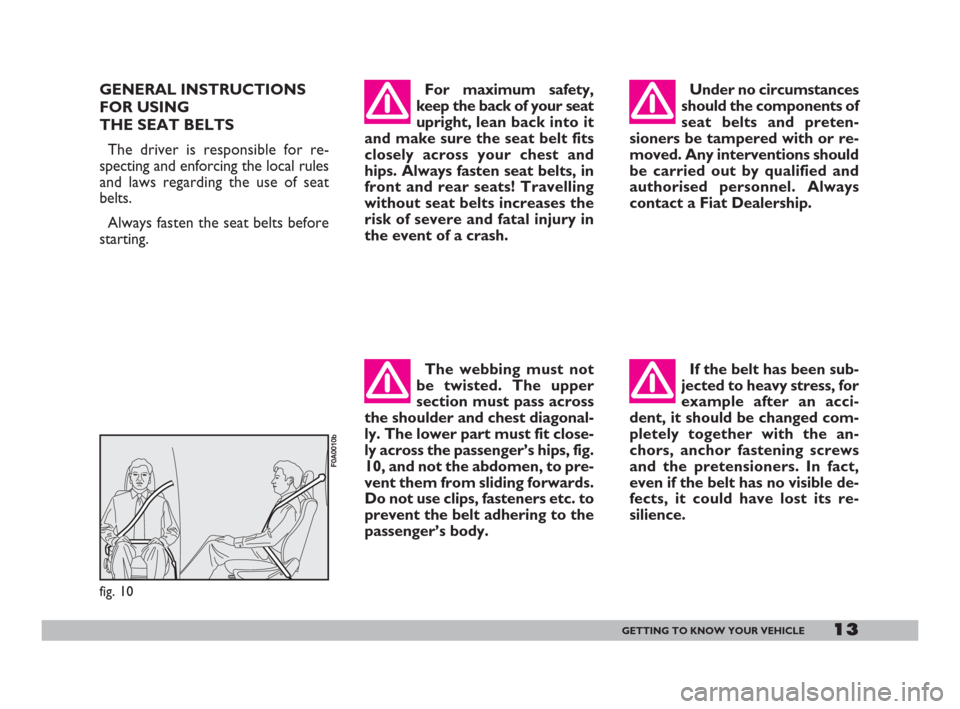
For maximum safety,
keep the back of your seat
upright,lean back into it
and make sure the seat belt fits
closely across your chest and
hips. Always fasten seat belts, in
front and rear seats! Travelling
without seat belts increases the
risk of severe and fatal injury in
the event of a crash.
fig. 10
F0A0010b
GENERAL INSTRUCTIONS
FOR USING
THE SEAT BELTS
The driver is responsible for re-
specting and enforcing the local rules
and laws regarding the use of seat
belts.
Always fasten the seat belts before
starting.
The webbing must not
be twisted. The upper
section must pass across
the shoulder and chest diagonal-
ly. The lower part must fit close-
ly across the passenger’s hips, fig.
10, and not the abdomen, to pre-
vent them from sliding forwards.
Do not use clips, fasteners etc. to
prevent the belt adhering to the
passenger’s body.Under no circumstances
should the components of
seat belts and preten-
sioners be tampered with or re-
moved. Any interventions should
be carried out by qualified and
authorised personnel. Always
contact a Fiat Dealership.
If the belt has been sub-
jected to heavy stress, for
example after an acci-
dent, it should be changed com-
pletely together with the an-
chors, anchor fastening screws
and the pretensioners. In fact,
even if the belt has no visible de-
fects, it could have lost its re-
silience.
001-105 Doblo GB 16-12-2008 14:22 Pagina 13
Page 15 of 222
14GETTING TO KNOW YOUR VEHICLE
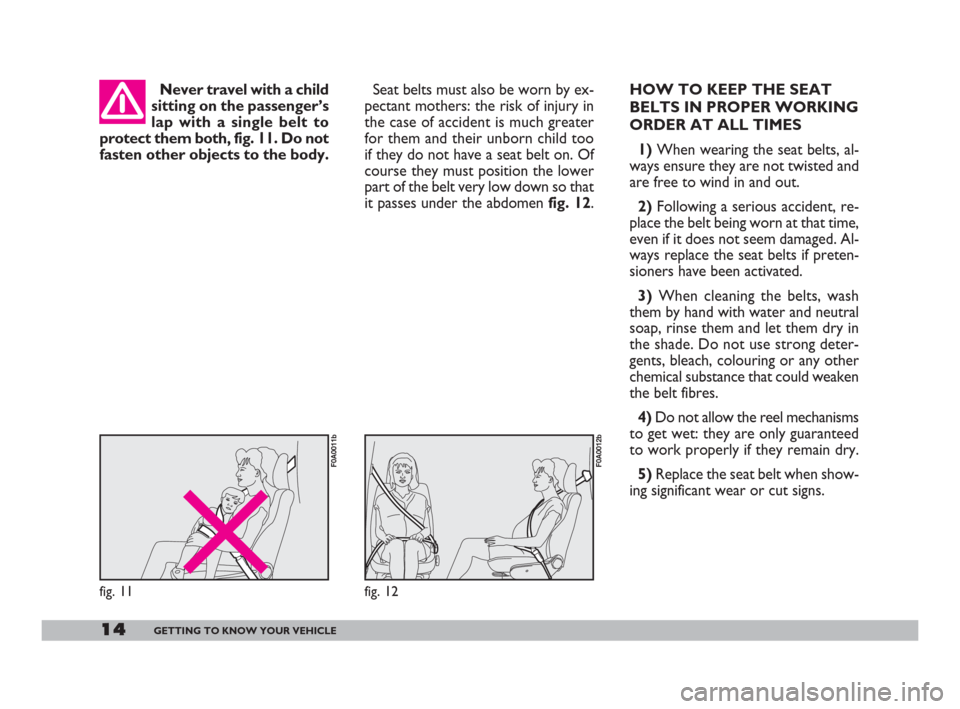
fig. 12
F0A0012b
fig. 11
F0A0011b
Seat belts must also be worn by ex-
pectant mothers: the risk of injury in
the case of accident is much greater
for them and their unborn child too
if they do not have a seat belt on. Of
course they must position the lower
part of the belt very low down so that
it passes under the abdomen fig. 12.HOW TO KEEP THE SEAT
BELTS IN PROPER WORKING
ORDER AT ALL TIMES
1)When wearing the seat belts, al-
ways ensure they are not twisted and
are free to wind in and out.
2)Following a serious accident, re-
place the belt being worn at that time,
even if it does not seem damaged. Al-
ways replace the seat belts if preten-
sioners have been activated.
3)When cleaning the belts, wash
them by hand with water and neutral
soap, rinse them and let them dry in
the shade. Do not use strong deter-
gents, bleach, colouring or any other
chemical substance that could weaken
the belt fibres.
4) Do not allow the reel mechanisms
to get wet: they are only guaranteed
to work properly if they remain dry.
5)Replace the seat belt when show-
ing significant wear or cut signs. Never travel with a child
sitting on the passenger’s
lap with a single belt to
protect them both, fig. 11. Do not
fasten other objects to the body.
001-105 Doblo GB 16-12-2008 14:22 Pagina 14
Page 16 of 222
15GETTING TO KNOW YOUR VEHICLE
TRANSPORTING CHILDREN SAFELYFor optimal protection in the event
of a crash, all passengers must be seat-
ed and wearing adequate restraint sys-
tems.
This is even more important for chil-
dren.
This prescription is compulsory in all
EC countries according to EC Direc-
tive 2003/20/EC.
Compared with adults, their head is
proportionally larger and heavier than
the rest of the body, while the mus-
cles and bone structure are not com-
pletely developed. Therefore, correct
restraint systems are necessary, oth-
er then adult seat belts. SERIOUS DANGER: Never place cradle child’s seats not
facing the running direction on the front seat of vehicles
with passenger’s airbag, which during inflation could cause
serious injury, even mortal. You are advised to carry children always on
the rear seat, as this is the most protected position in the case of a crash.
In any case, child’ seats must absolutely not be fitted on the front seats
of vehicles with passenger’s airbag, which during inflation could cause
serious injury, even mortal, regardless of the seriousness of the crash
that triggered it. Children may be placed on the front seat of vehicles
fitted with passenger’s airbag deactivation. In this case, it is absolutely
necessary to check the warning light
Fon the instrument panel to
make sure that deactivation has actually taken place (see paragraph
F
RONT AND SIDE AIRBAGS AT ITEMFRONT PASSENGER AIRBAG). The front pas-
senger’s seat shall be adjusted in the most backward position to pre-
vent any contact between child’s seat and dashboard.
001-105 Doblo GB 16-12-2008 14:22 Pagina 15
Page 59 of 222
58GETTING TO KNOW YOUR VEHICLE
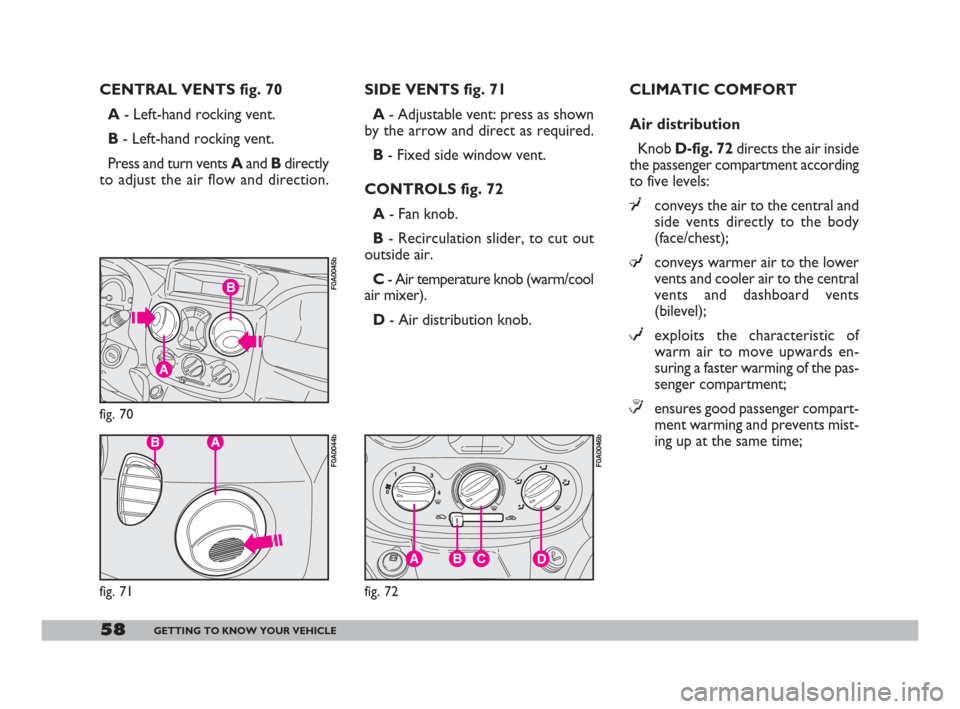
CENTRAL VENTS fig. 70
A- Left-hand rocking vent.
B- Left-hand rocking vent.
Press and turn vents Aand Bdirectly
to adjust the air flow and direction.SIDE VENTS fig. 71
A- Adjustable vent: press as shown
by the arrow and direct as required.
B- Fixed side window vent.
CONTROLS fig. 72
A- Fan knob.
B- Recirculation slider, to cut out
outside air.
C- Air temperature knob (warm/cool
air mixer).
D- Air distribution knob. CLIMATIC COMFORT
Air distribution
Knob D-fig. 72directs the air inside
the passenger compartment according
to five levels:
¥conveys the air to the central and
side vents directly to the body
(face/chest);
µconveys warmer air to the lower
vents and cooler air to the central
vents and dashboard vents
(bilevel);
wexploits the characteristic of
warm air to move upwards en-
suring a faster warming of the pas-
senger compartment;
≤ensures good passenger compart-
ment warming and prevents mist-
ing up at the same time;
B
A
fig. 70
F0A0045b
BA
fig. 71
F0A0044b
BCAD
fig. 72
F0A0046b
001-105 Doblo GB 16-12-2008 14:22 Pagina 58
Page 92 of 222
91GETTING TO KNOW YOUR VEHICLE
The cushion immediately inflates,
placing itself as a protection between
the body of the front occupants and
the structure that could cause injuries.
Immediately after, the cushion deflates.
The front air bag (driver and pas-
senger) is not a replacement of but
complementary to the use of belts,
which should always be worn, as spec-
ified by law in Europe and most non-
European countries.
In case of crash, a person not wear-
ing the seat belt moves forward and
may come into contact with the cush-
ion while it is still inflating. Under this
circumstance the protection offered
by the airbag is reduced.
Front airbags may not activate in the
following situations:
– in collisions against highly de-
formable objects not affecting the ve-
hicle front surface (e.g. bumper colli-
sion against guard rail); If the xbrake fluid low
warning light comes on,
stop the vehicle immedi-
ately and contact the nearest Fi-
at Dealership. Fluid leaks from
the hydraulic system, in fact, can
compromise brake system oper-
ation, both traditional systems
and systems with ABS.FRONT AND SIDE
AIRBAGS
The vehicle can be fitted with front
air bags for the driver and passenger
and with side bags.
FRONT AIRBAGS
Front airbags (driver and passenger)
have been designed to protect the oc-
cupants in the event of head-on crash-
es of medium-high severity, by plac-
ing the cushion between the occupant
and the steering wheel or dashboard.
Front airbags are designed to protect
vehicle’s occupants in front crashes
and therefore non-activation in other
types of collisions (side collisions, rear
shunts, roll-overs, etc.) is not a system
malfunction.
In case of crash, an electronic con-
trol unit, when required, triggers the
inflation of the cushion according to
the severity of the collision. Warning light >alone,
with the engine running,
normally indicates a fault
in the ABS system only. In this
case, the braking system is still ef-
ficient, though without the anti-
locking device. Under these con-
ditions, performance of the EBD
system may be reduced. Also in
this case, you are advised to go
immediately to the nearest Fiat
Dealership, driving in such a way
to avoid sharp braking to have
the system checked.
001-105 Doblo GB 16-12-2008 14:22 Pagina 91
Page 97 of 222
96GETTING TO KNOW YOUR VEHICLE
The correct operation of
front airbags, side airbags
and pretensioners is en-
sured only if the vehicle is not
overloaded.
Do not wash the seat
back in vehicles with side
airbags with pressurised
steam or water in automatic seat
washing stations.
The airbag does not re-
place seat belts but rather
increases their effective-
ness. Furthermore, the airbag is
not fired in the event of low
speed front collisions, side colli-
sions, rear-end shunts and roll-
overs. In these cases, the passen-
gers are only protected by the
seat belts which for this reason
must always be fastened.
Always drive with both
hands on the rim of the
steering wheel so that the
airbag is free to inflate during a
head-on collision, and protect
you from serious injury. Do not
drive with your body bending to-
wards the steering wheel, but sit
in an upright position with your
back resting against the seat.
Do not cover the back-
rest of front seats with
trims or covers that are
not suitable to be used with side
bags.
It is important to re-
member that the airbag
can be fired if the ignition
key is fitted and at MAR also if
the engine is not running and the
vehicle it is hit by another vehicle
travelling at suitable speed. As a
consequence, Fiat recommends
sitting children in their specific
restraint systems on the back
seat, which is the most protected
position possible. On the con-
trary, the airbags will not be fired
if the vehicle is crashed into when
the key is not inserted or turned.
Consequently, in this case, the
fact that the system is not fired
does not indicate a fault.
001-105 Doblo GB 16-12-2008 14:22 Pagina 96