bonnet FIAT DOBLO 2009 2.G User Guide
[x] Cancel search | Manufacturer: FIAT, Model Year: 2009, Model line: DOBLO, Model: FIAT DOBLO 2009 2.GPages: 274, PDF Size: 6.6 MB
Page 209 of 274
If, after buying the vehicle, you want to install electrical
accessories requiring permanent electric supply (alarm,
etc.) or having high power level consumption, contact
a Fiat Dealership, whose qualified personnel, in addition
to suggesting the most suitable devices from the Lin-
eacessori Fiat range, will assess the overall electrical con-
sumption to determine whether the vehicle’s electrical
system is capable of withstanding the load required, or
whether it should be integrated with a more powerful
battery.
Since these devices continue to use electricity even when
the engine is off, they gradually run down the battery.
208
KNOW
YOUR
VEHICLE
SAFETY
STARTING
AND
DRIVING
WARNING
LIGHTS AND
MESSAGES
IN AN
EMERGENCY
SERVICING
AND
MAINTENANCE
TECHNICAL
SPECIFICATIONS
INDEXUSEFUL ADVICE FOR EXTENDING THE LIFE
OF YOUR BATTERY
To avoid draining your battery and make it last longer,
follow these instructions closely:
❒when you park the vehicle, ensure the doors, boot and
bonnet are closed properly so that the ceiling lights do
not stay on;
❒turn off the ceiling lights, although the car does have
an automatic system for switching off internal lights;
❒do not leave devices (e.g. sound system, hazard lights,
etc.) switched on for a long time when the engine is
not running;
❒before performing any operation on the electrical sys-
tem, disconnect the negative battery cable;
❒make sure battery terminals are fully tightened.
The battery is also more prone to the risk of freezing (at
temperatures as high as –10°C). If the vehicle is off the
road for long periods, refer to “Vehicle inactivity” in the
“Starting and driving” section.
Page 214 of 274
213
KNOW
YOUR
VEHICLE
SAFETY
STARTING
AND
DRIVING
WARNING
LIGHTS AND
MESSAGES
IN AN
EMERGENCY
SERVICING
AND
MAINTENANCE
TECHNICAL
SPECIFICATIONS
INDEXRear window (rear window washer)
The rear window washer jets are fixed. The nozzle hold-
er is located above the rear window. NOZZLES
If the jet is not coming out, firstly check that there is flu-
id in the windscreen/rear window reservoir (for ver-
sions/markets where provided) (see “Checking levels” in
this section).
Then check that the nozzle holes are not clogged; use a
needle to unblock them if necessary.
Front windscreen
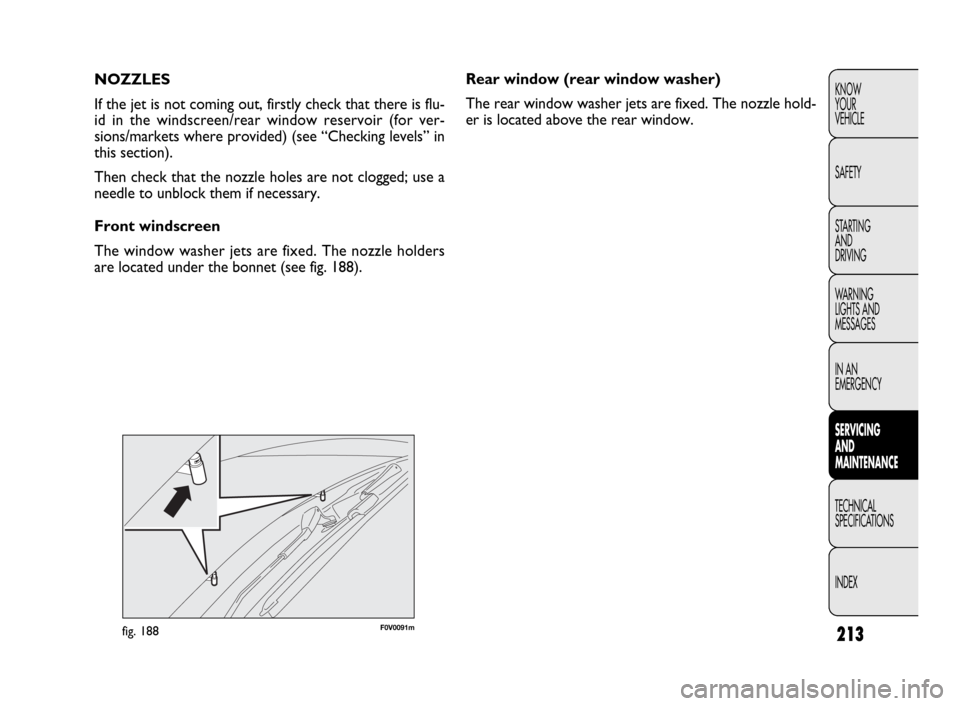
The window washer jets are fixed. The nozzle holders
are located under the bonnet (see fig. 188).
F0V0091mfig. 188
Page 216 of 274
215
KNOW
YOUR
VEHICLE
SAFETY
STARTING
AND
DRIVING
WARNING
LIGHTS AND
MESSAGES
IN AN
EMERGENCY
SERVICING
AND
MAINTENANCE
TECHNICAL
SPECIFICATIONS
INDEXTo wash the vehicle properly, proceed as follows:
❒wash the body using a low-pressure jet of water;
❒use a sponge to wipe a slightly soapy solution over the
bodywork, frequently rinsing the sponge;
❒rinse with plenty of water and dry with a jet of air or
a chamois leather.
Observe the following recommendations for washing the
vehicle in an automatic carwash:
– remove the aerial from the roof so it does not get dam-
aged;
– the car wash should use water added to a soapy solu-
tion;
– rinse thoroughly to avoid soap marks staying on the
bodywork or less visible parts.
Some car washes with old-style blades
and/or in a poor state of repair can dam-
age the paintwork, facilitating the forma-
tion of lines that give the paint a dull/misty ap-
pearance, especially on dark colours. If this hap-
pens, lightly polish the paintwork with appropri-
ate products.
Dry the less visible parts particularly carefully, such as the
door frames, bonnet and the headlight frames, where wa-
ter may stagnate more easily. It is a good idea to leave
the vehicle outdoors for a while after washing it to give
water time to evaporate.
Do not wash the vehicle after it has been left in the sun
or with the bonnet hot: this may alter the shine of the
paintwork.
Exterior plastic parts should be cleaned in the same way
as the rest of the vehicle. Where possible, do not park
the vehicle under trees; the resinous substances released
by many species give the paint a dull appearance and in-
crease the possibility of rust.
IMPORTANT Bird droppings should be washed off im-
mediately and thoroughly as the acid they contain is par-
ticularly aggressive.
Detergents cause water pollution. The ve-
hicle should be washed in areas equipped
for collecting and purifying the liquid used
in the washing process.
Page 221 of 274
220
KNOW
YOUR
VEHICLE
SAFETY
STARTING
AND
DRIVING
WARNING
LIGHTS AND
MESSAGES
IN AN
EMERGENCY
SERVICING
AND
MAINTENANCE
TECHNICAL
SPECIFICATIONS
INDEX
F0V0118mfig. 190F0V0117mfig. 192
F0V0116mfig. 191
ENGINE MARKING
This is printed onto the cylinder block and shows the type
and production serial number. BODYWORK PAINT IDENTIFICATION
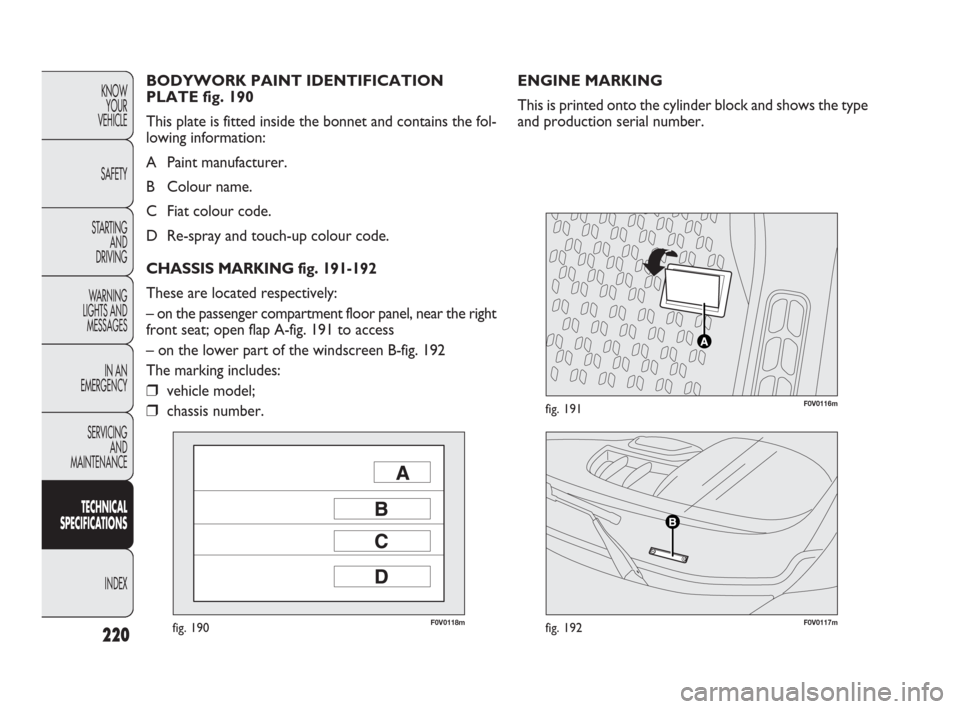
PLATE fig. 190
This plate is fitted inside the bonnet and contains the fol-
lowing information:
A Paint manufacturer.
B Colour name.
C Fiat colour code.
D Re-spray and touch-up colour code.
CHASSIS MARKING fig. 191-192
These are located respectively:
– on the passenger compartment floor panel, near the right
front seat; open flap A-fig. 191 to access
– on the lower part of the windscreen B-fig. 192
The marking includes:
❒vehicle model;
❒chassis number.
Page 262 of 274
261
KNOW
YOUR
VEHICLE
SAFETY
STARTING
AND
DRIVING
WARNING
LIGHTS AND
MESSAGES
IN AN
EMERGENCY
SERVICING
AND
MAINTENANCE
TECHNICAL
SPECIFICATIONS
INDEX
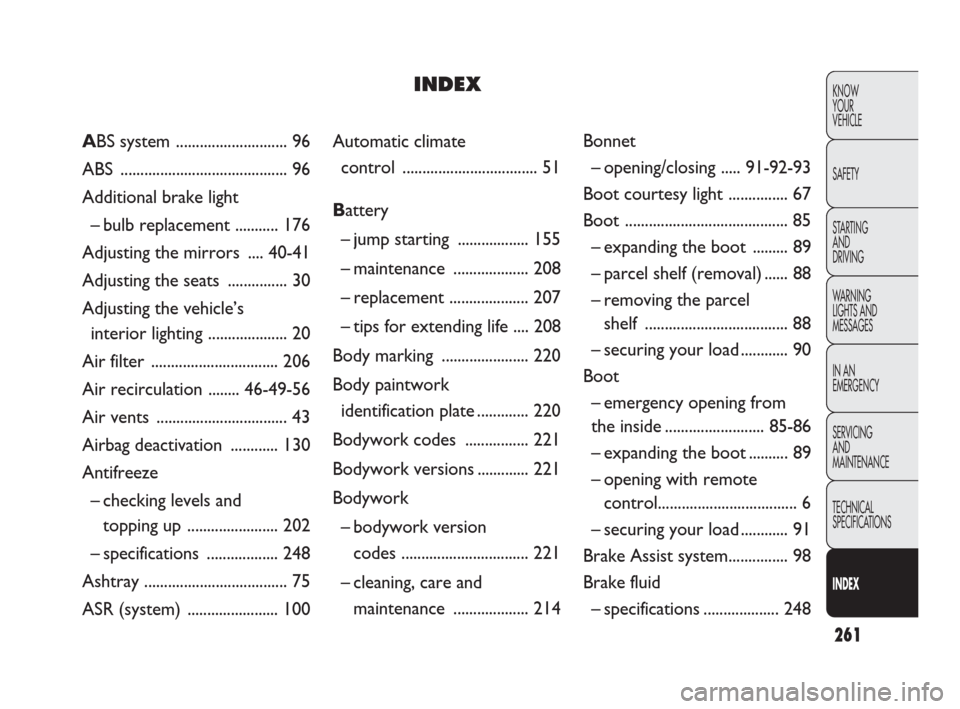
Automatic climate
control .................................. 51
Battery
– jump starting .................. 155
– maintenance ................... 208
– replacement .................... 207
– tips for extending life .... 208
Body marking ...................... 220
Body paintwork
identification plate............. 220
Bodywork codes ................ 221
Bodywork versions ............. 221
Bodywork
– bodywork version
codes ................................ 221
– cleaning, care and
maintenance ................... 214Bonnet
– opening/closing ..... 91-92-93
Boot courtesy light ............... 67
Boot ......................................... 85
– expanding the boot ......... 89
– parcel shelf (removal) ...... 88
– removing the parcel
shelf .................................... 88
– securing your load ............ 90
Boot
– emergency opening from
the inside.........................85-86
– expanding the boot .......... 89
– opening with remote
control................................... 6
– securing your load ............ 91
Brake Assist system............... 98
Brake fluid
– specifications................... 248 ABS system ............................ 96
ABS .......................................... 96
Additional brake light
– bulb replacement ........... 176
Adjusting the mirrors .... 40-41
Adjusting the seats ............... 30
Adjusting the vehicle’s
interior lighting .................... 20
Air filter ................................ 206
Air recirculation ........ 46-49-56
Air vents ................................. 43
Airbag deactivation ............ 130
Antifreeze
– checking levels and
topping up ....................... 202
– specifications .................. 248
Ashtray .................................... 75
ASR (system) ....................... 100
INDEX
Page 265 of 274
264
KNOW
YOUR
VEHICLE
SAFETY
STARTING
AND
DRIVING
WARNING
LIGHTS AND
MESSAGES
IN AN
EMERGENCY
SERVICING
AND
MAINTENANCE
TECHNICAL
SPECIFICATIONS
INDEX
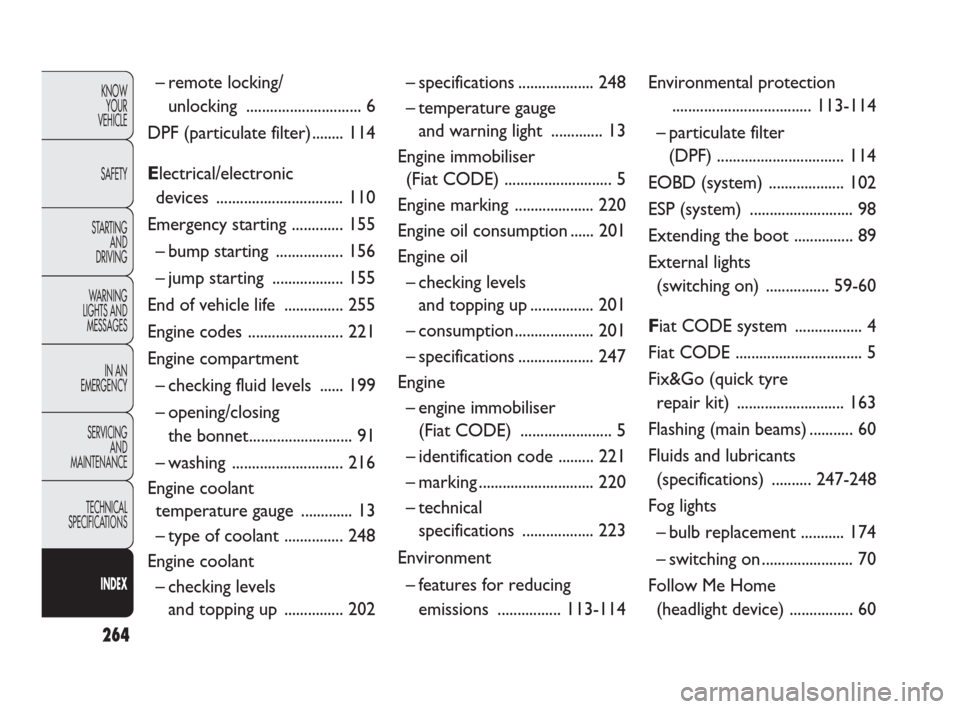
– remote locking/
unlocking ............................. 6
DPF (particulate filter)........ 114
Electrical/electronic
devices ................................ 110
Emergency starting ............. 155
– bump starting ................. 156
– jump starting .................. 155
End of vehicle life ............... 255
Engine codes ........................ 221
Engine compartment
– checking fluid levels ...... 199
– opening/closing
the bonnet.......................... 91
– washing ............................ 216
Engine coolant
temperature gauge ............. 13
– type of coolant ............... 248
Engine coolant
– checking levels
and topping up ............... 202– specifications................... 248
– temperature gauge
and warning light ............. 13
Engine immobiliser
(Fiat CODE) ........................... 5
Engine marking .................... 220
Engine oil consumption ...... 201
Engine oil
– checking levels
and topping up................ 201
– consumption .................... 201
– specifications................... 247
Engine
– engine immobiliser
(Fiat CODE) ....................... 5
– identification code ......... 221
– marking ............................. 220
– technical
specifications .................. 223
Environment
– features for reducing
emissions ................113-114Environmental protection
...................................113-114
– particulate filter
(DPF) ................................ 114
EOBD (system) ................... 102
ESP (system) .......................... 98
Extending the boot ............... 89
External lights
(switching on) ................ 59-60
Fiat CODE system ................. 4
Fiat CODE ................................ 5
Fix&Go (quick tyre
repair kit) ........................... 163
Flashing (main beams)........... 60
Fluids and lubricants
(specifications) ..........247-248
Fog lights
– bulb replacement ........... 174
– switching on....................... 70
Follow Me Home
(headlight device)................ 60