boot FIAT DOBLO 2009 2.G User Guide
[x] Cancel search | Manufacturer: FIAT, Model Year: 2009, Model line: DOBLO, Model: FIAT DOBLO 2009 2.GPages: 274, PDF Size: 6.6 MB
Page 190 of 274
189
KNOW
YOUR
VEHICLE
SAFETY
STARTING
AND
DRIVING
WARNING
LIGHTS AND
MESSAGES
IN AN
EMERGENCY
SERVICING
AND
MAINTENANCE
TECHNICAL
SPECIFICATIONS
INDEX
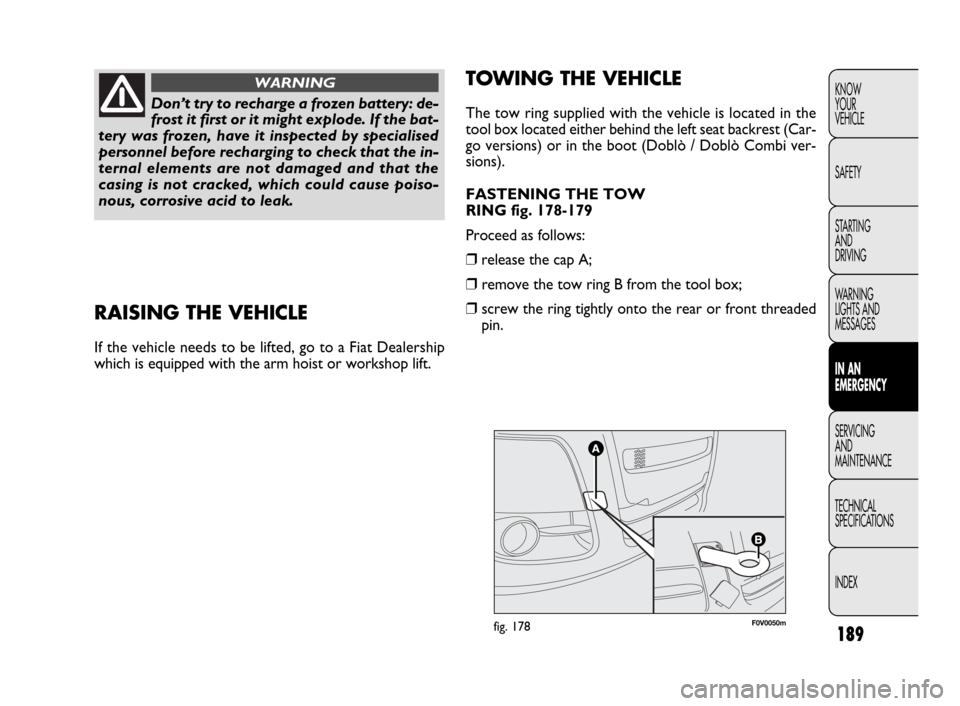
F0V0050mfig. 178
TOWING THE VEHICLE
The tow ring supplied with the vehicle is located in the
tool box located either behind the left seat backrest (Car-
go versions) or in the boot (Doblò / Doblò Combi ver-
sions).
FASTENING THE TOW
RING fig. 178-179
Proceed as follows:
❒release the cap A;
❒remove the tow ring B from the tool box;
❒screw the ring tightly onto the rear or front threaded
pin.
RAISING THE VEHICLE
If the vehicle needs to be lifted, go to a Fiat Dealership
which is equipped with the arm hoist or workshop lift.
Don’t try to recharge a frozen battery: de-
frost it first or it might explode. If the bat-
tery was frozen, have it inspected by specialised
personnel before recharging to check that the in-
ternal elements are not damaged and that the
casing is not cracked, which could cause poiso-
nous, corrosive acid to leak.
WARNING
Page 193 of 274
●●●●●●
●●●●●●
●●●●●●
●●●●●●
●●●●●●
●●●
●●●●●●
●●●●●●
●●
●●●
●●●●●●
●●●●●●
●●●●●●
192
KNOW
YOUR
VEHICLE
SAFETY
STARTING
AND
DRIVING
WARNING
LIGHTS AND
MESSAGES
IN AN
EMERGENCY
SERVICING
AND
MAINTENANCE
TECHNICAL
SPECIFICATIONS
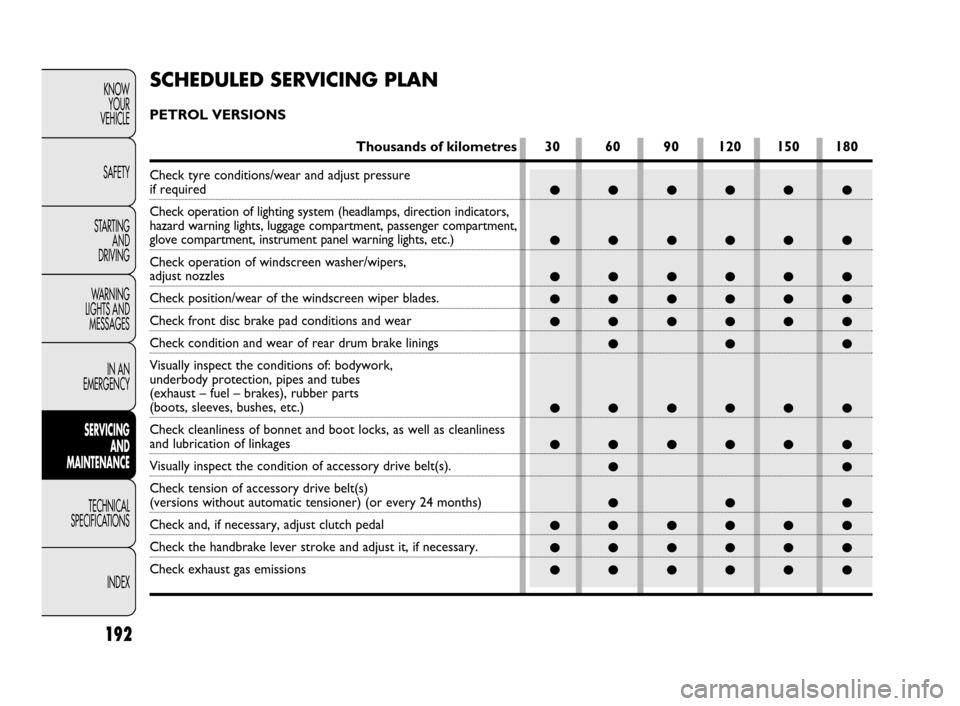
INDEXSCHEDULED SERVICING PLAN
PETROL VERSIONS
Thousands of kilometres 30 60 90 120 150 180
Check tyre conditions/wear and adjust pressure if required
Check operation of lighting system (headlamps, direction indicators,
hazard warning lights, luggage compartment, passenger compartment,
glove compartment, instrument panel warning lights, etc.)
Check operation of windscreen washer/wipers,
adjust nozzles
Check position/wear of the windscreen wiper blades.
Check front disc brake pad conditions and wear
Check condition and wear of rear drum brake linings
Visually inspect the conditions of: bodywork,
underbody protection, pipes and tubes
(exhaust – fuel – brakes), rubber parts
(boots, sleeves, bushes, etc.)
Check cleanliness of bonnet and boot locks, as well as cleanliness
and lubrication of linkages
Visually inspect the condition of accessory drive belt(s).
Check tension of accessory drive belt(s)
(versions without automatic tensioner) (or every 24 months)
Check and, if necessary, adjust clutch pedal
Check the handbrake lever stroke and adjust it, if necessary.
Check exhaust gas emissions
Page 195 of 274
●●●●●●
●●●●●●
●●●●●●
●●●●●●
●●●●●●
●●●
●●●●●●
●●●●●●
●●●●●●
●●
●●●●●●
●●
●●
●●●●●●
194
KNOW
YOUR
VEHICLE
SAFETY
STARTING
AND
DRIVING
WARNING
LIGHTS AND
MESSAGES
IN AN
EMERGENCY
SERVICING
AND
MAINTENANCE
TECHNICAL
SPECIFICATIONS
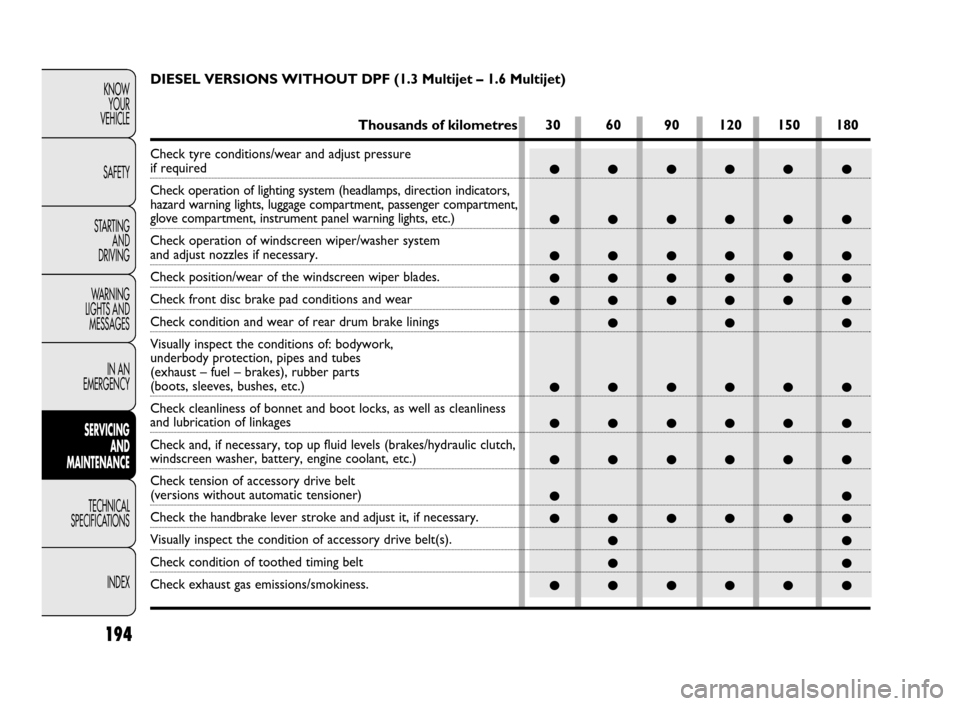
INDEXDIESEL VERSIONS WITHOUT DPF (1.3 Multijet – 1.6 Multijet)
Thousands of kilometres 30 60 90 120 150 180
Check tyre conditions/wear and adjust pressure if required
Check operation of lighting system (headlamps, direction indicators,
hazard warning lights, luggage compartment, passenger compartment,
glove compartment, instrument panel warning lights, etc.)
Check operation of windscreen wiper/washer system
and adjust nozzles if necessary.
Check position/wear of the windscreen wiper blades.
Check front disc brake pad conditions and wear
Check condition and wear of rear drum brake linings
Visually inspect the conditions of: bodywork,
underbody protection, pipes and tubes
(exhaust – fuel – brakes), rubber parts
(boots, sleeves, bushes, etc.)
Check cleanliness of bonnet and boot locks, as well as cleanliness
and lubrication of linkages
Check and, if necessary, top up fluid levels (brakes/hydraulic clutch,
windscreen washer, battery, engine coolant, etc.)
Check tension of accessory drive belt
(versions without automatic tensioner)
Check the handbrake lever stroke and adjust it, if necessary.
Visually inspect the condition of accessory drive belt(s).
Check condition of toothed timing belt
Check exhaust gas emissions/smokiness.
Page 197 of 274
196
KNOW
YOUR
VEHICLE
SAFETY
STARTING
AND
DRIVING
WARNING
LIGHTS AND
MESSAGES
IN AN
EMERGENCY
SERVICING
AND
MAINTENANCE
TECHNICAL
SPECIFICATIONS
INDEX
● ●●●●
● ●●●●
● ●●●●
● ●●●●
● ●●●●
●●
● ●●●●
● ●●●●
● ●●●●
●●
● ●●●●
●●
● ●●●●
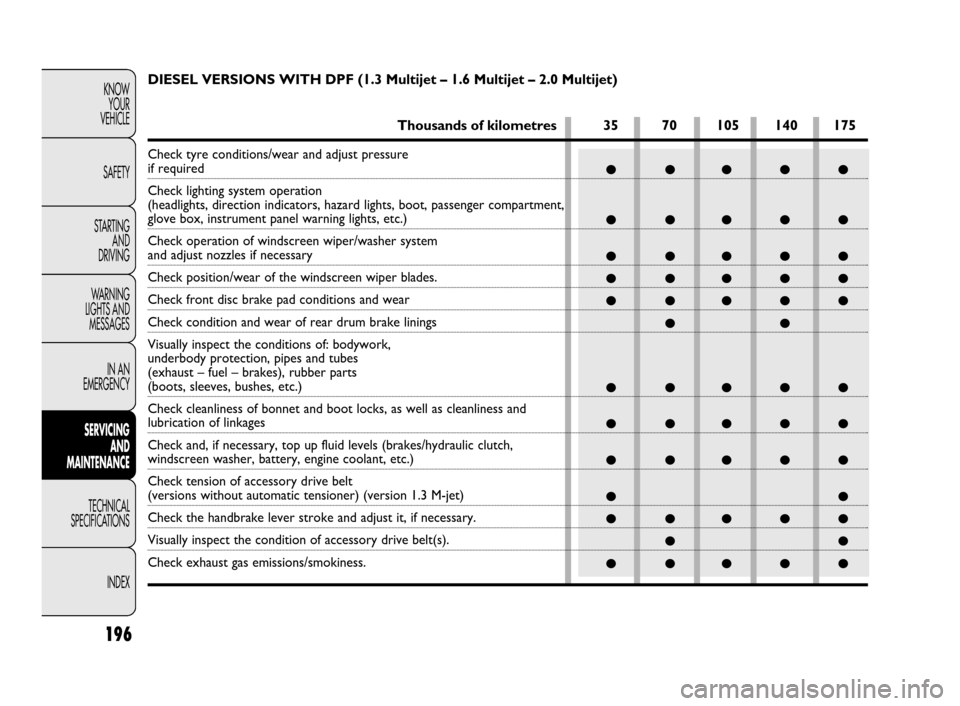
DIESEL VERSIONS WITH DPF (1.3 Multijet – 1.6 Multijet – 2.0 Multijet)
Thousands of kilometres 35 70 105 140 175
Check tyre conditions/wear and adjust pressure if required
Check lighting system operation
(headlights, direction indicators, hazard lights, boot, passenger compartment,
glove box, instrument panel warning lights, etc.)
Check operation of windscreen wiper/washer system
and adjust nozzles if necessary
Check position/wear of the windscreen wiper blades.
Check front disc brake pad conditions and wear
Check condition and wear of rear drum brake linings
Visually inspect the conditions of: bodywork,
underbody protection, pipes and tubes
(exhaust – fuel – brakes), rubber parts
(boots, sleeves, bushes, etc.)
Check cleanliness of bonnet and boot locks, as well as cleanliness and
lubrication of linkages
Check and, if necessary, top up fluid levels (brakes/hydraulic clutch,
windscreen washer, battery, engine coolant, etc.)
Check tension of accessory drive belt
(versions without automatic tensioner) (version 1.3 M-jet)
Check the handbrake lever stroke and adjust it, if necessary.
Visually inspect the condition of accessory drive belt(s).
Check exhaust gas emissions/smokiness.
Page 199 of 274
198
KNOW
YOUR
VEHICLE
SAFETY
STARTING
AND
DRIVING
WARNING
LIGHTS AND
MESSAGES
IN AN
EMERGENCY
SERVICING
AND
MAINTENANCE
TECHNICAL
SPECIFICATIONS
INDEXHEAVY USAGE OF THE VEHICLE
If the vehicle is primarily used in one of the following
particularly onerous conditions:
❒ towing trailers;
❒ dusty roads;
❒ short, repeated journeys (less than 7-8 km) at sub-ze-
ro temperatures;
❒ frequently idling engine or long-distance, low-speed
driving (e.g. door-to-door deliveries) or lengthy inac-
tivity;
❒ driving in towns and cities;
you should perform the following inspections more fre-
quently than shown on the Scheduled Servicing Plan:
❒ check front disc brake pad conditions and wear;
❒ check cleanliness of bonnet and boot locks, and clean-
liness and lubrication of linkages;
❒ visually inspect the conditions of: engine, gearbox,
transmission, pipes and tubes (exhaust – fuel – brakes),
rubber parts (boots, sleeves, bushes, etc.);
❒ check battery charge and fluid level (electrolite) (check
to be carried out only by specialists or at a Fiat Deal-
ership – see the “Battery” paragraph in this section);
❒ visually inspect the condition of the accessory drive
belts;
❒ check pollen filter and replace, if required;
❒ check and, if necessary, replace air filter.
REGULAR CHECKS
Every 1,000 km or before long journeys, check and, if nec-
essary, top up:
❒ engine coolant fluid level;
❒ brake fluid level;
❒ windscreen washer level;
❒ tyre pressure and conditions.
❒ operation of lighting system (headlights, direction in-
dicators, hazard lights, etc.);
❒ operation of windscreen washer/wipers system and
positioning/wear of windscreen/rear window wiper
blades (for versions/markets where provided);
Check and top up, if required, the engine oil level every
3,000 km.
You are recommended to use
PETRONAS LUBRI-
CANTS
products, which have been designed and pro-
duced specifically for Fiat vehicles (see “Capacities” table
in the “Technical specifications” section).
Page 209 of 274
If, after buying the vehicle, you want to install electrical
accessories requiring permanent electric supply (alarm,
etc.) or having high power level consumption, contact
a Fiat Dealership, whose qualified personnel, in addition
to suggesting the most suitable devices from the Lin-
eacessori Fiat range, will assess the overall electrical con-
sumption to determine whether the vehicle’s electrical
system is capable of withstanding the load required, or
whether it should be integrated with a more powerful
battery.
Since these devices continue to use electricity even when
the engine is off, they gradually run down the battery.
208
KNOW
YOUR
VEHICLE
SAFETY
STARTING
AND
DRIVING
WARNING
LIGHTS AND
MESSAGES
IN AN
EMERGENCY
SERVICING
AND
MAINTENANCE
TECHNICAL
SPECIFICATIONS
INDEXUSEFUL ADVICE FOR EXTENDING THE LIFE
OF YOUR BATTERY
To avoid draining your battery and make it last longer,
follow these instructions closely:
❒when you park the vehicle, ensure the doors, boot and
bonnet are closed properly so that the ceiling lights do
not stay on;
❒turn off the ceiling lights, although the car does have
an automatic system for switching off internal lights;
❒do not leave devices (e.g. sound system, hazard lights,
etc.) switched on for a long time when the engine is
not running;
❒before performing any operation on the electrical sys-
tem, disconnect the negative battery cable;
❒make sure battery terminals are fully tightened.
The battery is also more prone to the risk of freezing (at
temperatures as high as –10°C). If the vehicle is off the
road for long periods, refer to “Vehicle inactivity” in the
“Starting and driving” section.
Page 262 of 274
261
KNOW
YOUR
VEHICLE
SAFETY
STARTING
AND
DRIVING
WARNING
LIGHTS AND
MESSAGES
IN AN
EMERGENCY
SERVICING
AND
MAINTENANCE
TECHNICAL
SPECIFICATIONS
INDEX
Automatic climate
control .................................. 51
Battery
– jump starting .................. 155
– maintenance ................... 208
– replacement .................... 207
– tips for extending life .... 208
Body marking ...................... 220
Body paintwork
identification plate............. 220
Bodywork codes ................ 221
Bodywork versions ............. 221
Bodywork
– bodywork version
codes ................................ 221
– cleaning, care and
maintenance ................... 214Bonnet
– opening/closing ..... 91-92-93
Boot courtesy light ............... 67
Boot ......................................... 85
– expanding the boot ......... 89
– parcel shelf (removal) ...... 88
– removing the parcel
shelf .................................... 88
– securing your load ............ 90
Boot
– emergency opening from
the inside.........................85-86
– expanding the boot .......... 89
– opening with remote
control................................... 6
– securing your load ............ 91
Brake Assist system............... 98
Brake fluid
– specifications................... 248 ABS system ............................ 96
ABS .......................................... 96
Additional brake light
– bulb replacement ........... 176
Adjusting the mirrors .... 40-41
Adjusting the seats ............... 30
Adjusting the vehicle’s
interior lighting .................... 20
Air filter ................................ 206
Air recirculation ........ 46-49-56
Air vents ................................. 43
Airbag deactivation ............ 130
Antifreeze
– checking levels and
topping up ....................... 202
– specifications .................. 248
Ashtray .................................... 75
ASR (system) ....................... 100
INDEX
Page 265 of 274
264
KNOW
YOUR
VEHICLE
SAFETY
STARTING
AND
DRIVING
WARNING
LIGHTS AND
MESSAGES
IN AN
EMERGENCY
SERVICING
AND
MAINTENANCE
TECHNICAL
SPECIFICATIONS
INDEX
– remote locking/
unlocking ............................. 6
DPF (particulate filter)........ 114
Electrical/electronic
devices ................................ 110
Emergency starting ............. 155
– bump starting ................. 156
– jump starting .................. 155
End of vehicle life ............... 255
Engine codes ........................ 221
Engine compartment
– checking fluid levels ...... 199
– opening/closing
the bonnet.......................... 91
– washing ............................ 216
Engine coolant
temperature gauge ............. 13
– type of coolant ............... 248
Engine coolant
– checking levels
and topping up ............... 202– specifications................... 248
– temperature gauge
and warning light ............. 13
Engine immobiliser
(Fiat CODE) ........................... 5
Engine marking .................... 220
Engine oil consumption ...... 201
Engine oil
– checking levels
and topping up................ 201
– consumption .................... 201
– specifications................... 247
Engine
– engine immobiliser
(Fiat CODE) ....................... 5
– identification code ......... 221
– marking ............................. 220
– technical
specifications .................. 223
Environment
– features for reducing
emissions ................113-114Environmental protection
...................................113-114
– particulate filter
(DPF) ................................ 114
EOBD (system) ................... 102
ESP (system) .......................... 98
Extending the boot ............... 89
External lights
(switching on) ................ 59-60
Fiat CODE system ................. 4
Fiat CODE ................................ 5
Fix&Go (quick tyre
repair kit) ........................... 163
Flashing (main beams)........... 60
Fluids and lubricants
(specifications) ..........247-248
Fog lights
– bulb replacement ........... 174
– switching on....................... 70
Follow Me Home
(headlight device)................ 60