clutch FIAT DOBLO 2009 2.G User Guide
[x] Cancel search | Manufacturer: FIAT, Model Year: 2009, Model line: DOBLO, Model: FIAT DOBLO 2009 2.GPages: 274, PDF Size: 6.6 MB
Page 193 of 274
●●●●●●
●●●●●●
●●●●●●
●●●●●●
●●●●●●
●●●
●●●●●●
●●●●●●
●●
●●●
●●●●●●
●●●●●●
●●●●●●
192
KNOW
YOUR
VEHICLE
SAFETY
STARTING
AND
DRIVING
WARNING
LIGHTS AND
MESSAGES
IN AN
EMERGENCY
SERVICING
AND
MAINTENANCE
TECHNICAL
SPECIFICATIONS
INDEXSCHEDULED SERVICING PLAN
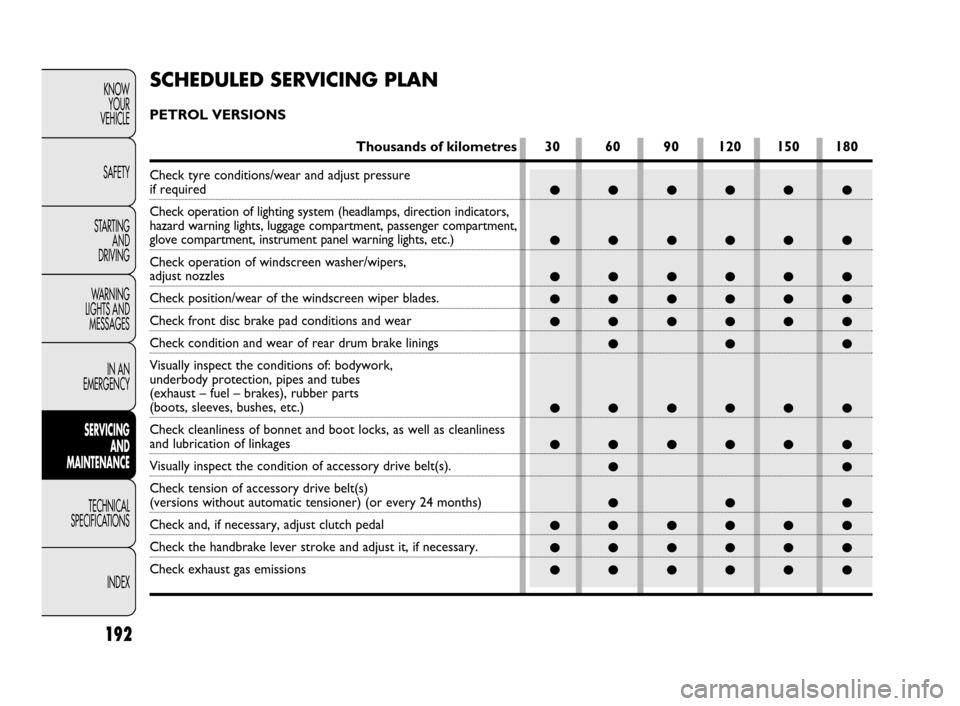
PETROL VERSIONS
Thousands of kilometres 30 60 90 120 150 180
Check tyre conditions/wear and adjust pressure if required
Check operation of lighting system (headlamps, direction indicators,
hazard warning lights, luggage compartment, passenger compartment,
glove compartment, instrument panel warning lights, etc.)
Check operation of windscreen washer/wipers,
adjust nozzles
Check position/wear of the windscreen wiper blades.
Check front disc brake pad conditions and wear
Check condition and wear of rear drum brake linings
Visually inspect the conditions of: bodywork,
underbody protection, pipes and tubes
(exhaust – fuel – brakes), rubber parts
(boots, sleeves, bushes, etc.)
Check cleanliness of bonnet and boot locks, as well as cleanliness
and lubrication of linkages
Visually inspect the condition of accessory drive belt(s).
Check tension of accessory drive belt(s)
(versions without automatic tensioner) (or every 24 months)
Check and, if necessary, adjust clutch pedal
Check the handbrake lever stroke and adjust it, if necessary.
Check exhaust gas emissions
Page 194 of 274
●●
●●●
●
●
●●●
●●●●●●
●●●●●●
●●●●●●
●●●●●●
●●●
●●●●●●
193
KNOW
YOUR
VEHICLE
SAFETY
STARTING
AND
DRIVING
WARNING
LIGHTS AND
MESSAGES
IN AN
EMERGENCY
SERVICING
AND
MAINTENANCE
TECHNICAL
SPECIFICATIONS
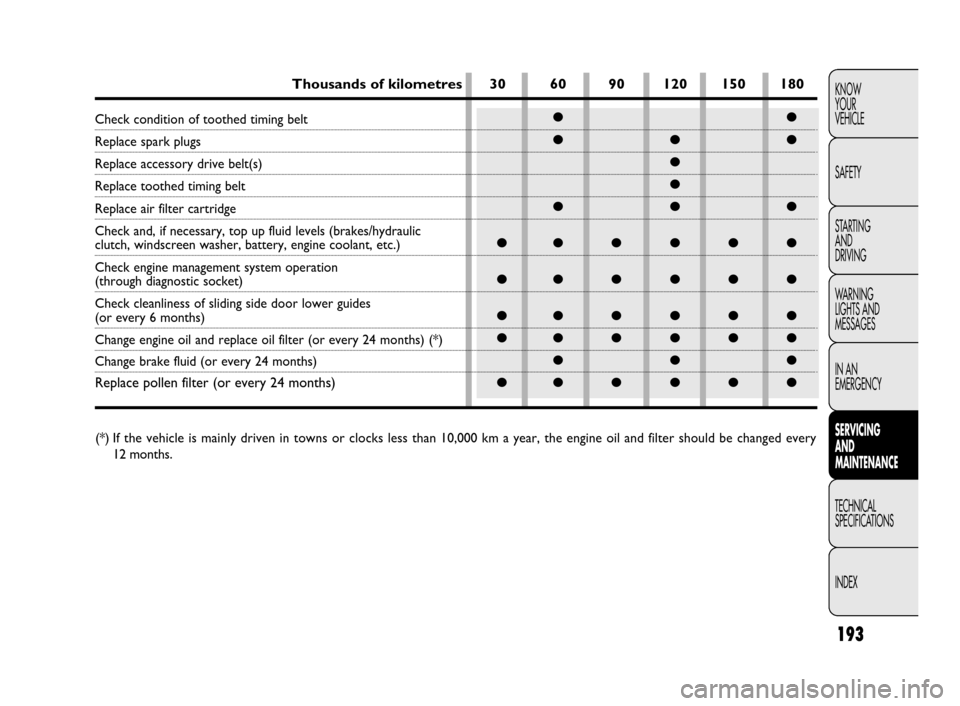
INDEXThousands of kilometres 30 60 90 120 150 180
Check condition of toothed timing belt
Replace spark plugs
Replace accessory drive belt(s)
Replace toothed timing belt
Replace air filter cartridge
Check and, if necessary, top up fluid levels (brakes/hydraulic
clutch, windscreen washer, battery, engine coolant, etc.)
Check engine management system operation
(through diagnostic socket)
Check cleanliness of sliding side door lower guides
(or every 6 months)
Change engine oil and replace oil filter (or every 24 months) (*)
Change brake fluid (or every 24 months)
Replace pollen filter (or every 24 months)
(*) If the vehicle is mainly driven in towns or clocks less than 10,000 km a year, the engine oil and filter should be changed every
12 months.
Page 195 of 274
●●●●●●
●●●●●●
●●●●●●
●●●●●●
●●●●●●
●●●
●●●●●●
●●●●●●
●●●●●●
●●
●●●●●●
●●
●●
●●●●●●
194
KNOW
YOUR
VEHICLE
SAFETY
STARTING
AND
DRIVING
WARNING
LIGHTS AND
MESSAGES
IN AN
EMERGENCY
SERVICING
AND
MAINTENANCE
TECHNICAL
SPECIFICATIONS
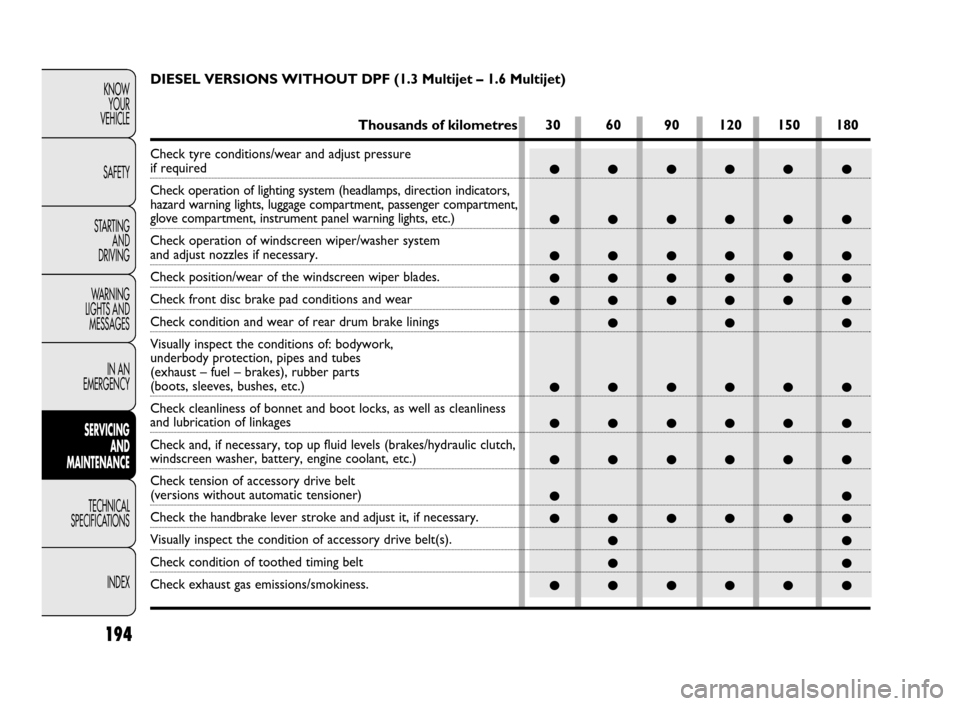
INDEXDIESEL VERSIONS WITHOUT DPF (1.3 Multijet – 1.6 Multijet)
Thousands of kilometres 30 60 90 120 150 180
Check tyre conditions/wear and adjust pressure if required
Check operation of lighting system (headlamps, direction indicators,
hazard warning lights, luggage compartment, passenger compartment,
glove compartment, instrument panel warning lights, etc.)
Check operation of windscreen wiper/washer system
and adjust nozzles if necessary.
Check position/wear of the windscreen wiper blades.
Check front disc brake pad conditions and wear
Check condition and wear of rear drum brake linings
Visually inspect the conditions of: bodywork,
underbody protection, pipes and tubes
(exhaust – fuel – brakes), rubber parts
(boots, sleeves, bushes, etc.)
Check cleanliness of bonnet and boot locks, as well as cleanliness
and lubrication of linkages
Check and, if necessary, top up fluid levels (brakes/hydraulic clutch,
windscreen washer, battery, engine coolant, etc.)
Check tension of accessory drive belt
(versions without automatic tensioner)
Check the handbrake lever stroke and adjust it, if necessary.
Visually inspect the condition of accessory drive belt(s).
Check condition of toothed timing belt
Check exhaust gas emissions/smokiness.
Page 197 of 274
196
KNOW
YOUR
VEHICLE
SAFETY
STARTING
AND
DRIVING
WARNING
LIGHTS AND
MESSAGES
IN AN
EMERGENCY
SERVICING
AND
MAINTENANCE
TECHNICAL
SPECIFICATIONS
INDEX
● ●●●●
● ●●●●
● ●●●●
● ●●●●
● ●●●●
●●
● ●●●●
● ●●●●
● ●●●●
●●
● ●●●●
●●
● ●●●●
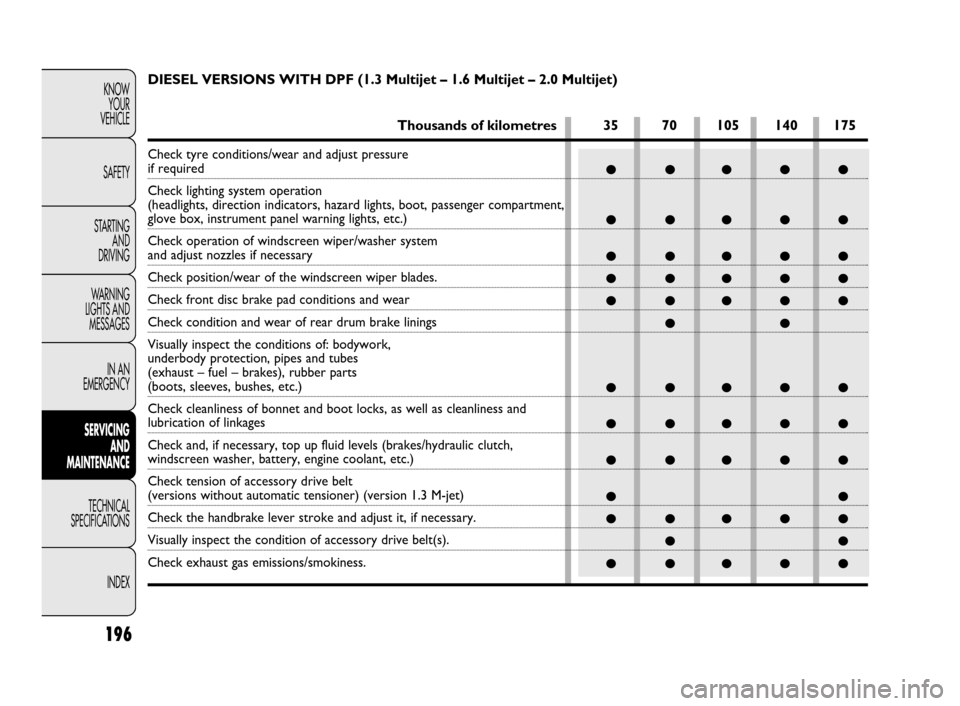
DIESEL VERSIONS WITH DPF (1.3 Multijet – 1.6 Multijet – 2.0 Multijet)
Thousands of kilometres 35 70 105 140 175
Check tyre conditions/wear and adjust pressure if required
Check lighting system operation
(headlights, direction indicators, hazard lights, boot, passenger compartment,
glove box, instrument panel warning lights, etc.)
Check operation of windscreen wiper/washer system
and adjust nozzles if necessary
Check position/wear of the windscreen wiper blades.
Check front disc brake pad conditions and wear
Check condition and wear of rear drum brake linings
Visually inspect the conditions of: bodywork,
underbody protection, pipes and tubes
(exhaust – fuel – brakes), rubber parts
(boots, sleeves, bushes, etc.)
Check cleanliness of bonnet and boot locks, as well as cleanliness and
lubrication of linkages
Check and, if necessary, top up fluid levels (brakes/hydraulic clutch,
windscreen washer, battery, engine coolant, etc.)
Check tension of accessory drive belt
(versions without automatic tensioner) (version 1.3 M-jet)
Check the handbrake lever stroke and adjust it, if necessary.
Visually inspect the condition of accessory drive belt(s).
Check exhaust gas emissions/smokiness.
Page 225 of 274
224
KNOW
YOUR
VEHICLE
SAFETY
STARTING
AND
DRIVING
WARNING
LIGHTS AND
MESSAGES
IN AN
EMERGENCY
SERVICING
AND
MAINTENANCE
TECHNICAL
SPECIFICATIONS
INDEX
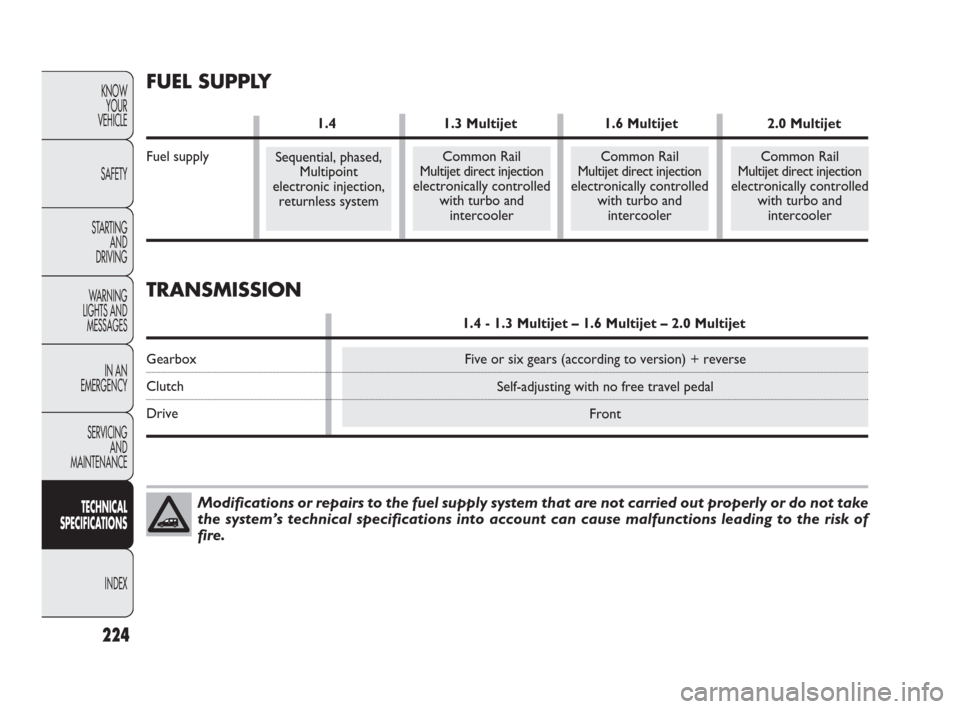
Modifications or repairs to the fuel supply system that are not carried out properly or do not take
the system’s technical specifications into account can cause malfunctions leading to the risk of
fire.
Sequential, phased,
Multipoint
electronic injection,
returnless systemCommon Rail
Multijet direct injection
electronically controlled
with turbo and
intercoolerCommon Rail
Multijet direct injection
electronically controlled
with turbo and
intercoolerCommon Rail
Multijet direct injection
electronically controlled
with turbo and
intercooler
Five or six gears (according to version) + reverse
Self-adjusting with no free travel pedal
Front
FUEL SUPPLY
1.4 1.3 Multijet 1.6 Multijet 2.0 Multijet
Fuel supply
TRANSMISSION
1.4 - 1.3 Multijet – 1.6 Multijet – 2.0 Multijet
Gearbox
Clutch
Drive
Page 249 of 274
248
KNOW
YOUR
VEHICLE
SAFETY
STARTING
AND
DRIVING
WARNING
LIGHTS AND
MESSAGES
IN AN
EMERGENCY
SERVICING
AND
MAINTENANCE
TECHNICAL
SPECIFICATIONS
INDEX
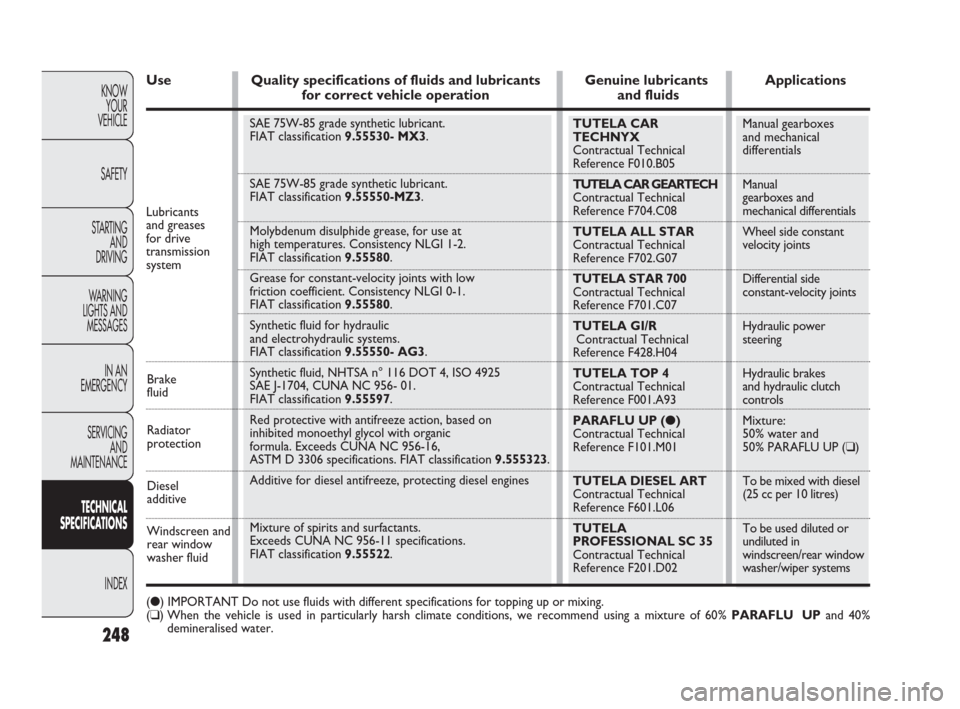
Lubricants
and greases
for drive
transmission
system
Manual gearboxes
and mechanical
differentials
Manual
gearboxes and
mechanical differentials
Wheel side constant
velocity joints
Differential side
constant-velocity joints
Hydraulic power
steering
Hydraulic brakes
and hydraulic clutch
controls
Mixture:
50% water and
50% PARAFLU UP (❑)
To be mixed with diesel
(25 cc per 10 litres)
To be used diluted or
undiluted in
windscreen/rear window
washer/wiper systems Brake
fluid
Radiator
protection
Diesel
additive
Windscreen and
rear window
washer fluidTUTELA CAR
TECHNYX
Contractual Technical
Reference F010.B05
TUTELA CAR GEARTECH
Contractual Technical
Reference F704.C08
TUTELA ALL STAR
Contractual Technical
Reference F702.G07
TUTELA STAR 700
Contractual Technical
Reference F701.C07
TUTELA GI/R
Contractual Technical
Reference F428.H04
TUTELA TOP 4
Contractual Technical
Reference F001.A93
PARAFLU UP (
●)
Contractual Technical
Reference F101.M01
TUTELA DIESEL ART
Contractual Technical
Reference F601.L06
TUTELA
PROFESSIONAL SC 35
Contractual Technical
Reference F201.D02
SAE 75W-85 grade synthetic lubricant.
FIAT classification 9.55530- MX3.
SAE 75W-85 grade synthetic lubricant.
FIAT classification 9.55550-MZ3.
Molybdenum disulphide grease, for use at
high temperatures. Consistency NLGI 1-2.
FIAT classification 9.55580.
Grease for constant-velocity joints with low
friction coefficient. Consistency NLGI 0-1.
FIAT classification 9.55580.
Synthetic fluid for hydraulic
and electrohydraulic systems.
FIAT classification 9.55550- AG3.
Synthetic fluid, NHTSA n° 116 DOT 4, ISO 4925
SAE J-1704, CUNA NC 956- 01.
FIAT classification 9.55597.
Red protective with antifreeze action, based on
inhibited monoethyl glycol with organic
formula. Exceeds CUNA NC 956-16,
ASTM D 3306 specifications. FIAT classification 9.555323.
Additive for diesel antifreeze, protecting diesel engines
Mixture of spirits and surfactants.
Exceeds CUNA NC 956-11 specifications.
FIAT classification 9.55522.
Use Quality specifications of fluids and lubricants Genuine lubricants Applications for correct vehicle operation and fluids
(●) IMPORTANT Do not use fluids with different specifications for topping up or mixing.
(❑) When the vehicle is used in particularly harsh climate conditions, we recommend using a mixture of 60% PARAFLU UPand 40%
demineralised water.
Page 251 of 274
250
KNOW
YOUR
VEHICLE
SAFETY
STARTING
AND
DRIVING
WARNING
LIGHTS AND
MESSAGES
IN AN
EMERGENCY
SERVICING
AND
MAINTENANCE
TECHNICAL
SPECIFICATIONS
INDEX
9. Air conditioning leads to higher fuel consumption (on
average up to +30%). If the temperature outside is not
too extreme, try and use the air vents.
Driving style
1. After starting the engineyou should drive away im-
mediately and slowly, avoiding high revs. Do not warm
up the engine at low or high revs when the vehicle is
stationary; this causes the engine to warm up more
slowly, thereby increasing fuel consumption, emissions
and mechanical component wear.
2. Avoid pointless actions such as revving up when at
traffic lights or before stopping the engine. The latter
action, like double-declutching, is unnecessary and caus-
es increased fuel consumption and pollution.
3.Gear selection: select a high gear as soon as possible
(taking into account normal engine operation and traf-
fic conditions) without pushing the engine to high revs
during the intermediate gears. Using low gears at high
revs to get excellent acceleration increases fuel con-
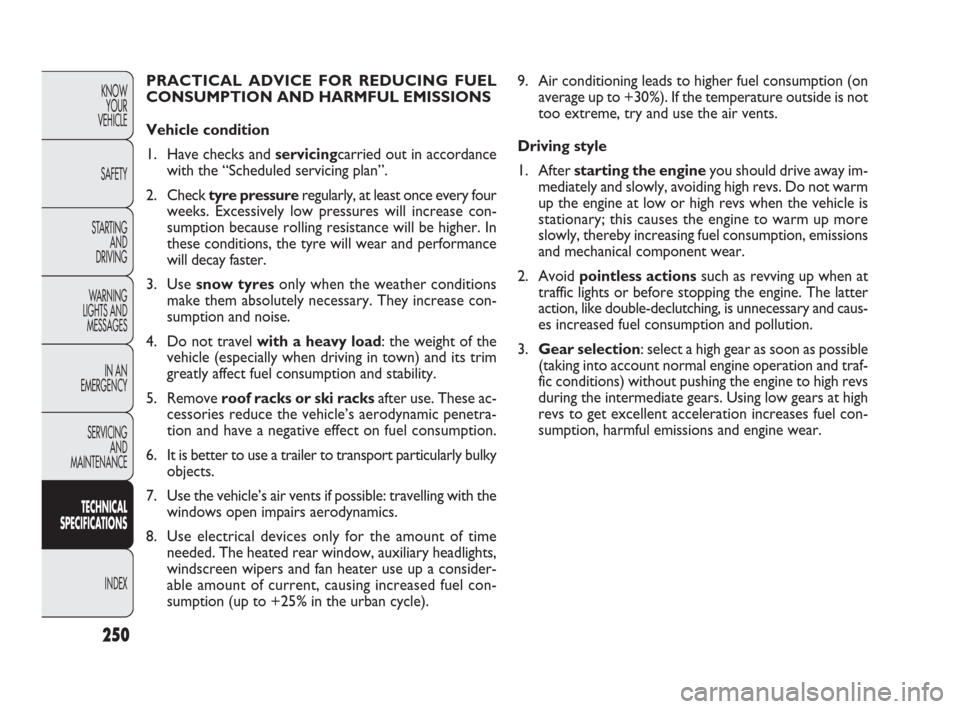
sumption, harmful emissions and engine wear. PRACTICAL ADVICE FOR REDUCING FUEL
CONSUMPTION AND HARMFUL EMISSIONS
Vehicle condition
1. Have checks and servicingcarried out in accordance
with the “Scheduled servicing plan”.
2. Check tyre pressure regularly, at least once every four
weeks. Excessively low pressures will increase con-
sumption because rolling resistance will be higher. In
these conditions, the tyre will wear and performance
will decay faster.
3. Use snow tyresonly when the weather conditions
make them absolutely necessary. They increase con-
sumption and noise.
4. Do not travel with a heavy load: the weight of the
vehicle (especially when driving in town) and its trim
greatly affect fuel consumption and stability.
5. Remove roof racks or ski racksafter use. These ac-
cessories reduce the vehicle’s aerodynamic penetra-
tion and have a negative effect on fuel consumption.
6. It is better to use a trailer to transport particularly bulky
objects.
7. Use the vehicle’s air vents if possible: travelling with the
windows open impairs aerodynamics.
8. Use electrical devices only for the amount of time
needed. The heated rear window, auxiliary headlights,
windscreen wipers and fan heater use up a consider-
able amount of current, causing increased fuel con-
sumption (up to +25% in the urban cycle).
Page 264 of 274
263
KNOW
YOUR
VEHICLE
SAFETY
STARTING
AND
DRIVING
WARNING
LIGHTS AND
MESSAGES
IN AN
EMERGENCY
SERVICING
AND
MAINTENANCE
TECHNICAL
SPECIFICATIONS
INDEX
CODE card .............................. 5
Control buttons..................... 70
Coolant overheating
warning light .......................145
Cruise Control....................... 63
Dashboard ................................ 3
Dead lock ................................. 8
Defrosting/demisting
– rear window ......... 46-49-58
– windscreen and front
side windows ........ 45-48-57
Demisting/defrosting
– rear window ......... 46-49-58
– windscreen and front
side windows............... 45-49
– door mirrors ......... 46-49-58
Diesel filter............................ 206
– light warning of water
in filter.............................. 151
Digital display ......................... 14– control buttons ................ 14
– setup menu ....................... 15
– standard screen ............... 14
Dipped beam headlights
– bulb replacement ........... 173
– switching on ...................... 59
Direction Indicators
– front bulb
replacement .................... 173
– rear bulb
replacement ...........175-176
– side bulb
replacement .................... 173
– switching on ...................... 60
Door locking ......................... 77
Doors
– central locking................... 77
– child safety device............. 80
– load area unlocking .......... 77
– locking/unlocking from
the inside......................79-80 – interiors ........................... 216
– leather upholstery ......... 217
– plastic parts .................... 217
– windows............................. 61
Cleaning your vehicle
– engine compartment .... 216
– exterior............................ 214
– interior ............................ 216
Climate control system
controls ..........................47-51
Climate control vents .......... 43
Climate control ............... 47-51
– air vents ...............................43
Clock
– adjusting ...............................22
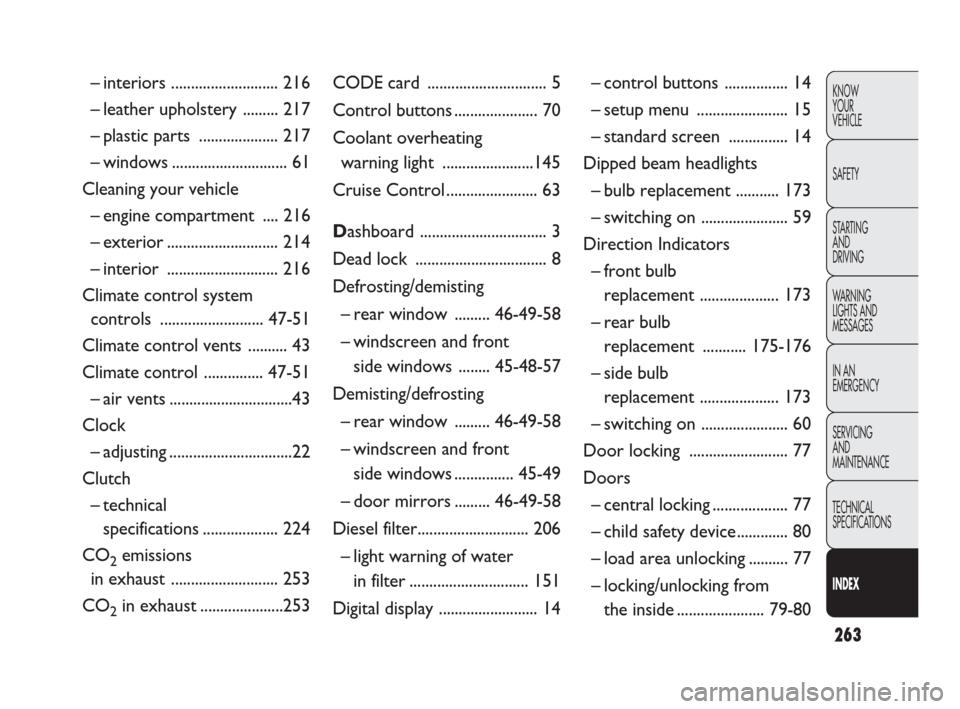
Clutch
– technical
specifications................... 224
CO
2emissions
in exhaust ........................... 253
CO
2in exhaust .....................253