steering wheel FIAT DOBLO 2009 2.G User Guide
[x] Cancel search | Manufacturer: FIAT, Model Year: 2009, Model line: DOBLO, Model: FIAT DOBLO 2009 2.GPages: 274, PDF Size: 6.6 MB
Page 191 of 274
190
KNOW
YOUR
VEHICLE
SAFETY
STARTING
AND
DRIVING
WARNING
LIGHTS AND
MESSAGES
IN AN
EMERGENCY
SERVICING
AND
MAINTENANCE
TECHNICAL
SPECIFICATIONS
INDEX
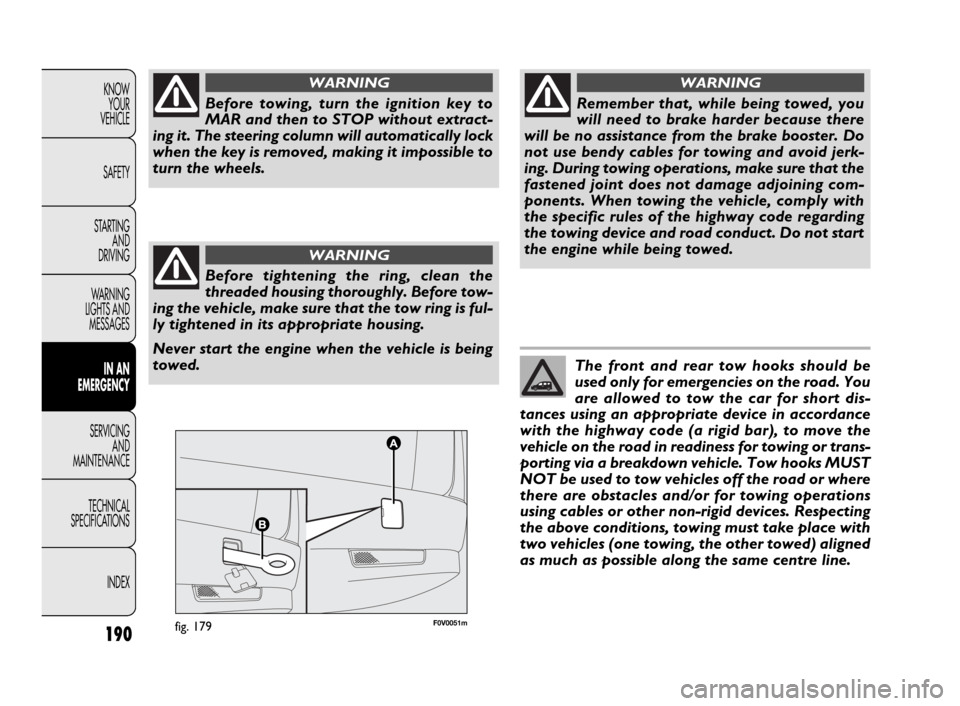
F0V0051mfig. 179
Before towing, turn the ignition key to
MAR and then to STOP without extract-
ing it. The steering column will automatically lock
when the key is removed, making it impossible to
turn the wheels.
WARNING
Before tightening the ring, clean the
threaded housing thoroughly. Before tow-
ing the vehicle, make sure that the tow ring is ful-
ly tightened in its appropriate housing.
Never start the engine when the vehicle is being
towed.
WARNING
Remember that, while being towed, you
will need to brake harder because there
will be no assistance from the brake booster. Do
not use bendy cables for towing and avoid jerk-
ing. During towing operations, make sure that the
fastened joint does not damage adjoining com-
ponents. When towing the vehicle, comply with
the specific rules of the highway code regarding
the towing device and road conduct. Do not start
the engine while being towed.
WARNING
The front and rear tow hooks should be
used only for emergencies on the road. You
are allowed to tow the car for short dis-
tances using an appropriate device in accordance
with the highway code (a rigid bar), to move the
vehicle on the road in readiness for towing or trans-
porting via a breakdown vehicle. Tow hooks MUST
NOT be used to tow vehicles off the road or where
there are obstacles and/or for towing operations
using cables or other non-rigid devices. Respecting
the above conditions, towing must take place with
two vehicles (one towing, the other towed) aligned
as much as possible along the same centre line.
Page 210 of 274
209
KNOW
YOUR
VEHICLE
SAFETY
STARTING
AND
DRIVING
WARNING
LIGHTS AND
MESSAGES
IN AN
EMERGENCY
SERVICING
AND
MAINTENANCE
TECHNICAL
SPECIFICATIONS
INDEXIMPORTANT NOTES
❒Where possible, avoid braking suddenly, wheel-spin-
ning and crashing into kerbs, potholes or other obsta-
cles. Long distances on uneven roads can damage the
tyres;
❒check the tyres regularly for cuts on the sides, swelling
or irregular tread wear. Go to a Fiat Dealership if re-
quired.
❒avoid overloading the car when travelling: this may cause
serious damage to the wheels and tyres;
❒if a tyre is punctured, stop the vehicle immediately and
change it to avoid damage to the tyre, the rim, and the
suspension and steering systems;
❒a tyre will age even if it is not used much. Cracks in
the tread and on the sidewalls are a sign of ageing. In
any event, have the tyres checked by specialised per-
sonnel if they have been fitted for longer than six years.
Remember to check the spare wheel very carefully;WHEELS AND TYRES
Check the pressure of each tyre, including the spare, every
two weeks and before long journeys. The pressure should
be checked with the tyre rested and cold.
It is normal for the pressure to increase when the vehi-
cle is used; for the correct tyre inflation pressure, see
“Wheels” in the “Technical specifications” section.
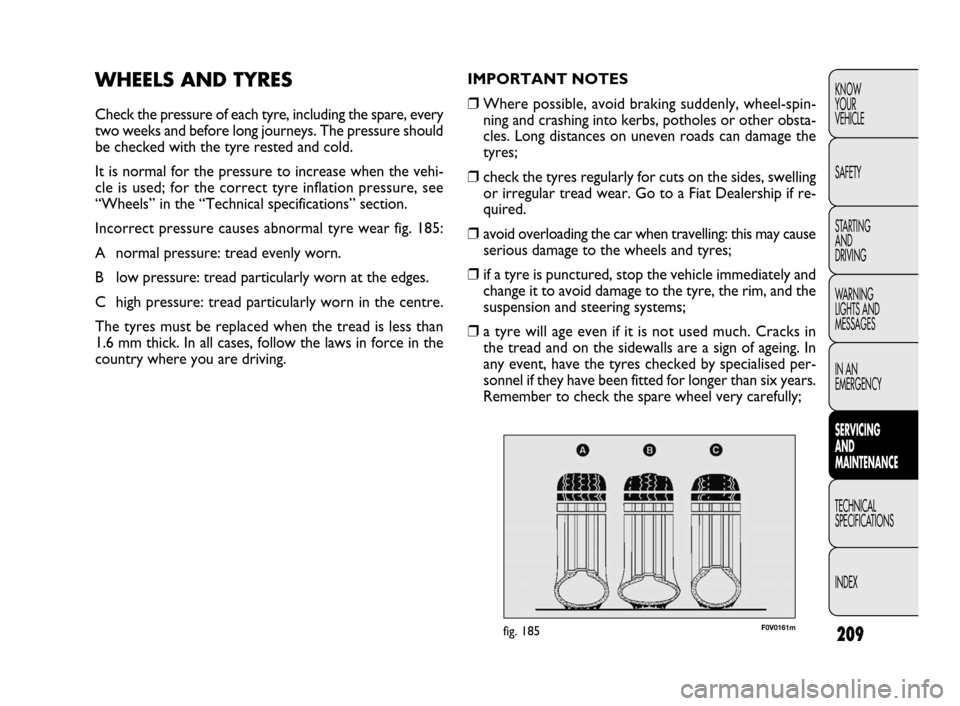
Incorrect pressure causes abnormal tyre wear fig. 185:
A normal pressure: tread evenly worn.
B low pressure: tread particularly worn at the edges.
C high pressure: tread particularly worn in the centre.
The tyres must be replaced when the tread is less than
1.6 mm thick. In all cases, follow the laws in force in the
country where you are driving.
F0V0161mfig. 185
Page 218 of 274

217
KNOW
YOUR
VEHICLE
SAFETY
STARTING
AND
DRIVING
WARNING
LIGHTS AND
MESSAGES
IN AN
EMERGENCY
SERVICING
AND
MAINTENANCE
TECHNICAL
SPECIFICATIONS
INDEXLEATHER UPHOLSTERED STEERING
WHEEL/GEAR KNOB/HANDBRAKE LEVER
(for versions/market, where provided)
These components must be cleaned with mild soap and
water only. Never use spirits or alcohol-based products.
Read the product label carefully before using specific prod-
ucts for cleaning the interiors: make sure the product does
not contain spirits or alcohol-based substances.
If, when cleaning the windscreen with special products,
window cleaner accidentally drips onto the leather of the
steering wheel/gear lever knob/hand brake, wipe away im-
mediately and then wash the affected area with mild soap
and water.
IMPORTANT Be careful when installing a steering wheel
locking device not to damage the leather upholstery. SEATS AND FABRIC PARTS
Remove dust with a soft brush or a vacuum cleaner. It is
advisable to use a damp brush on velvet upholstery.
Rub the seats with a sponge and a solution of water and
mild soap.
PLASTIC PARTS
It is advisable to clean interior plastic parts with a damp
cloth and a solution of water and non-abrasive mild soap.
To remove grease and tough stains, use products designed
specifically for cleaning plastics. These have no solvents
and have been designed so that they do not alter the ap-
pearance and colour of the components.
IMPORTANT Never use spirits or petroleum to clean
the instrument panel glass.
Page 226 of 274
225
KNOW
YOUR
VEHICLE
SAFETY
STARTING
AND
DRIVING
WARNING
LIGHTS AND
MESSAGES
IN AN
EMERGENCY
SERVICING
AND
MAINTENANCE
TECHNICAL
SPECIFICATIONS
INDEX
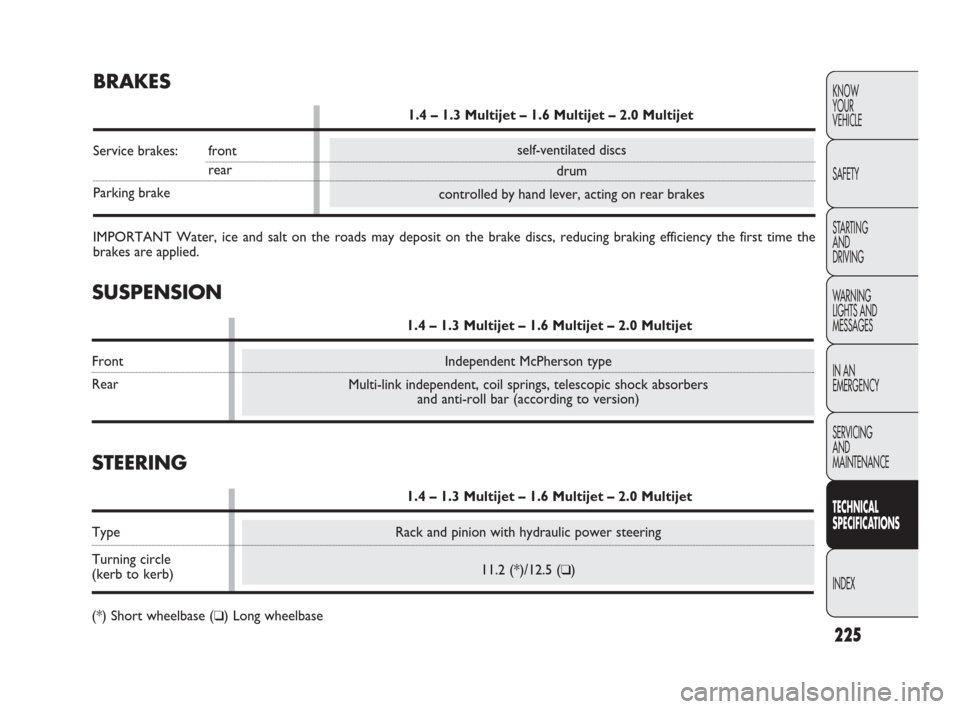
Rack and pinion with hydraulic power steering
11.2 (*)/12.5 (
❑)
self-ventilated discs
drum
controlled by hand lever, acting on rear brakes
Independent McPherson type
Multi-link independent, coil springs, telescopic shock absorbers
and anti-roll bar (according to version)
BRAKES
1.4 – 1.3 Multijet – 1.6 Multijet – 2.0 Multijet
Service brakes: front
rear
Parking brake
IMPORTANT Water, ice and salt on the roads may deposit on the brake discs, reducing braking efficiency the first time the
brakes are applied.
SUSPENSION
1.4 – 1.3 Multijet – 1.6 Multijet – 2.0 Multijet
Front
Rear
STEERING
1.4 – 1.3 Multijet – 1.6 Multijet – 2.0 Multijet
Type
Turning circle
(kerb to kerb)
(*) Short wheelbase (
❑) Long wheelbase
Page 249 of 274
248
KNOW
YOUR
VEHICLE
SAFETY
STARTING
AND
DRIVING
WARNING
LIGHTS AND
MESSAGES
IN AN
EMERGENCY
SERVICING
AND
MAINTENANCE
TECHNICAL
SPECIFICATIONS
INDEX
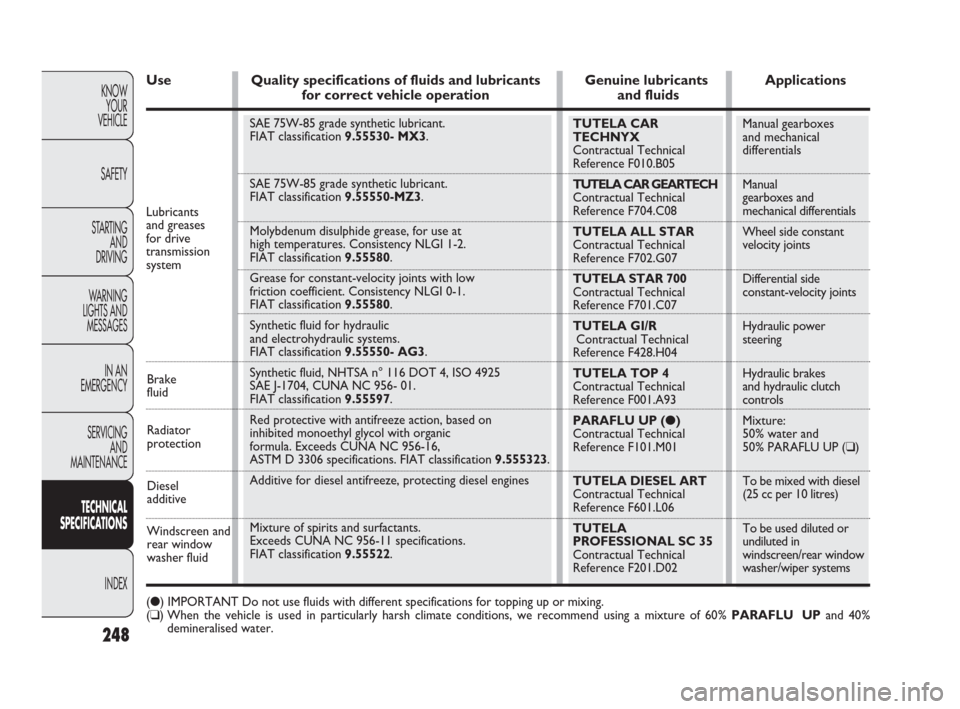
Lubricants
and greases
for drive
transmission
system
Manual gearboxes
and mechanical
differentials
Manual
gearboxes and
mechanical differentials
Wheel side constant
velocity joints
Differential side
constant-velocity joints
Hydraulic power
steering
Hydraulic brakes
and hydraulic clutch
controls
Mixture:
50% water and
50% PARAFLU UP (❑)
To be mixed with diesel
(25 cc per 10 litres)
To be used diluted or
undiluted in
windscreen/rear window
washer/wiper systems Brake
fluid
Radiator
protection
Diesel
additive
Windscreen and
rear window
washer fluidTUTELA CAR
TECHNYX
Contractual Technical
Reference F010.B05
TUTELA CAR GEARTECH
Contractual Technical
Reference F704.C08
TUTELA ALL STAR
Contractual Technical
Reference F702.G07
TUTELA STAR 700
Contractual Technical
Reference F701.C07
TUTELA GI/R
Contractual Technical
Reference F428.H04
TUTELA TOP 4
Contractual Technical
Reference F001.A93
PARAFLU UP (
●)
Contractual Technical
Reference F101.M01
TUTELA DIESEL ART
Contractual Technical
Reference F601.L06
TUTELA
PROFESSIONAL SC 35
Contractual Technical
Reference F201.D02
SAE 75W-85 grade synthetic lubricant.
FIAT classification 9.55530- MX3.
SAE 75W-85 grade synthetic lubricant.
FIAT classification 9.55550-MZ3.
Molybdenum disulphide grease, for use at
high temperatures. Consistency NLGI 1-2.
FIAT classification 9.55580.
Grease for constant-velocity joints with low
friction coefficient. Consistency NLGI 0-1.
FIAT classification 9.55580.
Synthetic fluid for hydraulic
and electrohydraulic systems.
FIAT classification 9.55550- AG3.
Synthetic fluid, NHTSA n° 116 DOT 4, ISO 4925
SAE J-1704, CUNA NC 956- 01.
FIAT classification 9.55597.
Red protective with antifreeze action, based on
inhibited monoethyl glycol with organic
formula. Exceeds CUNA NC 956-16,
ASTM D 3306 specifications. FIAT classification 9.555323.
Additive for diesel antifreeze, protecting diesel engines
Mixture of spirits and surfactants.
Exceeds CUNA NC 956-11 specifications.
FIAT classification 9.55522.
Use Quality specifications of fluids and lubricants Genuine lubricants Applications for correct vehicle operation and fluids
(●) IMPORTANT Do not use fluids with different specifications for topping up or mixing.
(❑) When the vehicle is used in particularly harsh climate conditions, we recommend using a mixture of 60% PARAFLU UPand 40%
demineralised water.
Page 270 of 274
269
KNOW
YOUR
VEHICLE
SAFETY
STARTING
AND
DRIVING
WARNING
LIGHTS AND
MESSAGES
IN AN
EMERGENCY
SERVICING
AND
MAINTENANCE
TECHNICAL
SPECIFICATIONS
INDEX
– general information ...... 118
– load limiters .................... 118
– maintenance ................... 120
– pretensioners ................. 117
– SBR ................................... 117
– using the seat belts ....... 115
Safety ..................................... 115
Satellite navigation
socket .................................... 75
Saving fuel ............................. 137
SBR system .......................... 117
Scheduled Servicing
Plan .....................192-194-196
Scrappage ............................. 255
Seat belt pretensioners ...... 117
– load limiters .................... 118
Seat heating ......................30-32
Servicing and
maintenance ...................... 191
– checking fluid levels
...........................199-200-201– heavy use of
the vehicle ....................... 198
– precautions
and warnings .................. 191
– regular checks ................ 198
– scheduled servicing plan
....192-193-194-195-196-197
Setting the clock ................... 22
Side airbags (side bag
– window bag).....130-131-132
– general information ...... 131
Sliding side doors ................... 78
Smart washing
(windscreen wipers) .......... 61
Snow chains ......................... 141
Sockets ..............................72-73
Sound system
(wiring) .......................109-110
Spare wheel ......................... 228
– technical
specifications .................. 228Spark plugs (type) ............... 223
Speed block ......................... 102
Speedometer.......................... 12
Start&Stop system............... 105
Starting the engine ............. 133
– emergency
starting.......................134-155
– ignition switch .................... 9
– ignition switch .................... 9
– procedure for
diesel versions................. 134
– procedure for petrol
versions ........................... 133
– stopping the engine ........ 135
– warming up
the engine ....................... 134
Starting up and driving ....... 133
Steering lock and ignition
switch ...................................... 9
Steering lock ............................ 9
Page 271 of 274
270
KNOW
YOUR
VEHICLE
SAFETY
STARTING
AND
DRIVING
WARNING
LIGHTS AND
MESSAGES
IN AN
EMERGENCY
SERVICING
AND
MAINTENANCE
TECHNICAL
SPECIFICATIONS
INDEX
Steering system
– steering wheel
adjustment lever............... 39
– technical
specifications................... 225
Steering wheel stalks ....... 59-61
Steering wheel
– adjustment lever............... 39
– turning circle................... 225
Steering-wheel
adjustment ............................ 39
Storage compartments ... 71-72
Sun visors................................ 75
Suspensions........................... 225
Switching ceiling lights
on/off ..................................... 69
Symbols...................................... 4
Tailgate
– emergency opening
from the inside ............ 85-86– opening with remote
control .............................. 6-7
Taillights
– front bulb
replacement .................... 172
– rear bulb
replacement .............175-176
– switching on ...................... 59
Technical specifications ...... 219
Third brake light.................. 176
Top speeds............................ 232
Topping up the engine
oil .......................................... 201
– specifications................... 247
Tow hook
– installing ..................189-190
Towing the vehicle ............. 189
Towing trailers .................... 139
Trailer (towing) ..........189-190
– installing the tow
hook .........................189-190Transmission
– technical
specifications .................. 224
Transporting children ......... 120
Trip computer ....................... 28
Turning circle ...................... 225
Tyre pressures .................... 229
Tyres
– changing a wheel .............156
– Fix&Go quick
repair kit ......................... 163
– in the event of
a puncture ....................... 156
– inflation pressure ........... 229
– reading the symbols
correctly .................226-227
– snow chains .................... 141
– snow tyres .............. 140-228
– storing tools and
space-saver wheel ......... 156
– tyre and wheel types ..... 228
– winter tyres .................... 228