battery FIAT DOBLO 2009 2.G Owner's Manual
[x] Cancel search | Manufacturer: FIAT, Model Year: 2009, Model line: DOBLO, Model: FIAT DOBLO 2009 2.GPages: 274, PDF Size: 6.6 MB
Page 189 of 274
188
KNOW
YOUR
VEHICLE
SAFETY
STARTING
AND
DRIVING
WARNING
LIGHTS AND
MESSAGES
IN AN
EMERGENCY
SERVICING
AND
MAINTENANCE
TECHNICAL
SPECIFICATIONS
INDEXRECHARGING THE BATTERY
IMPORTANT The battery recharging procedure is pro-
vided for information purposes only. You are recom-
mended to go to a Fiat Dealership to have this operation
performed.
We recommend recharging the battery slowly for ap-
proximately 24 hours at low amperage. A prolonged
recharge might damage the battery.
Charge the battery as follows:
WITHOUT START&STOP SYSTEM
❒disconnect battery negative terminal;
❒connect the charger cables to the battery terminals,
observing the polarity;
❒turn on the charger;
❒when you have finished, turn the charger off before
disconnecting it from the battery;
❒reconnect negative battery terminal.
Battery fluid is poisonous and corrosive:
avoid contact with your skin and eyes. The
battery recharging operation must be performed
in a ventilated place, away from naked flames or
possible sources of sparks to avoid the risk of ex-
plosion and fire.
WARNING
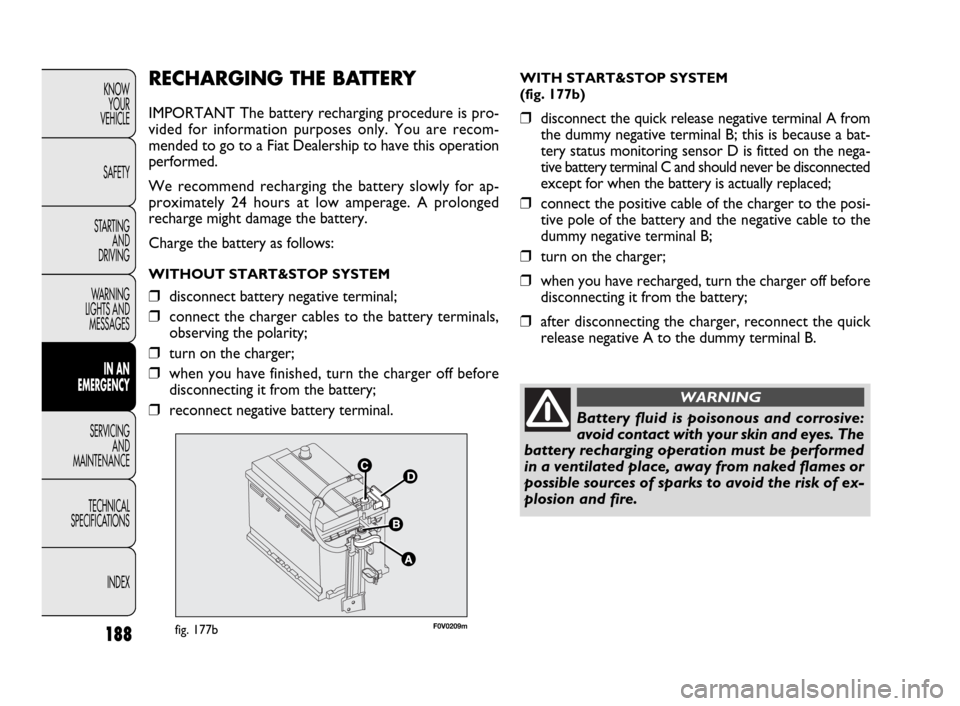
F0V0209mfig. 177b
WITH START&STOP SYSTEM
(fig. 177b)
❒disconnect the quick release negative terminal A from
the dummy negative terminal B; this is because a bat-
tery status monitoring sensor D is fitted on the nega-
tive battery terminal C and should never be disconnected
except for when the battery is actually replaced;
❒connect the positive cable of the charger to the posi-
tive pole of the battery and the negative cable to the
dummy negative terminal B;
❒turn on the charger;
❒when you have recharged, turn the charger off before
disconnecting it from the battery;
❒after disconnecting the charger, reconnect the quick
release negative A to the dummy terminal B.
Page 190 of 274
189
KNOW
YOUR
VEHICLE
SAFETY
STARTING
AND
DRIVING
WARNING
LIGHTS AND
MESSAGES
IN AN
EMERGENCY
SERVICING
AND
MAINTENANCE
TECHNICAL
SPECIFICATIONS
INDEX
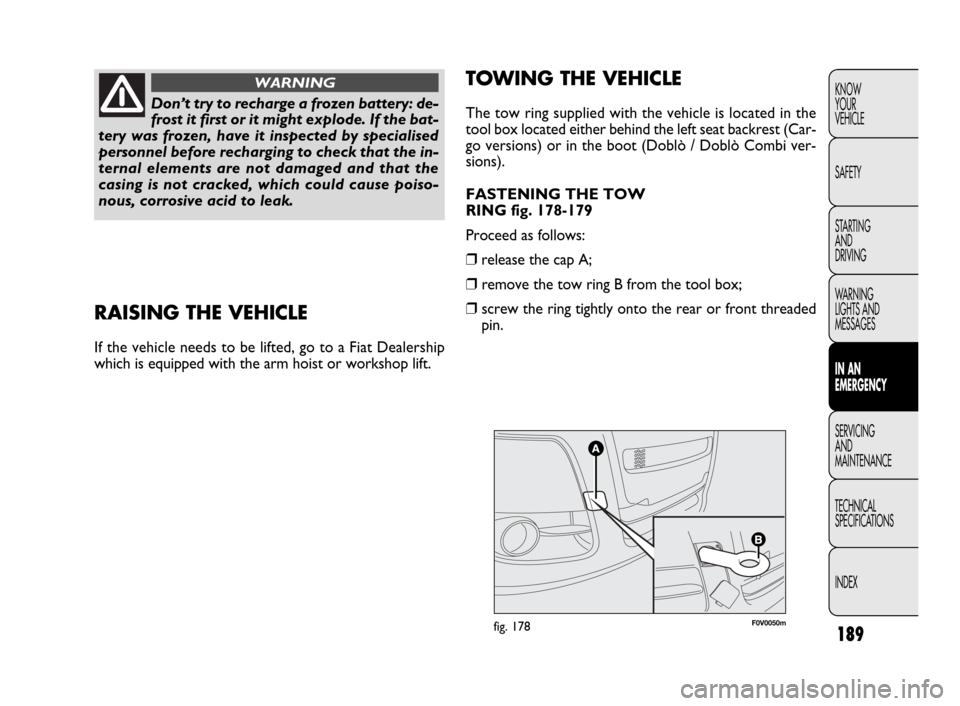
F0V0050mfig. 178
TOWING THE VEHICLE
The tow ring supplied with the vehicle is located in the
tool box located either behind the left seat backrest (Car-
go versions) or in the boot (Doblò / Doblò Combi ver-
sions).
FASTENING THE TOW
RING fig. 178-179
Proceed as follows:
❒release the cap A;
❒remove the tow ring B from the tool box;
❒screw the ring tightly onto the rear or front threaded
pin.
RAISING THE VEHICLE
If the vehicle needs to be lifted, go to a Fiat Dealership
which is equipped with the arm hoist or workshop lift.
Don’t try to recharge a frozen battery: de-
frost it first or it might explode. If the bat-
tery was frozen, have it inspected by specialised
personnel before recharging to check that the in-
ternal elements are not damaged and that the
casing is not cracked, which could cause poiso-
nous, corrosive acid to leak.
WARNING
Page 194 of 274
●●
●●●
●
●
●●●
●●●●●●
●●●●●●
●●●●●●
●●●●●●
●●●
●●●●●●
193
KNOW
YOUR
VEHICLE
SAFETY
STARTING
AND
DRIVING
WARNING
LIGHTS AND
MESSAGES
IN AN
EMERGENCY
SERVICING
AND
MAINTENANCE
TECHNICAL
SPECIFICATIONS
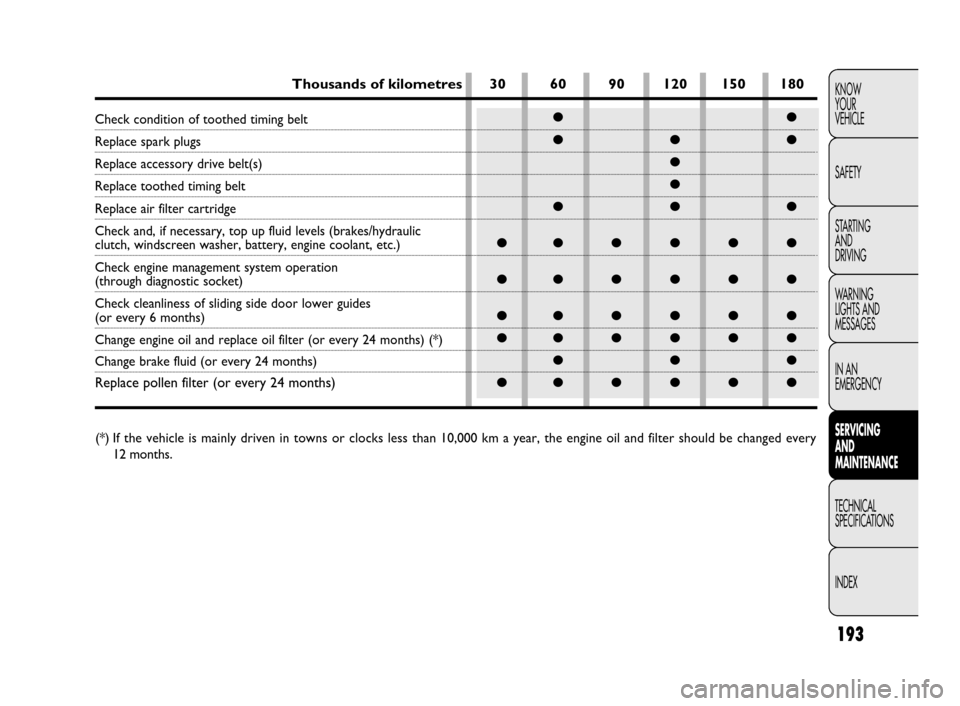
INDEXThousands of kilometres 30 60 90 120 150 180
Check condition of toothed timing belt
Replace spark plugs
Replace accessory drive belt(s)
Replace toothed timing belt
Replace air filter cartridge
Check and, if necessary, top up fluid levels (brakes/hydraulic
clutch, windscreen washer, battery, engine coolant, etc.)
Check engine management system operation
(through diagnostic socket)
Check cleanliness of sliding side door lower guides
(or every 6 months)
Change engine oil and replace oil filter (or every 24 months) (*)
Change brake fluid (or every 24 months)
Replace pollen filter (or every 24 months)
(*) If the vehicle is mainly driven in towns or clocks less than 10,000 km a year, the engine oil and filter should be changed every
12 months.
Page 195 of 274
●●●●●●
●●●●●●
●●●●●●
●●●●●●
●●●●●●
●●●
●●●●●●
●●●●●●
●●●●●●
●●
●●●●●●
●●
●●
●●●●●●
194
KNOW
YOUR
VEHICLE
SAFETY
STARTING
AND
DRIVING
WARNING
LIGHTS AND
MESSAGES
IN AN
EMERGENCY
SERVICING
AND
MAINTENANCE
TECHNICAL
SPECIFICATIONS
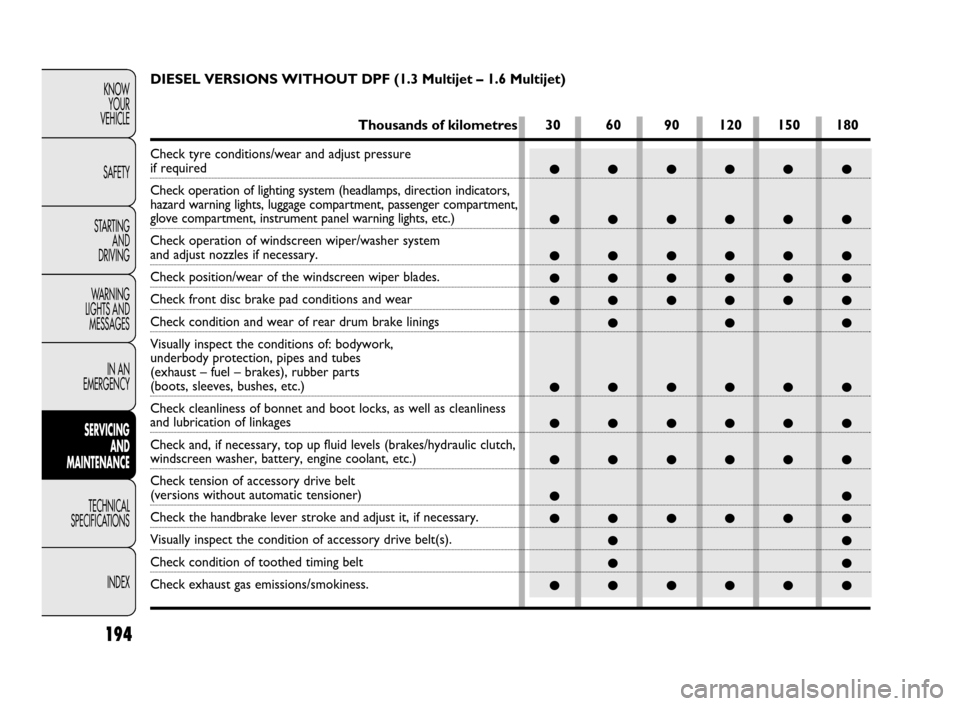
INDEXDIESEL VERSIONS WITHOUT DPF (1.3 Multijet – 1.6 Multijet)
Thousands of kilometres 30 60 90 120 150 180
Check tyre conditions/wear and adjust pressure if required
Check operation of lighting system (headlamps, direction indicators,
hazard warning lights, luggage compartment, passenger compartment,
glove compartment, instrument panel warning lights, etc.)
Check operation of windscreen wiper/washer system
and adjust nozzles if necessary.
Check position/wear of the windscreen wiper blades.
Check front disc brake pad conditions and wear
Check condition and wear of rear drum brake linings
Visually inspect the conditions of: bodywork,
underbody protection, pipes and tubes
(exhaust – fuel – brakes), rubber parts
(boots, sleeves, bushes, etc.)
Check cleanliness of bonnet and boot locks, as well as cleanliness
and lubrication of linkages
Check and, if necessary, top up fluid levels (brakes/hydraulic clutch,
windscreen washer, battery, engine coolant, etc.)
Check tension of accessory drive belt
(versions without automatic tensioner)
Check the handbrake lever stroke and adjust it, if necessary.
Visually inspect the condition of accessory drive belt(s).
Check condition of toothed timing belt
Check exhaust gas emissions/smokiness.
Page 197 of 274
196
KNOW
YOUR
VEHICLE
SAFETY
STARTING
AND
DRIVING
WARNING
LIGHTS AND
MESSAGES
IN AN
EMERGENCY
SERVICING
AND
MAINTENANCE
TECHNICAL
SPECIFICATIONS
INDEX
● ●●●●
● ●●●●
● ●●●●
● ●●●●
● ●●●●
●●
● ●●●●
● ●●●●
● ●●●●
●●
● ●●●●
●●
● ●●●●
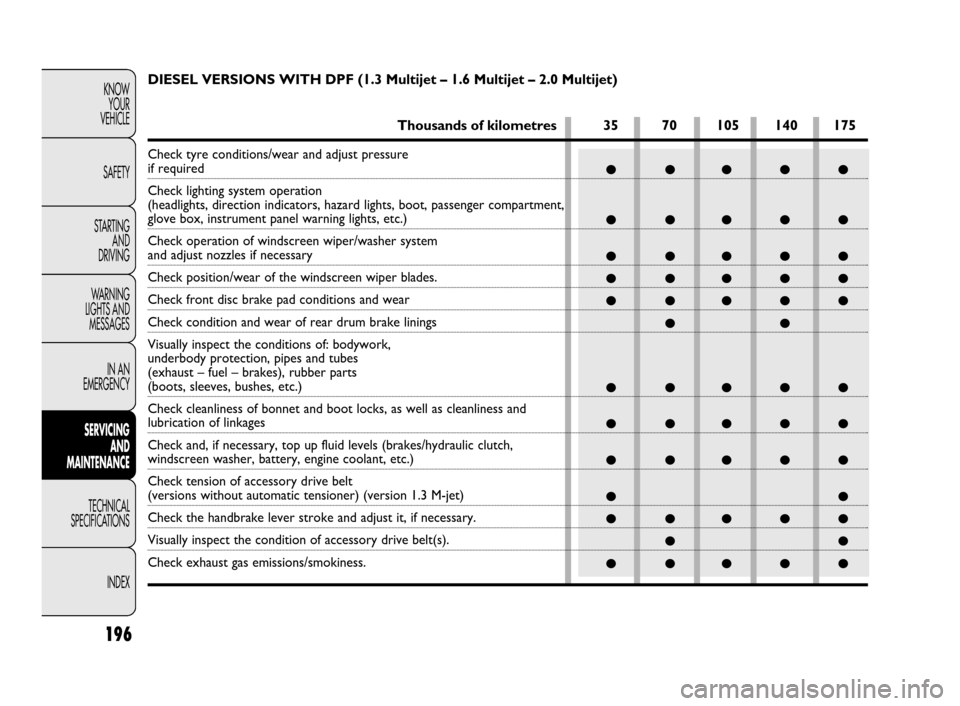
DIESEL VERSIONS WITH DPF (1.3 Multijet – 1.6 Multijet – 2.0 Multijet)
Thousands of kilometres 35 70 105 140 175
Check tyre conditions/wear and adjust pressure if required
Check lighting system operation
(headlights, direction indicators, hazard lights, boot, passenger compartment,
glove box, instrument panel warning lights, etc.)
Check operation of windscreen wiper/washer system
and adjust nozzles if necessary
Check position/wear of the windscreen wiper blades.
Check front disc brake pad conditions and wear
Check condition and wear of rear drum brake linings
Visually inspect the conditions of: bodywork,
underbody protection, pipes and tubes
(exhaust – fuel – brakes), rubber parts
(boots, sleeves, bushes, etc.)
Check cleanliness of bonnet and boot locks, as well as cleanliness and
lubrication of linkages
Check and, if necessary, top up fluid levels (brakes/hydraulic clutch,
windscreen washer, battery, engine coolant, etc.)
Check tension of accessory drive belt
(versions without automatic tensioner) (version 1.3 M-jet)
Check the handbrake lever stroke and adjust it, if necessary.
Visually inspect the condition of accessory drive belt(s).
Check exhaust gas emissions/smokiness.
Page 199 of 274
198
KNOW
YOUR
VEHICLE
SAFETY
STARTING
AND
DRIVING
WARNING
LIGHTS AND
MESSAGES
IN AN
EMERGENCY
SERVICING
AND
MAINTENANCE
TECHNICAL
SPECIFICATIONS
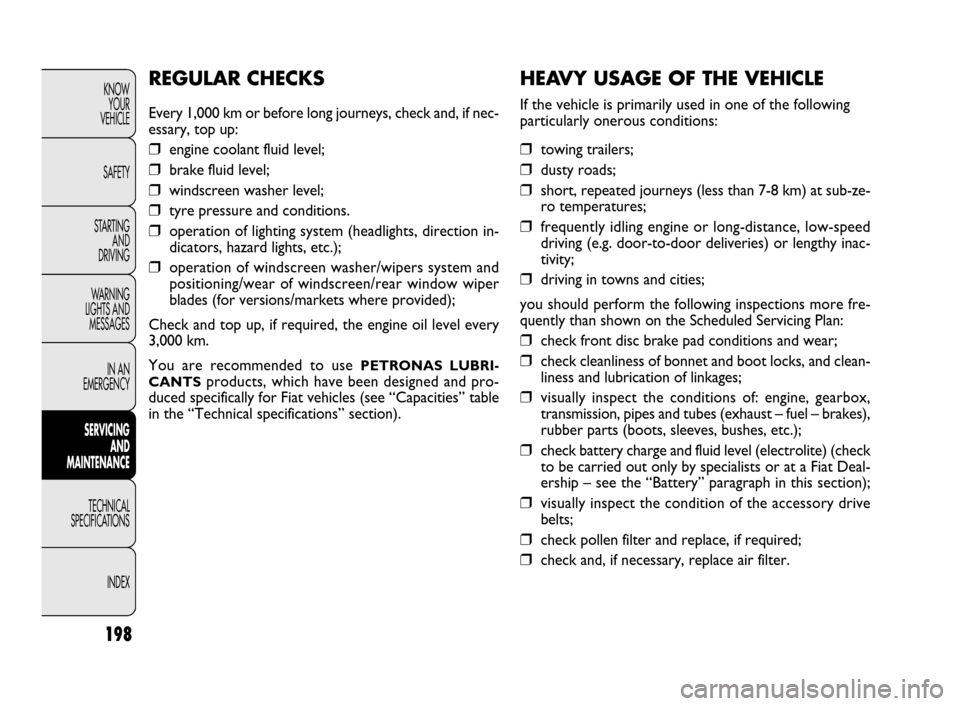
INDEXHEAVY USAGE OF THE VEHICLE
If the vehicle is primarily used in one of the following
particularly onerous conditions:
❒ towing trailers;
❒ dusty roads;
❒ short, repeated journeys (less than 7-8 km) at sub-ze-
ro temperatures;
❒ frequently idling engine or long-distance, low-speed
driving (e.g. door-to-door deliveries) or lengthy inac-
tivity;
❒ driving in towns and cities;
you should perform the following inspections more fre-
quently than shown on the Scheduled Servicing Plan:
❒ check front disc brake pad conditions and wear;
❒ check cleanliness of bonnet and boot locks, and clean-
liness and lubrication of linkages;
❒ visually inspect the conditions of: engine, gearbox,
transmission, pipes and tubes (exhaust – fuel – brakes),
rubber parts (boots, sleeves, bushes, etc.);
❒ check battery charge and fluid level (electrolite) (check
to be carried out only by specialists or at a Fiat Deal-
ership – see the “Battery” paragraph in this section);
❒ visually inspect the condition of the accessory drive
belts;
❒ check pollen filter and replace, if required;
❒ check and, if necessary, replace air filter.
REGULAR CHECKS
Every 1,000 km or before long journeys, check and, if nec-
essary, top up:
❒ engine coolant fluid level;
❒ brake fluid level;
❒ windscreen washer level;
❒ tyre pressure and conditions.
❒ operation of lighting system (headlights, direction in-
dicators, hazard lights, etc.);
❒ operation of windscreen washer/wipers system and
positioning/wear of windscreen/rear window wiper
blades (for versions/markets where provided);
Check and top up, if required, the engine oil level every
3,000 km.
You are recommended to use
PETRONAS LUBRI-
CANTS
products, which have been designed and pro-
duced specifically for Fiat vehicles (see “Capacities” table
in the “Technical specifications” section).
Page 200 of 274
199
KNOW
YOUR
VEHICLE
SAFETY
STARTING
AND
DRIVING
WARNING
LIGHTS AND
MESSAGES
IN AN
EMERGENCY
SERVICING
AND
MAINTENANCE
TECHNICAL
SPECIFICATIONS
INDEX
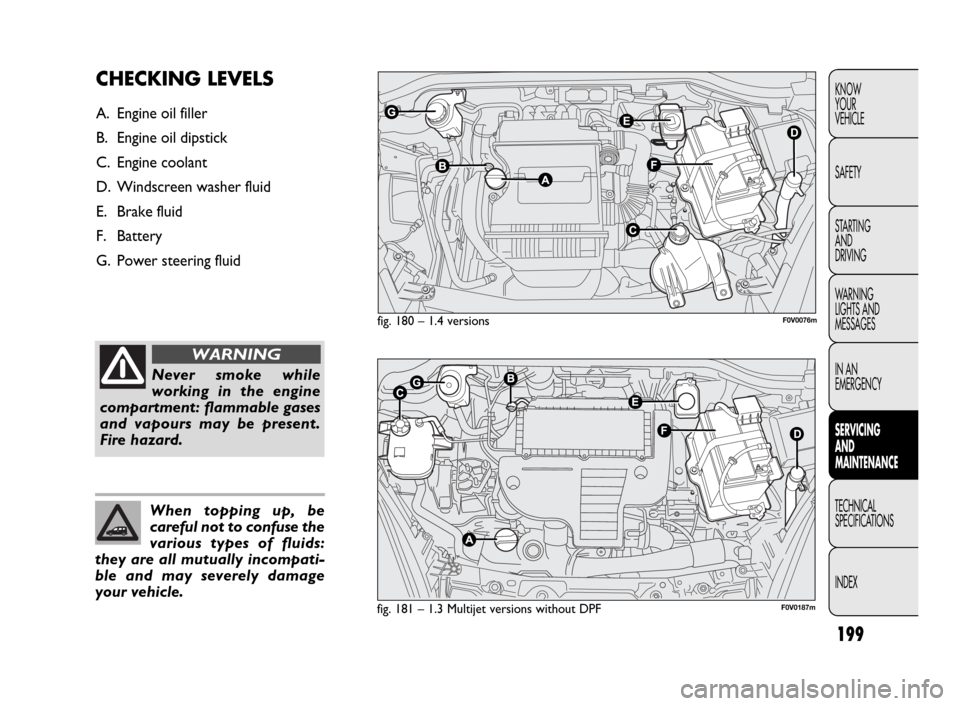
fig. 180 – 1.4 versions
fig. 181 – 1.3 Multijet versions without DPFF0V0076m
F0V0187m
CHECKING LEVELS
A. Engine oil filler
B. Engine oil dipstick
C. Engine coolant
D. Windscreen washer fluid
E. Brake fluid
F. Battery
G. Power steering fluid
Never smoke while
working in the engine
compartment: flammable gases
and vapours may be present.
Fire hazard.
WARNING
When topping up, be
careful not to confuse the
various types of fluids:
they are all mutually incompati-
ble and may severely damage
your vehicle.
Page 201 of 274
200
KNOW
YOUR
VEHICLE
SAFETY
STARTING
AND
DRIVING
WARNING
LIGHTS AND
MESSAGES
IN AN
EMERGENCY
SERVICING
AND
MAINTENANCE
TECHNICAL
SPECIFICATIONS
INDEX
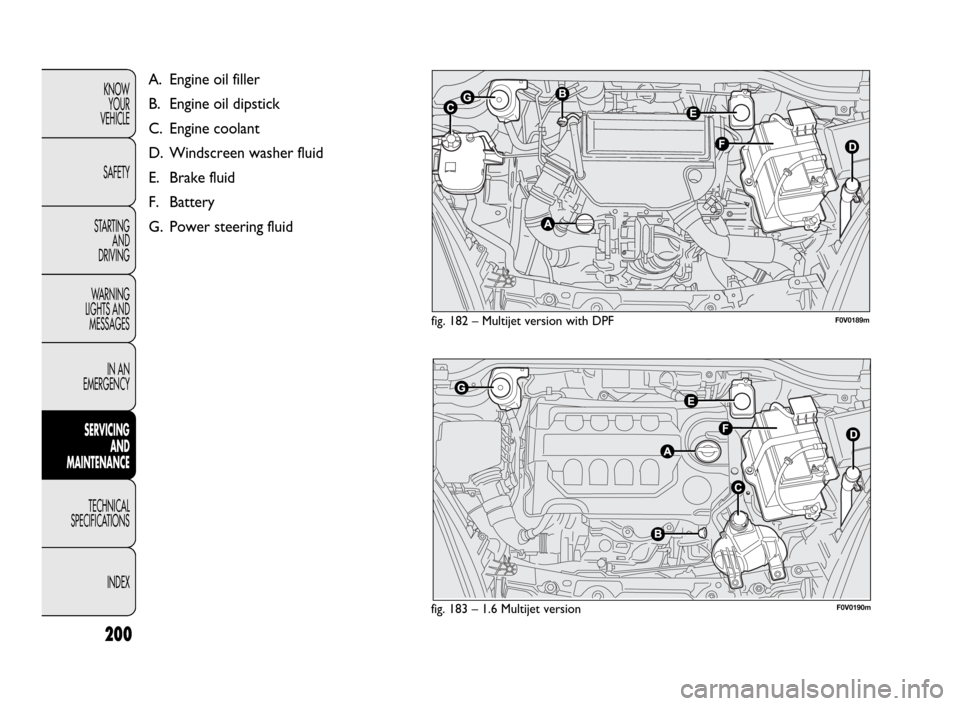
fig. 182 – Multijet version with DPF
fig. 183 – 1.6 Multijet versionF0V0189m
F0V0190m
A. Engine oil filler
B. Engine oil dipstick
C. Engine coolant
D. Windscreen washer fluid
E. Brake fluid
F. Battery
G. Power steering fluid
Page 202 of 274
201
KNOW
YOUR
VEHICLE
SAFETY
STARTING
AND
DRIVING
WARNING
LIGHTS AND
MESSAGES
IN AN
EMERGENCY
SERVICING
AND
MAINTENANCE
TECHNICAL
SPECIFICATIONS
INDEX
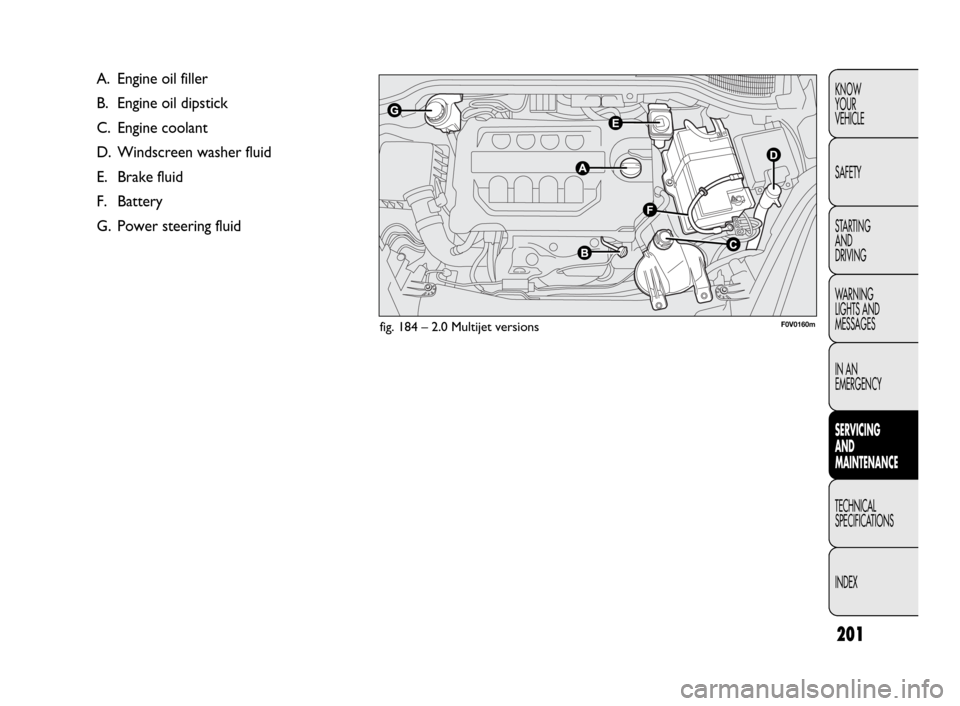
fig. 184 – 2.0 Multijet versions
A. Engine oil filler
B. Engine oil dipstick
C. Engine coolant
D. Windscreen washer fluid
E. Brake fluid
F. Battery
G. Power steering fluid
F0V0160m
Page 207 of 274
206
KNOW
YOUR
VEHICLE
SAFETY
STARTING
AND
DRIVING
WARNING
LIGHTS AND
MESSAGES
IN AN
EMERGENCY
SERVICING
AND
MAINTENANCE
TECHNICAL
SPECIFICATIONS
INDEX
The battery fluid is poisonous and corro-
sive. Avoid contact with the skin and eyes.
Keep naked flames or possible sources of sparks
away from the battery: risk of explosion or fire.
WARNING
Using the battery when the fluid is too low
can damage it irreparably and generate
a risk of explosion.
WARNING
AIR FILTER/POLLEN FILTER
Have the air filter or the pollen filter replaced by a Fiat
Dealership.
DIESEL FILTER
CONDENSATION DISCHARGE
(Multijet versions)
BATTERY
The battery is of the “limited maintenance” type: under
normal conditions of use, the electrolyte does not need
topping up with distilled water.
It does, however, need to be checked regularly at a Fiat
Dealership or by specialist personnel to make sure it is
working properly.
The presence of water in the supply circuit
may cause severe damage to the injection
system and irregular engine operation. If
the warning light comes on, go to a Fiat Dealer-
ship as soon as possible to have the system bled.
Water may have entered the tank if this appears
immediately after refuelling: if this happens, switch
the engine off immediately and contact a Fiat Deal-
ership.