wheel FIAT DOBLO 2009 2.G Owner's Guide
[x] Cancel search | Manufacturer: FIAT, Model Year: 2009, Model line: DOBLO, Model: FIAT DOBLO 2009 2.GPages: 274, PDF Size: 6.6 MB
Page 191 of 274
190
KNOW
YOUR
VEHICLE
SAFETY
STARTING
AND
DRIVING
WARNING
LIGHTS AND
MESSAGES
IN AN
EMERGENCY
SERVICING
AND
MAINTENANCE
TECHNICAL
SPECIFICATIONS
INDEX
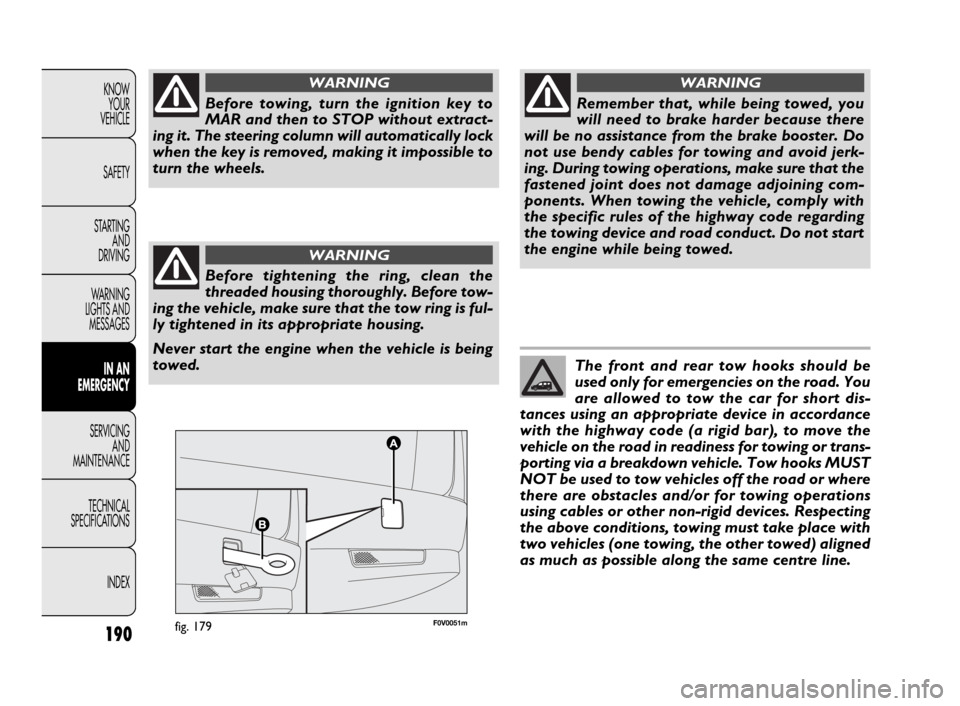
F0V0051mfig. 179
Before towing, turn the ignition key to
MAR and then to STOP without extract-
ing it. The steering column will automatically lock
when the key is removed, making it impossible to
turn the wheels.
WARNING
Before tightening the ring, clean the
threaded housing thoroughly. Before tow-
ing the vehicle, make sure that the tow ring is ful-
ly tightened in its appropriate housing.
Never start the engine when the vehicle is being
towed.
WARNING
Remember that, while being towed, you
will need to brake harder because there
will be no assistance from the brake booster. Do
not use bendy cables for towing and avoid jerk-
ing. During towing operations, make sure that the
fastened joint does not damage adjoining com-
ponents. When towing the vehicle, comply with
the specific rules of the highway code regarding
the towing device and road conduct. Do not start
the engine while being towed.
WARNING
The front and rear tow hooks should be
used only for emergencies on the road. You
are allowed to tow the car for short dis-
tances using an appropriate device in accordance
with the highway code (a rigid bar), to move the
vehicle on the road in readiness for towing or trans-
porting via a breakdown vehicle. Tow hooks MUST
NOT be used to tow vehicles off the road or where
there are obstacles and/or for towing operations
using cables or other non-rigid devices. Respecting
the above conditions, towing must take place with
two vehicles (one towing, the other towed) aligned
as much as possible along the same centre line.
Page 210 of 274
209
KNOW
YOUR
VEHICLE
SAFETY
STARTING
AND
DRIVING
WARNING
LIGHTS AND
MESSAGES
IN AN
EMERGENCY
SERVICING
AND
MAINTENANCE
TECHNICAL
SPECIFICATIONS
INDEXIMPORTANT NOTES
❒Where possible, avoid braking suddenly, wheel-spin-
ning and crashing into kerbs, potholes or other obsta-
cles. Long distances on uneven roads can damage the
tyres;
❒check the tyres regularly for cuts on the sides, swelling
or irregular tread wear. Go to a Fiat Dealership if re-
quired.
❒avoid overloading the car when travelling: this may cause
serious damage to the wheels and tyres;
❒if a tyre is punctured, stop the vehicle immediately and
change it to avoid damage to the tyre, the rim, and the
suspension and steering systems;
❒a tyre will age even if it is not used much. Cracks in
the tread and on the sidewalls are a sign of ageing. In
any event, have the tyres checked by specialised per-
sonnel if they have been fitted for longer than six years.
Remember to check the spare wheel very carefully;WHEELS AND TYRES
Check the pressure of each tyre, including the spare, every
two weeks and before long journeys. The pressure should
be checked with the tyre rested and cold.
It is normal for the pressure to increase when the vehi-
cle is used; for the correct tyre inflation pressure, see
“Wheels” in the “Technical specifications” section.
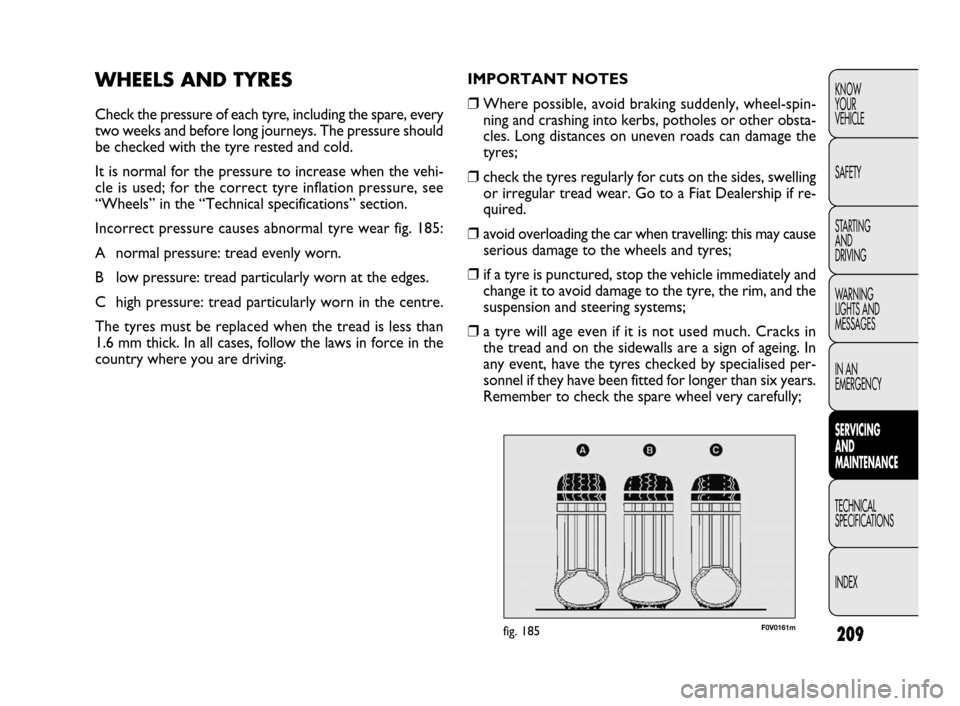
Incorrect pressure causes abnormal tyre wear fig. 185:
A normal pressure: tread evenly worn.
B low pressure: tread particularly worn at the edges.
C high pressure: tread particularly worn in the centre.
The tyres must be replaced when the tread is less than
1.6 mm thick. In all cases, follow the laws in force in the
country where you are driving.
F0V0161mfig. 185
Page 211 of 274
210
KNOW
YOUR
VEHICLE
SAFETY
STARTING
AND
DRIVING
WARNING
LIGHTS AND
MESSAGES
IN AN
EMERGENCY
SERVICING
AND
MAINTENANCE
TECHNICAL
SPECIFICATIONS
INDEX❒In case of replacement, always fit new tyres, avoiding
those with an unknown origin.
❒If a tyre is replaced, you should also change the infla-
tion valve.
❒to allow even wear between the front and rear tyres,
it is advisable to switch them every 10-15 thousand kilo-
metres, keeping them on the same side of the car so
as not to reverse the direction of rotation.
Remember that road hold depends on cor-
rect tyre pressures.
WARNING
If the pressure is too low, the tyre
overheats and this can cause it serious
damage.
WARNING
Do not switch the tyres from the right of
the vehicle to the left and vice versa.
WARNING
Do not re-spray alloy wheel rims at tem-
peratures higher than 150 °C. The me-
chanical characteristics of the wheels may be
compromised.
WARNING
Page 215 of 274

214
KNOW
YOUR
VEHICLE
SAFETY
STARTING
AND
DRIVING
WARNING
LIGHTS AND
MESSAGES
IN AN
EMERGENCY
SERVICING
AND
MAINTENANCE
TECHNICAL
SPECIFICATIONS
INDEXVEHICLE BODY
AND UNDERBODY WARRANTY
Your vehicle is covered by warranty against perforation
due to rust of any original element of the structure or
body.
For the general terms of this warranty, refer to your War-
ranty Booklet.
ADVICE FOR PRESERVING THE BODYWORK
Paint
Paintwork does not only serve an aesthetic purpose, but
also protects the underlying sheet metal.
Touch up abrasions and scratches immediately to pre-
vent the formation of rust. Use only original paint prod-
ucts for touch-ups (see “Bodywork paint identification
plate” in the “Technical specifications” section).
Standard upkeep of the paintwork consists of washing the
vehicle: the frequency depends on the conditions and en-
vironment where the vehicle is used.
For example, it is advisable to wash the vehicle more of-
ten in areas with high atmospheric pollution or if you are
travelling on roads sprinkled with salt.BODYWORK
PROTECTION FROM ATMOSPHERIC
AGENTS
The main causes of corrosion are the following:
❒atmospheric pollution;
❒salty air and humidity (coastal areas or hot and humid
climates);
❒seasonal environmental conditions.
The abrasive action of wind-borne atmospheric dust and
sand, as well as mud and gravel raised by other cars, is al-
so not to be underestimated.
Fiat used the best manufacturing technologies on your
vehicle to effectively protect the bodywork against cor-
rosion.
These are the most important:
❒painting products and systems which give the vehicle
particular resistance to corrosion and abrasion;
❒use of galvanised (or pre-treated) steel sheets with high
resistance to corrosion;
❒spraying the underbody, engine compartment, wheel-
house internal parts and other elements with highly pro-
tective wax-based products;
❒spraying protective plastic materials in the most ex-
posed areas: underdoor, inner mudguard parts, edges,
etc.;
❒using “open” boxed sections to prevent condensation
and pockets of moisture from triggering rust inside.
Page 217 of 274
216
KNOW
YOUR
VEHICLE
SAFETY
STARTING
AND
DRIVING
WARNING
LIGHTS AND
MESSAGES
IN AN
EMERGENCY
SERVICING
AND
MAINTENANCE
TECHNICAL
SPECIFICATIONS
INDEXINTERIORS
Check regularly that water is not trapped under the mats
(from dripping off shoes, umbrellas, etc.) which could cause
the metal to rust. Windows
Use specific detergents to clean the windows. Also use
clean cloths to avoid scratching the glass or altering the
transparency.
IMPORTANT Wipe the rear window gently with a cloth
in the direction of the filaments to avoid damaging the
heating device.
Engine compartment
At the end of each winter, thoroughly wash the engine
compartment, taking care to avoid spraying the water jet
directly onto the electronic control units and the relay/fuse
control unit on the left side of the engine compartment
(as you look from behind the wheel). Have this operation
performed at a specialist garage.
IMPORTANT The washing should take place with the en-
gine cold and the ignition key in the STOP position. After
the wash, make sure that the various protective devices
(e.g. rubber caps and guards) have not been removed or
damaged.
Front headlights
IMPORTANT Never use aromatic substances (e.g. petrol)
or ketenes (e.g. acetone) for cleaning the plastic lenses of
the front headlights.
Never use flammable products, such as pe-
troleum ether or modified petrol, to clean
the inside of the vehicle. The electrostatic charges
which are generated by rubbing during cleaning
may cause a fire.
WARNING
Do not keep aerosol cans in the vehicle:
these could explode. Aerosol cans must
not be exposed to temperatures of more than
50 °C. When the vehicle is exposed to sunlight,
the temperature inside can greatly exceed this
value.
WARNING
Page 218 of 274

217
KNOW
YOUR
VEHICLE
SAFETY
STARTING
AND
DRIVING
WARNING
LIGHTS AND
MESSAGES
IN AN
EMERGENCY
SERVICING
AND
MAINTENANCE
TECHNICAL
SPECIFICATIONS
INDEXLEATHER UPHOLSTERED STEERING
WHEEL/GEAR KNOB/HANDBRAKE LEVER
(for versions/market, where provided)
These components must be cleaned with mild soap and
water only. Never use spirits or alcohol-based products.
Read the product label carefully before using specific prod-
ucts for cleaning the interiors: make sure the product does
not contain spirits or alcohol-based substances.
If, when cleaning the windscreen with special products,
window cleaner accidentally drips onto the leather of the
steering wheel/gear lever knob/hand brake, wipe away im-
mediately and then wash the affected area with mild soap
and water.
IMPORTANT Be careful when installing a steering wheel
locking device not to damage the leather upholstery. SEATS AND FABRIC PARTS
Remove dust with a soft brush or a vacuum cleaner. It is
advisable to use a damp brush on velvet upholstery.
Rub the seats with a sponge and a solution of water and
mild soap.
PLASTIC PARTS
It is advisable to clean interior plastic parts with a damp
cloth and a solution of water and non-abrasive mild soap.
To remove grease and tough stains, use products designed
specifically for cleaning plastics. These have no solvents
and have been designed so that they do not alter the ap-
pearance and colour of the components.
IMPORTANT Never use spirits or petroleum to clean
the instrument panel glass.
Page 226 of 274
225
KNOW
YOUR
VEHICLE
SAFETY
STARTING
AND
DRIVING
WARNING
LIGHTS AND
MESSAGES
IN AN
EMERGENCY
SERVICING
AND
MAINTENANCE
TECHNICAL
SPECIFICATIONS
INDEX
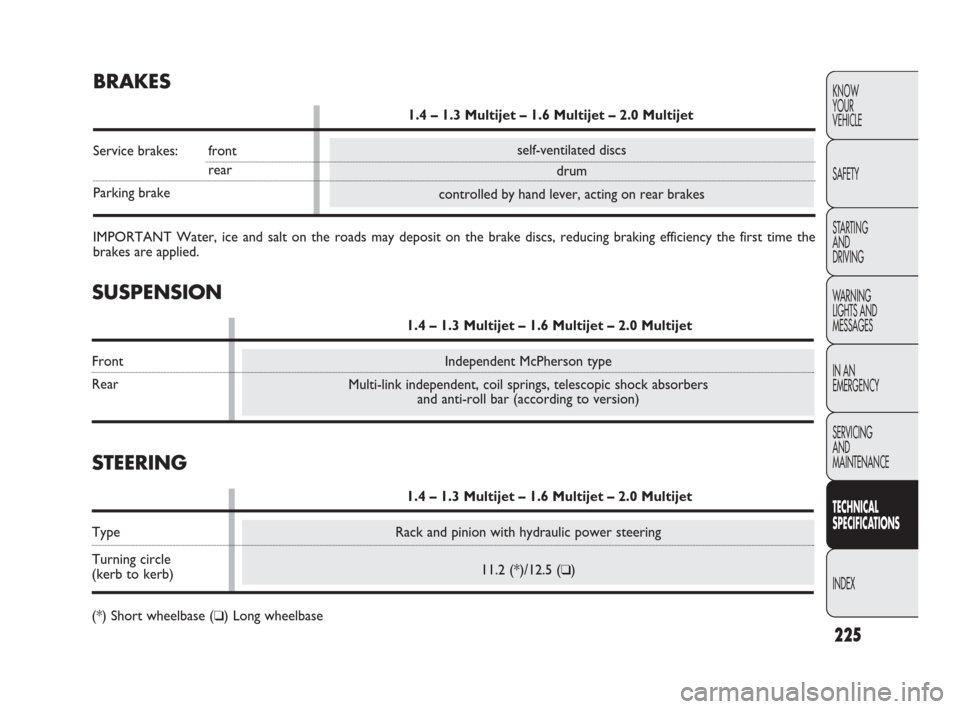
Rack and pinion with hydraulic power steering
11.2 (*)/12.5 (
❑)
self-ventilated discs
drum
controlled by hand lever, acting on rear brakes
Independent McPherson type
Multi-link independent, coil springs, telescopic shock absorbers
and anti-roll bar (according to version)
BRAKES
1.4 – 1.3 Multijet – 1.6 Multijet – 2.0 Multijet
Service brakes: front
rear
Parking brake
IMPORTANT Water, ice and salt on the roads may deposit on the brake discs, reducing braking efficiency the first time the
brakes are applied.
SUSPENSION
1.4 – 1.3 Multijet – 1.6 Multijet – 2.0 Multijet
Front
Rear
STEERING
1.4 – 1.3 Multijet – 1.6 Multijet – 2.0 Multijet
Type
Turning circle
(kerb to kerb)
(*) Short wheelbase (
❑) Long wheelbase
Page 227 of 274
226
KNOW
YOUR
VEHICLE
SAFETY
STARTING
AND
DRIVING
WARNING
LIGHTS AND
MESSAGES
IN AN
EMERGENCY
SERVICING
AND
MAINTENANCE
TECHNICAL
SPECIFICATIONS
INDEX
WHEELS
RIMS AND TYRES
Pressed steel or alloy wheels. Tubeless radial carcass tyres.
All approved tyres are listed in the Log Book.
IMPORTANT In the event of discrepancies between the in-
formation provided in this Owner Handbook and the Log
Book, the latter takes precedence.
To ensure driving safety, ensure that tyres of the same
make and type are fitted on all wheels.
IMPORTANT Do not use inner tubes with tubeless tyres.
F0V0162mfig. 193
SPARE WHEEL
Pressed steel wheel.
Tubeless tyre, same as standard tyre.
WHEEL GEOMETRY
Total front toe in: – 1 ± 1 mm
The values refer to the vehicle in running order.
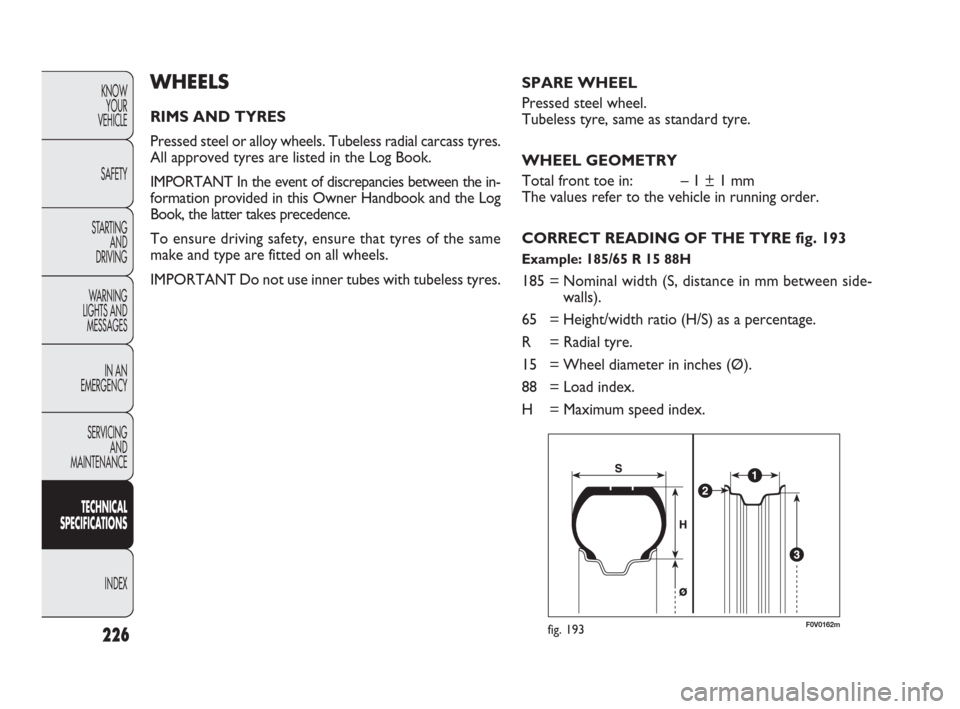
CORRECT READING OF THE TYRE fig. 193
Example: 185/65 R 15 88H
185 = Nominal width (S, distance in mm between side-
walls).
65 = Height/width ratio (H/S) as a percentage.
R = Radial tyre.
15 = Wheel diameter in inches (Ø).
88 = Load index.
H = Maximum speed index.
Page 229 of 274
228
KNOW
YOUR
VEHICLE
SAFETY
STARTING
AND
DRIVING
WARNING
LIGHTS AND
MESSAGES
IN AN
EMERGENCY
SERVICING
AND
MAINTENANCE
TECHNICAL
SPECIFICATIONS
INDEX
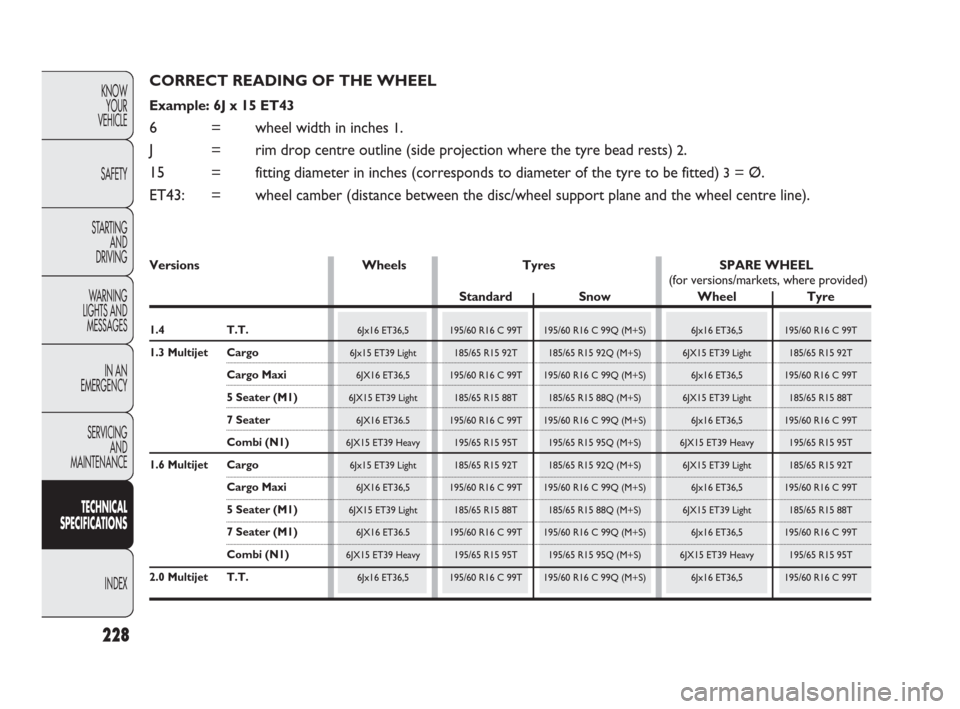
CORRECT READING OF THE WHEEL
Example: 6J x 15 ET43
6 = wheel width in inches 1.
J = rim drop centre outline (side projection where the tyre bead rests)
2.
15 = fitting diameter in inches (corresponds to diameter of the tyre to be fitted)
3= Ø.
ET43: = wheel camber (distance between the disc/wheel support plane and the wheel centre line).
Versions Wheels Tyres SPARE WHEEL
(for versions/markets, where provided)
Standard Snow Wheel Tyre
1.4 T.T.6Jx16 ET36,5 195/60 R16 C 99T 195/60 R16 C 99Q (M+S) 6Jx16 ET36,5 195/60 R16 C 99T
1.3 Multijet Cargo6Jx15 ET39 Light 185/65 R15 92T 185/65 R15 92Q (M+S) 6JX15 ET39 Light 185/65 R15 92T
Cargo Maxi6JX16 ET36,5 195/60 R16 C 99T 195/60 R16 C 99Q (M+S) 6Jx16 ET36,5 195/60 R16 C 99T
5 Seater (M1)6JX15 ET39 Light 185/65 R15 88T 185/65 R15 88Q (M+S) 6JX15 ET39 Light 185/65 R15 88T
7 Seater6JX16 ET36.5 195/60 R16 C 99T 195/60 R16 C 99Q (M+S) 6Jx16 ET36,5 195/60 R16 C 99T
Combi (N1)6JX15 ET39 Heavy 195/65 R15 95T 195/65 R15 95Q (M+S) 6JX15 ET39 Heavy 195/65 R15 95T
1.6 Multijet Cargo6Jx15 ET39 Light 185/65 R15 92T 185/65 R15 92Q (M+S) 6JX15 ET39 Light 185/65 R15 92T
Cargo Maxi6JX16 ET36,5 195/60 R16 C 99T 195/60 R16 C 99Q (M+S) 6Jx16 ET36,5 195/60 R16 C 99T
5 Seater (M1)6JX15 ET39 Light 185/65 R15 88T 185/65 R15 88Q (M+S) 6JX15 ET39 Light 185/65 R15 88T
7 Seater (M1)6JX16 ET36.5 195/60 R16 C 99T 195/60 R16 C 99Q (M+S) 6Jx16 ET36,5 195/60 R16 C 99T
Combi (N1)6JX15 ET39 Heavy 195/65 R15 95T 195/65 R15 95Q (M+S) 6JX15 ET39 Heavy 195/65 R15 95T
2.0 Multijet T.T.6Jx16 ET36,5 195/60 R16 C 99T 195/60 R16 C 99Q (M+S) 6Jx16 ET36,5 195/60 R16 C 99T
Page 230 of 274
229
KNOW
YOUR
VEHICLE
SAFETY
STARTING
AND
DRIVING
WARNING
LIGHTS AND
MESSAGES
IN AN
EMERGENCY
SERVICING
AND
MAINTENANCE
TECHNICAL
SPECIFICATIONS
INDEX
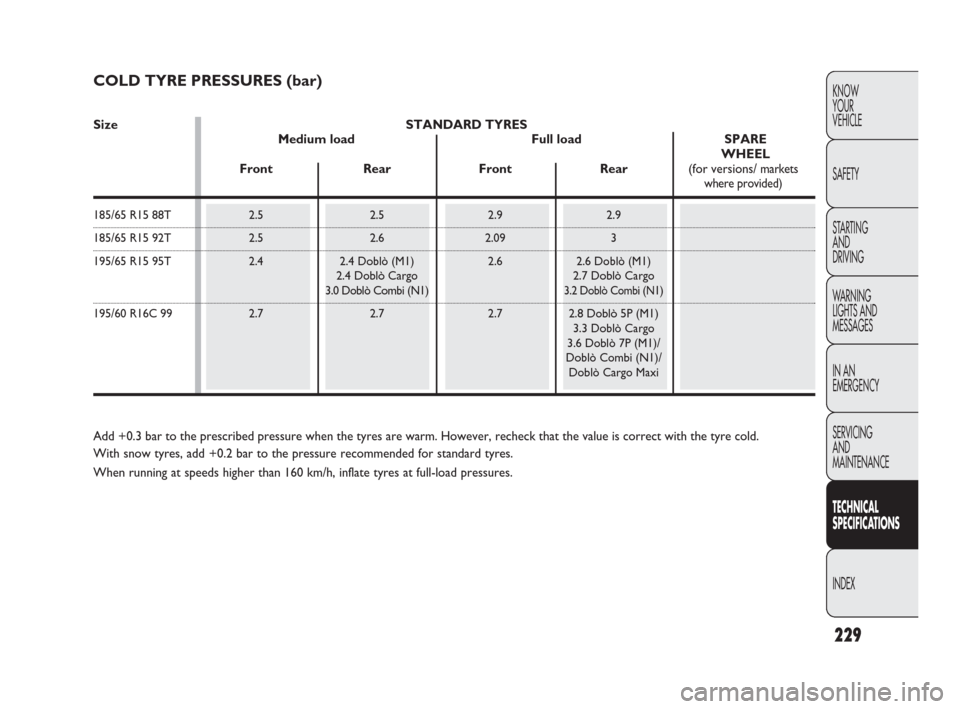
COLD TYRE PRESSURES (bar)
Add +0.3 bar to the prescribed pressure when the tyres are warm. However, recheck that the value is correct with the tyre cold.
With snow tyres, add +0.2 bar to the pressure recommended for standard tyres.
When running at speeds higher than 160 km/h, inflate tyres at full-load pressures.
Size STANDARD TYRES
Medium load Full load SPARE
WHEEL
Front Rear Front Rear(for versions/
marketswhere provided)
185/65 R15 88T 2.5 2.5 2.9 2.9
185/65 R15 92T 2.5 2.6 2.09 3
195/65 R15 95T 2.4 2.4 Doblò (M1) 2.6 2.6 Doblò (M1)
2.4 Doblò Cargo 2.7 Doblò Cargo
3.0 Doblò Combi (N1)3.2 Doblò Combi (N1)
195/60 R16C 99 2.7 2.7 2.7 2.8 Doblò 5P (M1)
3.3 Doblò Cargo
3.6 Doblò 7P (M1)/
Doblò Combi (N1)/
Doblò Cargo Maxi