spare wheel FIAT DOBLO 2009 2.G Owners Manual
[x] Cancel search | Manufacturer: FIAT, Model Year: 2009, Model line: DOBLO, Model: FIAT DOBLO 2009 2.GPages: 274, PDF Size: 6.6 MB
Page 157 of 274
156
KNOW
YOUR
VEHICLE
SAFETY
STARTING
AND
DRIVING
WARNING
LIGHTS AND
MESSAGES
IN AN
EMERGENCY
SERVICING
AND
MAINTENANCE
TECHNICAL
SPECIFICATIONS
INDEXStrictly avoid using a rapid battery charg-
er for jump starting: this could damage the
system electronics and the ignition and en-
gine supply control units.
This procedure must be performed by ex-
perts because incorrect actions may cause
considerable electrical discharge. Furthermore,
battery fluid is poisonous and corrosive: avoid con-
tact with skin and eyes. Keep naked flames and
lit cigarettes away from the battery. Do not cre-
ate sparks.
WARNING
BUMP STARTING
Never bump start the engine by pushing, towing or dri-
ving downhill. This could cause fuel to flow into the cat-
alytic converter and damage it beyond repair.
IMPORTANT Remember that the brake booster and the
power steering system are not active until the engine is
started, so you will need to apply much more force to
the brake pedal or steering wheel.
CHANGING A TYRE
The vehicle is originally equipped with the Fix&Go quick
tyre repair kit (see instructions in the next section). As
an alternative, the vehicle may have a normal-sized spare
wheel.
Wheel changing and correct use of the jack and spare
wheel call for some precautions, as listed below.
Page 158 of 274
157
KNOW
YOUR
VEHICLE
SAFETY
STARTING
AND
DRIVING
WARNING
LIGHTS AND
MESSAGES
IN AN
EMERGENCY
SERVICING
AND
MAINTENANCE
TECHNICAL
SPECIFICATIONS
INDEXThe spare wheel (where provided) is
specifically for your vehicle. Therefore, it
must not be used on other models. Do not use
spare wheels of other models on your vehicle. The
spare wheel should be used only in an emergency.
Use it as little as possible.
WARNING
Use your hazard lights, warning triangle,
etc to show that your car is stationary.
Passengers should get out of the car, particularly
if it is heavily loaded, and wait for the wheel to
be changed away from the traffic. If you are on
a steep slope or uneven surface, place wedges or
other suitable objects under the wheels to secure
the vehicle. Repair and refit the standard wheel
as soon as possible. Do not grease the bolt threads
before you fit them, because they could sudden-
ly come loose.
WARNING
Use the jack only to replace wheels on the
vehicle with which it is supplied or on oth-
er vehicles of the same model. Never use the jack
for other purposes, such as lifting other models.
Never use the jack to carry out repairs under the
vehicle. Incorrect positioning of the jack may
cause the lifted vehicle to fall. Do not use the jack
for loads higher than the one shown on its label.
WARNING
Incorrect hub cap assembly may cause it
to come off when the car is moving. Nev-
er tamper with the inflation valve. Never intro-
duce tools of any kind between the rim and the
tyre. Check tyre and spare wheel pressures regu-
larly, referring to the values shown in the “Tech-
nical specifications” section.
WARNING
Page 162 of 274
161
KNOW
YOUR
VEHICLE
SAFETY
STARTING
AND
DRIVING
WARNING
LIGHTS AND
MESSAGES
IN AN
EMERGENCY
SERVICING
AND
MAINTENANCE
TECHNICAL
SPECIFICATIONS
INDEX
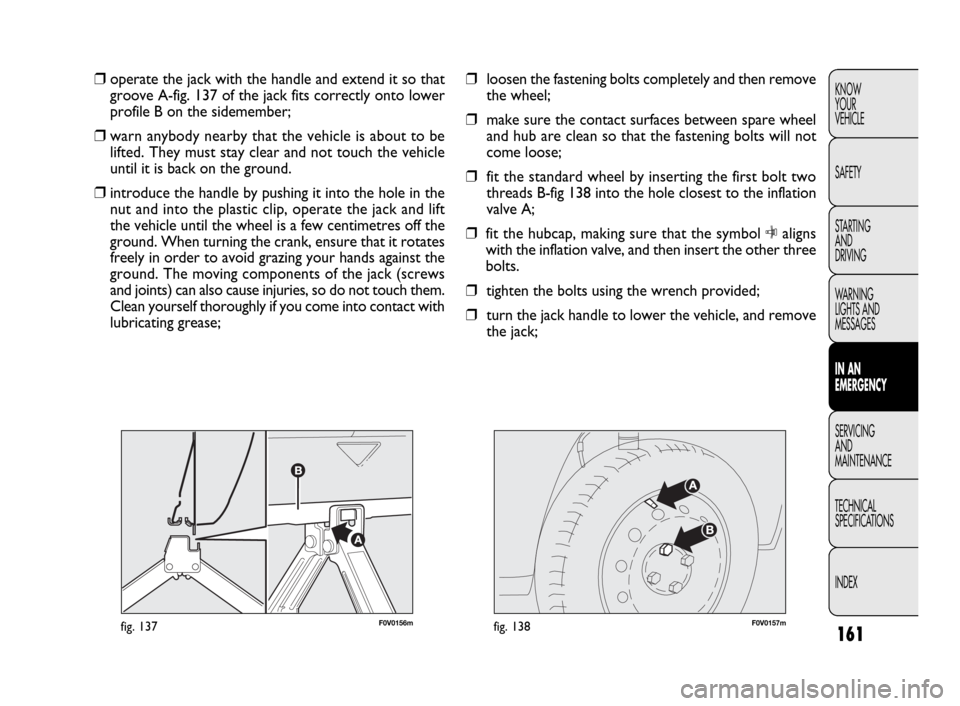
F0V0156mfig. 137F0V0157mfig. 138
❒loosen the fastening bolts completely and then remove
the wheel;
❒make sure the contact surfaces between spare wheel
and hub are clean so that the fastening bolts will not
come loose;
❒fit the standard wheel by inserting the first bolt two
threads B-fig 138 into the hole closest to the inflation
valve A;
❒fit the hubcap, making sure that the symbol Caligns
with the inflation valve, and then insert the other three
bolts.
❒tighten the bolts using the wrench provided;
❒turn the jack handle to lower the vehicle, and remove
the jack; ❒operate the jack with the handle and extend it so that
groove A-fig. 137 of the jack fits correctly onto lower
profile B on the sidemember;
❒warn anybody nearby that the vehicle is about to be
lifted. They must stay clear and not touch the vehicle
until it is back on the ground.
❒introduce the handle by pushing it into the hole in the
nut and into the plastic clip, operate the jack and lift
the vehicle until the wheel is a few centimetres off the
ground. When turning the crank, ensure that it rotates
freely in order to avoid grazing your hands against the
ground. The moving components of the jack (screws
and joints) can also cause injuries, so do not touch them.
Clean yourself thoroughly if you come into contact with
lubricating grease;
Page 210 of 274
209
KNOW
YOUR
VEHICLE
SAFETY
STARTING
AND
DRIVING
WARNING
LIGHTS AND
MESSAGES
IN AN
EMERGENCY
SERVICING
AND
MAINTENANCE
TECHNICAL
SPECIFICATIONS
INDEXIMPORTANT NOTES
❒Where possible, avoid braking suddenly, wheel-spin-
ning and crashing into kerbs, potholes or other obsta-
cles. Long distances on uneven roads can damage the
tyres;
❒check the tyres regularly for cuts on the sides, swelling
or irregular tread wear. Go to a Fiat Dealership if re-
quired.
❒avoid overloading the car when travelling: this may cause
serious damage to the wheels and tyres;
❒if a tyre is punctured, stop the vehicle immediately and
change it to avoid damage to the tyre, the rim, and the
suspension and steering systems;
❒a tyre will age even if it is not used much. Cracks in
the tread and on the sidewalls are a sign of ageing. In
any event, have the tyres checked by specialised per-
sonnel if they have been fitted for longer than six years.
Remember to check the spare wheel very carefully;WHEELS AND TYRES
Check the pressure of each tyre, including the spare, every
two weeks and before long journeys. The pressure should
be checked with the tyre rested and cold.
It is normal for the pressure to increase when the vehi-
cle is used; for the correct tyre inflation pressure, see
“Wheels” in the “Technical specifications” section.
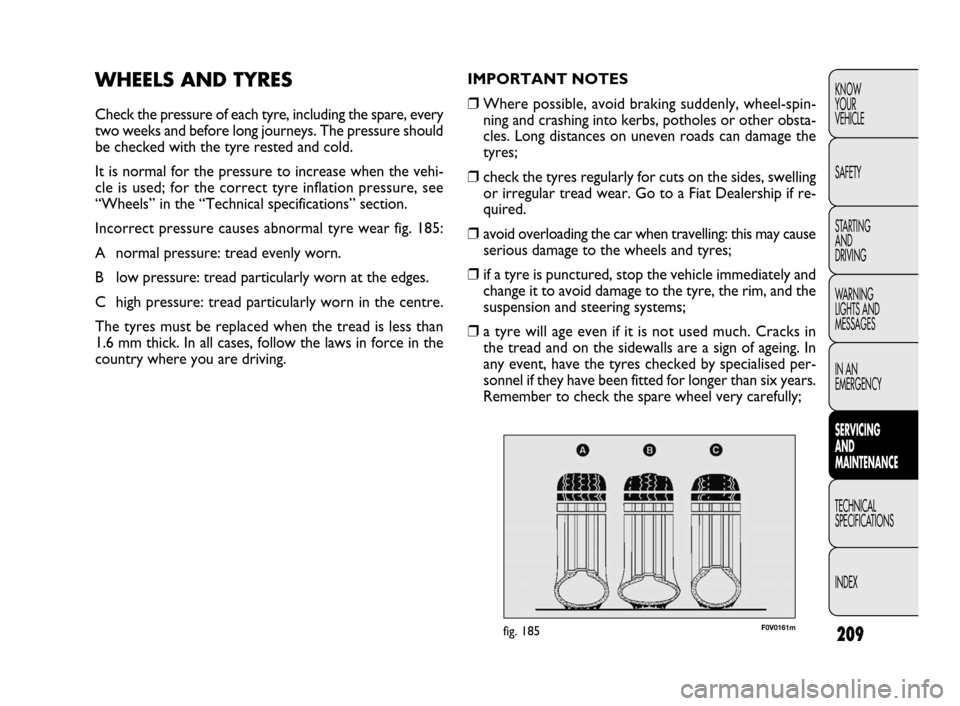
Incorrect pressure causes abnormal tyre wear fig. 185:
A normal pressure: tread evenly worn.
B low pressure: tread particularly worn at the edges.
C high pressure: tread particularly worn in the centre.
The tyres must be replaced when the tread is less than
1.6 mm thick. In all cases, follow the laws in force in the
country where you are driving.
F0V0161mfig. 185
Page 217 of 274
216
KNOW
YOUR
VEHICLE
SAFETY
STARTING
AND
DRIVING
WARNING
LIGHTS AND
MESSAGES
IN AN
EMERGENCY
SERVICING
AND
MAINTENANCE
TECHNICAL
SPECIFICATIONS
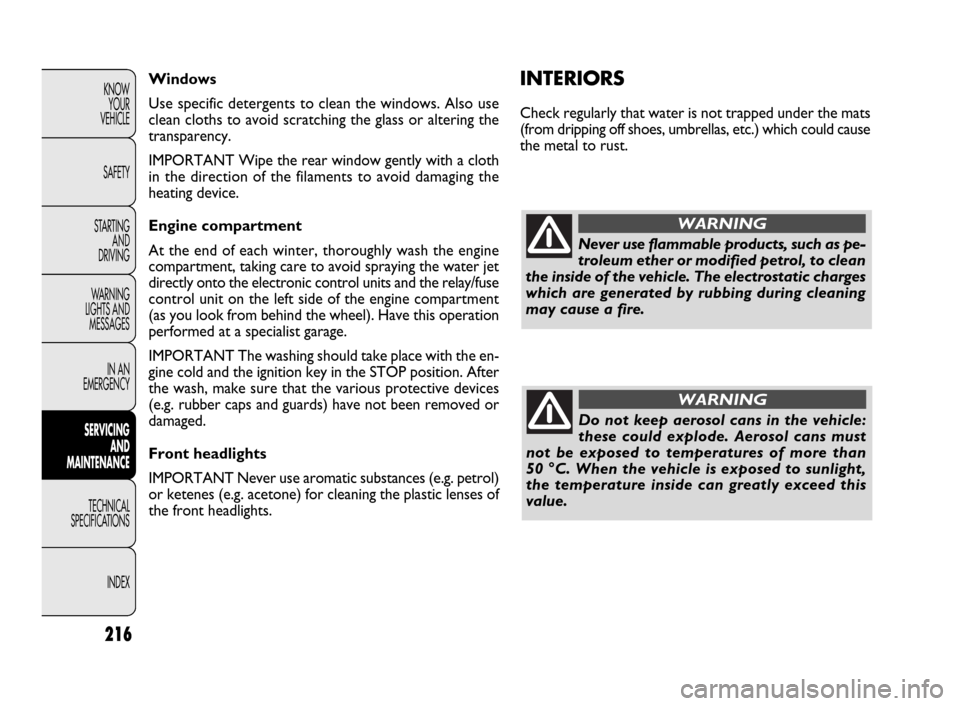
INDEXINTERIORS
Check regularly that water is not trapped under the mats
(from dripping off shoes, umbrellas, etc.) which could cause
the metal to rust. Windows
Use specific detergents to clean the windows. Also use
clean cloths to avoid scratching the glass or altering the
transparency.
IMPORTANT Wipe the rear window gently with a cloth
in the direction of the filaments to avoid damaging the
heating device.
Engine compartment
At the end of each winter, thoroughly wash the engine
compartment, taking care to avoid spraying the water jet
directly onto the electronic control units and the relay/fuse
control unit on the left side of the engine compartment
(as you look from behind the wheel). Have this operation
performed at a specialist garage.
IMPORTANT The washing should take place with the en-
gine cold and the ignition key in the STOP position. After
the wash, make sure that the various protective devices
(e.g. rubber caps and guards) have not been removed or
damaged.
Front headlights
IMPORTANT Never use aromatic substances (e.g. petrol)
or ketenes (e.g. acetone) for cleaning the plastic lenses of
the front headlights.
Never use flammable products, such as pe-
troleum ether or modified petrol, to clean
the inside of the vehicle. The electrostatic charges
which are generated by rubbing during cleaning
may cause a fire.
WARNING
Do not keep aerosol cans in the vehicle:
these could explode. Aerosol cans must
not be exposed to temperatures of more than
50 °C. When the vehicle is exposed to sunlight,
the temperature inside can greatly exceed this
value.
WARNING
Page 227 of 274
226
KNOW
YOUR
VEHICLE
SAFETY
STARTING
AND
DRIVING
WARNING
LIGHTS AND
MESSAGES
IN AN
EMERGENCY
SERVICING
AND
MAINTENANCE
TECHNICAL
SPECIFICATIONS
INDEX
WHEELS
RIMS AND TYRES
Pressed steel or alloy wheels. Tubeless radial carcass tyres.
All approved tyres are listed in the Log Book.
IMPORTANT In the event of discrepancies between the in-
formation provided in this Owner Handbook and the Log
Book, the latter takes precedence.
To ensure driving safety, ensure that tyres of the same
make and type are fitted on all wheels.
IMPORTANT Do not use inner tubes with tubeless tyres.
F0V0162mfig. 193
SPARE WHEEL
Pressed steel wheel.
Tubeless tyre, same as standard tyre.
WHEEL GEOMETRY
Total front toe in: – 1 ± 1 mm
The values refer to the vehicle in running order.
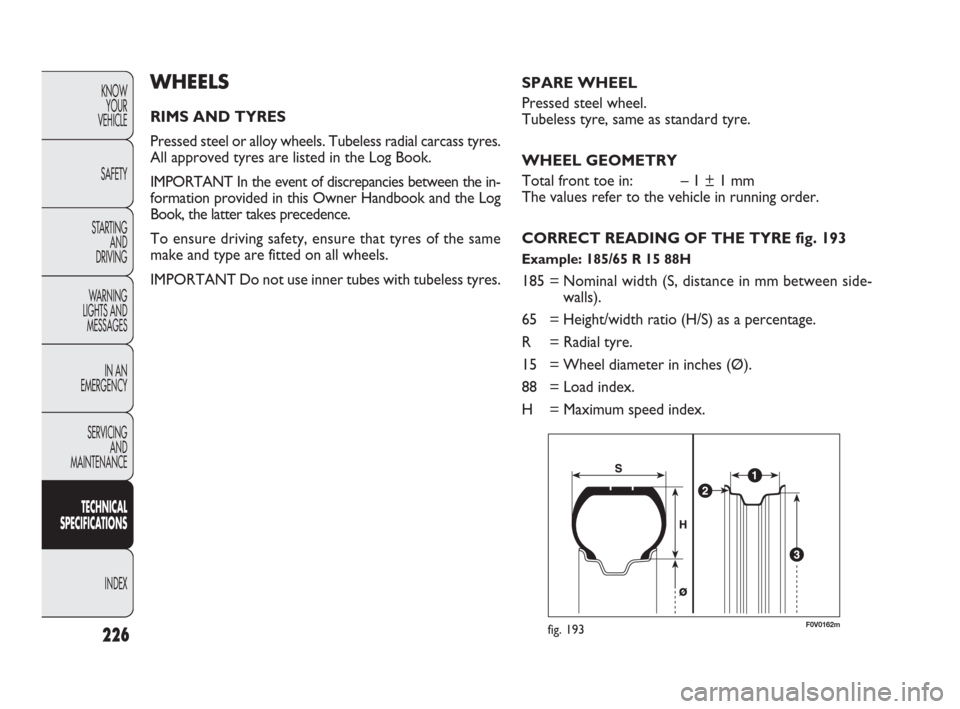
CORRECT READING OF THE TYRE fig. 193
Example: 185/65 R 15 88H
185 = Nominal width (S, distance in mm between side-
walls).
65 = Height/width ratio (H/S) as a percentage.
R = Radial tyre.
15 = Wheel diameter in inches (Ø).
88 = Load index.
H = Maximum speed index.
Page 229 of 274
228
KNOW
YOUR
VEHICLE
SAFETY
STARTING
AND
DRIVING
WARNING
LIGHTS AND
MESSAGES
IN AN
EMERGENCY
SERVICING
AND
MAINTENANCE
TECHNICAL
SPECIFICATIONS
INDEX
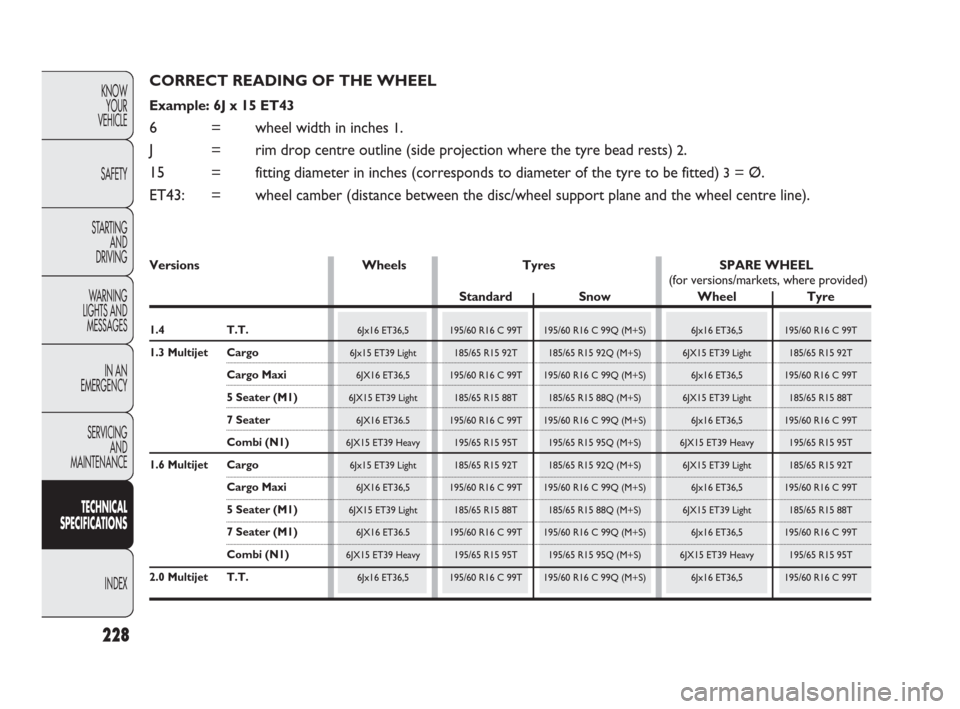
CORRECT READING OF THE WHEEL
Example: 6J x 15 ET43
6 = wheel width in inches 1.
J = rim drop centre outline (side projection where the tyre bead rests)
2.
15 = fitting diameter in inches (corresponds to diameter of the tyre to be fitted)
3= Ø.
ET43: = wheel camber (distance between the disc/wheel support plane and the wheel centre line).
Versions Wheels Tyres SPARE WHEEL
(for versions/markets, where provided)
Standard Snow Wheel Tyre
1.4 T.T.6Jx16 ET36,5 195/60 R16 C 99T 195/60 R16 C 99Q (M+S) 6Jx16 ET36,5 195/60 R16 C 99T
1.3 Multijet Cargo6Jx15 ET39 Light 185/65 R15 92T 185/65 R15 92Q (M+S) 6JX15 ET39 Light 185/65 R15 92T
Cargo Maxi6JX16 ET36,5 195/60 R16 C 99T 195/60 R16 C 99Q (M+S) 6Jx16 ET36,5 195/60 R16 C 99T
5 Seater (M1)6JX15 ET39 Light 185/65 R15 88T 185/65 R15 88Q (M+S) 6JX15 ET39 Light 185/65 R15 88T
7 Seater6JX16 ET36.5 195/60 R16 C 99T 195/60 R16 C 99Q (M+S) 6Jx16 ET36,5 195/60 R16 C 99T
Combi (N1)6JX15 ET39 Heavy 195/65 R15 95T 195/65 R15 95Q (M+S) 6JX15 ET39 Heavy 195/65 R15 95T
1.6 Multijet Cargo6Jx15 ET39 Light 185/65 R15 92T 185/65 R15 92Q (M+S) 6JX15 ET39 Light 185/65 R15 92T
Cargo Maxi6JX16 ET36,5 195/60 R16 C 99T 195/60 R16 C 99Q (M+S) 6Jx16 ET36,5 195/60 R16 C 99T
5 Seater (M1)6JX15 ET39 Light 185/65 R15 88T 185/65 R15 88Q (M+S) 6JX15 ET39 Light 185/65 R15 88T
7 Seater (M1)6JX16 ET36.5 195/60 R16 C 99T 195/60 R16 C 99Q (M+S) 6Jx16 ET36,5 195/60 R16 C 99T
Combi (N1)6JX15 ET39 Heavy 195/65 R15 95T 195/65 R15 95Q (M+S) 6JX15 ET39 Heavy 195/65 R15 95T
2.0 Multijet T.T.6Jx16 ET36,5 195/60 R16 C 99T 195/60 R16 C 99Q (M+S) 6Jx16 ET36,5 195/60 R16 C 99T
Page 230 of 274
229
KNOW
YOUR
VEHICLE
SAFETY
STARTING
AND
DRIVING
WARNING
LIGHTS AND
MESSAGES
IN AN
EMERGENCY
SERVICING
AND
MAINTENANCE
TECHNICAL
SPECIFICATIONS
INDEX
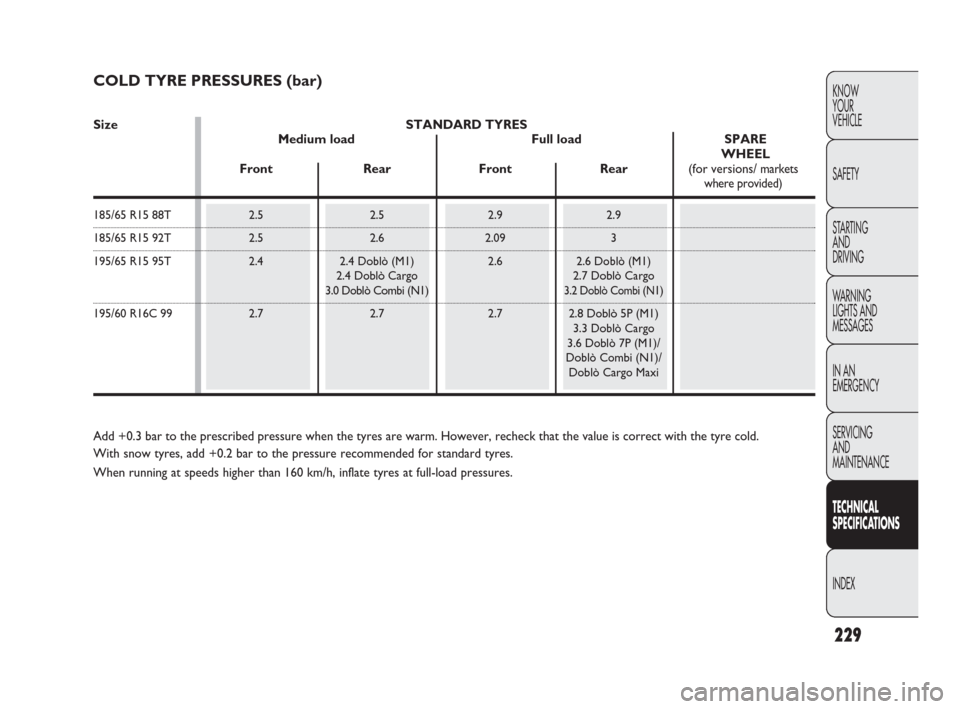
COLD TYRE PRESSURES (bar)
Add +0.3 bar to the prescribed pressure when the tyres are warm. However, recheck that the value is correct with the tyre cold.
With snow tyres, add +0.2 bar to the pressure recommended for standard tyres.
When running at speeds higher than 160 km/h, inflate tyres at full-load pressures.
Size STANDARD TYRES
Medium load Full load SPARE
WHEEL
Front Rear Front Rear(for versions/
marketswhere provided)
185/65 R15 88T 2.5 2.5 2.9 2.9
185/65 R15 92T 2.5 2.6 2.09 3
195/65 R15 95T 2.4 2.4 Doblò (M1) 2.6 2.6 Doblò (M1)
2.4 Doblò Cargo 2.7 Doblò Cargo
3.0 Doblò Combi (N1)3.2 Doblò Combi (N1)
195/60 R16C 99 2.7 2.7 2.7 2.8 Doblò 5P (M1)
3.3 Doblò Cargo
3.6 Doblò 7P (M1)/
Doblò Combi (N1)/
Doblò Cargo Maxi
Page 270 of 274
269
KNOW
YOUR
VEHICLE
SAFETY
STARTING
AND
DRIVING
WARNING
LIGHTS AND
MESSAGES
IN AN
EMERGENCY
SERVICING
AND
MAINTENANCE
TECHNICAL
SPECIFICATIONS
INDEX
– general information ...... 118
– load limiters .................... 118
– maintenance ................... 120
– pretensioners ................. 117
– SBR ................................... 117
– using the seat belts ....... 115
Safety ..................................... 115
Satellite navigation
socket .................................... 75
Saving fuel ............................. 137
SBR system .......................... 117
Scheduled Servicing
Plan .....................192-194-196
Scrappage ............................. 255
Seat belt pretensioners ...... 117
– load limiters .................... 118
Seat heating ......................30-32
Servicing and
maintenance ...................... 191
– checking fluid levels
...........................199-200-201– heavy use of
the vehicle ....................... 198
– precautions
and warnings .................. 191
– regular checks ................ 198
– scheduled servicing plan
....192-193-194-195-196-197
Setting the clock ................... 22
Side airbags (side bag
– window bag).....130-131-132
– general information ...... 131
Sliding side doors ................... 78
Smart washing
(windscreen wipers) .......... 61
Snow chains ......................... 141
Sockets ..............................72-73
Sound system
(wiring) .......................109-110
Spare wheel ......................... 228
– technical
specifications .................. 228Spark plugs (type) ............... 223
Speed block ......................... 102
Speedometer.......................... 12
Start&Stop system............... 105
Starting the engine ............. 133
– emergency
starting.......................134-155
– ignition switch .................... 9
– ignition switch .................... 9
– procedure for
diesel versions................. 134
– procedure for petrol
versions ........................... 133
– stopping the engine ........ 135
– warming up
the engine ....................... 134
Starting up and driving ....... 133
Steering lock and ignition
switch ...................................... 9
Steering lock ............................ 9