air condition FIAT DOBLO PANORAMA 2015 2.G User Guide
[x] Cancel search | Manufacturer: FIAT, Model Year: 2015, Model line: DOBLO PANORAMA, Model: FIAT DOBLO PANORAMA 2015 2.GPages: 323, PDF Size: 47.13 MB
Page 75 of 323
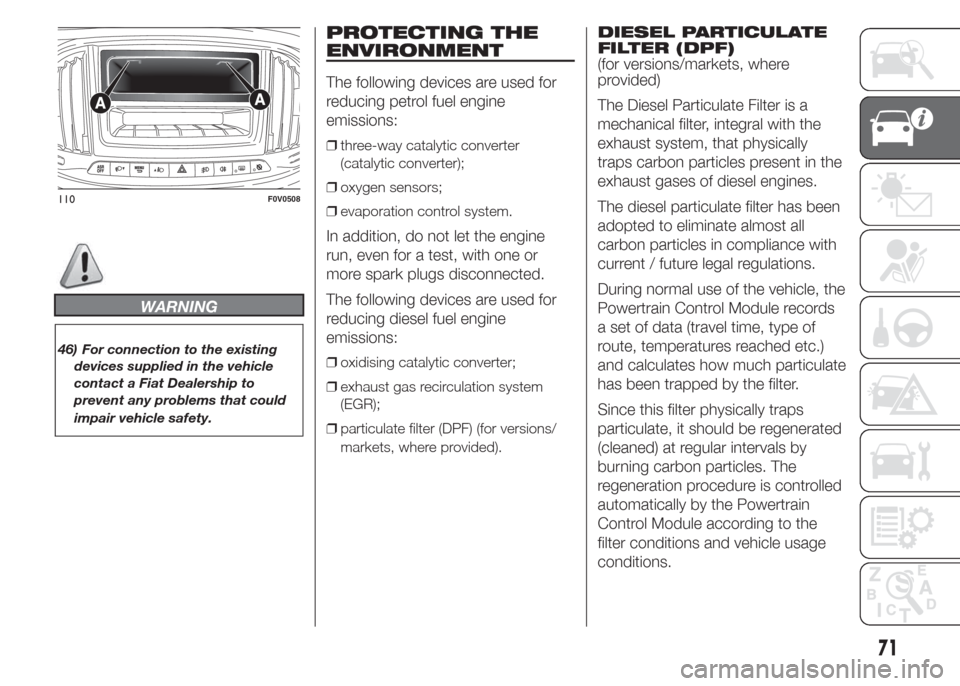
WARNING
46) For connection to the existing
devices supplied in the vehicle
contact a Fiat Dealership to
prevent any problems that could
impair vehicle safety.
PROTECTING THE
ENVIRONMENT
The following devices are used for
reducing petrol fuel engine
emissions:
❒three-way catalytic converter
(catalytic converter);
❒oxygen sensors;
❒evaporation control system.
In addition, do not let the engine
run, even for a test, with one or
more spark plugs disconnected.
The following devices are used for
reducing diesel fuel engine
emissions:
❒oxidising catalytic converter;
❒exhaust gas recirculation system
(EGR);
❒particulate filter (DPF) (for versions/
markets, where provided).
DIESEL PARTICULATE
FILTER (DPF)
(for versions/markets, where
provided)
The Diesel Particulate Filter is a
mechanical filter, integral with the
exhaust system, that physically
traps carbon particles present in the
exhaust gases of diesel engines.
The diesel particulate filter has been
adopted to eliminate almost all
carbon particles in compliance with
current / future legal regulations.
During normal use of the vehicle, the
Powertrain Control Module records
a set of data (travel time, type of
route, temperatures reached etc.)
and calculates how much particulate
has been trapped by the filter.
Since this filter physically traps
particulate, it should be regenerated
(cleaned) at regular intervals by
burning carbon particles. The
regeneration procedure is controlled
automatically by the Powertrain
Control Module according to the
filter conditions and vehicle usage
conditions.
110F0V0508
71
Page 150 of 323
NOTE The vehicle may be equipped
with FiX&Go Automatic tyre repair
kit, space-saver wheel or full size
spare wheel (with or without original
TPMS sensor to measure tyre
pressure).
After the punctured tyre has been
repaired with the original tyre sealant
contained in the FiX&Go Automatic
tyre repair kit, the previous condition
must be restored, so that the
warning light is off during normal
driving.
Space-saver wheel (for versions/
markets, where provided): the
space-saver wheel is not equipped
with a TPMS sensor. Once fitted,
while driving normally, the warning
light comes on (flashing for about 75
seconds, and then constantly).
This condition lasts until a wheel
equipped with an original TPMS
sensor is fitted on the vehicle.Normal spare wheel (without TPMS
sensor): once fitted, while driving
normally, the
warning light comes
on (flashing for about 75 seconds,
and then constantly). This condition
lasts until a wheel equipped with
an original TPMS sensor is fitted on
the vehicle. The system is then
restored and the
warning light
switches off.
Normal spare wheel (with TPMS
sensor): once fitted, while driving
normally, the
warning light
switches off.
IMPORTANT In all the above-
mentioned cases, it is advisable to
check the spare wheel tyre pressure
before starting driving.
NOTE If the tyres are replaced,
driving the vehicle for short
stretches, some time might be
needed before the system is
restored.IMPORTANT
WARNING
86) The TPMS is optimised for the
original tyres and wheels
provided. TPMS pressures and
alerts have been defined
according to the size of the tyres
mounted on the vehicle. Using
equipment with different size,
type or kind may cause irregular
system operation or sensor
damage. Non-original spare
wheels can damage the sensor.
Do not use tyre sealant or
balancing weights if the vehicle is
equipped with TPMS as these
may damage the sensors.
87) If the system signals a pressure
decrease on a specific tyre, it is
recommended to check the
pressure on all four tyres.
88) TPMS does not relieve the driver
from the obligation to check the
tyre pressure every month; it is
not to be considered a replacing
system for maintenance or a
safety system.
146
STARTING AND DRIVING
Page 158 of 323
IMPORTANT
22) For diesel engines, use only
diesel fuel for motor vehicles
in accordance with EN590
European specifications. The use
of other products or mixtures
may damage the engine beyond
repair and consequently invalidate
the warranty, due to the damage
caused. If you accidentally refuel
with another type of fuel, do not
start the engine, and drain the
tank. If the engine has run, even
for a very short time, you will need
to have the entire fuel supply
system emptied in addition to the
tank.
23) Do not bring naked flames or lit
cigarettes near the fuel tank filler:
fire risk. Keep your face away
from the fuel filler to prevent
breathing in harmful vapours.
SAVING FUEL
Some useful tips are given below for
fuel saving and reducing harmful
emissions of CO2 and other
pollutants (nitrogen oxides, unburnt
hydrocarbons, Particulate Matter
(PM), etc.).
PRACTICAL ADVICE
FOR REDUCING FUEL
CONSUMPTION AND
HARMFUL EMISSIONS
Vehicle conditions
❒Have checks and adjustments for
vehicle maintenancecarried out
in accordance with the “Scheduled
servicing plan”.
❒Checktyrepressure regularly, at
least once every four weeks.
Excessively low pressures will
increase consumption because
rolling resistance will be higher. In
addition, this wears the tyre more
quickly and impairs performance.
❒Only usesnow tyreswhen
the weather conditions make them
absolutely necessary. They increase
consumption and noise.❒Do not travel witha heavy load: the
weight of the vehicle (especially when
driving in town) and its geometry
greatly affect fuel consumption and
stability.
❒Removeroof racks or ski racks
after use. These accessories reduce
the vehicle's aerodynamic
penetration and have a negative
effect on fuel consumption.
❒When transporting particularly large
objects, use atrailerif possible.
❒Use the vehicle's air vents if possible:
travelling with the windows open
impairs aerodynamics.
❒Use electrical devices only for the
amount of time needed. The vehicle’s
heated rear window, additional
headlights, screen wipers and heater
fan require a considerable amount
of energy; this increases fuel
consumption (by up to +25% in an
urban cycle).
❒Air conditioning leads to higher fuel
consumption (on average up to
+30%). If the temperature outside is
not too extreme, try and use the
air vents.
154
STARTING AND DRIVING
Page 179 of 323
CHANGING A WHEEL
The vehicle is originally equipped
with the Fix&Go automatic quick
tyre repair kit (see instructions in the
next section). As an alternative,
the vehicle may have a normal-sized
spare wheel.
Wheel changing and correct use of
the jack and spare wheel call for
some precautions, as listed below.
108) 109) 110) 111)
Note for one-way
tyres
One-way tyres have a few arrows on
the side indicating the rotation
direction. If a wheel is changed
(when punctured, for example) the
direction of the arrows on the spare
wheel tyre may not coincide with
the rotation direction of the wheel to
be replaced.
In these conditions, too, the tyre still
maintains its safety features.Anyway, it is recommended to have
the wheel repaired and refitted as
soon as possible, as the best
performance is achieved when the
rotation direction of all tyres
coincides with the one indicated by
the arrows.
Please note that:
❒the jack weight is 4 kg;
❒the jack requires no adjustment;
❒the jack cannot be repaired and in
the event of a fault it must be
replaced by another original one;
❒no tool other than its cranking device
may be fitted on the jack.
To change a wheel, proceed as
follows:
❒stop the vehicle in a position that is
not dangerous for oncoming traffic
where you can change the wheel
safely. The ground should be flat
if possible, and sufficiently firm;
❒stop the engine and pull the
handbrake;
❒engage first gear or reverse;
❒wear the reflective safety jacket
(compulsory by law in certain
countries) before getting out of the
vehicle;❒indicate that the vehicle has broken
down using the devices required by
the law in the current country (e.g.
warning triangle, hazard lights, etc.);
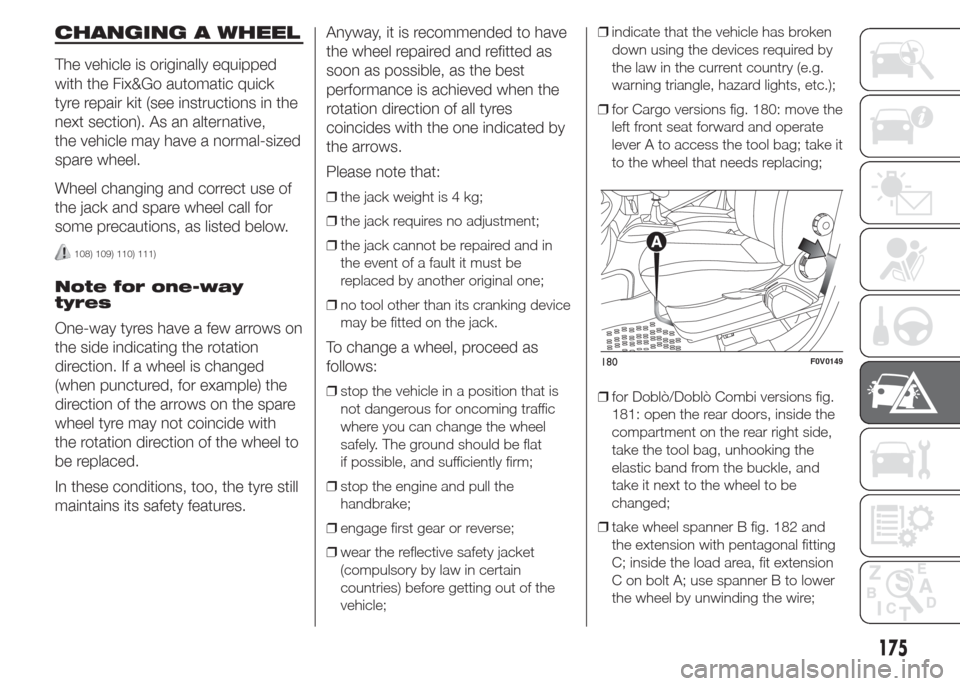
❒for Cargo versions fig. 180: move the
left front seat forward and operate
lever A to access the tool bag; take it
to the wheel that needs replacing;
❒for Doblò/Doblò Combi versions fig.
181: open the rear doors, inside the
compartment on the rear right side,
take the tool bag, unhooking the
elastic band from the buckle, and
take it next to the wheel to be
changed;
❒take wheel spanner B fig. 182 and
the extension with pentagonal fitting
C; inside the load area, fit extension
C on bolt A; use spanner B to lower
the wheel by unwinding the wire;
180F0V0149
175
Page 194 of 323
SCHEDULED
SERVICING
Correct servicing is essential for
ensuring long vehicle life under the
best conditions.
This is why Fiat has planned a series
of checks and services every
30,000/35,000 km (depending on
the version).
It is, however, important to
remember that scheduled servicing
does not completely cover all the
vehicle's requirements: even in the
initial period before 30,000/35,000
km, and then subsequently between
one service and another, ordinary
care is always required such as
routine checks involving topping up
fluid levels, checking tyre pressures
etc...
IMPORTANT Scheduled Servicing
Coupons are required by the
manufacturer. Failure to have them
carried out may invalidate the
warranty.
Scheduled Servicing can be carried
out by any Fiat Dealership, at
pre-established times.If during each operation, in addition
to the ones scheduled, the need
arises for further replacements
or repairs, these may only be carried
out with the express agreement of
the Customer.
IMPORTANT It is advisable to
contact a Fiat Dealership in the
event of any minor operating failure,
without waiting for the next service
coupon.
If your vehicle is used frequently for
trailer towing, the interval between
scheduled maintenance services
must be reduced.
190
SERVICING AND MAINTENANCE
Page 196 of 323
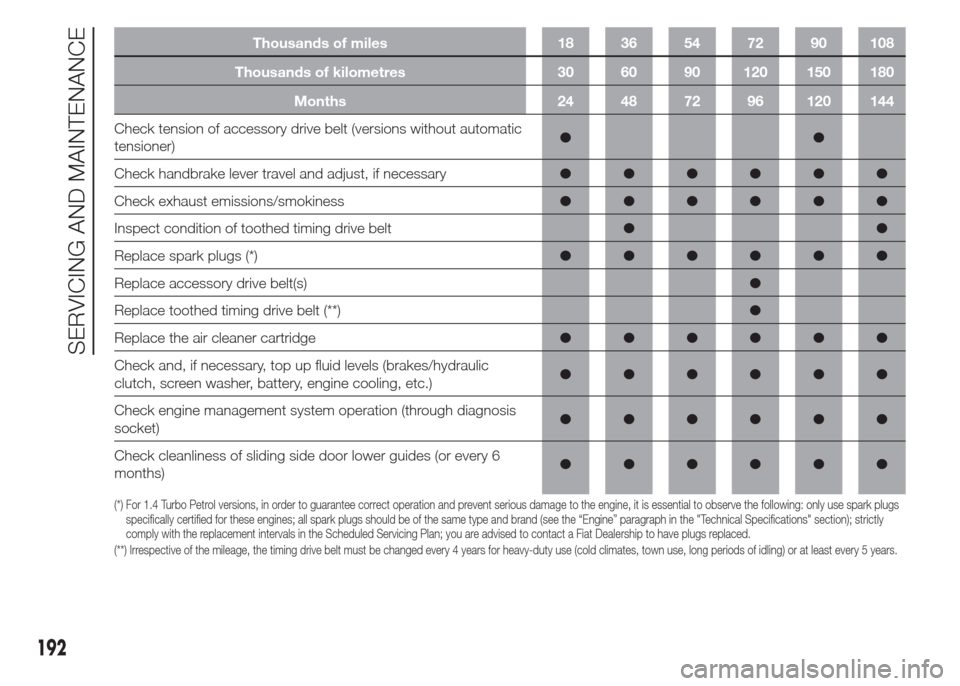
Thousands of miles 18 36 54 72 90 108
Thousands of kilometres 30 60 90 120 150 180
Months 24 48 72 96 120 144
Check tension of accessory drive belt (versions without automatic
tensioner)●●
Check handbrake lever travel and adjust, if necessary●●●●●●
Check exhaust emissions/smokiness●●●●●●
Inspect condition of toothed timing drive belt●●
Replace spark plugs (*)●●●●●●
Replace accessory drive belt(s)●
Replace toothed timing drive belt (**)●
Replace the air cleaner cartridge●●●●●●
Check and, if necessary, top up fluid levels (brakes/hydraulic
clutch, screen washer, battery, engine cooling, etc.)●●●●●●
Check engine management system operation (through diagnosis
socket)●●●●●●
Check cleanliness of sliding side door lower guides (or every 6
months)●●●●●●
(*) For 1.4 Turbo Petrol versions, in order to guarantee correct operation and prevent serious damage to the engine, it is essential to observe the following: only use spark plugs
specifically certified for these engines; all spark plugs should be of the same type and brand (see the “Engine” paragraph in the "Technical Specifications" section); strictly
comply with the replacement intervals in the Scheduled Servicing Plan; you are advised to contact a Fiat Dealership to have plugs replaced.
(**) Irrespective of the mileage, the timing drive belt must be changed every 4 years for heavy-duty use (cold climates, town use, long periods of idling) or at least every 5 years.
192
SERVICING AND MAINTENANCE
Page 199 of 323
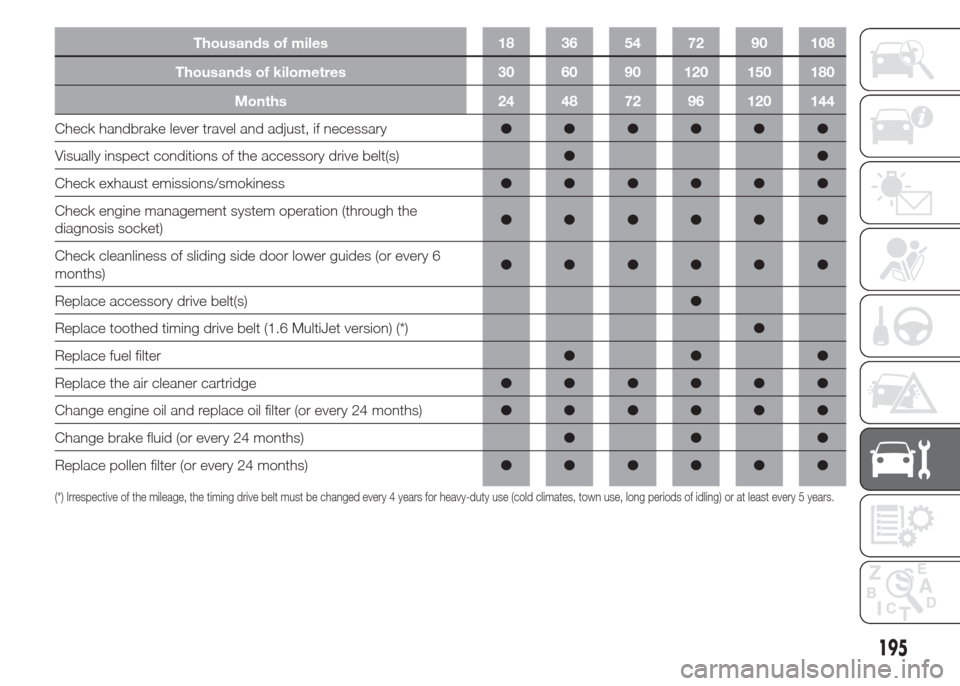
Thousands of miles 18 36 54 72 90 108
Thousands of kilometres 30 60 90 120 150 180
Months 24 48 72 96 120 144
Check handbrake lever travel and adjust, if necessary●●●●●●
Visually inspect conditions of the accessory drive belt(s)●●
Check exhaust emissions/smokiness●●●●●●
Check engine management system operation (through the
diagnosis socket)●●●●●●
Check cleanliness of sliding side door lower guides (or every 6
months)●●●●●●
Replace accessory drive belt(s)●
Replace toothed timing drive belt (1.6 MultiJet version) (*)●
Replace fuel filter●●●
Replace the air cleaner cartridge●●●●●●
Change engine oil and replace oil filter (or every 24 months)●●●●●●
Change brake fluid (or every 24 months)●●●
Replace pollen filter (or every 24 months)●●●●●●
(*) Irrespective of the mileage, the timing drive belt must be changed every 4 years for heavy-duty use (cold climates, town use, long periods of idling) or at least every 5 years.
195
Page 201 of 323
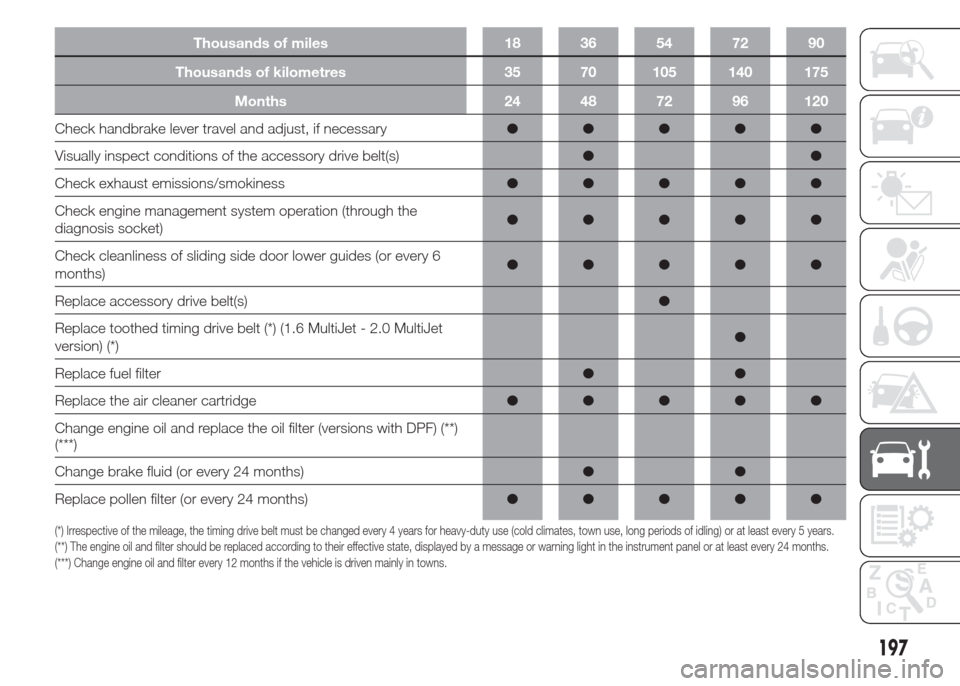
Thousands of miles 18 36 54 72 90
Thousands of kilometres 35 70 105 140 175
Months 24 48 72 96 120
Check handbrake lever travel and adjust, if necessary●●●●●
Visually inspect conditions of the accessory drive belt(s)●●
Check exhaust emissions/smokiness●●●●●
Check engine management system operation (through the
diagnosis socket)●●●●●
Check cleanliness of sliding side door lower guides (or every 6
months)●●●●●
Replace accessory drive belt(s)●
Replace toothed timing drive belt (*) (1.6 MultiJet - 2.0 MultiJet
version) (*)●
Replace fuel filter●●
Replace the air cleaner cartridge●●●●●
Change engine oil and replace the oil filter (versions with DPF) (**)
(***)
Change brake fluid (or every 24 months)●●
Replace pollen filter (or every 24 months)●●●●●
(*) Irrespective of the mileage, the timing drive belt must be changed every 4 years for heavy-duty use (cold climates, town use, long periods of idling) or at least every 5 years.
(**) The engine oil and filter should be replaced according to their effective state, displayed by a message or warning light in the instrument panel orat least every 24 months.
(***) Change engine oil and filter every 12 months if the vehicle is driven mainly in towns.
197
Page 202 of 323
PERIODIC CHECKS
Every 1,000 km or before long
journeys, check and, if necessary,
top up the following:
❒engine coolant level;
❒brake fluid level;
❒windscreen washer fluid level;
❒tyre inflation pressure and condition;
❒operation of lighting system
(headlights, direction indicators,
hazard warning lights, etc.);
❒operation of screen washer/wiper
system and positioning/wear of
windscreen/rear screen wiper blades
(for versions/markets where
provided);
Every 3,000 km check and top up if
required: engine oil level.
DEMANDING
VEHICLE USE
If the vehicle is mostly used in one of
the following conditions:
❒towing a trailer or motorhome;
❒dusty roads;
❒short, repeated journeys (less than
7-8 km) at sub-zero outside
temperatures;
❒engine often idling or driving long
distances at low speeds or long
periods of inactivity;
the following checks must be
carried out more often than
indicated in the Scheduled Servicing
Plan:
❒check front disc brake pad condition
and wear;
❒check cleanliness of bonnet and
luggage compartment locks,
cleanliness and lubrication of linkage;
❒visually inspect condition of: engine,
gearbox, transmission, pipes and
hoses (exhaust - fuel system -
brakes) and rubber elements (boots -
sleeves - bushes - etc.);
❒check battery charge and battery
fluid level (electrolyte);❒visually inspect conditions of the
auxiliary drive belts;
❒check and, if necessary, change
engine oil and replace oil filter;
❒check and, if necessary, replace
pollen filter;
❒replacement of air cleaner cartridge
every 15,000 km.
198
SERVICING AND MAINTENANCE
Page 212 of 323
AIR CLEANER/
POLLEN FILTER
Have the air cleaner or the pollen
filter replaced by a Fiat Dealership.
DIESEL FILTER
DRAINING
CONDENSATION
(MultiJet versions)
36)
IMPORTANT
36) The presence of water in the
supply circuit may cause severe
damage to the injection system
and irregular engine operation. If
the
warning light comes on,
go to a Fiat Dealership as soon as
possible to have the system bled.
If this problem is indicated
immediately after refuelling, water
may have entered the fuel tank.
In this case, immediately turn off
the engine and contact a Fiat
Dealership.
BATTERY
The battery is of the “limited
maintenance” type: under normal
conditions of use, the electrolyte
does not need topping up with
distilled water.
It does, however, need to be
checked periodically at a Fiat
Dealership or by specialist personnel
to make sure it is working correctly.
133) 134)
REPLACING THE
BATTERY
If required, replace the battery with
an original spare part with the same
specifications.
If a battery with different
specifications is fitted, the service
intervals given in the “Scheduled
Servicing Plan” will no longer be
valid.
Follow the battery manufacturer's
instructions for maintenance.
37) 38)
5)
135)
208
SERVICING AND MAINTENANCE