lights FIAT DOBLO PANORAMA 2015 2.G Repair Manual
[x] Cancel search | Manufacturer: FIAT, Model Year: 2015, Model line: DOBLO PANORAMA, Model: FIAT DOBLO PANORAMA 2015 2.GPages: 323, PDF Size: 47.13 MB
Page 169 of 323
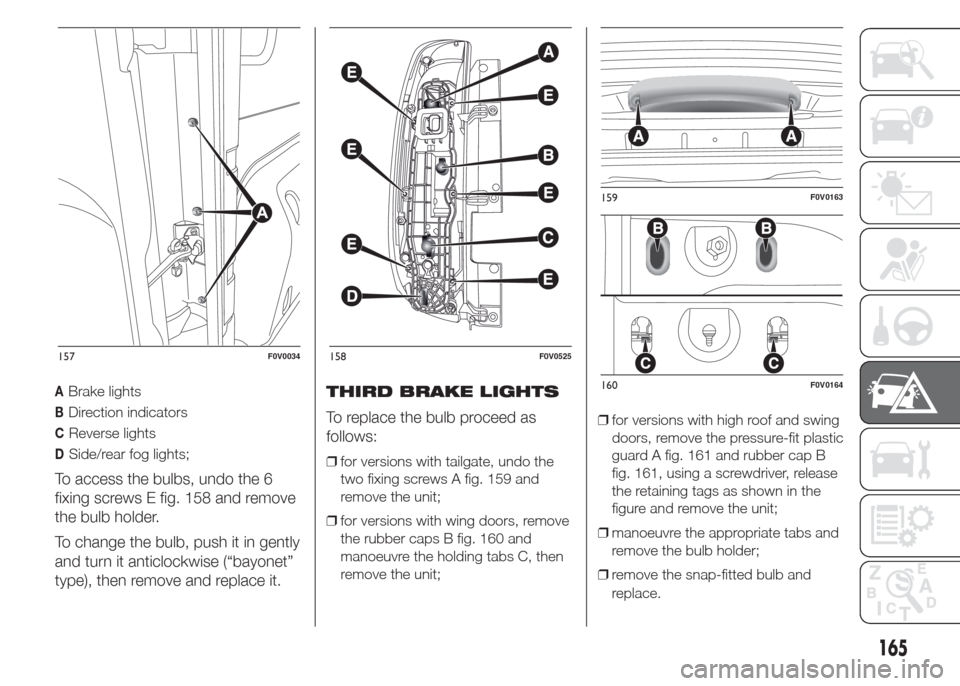
ABrake lights
BDirection indicators
CReverse lights
DSide/rear fog lights;
To access the bulbs, undo the 6
fixing screws E fig. 158 and remove
the bulb holder.
To change the bulb, push it in gently
and turn it anticlockwise (“bayonet”
type), then remove and replace it.THIRD BRAKE LIGHTS
To replace the bulb proceed as
follows:
❒for versions with tailgate, undo the
two fixing screws A fig. 159 and
remove the unit;
❒for versions with wing doors, remove
the rubber caps B fig. 160 and
manoeuvre the holding tabs C, then
remove the unit;❒for versions with high roof and swing
doors, remove the pressure-fit plastic
guard A fig. 161 and rubber cap B
fig. 161, using a screwdriver, release
the retaining tags as shown in the
figure and remove the unit;
❒manoeuvre the appropriate tabs and
remove the bulb holder;
❒remove the snap-fitted bulb and
replace.
157F0V0034158F0V0525
159F0V0163
160F0V0164
165
Page 170 of 323
NUMBER PLATE
LIGHTS (for
hatchback versions)
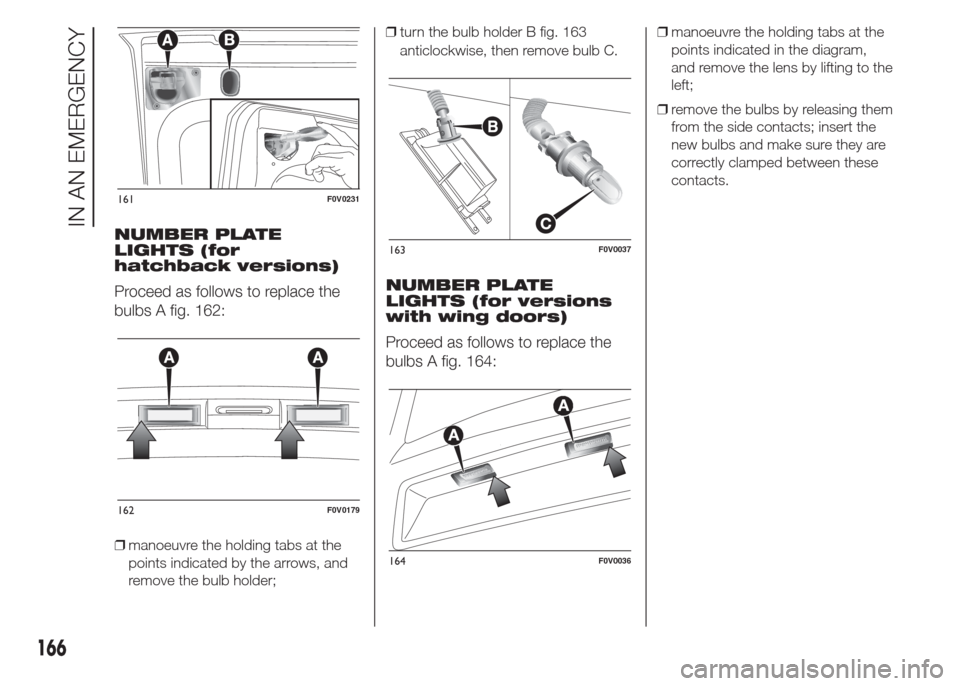
Proceed as follows to replace the
bulbs A fig. 162:
❒manoeuvre the holding tabs at the
points indicated by the arrows, and
remove the bulb holder;❒turn the bulb holder B fig. 163
anticlockwise, then remove bulb C.
NUMBER PLATE
LIGHTS (for versions
with wing doors)
Proceed as follows to replace the
bulbs A fig. 164:
❒manoeuvre the holding tabs at the
points indicated in the diagram,
and remove the lens by lifting to the
left;
❒remove the bulbs by releasing them
from the side contacts; insert the
new bulbs and make sure they are
correctly clamped between these
contacts.
161F0V0231
162F0V0179
163F0V0037
164F0V0036
166
IN AN EMERGENCY
Page 171 of 323
REPLACING AN
INTERIOR BULB
For the type of bulb and power
rating, see "Changing a bulb".
FRONT ROOF LIGHT
Roof light with
movable lens
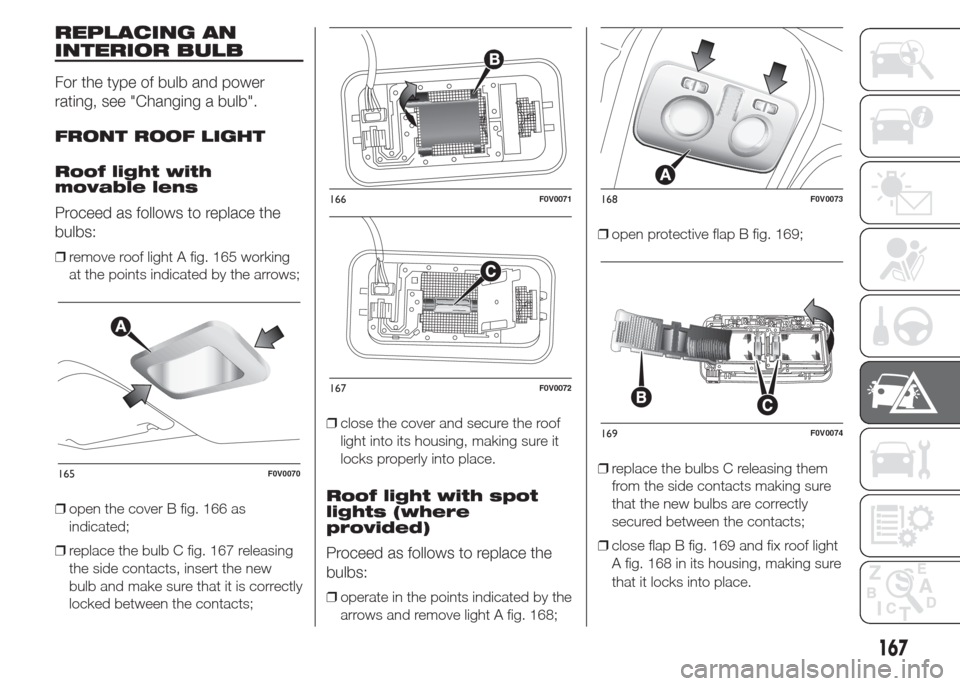
Proceed as follows to replace the
bulbs:
❒remove roof light A fig. 165 working
at the points indicated by the arrows;
❒open the cover B fig. 166 as
indicated;
❒replace the bulb C fig. 167 releasing
the side contacts, insert the new
bulb and make sure that it is correctly
locked between the contacts;❒close the cover and secure the roof
light into its housing, making sure it
locks properly into place.
Roof light with spot
lights (where
provided)
Proceed as follows to replace the
bulbs:
❒operate in the points indicated by the
arrows and remove light A fig. 168;❒open protective flap B fig. 169;
❒replace the bulbs C releasing them
from the side contacts making sure
that the new bulbs are correctly
secured between the contacts;
❒close flap B fig. 169 and fix roof light
A fig. 168 in its housing, making sure
that it locks into place.
165F0V0070
166F0V0071
167F0V0072
168F0V0073
169F0V0074
167
Page 175 of 323
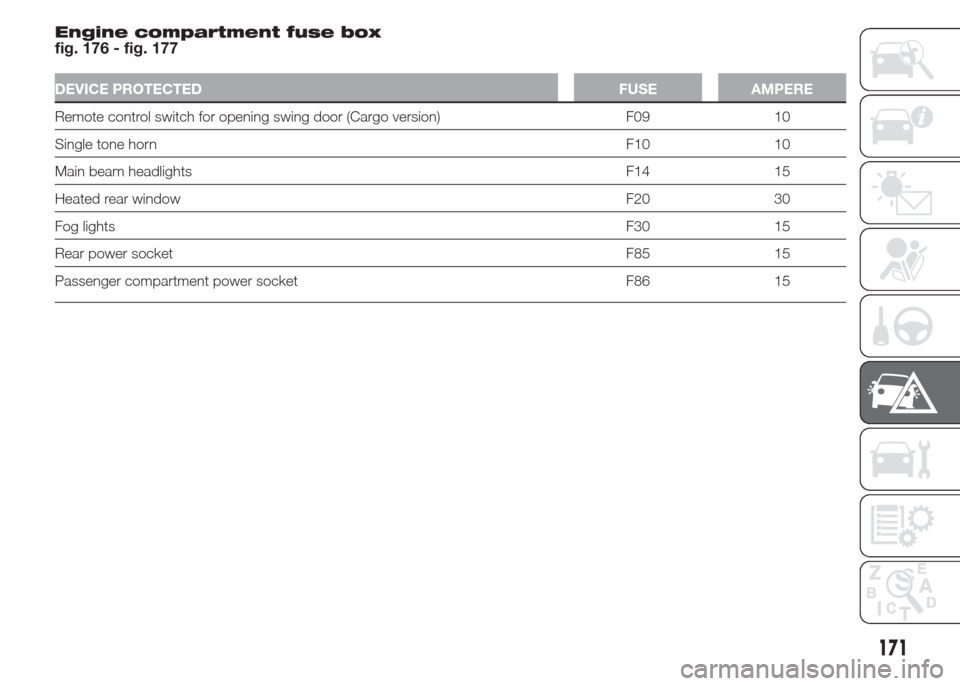
Engine compartment fuse box
fig. 176 - fig. 177
DEVICE PROTECTED FUSE AMPERE
Remote control switch for opening swing door (Cargo version) F09 10
Single tone hornF10 10
Main beam headlights F14 15
Heated rear window F20 30
Fog lightsF30 15
Rear power socket F85 15
Passenger compartment power socket F86 15
171
Page 179 of 323
CHANGING A WHEEL
The vehicle is originally equipped
with the Fix&Go automatic quick
tyre repair kit (see instructions in the
next section). As an alternative,
the vehicle may have a normal-sized
spare wheel.
Wheel changing and correct use of
the jack and spare wheel call for
some precautions, as listed below.
108) 109) 110) 111)
Note for one-way
tyres
One-way tyres have a few arrows on
the side indicating the rotation
direction. If a wheel is changed
(when punctured, for example) the
direction of the arrows on the spare
wheel tyre may not coincide with
the rotation direction of the wheel to
be replaced.
In these conditions, too, the tyre still
maintains its safety features.Anyway, it is recommended to have
the wheel repaired and refitted as
soon as possible, as the best
performance is achieved when the
rotation direction of all tyres
coincides with the one indicated by
the arrows.
Please note that:
❒the jack weight is 4 kg;
❒the jack requires no adjustment;
❒the jack cannot be repaired and in
the event of a fault it must be
replaced by another original one;
❒no tool other than its cranking device
may be fitted on the jack.
To change a wheel, proceed as
follows:
❒stop the vehicle in a position that is
not dangerous for oncoming traffic
where you can change the wheel
safely. The ground should be flat
if possible, and sufficiently firm;
❒stop the engine and pull the
handbrake;
❒engage first gear or reverse;
❒wear the reflective safety jacket
(compulsory by law in certain
countries) before getting out of the
vehicle;❒indicate that the vehicle has broken
down using the devices required by
the law in the current country (e.g.
warning triangle, hazard lights, etc.);
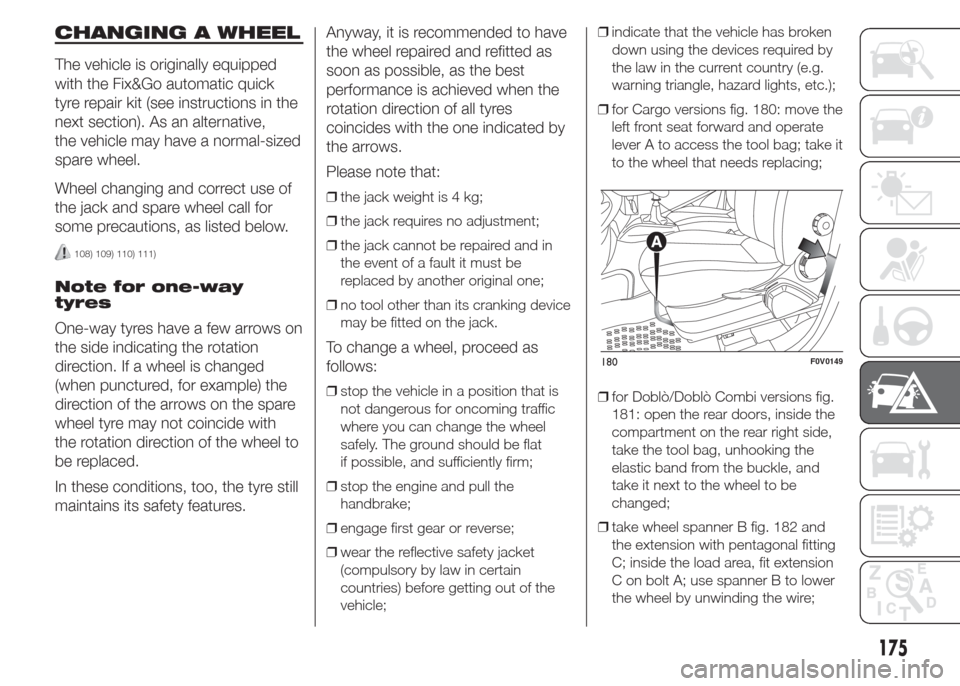
❒for Cargo versions fig. 180: move the
left front seat forward and operate
lever A to access the tool bag; take it
to the wheel that needs replacing;
❒for Doblò/Doblò Combi versions fig.
181: open the rear doors, inside the
compartment on the rear right side,
take the tool bag, unhooking the
elastic band from the buckle, and
take it next to the wheel to be
changed;
❒take wheel spanner B fig. 182 and
the extension with pentagonal fitting
C; inside the load area, fit extension
C on bolt A; use spanner B to lower
the wheel by unwinding the wire;
180F0V0149
175
Page 183 of 323
❒reposition the tool bag behind the left
side seat (Cargo versions) or, resting
the bottom of the bag against the
side panel, in the compartment inside
the rear right side (Doblò/Doblò
Combi versions).
WARNING
108) The spare wheel (where
provided) is specifically for your
vehicle. Therefore, it must not be
used on other models. Do not
use spare wheels of other models
on your vehicle. The spare wheel
must be used only in an
emergency. Use of the spare
wheel must kept to the minimum
necessary.109) Use your hazard lights, warning
triangle, etc. to show that your
vehicle is stationary according to
the regulations in force.
Passengers should get out of the
vehicle, particularly if it is heavily
loaded, and wait for the wheel
to be changed away from the
traffic. If you are on a slope or
uneven surface, place wedges or
other suitable objects under the
wheels to secure the vehicle.
Have the wheel repaired and
refitted as soon as possible. Do
not apply grease to the bolt
threads before assembly: they
might spontaneously unscrew.
110) Use the jack only to replace
wheels on the vehicle with which
it is supplied or on other vehicles
of the same model. Never use
the jack for other purposes, such
as lifting other models. Never
use the jack to carry out repairs
under the vehicle. Incorrect
positioning of the jack may cause
the lifted vehicle to fall. Do not
use the jack for loads higher than
those shown on the label.111) Incorrect hub cap assembly
may cause it to come off when the
vehicle is moving. Never tamper
with the inflation valve. Never
introduce tools of any kind
between rim and tyre. Check tyre
and spare wheel pressures
regularly, referring to the values
shown in the "Technical
specifications" section.
179
Page 189 of 323
FUEL CUT-OFF
SYSTEM
This intervenes in the case of an
impact causing:
❒the fuel supply cut-off with the engine
consequently switching off;
❒the automatic unlocking of the doors;
❒the switching on of the interior lights;
❒switching on of the hazard warning
lights (to deactivate the lights press
the dedicated button on the
dashboard).
122)
When the system has been
triggered, the message “Fuel cut off,
see handbook” is displayed on
some versions.
Check carefully for fuel leaks, for
instance in the engine compartment,
under the vehicle or near the tank
area.
After a collision, turn the ignition key
to STOP to prevent the battery
from running down.
The following procedure should be
carried out to restore the correct
operation of the vehicle:
❒turn the ignition key to the MAR
position;❒activate the right direction indicator;
❒deactivate the right direction
indicator;
❒activate the left direction indicator;
❒deactivate the left direction indicator;
❒activate the right direction indicator;
❒deactivate the right direction
indicator;
❒activate the left direction indicator;
❒deactivate the left direction indicator;
❒turn the ignition key to the OFF
position.
WARNING
122) If, after an impact, you smell
fuel or notice leaks from the fuel
supply system, do not reactivate
the system to avoid the risk of fire.
LIFTING THE
VEHICLE
If the vehicle needs to be lifted, go
to a Fiat Dealership which is
equipped with the arm hoist or
workshop lift.
185
Page 195 of 323
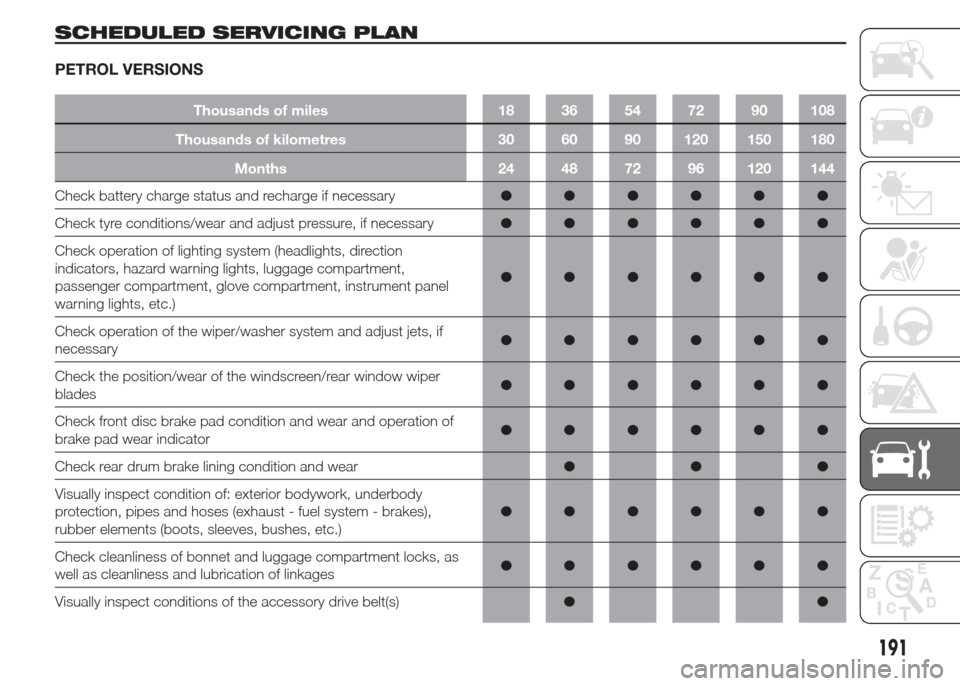
SCHEDULED SERVICING PLAN
PETROL VERSIONS
Thousands of miles 18 36 54 72 90 108
Thousands of kilometres 30 60 90 120 150 180
Months 24 48 72 96 120 144
Check battery charge status and recharge if necessary●●●●●●
Check tyre conditions/wear and adjust pressure, if necessary●●●●●●
Check operation of lighting system (headlights, direction
indicators, hazard warning lights, luggage compartment,
passenger compartment, glove compartment, instrument panel
warning lights, etc.)●●●●●●
Check operation of the wiper/washer system and adjust jets, if
necessary●●●●●●
Check the position/wear of the windscreen/rear window wiper
blades●●●●●●
Check front disc brake pad condition and wear and operation of
brake pad wear indicator●●●●●●
Check rear drum brake lining condition and wear●●●
Visually inspect condition of: exterior bodywork, underbody
protection, pipes and hoses (exhaust - fuel system - brakes),
rubber elements (boots, sleeves, bushes, etc.)●●●●●●
Check cleanliness of bonnet and luggage compartment locks, as
well as cleanliness and lubrication of linkages●●●●●●
Visually inspect conditions of the accessory drive belt(s)●●
191
Page 198 of 323
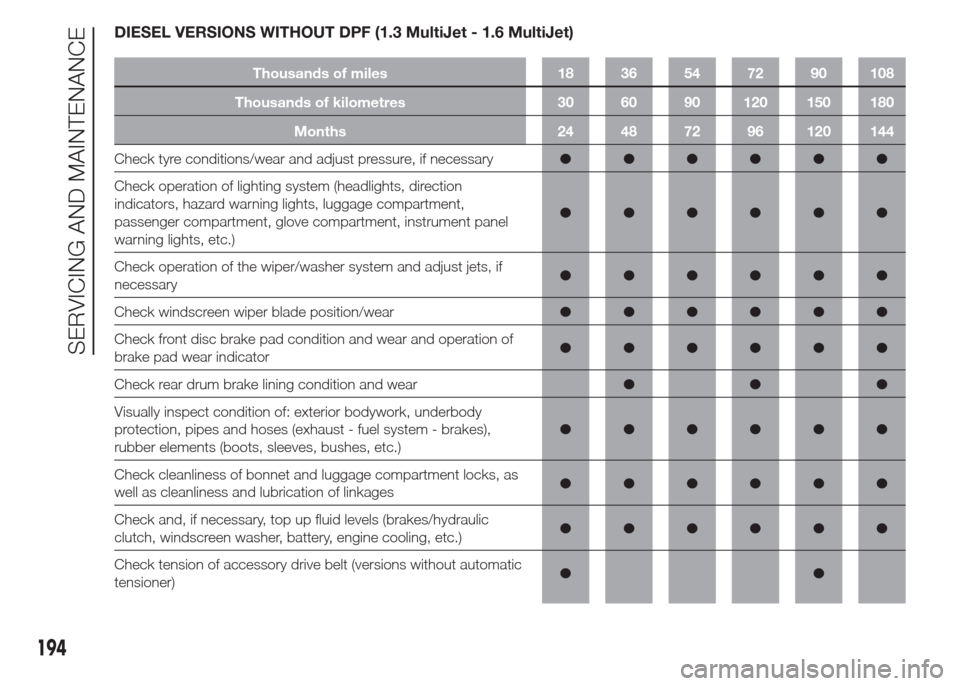
DIESEL VERSIONS WITHOUT DPF (1.3 MultiJet - 1.6 MultiJet)
Thousands of miles 18 36 54 72 90 108
Thousands of kilometres 30 60 90 120 150 180
Months 24 48 72 96 120 144
Check tyre conditions/wear and adjust pressure, if necessary●●●●●●
Check operation of lighting system (headlights, direction
indicators, hazard warning lights, luggage compartment,
passenger compartment, glove compartment, instrument panel
warning lights, etc.)●●●●●●
Check operation of the wiper/washer system and adjust jets, if
necessary●●●●●●
Check windscreen wiper blade position/wear●●●●●●
Check front disc brake pad condition and wear and operation of
brake pad wear indicator●●●●●●
Check rear drum brake lining condition and wear●●●
Visually inspect condition of: exterior bodywork, underbody
protection, pipes and hoses (exhaust - fuel system - brakes),
rubber elements (boots, sleeves, bushes, etc.)●●●●●●
Check cleanliness of bonnet and luggage compartment locks, as
well as cleanliness and lubrication of linkages●●●●●●
Check and, if necessary, top up fluid levels (brakes/hydraulic
clutch, windscreen washer, battery, engine cooling, etc.)●●●●●●
Check tension of accessory drive belt (versions without automatic
tensioner)●●
194
SERVICING AND MAINTENANCE
Page 200 of 323
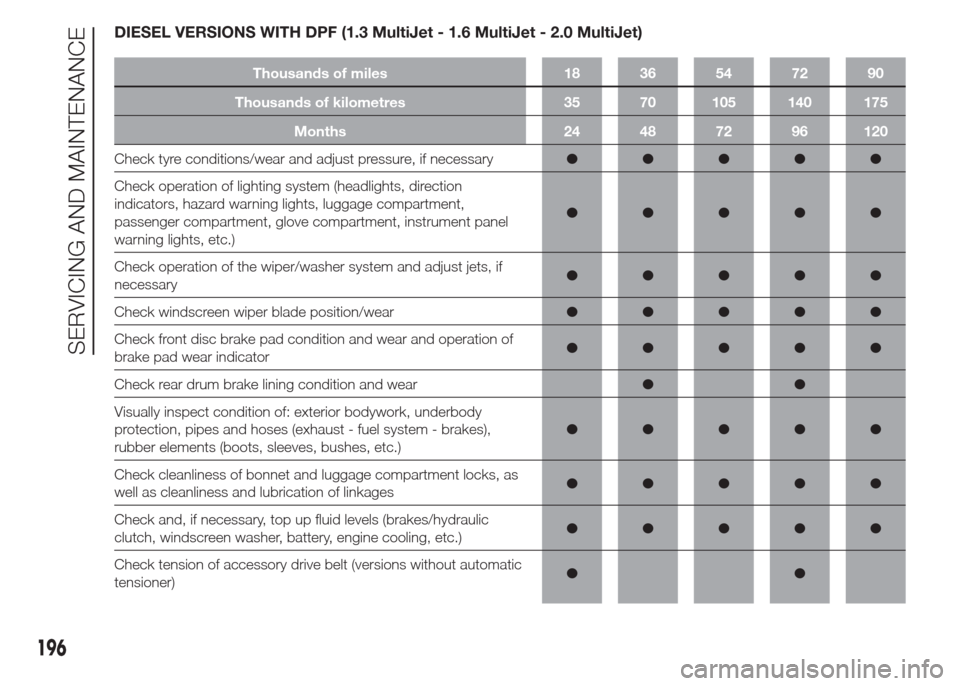
DIESEL VERSIONS WITH DPF (1.3 MultiJet - 1.6 MultiJet - 2.0 MultiJet)
Thousands of miles 18 36 54 72 90
Thousands of kilometres 35 70 105 140 175
Months 24 48 72 96 120
Check tyre conditions/wear and adjust pressure, if necessary●●●●●
Check operation of lighting system (headlights, direction
indicators, hazard warning lights, luggage compartment,
passenger compartment, glove compartment, instrument panel
warning lights, etc.)●●●●●
Check operation of the wiper/washer system and adjust jets, if
necessary●●●●●
Check windscreen wiper blade position/wear●●●●●
Check front disc brake pad condition and wear and operation of
brake pad wear indicator●●●●●
Check rear drum brake lining condition and wear●●
Visually inspect condition of: exterior bodywork, underbody
protection, pipes and hoses (exhaust - fuel system - brakes),
rubber elements (boots, sleeves, bushes, etc.)●●●●●
Check cleanliness of bonnet and luggage compartment locks, as
well as cleanliness and lubrication of linkages●●●●●
Check and, if necessary, top up fluid levels (brakes/hydraulic
clutch, windscreen washer, battery, engine cooling, etc.)●●●●●
Check tension of accessory drive belt (versions without automatic
tensioner)●●
196
SERVICING AND MAINTENANCE